The Influence of Diabetes Mellitus on Short-Term Outcomes of Patients with Bleeding Peptic Ulcers
Atsuhiko Murata,
1Shinya Matsuda,
1Kazuaki Kuwabara,
2Yukako Ichimiya,
1Yoshihisa Fujino,
1and Tatsuhiko Kubo
11Department of Preventive Medicine and Community Health, School of Medicine, University of Occupational and Environmental Health, Kitakyushu;
2Department of Health Care Administration and Management, Graduate School of Medical Sciences, Kyushu University, Fukuoka, Japan.
Received: August 26, 2011 Revised: October 18, 2011 Accepted: October 20, 2011
Corresponding author: Dr. Atsuhiko Murata, Department of Preventive Medicine and Community Health, School of Medicine, University of Occupational and Environmental Health, 1-1 Iseigaoka, Yahatanishi-ku, Kitakyushu 807-8555, Japan.
Tel: 81-93-691-7244, Fax: 81-93-603-4307 E-mail: [email protected]
∙ The authors have no financial conflicts of interest.
© Copyright:
Yonsei University College of Medicine 2012 This is an Open Access article distributed under the terms of the Creative Commons Attribution Non- Commercial License (http://creativecommons.org/
licenses/by-nc/3.0) which permits unrestricted non- commercial use, distribution, and reproduction in any medium, provided the original work is properly cited.
Purpose: Little information is available on the influence of diabetes mellitus on the short-term clinical outcomes of patients with bleeding peptic ulcers. The aim of this study is to investigate whether diabetes mellitus influences the short-term clinical outcomes of patients with bleeding peptic ulcers using a Japanese national adminis- trative database. Materials and Methods: A total of 4863 patients treated by endo- scopic hemostasis on admission for bleeding peptic ulcers were referred to 586 par- ticipating hospitals in Japan. We collected their data to compare the risk-adjusted length of stay (LOS) and in-hospital mortality of patients with and without diabetes mellitus within 30 days. Patients were divided into two groups: patients with diabe- tes mellitus (n=434) and patients without diabetes mellitus (n=4429). Results:
Mean LOS in patients with diabetes mellitus was significantly longer than those without diabetes mellitus (15.8 days vs. 12.5 days, p<0.001). Also, higher in-hospi- tal mortality within 30 days was observed in patients with diabetes mellitus com- pared with those without diabetes mellitus (2.7% vs. 1.1%, p=0.004). Multiple lin- ear regression analysis revealed that diabetes mellitus was significantly associated with an increase in risk-adjusted LOS. The standardized coefficient was 0.036 days (p=0.01). Furthermore, the analysis revealed that diabetes mellitus significantly in- creased the risk of in-hospital mortality within 30 days (odds ratio=2.285, 95%
CI=1.161-4.497, p=0.017). Conclusion: This study demonstrated that presence of diabetes mellitus significantly influences the short-term clinical outcomes of pa- tients with bleeding peptic ulcers.
Key Words: Bleeding peptic ulcers, diabetes mellitus, health care quality, retro- spective studies, databases
INTRODUCTION
Bleeding peptic ulcers are one of the most frequently encountered emergency con- ditions in daily practice for clinicians.1,2 The incidence of bleeding peptic ulcers patients with several chronic conditions has been increasing as a result of the aging of society in developed countries.3-5 In a recent report concerning bleeding peptic ulcers, Theocharis, et al.3 reported that the proportion of patients with chronic con-
ternational Classification of Diseases and Injuries (ICD)- 10th. In addition, this administrative database also contains detailed patients’ information, such as all surgical proce- dures and medications that have been indexed in the origi- nal code. These codes are determined by the Ministry of Health, Labor and Welfare of Japan. The administrative da- tabase associated with the DPC system also includes the quantity and date of all care delivered on a daily basis.10-12 Study setting
We selected 4863 patients treated by endoscopic hemosta- sis on admission for bleeding peptic ulcers in 586 DPC par- ticipating hospitals (55 academic and 531 community hospi- tals) between April and December in 2008. These hospitals are dispersed throughout Japan and play a leading role in providing acute care medicine, advancing medical research, and educating students and medical residents.10-12
Using the data of comorbidities in the administrative data- base, patients were divided into two groups according to the presence of diabetes mellitus: patients with diabetes mellitus (n=434) and patients without diabetes mellitus (n=4429). In the present study, diabetes mellitus was defined as code E10-E14 (insulin dependent, non-insulin dependent, malnu- trition-related diabetes mellitus, other specified diabetes, and other non-specified diabetes) in the ICD-10th.
The use of DPC data was permitted by all institution and hospitals that provided detailed data. The research protocol of the study was approved by the ethics committee of medi- cal care and research of the University of Occupational and Environmental Health, Kitakyushu, Japan.
Study variables
We collected data in the administrative database with re- gard to the clinical characteristics of patients as follows:
causes of bleeding peptic ulcers, gender, chronic comorbid conditions, sex, hospital type, use of ambulance transporta- tion, use of a proton pump inhibitor, antiplatelet and antico- agulation drugs, frequencies of endoscopic hemostasis for recurrent bleeding and salvage surgery after endoscopic he- mostasis, length of stay (LOS) and in-hospital mortality within 30 days after admission.
The causes of the bleeding peptic ulcers were defined in accordance with the ICD-10th: hemorrhagic gastric ulcer (K25.0, K25.2, K25.4 and K25.6) and hemorrhagic duodenal ulcer (K26.0, K26.2, K26.4 and K26.6). Elderly patients have a higher risk of recurrent bleeding or death than young- er patients, and the patients were therefore stratified by age ditions had increased between 1995 and 2005 in Greece.
Furthermore, some previous studies have suggested that the presence of chronic conditions is significantly associated with the clinical outcomes of patients with bleeding peptic ulcers.4,5
Many researchers have investigated the influence of dia- betes mellitus on clinical outcomes of patients with certain medical conditions or surgical procedures.6-9 In particular, many previous reports have shown strong associations be- tween diabetes mellitus and cardiovascular diseases or inter- ventional procedures, such as acute myocardial infarction or coronary stent implantation, and concluded that diabetes mellitus significantly influences the short-term clinical out- comes of patients with cardiac disease or procedure.8,9 It is plausible that diabetes mellitus is an independent predictor for the short-term clinical outcomes of these patients.
However, little information is available on the influence of diabetes mellitus on the short-term clinical outcomes of pa- tients with bleeding peptic ulcers. Establishment of a rela- tionship between diabetes mellitus and the clinical outcomes of patients with bleeding peptic ulcers could contribute to future studies about bleeding peptic ulcers and have signifi- cant implications for the quality of patient medical care.
In this study, we investigated the influence of diabetes mel- litus on short-term clinical outcomes of patients with bleed- ing peptic ulcers. This study was achieved using a national administrative database asscoaited with the Diagnosis Proce- dure Combination (DPC) system.
MATERIALS AND METHODS
Administrative database associated with the DPC system
Japanese case mix projects based on the DPC system were introduced to 82 academic hospitals (80 university hospitals, the National Cancer Centre and the National Cardiovascular Centre) in 2003.10-12 Insurance reimbursement using the DPC system is quite prevalent in Japan, and the administrative da- tabase of the DPC system has increased the representation of acute care hospitals. As of 2007, data from approximately 450000 inpatients have been compiled, representing approxi- mately 90% of all acute care inpatient hospitalizations.10-12
The administrative database of the DPC system includes each patient’s discharge summary and claim information, including principal diagnosis, comorbidities and complica- tions during hospitalization. These data are coded in the In-
and additional factors related to LOS, such as causes of bleeding peptic ulcers, age, gender, hospital type, use of am- bulance transportation, use of a proton pump inhibitor, anti- platelet and anticoagulation drugs, and endoscopic hemosta- sis and salvage surgery during hospitalization. Because the distribution of LOS was skewed to the right, LOS was log- transformed in this model. Multiple logistic regression mod- els were also used to identify the impact of the presence of diabetes mellitus on the in-hospital mortality within 30 days, considering the above factors.
All statistical analysis was performed using the STATA statistical software package version 9.0 (Stata Corporation, College Station, TX, USA). Values of p<0.05 were consid- ered to indicate statistical significance.
RESULTS
We identified a total of 4863 patients across 586 hospitals, comprising 3899 with hemorrhagic gastric ulcers, and 964 with hemorrhagic duodenal ulcers. The clinical characteris- tics and presentations of the patients are shown in Table 1.
The mean age and proportions of elderly patients were sig- into those aged <80 years and those aged ≥80 years, as de-
scribed in a previous study.13 To assess the severities of chronic comorbid conditions except for diabetes mellitus, we used the Charlson Comorbidity Index (CCI) for every patient using the administrative database.10-12 CCI was expressed as the score of comorbid conditions and was initially evaluated as a continuous variable. However, categorical variables de- fining three categories of severity of comorbidity were creat- ed to simplify the presentation of the results: 0, mild; 1, mod- erate; and 2 or more, severe.10,11 Hospital type was classified as academic or community.10-12 In-hospital mortality within 30 days was evaluated, rather than overall in-hospital mortal- ity, because this measure eliminates potential bias due to dif- ferences in LOS across hospitals and over time.14
Statistical analysis
The categorical data were compared using the chi-square test for categorical variables and the Mann-Whitney U test for continuous variables. In additional analyses, we used multiple linear regression models to identify the impact of the presence of diabetes mellitus on LOS, and addressed po- tential confounding variables in the case mix data by con- trolling for the severities of chronic comorbid conditions
Table 1. Clinical Characteristics and Presentations of Patients according to the Presence of Diabetes Mellitus
Patients with DM Patients without DM p value
Number of patients 434 4429
Causes of the bleeding peptic ulcers (%)
Hemorrhagic gastric ulcer 79.9 82.5 0.206
Hemorrhagic duodenal ulcer 20.1 17.5
Mean age [yrs (SD)] 66.5 (18.1) 64.3 (17.8) 0.016
Elderly patients [≥80 yrs, (%)] 26.7 19.7 0.001
Severities of chronic comorbid conditions (%)
Mild 39.4 45.3 0.062
Moderate 44.9 40.7
Severe 15.7 14.0
Male patients (%) 67.7 67.0 0.772
Hospital type (%)
Academic hospitals 5.9 6.7 0.556
Community hospitals 94.1 93.3
Use of ambulance transportation (%) 39.4 40.5 0.671
Use of proton pump inhibitor (%) 85.9 86.8 0.602
Use of antiplatelet drugs (%) 4.2 4.1 0.959
Use of anticoagulation drugs (%) 2.8 3.0 0.836
Endoscopic hemostasis for recurrent bleeding (%) 13.0 14.2 0.476
Salvage surgery after endoscopic hemostasis (%) 0.9 0.6 0.594
Mean length of stay [days (SD)] 15.8 (18.7) 12.5 (10.3) <0.001
In-hospital mortality within 30 days (%) 2.7 1.1 0.004
DM, diabetes mellitus; SD, standard deviation.
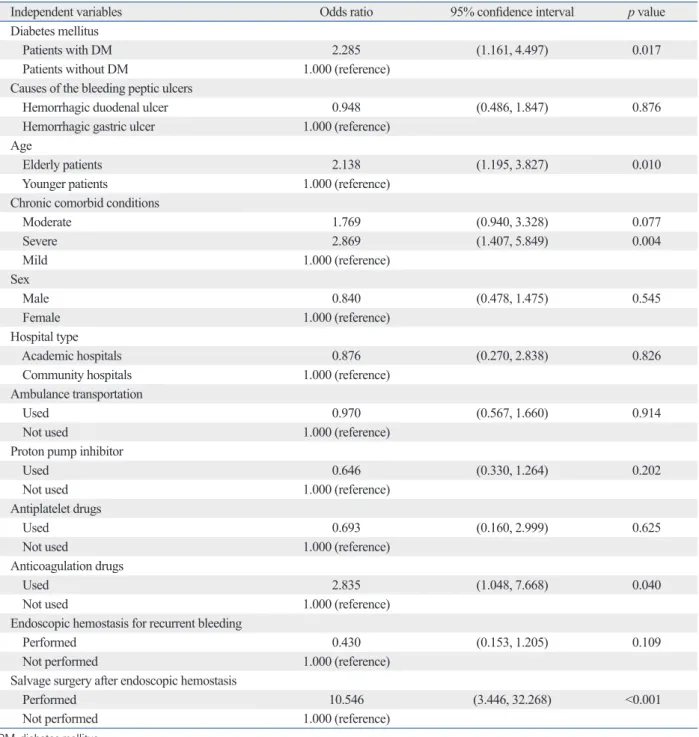
with the in-hospital mortality within 30 days are demon- strated in Table 3. In these analyses, diabetes mellitus sig- nificantly increased the risk of in-hospital mortality within 30 days [odds ratio (OR)=2.285, 95% CI=1.161-4.497, p=
0.017]. Also, elderly patients, severe comorbid conditions, use of anticoagulation drugs, and salvage surgery after en- doscopic hemostasis were associated with increased risks of in-hospital mortality within 30 days (OR: 2.138, 2.869, 2.835 and 10.546, respectively).
DISCUSSION
We conducted this study to investigate the influence of dia- betes mellitus on short-term clinical outcomes of patients with bleeding peptic ulcers using the Japanese administra- tive database. The current study demonstrated that diabetes mellitus significantly increases in-hospital mortality and LOS in patients with bleeding peptic ulcers after adjustment for other chronic comorbid conditions and other factors.
Although there have been no studies with regard to LOS for the association between diabetes mellitus and bleeding peptic ulcers, our present findings about the influence of di- abetes mellitus on in-hospital mortality to date are consis- nificantly higher in patients with diabetes mellitus than those
without diabetes mellitus. However, there were no significant differences between the two groups with regard to the pro- portion of the severities of chronic comorbid conditions, male patients, hospital type, use of ambulance transportation, use of proton pump inhibitor, antiplatelet and anticoagulation drugs, endoscopic hemostasis and salvage surgery during hospitalization. Significant variation in mean LOS was ob- served between groups (15.8±18.7 days in patients with dia- betes mellitus vs. 12.5±10.3 days in patients without diabetes mellitus, p<0.001). Higher in-hospital mortality within 30 days was observed in patients with diabetes mellitus than in those without diabetes mellitus (2.7% vs. 1.1%, p=0.004).
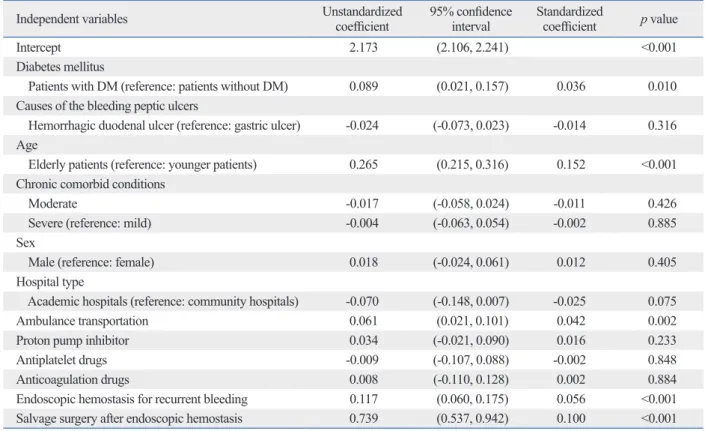
Multiple linear regression analyses of factors associated with the LOS are represented in Table 2. After adjustment for potentially confounding demographic and clinical vari- ables, diabetes mellitus was significantly associated with an increased LOS. The standardized coefficient was 0.036 days (p=0.01). Elderly patients, ambulance transportation, endo- scopic hemostasis for recurrent bleeding and salvage sur- gery after endoscopic hemostasis were also significantly as- sociated with an increased LOS (standardized coefficients:
0.152, 0.042, 0.056 and 0.1, respectively).
Multiple logistic regression analyses of factors associated
Table 2. Linear Regression Analysis of Factors Associated with Log-Transformed Length of Stay
Independent variables Unstandardized
coefficient 95% confidence
interval Standardized
coefficient p value
Intercept 2.173 (2.106, 2.241) <0.001
Diabetes mellitus
Patients with DM (reference: patients without DM) 0.089 (0.021, 0.157) 0.036 0.010 Causes of the bleeding peptic ulcers
Hemorrhagic duodenal ulcer (reference: gastric ulcer) -0.024 (-0.073, 0.023) -0.014 0.316 Age
Elderly patients (reference: younger patients) 0.265 (0.215, 0.316) 0.152 <0.001 Chronic comorbid conditions
Moderate -0.017 (-0.058, 0.024) -0.011 0.426
Severe (reference: mild) -0.004 (-0.063, 0.054) -0.002 0.885
Sex
Male (reference: female) 0.018 (-0.024, 0.061) 0.012 0.405
Hospital type
Academic hospitals (reference: community hospitals) -0.070 (-0.148, 0.007) -0.025 0.075
Ambulance transportation 0.061 (0.021, 0.101) 0.042 0.002
Proton pump inhibitor 0.034 (-0.021, 0.090) 0.016 0.233
Antiplatelet drugs -0.009 (-0.107, 0.088) -0.002 0.848
Anticoagulation drugs 0.008 (-0.110, 0.128) 0.002 0.884
Endoscopic hemostasis for recurrent bleeding 0.117 (0.060, 0.175) 0.056 <0.001 Salvage surgery after endoscopic hemostasis 0.739 (0.537, 0.942) 0.100 <0.001 DM, diabetes mellitus.
crease of in-hospital mortality and LOS may be explained by several factors. First, with regard to the association be- tween diabetes mellitus and increased in-hospital mortality of patients with bleeding peptic ulcers, several studies sug- gested that diabetic angiopathy impairs mucosal integrity, leading to more severe ulcers,15,16 and that diabetes mellitus increases susceptibility to acute gastrointestinal injury and impairs mucosal healing.17,18 Therefore, the angiopathy re- lated to diabetes mellitus may make the control of bleeding from the lesions more difficult and may influence in-hospi- tent with some previous studies.15,16 In a population-based
cohort study in Denmark, Thomsen, et al.15 reported that the adjusted 30 days mortality rate ratio for bleeding peptic ulcer patients with diabetes mellitus to those without diabe- tes was 1.40 (95% CI=1.15-1.70). In a case-control study in the UK, Weil, et al.16 also reported that diabetes mellitus was a significant factor for poor outcomes of patients with peptic ulcer bleeding associated with non-steroidal anti-in- flammatory drugs (OR=3.1, 95% CI=1.2-4.3).
The associations between diabetes mellitus and the in-
Table 3. Logistic Regression Analyses of Factors Associated with In-Hospital Mortality Within 30 Days
Independent variables Odds ratio 95% confidence interval p value
Diabetes mellitus
Patients with DM 2.285 (1.161, 4.497) 0.017
Patients without DM 1.000 (reference)
Causes of the bleeding peptic ulcers
Hemorrhagic duodenal ulcer 0.948 (0.486, 1.847) 0.876
Hemorrhagic gastric ulcer 1.000 (reference)
Age
Elderly patients 2.138 (1.195, 3.827) 0.010
Younger patients 1.000 (reference)
Chronic comorbid conditions
Moderate 1.769 (0.940, 3.328) 0.077
Severe 2.869 (1.407, 5.849) 0.004
Mild 1.000 (reference)
Sex
Male 0.840 (0.478, 1.475) 0.545
Female 1.000 (reference)
Hospital type
Academic hospitals 0.876 (0.270, 2.838) 0.826
Community hospitals 1.000 (reference)
Ambulance transportation
Used 0.970 (0.567, 1.660) 0.914
Not used 1.000 (reference)
Proton pump inhibitor
Used 0.646 (0.330, 1.264) 0.202
Not used 1.000 (reference)
Antiplatelet drugs
Used 0.693 (0.160, 2.999) 0.625
Not used 1.000 (reference)
Anticoagulation drugs
Used 2.835 (1.048, 7.668) 0.040
Not used 1.000 (reference)
Endoscopic hemostasis for recurrent bleeding
Performed 0.430 (0.153, 1.205) 0.109
Not performed 1.000 (reference)
Salvage surgery after endoscopic hemostasis
Performed 10.546 (3.446, 32.268) <0.001
Not performed 1.000 (reference)
DM, diabetes mellitus.
tients minimizes any bias due to differences in the bleeding conditions of bleeding peptic ulcers, because almost all the patients were considered to be in a temporary hemostatic condition (in other words, almost all the patients were in the same condition at the baseline). For this reason, we be- lieve that the administrative database used does not dimin- ish the reliability of the present study.
Despite this limitation, the current study has implications for future research about the quality of patient care and health care policy decision making. The current study con- firmed that diabetes mellitus significantly contributes to in- creased mortality and prolonged LOS of patients with bleed- ing peptic ulcers. Therefore, policy implementation of more appropriate medical treatments is necessary to achieve better clinical outcomes in patients with bleeding peptic ulcers and diabetes mellitus. One strategy for improving care for pa- tients would be disease management programs, such as clin- ical practice guidelines (CPGs). As an example, CPGs for cardiovascular diseases in diabetes mellitus have been de- veloped.24 These CPGs contain detailed practical instruc- tions for management of cardiovascular diseases in diabetic patients.24 Some studies have reported that CPGs can im- prove the health outcomes of patients in terms of in-hospital mortality or LOS and concluded that CPGs were a signifi- cant independent predictor of clinical outcomes of pa- tients.25,26 Therefore, we think that the preparation and insti- tution of CPGs for bleeding peptic ulcers with comorbid diabetes mellitus would be a promising policy implementa- tion for improving the short-term clinical outcomes of these patients. In addition, prospective monitoring of clinical out- comes of patients after introduction of CPGs should also be conducted in the future.
In conclusion, we have demonstrated that the presence of diabetes mellitus significantly influences the short-term clini- cal outcomes of patients with bleeding peptic ulcers using a national administrative database. The current findings could contribute to the policy implementation of disease manage- ment programs in patients with bleeding peptic ulcers and di- abetes mellitus. To achieve better clinical outcomes for dia- betic patients with bleeding peptic ulcers, CPGs for more appropriate medical treatments may be required in the future.
ACKNOWLEDGEMENTS
This study was funded by Grants-in-Aid for Research on Policy Planning and Evaluation from the Ministry of Health, tal mortality of patients with bleeding peptic ulcers. Sec-
ond, with regard to the association between diabetes melli- tus and prolonged LOS, one possible explanation is that hospitalization was prolonged by high levels of blood sugar associated with hemorrhage from upper gastrointestinal le- sions. Faigel, et al.19 reported that the glucose concentra- tions of patients with diabetic ketoacidosis were significant- ly elevated in cases of upper gastrointestinal hemorrhage.
In addition, Bhatia, et al.20 concluded that the admission and in-hospital blood glucose levels strongly positively cor- related with the number of days of hospitalization. Several studies also showed a strong association between hypergly- cemia and prolonged hospitalization.21-23 Therefore, the hemorrhage from the lesions may contribute to the tempo- rary high levels of blood sugar and lead to time-consuming glycemic control. As a consequence, LOS is prolonged in patients with bleeding peptic ulcers. These putative mecha- nisms may help explain the short-term clinical outcomes among patients with diabetes mellitus.
The strength of this study is its use of the clinical data- base. This administrative database can allow the assessment of a large number of patients, as well as the enrollment of a representative sample of patients with bleeding peptic ulcers for analysis in a community setting.10-12 In addition, detailed medical data during hospitalizations such as all procedures and medications have been thoroughly coded.10-12 This ad- ministrative database therefore enables a detailed evaluation of the quality of care and clinical outcomes, based on indi- vidual medical treatments for bleeding peptic ulcers with di- abetes mellitus.
Several limitations of this study also warrant mention.
First, we could not evaluate the history of diabetes mellitus or the circumstances of treatments for diabetes mellitus.
Therefore, further clinical studies evaluating the relationship between diabetes mellitus and clinical outcomes in patients with bleeding peptic ulcers are required, taking account of the history or treatments of diabetes mellitus. Second, be- cause this administrative database does not include endo- scopic imaging data such as lesion size, stigmata of hemor- rhage or laboratory test data such as hemoglobin, creatinine and blood urea nitrogen, we were unable to evaluate and control for some important clinical aspects of bleeding pep- tic ulcers. These clinical aspects of bleeding peptic ulcers may influence LOS and/or in-hospital mortality of patients.
However, the subjects of this study comprised patients treat- ed by endoscopic hemostasis on admission for bleeding peptic ulcers. Therefore, we think that our selection of pa-
base to determine the impact of hospital volume on compliance with clinical practice guidelines. Med Care 2011;49:313-20.
13. Chow LW, Gertsch P, Poon RT, Branicki FJ. Risk factors for re- bleeding and death from peptic ulcer in the very elderly. Br J Surg 1998;85:121-4.
14. Murata A, Matsuda S, Mayumi T, Yokoe M, Kuwabara K, Ichimi- ya Y, et al. Effect of hospital volume on clinical outcome in pa- tients with acute pancreatitis, based on a national administrative database. Pancreas 2011;40:1018-23.
15. Thomsen RW, Riis A, Christensen S, Nørgaard M, Sørensen HT.
Diabetes and 30-day mortality from peptic ulcer bleeding and per- foration: a Danish population-based cohort study. Diabetes Care 2006;29:805-10.
16. Weil J, Langman MJ, Wainwright P, Lawson DH, Rawlins M, Lo- gan RF, et al. Peptic ulcer bleeding: accessory risk factors and in- teractions with non-steroidal anti-inflammatory drugs. Gut 2000;
46:27-31.
17. Harsch IA, Brzozowski T, Bazela K, Konturek SJ, Kukharsky V, Pawlik T, et al. Impaired gastric ulcer healing in diabetic rats: role of heat shock protein, growth factors, prostaglandins and proin- flammatory cytokines. Eur J Pharmacol 2003;481:249-60.
18. Konturek PC, Brzozowski T, Burnat G, Szlachcic A, Koziel J, Kwiecien S, et al. Gastric ulcer healing and stress-lesion preven- tive properties of pioglitazone are attenuated in diabetic rats. J Physiol Pharmacol 2010;61:429-36.
19. Faigel DO, Metz DC. Prevalence, etiology, and prognostic signifi- cance of upper gastrointestinal hemorrhage in diabetic ketoacido- sis. Dig Dis Sci 1996;41:1-8.
20. Bhatia V, Wilding GE, Dhindsa G, Bhatia R, Garg RK, Bonner AJ, et al. Association of poor glycemic control with prolonged hospital stay in patients with diabetes admitted with exacerbation of congestive heart failure. Endocr Pract 2004;10:467-71.
21. Moghissi ES. Addressing hyperglycemia from hospital admission to discharge. Curr Med Res Opin 2010;26:589-98.
22. Whitcomb BW, Pradhan EK, Pittas AG, Roghmann MC, Per- encevich EN. Impact of admission hyperglycemia on hospital mortality in various intensive care unit populations. Crit Care Med 2005;33:2772-7.
23. Umpierrez GE, Isaacs SD, Bazargan N, You X, Thaler LM, Kitab- chi AE. Hyperglycemia: an independent marker of in-hospital mortality in patients with undiagnosed diabetes. J Clin Endocrinol Metab 2002;87:978-82.
24. Mooradian AD. Cardiovascular disease in type 2 diabetes mellitus:
current management guidelines. Arch Intern Med 2003;163:33-40.
25. Ellrodt AG, Conner L, Riedinger M, Weingarten S. Measuring and improving physician compliance with clinical practice guidelines.
A controlled interventional trial. Ann Intern Med 1995;122:277-82.
26. Micieli G, Cavallini A, Quaglini S; Guideline Application for Deci- sion Making in Ischemic Stroke (GLADIS) Study Group. Guide- line compliance improves stroke outcome: a preliminary study in 4 districts in the Italian region of Lombardia. Stroke 2002;33:1341-7.
Labour and Welfare, Japan.
REFERENCES
1. Park WG, Yeh RW, Triadafilopoulos G. Injection therapies for nonvariceal bleeding disorders of the GI tract. Gastrointest Endosc 2007;66:343-54.
2. Yuan Y, Wang C, Hunt RH. Endoscopic clipping for acute nonvari- ceal upper-GI bleeding: a meta-analysis and critical appraisal of randomized controlled trials. Gastrointest Endosc 2008;68:339-51.
3. Theocharis GJ, Thomopoulos KC, Sakellaropoulos G, Katsakou- lis E, Nikolopoulou V. Changing trends in the epidemiology and clinical outcome of acute upper gastrointestinal bleeding in a de- fined geographical area in Greece. J Clin Gastroenterol 2008;42:
128-33.
4. Lewis JD, Shin EJ, Metz DC. Characterization of gastrointestinal bleeding in severely ill hospitalized patients. Crit Care Med 2000;
28:46-50.
5. Marmo R, Koch M, Cipolletta L, Capurso L, Pera A, Bianco MA, et al. Predictive factors of mortality from nonvariceal upper gas- trointestinal hemorrhage: a multicenter study. Am J Gastroenterol 2008;103:1639-47.
6. Leibovici L, Yehezkelli Y, Porter A, Regev A, Krauze I, Harell D.
Influence of diabetes mellitus and glycaemic control on the char- acteristics and outcome of common infections. Diabet Med 1996;
13:457-63.
7. Christensen S, Thomsen RW, Tørring ML, Riis A, Nørgaard M, Sørensen HT. Impact of COPD on outcome among patients with complicated peptic ulcer. Chest 2008;133:1360-6.
8. Ishihara M, Kagawa E, Inoue I, Kawagoe T, Shimatani Y, Kurisu S, et al. Impact of admission hyperglycemia and diabetes mellitus on short- and long-term mortality after acute myocardial infarction in the coronary intervention era. Am J Cardiol 2007;99:1674-9.
9. Abizaid A, Kornowski R, Mintz GS, Hong MK, Abizaid AS, Mehran R, et al. The influence of diabetes mellitus on acute and late clinical outcomes following coronary stent implantation. J Am Coll Cardiol 1998;32:584-9.
10. Murata A, Matsuda S, Kuwabara K, Fujino Y, Kubo T, Fujimori K, et al. Impact of hospital volume on clinical outcomes of endo- scopic biliary drainage for acute cholangitis based on the Japanese administrative database associated with the diagnosis procedure combination system. J Gastroenterol 2010;45:1090-6.
11. Murata A, Matsuda S, Kuwabara K, Fujino Y, Kubo T, Fujimori K, et al. Evaluation of compliance with the Tokyo Guidelines for the management of acute cholangitis based on the Japanese adminis- trative database associated with the Diagnosis Procedure Combi- nation system. J Hepatobiliary Pancreat Sci 2011;18:53-9.
12. Murata A, Matsuda S, Kuwabara K, Fujino Y, Kubo T, Fujimori K, et al. An observational study using a national administrative data-