ABSTRACT
Background and Objectives: Smoking is well-established as a risk factor for coronary artery disease. However, recent studies demonstrated favorable results, including reduced mortality, among smokers, which are referred to as the “smoker's paradox”. This study examined the impact of smoking on clinical outcomes in patients with acute myocardial infarction (AMI) undergoing percutaneous coronary intervention (PCI).
Methods: Patients with AMI undergoing PCI between 2004 and 2014 were enrolled and classified according to smoking status. The primary endpoint was a composite of major adverse cardiovascular events (MACE) including cardiac death, myocardial infarction, stroke, and revascularization.
Results: Among the 10,683 patients, 4,352 (40.7%) were current smokers. Smokers were 10.7 years younger and less likely to have comorbidities such as hypertension, diabetes mellitus, chronic kidney disease, stroke, and prior PCI. Smokers had less MACE (hazard ratio [HR], 0.644; 95% confidence interval [CI], 0.594–0.698; p<0.001) and cardiac death (HR, 0.494;
95% CI, 0.443–0.551; p<0.001) compared to nonsmokers during the 5 years in an unadjusted model. However, after propensity-score matching, smokers showed higher risk of MACE (HR, 1.125; 95% CI, 1.009–1.254; p=0.034) and cardiac death (HR, 1.190; 95% CI, 1.026–
Original Research
Received: Oct 7, 2020 Revised: Nov 18, 2020 Accepted: Dec 1, 2020 Correspondence to
Ik Jun Choi, MD, PhD
Division of Cardiology, Department of Internal Medicine, Incheon St. Mary's Hospital, College of Medicine, The Catholic University of Korea, 56, Dongsu-ro, Bupyeong-gu, Incheon 21431, Korea.
E-mail: [email protected] Copyright © 2021. The Korean Society of Cardiology
This is an Open Access article distributed under the terms of the Creative Commons Attribution Non-Commercial License (https://
creativecommons.org/licenses/by-nc/4.0) which permits unrestricted noncommercial use, distribution, and reproduction in any medium, provided the original work is properly cited.
ORCID iDs
Su Nam Lee
https://orcid.org/0000-0003-2275-1537 Ik Jun Choi
https://orcid.org/0000-0001-9996-2346 Sungmin Lim
https://orcid.org/0000-0003-4833-4440 Eun Ho Choo
https://orcid.org/0000-0003-3166-3176 Byung-Hee Hwang
https://orcid.org/0000-0001-7770-0791 Chan Joon Kim
https://orcid.org/0000-0003-2929-8325 Mahn-Won Park
https://orcid.org/0000-0001-5293-8461 Jong-Min Lee
https://orcid.org/0000-0002-3008-6330
Su Nam Lee , MD, PhD
1, Ik Jun Choi , MD, PhD
2, Sungmin Lim , MD, PhD
3, Eun Ho Choo , MD
4, Byung-Hee Hwang , MD
4, Chan Joon Kim , MD, PhD
3, Mahn-Won Park , MD, PhD
5, Jong-Min Lee , MD, PhD
3, Chul Soo Park , MD, PhD
6, Hee Yeol Kim , MD, PhD
7, Ki-Dong Yoo , MD, PhD
1, Doo Soo Jeon , MD, PhD
2, Ho Joong Youn , MD, PhD
4, Wook-Sung Chung , MD, PhD
4,
Min Chul Kim , MD, PhD
8, Myung Ho Jeong , MD, PhD
8, Youngkeun Ahn , MD, PhD
8, and Kiyuk Chang , MD, PhD
41
Division of Cardiology, Department of Internal Medicine, St. Vincent's Hospital, College of Medicine, The Catholic University of Korea, Seoul, Korea
2
Division of Cardiology, Department of Internal Medicine, Incheon St. Mary's Hospital, College of Medicine, The Catholic University of Korea, Seoul, Korea
3
Division of Cardiology, Department of Internal Medicine, Uijeongbu St Mary's Hospital, College of Medicine, The Catholic University of Korea, Seoul, Korea
4
Division of Cardiology, Department of Internal Medicine, Seoul St. Mary's Hospital, College of Medicine, The Catholic University of Korea, Seoul, Korea
5
Division of Cardiology, Department of Internal Medicine, Daejeon St. Mary's Hospital, College of Medicine, The Catholic University of Korea, Seoul, Korea
6
Division of Cardiology, Department of Internal Medicine, Yeouido St. Mary's Hospital, College of Medicine, The Catholic University of Korea, Seoul, Korea
7
Division of Cardiology, Department of Internal Medicine, Bucheon St. Mary's Hospital, College of Medicine, The Catholic University of Korea, Seoul, Korea
8
Cardiovascular Center, Chonnam National University Hospital, Chonnam National University Medical School, Gwangju, Korea
Effects of Smoking on Long-Term
Clinical Outcomes and Lung Cancer
in Patients with Acute Myocardial
Infarction
Chul Soo Park
https://orcid.org/0000-0002-6099-7709 Hee Yeol Kim
https://orcid.org/0000-0002-3383-9318 Ki-Dong Yoo
https://orcid.org/0000-0001-5425-1102 Doo Soo Jeon
https://orcid.org/0000-0001-6270-6621 Ho Joong Youn
https://orcid.org/0000-0002-0435-3570 Wook-Sung Chung
https://orcid.org/0000-0002-8871-5830 Min Chul Kim
https://orcid.org/0000-0001-6026-1702 Myung Ho Jeong
https://orcid.org/0000-0003-2424-810X Youngkeun Ahn
https://orcid.org/0000-0003-2022-9366 Kiyuk Chang
https://orcid.org/0000-0003-3456-8705
FundingThe authors received no financial support for the research, authorship, and/or publication of this article.
Conflict of Interest
The authors have no financial conflicts of interest.
Author Contributions
Conceptualization: Lee SN, Choi IJ, Lim S, Choo EH; Formal analysis: Lee SN, Choi IJ, Kim CJ, Park MW, Lee JM, Park CS, Kim MC;
Methodology: Choi IJ, Hwang BH; Supervision:
Kim HY, Yoo KD, Jeon DS, Youn HJ, Chung WS, Jeong MH, Ahn Y, Chang K; Writing - original draft: Lee SN, Choi IJ; Writing - review &
editing: Jeon DS, Ahn Y, Chang K.
1.381; p=0.022). Smoking was a strong independent predictor of lung cancer (propensity- score matched HR, 2.749; 95% CI, 1.416–5.338; p=0.003).
Conclusions: In contrast to the unadjusted model, smoking is associated with worse cardiovascular outcome and higher incidence of lung cancer after adjustment of various confounding factors. This result can be explained by the characteristics of smokers, which were young and had fewer comorbidities.
Keywords: Smoking; Myocardial infarction; Percutaneous coronary intervention; Lung cancer
INTRODUCTION
Cigarette smoking is globally recognized as a risk factor for the development of coronary artery disease (CAD), such as acute myocardial infarction (AMI), and most cancers, including lung cancer.
1-4)Smokers with CAD have increased risk of adverse cardiovascular events and death worldwide.
3)5)Cigarette smoking and its detrimental health effects also increase the economic burden globally. Interestingly, despite the detrimental effects of cigarette smoking on cardiovascular health, some studies have suggested that a “smoker's paradox”
exists. Smoker's paradox suggests that smokers with CAD, especially AMI, may be the same as or better off than nonsmokers.
6)7)However, such reports could have a negative public health impacts. In fact, previous surveys have reported that more than one-third of smokers disagreed that smoking was associated with the occurrence of smoking-related diseases such as lung cancer and CAD.
8)9)Previous studies have investigated the effects of smoking on clinical outcomes in patients with CAD.
10-15)Although some studies have still reported smoker's paradox,
14)16)numerous recent studies have shown similar or higher mortality in smokers compared to nonsmokers.
10-13)15)These discrepancies in study results are likely due to differences in study characteristics and covariate selection. It has been reported that smoker's paradox existed only in the thrombolysis era,
17)18)but it still remains unclear whether smoker's paradox exists in the percutaneous coronary intervention (PCI) era.
Smoking is involved in the development of most cancers, especially lung cancer, which is the most closely linked to smoking among all smoking-related diseases.
4)Unfortunately, the impact of smoking on cancer incidence in patients with AMI has not been reported.
Therefore, the present study aimed to investigate the impact of smoking status on 5-year clinical outcomes, especially cancer incidence, in patients with AMI undergoing PCI.
METHODS
Study population
The CardiOvascular Risk and idEntificAtion of potential high-risk population in AMI
(COREA-AMI) registry was designed to evaluate the real-world long-term clinical outcomes
in all patients with AMI. The COREA-AMI I registry was already reported and included
patients with AMI who underwent PCI from January 2004 to December 2009. The COREA-
AMI II registry included additional patients from January 2010 to August 2014. The current
registry had updated clinical and angiographic parameters and evaluated long-term clinical
follow-up data as long as possible by 2019. Included patients were over 20 years old and were
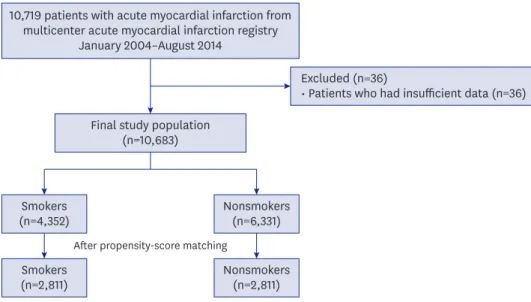
treated with PCI. Patients who had insufficient data about smoking status were excluded
(Figure 1). The study was conducted in compliance with the Declaration of Helsinki (2013),
regarding investigations in humans. The study protocol was approved by the Institutional Review Board at participating centers. This registry has been registered on ClinicalTrials.gov (study ID: NCT02806102).
Study definition
AMI was diagnosed by detecting elevated cardiac biomarkers that were at least 1 value above the 99th percentile upper reference limit with temporal rise and fall and at least 1 of the following indications: symptoms of ischemia, new or presumed new significant ST- segment-T wave changes or new left bundle branch block, development of pathological Q waves in electrocardiography, imaging evidence of new viable myocardium loss or new regional wall motion abnormality, or intracoronary thrombus identified by angiography.
19)The clinical presentation was divided into 2 groups according to the electrocardiography findings: ST-segment elevation myocardial infarction (STEMI) and non-STEMI (NSTEMI).
Typical ST-segment elevation in 2 contiguous leads and atypical electrocardiographic presentations, such as bundle branch block, isolated posterior wall myocardial infarction (MI), or ST-segment elevation in lead augmented vector right, with appropriate clinical and angiographic findings indicated STEMI, while the other cases were regarded as NSTEMI.
Current smoking status at index admission was used to stratify the patient groups. Smokers were defined as patients who reported having smoked cigarettes within 3 months of index admission.
12)Nonsmokers included patients who have never smoked and ex-smokers.
Study endpoints
The primary endpoint was major adverse cardiovascular events (MACE), including cardiac death, nonfatal MI, stroke, and any revascularization during the 5-year follow-up. Secondary endpoints were all-cause death, cardiac death, nonfatal MI, stroke, any revascularization, malignancy, and lung cancer. Patients' follow-up data, including survival data and clinical event data, were collected through March 31, 2019, via hospital chart reviews and telephone interviews of patients that were conducted by trained reviewers who were blinded to the study results. In addition, the mortality data were verified by the database of the National Health Insurance Corporation, Korea, using a unique personal identification number.
10,719 patients with acute myocardial infarction from multicenter acute myocardial infarction registry
January 2004–August 2014
Final study population (n=10,683)
Smokers
(n=4,352) Nonsmokers
(n=6,331)
Excluded (n=36)
• Patients who had insufficient data (n=36)
Smokers
(n=2,811) Nonsmokers
(n=2,811) After propensity-score matching
Figure 1. Study flow.
Treatment and data collection
Coronary angiography and other interventions were performed according to standard guidelines. Aspirin- or P2Y
12inhibitor-native patients received loading doses of aspirin and a loading dose of clopidogrel, ticagrelor, or prasugrel. The strategy for revascularization, techniques, selection of devices, and adjunctive antithrombotic therapy were determined by the operator.
20)21)After the intervention, patients were recommended to receive optimal pharmacological therapy, including statins, beta-blockers, or renin-angiotensin system inhibitors, according to standard guidelines.
22)23)All data were collected on a web-based system after eliminating personal information.
Independent reviewers and interventional cardiologists assessed angiographic and
procedural data, while independent research personnel collected baseline clinical, laboratory and medication data. Clinical events and outcome data were assessed with electrical medical records and telephone conversations. All adverse clinical events of interest were confirmed centrally by the committee at the Cardiovascular Center of Seoul St. Mary's Hospital, Seoul, Republic of Korea. Validation for mortality was performed on the basis of disqualification from the National Health Insurance Service, which is the single government-managed insurance and covers almost all of the nation's population. The final dataset was handled by independent statisticians of the Clinical Research Coordinating Center and sealed with a code by the Clinical Research Associate.
Statistical analysis
Continuous variables are expressed as the mean±standard deviation; they were analyzed by an independent sample t-test or the Mann-Whitney U test. Categorical variables are presented as percentages or rates; they were analyzed by the χ
2test or Fisher's exact test.
Kaplan-Meier curves were used to analyze the overall survival rate of patients. A comparison
of clinical outcomes between groups was performed with the log-rank test. Cox proportional
hazard models were applied to analyze the hazard ratio (HR) and 95% confidence interval
(CI) for clinical outcomes. To reduce the impact of bias and potential confounding factors in
an observational study, a propensity score analysis was also performed to adjust for potential
confounders using a logistic regression model. The covariates in the propensity score analysis
were as follows: age, sex, body mass index, Killip class, systolic blood pressure, diastolic
blood pressure, heart rate, hypertension, diabetes mellitus, dyslipidemia, smoking, chronic
kidney disease, stroke, prior PCI, prior MI, prior coronary artery bypass graft, malignancy,
chronic obstructive lung disease, clinical presentation (STEMI vs. NSTEMI), left ventricular
ejection fraction, total cholesterol, triglyceride, high-density lipoprotein cholesterol,
low-density lipoprotein cholesterol, hemoglobin, estimated glomerular filtration rate
(eGFR), high sensitivity C-reactive protein (hs-CRP), hemoglobin A1c, multivessel disease,
culprit lesion, stent generation, restenosis, chronic total occlusion, bifurcation, the use of
intravascular imaging number of total stents, mean diameter of stents, total length of stents,
aspirin, clopidogrel, potent P2Y
12inhibitors (prasugrel or ticagrelor), statins, beta-blockers,
and angiotensin converting enzyme inhibitors/angiotensin receptor blockers. According
to the propensity score, patients were selected by 1:1 matching without replacement using
the nearest neighbor method. A caliper width of 0.2 standardized differences was used for
matching. All analyses were 2-tailed, and p<0.05 was considered statistically significant. All
statistical analyses were performed using SPSS 20.0 statistical software (SPSS Inc., Chicago,
IL, USA) and R version 3.6.1 (R Foundation for Statistical Computing, Vienna, Austria).
RESULTS
Baseline clinical and procedural characteristics
Among 10,719 patients, a total of 10,683 patients with AMI were included in the final analysis, of whom 4,352 (40.7%) were current smokers and 6,331 (59.3%) were nonsmokers. The mean age of overall patients was 63.7±12.8 years old, and 71.4% of the patients were men.
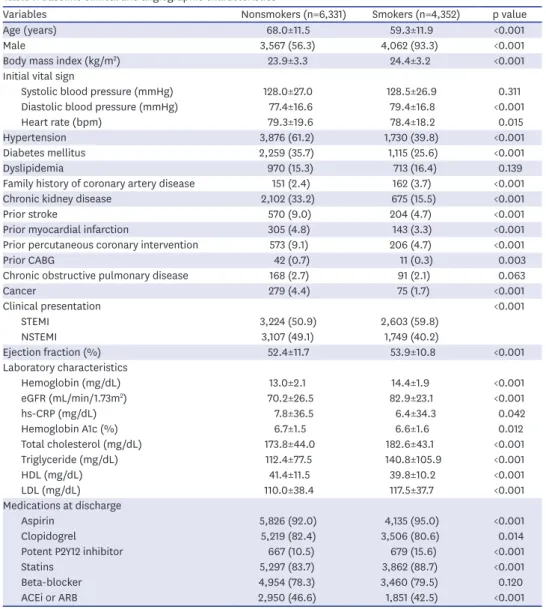
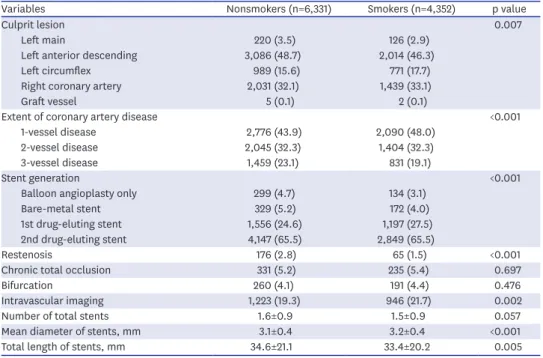
Among them, 5,827 patients (54.5%) presented with STEMI. Baseline clinical and procedural characteristics are listed in Tables 1 and 2. Smokers were younger than nonsmokers. The frequency of females, hypertension, diabetes mellitus, chronic kidney disease, stroke, cancer, and NSTEMI was higher in nonsmokers. Smokers had lower levels of hs-CRP and higher levels of eGFR than nonsmokers. In nonsmokers, multivessel disease, left anterior descending artery as the culprit lesion, and restenosis were more frequent. Nonsmokers had
Table 1. Baseline clinical and angiographic characteristics
Variables Nonsmokers (n=6,331) Smokers (n=4,352) p value
Age (years) 68.0±11.5 59.3±11.9 <0.001
Male 3,567 (56.3) 4,062 (93.3) <0.001
Body mass index (kg/m
2) 23.9±3.3 24.4±3.2 <0.001
Initial vital sign
Systolic blood pressure (mmHg) 128.0±27.0 128.5±26.9 0.311
Diastolic blood pressure (mmHg) 77.4±16.6 79.4±16.8 <0.001
Heart rate (bpm) 79.3±19.6 78.4±18.2 0.015
Hypertension 3,876 (61.2) 1,730 (39.8) <0.001
Diabetes mellitus 2,259 (35.7) 1,115 (25.6) <0.001
Dyslipidemia 970 (15.3) 713 (16.4) 0.139
Family history of coronary artery disease 151 (2.4) 162 (3.7) <0.001
Chronic kidney disease 2,102 (33.2) 675 (15.5) <0.001
Prior stroke 570 (9.0) 204 (4.7) <0.001
Prior myocardial infarction 305 (4.8) 143 (3.3) <0.001
Prior percutaneous coronary intervention 573 (9.1) 206 (4.7) <0.001
Prior CABG 42 (0.7) 11 (0.3) 0.003
Chronic obstructive pulmonary disease 168 (2.7) 91 (2.1) 0.063
Cancer 279 (4.4) 75 (1.7) <0.001
Clinical presentation <0.001
STEMI 3,224 (50.9) 2,603 (59.8)
NSTEMI 3,107 (49.1) 1,749 (40.2)
Ejection fraction (%) 52.4±11.7 53.9±10.8 <0.001
Laboratory characteristics
Hemoglobin (mg/dL) 13.0±2.1 14.4±1.9 <0.001
eGFR (mL/min/1.73m
2) 70.2±26.5 82.9±23.1 <0.001
hs-CRP (mg/dL) 7.8±36.5 6.4±34.3 0.042
Hemoglobin A1c (%) 6.7±1.5 6.6±1.6 0.012
Total cholesterol (mg/dL) 173.8±44.0 182.6±43.1 <0.001
Triglyceride (mg/dL) 112.4±77.5 140.8±105.9 <0.001
HDL (mg/dL) 41.4±11.5 39.8±10.2 <0.001
LDL (mg/dL) 110.0±38.4 117.5±37.7 <0.001
Medications at discharge
Aspirin 5,826 (92.0) 4,135 (95.0) <0.001
Clopidogrel 5,219 (82.4) 3,506 (80.6) 0.014
Potent P2Y12 inhibitor 667 (10.5) 679 (15.6) <0.001
Statins 5,297 (83.7) 3,862 (88.7) <0.001
Beta-blocker 4,954 (78.3) 3,460 (79.5) 0.120
ACEi or ARB 2,950 (46.6) 1,851 (42.5) <0.001
Data are shown as mean±standard deviation or number (%).
ACEi = angiotensin-converting enzyme inhibitors; ARB = angiotensin receptor blocker; CABG = coronary artery
bypass graft; eGFR = estimated glomerular filtration rate; HDL = high-density lipoprotein; hs-CRP = high sensitivity
C-reactive protein; LDL = low-density lipoprotein; NSTEMI, non-ST-segment elevation myocardial infarction; STEMI,
ST-segment elevation myocardial infarction.
a smaller mean stent diameter and a longer total stent length than smokers. After propensity score matching, there were no differences in baseline clinical and procedural characteristics between the 2 groups (Supplementary Tables 1 and 2).
Clinical outcomes
In the overall patients, smoking was associated with lower in-hospital mortality (3.7%
vs. 6.9%; unadjusted HR, 0.580; 95% CI, 0.489–0.689, p<0.001). After propensity-score matching, there was no significant difference of in-hospital mortality between smokers and nonsmokers (propensity-score matched HR, 0.996; 95% CI, 0.766–1.294; p=0.976).
During the 5-year follow-up, MACE occurred in 1,795 patients (18.2%), and 1,586 patients (16.1%) died. The clinical outcomes are presented in Table 3. Figure 2 demonstrates the comparison of HRs for long-term clinical outcomes before and after propensity score matching. In the unadjusted model, the incidences of MACE, all-cause death, cardiac death, MI, and stroke were higher in nonsmokers. After propensity score matching, current
Table 2. Baseline angiographic and procedural characteristicsVariables Nonsmokers (n=6,331) Smokers (n=4,352) p value
Culprit lesion 0.007
Left main 220 (3.5) 126 (2.9)
Left anterior descending 3,086 (48.7) 2,014 (46.3)
Left circumflex 989 (15.6) 771 (17.7)
Right coronary artery 2,031 (32.1) 1,439 (33.1)
Graft vessel 5 (0.1) 2 (0.1)
Extent of coronary artery disease <0.001
1-vessel disease 2,776 (43.9) 2,090 (48.0)
2-vessel disease 2,045 (32.3) 1,404 (32.3)
3-vessel disease 1,459 (23.1) 831 (19.1)
Stent generation <0.001
Balloon angioplasty only 299 (4.7) 134 (3.1)
Bare-metal stent 329 (5.2) 172 (4.0)
1st drug-eluting stent 1,556 (24.6) 1,197 (27.5)
2nd drug-eluting stent 4,147 (65.5) 2,849 (65.5)
Restenosis 176 (2.8) 65 (1.5) <0.001
Chronic total occlusion 331 (5.2) 235 (5.4) 0.697
Bifurcation 260 (4.1) 191 (4.4) 0.476
Intravascular imaging 1,223 (19.3) 946 (21.7) 0.002
Number of total stents 1.6±0.9 1.5±0.9 0.057
Mean diameter of stents, mm 3.1±0.4 3.2±0.4 <0.001
Total length of stents, mm 34.6±21.1 33.4±20.2 0.005
Data are shown as mean±standard deviation or number (%).
Table 3. Comparison of 5-year clinical outcomes between nonsmokers and smokers
Outcomes Unadjusted Multivariate Propensity score matched
Nonsmokers
(n=6,331) Smokers
(n=4,352) HR (95% CI) p value HR (95% CI) p value HR (95% CI) p value
MACE
*1,862 (29.4) 883 (20.3) 0.644 (0.594–0.698) <0.001 1.124 (1.011–1.249) 0.030 1.125 (1.009–1.254) 0.034 All-cause death 1,531 (24.2) 570 (13.1) 0.510 (0.464–0.562) <0.001 1.263 (1.110–1.436) <0.001 1.244 (1.092–1.416) 0.001 Cardiac death 1,209 (19.1) 434 (10.0) 0.494 (0.443–0.551) <0.001 1.213 (1.045–1.409) 0.011 1.190 (1.026–1.381) 0.022 Myocardial infarction 307 (4.9) 157 (3.6) 0.692 (0.571–0.839) <0.001 0.850 (0.666–1.087) 0.195 0.922 (0.711–1.196) 0.543 Stroke 461 (7.3) 340 (7.8) 0.715 (0.574–0.891) 0.003 1.200 (0.911–1.581) 0.196 1.297 (0.958–1.756) 0.092 Any revascularization 461 (7.3) 340 (7.8) 1.001 (0.870–1.151) 0.991 1.112 (0.931–1.327) 0.242 1.134 (0.941–1.365) 0.187 Stent thrombosis 107 (1.7) 62 (1.4) 0.799 (0.584–1.093) 0.160 0.885 (0.589–1.330) 0.557 1.065 (0.705–1.611) 0.764 Malignancy 174 (2.8) 113 (2.6) 0.876 (0.691–1.110) 0.272 1.259 (0.946–1.674) 0.114 1.229 (0.909–1.660) 0.180 Lung cancer 21 (0.3) 39 (0.9) 2.496 (1.468–4.242) <0.001 4.186 (2.155–8.129) <0.001 2.749 (1.416–5.338) 0.003 Values are presented as number (%).
CI = confidence interval; HR = hazard ratio; MACE = major adverse cardiovascular events.
*
MACE was defined as a composite of cardiac death, myocardial infarction, stroke, and any revascularization.
smoking was associated with higher MACE, all-cause death, and cardiac death. Furthermore, the incidence of lung cancer was significantly higher in smokers (unadjusted HR, 2.496;
95% CI, 1.468–4.242; p<0.001; propensity-score matched adjusted HR, 2.749; 95% CI, 1.416–5.338; p=0.003). Although smoking was associated with lower risk of MI and stroke in the unadjusted model, there was no significant difference statistically in the risk of MI and stroke between smokers and nonsmokers after propensity-score matching. There were no significant differences in any revascularization, stent thrombosis, and malignancy before or after propensity-score matching between the 2 groups. Figure 3 demonstrates the Kaplan- Meier curves for clinical outcomes after propensity score matching.
Subgroup analysis
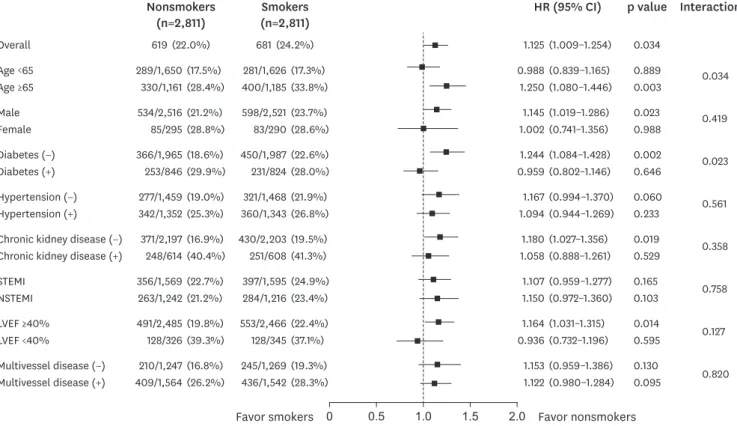
For subgroup analyses, we stratified the overall patients by age, sex, and valuable comorbidities. Figure 4 presents a forest plot indicating the MACE as related to various patient or procedural characteristics in the propensity-score matched population. This subgroup analysis revealed an interaction in patients between age (p for interaction=0.034) and diabetes status (p for interaction=0.023). Elderly (HR, 1.250; 95% CI, 1.080–1.446;
p=0.003) and nondiabetes (HR, 1.244; 95% CI, 1.084–1.428; p=0.002) had higher rates of MACE in smoker.
DISCUSSION
In the present study, we have shown in a large, multicenter cohort of patients with AMI that smoking is a strong and independent predictor of 5-year mortality and lung cancer. Smokers
p value HR (95% CI)
<0.001 0.034 0.644 (0.594–0.698)
1.125 (1.009–1.254) Unadjusted
Adjusted MACE
<0.001 0.001 0.510 (0.464–0.562) 1.244 (1.092–1.416) Unadjusted
Adjusted All-cause death
<0.001 0.022 0.494 (0.443–0.551)
1.190 (1.026–1.381) Unadjusted
Adjusted Cardiac death
<0.001 0.543 0.692 (0.571–0.839) 0.922 (0.711–1.196) Unadjusted
Adjusted Myocardial infarction
0.003 0.092 0.715 (0.574–0.891) 1.297 (0.958–1.756) Unadjusted
Adjusted Stroke
0.991 0.187 1.001 (0.870–1.151)
1.134 (0.941–1.365) Unadjusted
Adjusted Any revascularization
0.160 0.764 0.799 (0.584–1.093)
1.065 (0.705–1.611) Unadjusted
Adjusted Stent thrombosis
0.272 0.180 0.876 (0.691–1.110)
1.229 (0.909–1.660) Unadjusted
Adjusted Malignancy
<0.001 0.003 2.496 (1.468–4.242)
2.749 (1.416–5.338) Unadjusted
Adjusted Lung cancer
0.1 1.0 10.0
Favor smokers Favor nonsmokers
Figure 2. Unadjusted and propensity-score adjusted associations of smoking and long-term clinical outcomes.
CI = confidence interval; HR = hazard ratio; MACE = major adverse cardiovascular events.
were younger than nonsmokers. The incidence of females, NSTEMI, hypertension, diabetes mellitus, prior MI, prior CABG, stroke, chronic kidney disease, and cancer was higher in nonsmokers compared with smokers. In the crude model, smoking was associated with decreased long-term cardiovascular events. However, after propensity-score matching, 30
20 10 40
0 0 1 2 3 4 5
Time (years) Major adv er se car dio vascular e vents (%)
Nonsmokers Smokers
Log-rank, p=0.034
Nonsmokers Smokers
2,811 2,811
2,337 2,290
2,171 2,097
2,023 1,921
1,644 1,543
1,287 1,206 Number at risk
A
30 20 10 40
0 0 1 2 3 4 5
Time (years)
All -ca use de ath (%)
Nonsmokers Smokers
2,811 2,811
2,491 2,432
2,380 2,294
2,244 2,143
1,863 1,764
1,488 1,417 Number at risk
B
Nonsmokers Smokers
Log-rank, p=0.001
30 20 10 40
0 0 1 2 3 4 5
Time (years)
Car diac de ath (%)
Nonsmokers Smokers
2,811 2,811
2,491 2,432
2,380 2,294
2,244 2,143
1,863 1,764
1,488 1,417 Number at risk
C
30 20 10 40
0 0 1 2 3 4 5
Time (years)
My ocar dial infar ction (%)
Nonsmokers Smokers
2,811 2,811
2,445 2,397
2,316 2,244
2,172 2,079
1,792 1,701
1,425 1,362 Number at risk
D
Nonsmokers Smokers
Nonsmokers Smokers
Log-rank, p=0.021 Log-rank, p=0.543
30 20 10 40
0 0 1 2 3 4 5
Time (years)
Str ok e (%)
Nonsmokers Smokers
2,811 2,811
2,456 2,404
2,344 2,254
2,206 2,099
1,818 1,716
1,451 1,374 Number at risk
E
30 20 10 40
0 0 1 2 3 4 5
Time (years)
An y r evascularization (%)
Nonsmokers Smokers
Nonsmokers Smokers
Log-rank, p=0.091 Log-rank, p=0.186
Nonsmokers Smokers
2,811 2,811
2,395 2,334
2,235 2,153
2,093 1,984
1,716 1,603
1,343 1,257 Number at risk
F
Figure 3. Cumulative incidence rate of (A) major adverse cardiovascular events, (B) all-cause death, (C) cardiac death, (D) myocardial infarction, (E) stroke, and
(F) any revascularization among propensity-score matched patients.
smokers had a higher risk of MACE, all-cause death, and cardiac death. Furthermore, smokers had a higher risk of lung cancer among patients with AMI.
Several mechanisms can explain the increase in adverse cardiovascular events in AMI patients who smoke. Smokers have higher plasma levels of fibrinogen and increased platelet aggregation, resulting in a hypercoagulability state.
24)Smoking also causes coronary vasoconstriction and endothelial dysfunction.
25)26)Moreover, smoking contributes to atherosclerosis and plaque progression, leading to LDL and HDL cholesterol changes.
2)In the thrombolytic therapy era, numerous studies reported that smokers were associated with favorable clinical outcomes compared with nonsmokers.
17)18)However, recent studies have shown that this hypothesized survival benefit in smokers with CAD no longer exists in the PCI era.
10-13)15)27)Nevertheless, some studies have reported the “smoker's paradox.”
14)16)These previous studies have investigated on shorter clinical outcomes compared with our results assessing 5-year clinical outcomes.
10-13)Parasuraman et al.
13)collected 12,656 patients with acute coronary syndrome following PCI to assess 30 day and 6 month mortality according to smoking status. Yadav et al.
10)investigated the relationship between smoking and 5-year clinical outcomes from an individual patient pooled database, however only approximately 25% of the study population were diagnosed with AMI. In contrast, we conducted a multicenter registry evaluation to investigate clinical outcomes of 10,683 AMI patients based on their smoking status.
10)In addition, recent reports suggested that the smoker's paradox was limited to assessing in-hospital mortality only.
15)The present study
0 0.5 1.0 1.5 2.0
Favor smokers Favor nonsmokers
Interaction p
0.034
0.419
0.023
0.561
0.358
0.758
0.127
0.820 p value
0.034 0.889 0.003 0.023 0.988 0.002 0.646 0.060 0.233 0.019 0.529 0.165 0.103 0.014 0.595 0.130 0.095 HR (95% CI)
1.125 (1.009–1.254) 0.988 (0.839–1.165) 1.250 (1.080–1.446)
1.145 (1.019–1.286) 1.002 (0.741–1.356) 1.244 (1.084–1.428) 0.959 (0.802–1.146) 1.167 (0.994–1.370) 1.094 (0.944–1.269) 1.180 (1.027–1.356) 1.058 (0.888–1.261)
1.107 (0.959–1.277) 1.150 (0.972–1.360) (1.031–1.315) 1.164
0.936 (0.732–1.196) 1.153 (0.959–1.386) 1.122 (0.980–1.284) Smokers
(n=2,811) 681 (24.2%) 281/1,626 (17.3%) 400/1,185 (33.8%) 598/2,521 (23.7%) 83/290 (28.6%) 450/1,987 (22.6%) 231/824 (28.0%) 321/1,468 (21.9%) 360/1,343 (26.8%) 430/2,203 (19.5%) 251/608 (41.3%) 397/1,595 (24.9%) 284/1,216 (23.4%) (22.4%) 553/2,466
128/345 (37.1%) 245/1,269 (19.3%) 436/1,542 (28.3%) Overall
Age <65 Age ≥65 Male Female Diabetes (−) Diabetes (+) Hypertension (−) Hypertension (+) Chronic kidney disease (−) Chronic kidney disease (+) STEMI
NSTEMI LVEF ≥40%
LVEF <40%
Multivessel disease (−) Multivessel disease (+)
Nonsmokers (n=2,811) 619 (22.0%) 289/1,650 (17.5%)
330/1,161 (28.4%) 534/2,516 (21.2%) 85/295 (28.8%) 366/1,965 (18.6%) 253/846 (29.9%) 277/1,459 (19.0%) 342/1,352 (25.3%) 371/2,197 (16.9%) 248/614 (40.4%) 356/1,569 (22.7%) 263/1,242 (21.2%) (19.8%) 491/2,485
128/326 (39.3%) 210/1,247 (16.8%) 409/1,564 (26.2%)
Figure 4. Comparative hazard ratios of major adverse cardiovascular events for subgroups in propensity-score matched patients.
CI = confidence interval; HR = hazard ratio; LVEF = left ventricular ejection fraction; NSTEMI = non-ST-segment elevation myocardial infarction; STEMI = ST-
segment elevation myocardial infarction.
found no significant difference in the risk of in-hospital mortality between smokers and nonsmokers among the propensity-score matched cohort.
In the present study, smokers were significantly younger, predominantly men, and had a lower prevalence of risk factors, including hypertension, diabetes mellitus, chronic kidney disease, and stroke. These baseline differences are consistent with previous reports.
27)28)This finding emphasized the fact that smokers are prone to more rapidly developing CAD requiring PCI with plaque rupture and thrombosis. Although smokers had a better prognosis in an unadjusted analysis, after proper adjustment for cardiovascular risk factors, smokers had a higher risk of cardiac death, all-cause death, and developing lung cancer during the 5-year follow-up period. However, smoking did not increase the risk of any revascularization, which was consistent with previous reports.
27)29)Our study detected that the rate of MI did not differ between the 2 groups. Although our study included only AMI patients, the incidence of MI and any revascularization was relatively lower than those from the previous meta- analysis.
10)The point to note in our study was that we investigated the relationship between smoking status and 5-year clinical outcomes, including MACE and risk of any cancer, in patients with AMI. In our study, the harmful effect of smoking was greatest in patients classified as elderly or nondiabetes. These results emphasize the importance of quitting smoking, especially in elderly and nondiabetic patients. More studies are needed to examine why the harmful effects of smoking are greatest in elderly and nondiabetic patients.
Smoking is involved in the development of most cancers, and lung cancer is the most closely associated with smoking among all smoking-related diseases.
4)The impact of smoking on cancer development in AMI patients has not yet been reported. In our study, smoking did not increase the risk of developing other cancers, but it did increase the risk of developing lung cancer in AMI patients. From a public health perspective, the message of our study is that smokers with AMI are at a high risk of death and increased risk of lung cancer, increasing their socioeconomic burden.
30)Our study has several limitations. First, this study was a retrospective cohort study. However, this study had several advantages to minimize the limitations, such as large sample size, homogenous group of AMI patients and statistical adjustments, including propensity score matching. Second, we obtained the information on smoking status only at the time of the index event and not during follow-up. Based on the beneficial effect of smoking cessation, information on smoking status at serial time points would have provided additional useful information.
1)Third, the smoking status presented here is self-reported. In addition, detailed data on smoking intensity and duration of smoking were not recorded. Finally, the incidence rates of MI, stroke, and any revascularization were relatively low. This could be related to selection bias because only patients who signed informed consent were included in our study.
Alternatively, the incidence rates may have been underestimated in the process of collecting data. Nonetheless, despite these limitations, our results emphasize the impact of smoking on long term MACE and cancer risk in patients with AMI.
In conclusion, the present large-scale multicenter study of AMI patients shows that smokers
undergoing PCI were significantly younger and had less coronary risk factors compared with
nonsmokers. Smoking was associated with worse cardiovascular outcomes and lung cancer in
AMI patients during the 5-year follow-up period. Our results emphasize the public message
concerning the harmful effects of cigarette smoking.
SUPPLEMENTARY MATERIALS
Supplementary Table 1
Baseline clinical characteristics in propensity-matched population Click here to view
Supplementary Table 2
Baseline angiographic and procedural characteristics in propensity-matched population Click here to view
REFERENCES
1. Jha P, Ramasundarahettige C, Landsman V, et al. 21st-century hazards of smoking and benefits of cessation in the United States. N Engl J Med 2013;368:341-50.
PUBMED | CROSSREF
2. Ambrose JA, Barua RS. The pathophysiology of cigarette smoking and cardiovascular disease: an update. J Am Coll Cardiol 2004;43:1731-7.
PUBMED | CROSSREF
3. Ezzati M, Henley SJ, Thun MJ, Lopez AD. Role of smoking in global and regional cardiovascular mortality.
Circulation 2005;112:489-97.
PUBMED | CROSSREF
4. Gu D, Kelly TN, Wu X, et al. Mortality attributable to smoking in China. N Engl J Med 2009;360:150-9.
PUBMED | CROSSREF
5. Thun MJ, Carter BD, Feskanich D, et al. 50-year trends in smoking-related mortality in the United States.
N Engl J Med 2013;368:351-64.
PUBMED | CROSSREF
6. Barbash GI, Reiner J, White HD, et al. Evaluation of paradoxic beneficial effects of smoking in patients receiving thrombolytic therapy for acute myocardial infarction: mechanism of the “smoker's paradox”
from the GUSTO-I trial, with angiographic insights. Global Utilization of Streptokinase and Tissue- Plasminogen Activator for Occluded Coronary Arteries. J Am Coll Cardiol 1995;26:1222-9.
PUBMED | CROSSREF
7. Andrikopoulos GK, Richter DJ, Dilaveris PE, et al. In-hospital mortality of habitual cigarette smokers after acute myocardial infarction; the “smoker's paradox” in a countrywide study. Eur Heart J 2001;22:776-84.
PUBMED | CROSSREF
8. Finney Rutten LJ, Augustson EM, Moser RP, Beckjord EB, Hesse BW. Smoking knowledge and behavior in the United States: sociodemographic, smoking status, and geographic patterns. Nicotine Tob Res 2008;10:1559-70.
PUBMED | CROSSREF
9. Cheng HG, McBride O, Phillips MR. Relationship between knowledge about the harms of smoking and smoking status in the 2010 Global Adult Tobacco China Survey. Tob Control 2015;24:54-61.
PUBMED | CROSSREF
10. Yadav M, Mintz GS, Généreux P, et al. The smoker's paradox revisited: a patient-level pooled analysis of 18 randomized controlled trials. JACC Cardiovasc Interv 2019;12:1941-50.
PUBMED | CROSSREF
11. Robertson JO, Ebrahimi R, Lansky AJ, Mehran R, Stone GW, Lincoff AM. Impact of cigarette smoking on extent of coronary artery disease and prognosis of patients with non-ST-segment elevation acute coronary syndromes: an analysis from the ACUITY Trial (Acute Catheterization and Urgent Intervention Triage Strategy). JACC Cardiovasc Interv 2014;7:372-9.
PUBMED | CROSSREF
12. Redfors B, Furer A, Selker HP, et al. Effect of smoking on outcomes of primary PCI in patients with STEMI. J Am Coll Cardiol 2020;75:1743-54.
PUBMED | CROSSREF
13. Parasuraman S, Zaman AG, Egred M, et al. Smoking status and mortality outcomes following percutaneous coronary intervention. Eur J Prev Cardiol. 2020 [Epub ahead of print].
PUBMED | CROSSREF
14. Gupta T, Kolte D, Khera S, et al. Smoker's paradox in patients with ST-segment elevation myocardial infarction undergoing primary percutaneous coronary intervention. J Am Heart Assoc 2016;5:e003370.
PUBMED | CROSSREF
15. Steele L, Palmer J, Lloyd A, Fotheringham J, Iqbal J, Grech ED. The impact of smoking on mortality after acute ST-segment elevation myocardial infarction treated with primary percutaneous coronary intervention: a retrospective cohort outcome study at 3 years. J Thromb Thrombolysis 2019;47:520-6.
PUBMED | CROSSREF
16. Song C, Fu R, Dou K, et al. Association between smoking and in-hospital mortality in patients with acute myocardial infarction: results from a prospective, multicentre, observational study in China. BMJ Open 2019;9:e030252.
PUBMED | CROSSREF
17. Gottlieb S, Boyko V, Zahger D, et al. Smoking and prognosis after acute myocardial infarction in the thrombolytic era (Israeli Thrombolytic National Survey). J Am Coll Cardiol 1996;28:1506-13.
PUBMED | CROSSREF
18. Jørgensen , Køber L, Ottesen MM, Torp-Pedersen C, Videbaek J, Kjøller E. The prognostic importance of smoking status at the time of acute myocardial infarction in 6676 patients. TRACE Study Group. J Cardiovasc Risk 1999;6:23-7.
PUBMED | CROSSREF
19. Thygesen K, Alpert JS, Jaffe AS, et al. Fourth universal definition of myocardial infarction (2018). J Am Coll Cardiol 2018;72:2231-64.
PUBMED | CROSSREF
20. Levine GN, Bates ER, Blankenship JC, et al. 2011 ACCF/AHA/SCAI guideline for percutaneous coronary intervention: a report of the American College of Cardiology Foundation/American Heart Association task force on practice guidelines and the society for cardiovascular angiography and interventions.
Circulation 2011;124:e574-651.
PUBMED | CROSSREF
21. Neumann FJ, Sousa-Uva M, Ahlsson A, et al. 2018 ESC/EACTS guidelines on myocardial revascularization.
Eur Heart J 2019;40:87-165.
PUBMED | CROSSREF
22. O'Gara PT, Kushner FG, Ascheim DD, et al. 2013 ACCF/AHA guideline for the management of ST- elevation myocardial infarction: a report of the American College of Cardiology Foundation/American Heart Association task force on practice guidelines. Circulation 2013;127:e362-425.
PUBMED | CROSSREF
23. Amsterdam EA, Wenger NK, Brindis RG, et al. 2014 AHA/ACC guideline for the management of patients with non-ST-elevation acute coronary syndromes: executive summary: a report of the American College of Cardiology/American Heart Association task force on practice guidelines. Circulation 2014;130:2354-94.
PUBMED | CROSSREF
24. Benowitz NL, Fitzgerald GA, Wilson M, Zhang Q. Nicotine effects on eicosanoid formation and hemostatic function: comparison of transdermal nicotine and cigarette smoking. J Am Coll Cardiol 1993;22:1159-67.
PUBMED | CROSSREF
25. Michael Pittilo R. Cigarette smoking, endothelial injury and cardiovascular disease. Int J Exp Pathol 2000;81:219-30.
PUBMED | CROSSREF
26. Nicod P, Rehr R, Winniford MD, Campbell WB, Firth BG, Hillis LD. Acute systemic and coronary hemodynamic and serologic responses to cigarette smoking in long-term smokers with atherosclerotic coronary artery disease. J Am Coll Cardiol 1984;4:964-71.
PUBMED | CROSSREF
27. Zhang YJ, Iqbal J, van Klaveren D, et al. Smoking is associated with adverse clinical outcomes in patients undergoing revascularization with PCI or CABG: the SYNTAX trial at 5-year follow-up. J Am Coll Cardiol 2015;65:1107-15.
PUBMED | CROSSREF
28. Hasdai D, Garratt KN, Grill DE, Lerman A, Holmes DR Jr. Effect of smoking status on the long-term outcome after successful percutaneous coronary revascularization. N Engl J Med 1997;336:755-61.
PUBMED | CROSSREF
29. Sherif MA, Nienaber CA, Toelg R, et al. Impact of smoking on the outcome of patients treated with drug- eluting stents: 1-year results from the prospective multicentre German Drug-Eluting Stent Registry (DES.
DE). Clin Res Cardiol 2011;100:413-23.
PUBMED | CROSSREF
30. Shi JF, Liu CC, Ren JS, et al. Economic burden of lung cancer attributable to smoking in China in 2015. Tob Control 2020;29:191-9.
PUBMED | CROSSREF