korean j intern med 2012;27:180-188
http://dx.doi.org/10.3904/kjim.2012.27.2.180 pISSN 1226-3303 eISSN 2005-6648
http://www.kjim.or.kr
Different Impact of Diabetes Mellitus on In-hospital
and 1-Year Mortality in Patients with Acute Myocardial Infarction Who Underwent Successful Percutaneous
Coronary Intervention: Results from the Korean Acute Myocardial Infarction Registry
Keun-Ho Park, Youngkeun Ahn, Myung Ho Jeong, Shung Chull Chae, Seung Ho Hur, Young Jo Kim, In Whan Seong, Jei Keon Chae, Taek Jong Hong, Myeong Chan Cho, Jang Ho Bae, Seung Woon Rha, Yang Soo Jang, and Korean Acute Myocardial Infarction Registry Investigators
Cardiovascular Center, Chonnam National University Hospital, Gwangju, Korea
Background/Aims: The aim of this study was to evaluate the impact of diabetes mellitus (DM) on in-hospital and 1-year mortality in patients who suffered acute myocardial infarction (AMI) and underwent successful percutaneous coronary intervention (PCI).
Methods: Among 5,074 consecutive patients from the Korea AMI Registry with successful revascularization between November 2005 and June 2007, 1,412 patients had a history of DM.
Results: The DM group had a higher mean age prevalence of history of hypertension, dyslipidemia, ischemic heart disease, high Killip class, and diagnoses as non-ST elevation MI than the non-DM group. Left ventricular ejection fraction (LVEF) and creatinine clearance were lower in the DM group, which also had a significantly higher incidence of in-hospital and 1-year mortality of hospital survivors (4.6% vs. 2.8%, p = 0.002; 5.0% vs. 2.5%, p < 0.001). A multivariate analysis revealed that independent predictors of in-hospital mortality were Killip class IV or III at admission, use of angiotensin converting enzyme inhibitors or angiotensin-II receptor blockers, LVEF, creatinine clearance, and a diagnosis of ST-elevated MI but not DM. However, a multivariate Cox regression analysis showed that DM was an independent predictor of 1-year mortality (hazard ratio, 1.504; 95% confidence interval, 1.032 to 2.191).
Conclusions: DM has a higher association with 1-year mortality than in-hospital mortality in patients with AMI who underwent successful PCI. Therefore, even when patients with AMI and DM undergo successful PCI, they may require further intensive treatment and continuous attention.
Keywords: Diabetes mellitus; Myocardial infarction; Mortality
Received : January 16, 2011 Revised : August 19, 2011 Accepted : December 22, 2011
Correspondence to Youngkeun Ahn, M.D.
Cardiovascular Center, Chonnam National University Hospital, 671 Jebong-ro, Dong-gu, Gwangju 501-757, Korea Tel: 82-62-220-4764, Fax: 82-62-224-4764, E-mail: [email protected]
INTRODUCTION
Acute myocardial infarction (AMI) remains a leading
cause of morbidity and mortality worldwide. However, mortality from MI has decreased over the years due to improvements in percutaneous coronary intervention
(PCI) techniques and the development of stents, new life-saving devices, and medications. Nevertheless, many clinical risk factors affect high mortality in pa- tients with AMI.
Diabetes mellitus (DM) is well-known as a coronary artery equivalent disease and a major cardiovascular risk factor [1]. Patients with DM have a higher rate of AMI and a greater need for repeated revascularization after PCI [2,3]. After suffering from AMI, short- and long-term mortality rates are twice as high for patients with DM as those without DM [4,5]. However, in the recently improved interventional era of drug-eluting stents, few large-scale studies have been reported about the impact of DM on clinical outcomes, particularly in patients with AMI who underwent successful PCI.
In the present study, we compared in-hospital and 1-year mortality in diabetic and non-diabetic patients with AMI who underwent successful PCI using data from the Korean Acute Myocardial Infarction Registry (KAMIR).
METHODS
Study design and patient population
We consecutively selected 5,074 patients with AMI who underwent successful PCI from November 2005 to June 2007 and had 1-year follow-up data in the KAMIR.
Among them, patients with a history of DM, regardless of whether they received treatment, were assigned to the DM group (n = 1,412) and those without a history of DM were assigned to the non-DM group (n = 3,662).
The KAMIR is a prospective, multicenter, observa- tional, online registry that can be used to evaluate epi- demiology, current management, and clinical outcomes in Korean patients with AMI and improve care for AMI patients. Data, including baseline clinical and angio- graphic characteristics as well as clinical outcomes, were collected by a specialized study coordinator at each center using a standardized case report form. AMI was diagnosed by characteristic clinical presentation, serial changes on electrocardiogram (ECG) suggesting infarction, and increases in cardiac enzymes [6]. The diagnosis of ST-segment elevated myocardial infarction (STEMI) was based on a suggestive history with an ST elevation of 2 mm in two precordial leads, an ST eleva-
tion of 1 mm in two limb leads, or a new left branch bundle block on 12-lead ECG with a concomitant in- crease in troponin-I or -T to the 99th percentile of the upper reference limit.
Procedural and post-intervention medications Emergent or early invasive treatments were deter- mined based on the status of the patients with AMI according to the clinical decision of the operators. Pri- mary PCI was defined as angioplasty and/or stenting as quickly as possible in patients with STEMI. Early invasive treatment was defined as angioplasty and/or stenting within 24 hours of admission in patients with non-STEMI. Coronary angiography was performed by transfemoral or transradial approaches. Conventional heparin was infused during the procedure to maintain an activated clotting time of at least 250 seconds. Stents were implanted in cases in which significant coronary artery stenosis was present following balloon angio- plasty. The type of stent was decided by the operator.
Successful revascularization was defined as a target vessel at the treatment site that had achieved angio- graphic residual stenosis of < 30% following balloon angioplasty or implantation of stents in the presence of thrombolysis in myocardial infarction (TIMI) antegrade 3 flow. Antiplatelet agents were administered to all pa- tients prior to intervention, including 300 mg aspirin and 300-600 mg clopidogrel. After the intervention, 100 mg aspirin was recommended as a treatment for life and 75 mg clopidogrel was administered for at least 1 year. Other medical treatments, including angiotensin converting enzyme inhibitors (ACEis) or angiotensin II receptor blockers (ARBs), beta-blockers, calcium chan- nel blockers, and lipid-lowering agents were also used based on the standard treatment regimen for patients with AMI according to the physician’s decision.
Study endpoints and definition
The primary endpoint was in-hospital and 1-year mortality of patients with AMI with and without DM.
The secondary endpoint was 1-year major adverse cardiac events (MACE) defined as the composite of cardiac death, nonfatal MI, target lesion revasculariza- tion (TLR), target vessel revascularization (TVR), and coronary artery bypass graft. Cardiac death was defined as any death with an undetermined cause and a defini-
tive noncardiac origin. TLR or TVR was defined as any percutaneous coronary revascularization performed on a treated lesion or vessel. Hypertension was defined as a history of hypertension or antihypertensive medica- tion use. A current smoker was defined as someone who reported smoking cigarettes during the past 30 days.
Dyslipidemia was defined as a diagnosis previously made by a physician or treatment with lipid-lowering medications. Baseline creatinine clearance was calcu- lated using the Cockcroft-Gault formula considering age, gender, and body weight.
Statistical analysis
Continuous variables are expressed as mean ± SD, and categorical variables are expressed as frequencies.
The analysis of continuous variables was performed using Student’s t test and that of categorical variables was performed using the chi-square or Fisher’s exact tests. Multiple logistic regression and Cox proportional regression analyses were conducted to identify the in- dependent predictors of in-hospital and 1-year mortal- ity. Variables entered into the multivariate models were age, gender, creatinine clearance, history of hyperten- sion, DM, dyslipidemia, ischemic heart disease, current smoker, left ventricular ejection fraction (LVEF), ACC/
AHA B2 or C lesions, Killip class on admission, mul- tivessel disease, STEMI or non-STEMI, concomitant medications, and stent type. All statistical analyses were performed using SPSS version 15.0 (SPSS Inc., Chicago, IL, USA). All statistical tests were two-tailed, and a p value < 0.05 was considered statistically signifi- cant.
RESULTS
Baseline characteristics
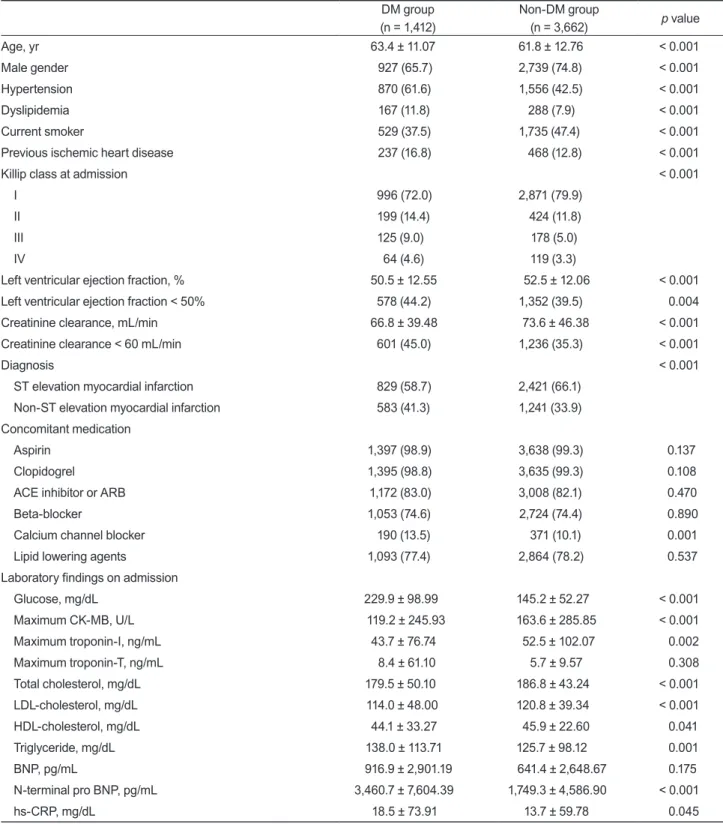
Mean age was higher in the DM group than in the non-DM group. Female gender, history of hyperten- sion, dyslipidemia, previous ischemic heart disease, and diagnosis of non-STEMI were more prevalent in the DM group. However, male gender, current smoker, and diagnosis of STEMI were more prevalent in the non- DM group. LVEF and creatinine clearance were lower in the DM group. However, no differences in concomitant medications except calcium channel blockers were ob-
served between the two groups. Table 1 shows the base- line clinical characteristics, concomitant medications, and laboratory findings of the two groups.
In the baseline angiographic and procedural charac- teristics, single-vessel disease was more prevalent in the non-DM group than in the DM group. However, three- vessel disease or left main coronary artery disease were more prevalent in the DM group, whereas preproce- dural TIMI antegrade 0 flow rates were more common in the non-DM group and postprocedural TIMI ante- grade flow rates did not differ between the two groups.
TAXUS stents (Boston Scientific Co., Natick, MA, USA) were used more commonly in the non-DM group, whereas Cypher stents (Cordis, Johnson & Johnson, Mi- ami Lakes, FL, USA) were used more commonly in the DM group. The stent diameter of the target lesion was smaller, and the total number of implanted stents was more numerous, in the DM group than in the non-DM group (Table 2).
Clinical outcomes
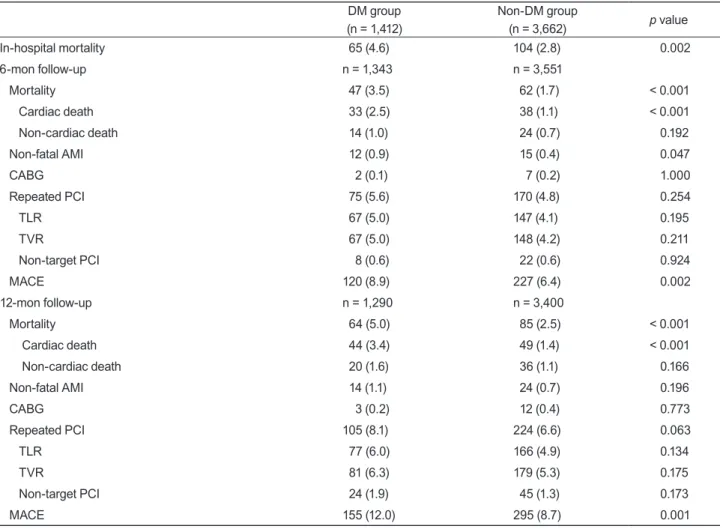
The DM group had a significantly higher incidence of in-hospital mortality than the non-DM group (4.6% vs.
2.8%, p = 0.002).
Approximately 92% of all hospital survivors were available for the 1-year clinical follow-up, during which the DM group had significantly higher incidences of to- tal mortality (5.0% vs. 2.5%, p < 0.001), cardiac death (3.4% vs. 1.4%, p < 0.001), and MACE (12.0% vs. 8.7%, p
= 0.001) than did the non-DM group (Table 3).
Subgroup analyses showed that the incidence of in- hospital mortality in the DM group was significantly higher than in non-DM patients with STEMI (6.2% vs.
3.5%, p = 0.001), but no difference in in-hospital mor- tality was observed between the two groups in patients with non-STEMI (2.4% vs. 1.6%, p = 0.164). However, the incidence of 1-year mortality in the DM group was higher than that of non-DM patients with both STEMI and non-STEMI (4.6% vs. 2.7%, p = 0.010 in STEMI;
5.5% vs. 2.1%, p < 0.001 in non-STEMI).
A Kaplan-Meier survival analysis revealed that the DM group had significantly lower 1-year survival rates than the non-DM group (95.2% vs. 97.7%, p < 0.001) (Fig. 1).
Multivariate analyses
The independent predictors of in-hospital mortality
Table 1. Baseline clinical characteristics, concomitant medications, and laboratory findings in the groups DM group
(n = 1,412)
Non-DM group
(n = 3,662) p value
Age, yr 63.4 ± 11.07 61.8 ± 12.76 < 0.001
Male gender 927 (65.7) 2,739 (74.8) < 0.001
Hypertension 870 (61.6) 1,556 (42.5) < 0.001
Dyslipidemia 167 (11.8) 288 (7.9) < 0.001
Current smoker 529 (37.5) 1,735 (47.4) < 0.001
Previous ischemic heart disease 237 (16.8) 468 (12.8) < 0.001
Killip class at admission < 0.001
I 996 (72.0) 2,871 (79.9)
II 199 (14.4) 424 (11.8)
III 125 (9.0) 178 (5.0)
IV 64 (4.6) 119 (3.3)
Left ventricular ejection fraction, % 50.5 ± 12.55 52.5 ± 12.06 < 0.001
Left ventricular ejection fraction < 50% 578 (44.2) 1,352 (39.5) 0.004
Creatinine clearance, mL/min 66.8 ± 39.48 73.6 ± 46.38 < 0.001
Creatinine clearance < 60 mL/min 601 (45.0) 1,236 (35.3) < 0.001
Diagnosis < 0.001
ST elevation myocardial infarction 829 (58.7) 2,421 (66.1)
Non-ST elevation myocardial infarction 583 (41.3) 1,241 (33.9)
Concomitant medication
Aspirin 1,397 (98.9) 3,638 (99.3) 0.137
Clopidogrel 1,395 (98.8) 3,635 (99.3) 0.108
ACE inhibitor or ARB 1,172 (83.0) 3,008 (82.1) 0.470
Beta-blocker 1,053 (74.6) 2,724 (74.4) 0.890
Calcium channel blocker 190 (13.5) 371 (10.1) 0.001
Lipid lowering agents 1,093 (77.4) 2,864 (78.2) 0.537
Laboratory findings on admission
Glucose, mg/dL 229.9 ± 98.99 145.2 ± 52.27 < 0.001
Maximum CK-MB, U/L 119.2 ± 245.93 163.6 ± 285.85 < 0.001
Maximum troponin-I, ng/mL 43.7 ± 76.74 52.5 ± 102.07 0.002
Maximum troponin-T, ng/mL 8.4 ± 61.10 5.7 ± 9.57 0.308
Total cholesterol, mg/dL 179.5 ± 50.10 186.8 ± 43.24 < 0.001
LDL-cholesterol, mg/dL 114.0 ± 48.00 120.8 ± 39.34 < 0.001
HDL-cholesterol, mg/dL 44.1 ± 33.27 45.9 ± 22.60 0.041
Triglyceride, mg/dL 138.0 ± 113.71 125.7 ± 98.12 0.001
BNP, pg/mL 916.9 ± 2,901.19 641.4 ± 2,648.67 0.175
N-terminal pro BNP, pg/mL 3,460.7 ± 7,604.39 1,749.3 ± 4,586.90 < 0.001
hs-CRP, mg/dL 18.5 ± 73.91 13.7 ± 59.78 0.045
Values are presented as mean ± SD or number (%).
DM, diabetes mellitus; ACE, angiotensin converting enzyme; ARB, angiotensin II receptor blocker; CK-MB, creatinine kinase MB isoen- zyme; LDL, low-density lipoprotein; HDL, high-density lipoprotein; BNP, brain-type natriuretic peptide; hs-CRP, high sensitivity C-reac- tive protein.
by multiple logistic regression analysis were Killip III or IV class on admission, use of ACEis or ARBs, LVEF, creatinine clearance, and STEMI, whereas DM was not an independent predictor of in-hospital mortality (haz- ard ratio, 1.386; 95% confidence interval, 0.810 to 2.374;
p = 0.234). However, independent predictors of 1-year mortality included Killip class on admission, age, LVEF, creatinine clearance, balloon angioplasty, use of bare metal stents, multivessel disease, female gender, cur- rent smoker, and history of DM (Table 4).
DISCUSSION
We evaluated the impact of DM on in-hospital and 1-year mortality in patients with AMI who underwent successful revascularization, and the results suggest that despite successful revascularization, the incidence of in-hospital and 1-year mortality in patients with AMI and DM remained high. However, DM was not an inde- pendent predictor of in-hospital mortality, whereas DM was a predictor of 1-year mortality in the multivariate analyses.
In our cohort, patients with DM had worse baseline Table 2. Coronary angiographic findings and procedural characteristics in the groups
DM group (n = 1,412)
Non-DM group
(n = 3,662) p value
Target lesion
Left anterior descending artery 660 (46.7) 1,785 (48.7) 0.201
Left circumflex artery 220 (15.6) 606 (16.5) 0.403
Right coronary artery 496 (35.1) 1,213 (33.1) 0.176
Left main 35 (2.5) 55 (1.5) 0.018
Diseased vessels
Single vessel disease 483 (34.2) 1,741 (47.6) < 0.001
Two vessel disease 459 (32.5) 1,104 (30.1) 0.103
Three vessel disease 411 (29.1) 730 (19.9) < 0.001
Left main disease 58 (4.1) 81 (2.2) < 0.001
ACC/AHA lesion classification 0.674
A or B1 357 (25.3) 905 (24.7)
B2 or C 1,055 (74.7) 2,757 (75.3)
Pre-procedural TIMI flow grade
0 532 (37.7) 1,645 (44.9) < 0.001
I 158 (11.2) 333 (9.1) 0.024
II 244 (17.3) 567 (15.5)) 0.117
III 472 (33.4) 1,099 (30.0) 0.018
Type of stent used 0.009
TAXUS 445 (31.5) 1,275 (34.8)
Cypher 654 (46.3) 1,548 (42.3)
Other drug-eluting stents 145 (10.3) 401 (11.0)
Bare metal stents 96 (6.8) 297 (8.1)
Only balloon angioplasty 72 (5.1) 141 (3.9)
Stent diameter of target lesion, mm 3.1 ± 0.39 3.2 ± 0.41 < 0.001
Stent length of target lesion, mm 25. 3 ± 6.29 25.3 ± 6.16 0.832
Total no. of stents 1.6 ± 0.91 1.5 ± 0.82 < 0.001
Values are presented as mean ± SD or number (%).
DM, diabetes mellitus; ACC/AHA, American College of Cardiology/American Heart Association; TIMI, thrombolysis in myocardial infarc- tion.
clinical characteristics than those without DM. In addi- tion, they were more likely to have developed a worsen- ing of Killip class at admission and a higher incidence of pump failure, because increased incidence of silent myocardial ischemia and infarction in patients with DM tends to lead to late presentation for medical attention and subsequent delayed initiation of treatment [7]. Sev- eral studies have found that patients with AMI and DM have a higher incidence of in-hospital mortality than those without DM [8-12]. However, almost all of these studies included patients who received only pharma- cological treatment for AMI. Successful revasculariza- tion via a catheter-based approach minimizes ischemic injury of the myocardium and improves survival rates.
Therefore, we included patients with AMI who under- Table 3. In-hospital and 1-year clinical outcomes in the groups
DM group (n = 1,412)
Non-DM group
(n = 3,662) p value
In-hospital mortality 65 (4.6) 104 (2.8) 0.002
6-mon follow-up n = 1,343 n = 3,551
Mortality 47 (3.5) 62 (1.7) < 0.001
Cardiac death 33 (2.5) 38 (1.1) < 0.001
Non-cardiac death 14 (1.0) 24 (0.7) 0.192
Non-fatal AMI 12 (0.9) 15 (0.4) 0.047
CABG 2 (0.1) 7 (0.2) 1.000
Repeated PCI 75 (5.6) 170 (4.8) 0.254
TLR 67 (5.0) 147 (4.1) 0.195
TVR 67 (5.0) 148 (4.2) 0.211
Non-target PCI 8 (0.6) 22 (0.6) 0.924
MACE 120 (8.9) 227 (6.4) 0.002
12-mon follow-up n = 1,290 n = 3,400
Mortality 64 (5.0) 85 (2.5) < 0.001
Cardiac death 44 (3.4) 49 (1.4) < 0.001
Non-cardiac death 20 (1.6) 36 (1.1) 0.166
Non-fatal AMI 14 (1.1) 24 (0.7) 0.196
CABG 3 (0.2) 12 (0.4) 0.773
Repeated PCI 105 (8.1) 224 (6.6) 0.063
TLR 77 (6.0) 166 (4.9) 0.134
TVR 81 (6.3) 179 (5.3) 0.175
Non-target PCI 24 (1.9) 45 (1.3) 0.173
MACE 155 (12.0) 295 (8.7) 0.001
Values are presented as number (%).
DM, diabetes mellitus; AMI, acute myocardial infarction; CABG, coronary artery bypass graft; PCI, percutaneous coronary intervention;
TLR, target lesion revascularization; TVR, target vessel revascularization; MACE, major adverse cardiovascular events.
Figure 1. Kaplan-Meier curves for all-cause mortality in the groups. DM, diabetes mellitus.
100
95
900 50 100 150 200 250
Survival days Log-rank p < 0.01
Survival probability, %
Non-DM 97.7%
95.2%
DM 300 350
went successful revascularization and excluded patients with AMI who received only medical treatment or thrombolytic therapy without mechanical revascular- ization.
Our results showed that despite successful revascu- larization in patients with AMI, patients with DM still had a higher incidence of in-hospital mortality than those without DM. Other trials have reported that a significant delay from symptom onset to hospital arrival in patients with DM results in a significant delay in re- perfusion treatment [7,13,14]. The presenting symptoms of patients with DM may also be more difficult to relate to active ischemic heart disease and may be associated with a delay in the AMI diagnosis. Delayed treatments were associated with poor clinical outcomes during the hospital stay.
Patients with DM have increased platelet aggrega- tory and procoagulant activity, leading to an inher- ently greater incidence and rate of thrombus formation
[13,15]. However, our results showed that patients with DM had a lower incidence of pre-procedural TIMI an- tegrade 0 or 1 flow than those without DM. This find- ing may be based on patient selection bias, because we included patients who underwent successful revascu- larization. However, despite better preprocedural TIMI flow, patients with DM had poorer in-hospital outcomes.
This is also evidence of the negative impact of DM on AMI.
DM was not an independent predictor of in-hospital mortality, which has been reported in other trials [8,9,12]. Independent predictors of in-hospital mortal- ity were high Killip class on admission, use of ACE is or ARBs, depressed LVEF, decreased renal function, and STEMI. Successful PCI could probably improve in-hos- pital survival rates and influence the predictors of in- hospital mortality. Therefore, in-hospital mortality was more likely to be associated with patient clinical status and medical treatment strategy than a history of DM in Table 4. Independent predictors of in-hospital and 1-year mortality in patients with acute myocardial infarction who underwent successful percutaneous coronary intervention
HR 95% CI p value
In-hospital mortality
Killip class IV vs. class I 4.568 2.178-9.579 < 0.001
ACE inhibitor or ARB 0.215 0.121-0.383 < 0.001
Left ventricular ejection fraction, % 0.918 0.897-0.938 < 0.001
Creatinine clearance, mL/min 0.964 0.951-0.978 < 0.001
Killip class III vs. class I 2.558 1.276-5.129 0.008
ST elevation MI vs. non-ST elevation MI 1.894 1.029-3.487 0.040
History of diabetes mellitus 1.381 0.799-2.387 0.248
One-year mortality
Killip class IV vs. class I 3.477 1.924-6.285 < 0.001
Age, yr 1.057 1.033-1.081 < 0.001
Left ventricular ejection fraction, % 0.960 0.945-0.974 < 0.001
Killip class III vs. class I 2.312 1.400-3.817 0.001
Creatinine clearance, mL/min 0.983 0.974-0.993 0.001
Balloon angioplasty vs. Cypher 2.979 1.409-6.296 0.004
Bare metal stents vs. Cypher 2.165 1.166-4.019 0.014
Multi-vessel disease 1.686 1.103-2.578 0.016
Female gender 1.617 1.057-2.475 0.027
Current smoker 1.560 1.037-2.346 0.033
History of diabetes mellitus 1.504 1.032-2.191 0.034
HR, hazard ratio; CI, confidence interval; ACE, angiotensin converting enzyme; ARB, angiotensin II receptor blocker; MI, myocardial infarction.
patients with AMI who underwent successful PCI.
DM is a well-known metabolic abnormality of hy- perglycemia and insulin resistance, and a variety of mechanisms, including endothelial dysfunction, abnor- mal platelet function, and coagulation abnormalities, are responsible for accelerated atherosclerosis and ex- cessive neointimal formation after coronary interven- tion [16-18]. DM is associated with an increased risk of death, stent thrombosis, and restenosis after PCI [19- 21]. Our results showed that DM was an independent predictor of 1-year mortality in patients with AMI. Al- though patients received successful revascularization and improved management, patients with DM still had high 1-year mortality rates. Patients with DM had more depressed left ventricular systolic function, decreased renal function, and an increased prevalence of three- vessel disease or left main coronary artery disease.
Therefore, patients with DM tended to receive incom- plete revascularization. These poor clinical conditions and incomplete revascularization could also affect the high incidence of 1-year mortality and MACE in patients with DM [22]. Our results showed that repeated PCI tended to be more frequent in patients with DM dur- ing the 1-year follow-up period. The major stimulus for increased intimal hyperplasia in patients with DM may be hyperinsulinemia, as supported by the findings of several studies [23-26]. Therefore, even though patients with AMI and DM underwent successful PCI, they re- quired further intensive treatment and continuous at- tention.
The rates of in-hospital mortality and 1-year mortal- ity were 4.6% and 5.0% in the patients with AMI and DM after successful revascularization. Even if a direct comparison is impossible, these rates are relatively low compared to those of previous studies [8,11,12,27,28].
While patients with DM still have high mortality rates, successful PCI and appropriate medical treatment should help to improve their clinical outcomes.
Study limitations
Many limitations of our study should be noted. First, this was a multicenter prospective observational regis- try study and not a randomized controlled trial. Second, we only included patients with AMI who underwent successful revascularization and excluded those who received medical treatment including thrombolytic
therapy. Therefore, we could not evaluate the impact of DM in patients with AMI. Third, because a follow-up coronary angiography was performed in only approxi- mately 43% of all patients, we may have underestimated the incidence of repeated PCI and MACE.
In conclusions, DM was more highly associated with 1-year mortality than in-hospital mortality in patients with AMI who underwent successful PCI. This suggests that patients with AMI and DM who undergo successful PCI may require further intensive treatment and con- tinuous attention.
Conflict of interest
No potential conflict of interest relevant to this article was reported.
Acknowledgments
KAMIR investigators; this work was supported by a grant from the National Research Foundation of Korea funded by the Korean Government (MEST), Republic of Korea (2010-0020261), and by a grant from the Ko- rea Healthcare Technology R&D Project, Ministry for Health, Welfare, and Family Affairs, Republic of Korea (A084869).
REFERENCES
1. Kannel WB, McGee DL. Diabetes and cardiovascular dis- ease: the Framingham study. JAMA 1979;241:2035-2038.
2. Stein B, Weintraub WS, Gebhart SP, et al. Influence of dia- betes mellitus on early and late outcome after percutaneous transluminal coronary angioplasty. Circulation 1995;91:979- 989.
3. Garg P, Normand SL, Silbaugh TS, et al. Drug-eluting or bare-metal stenting in patients with diabetes mellitus: re- sults from the Massachusetts Data Analysis Center Registry.
Circulation 2008;118:2277-2285.
4. Haffner SM, Lehto S, Ronnemaa T, Pyorala K, Laakso M.
Mortality from coronary heart disease in subjects with type 2 diabetes and in nondiabetic subjects with and without pri- or myocardial infarction. N Engl J Med 1998;339:229-234.
5. Sprafka JM, Burke GL, Folsom AR, McGovern PG, Hahn LP.
Trends in prevalence of diabetes mellitus in patients with myocardial infarction and effect of diabetes on survival: the Minnesota Heart Survey. Diabetes Care 1991;14:537-543.
6. French JK, White HD. Clinical implications of the new defi-
nition of myocardial infarction. Heart 2004;90:99-106.
7. Mak KH, Moliterno DJ, Granger CB, et al. Influence of dia- betes mellitus on clinical outcome in the thrombolytic era of acute myocardial infarction: GUSTO-I Investigators.
Global Utilization of Streptokinase and Tissue Plasminogen Activator for Occluded Coronary Arteries. J Am Coll Cardiol 1997;30:171-179.
8. Koek HL, Soedamah-Muthu SS, Kardaun JW, et al. Short- and long-term mortality after acute myocardial infarction:
comparison of patients with and without diabetes mellitus.
Eur J Epidemiol 2007;22:883-888.
9. Hirakawa Y, Masuda Y, Kuzuya M, Iguchi A, Kimata T, Ue- mura K. Influence of diabetes mellitus on in-hospital mortal- ity in patients with acute myocardial infarction in Japan: a report from TAMIS-II. Diabetes Res Clin Pract 2007;75:59- 64.
10. Kvan E, Pettersen KI, Sandvik L, Reikvam A; INPHARM Study Investigators. High mortality in diabetic patients with acute myocardial infarction: cardiovascular co-morbidities contribute most to the high risk. Int J Cardiol 2007;121:184- 188.
11. Norhammar A, Lindback J, Ryden L, Wallentin L, Stenes- trand U; Register of Information and Knowledge about Swedish Heart Intensive Care Admission (RIKS-HIA). Im- proved but still high short- and long-term mortality rates after myocardial infarction in patients with diabetes melli- tus: a time-trend report from the Swedish Register of Infor- mation and Knowledge about Swedish Heart Intensive Care Admission. Heart 2007;93:1577-1583.
12. Hasin T, Hochadel M, Gitt AK, Behar S, Bueno H, Hasin Y.
Comparison of treatment and outcome of acute coronary syndrome in patients with versus patients without diabetes mellitus. Am J Cardiol 2009;103:772-778.
13. Hasdai D, Granger CB, Srivatsa SS, et al. Diabetes mellitus and outcome after primary coronary angioplasty for acute myocardial infarction: lessons from the GUSTO-IIb Angio- plasty Substudy. Global Use of Strategies to Open Occluded Arteries in Acute Coronary Syndromes. J Am Coll Cardiol 2000;35:1502-1512.
14. Woodfield SL, Lundergan CF, Reiner JS, et al. Angiographic findings and outcome in diabetic patients treated with thrombolytic therapy for acute myocardial infarction: the GUSTO-I experience. J Am Coll Cardiol 1996;28:1661-1669.
15. Aronson D, Rayfield EJ, Chesebro JH. Mechanisms de- termining course and outcome of diabetic patients who have had acute myocardial infarction. Ann Intern Med 1997;126:296-306.
16. Moreno PR, Fuster V. New aspects in the pathogenesis of
diabetic atherothrombosis. J Am Coll Cardiol 2004;44:2293- 2300.
17. Kornowski R, Mintz GS, Kent KM, et al. Increased restenosis in diabetes mellitus after coronary interventions is due to exaggerated intimal hyperplasia: a serial intravascular ultra- sound study. Circulation 1997;95:1366-1369.
18. Creager MA, Luscher TF, Cosentino F, Beckman JA. Diabetes and vascular disease: pathophysiology, clinical consequenc- es, and medical therapy: Part I. Circulation 2003;108:1527- 1532.
19. Elezi S, Kastrati A, Pache J, et al. Diabetes mellitus and the clinical and angiographic outcome after coronary stent placement. J Am Coll Cardiol 1998;32:1866-1873.
20. Dibra A, Kastrati A, Mehilli J, et al. Paclitaxel-eluting or sirolimus-eluting stents to prevent restenosis in diabetic pa- tients. N Engl J Med 2005;353:663-670.
21. Mehilli J, Kastrati A, Schuhlen H, et al. Randomized clinical trial of abciximab in diabetic patients undergoing elective percutaneous coronary interventions after treatment with a high loading dose of clopidogrel. Circulation 2004;110:3627- 3635.
22. Kalarus Z, Lenarczyk R, Kowalczyk J, et al. Importance of complete revascularization in patients with acute myocardial infarction treated with percutaneous coronary intervention.
Am Heart J 2007;153:304-312.
23. West NE, Ruygrok PN, Disco CM, et al. Clinical and angio- graphic predictors of restenosis after stent deployment in diabetic patients. Circulation 2004;109:867-873.
24. Radke PW, Voswinkel M, Reith M, et al. Relation of fasting insulin plasma levels to restenosis after elective coronary stent implantation in patients without diabetes mellitus. Am J Cardiol 2004;93:639-641.
25. Takagi T, Akasaka T, Yamamuro A, et al. Impact of insulin resistance on neointimal tissue proliferation after coronary stent implantation: intravascular ultrasound studies. J Dia- betes Complications 2002;16:50-55.
26. Piatti P, Di Mario C, Monti LD, et al. Association of insulin resistance, hyperleptinemia, and impaired nitric oxide re- lease with in-stent restenosis in patients undergoing coro- nary stenting. Circulation 2003;108:2074-2081.
27. Takara A, Ogawa H, Endoh Y, et al. Long-term prognosis of diabetic patients with acute myocardial infarction in the era of acute revascularization. Cardiovasc Diabetol 2010;9:1.
28. Hong YJ, Jeong MH, Park OY, et al. The role of C-reactive protein on the long-term clinical outcome after primary or rescue percutaneous coronary intervention. Korean J Intern Med 2003;18:29-34.