DOI : 10.5369/JSST. 2011.20.2.1 pISSN 1225-5475/eISSN 2093-7563
Gas Sensing Characteristics of Sb-doped SnO
2Nanofibers
Joong-Ki Choi1, In-Sung Hwang1, Sun-Jung Kim1, Joon-Shik Park2, Soon-Sup Park2, Ki-Young Dong3, Byeong-Kwon Ju3and Jong-Heun Lee1,+
Abstract
Undoped and Sb-doped SnO2nanofibers were prepared by electrospinning and their responses to H2, CO, CH4, C3H8, and C2H5OH were measured. In the undoped SnO2nanofibers, the gas response (Ra/Rg, Ra: resistance in air, Rg: resistance in gas) to 100 ppm C2H5OH was very high(33.9), while that to the other gases ranged from 1.6 to 2.2. By doping with 2.65 wt% Sb, the response to 100 ppm C2H5OH was decreased to 4.5, whereas the response to H2was increased to 3.0. This demonstrates the possibility of detecting a high H2concentration with minimum interference from C2H5OH and the potential to control the gas selectivity by Sb doping.
Keywords : Gas Sensors, Electrospinning, Nanofibers; Sb-SnO2, Selective Detection
1Department of Materials Science and Engineering, Korea University, Seoul 136-713, Korea
2 Convergence Sensor and Device Research Center, Korea Electronics Technology Institute, Kyung-gi 463-816, Korea
3Display and Nanosystem laboratory, college of engineering, Korea University, Seoul 136-713, Korea
+Corresponding author : [email protected] (Received : Mar. 2, 2010, Revised : Jun. 22, Jul. 9, 2010,
Accepted : Aug. 2, 2010)
1. INTRODUCTION
Oxide semiconductor gas sensors give a conductance change according to the chemical interaction between the reducing/oxidizing gases and surface adsorbed species. To enhance the gas response, the particle size needs to be decreased to the thickness level of the electron depletion layer[1,2]. However, the strong agglomeration between primary particles often hampers the diffusion of analyte gas toward the entire sensing surface, which decreases the gas response[3,4].
In this respect, the less agglomerated configurations of nanostructures are good gas sensing materials. Among various nanostructures, one-dimensional nanofibers are promising candidates because they provide a high surface area due to the presence of many primary particles within each nanofiber, effective gas diffusion via the less agglomerated nanofiber network, and the short diffusion path in the nanofibers[5]. Moreover, Schottky barriers are formed not only between nanofibers but also between primary particles within the nanofibers. All of these can maximize the gas response.
Electrospinning is a facile chemical route to prepare one- dimensional nanofibers on a large scale[6]. Although this process was suggested in the beginning of the 20th century[7], intensive research on the fabrication and applications of electrospun nanofibers has been carried during the recent several years[8]. In particular, the gas sensor is one of the most promising applications for nanofibers. To date, the representative gas sensing materials such as SnO2[9], TiO2[10], ZnO[11], In2O3[12], and WO3[13] have been prepared in the form of nanofibers for sensor applications.
The remaining challenges are the control of selectivity using electrospun nanofibers. It is relatively easy to add various additives in the precursor solution for electrospinning. Thus, the compositional control of nanofibers, the preparation of composite nanofibers, and the addition of catalyst materials can be considered as the effective approaches to improve gas selectivity in the nanofiber-based sensors. In this contribution, undoped and Sb-doped SnO2nanofibers are prepared via electrospinning and their responses to H2, CO, C3H8, CH4, and C2H5OH are studied. The main focus of this study is placed on the control of gas selectivity and relative gas response by the compositional manipulation of gas sensing materials.
2. EXPERIMENTAL
The experimental procedures are shown in Fig. 1. A 8.5
g of ethyl alcohol(99.9 %, J. T. Baker Chemical Co., Ltd., USA) was mixed with 8.5 g of N, N-dimethylformamide (99.5%, Samchun Chemical Co., Ltd., Korea). Into these mixed solvents was dissolved 1 g of SnCl2·2H2O(98+%, Acros organics, Belgium) and the solution was homogenized for 2 h by stirring. After the addition of 2 g of polyvinylpyrroli-done(Mw=1,300,000, Sigma-Aldrich
Co., Ltd., USA), the solution was stirred again for 10 h.
This led to a clear Sn-precursor solution for the preparation of SnO2nanofibers. In order to prepare the Sb-doped SnO2 nanofibers, the corresponding amount of SbCl3(98.0 %, Kanto Chemical Co., Ltd., Japan) was added to the Sn- precursor solution and homogenized for 12 h by stirring.
The doping amount of Sb was 0.88 or 2.65 wt% of SnO2. Hereinafter, for simplicity, the 0.88 wt% Sb-doped and 2.65 wt% Sb-doped SnO2 nanofibers will be referred as '0.88Sb-SnO2nanofibers’and ‘2.65Sb-SnO2nano-fibers', respectively.
The precursor solution was loaded in a plastic syringe and electrospun by applying 20 kV at an electrode distance of 10 cm. The as-spun nanofibers were heat-treated at 600
。C for 2 h to convert the precursor nanofibers into undoped or Sb-doped SnO2nanofibers. Heat-treated nanofibers were dispersed in isopropanol(99.5 %, Sigma-Aldrich Co., Ltd., USA) by ultrasonic treatment and subsequently dried at 80 。C for 24 h. The nanofibers were mixed with organic binders(ethyl cellulose: α-terpineol = 1:14 by wt%) and printed on the SiO2/Si substrate with Pt/Ti electrode patterns. The sensor was dried at 80 。C for 2 h and heat- treated again at 600 。C for 2 h to decompose the organic contents.
The morphologies of the nanofibers were observed by scanning electron microscopy(SEM, S-4800, Hitachi) and transmission electron microscopy(TEM, FEI Tecnai 20, Philips). The crystal phase was studied using X-ray diffraction(XRD, Rigaku D/MAX-2500). The gas concentration was controlled by changing the mixing ratio of dry parent gases and dry synthetic air. A flow-through technique with a constant flow rate of 500 sccm was used.
The gas responses (S = Ra/Rg) to 100 ppm H2, 100 ppm CO, 500 ppm CH4, 100 ppm C3H8, and 100 ppm C2H5OH were measured at 400 。C by comparing the sensor resistance in air (Ra) with that in target gases (Rg). The dc 2-probe resistance of the sensor was measured using an electrometer interfaced with a computer.
Fig. 1. Schematic diagram of experimental process.
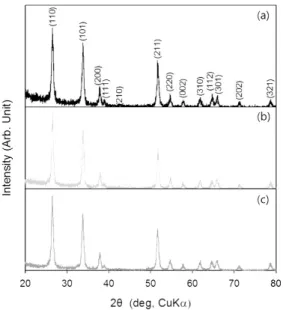
Fig. 2. X-ray diffraction(XRD) patterns of (a) undoped SnO2, (b) 0.88Sb-SnO2, and (c) 2.65Sb-SnO2nanofibers heat-treated at 600 °C for 2 h.
Fig. 3. SEM images of (a) as-spun, Sn-precursor nanofibers, (b) SnO2nanofibers heat-treated at 600 °C for 2 h, and (c) SnO2 sensor surface.
3. RESULTS AND DISCUSSION 3.1 X-ray diffraction(XRD)
The undoped SnO2nanofibers after heat treatment at 600
。C for 2 h were identified as having a rutile structure
(JCPDS # 77-0447) (Fig. 2a). The 0.88Sb-SnO2 and 2.65Sb-SnO2nanofibers showed similar XRD patterns (Fig. 2b and 2c). The Sb-related phases such as Sb, Sb2O5, and Sb2O3 were not found in the XRD patterns, which indicates that Sb is incorporated into the SnO2lattice.
3.2 SEM and TEM analysis
The as-spun Sn-precursor nanofibers showed clean surface morphology(Fig. 3a) with a diameter ranging from 200 to 300 nm and a length of several tens of micrometers.
The undoped SnO2nanofibers after heat treatment at 600 。 C for 2 h showed rougher surface morphology(Fig. 3b).
This morphology can be explained by the burn-out of organic content in the Sn-precursor nanofibers. The SnO2 nanofibers were uniformly coated on the surface of the substrates with electrodes(Fig. 3c). The morphologies of the Sb-doped Sn-precursor nanofibers and Sb-doped SnO2 nanofibers were similar to Fig. 3a and 3b, respectively(data not shown).
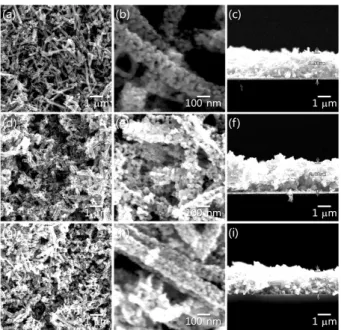
High magnification images of the sensor surfaces are shown in Fig. 4. All the undoped and Sb-doped SnO2 nanofibers on the sensor surface were several micrometers long(Fig. 3a,d,g). This is significantly shorter than the length of the as-spun precursor nanofibers and the heat-treated SnO2nanofibers(several tens micrometers, for example, as shown in the SEM images in Fig. 3a and 3b), which can be explained by the breaking of the nanofibers during their ultrasonic dispersion. All the nanofibers consisted of small primary particles(Fig. 4b,e,h). The thicknesses of the sensor films determined from the cross-sectional images were
~1.98, 2.01, and 1.72 μm for the undoped SnO2, 0.88Sb- SnO2and 2.65Sb-SnO2nanofibers, respectively(Fig. 4c,f,i).
The TEM images of all the specimens showed a bright contrast in the core region(Fig. 5). This indicates the hollow morphology of the undoped SnO2, 0.88Sb-SnO2 and 2.65Sb-SnO2nanofibers, which facilitated the diffusion of analyte gases toward the entire sensor surface. In general, hollow nanofibers have been prepared by coaxial two- capillary electrospinning of two immiscible liquids[14,15].
In this study, however, the hollow nanofibers were prepared by single capillary design, which offers the advantage of simplifying the fabrication process. The size of the primary particles within the oxide nanofibers ranged from 20 to 50 nm.
Fig. 4. SEM images of sensor surface: (a-c) undoped SnO2, (d-f) 0.88Sb-SnO2, and (g-i) 2.65Sb-SnO2nanofibers heat-treated at 600 °C for 2 h.
Fig. 5. TEM images of(a), (b) undoped SnO2, (c), (d) 0.88Sb-SnO2, and (e), (f) 2.65Sb-SnO2nanofibers heat-treated at 600 °C for 2 h.
3.3 Gas sensing characteristics
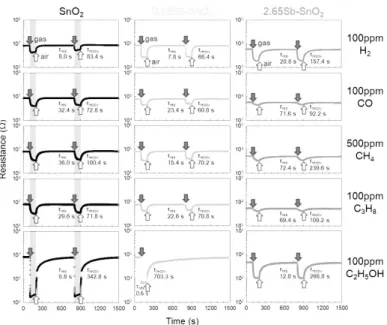
The sensing transients to 100 ppm H2, 100 ppm CO, 500 ppm CH4, 100 ppm C3H8, and 100 ppm C2H5OH at 400 。 C are shown in Fig. 6. The sensor showed typical n-type semiconductor characteristics, i.e., the resistance was decreased by exposure to the reducing gases. The Ravalue of ~ 9×10⁶ Ω in the undoped SnO2nanofiber sensor(Fig.
6a) was decreased to ~ 8×10⁴ Ω by doping with 0.88 wt%
Sb(Fig. 6b), and was decreased further to 5×10³ Ω by doping with 2.56 wt% Sb(Fig. 6c). Babar et al.[16]
prepared Sb-doped SnO2thin films by spray pyrolysis of the solution containing SnCl4 and SbCl3at 475 。C and observed that the resistivity of the thin film was decreased as the Sb doping concentration was increased. The XPS analysis results confirmed the dominance of Sb5+over Sb3+
and attributed the decrease of resistivity to the increase of
electron concentration by the incorporation of Sb5+ions into Sn4+ sites. Accordingly, the Sb in this study was thought to exist in the form of Sb5+rather than Sb3+and Sb5+ can decrease the resistance by the following reaction[17-19].
The times to reach 90 % variation in resistance upon exposures to gas and air are defined as the 90 % response time(τres) and 90 % recovery time(τrecov), respectively. The τresvalues were relatively short(0.6 ~ 72.4 s) while the τ
recovvalues were long(60.8 ~ 703 s). The short response kinetics implies that the in-diffusion of analyte gas and its oxidation with negatively charged surface oxygen occurred rapidly. Such rapid gas diffusion can also be applied to the in-diffusion of oxygen in the recovery reaction. Thus, the slow recovery suggests that the serial surface reactions
Fig. 6. Dynamic gas sensing transients at 400 °C.
Fig. 7. Gas responses to 100 ppm H2, 100 ppm CO, 500 ppm CH4, 100 ppm C3H8and 100 ppm C2H5OH of the sensors according to the variation of Sb-doping concentrations: (a) undoped SnO2, (b) 0.88Sb-SnO2, and (c) 2.65Sb-SnO2nanofibers(sensor temperature = 400 °C).
Sb2Ο5 2SnΟ2 Sbsn + 4Ο0+ Ο2 + 2e- (1)
(a) (b) (c)
such as adsorption, dissociation, and ionization of oxygen are sluggish.
The responses to 100 ppm H2, 100 ppm CO, 500 ppm CH4, 100 ppm C3H8, and 100 ppm C2H5OH at 400 。C are shown as polar plots in Fig. 7. The gas responses were closely dependent upon the Sb doping. As shown in Fig. 7a, the response to 100 ppm C2H5OH was very high(33.9) while that to other gases ranged from 1.6 to 2.2. This indicates that C2H5OH can be detected in a selective manner using the undoped SnO2nanofibers. By doping with 0.88 wt% Sb, the response to 100 ppm C2H5OH was decreased to 11.2, whereas that to H2was approximately doubled(3.1). The response to 100 ppm C2H5OH was further decreased to 4.5 by doping with 2.56 wt% Sb, whereas the response to H2 remained similar(3.0). Thus, increasing Sb doping concentration facilitates the detection of a high H2 concentration(for example > 200 ppm) with minimum interference from C2H5OH. Moreover, the different sensing pattern to various gases can be used in artificial olfaction for the recognition and quantization of gases.
3.4 Discussion
The sensing of C2H5OH is closely dependent upon the acid-base properties of the sensing materials[20,21].
C2H5OH(g) → CH3CHO(g) + H2(g) (for basic oxide) (2) C2H5OH(g) → C2H4(g) + H2O(g) (for acidic oxide) (3)
For the oxidation reaction, CH3CHO + H2consumes more surface oxygens with negative charge than C2H4 + H2O. Moreover, the oxidization of chemically stable C2H4 into CO2and H2O is difficult. Thus, the addition of basic oxides such as La2O3, Sm2O3 and Gd2O3is known to enhance the response to C2H5OH significantly[20,22]. The greater electronegativity of Sb(2.05) than that of Sn (1.96) means that Sb is more acidic. Therefore, the decrease of response to C2H5OH by Sb doping can be explained by the promotion of reaction (3) rather than reaction (2).
Zima et al.[23] reported that the doping of SnO2with Sb significantly enhances the response to H2, which is consistent with the present results. This again suggests that the H2sensing reaction is promoted by the catalytic activity of Sb. This is feasible considering that Sb is one of the important catalytic materials for the oxidation reaction[24, 25]. Thus, Sb doping can be used as an effective additive to enhance the response to H2while suppressing the response to C2H5OH.
4. CONCLUSION
Undoped and Sb-doped SnO2nanofibers were prepared by electrospinning and their sensing characteristics to H2, CO, CH4, C3H8 and C2H5OH were investigated. The undoped SnO2 nanofibers demonstrated the selective detection of C2H5OH. As the Sb doping concentration was increased to 2.65 wt%, the response to C2H5OH was decreased significantly while the response to H2was enhanced. The effect of Sb doping concentration on the selectivity was explained by the acid-base properties and catalytic function of Sb.
ACKNOWLEDGMENTS
This work was supported by Fundamental R&D program for Core Technology of Materials (M2008 010013) funded by the Ministry of Knowledge Economy.
REFERENCES
[1] N. Yamazoe, G. Sakai, and K. Shimanoe, “Oxide semiconductor gas sensors”, Catal. Surv. Asia, vol. 7, pp. 63-75, 2003.
[2] N. Yamazoe, “ New approaches for improving semiconductor gas sensors”, Sens. Actuators, B, vol. 5, pp. 7-19, 1991.
[3] G. Korotcenkov, “Gas response control through structural and chemical modification of metal oxide films: state of the art and approaches”, Sens. Actuators, B, vol. 107, pp. 209-232, 2005.
[4] D. E. Williams and K. F. E. Pratt, “Microstructure effects on the response of gas-sensitive resistors based on semiconducting oxides”, Sens. Actuators, B, vol. 70, pp. 214-221, 2000.
[5] A. Greiner and J. H. Wendorff, “Electrospinning : a fascinating method for the preparation of ultrathin fibers”, Angew. Chem. Int. Ed., vol. 46, pp. 5670-5703, 2007.
[6] D. Li and Y. Xia, “Electrospinning of nanofibers:
reinventing the wheel”, Adv. Mater., vol. 16, pp. 1151- 1170, 2004.
[7] D. H. Reneker and I.-S. Chun, “Nanometre diameter fibers of polymer, produced by electrospinning”, Nanotechnology, vol. 7, pp. 216-223, 1996.
[8] W. E. Teo and S. Ramakrishna, “A review on
electrospinning design and nanofibre assemblies”, Nanotechnology, vol. 17, pp. R89-R106, 2006.
[9] Y. Zhang, X. He, J. Li, Z. Miao and F. Huang,
“Fabrication and ethanol-sensing properties of micro gas sensor based on electrospun SnO2 nanofibers”, Sens. Actuators, B, vol. 132, pp. 67-73, 2008.
[10] I.-D. Kim, A. Rothschild, B. H. Lee, D. Y. Kim, S. M.
Jo and H. L. Tuller, “Ultrasensitive chemiresistors based on electrospun TiO2nanofibers”, Nano Lett., vol. 6, pp. 2009-2013, 2006.
[11] Z. Zhang, X. Li, C. Wang, L. Wei, Y. Liu, and C.
Shao, “ZnO hollow nanofibers: fabrication from facile single capillary electrospinning and applications in gas sensors”, J. Phys. Chem. C, vol. 113, pp. 19397- 19403, 2009.
[12] W. Zheng, X. Lu, W. Wang, Z. Li, H. Zhang, Y.
Wang, Z. Wang, and C. Wang, “A highly sensitive and fast-responding sensor based on electrospun In2O3 nanofibers”, Sens. Actuators, B, vol. 142, pp. 61-65, 2009.
[13] G. Wang, Y. Ji, X. Huang, X. Yang, P. Gouma, and M. Dudley, “Fabrication and characterization of polycrystalline WO3nanofibers and their application for ammonia sensing”, J. Phys. Chem. B, vol. 110, pp.
23777-23782, 2006.
[14] D. Li, Y. Xia, “Direct fabrication of composite and ceramic hollow nanofibers by electrospinning”, Nano Lett., vol. 4, pp. 933-938, 2004.
[15] D. Li and J. T. McCann, and Y. Xia, “Use of electrospinning to directly fabricate hollow nanofibers with functionalized inner and outer surfaces”, Small, vol. 1, pp. 83-86, 2005.
[16] A. R. Babar, S. S. Shinde, A. V. Moholkar, C. H.
Bhosale, J. H. Kim, and K. Y. Rajpure, “Structural and optoelectronic properties of antimony incorporated tin oxide thin films”, J. Alloys and Compd., vol. 505, pp. 416-422, 2010.
[17] V. Dusastre and D. E. Williams, “Sb(III) as a surface site for water adsorption on Sb(Sb)O2, and its effect on catalytic activity and sensor behavior”, J. Phys. Chem.
B, vol. 102, pp. 6732-6737, 1998.
[18] Q. Wan and T. H. Wang, “Single-crystalline Sb- doped SnO2nanowires: synthesis and gas sensor application”, Chem. Comm., pp. 3841-3843, 2005.
[19] A. A. Zhukova, M. N. Rumyantseva, A. M.
Abakumov, J. Arbiol, L. Calvo, and A. M. Gaskov,
“Influence of antimony doping on structure and conductivity of tin oxide whiskers”, Thin Solid Films, vol. 518, pp. 1359-1362, 2009.
[20] T. Jinkawa, G. Sakai, J. Tamaki, N. Miura, and N.
Yamazoe, “Relationshio between ethanol gas sensitivity and surface catalytic property of tin oxide sensors modified with acidic or basic oxides”, J. Mol.
Catal. A: Chem., vol. 155, pp. 193-200, 2000.
[21] S.-J. Kim, P.-S. Cho, J.-H. Lee, C.-Y. Kang, J.-S.
Kim, and S.-J. Yoon, “ Preparation of multi- compositional gas sensing films by combinatorial solution deposition”, Ceram. Int., vol. 34, pp. 827- 831, 2008.
[22] T. Maekawa, J. Tamaki, N. Miura, and N. Yamazoe,
“Development of SnO2-based ethanol gas sensor”, Sens. Actuators, B, vol. 9, pp. 63-69, 1992.
[23] A. Zima, A. Kock, and T. Maier, “In- and Sb-doped tin oxide nanocrystalline films for selective gas sensing”, Microelectron. Eng., vol. 87, pp. 1467-1470, 2010.
[24] J.-H. Moon, J.-A. Park, S.-J. Lee, T.-H. Zyung, and I.- D. Kim, “Pd-doped TiO2nanofiber networks for gas sensor applications”, Sens. Actuators, B, vol. 149, pp.
301-305, 2010.
[25] L. Liu, C. Guo, S. Li, L. Wang, Q. Dong, and W. Li,
“Improved H2 sensing properties of Co-doped SnO2 nanofibers”, Sens. Actuators, B, in press, 2010.
Joong-Ki Choistudied materials science and engineering and received his BS degree from Korea University in 2009.
He is currently a master course student at Korea University. His research topic is oxide nanofiber gas sensors.
In-Sung Hwangstudied materials science and engineering and received his B.S. from Kumoh National University, Korea, in 2004. In 2006, he received his M.S. degree from Korea University. He is currently studying for a Ph.D. at Korea University. His research interest is oxide nanostructure based electronic devices.
Sun-Jung Kim studied Materials Science and Engineering and received his BS and MS degrees in 2006 and 2008, respectively, at Korea University in Korea. He is currently studying for PhD degree at Korea University. His research interests are oxide nanostructures for chemical sensor applications and the combinatorial design of gas sensing materials.
Joon-Shik Park received his BS, MS, and PhD degrees in Materials Science and Engineering from Hanyang University, Seoul, Korea in 1992, 1994, and 2004, respectively. Since 1994, he has been doing research in the Korea Electronic Technology Institute (KETI).
Currently, he is a principal researcher at the Environmental Device &
Application Research Center of KETI.
His current research interests include nanowires, micro chemical and bio sensors, and MEMS standardization.
Soon-Sup Parkreceived the Ph.D.
degree in material science, from the KAIST in 1992. He is the director in the Environmental Device & Application Research Center, Korea Electronics Technology Institute (KETI). His current research interests include integrated optical bio-sensors based on a waveguide.
Ki-Young Dong received his MS degree at Korea University in 2009.
Currently, he is a Ph.D. candidate in the Department of Electrical Engineering, Korea University. His current research interests include micro-nano electrome- chanical systems (M-NEMS) and patterning techniques for nano-devices.
Byeong-Kwon Jureceived the Ph.D. in semiconductor engineering from Korea University in 1995. From 1988, he joined the Korea Institute of Science and Technology (KIST), Seoul, where he was engaged in development of mainly flat panel display and MEMS technology as a principal research scientist. In 1996, he spent 6 months as a visiting research fellow at Microele-ctronics Centre, University of South Australia, Australia.
Since 2005, he has been a associate professor of Dept. EE of Korea University with his main interest in flexible electronics (OLED, OTFT), field emission devices, Si-microma- chining and carbon nanotube-based nano systems. And also he is a program direc- tor of National Research Lab.(Display and Nanosystem Lab.) supported by Korean government. Prof. Ju is a member of Society for Information Display(SID), Korea Institute of Electri- cal Engineering (KIEE), and Korea Sensor Society.
Jong-Heun Leejoined the Department of Materials Science and Engineering at Korea University as an associate professor in 2003, where he is currently professor. He received his B.S., M.S., and Ph.D. degrees from Seoul National University in 1987, 1989, and 1993, respectively. Between 1993 and 1999, he developed automotive air-fuel-ratio sensors at the Samsung Advanced Institute of Technology. He was a Science and Technology Agency (STA) of Japan fellow at the National Institute for Research in Inorganic Materials (currently NIMS, Japan) from 1999 to 2000 and a research professor at Seoul National University from 2000 to 2003.
His current research interests include chemical sensors, functional nanostruc- tures, and solid oxide electrolytes.