Trends in the Use of Chemotherapy before and after Radical Cystectomy in Patients with Muscle-invasive Bladder Cancer in Korea
We investigated trends in perioperative chemotherapy use, and determined factors associated with neoadjuvant chemotherapy (NAC) and adjuvant chemotherapy (AC) use in Korean patients with muscle- invasive bladder cancer (MIBC). We recruited 1,324 patients who had MIBC without nodal invasion or metastases and had undergone radical
cystectomies (RC) between 2003 and 2013. The study’s cut-off time for AC was three months after surgery, and the study’s timespan was divided into three periods based on NAC use, namely, 2003-2005, 2006-2009, and 2010-2013. Complete remission was defined as histologically confirmed T0N0M0 after RC. NAC and AC were administered to 7.3% and 18.1% of the patients, respectively. The median time interval between
completing NAC and undergoing RC was 32 days and the mean number of cycles was 3.2.
The median time interval between RC and AC was 43 days and the mean number of cycles was 4.1. Gemcitabine and cisplatin were most frequently used in combination for NAC (49.0%) and AC (74.9%). NAC use increased significantly from 4.6% between 2003 and 2005 to 8.4% between 2010 and 2013 (P < 0.05), but AC use did not increase. Only 1.9%
of patients received NAC and AC. Complete remission after NAC was achieved in 12 patients (12.5%). Multivariable modeling revealed that an advanced age, the earliest time period analyzed, and clinical tumor stage ≤ cT2 bladder cancer were negatively associated with NAC use (P < 0.05). While NAC use has slowly increased over time, it remains an underutilized therapeutic approach in Korean clinical practice.
Keywords: Urinary Bladder Neoplasms; Neoadjuvant Therapy; Adjuvant; Chemotherapy;
Cystectomy Sung Han Kim,1,* Ho Kyung Seo,1,*
Hee Chul Shin,1 Sung Ja Chang,1 Sooin Yun,2 Jungnam Joo,2 Ja Hyeon Ku,3 Hyung Suk Kim,3 Hwang Gyun Jeon,4 Byong Chang Jeong,4 In Gab Jeong,5 Seok Ho Kang,5 Bumsik Hong,6 and UCART (urothelial cancer-advanced research and treatment group in Korea) group
1Department of Urology and 2Biometric Research Branch, National Cancer Center, Goyang;
3Department of Urology, Seoul National University Hospital, Seoul; 4Department of Urology, Samsung Medical Center, Sungkyunkwan University School of Medicine, Seoul; 5Department of Urology, Korea University Medical Center, Seoul; 6Department of Urology, Asan Medical Center, Seoul, Korea
* Sung Han Kim and Ho Kyung Seo contributed equally to this work.
Received: 31 December 2014 Accepted: 17 April 2015 Address for Correspondence:
Bumsik Hong, MD
Department of Urology, Asan Medical Center, 88 Olympic-ro 43 gil, Songpa-gu, Seoul 138-736, Korea
Tel: +82.2-720-1684, Fax: +82.2-720-3728 E-mail: [email protected]
Funding: This research was supported in part by the Korean Urologic Oncology Society Grant 14-04.
http://dx.doi.org/10.3346/jkms.2015.30.8.1150 • J Korean Med Sci 2015; 30: 1150-1156
INTRODUCTION
Reports from annual surveys of bladder cancer (BC) estimate that about 380,000 patients worldwide are newly diagnosed with BC each year, and that there are about 150,000 BC-related deaths each year, which verifies that BC is one of the top 10 cancers worldwide (1, 2). Between 25% and 30% of newly diagnosed patients have muscle invasive BC (MIBC) (3, 4), and the stan- dard treatment for MIBC is radical cystectomy (RC) with uri- nary diversion and lymph node (LN) dissection (5).
Despite improvements in surgical and medical treatments, the five-year overall survival rates for organ-confined LN-nega- tive disease (pathologic tumor stage > pT2), extravesical disease, and LN metastasis after RC are estimated at 80%, 40%-50%, and
15%-35%, respectively; hence, the five-year overall survival rates have barely improved. These poor survival rates for MIBC are thought to be associated with understaging accompanied by micrometastasis at the time of RC, because postoperative dis- tant recurrences occur more frequently than postoperative lo- cal recurrences (20%-50% vs. 5%-15% of cases). These findings suggest that perioperative systemic therapy has the potential to improve survival outcomes for those patients with understaged BC accompanied by micrometastasis (6).
In 2003, the Southwest Oncology Group (SWOG)-8710 ran- domized controlled trial demonstrated improved survival and pathologic down-staging in association with the use of neoad- juvant chemotherapy (NAC) administered before RC in patients with MIBC (7), and the results from subsequent meta-analyses Urology
have also suggested significant benefits associated with NAC (8, 9). However, the adoption of NAC for MIBC has been slow and inconsistent among oncologists, and only 1%-12% of MIBC pa- tients receive NAC (6, 7, 10-13). Several explanations have been proposed for the slow uptake of the use of NAC for MIBC, inclu- ding the significant toxicities of the chemotherapeutic agents, the higher proportions of older MIBC patients with multiple comorbidities, poor renal function, and poor performance sta- tuses. Additionally, the slow uptake of the use of NAC for MIBC may be associated with patients being from lower social strata, for example, those from minority races, those on lower incomes, those without insurance, and patients who were treated at low- volume hospital centers.
In Korea, BC has been ranked the eleventh most common cancer and the ninth most common cancer affecting men (14).
However, there is no information available about perioperative chemotherapy in Korean patients with MIBC who have under- gone RC, and no reports have been published that describe the use of NAC before RC for MIBC in Korea. Therefore, this study used data from 2003 to 2013 that was retrieved from the cancer registries at five tertiary centers in Korea to investigate trends in the use of perioperative chemotherapy before and after RC, to search for general information about perioperative chemother- apy, including NAC, and to determine the reasons underlying the low utilization of NAC in Korean patients with MIBC.
MATERIALS AND METHODS
A total of 1,324 patients with clinical tumor stage ≥ T2 (cT2-4a N0M0) BC who underwent RC at the five participating Korean tertiary institutions between 2003 and 2013 were retrospective- ly recruited for this study after data-sharing agreements were approved. Based on information retrieved from the National Health Insurance Cooperation database, the enrolled patients comprised 39.4% (1,259/3,163) of the total number of patients who underwent RC in Korea during the time period investigat- ed in this study, which included patients who did not have MIBC.
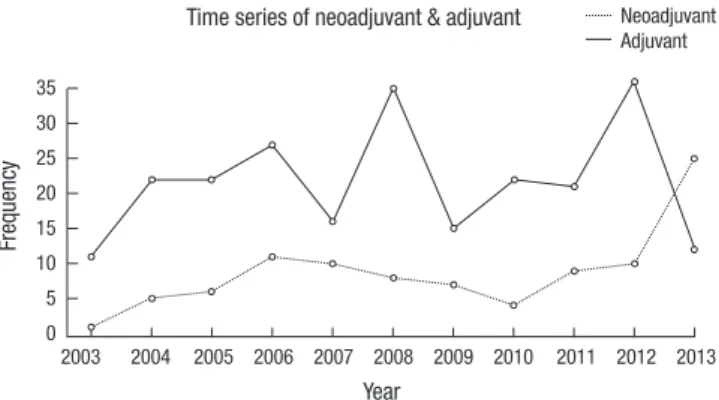
In addition to the patients’ clinicopathologic data, we gath- ered information about the chemotherapeutic agents used, the number of chemotherapy cycles undertaken, and the time in- tervals between chemotherapy and RC. The study’s cut-off time for AC was three months after surgery, and the study’s time frame was divided into three time periods, namely, 2003-2005, 2006- 2009, and 2010-2013, to ensure there was a delineation between 2006 and 2010, and to capture information relating to signifi- cantly different rates of NAC use (P < 0.05) (Fig. 1).
All of the patients with bladder masses underwent diagnostic transurethral resections of the bladder (TURB) to confirm the presence of MIBC, and those who did not have sufficient tissue to confirm the presence of MIBC underwent diagnostic TURB repeatedly during the course of 1 week. Patients with pure uro-
thelial cell carcinomas or with BC of mixed histologic profiles involving squamous cell and/or glandular differentiation were included in this analysis. Patients with any other histologic vari- ants were excluded from the analysis. Other exclusion criteria included non-MIBC, any MIBC with clinical LN positivity and/
or distant metastases, and non-urothelial cell carcinomas, pa- tients who had undergone salvage and palliative cystectomies, and those with no medical follow-up data after RC. A patholog- ic complete response following NAC was defined as pT0N0M0 without any visible cancer cells in RC specimens. Hospital pa- thologists from each institution assessed the specimens histo- pathologically using the World Health Organization’s grading system (15) and the American Joint Committee on Cancer tu- mor-node-metastasis cancer staging system (16).
Statistical analysis
The clinical characteristics of the patients were analyzed with the patients grouped as “All patients”, “RC only patients”, “NAC and RC patients”, and “RC and AC patients”, and the data were express- ed as numbers and percentages (Table 1). The Chi-squar ed test and Fisher’s exact test were used to compare the clinical charac- teristics of the patients who received NAC with those who did not receive NAC, and to compare the clinical characteristics of the patients who received AC with those who did not receive AC.
Multivariable analysis was performed to examine chrono- logical changes in NAC and AC after adjusting for all of the clin- ical characteristics listed in Table 1. All of the variables described in Table 1 were included in the multivariable logistic regression model, and their odds ratios and P values were calculated. In addition, backward selection at a significance level of 0.05 was performed using all of the variables within the multivariable model (Table 2) until no variables with P values > 0.05 existed.
Table 3 shows the variables with P values < 0.05 in the multi- variable logistic model. All of the statistical analyses were per- formed using Stata software version 11.1 (StataCorp, College Station, TX, USA). All P values were two-sided, and P values
< 0.05 were considered statistically significant.
Fig. 1. Changes in neoadjuvant chemotherapy and adjuvant chemotherapy in patients with muscle invasive bladder cancer between 2003 and 2013.
Frequency
Year
2003 2004 2005 2006 2007 2008 2009 2010 2011 2012 2013 35
30 25 20 15 10 5 0
Time series of neoadjuvant & adjuvant Neoadjuvant Adjuvant
Ethics statement
This study was approved by the ethics committees and the in- stitutional review boards at each hospital (IRB No. NCC- 2014- 0117) that participated in the study, and the requirement for the patients to provide consent was waived.
RESULTS
Table 1 presents the patients’ demographic and clinicopatho- logic data. The mean ± standard deviation (SD) age of the study population was 64.4 ± 10.0 yr, and the study population com- prised 1,141 (86.2%) men and 183 (13.8%) women with BC. With- in the study population, 7.3% (96/1,324) received NAC and 18.1%
(239/1,324) received AC.
The utilization of NAC increased significantly from 4.6% be- tween 2003 and 2005 to 8.4% between 2010 and 2013 (P = 0.019).
The utilization of AC did not show any significant changes, with decreases from 20.8% to 16.0% during the three study periods (Fig. 1). The median time interval between completing NAC and undergoing RC was 32 days (range, 9-369 days), and the mean (± SD) number of NAC cycles was 3.2 (±1.8) cycles. The
median time interval between AC and RC was 43 days (range, 7-100 days), and the mean (± SD) number of AC cycles was 4.1 (±1.7) cycles. The most frequently used combination of NAC and AC agents was gemcitabine and cisplatin, which was used in 49.0% of NAC and 74.9% of AC recipients, followed by a com- bination of gemcitabine and carboplatin, which was used in 20.8% of NAC and 14.2% of AC recipients (data not shown). Of the 96 patients who received NAC, five patients delayed under- going RC by more than three months after completing their NAC treatment, and, of these, three patients were apprehensive about undergoing RC, one patient developed sepsis, and one patient had irregular follow-up assessments. Twelve patients (12.5%) achieved complete remission after NAC.
The multivariable analysis, which evaluated the use of peri- operative chemotherapy, showed that particular variables in the NAC model, including age (P = 0.002), the study period an- alyzed (P = 0.019), the institution (P < 0.001), and the clinical tumor stage (P = 0.007), and that particular variables in the AC model, including age (P < 0.001), the institution (P < 0.001), the pathologic tumor stage (P < 0.001), and the presence of any LN metastases (P < 0.001), were significantly associated with the Table 1. Analysis of patient characteristics
Characteristics All patients, n (%) RC only, n (%) NAC and RC, n (%) P value* RC and AC, n (%) P value†
No. subjects 1,324 (100) 1,014 (76.59) 96 (7.25) 239 (18.05)
Age -49 50-59 60-69 70-
116 (8.76) 269 (20.32) 491 (37.08) 448 (33.84)
81 (69.83) 195 (72.49) 374 (76.17) 364 (81.25)
11 (9.48) 29 (10.78) 29 (5.91) 27 (6.03)
0.043
26 (22.41) 55 (20.45) 92 (18.74) 66 (14.73)
0.110
Gender Male Female
1141 (86.18) 183 (13.82)
874 (76.6) 140 (76.5)
78 (6.84) 18 (9.84)
0.146
209 (18.32) 30 (16.39)
0.530
Study period 2003-2005 2006-2009 2010-2013
264 (19.94) 491 (37.08) 569 (42.98)
199 (75.38) 377 (76.78) 438 (76.98)
12 (4.55) 36 (7.33) 48 (8.44)
0.131
55 (20.83) 93 (18.94) 91 (15.99)
0.195
Name of hospital NCC SMC AMC SNUH KUMC
101 (7.63) 386 (29.15) 492 (37.16) 295 (22.28) 50 (3.78)
41 (40.59) 346 (89.64) 384 (78.05) 204 (69.15)
39 (78)
23 (22.77) 9 (2.33) 30 (6.1) 29 (9.83)
5 (10)
< 0.001
53 (52.48) 32 (8.29) 81 (16.46) 67 (22.71)
6 (12)
< 0.001
Clinical stage ≤ cT2
≥ cT3 722 (54.53)
602 (45.47) 575 (79.64)
439 (72.92) 49 (6.79) 47 (7.81)
0.476
113 (15.65) 126 (20.93)
0.013
Pathologic stage ≤ pT2 ≥ pT3
630 (47.58) 694 (52.42)
550 (87.3) 464 (66.86)
47 (7.46) 49 (7.06)
0.779
38 (6.03) 201 (28.96)
< 0.001
pNstage§ Node positive Node negative
376 (29.40) 917 (69.26)
211 (56.12) 777 (84.73)
39 (10.37) 54 (5.89)
0.005
141 (37.5) 95 (10.36)
< 0.001
Type of urinary diversion Ileal conduit Orthotopic neobladder Others
800 (60.42) 510 (38.52) 14 (1.06)
615 (76.88) 386 (75.69) 13 (92.86)
59 (7.38) 36 (7.06) 1 (7.14)
0.967‡
143 (17.88) 96 (18.82) 0 (0.00)
0.192‡
*P value of Chi-square test for NAC and RC group; †P value of Chi-square test for RC and AC group; ‡Fisher's exact test; §Missing 31 (pNstage = Nx). NCC, National Cancer Center; SNUH, Seoul National University Hospital; SMC, Samsung Medical Center; AMC, Asan Medical Center; KUMC, Korean University Medical Center.
use of perioperative chemotherapy (Tables 2 and 3). However, sex (P = 0.064), the study period analyzed (P = 0.853), and the type of urinary diversion (P = 0.089) used were not significantly associated with the use of AC after RC (Table 3).
DISCUSSION
This study identified for the first time since the SWOG-8710 trial results, which were published in 2003, important trends in the use of perioperative chemotherapy, including NAC and in the use of AC after RC, in patients with MIBC in Korea. NAC use has slowly and significantly increased from 4.6% between 2003 and 2005 to 8.4% between 2010 and 2013 (P = 0.019), whereas AC use has not changed significantly, despite a decrease from 20.8% to 16.0% (P = 0.853).
This study is of further clinical significance because it is the first to demonstrate pathologic complete remission to NAC treatment in Korean MIBC patients after RC. However, some reports have suggested that the complete remission response achieved after NAC treatment might be affected by the quality
of the TURB before and, particularly, after NAC (7, 17). Herr ex- amined a population of patients with MIBC who received NAC and subsequently declined RC, and found that the complete- ness of the endoscopic resection was a factor that contributed to improve survival, which suggested a role for aggressive en- doscopic resection (7). As this study had not fully evaluated the surgical complete remission rate among the cases with patho- logic complete remission of NAC at RC specimens, it would be necessary in the future study to compare the complete remis- sion rate affected by between TURB or NAC with a repeated TURB before RC.
While none of the previously published reports have address- ed the use of NAC in patients with MIBC in Korea, investigators from four tertiary Korean hospitals have described clinical out- comes in relation to the use of AC after RC in patients with MIBC (18-21). Kwon et al. showed that of 338 cases who underwent RC, 153 (45.3%) patients with clinical stage ≥ T3 BC received AC between 1990 and 2012, and that combined therapy with gemcitabine and cisplatin was used more frequently than com- binations of methotrexate (M), vinblastine (V), Adriamycin® Table 2. Univariable analysis of covariates associated with delivery of perioperative chemotherapy
Characteristics
Neoadjuvant chemotherapy Adjuvant chemotherapy*
Proportion NC Univariate analysis
Proportion AC Univariate analysis
OR (95% CI) P value OR (95% CI) P value
No. of subjects (%) 96 (7.25) 236 (18.25)
Age -50 50-59 60-69 †70-
11 (9.5) 29 (10.8) 29 (5.9) 27 (6.0)
2.84 (1.262, 6.394) 2.977 (1.6, 5.536) 1.357 (0.756, 2.435)
0.002 0.104 0.012 0.098
26 (22.4) 55 (20.5) 92 (18.7) 66 (14.7)
3.311 (1.75, 6.266) 2.335 (1.407, 3.877) 2.168 (1.402, 3.355)
< 0.001 0.019 0.374 0.609 Gender
Male †Female
78 (6.84) 18 (9.84)
0.75 (0.417, 1.35) 0.337
0.337 209 (18.3)
30 (16.4)
1.654 (0.985, 2.777) 0.056 0.056 Study period
2003-2005 2006-2009 †2010-2013
12 (4.6) 36 (7.3) 48 (8.4)
0.39 (0.198, 0.767) 0.809 (0.505, 1.297)
0.024 0.011 0.296
55 (20.8) 93 (18.9) 91 (16.0)
1.082 (0.683, 1.713) 1.112 (0.762, 1.621)
0.853 0.905 0.709 Name of hospital
NCC SMC AMC SNUH KUMC
23 (22.8) 9 (2.3) 30 (6.1) 29 (9.8) 5 (10)
4.354 (1.471, 12.887) 0.18 (0.057, 0.572) 0.657 (0.234, 1.847) 1.172 (0.422, 3.257)
< 0.001
< 0.001
< 0.001 0.141 0.213
53 (52.5) 32 (8.3) 81 (16.5) 67 (22.7) 6 (12)
7.616 (2.656, 21.838) 0.278 (0.1, 0.77) 0.815 (0.303, 2.197) 1.557 (0.58, 4.178)
< 0.001
< 0.001
< 0.001 0.021 0.159 Clinical stage
≤ cT2
≥ cT3 49 (6.8)
47 (7.8) 1.810 (1.141, 2.872)
0.012
0.012 113 (15.7)
126 (20.9) 1.289 (0.889, 1.869)
0.181 0.181 Pathologic stage
†≤ pT2 ≥ pT3
38 (6.0)
201 (29.0) 5.650 (3.679, 8.678)
< 0.001
< 0.001 pNstage
Node positive †Node negative
141 (37.5) 95 (10.4)
4.299 (3.028, 6.102) < 0.001
< 0.001 Type of urinary diversion
Ileal conduit & others †Orthotopic neobladder
60 (14.5) 36 (7.1)
1.098 (0.65, 1.856) 0.726
0.726 143 (17.9)
96 (18.8)
0.704 (0.472, 1.05) 0.085 0.085
*Missing 31 (pNstage = Nx); †Bold font, rereference variable. NCC, National Cancer Center; SNUH, Seoul National University Hospital; SMC, Samsung Medical Center; AMC, Asan Medical Center; KUMC, Korean University Medical Center.
(A), and cisplatin (C) (MVAC) (20). Other Korean tertiary insti- tutions have shown rates of AC use after RC of 55%-60% between 2001 and 2011, and that combinations of gemcitabine and cis- platin are mainly used because of their favorable safety and tol- erability profiles in patients with clinical stage ≥ T3 BC (18, 19, 21). These rates of AC use are much higher than the rate of AC use in the current study (18.1%) and the rates of AC use report- ed from studies in countries other than Korea (20%-38%). These differences in the AC usage rates relate to the different stages of the disease that were present when the patients were enrolled to participate in the studies, because the patients in the previ- ously reported studies included those with clinical stage > T3 BC. Therefore, no definitive reports have been published to date that have assessed perioperative chemotherapy in MIBC patients with clinical stage > T2 BC in Korea.
Since the investigators involved in the SWOG-8710 trial pub- lished their favorable results for NAC, the use of NAC has been described (6, 7). Compared with papers published since 2003 that describe rates of NAC use of between 12% and 20% in coun- tries other than Korea, the rate of NAC use in this study (7.3%) was much lower. This underutilization of NAC can be explained in the context of the Korean medical system. Firstly, the policy associated with the national health insurance system in Korea
has not supported the use of NAC in MIBC patients. This policy could be the most important reason underlying the reluctance of clinicians to use NAC in MIBC patients before RC. However, the national health insurance system covers AC use and clini- cians should use AC after RC. Secondly, given that the observed complete response rate following NAC in this study was 12.5%
after RC in MIBC patients, the complete response rate reported from the SWOG trial that reached 38% could be considered to be overestimated (7). Hence, uro-oncologists, particularly those in Korea, should expect more realistic and much lower effica- cies with NAC in routine clinical practice. However, the discrep- ancies between the complete response rates might be explain- ed by differences in the studies’ inclusion criteria and the dif- ferent chemotherapeutic regimens. Other randomized controlled trials have reported NAC response rates of between 20% and 30%, which are lower than the response rate reported from the SWOG trial (10). The low NAC response rate in the current study may be explained by differences between this study and the randomized controlled trials in relation to the enrolled patients’
disease statuses and the response rates associated with more advanced disease. Thirdly, the relatively slow adoption of NAC use might be associated with the chemotherapeutic regimen used and its related toxicities. In this study, the most frequently Table 3. Mutivariable analysis of covariates associated with delivery of perioperative chemotherapy (Backward selection at alpha = 0.10)
Neoadjuvant chemotherapy Adjuvant chemotherapy*
Characteristics Multivariate analysis
Characteristics Multivariate analysis
OR (95% CI) P value OR (95% CI) P value
No. of subject (%) 96 (7.25) 236 (18.25)
Age 0.002 Age < 0.001
-50 2.702 (1.235, 5.913) 0.114 -50 3.858 (2.087, 7.13) 0.017
50-59 2.81 (1.559, 5.064) 0.016 50-59 2.648 (1.624, 4.318) 0.362
60-69 1.321 (0.746, 2.337) 0.105 60-69 2.361 (1.542, 3.615) 0.626
†70- †70-
Study period 0.019 Gender 0.064
2003-2005 0.381 (0.194, 0.748) 0.008 Male 1.734 (1.041, 2.889) 0.064
2006-2009 0.807 (0.504, 1.292) 0.281 †Female
†2010-2013
Hospitals < 0.001 Hospitals < 0.001
NCC 4.446 (1.506, 13.12) < 0.001 NCC 7.594 (2.669, 21.61) < 0.001
SMC 0.18 (0.057, 0.57) < 0.001 SMC 0.295 (0.106, 0.82) < 0.001
AMC 0.629 (0.229, 1.732) 0.083 AMC 1 (0.377, 2.649) 0.038
SNUH 1.161 (0.419, 3.217) 0.217 SNUH 1.712 (0.64, 4.581) 0.17
KUMC KUMC
Clinical stage 0.007 Pathologic stage < 0.001
†≤ cT2 †≤ pT2
≥ cT3 1.865 (1.182, 2.943) 0.007 ≥ pT3 5.857 (3.887, 8.824) < 0.001
pNstage < 0.001
Node positive 4.17 (2.953, 5.888) < 0.001 †Node negative
Type of urinary diversion 0.089
Ileal conduit 0.709 (0.476, 1.055) 0.089
Orthotopic neobladder
*Missing 31 (pNstage = Nx); †rereference variable. NCC, National Cancer Center; SNUH, Seoul National University Hospital; SMC, Samsung Medical Center; AMC, Asan Medical Center; KUMC, Korean University Medical Center.
used NAC regimen was a combination of gemcitabine and cis- platin (48.0%), which has a more favorable toxicity profile than the MVAC treatment regimen used in the SWOG trial (7). The second most commonly used NAC regimen was gemcitabine and carboplatin (20.8%). This substitution indicated that a con- siderable portion of the patients in this study already had prob- lems in relation to renal function (data not shown).
The multivariable logistic regression analysis identified signi- ficant associations between the use of NAC and age (P = 0.002), the study period analyzed (P = 0.019), the institution (P < 0.001), and the clinical tumor stage (P = 0.007), Patients aged < 60 yr received NAC significantly more frequently than patients aged
≥ 60 yr (hazard ratio [HR], 2.81; 95% confidence Interval [CI], 1.56-5.06; P = 0.016). Furthermore, patients who were treated between 2003 and 2005 (HR, 0.38; 95% CI, 0.19-0.75; P = 0.008) and those with clinical stage T2 BC (HR, 0.54; 95% CI, 0.34-0.85;
P = 0.007) were less likely to receive NAC.
Similarly, patients aged < 50 yr (HR, 3.858; 95% CI, 2.087-7.130;
P = 0.017) and who were managed at the National Cancer Cen- ter Hospital (HR, 7.594; 95% CI, 2.669-21.610; P < 0.001), had pathologic stage ≥ T3 BC (HR, 5.857; 95% CI, 3.887-8.824; P <
0.001), and who were LN positive (HR, 4.17; 95% CI 2.953-5.888;
P < 0.001) were more likely to receive AC after RC than patients who were aged > 60 yr, were managed at the Samsung Medical Center or Asan Medical Center hospitals, had pathologic stage
≤ T2 BC, and were LN negative (P < 0.05). However, sex and the type of urinary diversion used did not significantly affect the use of AC after RC.
This study has some important limitations, which include its retrospective nature, the small number of patients that did not adequately represent all Korean BC patients, the lack of rando- mization, the lack of standardization of NAC and AC adminis- tration across the participating centers, the variability in the in- dications for NAC and AC, the different rates of NAC use among the hospitals, and the selection bias associated with the choice of chemotherapy regimen. Moreover, centralized radiologic evaluations and pathologic assessments were lacking, which represented additional potentially confounding factors. Fur- thermore, we did not assess the chemotherapeutic dose densi- ties, dose adjustments, or drug-related toxicities. In addition, using the pathologic response as a primary end point meant that those patients who received NAC but did not undergo cys- tectomies because of disease progression or changes in their performance statuses, were not assessed in relation to their outcomes. Furthermore, data relating to some risk factors that were associated with the patients’ baseline characteristics, in- cluding performance statuses, renal function, and laboratory data, were not collected. Despite these limitations, this study is the largest and the first to assess perioperative chemotherapy use in patients with MIBC and their pathologic responses to NAC, and it is representative of routine clinical experiences in
Korea as opposed to the controlled environment that exists with- in clinical trials.
We have demonstrated some of the trends in perioperative chemotherapy use in Korean patients with MIBC for the first time since 2003, and we have shown that NAC remains under- utilized despite a slow but significant increase in its use. Those patients who were aged > 60 yr, were treated between 2003 and 2009, and had BC at lower clinical stages, were less likely to be administered NAC. Further studies that analyze the different results generated by NAC and AC are recommended.
ACKNOWLEDGMENTS
We thank all of the researchers in the UCART (urothelial can- cer-advanced research and treatment) group, who gathered the data from the five Korean academic institutions, including those from the National Cancer Center, Seoul National University Hos- pital; Samsung Medical Center, Asan Medical Center, and the Korean University Medical Center.
DISCLOSURE
The authors have no conflicts of interest to disclose.
AUTHOR CONTRIBUTION
Manuscript conception and preparation: Ku JH, Kim HS, Jeon HK, Jung BC, Jeong IG, Kang SH, Hong B. Data collection and analysis: Chang SJ, Shin HC, Kim SH, Seo HK. Internal review for draft: Kim SH, Seo HK. Manuscript approval: All authors.
ORCID
BumSik Hong http://orcid.org/0000-0003-1991-1229 Ho Kyung Seo http://orcid.org/0000-0003-2601-1093 Sung han Kim http://orcid.org/0000-0002-1689-5203 Hee Chul Shin http://orcid.org/0000-0003-3144-1944 Sung Ja Chang http://orcid.org/0000-0002-2245-5159 Sooin Yun http://orcid.org/0000-0003-2691-7776 Jungnam Joo http://orcid.org/0000-0001-6961-8122 Ja Hyeon Ku http://orcid.org/0000-0002-0391-2342 Hyung Suk Kim http://orcid.org/0000-0002-3661-275X Hwang Gyun Jeon http://orcid.org/0000-0002-5613-8389 Byong Chang Jeong http://orcid.org/0000-0002-5399-2184 In Gab Jeong http://orcid.org/0000-0003-4093-832X Seok Ho Kang http://orcid.org/0000-0002-1524-5233
REFERENCES
1. Ferlay J, Shin HR, Bray F, Forman D, Mathers C, Parkin DM. Estimates of worldwide burden of cancer in 2008: GLOBOCAN 2008. Int J Cancer
2010; 127: 2893-917.
2. Chavan S, Bray F, Lortet-Tieulent J, Goodman M, Jemal A. International variations in bladder cancer incidence and mortality. Eur Urol 2014; 66:
59-73.
3. Babjuk M, Oosterlinck W, Sylvester R, Kaasinen E, Böhle A, Palou-Re- dorta J, Rouprêt M; European Association of Urology (EAU). EAU guide- lines on non-muscle-invasive urothelial carcinoma of the bladder, the 2011 update. Eur Urol 2011; 59: 997-1008.
4. Stenzl A, Cowan NC, De Santis M, Kuczyk MA, Merseburger AS, Ribal MJ, Sherif A, Witjes JA; European Association of Urology (EAU). Treat- ment of muscle-invasive and metastatic bladder cancer: update of the EAU guidelines. Eur Urol 2011; 59: 1009-18.
5. Colombel M, Heidenreich A, Martínez-Piñeiro L, Babjuk M, Korneyev I, Surcel C, Yakovlev P, Colombo R, Radziszewski P, Witjes F, et al. Periop- erative chemotherapy in muscle-invasive bladder cancer: overview and the unmet clinical need for alternative adjuvant therapy as studied in the MAGNOLIA trial. Eur Urol 2014; 65: 509-11.
6. Leow JJ, Martin-Doyle W, Fay AP, Choueiri TK, Chang SL, Bellmunt J. A systematic review and meta-analysis of adjuvant and neoadjuvant che- motherapy for upper tract urothelial carcinoma. Eur Urol 2014; 66: 529- 41.
7. Grossman HB, Natale RB, Tangen CM, Speights VO, Vogelzang NJ, Trump DL, deVere White RW, Sarosdy MF, Wood DP Jr, Raghavan D, et al. Neo- adjuvant chemotherapy plus cystectomy compared with cystectomy alone for locally advanced bladder cancer. N Engl J Med 2003; 349: 859-66.
8. Advanced Bladder Cancer Overview Collaboration. Neoadjuvant che- motherapy for invasive bladder cancer. Cochrane Database Syst Rev 2005:
CD005246.
9. Advanced Bladder Cancer Meta-analysis Collaboration. Neoadjuvant chemotherapy in invasive bladder cancer: a systematic review and me- ta-analysis. Lancet 2003; 361: 1927-34.
10. Zargar H, Espiritu PN, Fairey AS, Mertens LS, Dinney CP, Mir MC, Krab- be LM, Cookson MS, Jacobsen NE, Gandhi NM, et al. Multicenter assess- ment of neoadjuvant chemotherapy for muscle-invasive bladder cancer.
Eur Urol 2015; 67: 241-9.
11. Johnson DC, Nielsen ME, Matthews J, Woods ME, Wallen EM, Pruthi RS, Milowsky MI, Smith AB. Neoadjuvant chemotherapy for bladder cancer does not increase risk of perioperative morbidity. BJU Int 2014;
114: 221-8.
12. Booth CM, Siemens DR, Li G, Peng Y, Tannock IF, Kong W, Berman DM, Mackillop WJ. Perioperative chemotherapy for muscle-invasive bladder cancer: A population-based outcomes study. Cancer 2014; 120: 1630-8.
13. Goebell PJ, Otto T, Rübben H. Perioperative chemotherapy in advanced bladder cancer: part I. Neoadjuvant treatment. Onkologie 2003; 26: 361-5.
14. Jung KW, Won YJ, Kong HJ, Oh CM, Lee DH, Lee JS. Prediction of cancer incidence and mortality in Korea, 2014. Cancer Res Treat 2014; 46: 124- 30.
15. Montironi R, Lopez-Beltran A. The 2004 WHO classification of bladder tumors: a summary and commentary. Int J Surg Pathol 2005; 13: 143-53.
16. Edge SB, Compton CC. The American Joint Committee on Cancer: the 7th edition of the AJCC cancer staging manual and the future of TNM.
Ann Surg Oncol 2010; 17: 1471-4.
17. Lavery HJ, Stensland KD, Niegisch G, Albers P, Droller MJ. Pathological T0 following radical cystectomy with or without neoadjuvant chemo- therapy: a useful surrogate. J Urol 2014; 191: 898-906.
18. Park J, Park S, Song C, Doo C, Cho YM, Ahn H, Kim CS. Effectiveness of adjuvant chemotherapy in transitional cell carcinoma of the urinary bladder with lymph node involvement and/or lymphovascular invasion treated by radical cystectomy. Urology 2007; 70: 257-62.
19. Cheon J, Chung H, Song J. Efficacy of bladder-preserving therapy for pa- tients with t3b, t4a, and t4b transitional cell carcinoma of the bladder.
Korean J Urol 2010; 51: 525-30.
20. Kwon T, Jeong IG, Lee J, Lee C, You D, Hong B, Hong JH, Ahn H, Kim CS. Adjuvant chemotherapy after radical cystectomy for bladder cancer:
a comparative study using inverse-probability-of-treatment weighting. J Cancer Res Clin Oncol 2015; 141: 169-76.
21. Sung JY, Sun JM, Chang Jeong B, Il Seo S, Soo Jeon S, Moo Lee H, Yong Choi H, Young Kang S, Choi YL, Young Kwon G. FGFR3 overexpression is prognostic of adverse outcome for muscle-invasive bladder carcinoma treated with adjuvant chemotherapy. Urol Oncol 2014; 32: 49.e23-31.