Korean J Hepatobiliary Pancreat Surg 2014;18:38-41
http://dx.doi.org/10.14701/kjhbps.2014.18.1.38
Case Report
Systemic capillary leak syndrome (Clarkson’s disease) during elective pylorus-preserving pancreaticoduodenectomy: case report
Kun Moo Choi1, Cheon Soo Park1, and Mi Hye Kim2
Departments of 1Surgery and 2Internal Medicine, Gangneung Asan Hospital, University of Ulsan College of Medicine, Gangneung, Korea
Systemic capillary leak syndrome (SCLS), also called Clarkson’s disease is rare and life-threatening disorder of un- known etiology, which is a characteristic triad of hypovolemic shock, hemoconcentration, and hypoalbuminemia. Unex- plained capillary leakage from the intravascular to the interstitial space, which has been estimated up to 70% of the intravascular volume, is the proposed mechanism. Because the pathogenesis is unknown, it is diagnosed clinically after exclusion of other diseases that cause systemic capillary leak and no efficacious pharmacological treatment has been clearly established. The mortality rate ranges from 30% to 76%. In Korea, four cases of SCLS (5 cases in adult and 1 case in child) were reported by 2012. We describe a case of severe SCLS that suddenly occurred and rapidly progressed during pylorus preserving pancreaticoduodenectomy and review the literature. (Korean J Hepatobiliary Pancreat Surg 2014;18:38-41)
Key Words: Systemic capillary leak syndrome; Hemoconcentration; Hypoalbuminemia
Received: November 17, 2013; Revised: December 10, 2013; Accepted: December 23, 2013 Corresponding author: Kun Moo Choi
Department of Surgery, Gangneung Asan Hospital, Bangdong-gil 38, Sacheon-myeon, Gangneung 210-711, Korea Tel: +82-33-610-3223, Fax: +82-33-641-8120, E-mail: [email protected]
Copyright Ⓒ 2014 by The Korean Association of Hepato-Biliary-Pancreatic Surgery Korean Journal of Hepato-Biliary-Pancreatic Surgery ∙ ISSN: 1738-6349
INTRODUCTION
Systemic capillary leak syndrome (SCLS) which is also called Clarkson’s disease is rare and life-threatening dis- order of unknown etiology.1 Unexplained capillary leak- age from the intravascular to the interstitial space, which has been estimated up to 70% of the intravascular volume, is the proposed mechanism and a transient dysfunction of the endothelium is accepted as the most suspected cause and triggering factor.2 In consequence of capillary leak- age, SCLS has a characteristic triad of hypovolemic shock, hemoconcentration, and hypoalbuminemia. Because the pathogenesis is unknown, it is diagnosed clinically af- ter exclusion of other diseases that cause systemic capil- lary leak. As the underlying mechanism is unknown, no efficacious pharmacological treatment has been clearly established. The mortality rate ranges from 30% to 76%.3 We describe a case of severe SCLS that suddenly oc- curred and rapidly progressed during pylorus preserving pancreaticoduodenectomy (PPPD) and review the literature.
CASE
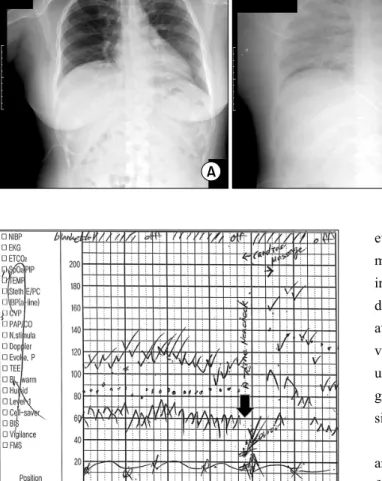
A 41-year-old, well-controlled type II diabetic woman (153 cm in height and 68 Kg in weight) was referred to the surgery department to have an elective pylorus-pre- serving pancreaticoduodenectomy (PPPD) for the distal bile duct cancer. Her preoperative blood pressure, pulse rate, and body temperature were 130/90 mmHg, 70/min, and 36.5oC, respectively. Laboratory studies showed leu- kocyte count 9,400 /ul, hemoglobin(Hb) 13.5 g/dl, hema- tocrit (Hct) 41.0%, C-reactive protein (CRP) 0.36 mg/dl, serum aspartate aminotransferase (AST) 124 IU/L, alanine aminotransferase (ALT) 179 IU/L, total bilirubin 3.8 mg/dl, alkaline phosphatase 1,313 IU/L, gamma-glutamyl trans- peptidase 1,218 IU/L, cholesterol 328 mg/dl, and CA19-9 246 U/ml. Urine analysis and urine pregnant test were negative. Her initial total bilirubin (6.5 mg/dl) has been decreased to 3.8 mg/dl after the percutaneous transhepatic biliary drainage (PTBD) catheter was placed. A chest ra- diograph revealed no significant findings (Fig. 1A). An electrocardiogram and echocardiogram did not show any
Kun Moo Choi, et al. Systemic capillary leak syndrome 39
Fig. 1. (A) Preoperative chest x-ray. (B) Postoperative chest x-ray.
Fig. 2. Episode of intraoperative hypotension (arrow).
abnormal signs. Two days prior to surgery, the patient’s body temperature had increased to 38.7oC, with normal range of white cell count and C-reactive protein, and the patient had no subjective symptoms. The body temper- ature was normalized soon without medication. On the op- eration day, pentothal sodium and vecuronium were ad- ministered to facilitate a tracheal intubation, and the anes- thesia was maintained with nitrous oxide and desflurane in oxygen. At this point, the arterial blood pressure was 140/80 mmHg, heart rate, 80 bpm, central venous pressure (CVP) 10 mmHg and the oxygen saturation 100%, bispec- tral index (BIS) 45-50. About three hours forty minutes after the operation started, when the surgical specimen was removed out and the intestinal anastomosis was about to start, the end-tidal carbon dioxide (EtCO2) curve was abruptly reduced and then, disappeared. At the same time, her arterial blood pressure, CVP, and oxygen saturation abruptly decreased to 40/25 mmHg, 3 mmHg, and 88%
respectively (Fig. 2) and BIS value was not checked with- out sudden blood loss or unusual conditions. There was no
evidence of airway obstruction. Intravenous fluid (1,000 ml of crystalloid and 3,000 ml of colloid) were rapidly infused and cardiopulmonary resuscitation including car- diac massage, ephedrine, phenylephrine, epinephrine, and atropine were conducted for 20 minutes. After that, her vital signs were recovered to 130/80 mmHg but, BIS val- ue was not. Intraoperative transesophageal echocardio- gram (TEE) demonstrated normal heart function. Her vital signs were stable until the surgery finished.
The patient was taken to the surgical intensive care unit and a chest radiograph just after the surgery revealed dif- fuse bilateral infiltrates, without cardiomegaly (Fig. 1B).
Mechanical ventilation with pressure support mode was applied. Immediate postoperative laboratory studies showed hemoglobin 18.1 g/dl, hematocrit 51.9%, leukocyte count 23,600/ul, total protein 2.8 g/dl, and albumin 1.1 g/dl.
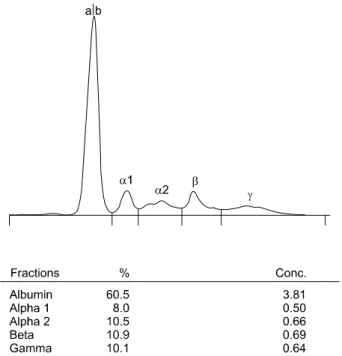
Critical medicine doctor presumptively diagnosed sys- temic capillary leak syndrome (SCLS) and 20% albumin, hydrocortisone 300 mg/day and theophylline 400 mg/day, human immune globulin G (IVIG) 1 g/kg/day were imme- diately administered, intravenously. On the postoperative day 3, total protein/albumin and Hb/Hct levels turned to 5.6/3.3 g/dl, 11.8 g/dl/35.1%, respectively, but creatine phosphokinase (CPK) was elevated to 1,897 U/L (normal range: 50-250 U/L), procalcinotnin 14 ng/ml, and CRP 21.53 mg/dl. Immunoglobulin quantification study showed that the complements, C3 and 4 were normal, the im- munoglobulin (Ig) G 406.5 mg/dl (normal range: 694- 1,618) and IgM 40 mg/dl (normal range: 60-263) were de- creased, and however, Ig E was 681.13 IU/ml (normal range: <120), which was elevated. Ig A was within the normal range. Serum electrophoresis showed that total protein was within normal limit (6.3 g/dl) and alpha-1- globulin fraction was increased, and there was no abnor-
40 Korean J Hepatobiliary Pancreat Surg Vol. 18, No. 1, February 2014
Fig. 3. Serum protein electrophoresis.
mal band (Fig. 3). About the time when pulmonary edema has improved considerably, the patient showed abnormal eye ball movements as well as the generalized seizure on the postoperative day 7. A portable electroencephalography (EEG) was taken, which showed suggestive of severe dif- fuse cerebral dysfunction. Subsequently performed en- hanced computed tomography scan and magnetic reso- nance imaging of the head showed diffuse brain atrophy and ischemic change in the periventricular deep white matter. In the meantime, the final report of surgical path- ology was an adenocarcinoma arisen from intraductal pap- illary neoplasm of the distal common bile duct with pan- creatic, perineural invasions, but clear resection margins.
Two out of 28 nodes were metastatic regional lymph nodes. On the postoperative day 14, her pulmonary con- dition has fully improved; however, unfortunately, she is still in bed more than one year because of brain injury.
DISCUSSION
Idiopathic systemic capillary leak syndrome (SCLS or ICLS) is a rare and severe disorder, first described by Clarkson et al in 1960.1 This syndrome presents with a characteristic triad of hypotension, hemoconcentration, and hypoalbuminemia.1The etiologies as well as the trig- gering factors, remain unknown. During an episode, up to
70% of the plasma rapidly shifts from the intravascular to the interstitial space, resulting in hypovolemic shock.
The cause of these episodes of marked capillary leakage is not known. Despite many reports have been proposing mechanisms involving biochemical substances or cells which might act on the capillaries to cause their leakiness, no consistent alteration has been proven histologically.2 Several reports strongly support an immunologic basis for this syndrome. Monoclonal immunoglobulin could be re- sponsible for endothelial damage and capillary hyper- permeability.3-5
SCLS is diagnosed clinically after exclusion of wide variety of diseases that cause systemic capillary leak such as infections, hereditary angioedema, chemotherapy, ma- lignancy, drugs, anesthesia, and surgery with laboratory evidence of the plasma leak.4,6-8 Hemoconcentration and hypoalbuminemia are the cornerstones of the diagnosis.
Dhir et al. has reported laboratory features of SCLS, that hematocrit was recorded to be high, 63.5±8.65%; serum albumin was mentioned to be low to 1.67±0.66 g/dl.
Complement levels are usually normal.2 The role of mon- oclonal protein found in the sera of many of the cases remains uncertain.3 Clinical Features of SCLS are that shock is a defining feature of this illness. The condition often mimics septic shock and has prodromal symptoms such as flu-like symptoms including myalgia, abdominal pain, nausea, vomiting. Non-pitting edema, effusion or tis- sue edema included bilateral pleural effusions, pericardial effusion or tamponade, cerebral edema, epiglottic edema and even macular edema leading to blindness.2,3,9
Because of hypovolemic shock, oliguria or anuria or deranged renal function tests, frank renal failure after res- olution of acute episode were few.10 It has been reported that the clinical features of an acute episode of SCLS con- sist of two phases: The initial capillary leak phase may last from 1 to 4 days and is essentially a phase of acute hypovolemia. In the recruitment phase, intravascular over- load may occur easily and result in acute pulmonary ede- ma and is characterized by unexplained recurrent episodes of severe capillary hyperpermeability, generalized edema, hemoconcentration and reduced serum albumin.5 Because the etiology is unknown and no efficacious pharmaco- logical treatment has been clearly established, the treat- ment of SCLS is empiric. Intensive care unit and careful monitoring of fluid volume are essential in SCLS. In
Kun Moo Choi, et al. Systemic capillary leak syndrome 41
acute stage, intravenous fluids such as crystalloids and colloids, inotropes and mechanical ventilation should be given but very aggressive fluid infusion in the leak phase carries a risk of causing pulmonary edema in the recovery phase. Respiratory failure due to pulmonary and upper air- way edema was successfully treated with massive infusion of human plasma or fresh frozen plasma, mechanical ven- tilation with PEEP. In chronic stage, theophylline, terbuta- linein combination or alone, intravenous steroid, calcium channel blockers, IVIG, leukotriene modifiers, and plas- mapheresis are recommended.11,12
The prognosis of SCLS is uncertain. Recurrent attacks are common and the condition is often fatal. The cause of death in the initial phase is circulatory collapse. The mortality among SCLS patients has been reported to be as high as 18-36%. The mortality rate ranges from 30%
to 76%. In contrast to the poor survival noted previously, 10-year survival rate estimates greater than 70% which has shown an increasing trend since this syndrome was first recognized.2,3
In conclusion, the present case typically matched with clinical findings of SCLS occurred during elective PPPD.
Our patient was survived from episodes of serious hypo- volemia after initiation of proper treatment, but un- fortunately she was injured in the brain. We still wonder if occult infection, because she had a self-limiting fever and surgical procedures including aggressive lymph node dissection could trigger this situation. We should be aware
that sudden and profound SCLS is a potentially lethal condition and can occur anytime even during elective sur- gery although the patient’s condition is well controlled.
REFERENCES
1. Clarkson B, Thompson D, Horwith M, et al. Cyclical edema and shock due to increased capillary permeability. Am J Med 1960;
29:193-216.
2. Dhir V, Arya V, Malav IC, et al. Idiopathic systemic capillary leak syndrome (SCLS): case report and systematic review of cas- es reported in the last 16 years. Intern Med 2007;46:899-904.
3. Druey KM, Greipp PR. Narrative review: the systemic capillary leak syndrome. Ann Intern Med 2010;153:90-98.
4. Lee TY, Chung YM, Kang HG, et al. A case of systemic capil- lary leak syndrome in a child. Korean J Pediatr 2002;45:1298- 1301.
5. Chihara R, Nakamoto H, Arima H, et al. Systemic capillary leak syndrome. Intern Med 2002;41:953-956.
6. Kanda K, Sari A, Nagai K, et al. Postpartum capillary leak syndrome. A case report. Crit Care Med 1980;8:661-662.
7. Kim YM, Seok HJ, Kim SH, et al. A case of systemic capillary leak syndrome following upper respiratory tract infection. Korean J Nephrol 2003;22:251-256.
8. Ohmi S, Takei T, Habuka K, et al. Acute pulmonary capillary leak syndrome during elective surgery under general anesthesia.
J Anesth 2008;22:77-80.
9. Bertorini TE, Gelfand MS, O'Brien TF. Encephalopathy due to capillary leak syndrome. South Med J 1997;90:1060-1062.
10. Baek SH, Shin N, Kim HJ, et al. A case of chronic renal failure associated with systemic capillary leak syndrome. YUJM 2012;
29:145-149.
11. Lambert M, Launay D, Hachulla E, et al. High-dose intravenous immunoglobulins dramatically reverse systemic capillary leak syndrome. Crit Care Med 2008;36:2184-2187.
12. Cho EJ, Cha IH, Yoon KC, et al. Recurrent systemic capillary leak syndrome responding to the corticosteroid therapy. Korean J Nephrol 2010;29:513-518.