1)
†
To whom correspondence should be addressed.
Department of Bio & Environmental Technology, Seoul Women’s University
E-mail: [email protected]
Type and vegetation of the Dongbaekdongsan wetland in Jeju, a southern island of Korea
Jung, Songhie * ・Yim, Bong Soon * ・Cho, Yong Chan ** ・Kim, Jin-Seok *** ・Lee, Chang Seok †
Department of Bio & Environmental Technology, Seoul Women’s University
*
Department of Bio & Environmental Technology, Graduate School of Seoul Women’s University
**
Division of Plant Conservation, Korea National Arboretum
***
Plant Resources Division, National Institute of Biological Resources
제주도 동백동산에 성립된 습지의 유형과 식생
정성희*
・임봉순
*・조용찬
**・김진석
***・이창석
† 서울여자대학교 생명환경공학과*서울여자대학교 대학원 생명환경공학과
**국립수목원 식물보존과
***국립생물자원과 식물자원부
(Received : 27 April 2018, Revised: 24 June 2018, Accepted: 23 August 2018)
Abstract
Wetlands of Dongbaekdongsan were classified into two types of pond and vernal pool. 11 plant communities are established there such as Nymphoides indica community, Sparganium stoloniferum Community, Persicaria hastato-auriculata community, Scirpus triangulatus community, Triadenum japonica community, Juncus papillosus community, Deinostema violacea community, Centipeda minima community, Apocynum sibiricum community, Isachne globosa community, and Ulmus parvifolia community. Nymphoides indica community is established in a pond located on the entrance of the Dongbaekdongsan and Persicaria hastatoauriculata community appears on edge of the pond. Sparganium stoloniferum community is formed in nearby pond with relatively shallow water and Persicaria hastatoauriculata community is established on margin of the pond. Vernal pools had been used for drinking water source and for livestock in some cases in the past. Scirpus triangulatus community is established in the most wet site as the center of the pools and Juncus papillosus community - Deinostema violacea community - Triadenum japonica community, and Apocynum sibiricum community appear in a concentric circle pattern as far away there.
Ulmus parvifolia community is established in a dry vernal pool. This is the first study on vernal pool carried out in Korea. Therefore, most vegetation types are new ones different from existing studies on wetland.
Key words : Dongbaekdongsan, Pond, Vegetation, Vernal pool, Wetland
요 약
동백동산 습지는 못과 한시적 못으로 구분되었다. 어리연꽃군락, 흑삼릉군락, 좁은잎미꾸리낚시군락, 송이고랭이군락, 물고추나물군 락, 청비녀골풀군락, 진땅고추풀군락, 중대가리풀군락, 수궁초군락, 기장대풀군락 및 참느릅나무군락의 11개 식물군락이 성립해 있다. 어리연꽃 군락은 동백동산입구에 위치한 한 못에 성립해 있고 좁은잎미꾸리낚시군락은 그 못의 가장자리에 성립해 있다.
흑삼릉군락은 수심이 비교적 낮은 인근의 못에 성립해 있고 그 못의 가장자리에도 좁은잎미꾸리낚시군락이 성립해 있다. 한시적 못은 과거 식수원으로 사용되었고 일부에서는 가축의 물먹이공간으로도 사용되었다. 송이고랭이군락은 그 못의 중심으로서 가장 습한 곳에 성립하고 청비녀골풀군락-진땅고추풀군락-물고추나물군락 및 수궁초군락이 그곳으로부터 멀어짐에 따라 동심원 구조로 성립해 있다. 참느릅나무군락은 상대적으로 더 건조한 한시적 못에 성립해 있다. 본 연구는 한국에서 한시적 못에 대해 처음으로 이루어진 연구이다. 따라서 본 연구에서 밝혀진 대부분의 식생유형은 습지에 대한 기존의 연구와 다른 새로운 유형으로서 그 가치가 있다.
핵심용어 : 동백동산, 못, 식생, 한시적 못, 습지
1. INTRODUCTION
Wetlands are established wherever the water table is either at or near the surface of the land: on the inside bends and former channels of a river, in the shallow braidings of a creek spreading out on a river delta, or where streams trickle slowly through flat land (Churney and Williams, 1996; Mitsch and Gosselink, 2000). Wetlands are amphibious worlds, places where land and water mingle, creating an invigorating challenge to their many plant and animal inhabitants. They are transitional areas where the land is either covered by shallow water or periodically inundated when seasonal rains saturate the soil (Cowardin et al., 1979; Churney and Williams, 1996). Here the primary plant life consists of hydrophytes, which have a high tolerance for living with their roots submerged in water or water-saturated soil. Types of wetland is defined by the communities of plants and animals typically associated with it. The presence of a particular plant or set of plants, the so-called indicator species, is one clue in determining both the presence and the identity of the wetland (Cylinder et al., 1995; Churney and Williams, 1996).
Another identifying characteristic of wetland is the presence of hydric soils. An important parameter in classifying a soil as hydric is a week of continuous surface soil saturation. This produces anaerobic (low oxygen) conditions in the soil and influences the growth and survival of the plants on that site (Churney and Williams, 1996;
Mitsch and Gosselink, 2000).
Lack of oxygen is also characteristic of wetlands. Water holds little oxygen compared to soil, which has extensive pore space between its particles. When soil is flooded with water, this oxygen reserve disappears. Furthermore, oxygen dissolves and diffuses into water or saturated soil very slowly.
As a result, many plants cannot survive in the wetland environment. Those plants that do live in wetlands have solved the problem of low oxygen availability in various ways. Plants living in water have particularly well-developed areas of spongy tissue-enlarged intercellular cavities that form a continuous system of gas passageways by which the roots can exchange oxygen with the air. Other water plants may have only a thin leaf covering, rather than a heavy cuticle, which allows oxygen and other gases to move freely between the plant and the water. Leaves below water may adapt in other ways; they may be divided into very fine leaflets, and thus have more surface area available for oxygen exchange (Churney and Williams, 1996; Mitsch and Gosselink, 2000; Cherry, 2011).
Wetlands play a number of roles in the environment,
principally water purification, flood control, carbon sink, and shoreline stability. Above all, wetlands are considered the most biologically diverse of all ecosystems, serving as home to a wide range of plant and animal life (Admiraal et al., 1997; Cylinder et al., 1995; Kusler and Opheim, 1996; Ramsar Convention on Wetlands, 2000; USGS, 1999;
Mitsch and Gosselink, 2000; Clarkson et al., 2013; Ghosh, 2016).
Extensive losses have occurred, with many of the original wetlands drained and converted to farmland. Activities resulting in wetlands loss and degradation include:
agriculture; commercial and residential development; road construction; impoundment; resource extraction; industrial siting, processes, and waste; dredge disposal; silviculture;
and mosquito control (USEPA 1993a, 1993b).
It is speculated that upwards of half of the world’s wetlands have disappeared since 1900, despite their value to the human population. Wetlands are often underappreciated because they are viewed as being more valuable for their water and developed land than the ecosystem services they provide.
They are often drained to make room for agriculture or human settlements. And any wetlands nearby left untouched may lose their own water to this development (Barbier et al., 1997).
Climate change brings a variety of alterations to patterns of water and climate. In some places, rising sea levels are swamping shallow wetlands and drowning some species of mangrove trees. In others, droughts are destroying estuaries, floodplains and marshes (Sodhi and Ehrlich, 2010).
Rice as an aquatic plant is the staple food in Asian countries including Korea. A history of rice farming in Korea is dating back to about 2,500 years ago (Kim, 1980, Choi, 1998).
Cultivation spread down most of riparian zone and its surrounding wetlands. Therefore, most of them were transformed in the past to rice fields, and more recently, were to urban areas. In such continuing transformation processes, most wetlands disappeared in Korea.
Furthermore, Korea is a mountainous country where about 2/3 of the whole territory is covered with mountainous land. Therefore, wetland is greatly deficient (MOE et al., 2008; Kang et al., 2010; MOE, 2013).
Korean government enacted ‘Wetlands Conservation Act’
to protect wetland loss and conserve and manage wetland efficiently as the importance of wetland is on the rise in 1998. ‘Wetlands Conservation Act’ requires survey on ecological and socio-economic status of inland wetland at 5-year interval. This study was carried out as part of the national inventory.
In Korea, studies on wetland vegetation were usually
carried out in riparian wetland, lake type wetland, swamp type wetland, and saltmarsh (Kim 2007) and thus there is no information for vernal pool. A number of studies were carried out for wetlands in Jeju (Oh 1974, Chung 1998, Kim 1999, Kim 2001, Kim and Song 2005, Song 2005, Kim et al. 2008, Zhin 2008, Koh and Moon 2009, Lim 2010, Moon and Kang 2012, Kang 2013, Ko et al. 2014, Kang et al. 2015) but they usually highlighted flora survey in the perspectives of national inventory. Kim et al. (2009) investigated wetland vegetation in Jeju but the study was carried out in a pond called in Minarimot.
This study aims to find the type of wetlands, which plays important structural and functional roles for conservation of biodiversity. Furthermore, this study also plans to clarify their ecological characteristics in a viewpoint of vegetation.
2. Material and Methods
2.1 Study area
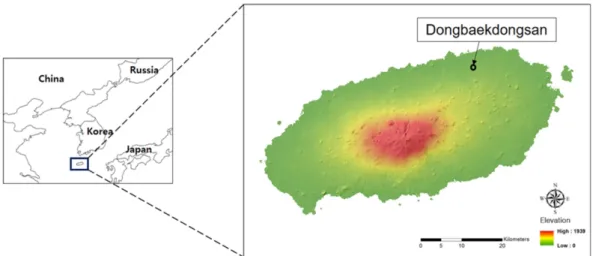
Dongbaekdongsan is located in Seonheul-ri, Jocheon-eub, Bukjeju-gun, Jeju-do (Fig. 1). Annual mean temperature and rainfall are 15.8℃ and 1498 mm, respectively (KMA 2018). Based on climate indices suggested Yim and Kira (1975,1976), and Yim (1977a, 1977b), this region belongs to warm temperate evergreen broadleaved forest zone. Parent rock of this region is basalt (Yoon et al. 2014). Grassland, shrub land, black pine forest, and evergreen broad-leaved forest, which is composed of
Quercus glauca
community,Castanea cuspidata
var.sieboldii
community,Camellia japonica
community and so on, form a vegetation of this area. Name of this area called "Dongbaekdongsan" is originated from that this area had had very many trees ofCamellia japonica
.Dongbaekdongsan is composed of low hills within 100 m above sea level and its slope is gentle. This area is divided into three zones different in developmental stages. For example, grassland and shrubby land, which had been stock farm in the past, black pine forest that successional process is more progressed, and evergreen broad-leaved forest, which can be evaluated as the late successional stage correspond to those zones. Evergreen broad-leaved forest, which is the late successional stage, is composed of
Quercus glauca
community,Castanea cuspidata
var.sieboldii
community, andCamellia japonica
community.This study area holds soil with low water holding capacity as parent rock is basalt. Therefore, wetland is not developed well. Wetland of this area was classified into two types of pond and vernal pool. Vernal pool was again divided into two types of wet and dry ones. The former stores water for relatively long period as clay and organic matter are accumulated on the bedrock, whereas the latter stores water for very short time at rainfall as coarse alluvial debris is stacked thickly on the bedrock. Therefore, dry vernal pool has no surface water except at rainfall and has very different wetland vegetation from that of wet one.
2.2 Methods
Vegetation data were collected in 41 plots, measuring 1 x 1 m and 10 x 10 m for grassland and forest, respectively, from July to August 2005. Vegetation survey was carried out by recording the cover degree of plant species appearing in quadrats installed randomly (Mueller-Dombois and Ellenberg, 1974). Cover degree was recorded applying the Braun-Blanquet (1964) scale. The differences in species composition among stands were analyzed by applying ordination method. For ordination, cover degree of each species was converted to the median value of percent cover
Fig. 1. A map showing the study area.
range in each cover class. Relative coverage was determined by multiplying by 100 to the fraction of each species to the summed cover of all species in each plot (Klaudisava and Osbornova, 1990). The relative coverage of each species was then regarded as the importance value (Curtis and McIntosh, 1951). Finally, differences in species composition among sites were analyzed with Nonmetric Multidimensional Scaling (NMDS) stand ordination (Kruskal, 1964) based on euclidean distance, which was performed using the function “vegan” of the R statistical package.
3. Results
3.1 Vegetation status
Nymphoides indica
community is established in a pond located on the entrance of the Dongbaekdongsan andPersicaria hastatoauriculata
community appears on margin of the pond (Photo 1).Nymphoides indica
dominatesNymphoides indica
community andNajas graminea
,Trapa japonica
,Potamogeton octandrus
and so on form together the plant community (Table 1).Persicaria hastatoauriculata
dominatesPersicaria hastato-auriculata
community (Photo 2) andAlisma canaliculatum
,Eleocharis wichurae
,Eupatorium fortunei
and so on appear in the plant community (Table 1).Sparganium stoloniferum
community is established in a small pond with shallow water andPersicaria hastatoauriculata
community is on margin of the pond (Table 1).Vernal pools had been used for drinking water source of human and livestock in some cases in the past. The pools
Photo 1.
Nymphoides indicacommunity established in a pond of the entrance of the Donabaekdongsan.
Photo 2.
Persicaria hastatoauriculatacommunity established in the edge of a pond of the entrance of the Donabaekdongsan.
Table 1. Species composition of 11 plant communities established in the Donabaekdongsan wetland. Numbers in parentheses indicate the number of plots that vegetation survey was carried out.
Scientific Name 1 (4) 2 (7) 3 (2) 4 (13) 5 (4) 6 (1) 7 (2) 8 (2) 9 (2) 10 (2) 1 1(2)
Agrostis clavata 0.00
Alisma canaliculatum 0.14 0.01 0.01 0.01 0.01
Aneilema keisak 0.00 0.00 0.00 0.01 0.01 0.01
Apocynum sibiricum 0.01 0.61 0.01
Ardisia japonica 0.00
Bidens tripartita
Callitriche verna 0.00
Camellia japonica 0.01
Cardamine flexuosa
Carex brownii 0.00
Carex dimorpholepis 0.00 0.03 0.08
Carex maculata 0.01
Carex maximowiczii 0.25 0.00
Centipeda minima 0.00 0.01 0.94
Cocculus triobus 0.00
Commelina communis 0.00
Table 1. Continued
Scientific Name 1 (4) 2 (7) 3 (2) 4 (13) 5 (4) 6 (1) 7 (2) 8 (2) 9 (2) 10 (2) 1 1(2) Corchoropsis tomentosa 0.00
Cudrania tricuspisata 0.01
Cyperaceae spp. 0.02 0.00 0.02
Cyperus amuricus 0.00
Cyperus flaccidus 0.00
Deinostema violacea 0.86
Duchesnea chrysantha 0.02 0.01
Dysophylla verticillata 0.01
Eleocharis congesta 0.30 0.36 0.02 0.01
Eleocharis wichurae 0.07
Eleocharis wichurae 0.00 0.03
Erechitites hieracifolia 0.00
Erigeron canadensis 0.00
Eupatorium fortunei
Eurya japonica 0.00
Galium trachyspermum 0.00
Geranium nepalense subsp. thunbergii 0.01
Gramineae spp. 0.00 0.00 0.01 0.01 0.12
Halorrhagis micrantha 0.00
Hedyotis diffusa 0.02 0.01 0.01
Hydrocotyle maritima 0.01 0.01 0.02 0.01
Hydrocotyle sibthorpioides 0.01 0.03
Hypericum laxum 0.00 0.00 0.01 0.01 0.01
Imperata cylindrica var. koenigii 0.00
Isachne globosa 0.02 0.00 0.01 0.83
Juncus effusus 0.02 0.00
Juncus leschenaultii 0.00
Juncus papillosus 0.00 0.52 0.01 0.01
Kummerowia striata 0.00
Leersia japonica 0.00
Lespedeza cuneata 0.00
Ligustrum obtusifolium 0.00
Limnophila aromatica 0.00 0.02 0.01 0.03
Liriope spicata 0.00 0.02
Ludwigia ovalis 0.09 0.00 0.00 0.02 0.01
Lythrum anceps 0.00
Lythrum salicaria 0.01 0.13 0.01
Mallotus japonicas 0.00
Malus siebolldi 0.01
Mazus japonicus 0.00
Mosla dianthera
Mosla punctulata 0.00
Najas graminea 0.15
Nymphoides indica 0.71 0.00
Oxalis corniculata 0.00
Persicaria hastato-auriculata 0.09 0.01 0.66 0.01 0.02 0.03
Persicaria hydropiper 0.02
Persicaria lapathifolia 0.00
Persicaria nodosa
have stone wall around them, which form a boundary between wetland vegetation in the pools and surrounding terrestrial vegetation. Water, which is flown from surrounding areas at rainfall, is infiltrated into the underground rapidly due to the characteristics of parent rock and thereby they do not provide good condition for wetland plants.
Scirpus triangulatus
community is established in the center of the pool (Photo 3) andJuncus papillosus
community -Deinostema violacea
community,Centipeda minima
community, andApocynum sibiricum
community appear with the distance from there (Photo 4).Scirpus triangulatus
dominatesScirpus triangulates
community andEleocharis congesta, Hedyotis diffusa, Persicaria hastato-auriculata
and so on compose the plant community (Table 1).Triadenum japonica
dominatesTriadenum japonica
community andCarex dimorpholepis, Eleocharis wichurae
and so on make the plant community (Table 1).Juncus papillosus
dominatesJuncus papillosus
community andEleocharis congesta, Hedyotis diffusa, Aneilema keisak
and so on consist the plant community (Table 1).Deinostema violacea
dominatesPhoto 3.
Scirpus triangulatuscommunity established in the Donabaekdongsan wetland.
Deinostema violacea
community andEleocharis congesta, Limnophila aromatica, Scirpus triangulatus
and so on form the community (Table 1).Centipeda minima
dominatesCentipeda minima
community andEleocharis congesta, Hydrocotyle maritima, Scirpus triangulatus
and so on growTable 1. Continued
Scientific Name 1 (4) 2 (7) 3 (2) 4 (13) 5 (4) 6 (1) 7 (2) 8 (2) 9 (2) 10 (2) 1 1(2)
Phyllanthus urinaria 0.00
Phyllanthus ussuriensis 0.00 0.00
Pinus thunbergii 0.00
Polygonum aviculare 0.01
Potamogeton octandrus 0.10
Potentilla kleiniana 0.00
Pourthuaea villosa 0.01
Ranunculus cantoniensis 0.01
Rosa multiflora 0.03
Rubus parvifolium 0.00
Sageretia theezans 0.01
Sasa spp. 0.00
Scirpus triangulatus 0.60 0.03 0.01
Smilax riparia var. ussuriensia 0.00
Sparganium erectum 0.99 0.00
symplocos paniculata 0.00
Trapa japonica 0.04
Triadenum japonica 0.93
Trigonotis nakaii 0.00
Ulmus parvifolia 0.22
Vandellia angustifolia 0.00
Viola mandshurica 0.04
Viola spp. 0.01 0.02 0.01
Zoysia japonica 0.02
1: Ulmus parvifolia community, 2: Nymphoides indica community, 3: Sparganium erectum community, 4: Persicaria hastato-auriculata
community, 5: Scirpus triangulates community, 6: Triadenum japonica community, 7: Juncus papillosus community, 8: Deinostema violacea
community, 9: Centipeda minima community, 10: Apocynum sibiricum community, 11: Isachne globosa community.
Photo 4. Wetland vegetation of the Donabaekdongsan.
Scirpus triangulatuscommunity (a) is established in the most wet site as the center of the pools and
Juncus papillosuscommunity -
Deinostema violacea
community -
Triadenum japonicacommunity (b), and
Apocynum sibiricumcommunity in a
concentric circle pattern.
Photo 5.
Triadenum japonicacommunity (a)
Persicaria hastatoauriculatacommunity (b) established in
Dongbaekdongsan.
in the plant community (Table 1).
Apocynum sibiricum
dominatesApocynum sibiricum
community andDuchesnea chrysantha, Lythrum salicaria, Hydrocotyle maritima
and so on make the plant community (Table 1).Isachne globosa
community, which is established near toApocynum sibiricum
community, is dominated byIsachne globosa
andPersicaria hastatoauriculata, Duchesnea chrysantha, Viola
sp. and so on appear in the community (Table 1).Ulmus parvifolia
dominatesUlmus parvifolia
community andMalus siebolldii
form subtree layer of this community andRosa multiflora, Pourthuaea villosa, Sageretia theezans, Ligustrum obtusifolium
and so on showed high frequency in shrub layer.Carex maximowiczii, Juncus effusus, Ludwigia ovalis, Persicaria hastato-auriculata
and so on showed high frequency in herb layer. Spatial distributionof vegetation showed a trend that herbaceous plants dominate waterfront and woody plats including
Ulmus parvifolia
tend to increase as distant from there similarly to spatial distribution pattern of riparian vegetation in streams with basalt as a bedrock (Table 1).3.2 A comparison of species composition among plant communities
As the result of NMDS ordination, stands tended to be divided four groups depending on habitat types: deep and shallow ponds, and wet and dry vernal pools (Fig. 2). The diagonal line drawn from lower left toward upper right on the plane that Axes ǀ and ǁ form divides vernal pool and pond types. For example, vernal pool and pond types were arranged in the upper left and lower right parts, respectively on the plane that Axes ǀ and ǁ make. On the other hand, vernal pool, shallow pond, and deep pond types were arranged from lower left toward upper right by reflecting water depth of each habitat along the diagonal line.
The results of stand ordination also reflected a difference of environmental conditions, primarily water table.
Nymphoides indica
community is established in the center of deep pond andPersicaria hastato-auriculata
community is in the margin of the pond. In the vernal pool and its surrounding areas,Scirpus triangulatus
community,Deinostema violacea
community,Juncus papillosus
community, andCentipeda minima
community tended to be arranged in the mentioned order.The result of ordination based on habitat trait of plant species composed of each community divided stands into four groups dominated by obligate wetland, facultative wetland, obligate upland, and facultative upland plants (Fig. 3).
Plant communities dominated by obligate wetland plants are composed of
Nymphoides indica
community,Sparganium stoloniferum
community,Scirpus triangulates
community,Deinostema violacea
community, andTriadenum japonica
community, whereasUlmus parvifolia
community andApocynum sibiricum
community are dominated by obligate upland plants. On the other hand,Persicaria hastato- auriculata
community is usually dominated by facultative wetland plants andCentipeda minima
community is by facultative upland plants. In addition,Isachne globose
community andJuncus papillosus
community are composed of plants, which do not show distinct habitat trait.As the result of ordination based on life form of plant species composed of each community, stands were divided into five groups dominated by hydrophyte, perennial herbs and hydrophyte, annual herbs, wetland plants, and non-clonal growth (monophyte), woody plants including
Fig. 2. NMDS ordination of plant communities established on Dongbaekdongsan wetland based on vegetation data (stress = 0.0887). Scientific names mean plant community names that the
plant dominates.
Fig. 3. NMDS biplot of plant communities established on Dongbaekdongsan wetland and frequency data (stress = 0.0820).
Scientific names mean plant community names that the plant dominates. FAC: Facultative plant, UPL: Obligate upland plant, FACW: Facultative wetland plant, OBL: Obligate wetland plant
Megaphanerophyte, and plants with rhizomatous radicoid form or stolon, hemicryptophyte, and so on (Fig. 4).Nymphoides indica
community andSparganium stoloniferum
community,Scirpus triangulates
community,Persicaria hastato-auriculata
community,Centipeda minima
community, andDeinostema violacea
community,Ulmus parvifolia
community, andTriadenum japonica
community,Isachne globosa
community, andApocynum sibiricum
community are belonged to the 1st, 2nd, 3rd, 4th, and 5th groups, respectively.Fig. 4. NMDS biplot of plant communities established on Dongbaekdongsan wetland and life form data (stress = 0.1614).
HerbPer: HerbPerennial, HerbAn: HerbAnnual, ClimbPer:
ClimbPerennial, tp: tussock form with procumbent stem, b.ps:
b form with pseudo-rosette, p.ps:procumbent form with pseudo-rosette, b: branched form, H: Hemicryptophyte, HH:
Hydatophyte, HH.rd: Hydatophyte(root in dirt), N:
Nanophanerophyte, l: liane form, M :Microphanerophyte, HH.Th: Hydatophyte (Therophyte), R
3.v: vertical type, R
3.s:
succulent type
Fig. 5. NMDS biplot of plant communities established on Dongbaekdongsan wetland and disseminule data (stress = 0.1022). D
1: disseminated widely by wind or water, D
2: disseminated attaching with or eaten by animals and man, D
4: having no special modification for dissemination, D
1,2, D
1,4: plant
with D
1and D
2, D
1and D
4The result of ordination based on disseminule form of plant species composed of each community divided stands into three groups dominated by wind and animal dissemination, autonomous dissemination by gravity, and autonomous dissemination by wind (Fig. 5).
Nymphoides indica
community andSparganium stoloniferum
community,Persicaria hastato- auriculata
community,Centipeda minima
community, andPersicaria hastato-auriculata
community, andIsachne globosa
community,Deinostema violacea
,Scirpus triangulates
community, andJuncus papillosus
community are belonged to the 1st, 2nd, and 3rd groups, respectively.4. Discussion
4.1 Wetland type
Two types of wetland of pond and vernal pool were found through this study. Based on the Ramsar wetland type classification system (Ramsar Convention on Wetlands, 2000), such pond and vernal pool correspond to Tp (permanent freshwater marshes/pools) and Ts (Seasonal/
intermittent freshwater marshes/pools on inorganic soils), respectively.
Vernal pools and their surrounding wetlands possess eight plant communities such as
Scirpus triangulates
community,Triadenum japonica
community,Juncus papillosus
community,Deinostema violacea
communityCentipeda minima
community,Apocynum sibiricum
community,Isachne globosa
community, andUlmus parvifolia
community and thereby maintain relatively high ecological diversity. Among them the former seven plant communities are established in wet vernal pool, while onlyUlmus parvifolia
community appear in dry vernal pool and thereby showed a big difference between both.Ponds and their surrounding wetlands maintain
Nymphoides indica
community,Persicaria hastato-auriculata
community, andSparganium stoloniferum
community.The wetlands show a remarkable difference in species composition from the surrounding forest ecosystem by possessing various wetland plants. Dongbaekdongsan seems a plain land externally but diverse micro-topographies exist within there and thereby possesses various wetland plants.
There is one endangered species,
Limnophila aromatica
and 7 floristic regional indicator plants such asDysophylla verticillata
(5th grade),Sparganium stoloniferum
(5th grade),Triadenum japonica
(3rd grade),Ludwigia ovalis
(3rd grade),Limnophila aromatic
(3rd grade),Carex maculate
(3rd grade), andNymphoides indica
(2nd grade) appeared (MOE, 2018).Wetland vegetation obtained through this study shows a big difference from the results from the existing studies for wetland vegetation (Kim 2007). The background is due
to a difference in the ecological condition of study areas.
Existing studies on wetland vegetation accomplished in Korea were usually focused on the flora survey and carried out in riparian wetland, lake type wetland, swamp type wetland, and saltmarsh (Kim 2007). Both subject and object for study were different from them of this study. Therefore, appearing plant species were partially overlapped but community types were new ones completely different from existing studies.
4.2 Functions and value of wetland
Wetland is very valuable land, which can play diverse functions in different aspects (Admiraal et al., 1997; Cylinder et al., 1995; Kusler and Opheim, 1996; Ramsar Convention on Wetlands, 2000; USGS, 1999; Mitsch and Gosselink, 2000; Clarkson et al., 2013). First of all, wetland provides food, habitat, shelter, and resting place to wildlife such as fish, mammal, amphibian, reptile, bird by drawing higher productivity than any other ecosystems on Earth. In particular, wetland offer space for breeding to them and thereby contribute to supporting biodiversity. In addition, wetland produce organic matter as basis of food chain and transfers that to the other habitats such as deep water and thus contribute to maintaining biodiversity in the other respects (Zedler, 2003; Lee, 2012; Cohen et al., 2016).
Further, wetland creates a specific landscape and a dynamic ecological space where cultural value as well as vitality are full (Clarkson et al., 2013). Wetland increases connectivity of landscape elements and spatial heterogeneity and thereby provide a spatial base, which can maintain high biodiversity, as it is usually established in ecotone where terrestrial and aquatic ecosystems come in contact with each other (Amezaga et al., 2002; Cohen et al., 2016).
In addition, wetland displays various economic values (Clarkson et al., 2013). Economic value that wetland provides is difficult to evaluate correctly. But wetland displays economic value by reducing costs for development and management of water resources, which contribute to secure and appropriate maintenance and for treatment of environmental pollution by purifying polluted water.
Further, it becomes an enormous income source as wetland occupies 2/3 of fish catch of the world as the cradle of fishery. In addition, wetland keeps very high economic values as it provides opportunities for agriculture, timber production, energy source such as peat, plant resource, and so on, wildlife resource, means for transportation, recreation, eco-tour, and so on (Clarkson et al., 2013).
But above all function of wetland would be a biodiversity supporting one. Biodiversity is the variety of life, in all of
its many manifestations. It is a broad unifying concept, encompassing all forms, levels and combinations of natural variation, at all levels of biological organization (Gaston and Spicer, 2013). In definition in CBD (Convention on Biological Diversity) Article 2, “‘Biological diversity’ means the variability among living organisms from all sources including, inter alia, terrestrial, marine and other aquatic ecosystems and the ecological complexes of which they are part; this includes diversity within species, between species and of ecosystems”. That is, “Biodiversity” means three broad things (Norse and McManus, 1980): (i) there is diversity within a species—usually genetic-based, but within our own species, there is a large, but rapidly shrinking cultural diversity (Pimm, 2000); (ii) the diversity of species themselves, and; (iii) the diversity of the different ecosystems they comprise.
Biodiversity decreases rapidly in these days. Species extinction is irreversible, is progressing at a high rate and is poised to accelerate. Species extinction really is forever and occurring at unprecedented rates. While large tracts of little changed habitat remain worldwide, most of the planet’s natural ecosystems have been replaced or fragmented (Pimm, 2001). Such destruction and fragmentation of habitat are known as predominant cause of species endangerment (BirdLife International, 2000). In this respect, securing diversity and integrity of ecosystem is the prerequisite condition for conservation of disappearing biodiversity.
4.3 Ecological importance of vernal pool
Vernal pools are so called because they are often, though not necessarily, at their maximum depth in the spring ("vernal" meaning of, relating to, or occurring in the spring).
Today they are used more broadly to include other small ephemeral wetlands and thus are also referred to as vernal ponds, ephemeral ponds, ephemeral pools, temporary pools, and seasonal wetlands (Keeley and Zedler 1998, Colburn 2004, Thomas et al. 2010).
Vernal pools are seasonal depressional wetlands. They are covered by shallow water for variable periods from winter to spring but may be completely dry for most of the summer and fall. These wetlands range in size from small puddles to shallow lakes and are usually found in a gently sloping plain of grassland. Beneath vernal pools lies either bedrock or a hard clay layer in the soil that helps keep water in the pool. Substrates often consist of mineral soils underlain by an impermeable layer such as clay and may be covered by a layer of interwoven fibrous roots and dead leaves. Vernal pools vary greatly in size. Vernal pools
may form in forests, but they are more typically associated with grasslands and rocky plains or basins (Colburn 2004, Calhoun and deMaynadier 2008, Thomas et al. 2010).
Despite being dry at times, vernal pools teem with life when filled. The unique environment of vernal pools provides habitat for numerous rare plants and animals that are able to survive and thrive in these harsh conditions. Many of these plants and animals spend the dry season as seeds, eggs, or cysts, and then grow and reproduce when the ponds are again filled with water. The most obvious inhabitants are various species of breeding frogs and toads. Some salamanders also utilize vernal pools for reproduction, but the adults may visit the pool only briefly. Other notable inhabitants are Daphnia and fairy shrimp, the latter often used as an indicator species to decisively define a vernal pool. In addition, birds such as egrets, ducks, and hawks use vernal pools as a seasonal source of food and water (Thomas et al. 2010).
Despite this fact, they have been destroyed rapidly. The major threats to vernal pool habitats are agriculture, urbanization, changes in hydrology, climate change, and improperly managed grazing by livestock (Thomas et al.
2010).
More information is needed in order to understand, classify, and protect vernal pools. Studies addressing the composition and ecology of plant and animal communities, hydrology, and water quality of vernal pools are warranted since no information has been systematically collected for vernal pool in Korea. Investigation of vernal pool locations, biota, and physical properties are needed to determine if vernal pool subtypes exist. The information obtained through such studies would help to hone overall vernal pool conservation strategies (Thomas et al. 2010).
5. Conclusion
Wetlands in the Dongbaekdongsan are scattered in a small scale within the forest similarly to most vernal pools (Thomas et al. 2010). They are composed of two types of pond and vernal pool and vernal pool dominate the wetland. Vernal pool showed the high vegetation diversity by possessing eight plant communities, whereas pond type wetland showed relatively low vegetation diversity. The background would be due to that not only areal size is not large but also water depth is relatively shallow.
Although wetland has diverse functions, it is speculated that biodiversity supporting function, particularly as water supply source and reproduction ground would be required the most urgently in this area as a conservation reserve.
This region receives relatively much rainfall but most of them infiltrated into soil rapidly and thus it is very difficult to find surface water, which can function water supply source for wildlife even in wetland. Therefore, the scale of wetlands found through this study is small but their ecological importance is very large. In Jeju, warm temperate evergreen broadleaved forest as a dominant landscape element decreased and fragmented rapidly in these days. In this respect, Dongbaekdongsan, which is covered with relatively wide and integrate evergreen broadleaved forests, is very important ecologically. In particular, it is expected that wetlands in Dongbaekdongsan would function as hot spot for maintaining biodiversity of Dongbaekdongsan enrich.
High vegetation and species diversities that they showed support this deduction.
Acknowledgements
This study was partially supported from “The national inventory project for survey on the natural environment”
of Ministry of Environment of Korea.
References
Admiraal, AN, Morris, MJ, Brooks, TC, Olson, JW and Miller, MV (1997). Illinois Wetland Restoration and creation Guide. Illinois National History Survey. Special Publication 19.
A Division of the Illinois Department of National Resources
.Amezaga, JM, Santamaria, L and Green AJ (2002). Biotic wetland connectivity-supporting a new approach for wetland policy.
Acta oecologica
, 23(3), pp. 213-222. [DOI https://doi.org/10.1016/S1146-609X(02)01152-9]Barbier, EB, Acreman, M and Knowler, D (1997).
Economic valuation of wetlands: A guide for policy makers and planners
. Ramsar Convention Bureau, Gland, Switzerland.BirdLife International (2000).
Threatened birds of the world
. Barcelona and Cambridge, Lynx Edicions and BirdLife International, United Kingdom.Braun-Blanquet, J (1964).
Pflanzensoziologie
. 3. Aufl, Springer-verlag, Wien. New York.Calhoun, AJ, deMaynadier, PG (2008).
Science and Conservation of Vernal Pools in Northeastern North America
. CRC Press, New York.Cherry, JA (2011). Ecology of wetland ecosystems: water, substrate, and life,
Nature Education Knowledge
, 3(10), pp. 16.Choi, KR (1998). The post-glacial vegetation history of the lowland in Korean Peninsula.
Korean Journal of Ecology
,21, pp. 169-174. [Korean Literature]
Churney, M and Williams, S (1996).
Bogs, Meadows, Marshes and Swamps: A Guide to 25 Wetland Sites of Washington State
. The Mountaineers, Seattle, pp. 173.Chung, GY (1998). Study on flora of bogs in Cheju Island, Korea,
Bulletin of the Korean Association for Conservation of Nature
, 17, pp. 3-22. [Korean Literature]Clarkson, BR, Ausseil, AGE and Gerbeaux, P (2013). Wetland ecosystem services.
Ecosystem services in New Zealand:
conditions and trends
. Manaaki Whenua Press, Lincoln, pp. 192-202.Cohen, MJ, Creed, IF, Alexander, L, Basu, NB, Calhoun, AJ, Craft, C, D’Amico, E, DeKeyser, E, Fowler, L, Golden, HE and Jawitz, JWQ (2016). Do geographically isolated wetlands influence landscape functions, Proceedings of the National Academy of Sciences, 113(8), pp. 19. [DOI https://doi.org/10.1073/pnas.1512650113]
Colburn, EA (2004).
Vernal Pools: Natural History and Conservation
. The McDonald and Woodward Publishing Company, Granville, OH, pp. 426.Cowardin, LM, Carter, V, Golet, FC and LaRoe, ET (1979).
Classification of Wetlands and Deepwater Habitats of the United States, U.S Department of the interior,
Fish and Wildlife Service Office of Biological Services.
Curtis, JT and McIntosh, RP (1951). An Upland Forest continuum in the Prairie-Forest Border Region of Wisconsin,
Ecology
, 32(3), pp. 476-496. [DOI https://doi.org/10.2307/1931725]
Cylinder, PD, Bogdan, KM, David, EM and Herson, AI (1995).
Wetlands Regulation: A complete Guide to Federal and California Programs
. Point Arena: Solano Press books.Gaston, KJ and Spicer, JI (2013).
Biodiversity: an introduction
. John Wiley & Sons.Ghosh, P (2016). Hydrological, Morphological, Ecological and Economical Importance and Threats of Wetland (A Case Study of Sandhya wetland in Jadupur-2). Solapur: Laxmi Book Publication, pp. 132.
Kang, DH (2013).
Flora of Aquatic and Wetland habitats in Jeju Island
. Master’s Thesis, Jeju national university, Jeju, Korea. [Korean Literature]Kang, DH, Yim, EY, and Moon, MO (2015). Flora of aquatic and wetland habitats on Jeju Island,
Korean Journal of Plant Taxonomy
, 45(1), pp. 96-107. [Korean Literature] [DOI https://doi.org/10.11110/kjpt.2015.45.1.96]Kang, SJ, Jo, GS and Choi, GY (2010).
Museum of Alive Nature History Yongnup (High Moor) of Mt. Daeamasn in Korea
, pp. 215-218.Keeley, JE, Zedler, PH (1998). Characterization and global distribution of vernal pools,
Ecology, Conservation, and
Management of Vernal Pool Ecosystems Proceedings from
a 1996 Conference
, CW Witham, ET Bauder, D Belk, WRFerren Jr., and R Ornduff (eds), California Native Plant Society, Sacramento, CA, pp 1-14.
Kim, CH (1999).
Distribution characteristics of Mullyeongari monticule Flora
, In Jeju Mullyeongari oreum Natural Environment Research, Ministry of Environment, Gwacheon, pp. 27-34. [Korean Literature] [DOI https://doi.org/10.11110/kjpt.2014.44.3.222]
Kim, JG (2007). Wetland vegetation in Korea,
Nature Conservation
, 138, pp. 35-56.Kim, H, Chung SC and Chung, MS (2008).
Flora of Mullyeongari oreum wetland protection area
, In 2008 Detailed investigation of Wetlands protection area, National Institute of Environmental Research, Incheon, 138, pp. 97-117.Kim, JM (1980). Environmental changes and origin of agriculture in Korea,
The Korean Journal Ecology
, 3, pp.40-51. [Korean Literature]
Kim, MH (2001). Higher plants, In 2000 Natural Environment Research of National inland wetlands, Jeju-do Muljangori. Ministry of Environment, Gwacheon, pp.
15-27. [Korean Literature]
Kim, MH and Song, KM (2005). Flora, In 2005 Natural Environment Research of National inland wetlands, Dongbaekdongsan wetland, Ministry of Environment, Gwacheon, pp. 23-40. [Korean Literature]
Klaudisova, A and Osbornova, J. (1990). Abandoned fields in the region,
Succession and abandoned fields: studies in central Bohemia, Czechoslovakia
, J Osbornova, M Kovarova, J Leps, and K Prach (eds.), Geobotany 15, Kluwer Academic Publisher, Dordrecht, pp. 7-21. [DOI https://doi.org/10.2307/2404405]Korea Meteorological Administration (KMA) (2018).
http://www.weather.go.kr/weather/.
Ko, SC, Son, DC and Park, BK (2014). Flora of Sumeunmulbaengdui wetland in Jeju-do, Korea,
Korean Journal of Plant Taxonomy
, 44(3), pp. 222-232. [Korean Literature] [DOI https://doi.org/10.11110/kjpt.2014.44.3.222]
Koh, JG and Moon, MO (2009). Flora, In 2008 Detailed investigation of National inland wetlands. 1,100 Altitude wetland, Ministry of Environment, Gwacheon, pp.
449-468. [Korean Literature]
Kruskal JB (1964). Nonmetric multidimensional scaling: a numerical method.
Psychometrika
, 29, pp. 115–129.Kusler, J and Opheim, T (1996).
Our National Wetland Heritage
: A Protection Guide (2nd. Ed.). An Environmental Law Institute Publication. [https://doi.org/10.1007/bf 02289694]Lee, SM (2012).
A study on vegetation succession in the abandoned paddy fields and landscape changes of rural area in Korea
, Ph.D. Dissertation, Seoul Women’s University,Seoul, Korea. [Korean Literature]
Lim, YS (2010).
Distribution Characteristics of Hydrophytes in Korea
, Ph.D. Dissertation, Soonchunhyang University, Asan, Korea. [Korean Literature]Ministry of Environment (2013).
Preparation of master plan for managing the National center for biodiversity
, pp. 271.[Korean Literature]
Ministry of Environment, UNDP, GEF, Korea Wetland Project, Ramsar Convention Preparation Committee (2008).
A Guide to Ramsar Wetlands & Wetland Protection Areas of Korea: Discovering Wetlands
. Ministry of Environment.Gwacheon, Pp. 172. [Korean Literature]
Moon, MO and Kang, DH (2012). Flora, In 2012 Detailed investigation of National inland wetlands.
Sumeunmulbaengdui., Ministry of Environment, Gwacheon, pp. 449-468. [Korean Literature]
Mitsch, WJ and Gosselink, JG (2000). Special Issue, The values of wetlands: Landscapes and institutional perspectives.
The value of wetlands: importance of scale and landscape setting.
Ecological Economics
, 35, pp. 25-33.Mueller-Dombois, D and Ellenberg, H (1974). Aims and Methods of Vegetation Ecology. Wiley, New York. pp. 547.
National Law Information center (NLIC) (2018).
http://law.go.kr/lsInfoP.do?lsiSeq=153571#0000.
Norse, EA, and McManus, RE (1980). Environmental quality, 1980: the eleventh annual report of the council on environmental quality. Council of Environmental Quality.
pp. 31-80.
Oh, SC (1974). A survey report on the plants lived in ponds in Cheju Island,
Jeju National University of Education Journal
, 4, pp. 93-98. [Korean Literature]Pimm, SL (2000). Biodiversity is us. Oikos, 90, pp. 3–6.
[https://doi.org/10.1034/j.1600-0706.2000.900101.x]
Pimm, SL (2001).
The World According to Pimm: A Scientist Audits the Earth
. McGraw–Hill, New York. pp. 248. [DOI https://doi.org/10.5860/choice.39-3373]Ramsar Convention on Wetlands (Ramsar, Iran 1971) (2000).
Frameworks for managing wetlands of International Importance and other wetlands
, Handbook 8.Sodhi, NS and Ehrlich, PR (2010).
Conservation Biology for All
. Oxford University Press, Oxford. pp. 358. [https://doi.org/10.1093/acprof:oso/9780199554232.001.0001]
Thomas, SA, Lee, Y, Kost, MA, Albert, DA (2010).
Abstract for vernal pool
. Michigan Natural Features Inventory, Lansing, MI. pp. 24.USEPA (1993a). Standards for the Use or Disposal of Sewage Sludge.
Federal Register
, 58, pp. 9248–9415.USEPA (1993b).
Guidance for Writing Permits for the Use or Disposal of Sewage Sludge
. pp. 120.USGS (1999).
Restoration, creation and Recovery of Wetlands
Wetland Functions, Values, and Assessment, National
Water Summary on Wetland Resources
, United States Geological survey. Water Supply paper, pp. 2425.Yim, YJ and Kira, T (1975). Distribution of forest vegetation and climate in the Korean Peninsula. I. Distribution of some indices of thermal climate,
Japanese Journal of Ecology
, 25(2), pp. 77-88.Yim, YJ and Kira, T (1976). Distribution of forest vegetation and climate in the Korean Peninsula. II. Distribution of climatic humidity/aridity,
Japanese Journal of Ecology
, 26(3), pp. 157-164.Yim, YJ (1977a). Distribution of forest vegetation and climate in the Korean Peninsula. III. Distribution of tree species along the thermal gradient,
Japanese Journal of Ecology,
27(3), pp. 177-189.Yim, YJ (1977b). Distribution of forest vegetation and climate
in the Korean Peninsula. IV. Zonal distribution of forest vegetation in relation to thermal climate,
Japanese Journal of Ecology,
27(4), pp. 177-189.Yoon, S, Jung, CY, Hyun, WH and Song, ST (2014). Tectonic history of Jeju Island,
Journal of the Geological Society of Korea,
50(4), pp. 457. [Korean Literature] [DOI https://doi.org/10.14770/jgsk.2014.50.4.457]Zedler, PH (2003). Vernal pools and the concept of “isolated wetlands”.
Wetlands,
23(3), pp. 597-607. [DOI https://doi.org/10.1672/0277-5212(2003)023[0597:vpatco]2.
0.co;2]
Zhin, KL (2008).