Physicochemical Properties of Fish-meat Gels Prepared from Farmed-fish
Hyung Kwang Kim
1, Se Jong Kim
1, Fatih Karadeniz
2, Myeong Sook Kwon
3, Min-Joo Bae
3, Ya Gao
3, Seul-Gi Lee
3, Byeong Guen Jang
1, Jun Mo Jung
1, Seo yeon Kim
1and Chang-Suk Kong
2,3*
1EverBlueSea Co., Ltd. Janglim-1 Dong, Saha-Gu, Busan 604-842, Korea
2Marine Biotechnology Center for Pharmaceuticals and Foods, Silla University, Busan 617-736, Korea
3Department of Food and Nutrition, College of Medical and Life Science, Silla University, Busan 617-736, Korea Received July 31, 2015 /Revised November 24, 2015 /Accepted November 25, 2015
Fish-meat gel is being produced mostly relying on surimi and raw materials imported from Southeast Asia and North America and present in small amount in local markets. In this study, common farmed local fishes were examined as stable and reliable sources of surimi for fish-meat gel production. For testing, five main farmed-fish of Korea, namely; Bastard halibut (Paralichthys olivaceus), Red sea bream (Pagrus major), Korean rockfish (Sebastes schlegeli), Common mulle (Mugil cephalus), and Finespotted flounder (Pleuronichthys cornutus) were used following a traditional washing process. The quality of the surimi was determined by the values of water content, whiteness index, gel strength and impurity.
Accordingly, fish-meat gel and surimi quality experiments were carried out by measuring compressive and texture properties, expressible moisture content, Hunter color scale values and SDS-page protein patterns. Also gel characteristics were compared with that of FA and RA grade surimi (Alaska Pollock). Fish-meat gels were prepared by salt mincing the farmed-fish surimi with NaCl (2% w/w) and moisture adjustment to 84% by ice water adding. Prepared fish-meat paste was filled into 20-25 cm long polyvinylidene chloride casings and heated at 90°C for 20 min. The whiteness values of fish-meat gels produced from surimi were increased by using farmed-fish and became comparable to that of FA Alaska Pollock gel. Among all tested farmed-fish, P. olivaceus and P. major exhibited better properties than RA Alaska Pollock and similar properties to FA Alaska Pollock. Therefore, current da- ta suggests that fish farming can be an efficient and sustainable fish-meat source for fish-meat gel pro- duction in Korea.
Key words :
Alaska Pollock, aquaculture, farmed-fish, fish-meat gel, surimi
*Corresponding author
*Tel : +82-51-999-5429, Fax : +82-51-999-5457
*E-mail : [email protected]
This is an Open-Access article distributed under the terms of the Creative Commons Attribution Non-Commercial License (http://creativecommons.org/licenses/by-nc/3.0) which permits unrestricted non-commercial use, distribution, and reproduction in any medium, provided the original work is properly cited.
Journal of Life Science 2015 Vol. 25. No. 11. 1280~1289 DOI : http://dx.doi.org/10.5352/JLS.2015.25.11.1280
Introduction
Surimi is a Japanese word to define the washed and minced deboned fish meat with some preservatives such as sorbitol, sucrose and polyphosphates [20, 27]. Quality of the produced surimi is defined by the rheological properties that are varying depending on the fish species, meat quality, salt content, additives and processing methods [11]. Surimi is mainly used for the manufacture of seafood substitute prod- ucts to imitate the more expensive ones such as crab legs and fish fillet. Surimi-based foods have been consumed worldwide due to their high nutritious properties along with affordable prices. Surimi production is usually carried out
in bulk amount and produced surimi is shipped to smaller factories to be utilized in manufacturing the surimi-based seafood. In this context, although the properties of raw sur- imi is to be at a certain desired level, physiochemical proper- ties of the final product harness a higher importance as it will be the one to be commercially available widely.
Fish-meat gels are one of the mainly desired surimi-based products, a base for other commercial products, which is prepared by salting and heating of surimi into gel-like form.
Fish-meat gels are highly demanded in food industry be- cause of the ease of utilization for imitate seafood products as well as food additive for increased nutritious values [21].
Most of the commercial products demand white-meat fish more compared to other fish species which makes the in- dustry depending on the white-meat fish forage [7, 18].
Alaska Pollock is one of the most desired white-meat fish
due to its high quality meat in terms of taste and texture
[10]. On the other hand increased demand for surimi-based
foods has resulted in a decline for the availability of fish
meat, particularly due to overfishing. However, in order to
match the certain quality criteria that Alaska Pollock pro- vides, farmed-fish surimi and derived products are needed to be studied and compared before utilization in high-scale production. Catch of the undesired fish species are reported to be increasing while Alaska Pollock catch is declining in last decade, urging for future actions to be taken in order to supply the white-meat fish demand, particularly quality surimi production [12].
Aquaculture of several marine organisms is an upcoming trend in seafood industry. Efforts in culturing the highly de- manded marine organisms have been increased in recent years [3]. The farming of fish is one of the most common aquaculture methods that supply the fish market with prod- ucts raised in ponds, tanks or sea enclosures. Recent devel- opments in aquaculture technology and the types of fish that can be farmed provided alternative ways for quality and sus- tainable production of surimi without relying on the supply of wild Alaska Pollock catch [19]. Main concern about the substitution of Alaska Pollock with farmed-fish products from aquaculture is the quality of the final product. In order to substitute Alaska Pollock in surimi production while not sacrificing the quality of the final products, five highly farmed-fish species; namely, Bastard halibut (Paralichthys oli- vaceus), Red sea bream (Pagrus major), Korean rockfish (Sebastes schlegeli), Common mulle (Mugil cephalus), and Finespotted flounder (Pleuronichthys cornutus) were com- pared with two grades (FA and RA grades) of Alaska Pollock in terms of surimi and fish-meat gel properties.
Hence, to match the quality of Alaska Pollock-derived sur- imi and fish-meat gel products, current study focused on the comparison of surimi and fish-meat gel from five differ- ent farmed-fish and two grades of Alaska Pollock in terms of whiteness, texture profile and gel properties.
Materials and Methods
Materials
Five kinds of farmed-fish such as Bastard halibut (P. oliva- ceus), Red sea bream (P. major), Korean rockfish (S. schlegeli), Common mulle (M. cephalus), and Finespotted flounder (P.
cornutus) were purchased at a local market in Busan and used in preparing the conventional washed surimi.
By comparison, frozen Alaska pollock surimi Theragra chalcogramma (FA and RA grade; Seongjin Fishery Food Co.
Ltd., Busan, Korea) were used in preparing the fish-meat gel. Surimi was cut in blocks of approximately 500 g, sealed
in a vacuum package, and stored at 20°C until use. Polyviny- lidene chloride casing was purchased from Ikjjin Corp.
(Kureha, Seoul, Korea). Potassium chloride and sodium chloride were purchased from Junsei Co., Ltd. (Tokyo, Japan).
Surimi preparation by conventional washing process Washed surimi was prepared by conventional washing process. The farmed-fish was headed, eviscerated by wash- ing, deboned manually and minced for 2 min in a silent cut- ter (Hanil Co. Ltd., Seoul, Korea). The fish mince was wash- ed in cold water in a 1:3(w/w) ratio of mince to cold water, continuously mixed for 10 min at 0-4°C and dewatered using centrifuge in 8,000× g for 30 min at 4°C. The washing process was repeated three times. Adding 0.2% NaCl was carried out in the last washing step. Finally, excess of water was removed manually by squeezing using cheesecloth layers.
Before freezing, 4% sorbitol, 4% sucrose and 0.2% sodium triphosphate were added as cryoprotectants in the washed surimi. Surimi was portioned in blocks of approximately 500 g, vacuum-packed and stored at until use.
Preparation of fish-meat gels
Fish-meat gels were made using the washed farmed-fish surimi and Alaska Pollock surimi with NaCl. Washed and frozen surimi was tempered in a chilled room, chopped into small pieces of 2×2×2 cm
3and ground by a refrigerated food cutter (Hanil Co. Ltd., Seoul, Korea) for 2 min at high speed.
NaCl (2.0% w/w) were added to the ground surimi and ho- mogenized for 3 min at slow speed. Then, the final moisture content was adjusted to 84% by adding ice water, followed by an additional 5 min of grinding at slow speed. The pre- pared fish meat paste was extruded into a polyvinylidene chloride casing. The stuffed casing was heated in a hot-water bath (HB-205WP; Hanbaek Scientific Co., Bucheon, Korea) at 90±2°C for 20 min. After heating, the fish-meat gels were immediately cooled in ice water (0-4°C) for 10 min to stop any further action due to heating. The gels were stored over- night at 4°C before analysis.
Determination of whiteness
The fish-meat gels were sliced at a thickness of 1.5 cm and color values were determined using the Color Difference Meter (Lovibond Tintometer Model RT 300; Tintometer Ltd., Salisbury, UK). The Hunter color parameters such as L*
(lightness), a* (redness/greenness), and b* (yellowness/
blueness) values were recorded (n=5) and whiteness was cal- culated by the Park equation (Park, 1994).
Whiteness = (L* - 3b*)
Determination of expressive moisture content Expressible moisture contents of gel samples were meas- ured by the method of Benjakul et al. [2]. The cylindrical gel samples were cut into a thickness of 5 mm, weighed, and placed into three pieces of filter paper (No.1, Whatman International Ltd., Maidstone, UK) at the bottom and two pieces on the top of the gel sample. The samples were weighted under 5 kg for 2 min. Expressible moisture content was calculated and expressed as percentage of gel sample weight.
Gel quality
Prepared washed surimi was cut into cylindrical samples (26 mm in diameter and 3 mm in height) and subjected to compressive test with a Rheometer (Type COMPAC-100II;
Sun Science Co., Tokyo, Japan) using a spherical plunger (5 mm in diameter) with a compression speed of 60 mm/
min.
The prepared fish-meat gels were cut into cylindrical sam- ples, 25 mm in height and 26 mm in diameter, tempered at 20°C and subjected to a compression test with a Rheometer (Type COMPAC-100II; Sun Science Co., Tokyo, Japan) using a cylindrical plunger (25 mm in diameter) with up to 10 mm of compressive strain and a compression speed of 60 mm/min.
The gel quality of the surimi and gels was assessed by measuring the breaking force (g), deformation (mm) and gel strength (g/cm
2) from stress-strain curve.
Textural properties
Texture analysis of fish-meat gels was carried out using a texture analyser (Model COMPAC-100II, Sun Science Co., Tokyo, Japan). The prepared fish-meat gels were equili- brated at room temperature (20-23°C), cut into cylindrical samples, 25 mm in height and 26 mm in diameter and tested.
Springiness, cohesiveness, chewiness and brittleness were measured by the texture analyser equipped with a cylin- drical plunger (50-mm diameter) with a compression speed of 60 mm/min.
For measuring cutting strength, the gels were cut into small disk (20×20×15 mm) and subjected to cutting test using the texture analyser with a compression speed of 60
mm/min.
SDS-polyacrylamide gel electrophoresis (SDS-PAGE) The protein patterns of surimi and fish-meat gels were analysed using SDS-PAGE [13, 22]. Gels (0.5 g) were solubi- lized in 5 ml of SDS-urea buffer pH 8 (20 mM Tris-HCl, containing 8 M urea, 2% SDS, and 2% β-ME) using homoge- nizer at speed of 10,000x g for 30 sec. The homogenate was incubated in boiling water for 2 min, continuously stirred for 16-24 hr at room temperature and centrifuged at 10,000 x g for 20 min. Protein contents in the supernatants were assayed using bovine serum albumin as standard based on the method of Bradford assay. The protein 6 μg per lane were separated onto the polyacrylamide gel made 100 g/l running gel and 40 g/l stacking gel and performed by elec- trophoresis using a voltage of 120 V constant at ambient temperature. After separation, the proteins were subjected to stain in Coomassie brilliant blue R-250 solution for 30 min and destained with 250 ml/l methanol and 100 ml/l acetic acid in water for 1 hr. The protein band intensity was vi- sualized using a Davinch-Chemi imager
TM(CAS-400SM, Seoul, Korea).
Statistical analysis
The data were expressed as means ± standard deviation (SD). Differences between the means of the individual groups were analyzed by one-way analysis of variance (ANOVA) using the Statistical Analysis System, SPSS ver- sion 9.1 (SPSS Inc., Chicago, IL, USA) with Duncan’s multi- ple range test; statistical significance was defined as p<0.05.
Results and Discussion
Color attributes
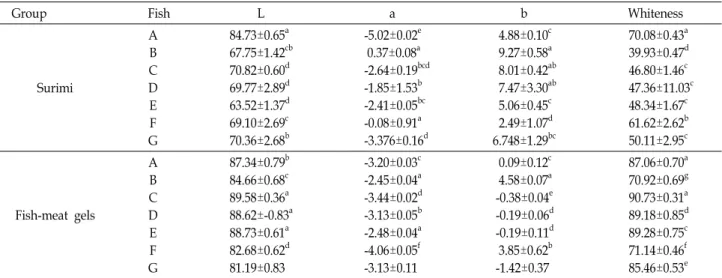
One of the main properties of the quality surimi and sur- imi-based products is the whiteness. Therefore, several color values of Alaska Pollock and farmed-fish products, partic- ularly whiteness values were compared. Whiteness of the surimi and fish-meat gels is a crucial property for a desired final product. Hence, most of the surimi manufacturing processes include addition of whitening agents in order to reach a defined whiteness level of Alaska Pollock meat [25].
We have compared the five kinds of farmed-fish surimi and
fish-meat gels with Alaska Pollock surimi and fish-meat gels
according to Hunter color values (Table 1). All compared
fish species had a higher whiteness value than RA grade
Table 1. Hunter color values of surimi and fish-meat gels prepared from farmed-fish
Group Fish L a b Whiteness
Surimi
A B C D E F G
84.73±0.65a 67.75±1.42cb 70.82±0.60d 69.77±2.89d 63.52±1.37d 69.10±2.69c 70.36±2.68b
-5.02±0.02e 0.37±0.08a -2.64±0.19bcd -1.85±1.53b -2.41±0.05bc -0.08±0.91a -3.376±0.16d
4.88±0.10c 9.27±0.58a 8.01±0.42ab 7.47±3.30ab 5.06±0.45c 2.49±1.07d 6.748±1.29bc
70.08±0.43a 39.93±0.47d 46.80±1.46c 47.36±11.03c 48.34±1.67c 61.62±2.62b 50.11±2.95c
Fish-meat gels
A B C D E F G
87.34±0.79b 84.66±0.68c 89.58±0.36a 88.62±-0.83a 88.73±0.61a 82.68±0.62d 81.19±0.83
-3.20±0.03c -2.45±0.04a -3.44±0.02d -3.13±0.05b -2.48±0.04a -4.06±0.05f -3.13±0.11
0.09±0.12c 4.58±0.07a -0.38±0.04e -0.19±0.06d -0.19±0.11d 3.85±0.62b -1.42±0.37
87.06±0.70a 70.92±0.69g 90.73±0.31a 89.18±0.85d 89.28±0.75c 71.14±0.46f 85.46±0.53e L*, lightness; a*, redness/greenness; b*, yellowness/blueness; W, whiteness.
a-eValues with different letters in the column indicate statistically significant differences at the p<0.05 level, according to Duncan's multiple-range test.
A, FA grade Alaska Pollock (Theragra chalcogramma); B, RA grade Alaska Pollock (Theragra chalcogramma); C, bastard halibut (Paralichthys olivaceus); D, Red sea bream (Pagrus major); E, Korean rockfish (Sebastes schlegeli); F, Common mulle (Mugil cephalus);
G, Finespotted flounder (Pleuronichthys cornutus).
Alaska Pollock but there was not any notable whiteness comparable to FA grade in surimi. However, in case of fish-meat gels, whiteness of P. olivaceus, P. major and S. sche- geli were 90.73±0.31, 89.18±0.85 and 89.28±0.75 while the whiteness of FA grade Alaska Pollock fish-meat gel was 87.06±0.70. The whiteness of the processed surimi is known to change depending on heating process, salt concentration and whitening agent addition. As seen on Table 1, pro- duction of fish-meat gel increased the whiteness values notably. Although surimi whiteness values of farmed-fish were only comparable to RA grade Alaska Pollock, final product of fish-meat gel provided results better than FA grade Alaska Pollock for three of the fish, while remaining two were still had higher values than RA grade Alaska Pollock. There are several methods such as addition of whitening agents such as calcium carbonate, titanium diox- ide [1], plant-based proteins and modified heating processes to increase the whiteness of surimi and fish-meat gels in or- der to obtain a desirable final product when Alaska Pollock was substituted [8]. Fish-meat gels produced using P. oliva- ceus, P. major and S. schlegeli had the color values better than FA grade Alaska Pollock gels without the addition of any extra agents or protein additives. Whiteness of afore- mentioned farmed-fish gels were 90.73, 89.18 and 89.28, re- spectively, according to Hunter color scale while FA grade Alaska Pollock had a whiteness value of 87.06. Also, in terms
of lightness P. olivaceus, P. major and S. schlegeli were ob- served to have values of 89.58, 88.62 and 88.73, respectively, compared to 87.34 value of FA grade Alaska Pollock.
Gel properties
Gel properties of raw surimi and final surimi product are main characteristics for measuring the quality of the product and the efficiency of production methods. Desired character- istics of final surimi product, particularly following the gel- ling process with heating and salting are defined in terms of gel strength, breaking force and deformation [14]. First, gel properties of surimi products from Alaska Pollock and farmed-fish were compared (Fig. 1). Raw surimi ought to possess lower gel strength and elasticity compared to fish-meat gels prepared from surimi. Gel strength of FA and RA grade Alaska Pollock surimi was higher than all of the farmed-fish while only P. olivaceus and P. major were able to show close gel strength to RA grade Alaska Pollock. Same manner was observed with breaking force and deformation levels with exception of M. cephalus which exhibited a three- fold higher breaking force than all other surimi products.
Surimi is produced to be used for further production of seafood products, mainly following a heat-set gelling proc- ess with salt and heat bath which induce the formation of actomyosin gel from myofibrillar part of the surimi [14].
Heating process and addition of salt are known to give the
Fig. 1. Gel strength of surimi prepared with five different farmed-fish species and Alaska Pollock. A, FA grade Alaska Pollock (Theragra chalcogramma); B, RA grade Alaska Pollock (Theragra chalcogramma); C, bastard halibut (Paralichthys olivaceus); D, red sea bream (Pagrus major); E, Korean rockfish (Sebastes schlegeli); F, Common mulle (Mugil cephalus); G, Finespotted flounder (Pleuroinchthys cornutus). Values are means±SD (n=3). a-e Means with the different letters are significantly different (p<0.05) by Duncan’s multiple range test. g/cm2=area value of plunger
Fig. 2. Gel properties of fish-meat gels prepared using five different farmed-fish species and Alaska Pollock. A, FA grade Alaska Pollock (Theragra chalcogramma); B, RA grade Alaska Pollock (Theragra chalcogramma); C, bastard halibut (Paralichthys olivaceus);
D, red sea bream (Pagrus major); E, Korean rockfish (Sebastes schlegeli); F, Common mulle (Mugil cephalus); G, Finespotted flounder (Pleuroinchthys cornutus). Values are means±SD (n=3). a-f Means with the different letters are significantly different (p<0.05) by Duncan’s multiple range test.
texture to fish-meat gels through this protein degradation.
Therefore, the gel properties of fish-meat gel from Alaska Pollock and farmed-fish were compared as well (Fig. 2).
Expectedly, preparation of fish-meat gels provided the gel-
ling along with strength and elasticity. Low quality Alaska
Pollock was, however, showed a very less elevation in gel
Table 2. Texture profile of fish-meat gels prepared with five different kinds of farmed-fish
Fish Hardness (g/cm2) Springiness (%) Cohesiveness (%) Chewiness (g) Brittleness (g) A
B C D E F G H
561.9±39.6a 156.9±7.3e 501.4±11.2b 557.6±12.5ab 380.3±18.6c 299.9±17.2d 284.1±12.3d 537.1±20.5ab
88.3±1.4a 62.5±4.0a 89.1±1.8a 86.4±5.3a 86.8±2.8a 86.8±0.4a 85.8±0.1b 87.2±3.3a
71.2±2.1ab 22.8±1.4d 69.3±1.4ab 71.8±0.1cd 65.1±1.5bc 61.4±5.1c 67.3±4.1abc 73.6±3.9a
1,881.5±346.1a 86.5±8.4be 1,198.4±63.6bc 1,494.0±104.7ab 919.6±93.4cd 703.9±6.7b 635.0±94.8d 1,705.9±113.7a
166,055±3,0649a 5,420±871e 106,853±7,765bc 128,803±1,092ab 81,195±7,594cd 61,116±335d 54,513±8,169d 148,467±14,764a
a-eValues with different letters in the column indicate statistically significant differences at the p<0.05 level, according to Duncan's multiple-range test.
A, FA grade Alaska Pollock (Theragra chalcogramma); B, RA grade Alaska Pollock (Theragra chalcogramma); C, bastard halibut (Paralichthys olivaceus); D, Red sea bream (Pagrus major); E, Korean rockfish (Sebastes schlegeli); F, Common mulle (Mugil cephalus);
G, Finespotted flounder (Pleuronichthys cornutus).
properties while producing the fish-meat gels from raw surimi. On the other hand, both P. olivaceus and P. major gels were observed to gain an important strength and elas- ticity exerted as gel strength and breaking force, respectively.
Strength and elasticity of P. olivaceus and P. major were stat- istically in the same level with FA grade Alaska Pollock.
Even though comparison of raw surimi properties showed a comparable quality for farmed-fish to RA grade Alaska Pollock, culture fishes were shown to be clinically provide same gelling quality with that of FA grade Alaska Pollock, doing so without inclusion of any additives or pro- tein extracts. Gel strength and elasticity are main character- istics of a quality and desired fish-meat gels in terms of pro- duction of commercial food based on raw surimi.
Fish-meat gels made from farmed-fish were shown to pos- sess the properties of Alaska Pollock products following the same processing methods inclusion of no other additives.
Although color and gel properties are important factors for both raw surimi and fish-meat gel, main point that makes Alaska Pollock desirable for surimi industry lies in the tex- ture profile of the final products [23]. High quality of Alaska Pollock as a favorable fish-meat gels source is mostly charac- terized by five different points such as hardness, springiness, cohesiveness, chewiness and brittleness. Therefore, farmed- fish gels were compared with FA and RA grade Alaska Pollock in terms of aforementioned criteria (Table 2). Alaska Pollock fish-meat gels texture profile is often accepted as a reference point for a desired fish-meat gel. Replacement of Alaska Pollock usually needs to go along with addition of soy or cattle protein extract and similar additives in order to match the Alaska Pollock gels texture profiles [4].
Comparison of farmed-fish suggested that fish-meat gels
prepared from farmed-fish could match the Alaska Pollock quality, not only in RA grade but also in FA grade. FA grade Alaska Pollock had hardness, springiness, cohesiveness, chewiness and brittleness of 561.9±39.6(g/cm
2), 88.3±1.4(%), 71.2±2.1(%), 1881.5±346.1(g) and 166055±30649(g), respectively.
Overall comparison pointed out that P. olivaceus and P. major were two main contenders to match the high quality Alaska Pollock texture profile in fish-meat gel. P. olivaceus had 89.1±1.8(%) and 69.3±1.4(%) values for springiness and cohe- siveness, which are statistically similar level to that of FA Alaska Pollock, and in other criteria also notably close to reference values, too. Also, P. major exhibited 557.6±12.5(g/
cm
2), 86.4±5.3(%), 71.8±0.1(%), 1494.0±104.7(g) and 128803±
1092(g) values for hardness, springiness, cohesiveness, chew- iness and brittleness, respectively, which are all in statistical significance level in terms of likeliness of Alaska Pollock tex- ture profile.
Texture profile of the surimi products define the favor- ableness of the manufactured seafood and as important as the gel and color properties in the eyes of the customers.
Most of the surimi source substitutes such as beef, soy, crab
and squid protein did not possess the desired texture profile
although they had the proper gel strength and whiteness
due to addition of whitening and gelling agents. However,
heating process of fish-meat gels preparation affects the tex-
ture profile of raw surimi significantly along with pH and
salt concentration [5]. High quality texture profile of
farmed-fish, comparable to Alaska Pollock, provided val-
uable potential as the fish-meat gels kept the similar texture
profile of high grade Alaska Pollock following heating and
salting process.
Fig. 3. Expressible moisture of fish-meat gels prepared using five different farmed-fish species and Alaska Pollock. A, FA grade Alaska Pollock (Theragra chalcogramma); B, RA grade Alaska Pollock (Theragra chalcogramma); C, bastard halibut (Paralichthys olivaceus); D, red sea bream (Pagrus major); E, Korean rockfish (Sebastes schlegeli); F, Common mulle (Mugil cephalus); G, Finespotted flounder (Pleur- oinchthys cornutus). Values are means±SD (n=3). a-e Means with the different letters are significantly different (p<0.05) by Duncan’s multiple range test.
Protein patterns
Although fish-meat gels from farmed-fish could possess the Alaska Pollock fish-meat gels’ texture profile and gel properties, protein profiles would defined the quality of the final product in the seafood industry. Fish-meat gels made from farmed-fish were shown to be able to compete with the FA grade Alaska Pollock in fish-meat gels production, owing to their comparable attributes in color, gel and texture properties. However, in order to provide a full insight on whether farmed-fish is an acceptable substitute to Alaska Pollock, protein profiles were compared with Alaska Pollock.
Fish-meat gels are prepared through the degradation of myofibril parts of the fish muscle and forming actomycin gels. However, these changes in protein profile come with a drastic change in the water-holding capacity of the meat.
Water is mainly hold in meat through protein bindings, es- pecially by myofibrils [9, 17]. Retaining the moisture is argu- ably the one of the most important quality criteria for raw meat products. Hence, we have compared the water-holding capacities of fish-meat gels prepared from farmed-fish to gels prepared from Alaska Pollock by means of expressible moisture (Fig. 3). Expectedly, quality of Alaska Pollock was observed by expressible moisture as FA grade Alaska
Pollock gel was able to show twofold less expressible mois- ture content compared to RA grade Alaska Pollock. P. oliva- ceus gel showed a similar water-holding capacity to that of high grade Alaska Pollock along with S. schlegeli. Among the rest, P. major had the highest water-holding properties.
All farmed-fish had lower expressible moisture content than RA grade Alaska Pollock.
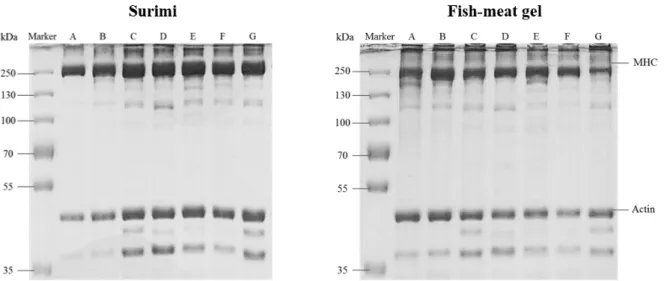
In addition to expressible moisture, SDS-page protein pro- files of farmed-fish and Alaska Pollock were compared in order to observe the protein quality of farmed-fish in com- parison with FA and RA grade Alaska Pollock (Fig. 4).
Results indicated that both surimi and fish-meat gel from farmed-fish had the sufficient fish protein to be comparable to Alaska Pollock surimi and fish-meat gel. Content of the fish protein in surimi and fish-meat gels are directly linked with their value as a food. Nutritious properties of commer- cial surimi products were defined by their fish protein con- tents [24]. Molecular weight based SDS-PAGE analysis is a common method to show the protein patterns in order to detect the fish protein as well as addition of other protein source [6]. Surimi protein pattern indicated that P. olivaceus, P. major and S. schlegeli had higher fish protein content com- pared to both FA and RA grade Alaska Pollock (Fig. 4A).
However, production of gels from surimi changed the pro- tein content balance too, as heating and salt were expected change the protein content (Fig. 4B). Nonetheless, fish pro- tein levels of fish-meat gels were still in close proportion to that of FA grade Alaska Pollock in terms of P. olivaceus and P. major gels. Other fishes were not comparable to FA grade but exhibited a protein pattern comparable to RA grade Alaska Pollock. Actin levels also indicated the gel pro- duction process affected the properties of surimi probably due to heating and salting.
In summary, surimi and fish-meat gel production require a defined set of quality criteria to match in order to be favor- able in both manufacture and consumption levels. Alaska Pollock is in high demand for fish-meat gels production due to its refined color, gel, texture profiles and protein pattern.
However, declining Alaska Pollock catch due to overfishing
direct the manufacturers to substitutes. Addition of whiten-
ing agents and different protein sources were adapted in or-
der to produce surimi products without relying on white-
meat fish sources. However, addition of these non-fish pro-
tein and additives also come with affected texture and pro-
tein profiles for end products. Up to date, several freshwater,
sea and farmed-fish have been studied for surimi production
Fig. 4. SDS-PAGE protein pattern of surimi and fish meat gels prepared from five different farmed-fish species and Alaska Pollock.
A, FA grade Alaska Pollock (Theragra chalcogramma); B, RA grade Alaska Pollock (Theragra chalcogramma); C, bastard halibut (Paralichthys olivaceus); D, red sea bream (Pagrus major); E, Korean rockfish (Sebastes schlegeli); F, Common mulle (Mugil cephalus);
G, Finespotted flounder (Pleuroinchthys cornutus).
and compared to Alaska Pollock in terms of quality.
Although the overall quality has been somewhat matched with the other white meat fish, high quality surimi has not been successfully substituted with other fish species apart from sea-origin white meat fishes [16, 26]. Aquaculture farm- ing of several fish species provides an easy way to obtain seafood sources without depending on wild catch. Surimi production is also being introduced with farmed-fish to re- place Alaska Pollock. Current study showed that, surimi and fish-meat gels prepared from farmed-fish, particularly P. oli- vaceus and P. major provided valuable meat for surimi and fish-meat gels production. Both species were resulted in sur- imi which matches the whiteness and gel quality of Alaska Pollock FA grade surimi. Also, protein patterns and texture profiles of culture fish-meat gels were in that same quality of Alaska Pollock and in more favorable properties than that of earlier studies species [15]. In conclusion, aquaculture farming of fish can be an efficient solution for providing sustainable and quality alternatives to Alaska Pollock in sur- imi production.
Acknowledgement
This research was financially supported by the Ministry of Oceans and Fisheries, Korea through the research project entitled “Development of high quality of aquacultural fish processing technique via texture improvement of fish-meat noodle (20140320)”.
References
1. Benjakul, S., Visessanguan, W. and Kwalumtharn, Y. 2004.
The effect of whitening agents on the gel-forming ability and whiteness of surimi. Int. J. Food Sci. Technol. 39, 773-781.
2. Benjakul, S., Visessanguan, W. and Srivilai, C. 2001. Gel properties of bigeye snapper (Priacanthus tayenus) surimi as affected by setting and porcine plasma proteins. J. Food Qual.
24, 453-471.
3. Bostock, J., McAndrew, B., Richards, R., Jauncey, K., Telfer, T., Lorenzen, K. and Corner, R. 2010. Aquaculture: global status and trends. Phil. Trans. R. Soc. B. 365, 2897-2912.
4. Campo-Deaño, L. and Tovar, C. 2009. The effect of egg albu- men on the viscoelasticity of crab sticks made from Alaska Pollock and Pacific Whiting surimi. Food Hydrocolloid. 23, 1641-1646.
5. Cardoso, C., Mendes, R., Vaz-Pires, P. and Nunes, M. L.
2010. Effect of salt and MTGase on the production of high quality gels from farmed sea bass. J. Food Eng. 101, 98-105.
6. Chinabhark, K., Benjakul, S. and Prodpran, T. 2007. Effect of pH on the properties of protein-based film from bigeye snapper (Priacanthus tayenus) surimi. Bioresour. Technol. 98, 221-225.
7. Daniel, C. R., Cross, A. J., Koebnick, C. and Sinha, R. 2011.
Trends in meat consumption in the USA. Public Health Nutr. 14, 575-583.
8. Duangmal, K. and Taluengphol, A. 2010. Effect of protein additives, sodium ascorbate, and microbial transglutaminase on the texture and colour of red tilapia fish-meat gels. Int.
J. Food Sci. Technol. 45, 48-55.
9. Huff-Lonergan, E. and Lonergan, S. M. 2005. Mechanisms of water-holding capacity of meat: The role of postmortem biochemical and structural changes. Meat Sci. 71, 194-204.
10. Huynh, M. D. and Kitts, D. D. 2009. Evaluating nutritional
quality of pacific fish species from fatty acid signatures. Food Chem. 114, 912-918.
11. Jin, S. K., Kim, I. S., Kim, S. J., Jeong, K. J., Choi, Y. J. and Hur, S. J. 2007. Effect of muscle type and washing times on physico-chemical characteristics and qualities of surimi. J.
Food Eng. 81, 618-623.
12. Keskin, E. and Atar, H. H. 2012. Molecular identification of fish species from surimi‐based products labeled as Alaskan Pollock. J. Appl. Inchtyol. 28, 811-814.
13. Laemmli, U. K. 1970. Cleavage of structural proteins during the assembly of the head of bacteriophage T4. Nature 227, 680-685.
14. Lanier, T. C., Yongsawatdigul, J. and Carvajal-Rondanelli, P. 2013. Fish-meat gelsation Chemistry, pp. 101-140. In:
Park, J. W. (ed.), Surimi and surimi seafood. CRC Press: Boca Raton, FL, USA.
15. Luo, Y. K., Kuwahara, R., Kaneniwa, M., Murata, Y. and Yokoyama, M. 2001. Comparison of gel properties of surimi from Alaska Pollock and three freshwater fish species:
Effects of thermal processing and protein concentration.
Food Sci. 66, 548-554.
16. Morales, O. G., Ramirez, J. A., Vivanco, D. I. and Vazquez, M. 2001. Surimi of fish species from the Gulf of Mexico:
evaluation of the setting phenomenon. Food Chem. 75, 43-48.
17. Offer, G. and Trinick, J. 1983. On the mechanism of water holding in meat: the swelling and shrinking of myofibrils.
Meat Sci. 8, 245-281.
18. Oken, E., Choi, A. L., Karagas, M. R., Mariën, K., Rheinberg- er, C. M., Schoeny, R. and Korrick, S. 2012. Which fish should I eat? Perspectives influencing fish consumption choices. Environ. Health Perspect. 120, 790.
19. Olsen, R. L. and Hasan, M. R. 2012. A limited supply of fishmeal: Impact on future increases in global aquaculture production. Trends Food Sci. Tech. 27, 120-128.
20. Pan, J., Shen, H. and Luo, Y. 2010. Cryoprotective effects of trehalose on grass carp (Ctenopharyngodon idellus) surimi during frozen storage. J. Food Process. Preserv. 34, 715-727.
21. Pietrowski, B. N., Tahergorabi, R., Matak, K. E., Tou, J. C.
and Jaczynski, J. 2011. Chemical properties of surimi sea- food nutrified with ω-3 rich oils. Food Chem. 129, 912-919.
22. Rawdkuen, S., Benjakul, S., Visessanguan, W. and Lanier, T. C. 2004. Chicken plasma protein affects gelation of surimi from bigeye snapper (Priacanthus tayenus). Food Hydrocolloid.
18, 259-270.
23. Shaviklo, A. R. and Fahim, A. 2014. Quality improvement of silver carp fingers by optimizing the level of major ele- ments influencing texture. Int. Food Res. J. 21, 283-290.
24. Shiku, Y., Hamaguchi, P. Y., Benjakul, S., Visessanguan, W.
and Tanaka, M. 2004. Effect of surimi quality on properties of edible films based on Alaska Pollack. Food Chem. 86, 493-499.
25. Taskaya, L., Chen, Y. C. and Jaczynski, J. 2010. Color im- provement by titanium dioxide and its effect on gelation and texture of proteins recovered from whole fish using iso- electric solubilization/precipitation. LWT-Food Sci. Technol.
43, 401-408.
26. Trondsen, T. 1998. Blue whiting surimi: new perspectives on the market value. Fish. Res. 34, 1-15.
27. Yoon, K. S. and Lee, C. M. 1990. Cryoprotectant effects in surimi and surimi/mince‐based extruded products. J.
Food Sci. 55, 1210-1216.
초록:해수어를 활용한 연제품의 제조 및 물리화학적 특성
김형광
1․김세종
1․파티카라데니즈
2․권명숙
3․배민주
3․고아
3․이슬기
3․장병근
1․정준모
1․김서연
1․
공창숙
2,3*
(1㈜늘푸른바다, 2신라대학교 해양식의약연구소, 3신라대학교 식품영양학과)