• 검색 결과가 없습니다.

Effect of Stabilizing Reversal Technique of Proprioceptive Neuromuscular Facilitation and Taping Convergence on Wrist Pain and Grip Strength

N/A
N/A
Protected

Academic year: 2021

Share "Effect of Stabilizing Reversal Technique of Proprioceptive Neuromuscular Facilitation and Taping Convergence on Wrist Pain and Grip Strength"

Copied!
8
0
0

로드 중.... (전체 텍스트 보기)

전체 글

(1)

*This paper was supported by the fund of Sahmyook University in 2018.

*Corresponding Author : JongEun Yim ([email protected]) Received May 16, 2018

Accepted July 20, 2018

Revised June 28, 2018 Published July 28, 2018

Effect of Stabilizing Reversal Technique of Proprioceptive Neuromuscular Facilitation and Taping Convergence on Wrist Pain

and Grip Strength

Beom-Ryong Kim 1 , Dong-Hyun Yi 1 , JongEun Yim 2*

1

Sahmyook University Graduate School

2

Dept. of Physical Therapy, Sahmyook University

고유수용성신경근촉진법의 안정적 반전기법과 테이핑 융합이 손목통증과 악력에 미치는 영향

김범룡1, 이동현1, 임종은2*

1
삼육대학교 일반대학원,

2

삼육대학교 물리치료학과

Abstract This study investigated the effect of wrist taping (WT) after application of stabilizing reversal technique (SRT) of proprioceptive neuromuscular facilitation (PNF) on pain and grip strength (GS) in patients with wrist pain (WP). Twenty patients with WP were randomly assigned to an experimental group (n=10) that received WT after application of SRT, and a control group (n=10) that received WT after application of stretching. The total intervention time consisted of a maximum of 10 minutes including breaks, and was performed 5 times a week for 2 weeks. Pain reduction was measured using a visual analogue scale. GS was measured using a dynamometer. Within group changes in pain and GS were significant in both experimental and control groups (p<0.01). Between group changes in pain and GS were greater in the experimental group than in the control group (p<0.01). This findings indicate that SRT of PNF and WT convergence can be an effective intervention for patients with WP. Continued development of convergence interventions for patients with WP various conditions in practice, is suggested.

Key Words : Grip strength, Proprioceptive neuromuscular facilitation, Stabilizing reversal technique, Taping, Wrist pain

요 약 본 연구의 목적은 고유수용성신경근촉진법의 안정적 반전기법 후에 손목테이핑 적용이 손목통증환자의 통증과 악력에 미치는 영향을 융복합적으로 알아보기 위해 실시하였다. 손목통증환자 20명을 대상으로 안정적 반전기법 후에 손목 테이핑을 적용한 실험군(n=10)과 스트레칭 후에 손목테이핑을 적용한 대조군(n=10)으로 무작위 배정하였다. 전체 중재시간 은 휴식시간 포함 최대 10분으로 구성, 주 5회 2주간 시행하였다. 통증정도는 시각적상사척도로 측정하였고, 악력은 악력계 로 측정하였다. 중재결과, 집단 내 통증과 악력은 두 군 모두 유의한 변화가 있었고(p<0.01), 집단 간 통증과 악력은 실험군 이 대조군보다 효과적인 통증의 감소와 악력의 향상을 보였다(p<0.01). 그러므로 고유수용성신경근촉진법의 안정적 반전기 법과 손목테이핑 융합은 손목통증환자를 위한 효과적인 중재로 활용될 수 있으며, 다양한 손목통증환자를 위한 지속적인 융합중재개발이 요구된다.

주제어 : 악력, 고유수용성신경근촉진법, 안정적 반전기법, 테이핑, 손목통증

(2)

1. Introduction

Musculoskeletal impairment results from pain in the neck, shoulder, elbow, wrist, low back, pelvis, knee, and ankle is due to accumulation of injuries to muscles, bones, joints, ligaments, and nerves. Insufficient rest and application of excessive force with incorrect posture ultimately lead to impairment and pain [1].

Overuse injury is the result of direct or indirect effects on microvascular structures. In combination with tissue oxygen deficits, these injuries cause microdamage to collagen tissue during supramaximal exertion. Wrist overuse syndrome due to sports participation is very common. Overuse is the cause of injury in 20% to 50%

of athletes [2], and is common in racket sports (e.g., badminton and tennis), rowing, volleyball, handball, and gymnastics [3]. About 25% of all sports-related injuries occur in the fingers or wrists [4]. The most common result of wrist overuse is increased pain and muscle weakness due to sprain injury in 89.1% of cases [5,6].

In a study on patients with wrist pain (WP), Michlovitz et al. [7] were able to reduce pain and improve grip strength (GS) using continuous, low-level heat-wrap therapy. Choung et al. [8] were able to reduce pain and improve range of motion using self-mobilization with a strap. Hincapie et al. [9] were able to reduce pain in patients with chronic WP and improve neuromuscular control and functional outcomes following ligament injuries using proprioceptive realization and joint position sense retraining.

Proprioceptive neuromuscular facilitation (PNF) as a physical therapy technique can improve function by stimulating proprioceptive sense in muscles, tendons, ligaments, and joints [10]. PNF increases muscle strength, flexibility, and balance [11], and improves physical and motor function [12-14]. PNF is widely used for treatment of muscle, bone, and joint disorders, as well as central nervous system disorders following stroke [15-17]. Among PNF techniques, the stabilizing reversal technique (SRT) is based on Sherrington's principle of successive induction. SRT induces alternate

or co-contraction of agonists and antagonists without triggering motion or movement against resistance.

SRT is used to reduce pain caused by joint instability [18]. Sports taping (ST) can also stimulate proprioceptive sense, and promotes reattachment after muscle elongation [19]. On review of previous studies, Lee et al. [20] suggested that ST may reduce pain and improve GS in patients with thumb metacarpophalangeal injuries. Park and Kim [21]

showed improved GS and muscle activity with ST in adult women with lateral epicondylitis. Shamsoddini and Hollisaz [22] showed reduced pain and improved GS with ST in patients with tennis elbow. Kim and Kim [23] showed improvement in GS with application of ST to wrist extensor muscles in normal adults.

Accordingly, ST is considered useful for pain reduction and improvement in range of motion, strength, and muscle activity. Therefore, ST can be used for treatment of wrist pain and impaired GS. Most previous studies assessed ST for elbow pain, with few examining its use for the wrist. There are no reports of PNF treatment technique for the wrist. Therefore, this study aimed to provide basic data by investigating the effect of wrist taping (WT) after application of SRT of PNF on wrist pain and GS.

2. Materials and Methods

2.1 Participants

G-power software was used for the power analysis (G-Power software 3.1.2; Franz Faul, University of Kiel, Kiel, Germany). Data obtained from a pilot study involving three subjects from each group showed that a sample size of 8 subjects per group was required to achieve a power of 0.97 and an effect size of 2.04 at an α level of 0.05.

This study was conducted for 2 weeks from

November to December, 2017 in 20 participants from

the D hospital badminton club in J city. The subjects

who consented to participate following explanation of

(3)

the study were randomly assigned to an experimental group (n=10) that received WT after application of SRT of PNF and a control group (n=10) that received WT after application of stretching. The study was approved by the Institutional Review Board of the Sahmyook University (IRB No. 2-1040781-AB-N- 01-2017113HR) in Seoul.

The inclusion criteria for participation were: (1) persistent symptoms for more than 3 months; (2) tenderness and pain around the wrist; (3) a positive Shuck test, with painful resistance to finger extension [24]; and (4) a positive sitting hands test, with wrist pain when pushing off the armrests of a chair to suspend the body using only the hands for support [25].

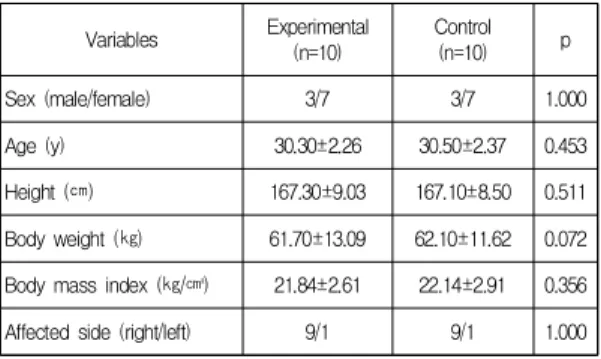
Patients were excluded for the following: (1) past history of arm fracture; (2) wrist osteoarthritis; or (3) oral administration or injection of anti-inflammatory agents to reduce wrist pain. Table 1 summarizes patient data.

Variables Experimental (n=10)

Control

(n=10) p

Sex (male/female) 3/7 3/7 1.000

Age (y) 30.30±2.26 30.50±2.37 0.453

Height (㎝) 167.30±9.03 167.10±8.50 0.511

Body weight (㎏) 61.70±13.09 62.10±11.62 0.072 Body mass index (㎏/㎠) 21.84±2.61 22.14±2.91 0.356

Affected side (right/left) 9/1 9/1 1.000

Values are presented as mean±standard deviation.

Table 1. General patient characteristics

2.2 Outcome Measurements 2.2.1 Pain

Pain reduction was measured with a visual analogue scale during wrist movement or wrist weighting during activity; 10 indicated severe pain and 0 indicated no pain, using a paper scale marked at 1-cm intervals.

This tool has high intra-rater and inter-rater reliability (Intraclass Correlation Coefficient=0.96) [26].

2.2.2 Grip strength

GS in the sitting hands test was measured using a dynamometer (Jamar Hydraulic Hand Dynamometer, Preston, USA), starting with the wrists in neutral position, the elbows at 90° flexion, and shoulders internally rotated with slight abduction [27]. This tool has high intra-rater and inter-rater reliability (Intraclass Correlation Coefficient=0.98) [28]. The mean value was determined from 3 measurements of 5 seconds without pain.

2.3 Intervention and Procedure 2.3.1 Stabilizing reversal technique

The SRT of PNF was performed with the subject in a hook-lying position on a treatment table, with the shoulder in 90° flexion, upper arm in neutral position, elbow extended, and forearm and wrist in neutral position. The therapist applied diagonal 1 (radial flexion and ulnar extension) and diagonal 2 (ulnar flexion and radial extension) techniques. Alternating SRT was performed starting with the flexors using a range of resistance that did not cause pain. SRT for the wrist was performed for 20 seconds, and repeated 5 times for each diagonal. The total intervention time consisted of a maximum of 10 minutes including rest time, 5 times a week for 2 weeks.

2.3.2 Stretching

Stretching was performed with the subject in a

hook-lying position on a treatment table, with the

shoulder in 90° flexion, upper arm in neutral position,

elbow extended, and forearm and wrist in neutral

position. The therapist again applied diagonal 1 and

diagonal 2 techniques. Alternating stretching was

performed using a range of elongation that did not

cause pain. Stretching for the wrist was performed for

20 seconds, and repeated 5 times for each diagonal. The

total intervention time consisted of a maximum of 10

minutes including resting time, 5 times a week for 2

weeks.

(4)

2.3.3 Wrist taping

WT was performed using one elastic tape (Benefact tape, NIPPON SIGMAX, Japan) about 15 cm long and two elastic tapes about 60 to 80 cm long. Elastic tape length varied according to forearm diameter. WT was performed with the subject in a hook-lying position on a treatment table, with the shoulder in 90° flexion, upper arm in neutral position, elbow extended, and forearm and wrist in neutral position. The therapist attached an elastic tape (60 to 80 cm long) to the affected side wrist in elongated posture of diagonal line 1 (radial flexion with finger flexion and finger extension) and diagonal line 2 (ulnar flexion with finger flexion and radial extension with finger extension).

Elastic tape about 15 cm long was wrapped around the wrist starting 3 cm from the snuffbox, with the wrist in isometric contraction in neutral position.

2.4 Statistical analysis

Statistical analysis was performed using SPSS/PC Statistics 18.0 software (IBM Corp., Armonk, NY, USA). The Shapiro-Wilk test was used to verify normal distribution of data. A paired t-test was performed to compare changes in pain and GS before and after intervention. An independent t-test was used to compare differences between experimental and control groups. Statistical significance was set at a p value of less than 0.05.

3. Results

3.1 Comparison of pain changes

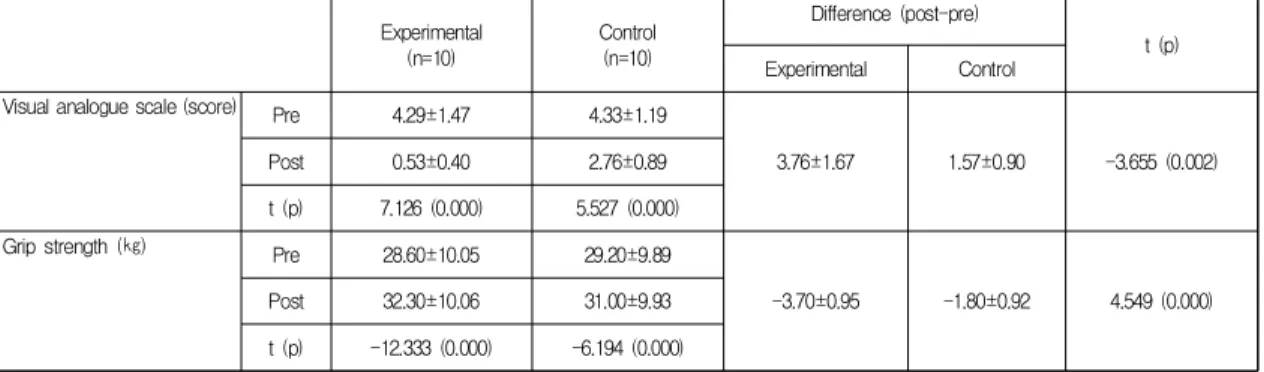
Within group changes in pain were significant in both experimental and control groups (p<0.01).

Between group changes in pain were greater in the experimental group than in the control group (p<0.01) (Table 2).

3.2 Comparison of grip strength changes Within group changes in GS were significant in both experimental and control groups (p<0.01). Between group changes in GS were greater in the experimental group than in the control group (p<0.01) (Table 2).

4. Discussion

This study was conducted in 20 adult male and female badminton players who complained of discomfort due to excessive wrist use. We divided the subjects into an experimental group of 10 that received WT after SRT of PNF, and a control group of 10 that received WT after stretching. The interventions were performed 5 times a week for 2 weeks, and the effects on pain and GS were assessed.

Excessive use of joints results in increased stress and damage to bones, ligaments, muscles, tendons, and nerves, as well as pain and reduced joint stability [29].

SRT of PNF technique can increase strength and

Experimental (n=10)

Control (n=10)

Difference (post-pre)

t (p) Experimental Control

Visual analogue scale (score) Pre 4.29±1.47 4.33±1.19

3.76±1.67 1.57±0.90 -3.655 (0.002)

Post 0.53±0.40 2.76±0.89

t (p) 7.126 (0.000) 5.527 (0.000)

Grip strength (㎏) Pre 28.60±10.05 29.20±9.89

-3.70±0.95 -1.80±0.92 4.549 (0.000)

Post 32.30±10.06 31.00±9.93

t (p) -12.333 (0.000) -6.194 (0.000) Values are presented as mean±standard deviation.

Table 2. Pain and grip strength before and after intervention

(5)

stability by enhancing cross resistance between agonist and antagonist muscles using very small motions in joints with pain due to instability with movement, or when joint stability and balance are reduced because of absence of isometric contraction between agonist and antagonist muscles [18,30]. Kim and Jung [31] were able to activate transversus abdominis and internal oblique abdominal muscles as well as lumbar deep muscles using PNF stabilization technique. PNF stabilization technique is considered an appropriate intervention to reduce pain and improve functional movement by increasing the stability of deep muscles in patients with low back pain. This study also showed reduced pain and improved GS in the experimental group using WT after application of SRT of PNF.

These results suggest that SRT of PNF may reduce weakness of the wrist antagonist muscles and improve stability and muscle strength as a result of pain reduction.

Lee et al. [20] showed significant reduction in pain in a comparison between groups after 2 weeks of ST intervention in 28 patients with thumb metacarpophalangeal joint injuries. Ro [32] showed significant reduction in pain after intervention with 4 weeks of ST in 40 patients aged 65 years or older with shoulder pain. Shamsoddini and Hollisaz [22] showed significant reduction in pain after intervention with ST in 30 patients with tennis elbow. In this study, pain was significantly reduced after intervention in the experimental group using WT after SRT of PNF and in the control group using WT after stretching. This result shows that the WT method in this study produced waves in the muscles attached to the tape when the attachment to the extensors and flexors of the wrist returned to normal position in the elongated posture of wrist movement in 4 directions. Muscle wave generation increased the space between skin and muscle, improving blood and lymphatic circulation [33].

It is thought that tension on the myotendinous junction helped to relax the muscles, and may have contributed to pain reduction. There was a significant reduction in

pain in the experimental group using WT after SRT of PNF compared to the control group. These results alternately activated wrist extensors and flexors with SRT of PNF, and the balance between agonist and antagonist muscles normalized with SRT of PNF [18].

Therefore, SRT of PNF seems to be more effective than stretching.

Kim et al. [34] used ST, Activator Methods Chiropractic Technique, and combined treatment in 30 patients diagnosed with lateral epicondylitis. After 2 weeks, GS showed significant improvement in all treatment groups. Kim and Kim [23] showed a significant improvement in GS after ST application to wrist extensors in 20 normal adults. Lemos et al. [35]

divided 75 adult women in to ST, tension ST, and control groups. After 24, 30, and 48 hours, GS was significantly improved in the ST group. In this study, GS improved significantly after intervention in both experimental groups using WT after SRT of PNF and in the control group using WT after stretching. There was a significant difference in GS in the experimental group using WT after SRT of PNF compared to the control group. These results indicate that subjects in this study had difficulty with GS due to wrist pain.

However, as the intervention proceeded, pain decreased and GS improved. Park and Kim [21] showed significant improvement in GS with ST in 22 patients with lateral epicondylitis. Muscle strength was improved with reduced muscle pain and facilitation of muscle activation with ST. This study and its application areas show different but valid results.

Thus, it was confirmed that WT after SRT of PNF effectively for reduced pain and improved GS.

Therefore, the application of WT after SRT of PNF for

overuse WP will have a positive effect by reducing

pain and improving GS. In general, PNF is thought to

be useful for patients with central nervous system

disorders. However, PNF is also applicable to patients

with other disorders. Further research is needed to

clarify these results.

(6)

5. Conclusion

This study effectively reduced pain and improved GS by applying WT after stretching or SRT of PNF in badminton players with WP due to overuse.

REFERENCES

[1] D. H. Lee, B. Kang, S. Choi, T. Kim, S. H. Jang, K. H.

Lee & S. H. Han. (2015). Change in musculoskeletal pain in patients with work-related musculoskeletal disorder after tailored rehabilitation education: A one-year follow-up survey. Annals of Rehabilitation Medicine, 39(5), 726-734.

DOI : 10.5535/arm.2015.39.5.726

[2] M. Pitner. (1990). Pathophysiology of overuse injuries in the hand and wrist. Hand Clinics, 6(3), 355-364.

[3] S. M. Fulcher, T. R. Kiefhaber & P. J. Stern. (1998).

Upper-extremity tendinitis and overuse syndromes in the athlete. Clinics in Sports Medicine, 17(3), 433-448.

DOI : 10.1016/s0278-5919(05)70095-8

[4] A. C. Rettig. (2003). Athletic injuries of the wrist and hand. The American Journal of Sports Medicine, 31(6), 1038-1048.

DOI : 10.1097/bco.0b013e3282f5557e

[5] A. H. Shariff, J. George & A. A. Ramlan. (2009).

Musculoskeletal injuries among Malaysian badminton players. Singapore Medical Journal, 50(11), 1095-1097.

[6] E. E. İnal, K. Demİrcİ, A. Çetİntürk, M. Akgönül & S.

Savaş. (2015). Effects of smartphone overuse on hand function, pinch strength, and the median nerve. Muscle

& Nerve, 52(2), 183-188.

DOI : 10.1002/mus.24695

[7] S. Michlovitz, L. Hun, G. N. Erasala, D. A. Hengehold &

K. W. Weingand. (2004). Continuous low-level heat wrap therapy is effective for treating wrist pain.

Archives of Physical Medicine and Rehabilitation, 85(9), 1409-1416.

[8] S. D. Choung, O. Y. Kwon, K. N. Park, S. H. Kim & H.

S. Cynn. (2013). Short-term effects of self-mobilization with a strap on pain and range of motion of the wrist joint in patients with dorsal wrist pain when weight bearing through the hand: a case series. Manual Therapy, 18(6), 568-572.

DOI : 10.1016/j.math.2013.06.001

[9] O. L. Hincapie, J. S. Elkins & L. Vasquez-Welsh. (2016).

Proprioception retraining for a patient with chronic wrist pain secondary to ligament injury with no structural instability. Journal of Hand Therapy, 29(2), 183-190.

DOI : 10.1016/j.jht.2016.03.008

[10] D. A. Klein, W. J. Stone, W. T. Phillips, J. Gangi & S.

Hartman. (2002). PNF training and physical function in assisted-living older adults. Journal of Aging and Physical Activity, 10(4), 476-488.

DOI : 10.1123/japa.10.4.476

[11] K. J. Hill, K. P. Robinson, J. W. Cuchna & M. C. Hoch.

(2016). Immediate effects of PNF stretching programs compared to passive stretching programs for hamstring flexibility: a critically appraised topic. Journal of Sport Rehabilitation, 26(6), 567-572.

DOI : 10.1123/jsr.2016-0003

[12] T. Akbulut & A. Agopyan. (2015). Effects of an eight-week proprioceptive neuromuscular facilitation stretching program on kicking speed and range of motion in young male soccer players. Journal of Strength and Conditioning Research, 29(12), 3412-3423.

DOI : 10.1519/jsc.0000000000001015

[13] J. Kim, J. Park & W. Choi. (2011). The effects of proprioceptive neuromuscular facilitation integrative pattern with elastic band training and weight training on isokinetic strength and balance in softball players.

International Journal of Sports Science & Coaching, 13(1), 243-249.

[14] H. S. Rhyu, S. H. Kim & H. S. Park. (2015). The effects of band exercise using proprioceptive neuromuscular facilitation on muscular strength in lower extremity.

Journal of Exercise Rehabilitation, 11(1), 36-40.

DOI : 10.12965/jer.150189

[15] N. Alaca, A. Atalay & Z. Güven. (2015). Comparison of the long-term effectiveness of progressive neuromuscular facilitation and continuous passive motion therapies after total knee arthroplasty. Journal of Physical Therapy Science, 27(11), 3377-80.

DOI : 10.1589/jpts.27.3377

[16] N. Kofotolis & E. Kellis. (2006). Effects of two 4-week proprioceptive neuromuscular facilitation programs on muscle endurance, flexibility, and functional performance in women with chronic low back pain. Physical Therapy, 86(7), 1001-1012.

DOI : 10.1093/ptj/86.7.1001

[17] B. R. Kim & H. J. Lee. (2017). Effects of proprioceptive

neuromuscular facilitation-based abdominal muscle

strengthening training on pulmonary function, pain, and

functional disability index in chronic low back pain

(7)

patients. Journal of Exercise Rehabilitation, 13(4), 486-490.

DOI : 10.12965/jer.1735030.515

[18] S. Adler, D. Beckers & M. Buck. (2007). PNF in practice: an illustrated guide. Verlag Berlin Heidelberg : Springer.

[19] H. Y. Cho, E. H. Kim, J. Kim & Y. W. Yoon. (2015).

Kinesio taping improves pain, range of motion, and proprioception in older patients with knee osteoarthritis:

a randomized controlled trial. American Journal of Physical Medicine & Rehabilitation, 94(3), 192-200.

DOI : 10.1097/phm.0000000000000148

[20] M. H. Lee, E. C. Kim, S. Y. Lee & R. J. Park. (2010). The effects of taping on metacarpophalangeal disorders of the thumb. Journal of Korean Society of Physical Therapy, 22(1), 33-38.

[21] J. H. Park & K. Kim. (2012). Initial effects of the non-elastic taping technique on grip strength and EMG in female with lateral epicondylalgia. Journal of The Korean Society of Physical Medicine, 7(4), 525-533.

DOI : 10.13066/kspm.2012.7.4.525

[22] A. Shamsoddini & M. T. Hollisaz. (2013). Effects of taping on pain, grip strength and wrist extension force in patients with tennis elbow. Trauma Monthly, 18(2), 71-74.

DOI : 10.5812/traumamon.12450

[23] J. Y. Kim & S. Y. Kim. (2016). Effects of kinesio tape compared with non-elastic tape on hand grip strength.

Journal of Physical Therapy Science, 28(5), 1565-1568.

DOI : 10.1589/jpts.28.1565

[24] D. T. Nguyen, F. C. McCue & S. E. Urch. (1998).

Evaluation of the injured wrist on the field and in the office. Clinics in Sports Medicine, 17(3), 421-432.

DOI : 10.1016/s0278-5919(05)70094-6

[25] T. Skirven. (1996). Clinical examination of the wrist.

Journal of Hand Therapy, 9(2), 96-107.

DOI : 10.1016/s0894-1130(96)80068-8

[26] B. S. Sindhu, O. Shechtman & L. Tuckey. (2011).

Validity, reliability, and responsiveness of a digital version of the visual analog scale. Journal of Hand Therapy, 24(4), 356-364.

DOI : 10.1016/j.jht.2011.06.003

[27] E. E. Fess & C. C. Moran. (1981). linical Assessment Recommendations. Indianapolis : American Society of Hand Therapists.

DOI : 10.1016/s0363-5023(81)80089-5

[28] C. Savva, G. Giakas, M. Efstathiou & C. Karagiannis.

(2014). Test-retest reliability of handgrip strength measurement using a hydraulic hand dynamometer in patients with cervical radiculopathy. Journal of

Manipulative and Physiological Therapeutics, 37(3), 206-210.

DOI : 10.1016/j.jmpt.2014.02.001

[29] C. H. Park, Y. S. Kwak & T. U. Kim. (2010).

Triathlon-related overuse injury and medical issues.

Journal of Life Sciences, 20(2), 314-320.

DOI : 10.5352/jls.2010.20.2.314

[30] J. W. Shin, S. M. Lee & J. J. Kim. (2015). The effects of stabilizing reversal and rhythmic stabilization in proprioceptive neuromuscular facilitation techniques on the static balance in normal female adult. PNF and Movement, 13(3), 119-125.

[31] Y. H. Kim & J. H. Jung. (2017). Effects of the PNF stabilization technique for the hip joint and the bridging exercise on the trunk stabilizer muscles in healthy adults. PNF and Movement, 15(1), 51-56.

[32] H. L. Ro. (2010). Effects of taping therapy and passive range of motion exercises on shoulder joint, hand dexterity in the elderly. Journal of the Korea Academia-Industrial cooperation Society, 11(7), 2468-2474.

DOI : 10.5762/kais.2010.11.7.2468

[33] M. A. Nakajima & C. Baldridge. (2013). The effect of kinesio® tape on vertical jump and dynamic postural control. International Journal of Sports Physical Therapy, 8(4), 393-406.

[34] E. Y. Kim, S. Y. Ma & W. T. Gong. (2008). The effects of taping, amct, combination treatment on the pain and grip strength in patient with lateral epicondylitis.

Journal of The Korean Society of Physical Medicine, 3(2), 103-112.

[35] T. V. Lemos, K. C. Pereira, C. C. Protássio, L. B. Lucas

& J. P. C. Matheus. (2015). The effect of kinesio taping on handgrip strength. Journal of Physical Therapy Science, 27(3), 567-570.

DOI : 10.1589/jpts.27.567

김 범 룡(Kim, Beom Ryong) [정회원]

▪2010년 2월 : 원광대학교 건강관리 학과 (체육학사)

▪2016년 2월 : 세한대학교 대학원 물리치료학과 (이학석사)

▪2017년 2월 ~ 현재 : 삼육대학교 대학원 물리치료학과 박사과정 중

▪관심분야 : 운동재활, 근골격계물리치료, 심장호흡물리 치료

▪E-Mail : [email protected]

(8)

이 동 현(Yi, Dong Hyun) [정회원]

▪2014년 8월 : 고려대학교 물리치료 학과 (이학사)

▪2017년 2월 ~ 현재 : 삼육대학교 대학원 물리치료학과 석박사과정 중

▪관심분야 : 노인낙상, 전정재활, 이 학적치료

▪E-Mail : [email protected]

임 종 은(Yim, Jong Eun) [정회원]

▪2005년 8월 : 삼육대학교 물리치료 학과 (이학사)

▪2007년 2월 : 삼육대학교 대학원 물리치료학과 (이학석사)

▪2012년 6월 : 로마린다대학교 대학 원 물리치료학과 (이학박사)

▪2012년 9월 ~ 현재 : 삼육대학교 물리치료학과 교수

▪관심분야 : 노인낙상, 전정재활, 이학적치료

▪E-Mail : [email protected]

수치

Table  1.  General  patient  characteristics
Table  2.  Pain  and  grip  strength  before  and  after  intervention

참조

관련 문서

Depending on Tennis Forehand Stroke with elbow pain and without elbow pain Kinematic Analysis of

Comparison of pain scale between the conventional and 2-step needle insertion technique according to the injection area ··· 11... The combination of pain scale and

Effect of pain control and improve function of knee joint applied to osteoarthritis by carbon surface-heating... Diagram of

The influence of age and gender on remifentanil EC 50 for preventing microemulsion propofol injection pain.. - Remifentanil EC 50 on propofol injection

surveillance study of patients with Emergency Department injuries under the control of the Korea Centers for Disease Control and Prevention (KCDC).Statistical

The associations of hepatic steatosis and fibrosis using fatty liver index and BARD score with cardiovascular outcomes and mortality in patients with new‑onset type 2

Gait status and lower extremity strength cannot be prop- erly evaluated in patients with hip fractures due to their pain and loss of walking ability at the time of injury.

Objective: This study aimed to analyze the prevalence and risk factors of neuromuscular complications after lung transplantation (LT), as well as the association