†: 이 논문은 2016학년도 배재대학교 교내학술연구비 지원에 의하여 수행된 것임.
Corresponding author: Shiyoung Lee, Dept. of Landscape Architecture, PaiChai University, Daejeon 302-735, Korea, Tel.: +82- 42-520-5881, E-mail: [email protected]
공동주택에서 치유조경계획을 위한 가이드라인 연구
†천현우*․이시영**
*배재대학교 조경학과 대학원․**배재대학교 조경학과
A Study on the Design Guidelines of Healing Landscape in Housing Complexes
Chun, Hyunwoo*․Lee, Shiyoung**
*Graduate School of Landscape Architectural Design, PaiChai University
**Dept. of Landscape Architecture, PaiChai University
ABSTRACT
As activities and convenience of residents in outdoor spaces in apartment houses have been considered important, strategies for making outdoor spaces in apartment houses healing spaces have emerged as a major interest. The purpose of this study is to draw elements for planning healing to create healing spaces in collective housing areas and to present design guidelines. The findings of this study are as follows. Functional elements of a healing environment were classified into safe environment, therapeutic environment, ancillary environment, orientation-reinforcing environment, amenities, and social environment. Outdoor spaces in collective housing areas were divided into collective housing entrance areas, internal and external spread areas, outdoor activity areas, and areas by theme. First, collective housing entrance areas should be planned in such a manner that residents can feel the area is private and easy to recognize. Second, internal and external spread areas should be planned in such a manner that they are easy to access and communicate with neighbors. Third, outdoor activity areas should be divided into an open space, resting space, playing space, and sports space. Open spaces should be planned in such a manner that they can command a fine view and respect the privacy of nearby residents. Resting spaces should be equipped with a shelter that protects users from direct sunlight, rain, and snow as well as include a movable bench. Playing spaces should be built considering development of children's curiosity, adventurous spirit, character, stimulation, and physical health. Playing spaces should be designed in such a manner that roadways and sidewalks can be separated for safe traffic. Sport spaces should be planned in such a manner that they can be associated with a pavilion and trail that provide residents with an opportunity to communicate with each other and rest. Fourth, spaces by theme are classified into sense garden, therapeutic garden, experiential garden, and learning garden. Sense gardens are a small garden based on the five senses. Sense gardens should be designed in such a manner that they can improve users' mental and physical health through programs that stimulate the sense of sight, auditory sense, and olfactory sense. Therapeutic gardens should be designed in such a manner that they can provide a comfortable and relaxing space by minimizing noise.
It is advisable for therapeutic gardens to be equipped with a medicinal herb garden, meditation garden, and sense garden.
Experiential and learning gardens should be designed in such a manner that they can provide users with a space in which
they can enjoy nature and leisure activities. It is advisable for experiential and learning gardens to be equipped with a tea garden, vegetable garden, and camping garden. Healing programs should be designed in such a manner that users can feel relaxed by providing a healing environment, making the most of the natural environment. Further research on evaluating whether the findings of this study are effective in healing in a qualitative and quantitative manner is needed.
Key Words: Healing Landscape Architecture Plan, Healing Environment, Design Guideline, Apartment Landscape Architecture
국문초록
본 연구는 공동주택단지를 대상으로 하여 외부의 조경공간을 통해 치유환경을 제공하여 치유기능을 높이기 위한 조경계획방안을 제시하고자 한다. 본 연구를 통해 지속적으로 늘어나고 있는 집합주거공간의 외부공간 조성에 있어 거주민들에게 생활환경을 높일 수 있는 기회와 함께 조경설계기법의 대안적인 기준을 마련한다는 점에서, 정형화되어 있지 못하고 있는 조경설계 분야의 새로운 가이드라인을 제공하는데 그 의미가 있다. 연구 방법으로는 기존 학자들의 치유정원에 관한 특성을 분석하여 공통적인 환경특성 요소들을 도출하고, 이를 바탕으로 기존 국내․외 문헌을 통하여 세부항목을 설정하며, 선행연구와 사례조사, 설문분석을 통해 치유조경계획 요소를 도출하였다. 치유환경의 기능적 계획 요소 6가지 항목을 설정하였다. 안전한 환경, 치료적 환경, 보조적 환경, 지남력 강화환경, 쾌적성, 사회적 환경으로 구분하 였고, 공간계획요소는 국내․외 사례고찰로 병원, 요양원, 숲 등을 대상으로 하여 육체적, 정신적 안정에 도움을 주기 위한 공간 및 시설을 도입하고 있는 것을 알 수 있었다. 계획요소로 공간계획, 동선계획, 포장계획, 수경계획, 식재계획, 시설계획, 프로그램으로 구분하여 계획요소를 도출하였다. 도출된 항목을 외부공간의 단지출입 영역, 내․외부 전이영역, 외부활동 영역, 테마별 공간영역으로 구분하고, 계획 요소로 공간계획에는 자연속 산책이 가능하고, 범죄로부터 안전, 다양한 휴게시설이 있도록 계획한다. 식재계획으로는 계절감을 느낄 수 있는 수목 식재, 촉각 미각, 후각을 자극하는 식물 식재, 풍부하고 다양한 식물 식재로 계획한다. 동선계획은 외부로부터 동선을 분리하고, 건강증진을 위한 산책, 지압로, 흙길 등 자연감상이 가능한 동선으로 계획한다. 포장계획은 위험에 쉽게 인식할 수 있고, 인공재료보다는 자연형 재료로 계획한다. 시설물계획은 취약계층을 위한 안내표, 강설시에도 이용할 수 있도록 쉘터 및 이동 가능한 벤치를 계획한다. 수 공간계획은 잔잔한 물 공간을 조망하는 사색 가능한 물시설과 분수 등 깔끔하고 도식적인 물시설로 계획한다.
치유프로그램으로는 휴식․명상을 취할 수 있으며, 요가, 산책 등 가벼운 운동을 위한 프로그램을 계획한다. 치유조경계획 요소를 도출하여 가이드라인을 제시하였으나, 계획요소와 계획내용들이 치유기능을 향상시키는데 효과가 있을지에 대한 정성적, 정량적 평가가 제한되어 이에 대한 연구가 추후 이루어질 필요가 있다.
주제어: 치유환경, 설계가이드라인, 아파트 조경
Ⅰ. 서론
자연환경에 대한 최근 트렌드는 보고 즐기는 웰빙의 시대를 지나 이를 적극적으로 체험하고 오감으로 조성하여 몸과 마음 을 치유하려는 회복환경의 역할을 기대하고 있다. 이는 현대사 회에서 인간이 자신의 심리적․신체적 스트레스를 감소시켜 원 래의 상태로 회복시키고, 건강을 증진시키는데 있어 자연환경 이 갖는 치유적 특성을 기대하기 때문이다(Kaplan and Kaplan, 1989).
이러한 치유개념을 이용하여 병원이나 요양원 등 신체적, 정 신적 장애를 가지고 있는 사람들을 위한 기관들에서 외부공간
에 치유환경 요소를 적용하여 정원을 조성하고, 이를 치료활동 의 하나로 이용하려는 추세가 점점 증가하고 있다. 또한, 도시 생활을 하는 현대인들은 삭막한 도시환경과 복잡한 사회구조 속에서 대부분이 정신적 스트레스 및 육체적 피로감을 받으며 살아가고 있어, 이를 해소하기 위해 가까운 거리의 공원이나 먼 거리의 자연환경을 찾아 활력을 얻고자 한다. 실제로 현대 인들이 스트레스로 인한 질병유발은 심각한 수준에 올라와 있 으며, 이러한 치유개념을 접목시킬 수 있는 환경의 조성이 요 구되고 있다.
최근 우리나라의 전체 주택 가운데 공동주택 아파트 비율은 과반수를 넘긴 후 꾸준히 증가하고 있다. 현대 조경공사의 대
부분이 공동주택단지에서 진행되고 있어 생활환경 개선에 있 어서도 외부공간을 다루는 조경의 역할이 매우 중요하다. 또 자연에 대한 동경과 쾌적한 생활에 대한 요구가 증가하여 환경 에 대한 관심과 생태적인 환경을 중요시하는 경향이 확대되고 있어 공동주택단지 조경의 중요성은 날로 높아지고 있다(Shin, 2010).
현대의 공동주택 주거공간은 입주민의 주거의 쾌적성과 활 동성에 대한 공동주택단지의 외부공간에 대한 활용성을 제고 하기 시작했으며, 최근 단지 내의 외부공간에 대한 치유환경으 로서 특성화 전략이 대두되기 시작했다. 그러나 현재 공동주택 을 대상으로 치유개념을 도입한 연구가 부족한 실정이다.
따라서 공동주택단지의 거주자들의 심리적, 신체적, 행동적 스트레스의 영향을 저감시켜 주거나, 치유해 줄 수 있는 치유 공간으로서의 외부환경계획이 필요한 실정이다. 본 연구는 공 동주택단지를 대상으로 하여 외부의 조경공간을 통해 치유환 경을 제공하여 치유기능을 높이기 위한 조경 계획 방안을 모색 한다. 이를 통해 공동 주택단지의 외부공간을 대상으로 치유효 과를 높이기 위해 계획단계에서 고려해야 할 계획요소와 공간 조성기법에 대한 연구를 통해 치유개념을 적용한 기초적 지침 을 제시하고자 한다.
Ⅱ. 이론적 고찰
1. 치유조경
치유란 환자에 초점을 맞춰 환경적, 심리적, 사회적, 문화적 지원을 통해 건강에 접근해가는 방법으로, 질병 상태뿐만 아니 라, 질병예방과 건강증진에까지 의미를 확대 해석할 수 있다 (Lee, 2009). 그러므로 치유조경은 조경의 개념에 치유를 적극 적으로 도입한 정원․조경의 형태일 뿐만 아니라, 원예치료 활 동에도 사용될 수 있도록 계획된 공간이라고 할 수 있다. 여러 시설물들을 이용하여 식물을 가꾸고, 수확, 관찰, 경험하는 과 정을 돕는 기능성 조경공간으로 말한다. 치유조경은 허약한 신 체와 마음을 본래 상태로 회복시키는 리듬을 이끌어내는 개념 을 포함하고 있다. 치유조경의 중요한 것은 ‘치료: Cure’의 의 미가 담겨져 있는 것보다 ‘치유: Healing’의 측면이 강조된다는 것이다. 치유적 공간을 조성함으로 암을 치료하거나, 부러진 다 리를 붙일 수는 없다. 하지만 이용자의 신체적․정신적 증상의 경감과 스트레스 감소, 편안함 제공, 오감 향상 등 건강회복 능 력을 증진시킴으로써 임상치료를 받을 수 있는 상태를 유지할 수 있다(Lee, 2012). 따라서, 치유조경 혹은 정원은 조경공간에 식재된 조경식물 또는 시설물들을 활용하여 사용자들의 신체 면역력을 높이고 신체적, 정신적 건강을 회복시키는 활동 공간 으로 질병의 치료행위가 아닌 건강유지를 돕고, 면역력을 높이
는 치유활동 공간으로 정의해 볼 수 있다.
숲, 식물 등 자연요소를 접했을 때 쾌적함을 느끼는 인간의 반응에 대해서 몇 가지 이론이 논의되고 있다. 생리진화적 이 론, 심리진화적 이론, 회복환경이론, 경험과 학습에 관한 이론 등이 대표적이다(National Institute of Forest Science, 2008).
이를 통해 숲, 식물 등 자연환경 요소는 쾌적함을 제공하여 인 간의 몸과 마음을 건강하게 만들어 주는 자연요법 등이 작용하 고 있음이 논리적으로 밝혀져 있다고 할 수 있다. 치유공간에 의한 치유효과를 문헌을 통해 살펴보면 전반적으로 우울증, 고 혈압, 아토피 등에 효과가 있는 것으로 알려져 있다. 즉, 우울증 상을 완화시키는데 효과가 있으며, 산책로, 숲길 등을 걷는 행 위를 통해 혈압을 낮추는데 도움을 주고 있다. 또한 수술 후 회 복속도를 높이는데 효과가 있는 것으로 알려져 있으며, 아토피 피부염, 천식 등의 호전에 도움을 주고 있다. 이렇게 치유조경 은 신체적 증상의 경감, 스트레스 감소, 안락수준의 제고, 오감 을 통한 웰빙(Well-being)의 향상을 준다. 이러한 치유조경은 원예활동과 경험에 의한 신체적․정신적 증상의 경감과 스트 레스 감소, 편안함 제공, 오감 향상 등 건강회복 능력을 증진시 킴으로써 임상치료를 지지하고, 나아가 사람들과의 사회적 접 촉을 도모함으로써 삶의 질을 향상시켜 주는 효과를 지니고 있 는 자연 치료적 의미의 치유공간이다(Marcus and Barnes 1999).
2. 공동주택단지 외부공간
아파트단지의 외부공간은 지난 30년간 많은 변화가 있었다.
1970년대는 주택시장의 변화와 현대건축운동의 영향이 있었으 며, 1980년대는 계속되는 주택시장의 변화와 외부공간과 관련 한 구체적 법조문의 변화로 녹지율이 증가하였다. 1990년대는 인구․사회구조 변화, 커뮤니티의식의 활성화, 사회․경제적 변화, 브랜드 도입을 통한 이미지 차별화 등 아파트 단지 외부 공간에 많은 변화를 겪었다. 2000년대에는 사회적 변화에 영향 으로 광장의 변화가 나타났다. 그 결과, 공간의 변화가 있었던 시점에는 사회 환경 변화의 영향 요소가 잠재되어 있었다. 이 러한 요소는 아파트단지 외부공간의 공간구조에도 영향을 미 치고 있음을 알 수 있으며, 아파트 단지 계획 시 사회적인 변화 와 소비자들의 욕구를 반영한 외부공간 설계는 소비자의 만족 을 이끔과 동시에 새로운 주거문화의 발전에 기여할 수 있을 것이다(Kong, 2009).
민간 건설사에서 정리한 최근 10년 동안의 아파트 외부공간 계획 트랜드는 2000년대 초기에는 식재를 강조한 계획에서 브 랜드 아이덴티티 부각 및 고급화 경향을 띄고 있다. 최근 참여 및 체험형 계획을 외부공간 계획의 특징적 요소로 명시하고, 주요 요소인 도시농업, 지피초화식재, 미술장식품과 연계한 가 드닝 공간조성 등을 선정하였다.
따라서 아파트단지 외부공간은 시대적 변화에 따라 1997년 이후 건설업체의 이미지 광고와 아파트 차별화 전략을 시도하 여 테마공원과 광장이 단지 곳곳에 도입되어 있거나, 녹지 공 간의 개선 및 확대를 통해 옥외공간을 공원처럼 꾸미고 있으며, 주민교류시설 확대, 보행자전용로 및 산책로 조성, 수경시설 등 다양한 시설물을 도입하는 등 변화하기 시작하였다. 현재 아파 트단지 조경공간은 크게 보행공간, 주차공간, 녹지공간, 교류공 간, 휴게공간, 체육공간, 기타공간으로 분류한다(Kimet al., 2005).
종합노인주거단지의 외부공간은 노인의 제 특성을 고려하여 단지출입영역, 건물입구영역, 내․외부 전이영역, 주차영역, 외 부활동영역으로 구분하였다(Hong, 2007).
아파트 단지의 외부공간과 종합노인주거단지의 외부공간의 비교로 종합노인주거단지는 물리적 안전과 심리적 안정추구, 다양한 활동을 통한 기능능력 유지, 사회적 교류의 기회 제공, 프라이버시 보호 및 공간의 개인화로 치유적 환경을 전제한다 (Table 1 참조).
3. 선행연구 고찰
치유공간 및 치유조경에 대한 선행연구들은 다음과 같다. 치 유에 대한 선행연구는 정원, 경관, 환경, 디자인에 관한 연구로 구분하였다.
정원에 관한 연구로서 Lee(2012)는 장애 아동을 위한 치유 정원 조성을 위한 가이드라인에 대한 연구를 하였는데, 이를
Classification Category Subsection
Exterior space of apartment
complexes
Walking area ․Introduction/application of safely facilities focused on pedestrians, generalization and application of pedestrian road in an apartment complex
Parking space ․Expansion of the underground parking lot and curved-type parking lot Green area ․Form a participating green area, Station a free-curve form green area and space Space for interaction ․Adding a space below pilotis, Adding a private square for residents
Resting/relaxation area ․Resting/relaxation space with a park and a square
Physical training area ․Gym/exercise facilities focused on difference ages, private health/exercise facilities for residents Others ․Introducing/adding pilotis and refined decoration outside of buildings, introducing/adding environ-
mentally friendly material
Exterior space of elderly apartment complexes
Apartment complex entrance area ․Pedestrian form, composition and form of a building, indicator/direction board Building entrance area ․Pedestrian form, indicator/direction board
Interior/exterior transition region ․Entrance/exit of a complex, driveway to an apartment complex entrance, outside space easily recognizable by elders
Parking area ․Entrance/exit area of an apartment complex
Outside activity area
Community space ․Conditions of a location(about facilities/environments that are already given at an apartment complex), navigating
Nature friendly space ․Main entrance/arrival place, driveway to an apartment building, refined outside space Health/fitness training pace ․Entrance/exit area of a building
View space ․Interior/exterior transition region Table 1. Exterior space types of apartment complexes and elderly apartment complexes
위해 치유정원 조성항목을 도출하고, 장애아동을 위한 치유정 원 지침을 작성하고, 검증 대상지 현화 조사를 통해 세부요소 도입을 위한 평가를 분석하였다. Parket al.(2008)은 전라북도 에 거주하는 여성 362명을 대상으로 치유정원의 이용희망정도 와 도입할 시설들을 대상으로 선호도를 파악하여 시장성을 분 석할 수 있었다. 이 외에도 Kimet al.(2007), Tak(2012), Lee (2013) 등이 연구를 진행하였다.
경관에 관한 연구로는 Min(2013)은 경상대학교 병원 주변 옥외공간을 치유경관의 개념을 통하여 경상대학교병원 외부공 간을 설계의 기본계획안으로 제시하였다.
환경에 관한 연구로는 Choi and Yang(2007)은 치매노인들 을 대상으로 감각자극환경 정도를 평가하고, 그 결과를 평가도 구로 이용하여 검증하였다. 감각자극을 공간이용행태를 통해 치유환경요인을 규명하고, 건축적 지침을 제시하였다. Kim and Im(2011)은 치유환경 구성요소 및 설계기준에 관한 연구를 진 행하였고, 서울대학교병원, 보라매병원, 서울아산병원, 서울성 모병원을 대상으로 종합병원 옥상정원을 대상으로 연구를 하 였다. 이 외에도 Sunget al.(2013), Song and Choi(2009), Marcus and Barnes(1999), Kaplan(1995) 등이 연구를 진행한 것을 알 수 있었다.
디자인에 관한 연구는 Shinet al.(2013)의 실버세대를 위한 치유디자인 요소 추출에 관한 기초 연구를 진행하였는데, 노인 복지관 환경 개선에 필요한 실버치유디자인 요소 추출에 관한 기초연구로 실버 치유 디자인의 개념을 정리하고, 치유 디자인
의 선행 연구를 분석하여 실버 치유디자인 요소를 추출하여 향 후 노인복지관에 치유디자인을 접목하고 활용할 수 있는 연구 를 진행하였다.
과거에는 대부분이 단순하게 건강한 공간을 조성하는데 목 적을 두었다면, 최근에는 직․간접적으로 건강을 회복하는데 도움을 줄 수 있거나, 치료에 도움이 되는 기능을 가진 공간으 로 건축물, 노인치매시설 등의 복지시설, 병원 등의 일상공간에 도입하려는 사례가 증가하고 있다. 치유적인 공간에 대한 연구 는 어떠한 대상을 통한 공간적 치유공간에 대한 연구가 주를 이루었으며, 전 연령대 및 장애인과 비장애인 등 함께 공동체 생활을 하는 아파트 등 집합주거단지로서의 치유공간에 관한 연구는 미진한 것으로 판단되었다. 또한 기존 연구들은 병원이 나 고령자, 신체적 부자유 등 육체적, 정신적 제약을 가지고 있 는 대상자를 주로 하였다면, 본 연구에서는 일반 거주민들을
Classification Category Major factors of a plan Reference
Spatial factor
Awareness
Unique display for each space focusing
on visual effects Min, 2013
Simple system for the flow of path (pedestrian road/road), land mark, simplification of functions
Cooper Marcus,
1999
Accessibility
Planning friendly and familiar entrances/
exits, openness, easily accessible wal- king roads, freely accessible outside space(open space), different width of streets and slopes for various people
Ulrich, 1999
Independence
A resting/relaxation area with opened ceiling to see the sky without inter- ference of other spaces, location of a “healing” space, scale, and material etc.
Min,2013
Territory focused on connectivity rather than complete privacy
Song and Choi, 2009
Naturalness
Connection with neighboring nature view, wild animal observation facility
Cooper Marcus,
1999 Vegetation that can show change
of seasons Min,
2013
Location
Preservation of local area, native tree species, original geographical features, and vegetation
Min, 2013 Familiarly designed space, traditional
sculpture Kim,
2010
Environmental
factor Comfort/
amenity
Adjust microclimate Cooper
Marcus, 1999 A clean, comforting space through stimulating sensory organs
Song and Choi, 2009 Table 2. Exterior space types of apartment complexes and elderly
apartment complexes
Therapeutic factor
Recovery
Garden program where people can ex- perience farms and stimulation of all the five senses; installing various hydroponics facilities, trails for taking a walk, a horticultural therapy, a park where one’s five senses are stimulated, a rehabili- tation center, playing-therapy space, and a garden of meditation
Min, 2013
Comfort
Creating a quiet and comfortable atmo- sphere, creating a familiar atmosphere like home, installing vegetation to promote therapeutic effects
Lee, 2012
Barrier-free
Connecting spaces without cars for people on wheelchairs or crutches, installing various information facilities for the disabled, packaging roads and slopes for patients, adjusting roads of a resting/
relaxation area and walking roads
Min, 2013
Stableness
Installation of soft and non-slippery materials for floors
Cooper Marcus, 1999 Application of light, water and plant-
based materials Kim, 2010
Installation non-toxic materials and ve- getation
Cooper Marcus, 1999
Behavior factor
Public space
Securing a space for education programs and hobbies, securing a public resting/
relaxation are for education programs and hobbies
Min, 2013
Promoting
activity Space for playgrounds, exercising, and hobbies
Kim and Park,
2010 Participatory
experience Performance square for participating music concerts etc.
Song and Choi, 2009 (Table 2. Continued)
대상으로 치유개념을 적용하고자 하는데 그 의미가 있다. 선행 연구의 치유공간계획요소의 공통요소를 공간적 요소, 환경적 요소, 치료적 요소, 행위적 요소로 구분하였다(Table 2 참조).
4. 사례분석
치료의 기능과 역할로 중점이 맞춰진 사례지인 요양원, 병원, 노인보건센터, 재활센터 등 치료의 효과가 극대화로 필요한 공 간에 많이 조성이 되어 있는 것을 알 수 있었다. 사례 연구는 요양원, 병원, 노인보건센터로 구분하여 치유정원의 개념을 도 입한 공간 사례를 살펴본다.
분석기법으로는 공간구성기법, 공간연결기법, 시설 기법으로 구분하여 각 사례지에 대입하여 분석하였다. 요양원 및 노인보 건센터의 공간구성 기법으로는 지형은 완화시켰고, 수목의 형
태는 열린 공간이며, 구조물의 형태는 테마를 접목시켜 조화롭 게 하였다. 병원의 경우는 지형의 변화가 과장되었으며, 수목의 형태는 위요된 공간으로 닫힌 공간을 조성하였다.
공간연결 기법으로는 계단과 휠체어환자를 위한 경사로를 제공하였다. 시설로는 물을 도입하였고, 국내의 사례로는 텃밭 을 사용하여 원예치료 프로그램을 도입하였다(Table 3 참조).
국내․외 사례를 토대로 치유 적용공간을 살펴본 결과, 병원, 요양원, 노인보건센터는 프로그램을 운영하여, 외부공간을 통 해 치유 및 치유효과를 얻고자 하는 것을 알 수 있다. 치료공간 으로써 옥외의 정원은 개인공간과 종합적 사회공간을 제공함 으로써 육체적, 정신적 안정에 도움을 주고 있다(Ahn et al., 2006). 현재 치유를 목적으로 조성되어 있는 조경공간 등은 기 존 대형건물의 부속 정원과 별다른 차이가 없이 정원에 단편적 인 구성요소만을 도입하고, 치유정원이라 명명하는 것에 그치 고 있는 실정이다(Kim and Im, 2011). 사례분석 결과, 다음과 같이 정리하였다.
첫째, 시설의 입지이다. 치유의 대상이 특정인 또는 일반인 등 어느 한쪽에 국한되지 않고, 자연조건이 우수한 지역 주변 에 입지하고 있다. 도심의 경우, 대규모 공원에 인접하거나, 교 외의 경우 대규모 자연녹지와 연계되어 정원, 공원이 위치하고 있다.
둘째, 치유 또는 힐링의 효과를 위해 외부와의 단절을 유도 하고 있다. 정서적․심리적으로 불안정한 상태의 사람들에게 단계적인 소통이 가능하도록 오픈 정도를 조절하는 기능을 마 련해 주고 있다.
셋째, 다양한 형태와 소리를 갖는 수경 요소의 도입이다. 공 간의 규모와 상관없이 물의 움직임과 투영, 소리 요소는 힐링 의 기본요소로 선행연구에서도 많은 연구가 진행되었다.
넷째, 동선형태는 회랑형이 많다. 회랑의 중심공간은 호수나
Classification
Techniques of composing a space Techniques of connecting spaces Facility techniques Change of
topography Composition
by trees Form of
structure Composition of
a court Connection by stairs
Continuous construction of
space Pavement Structure
Sanatorium (Seoul Dongbu Senior
Care Center)
Slight, alleviated
change Open space Balanced/
harmony Curved type,
open Stairs, slopes
Vertical construction joint(위계형/
연직 시공 이음)
Deck, urethane pavement, accupressure trail pavement
Safely handrail, gazebo with low wooden floor, pergola, vegetable garden Hospital
(The Prouty Terrace and Garden, Children’s
Hospital, Boston)
Stronger
change Closed space Balanced/
harmony Curved type,
open Stairs, slopes
Vertical construction joint(위계형/
연직 시공 이음)
Deck, stone pavement
Fountain, movable chair,
table
Senior Health Center (Seongnam Center of
Senior Health)
Slight, alleviated
change Open space Balanced/
harmony Linear type,
open Stairs, slopes
Horizontal construction joint(직선형/
수평 시공 이음)
Deck, stone pavement
Pergola, long bench (연식의자) Table 3. Exterior space types of apartment complexes and elderly apartment complexes
잔디광장 등 수평의 오픈공간이 있고, 세부 동선으로 원로의 높낮이나 굴곡, 열리고 닫힌 시야를 통해 내부공간의 깊이와 변화감을 유도한다.
다섯째, 자연속의 사적공간이다. 프라이버시가 강한 위요된 공간으로 커뮤니티보다는 정적인 혼자만의 공간이 나타났다.
여섯째, 다양한 감각으로 자연의 경험이다. 인간의 오감을 통해 자연과의 접촉을 활용한 프로그램으로 치료에 적극 반영 하고 있다.
일곱째, 식재계획으로 기존 수종을 최대한 활용하며, 중심이 되는 공간은 잔디나 지피, 화훼류를 활용한 오픈식재, 외곽이나 경계부는 침엽이나 교목을 활용한 차폐식재, 물요소 경계부의 수경식재, 화단식재 등을 적용하였다.
마지막으로 자연과의 자연스럽고 무리 없는 공간을 위해 유 니버설디자인의 적용이다. 휠체어나 거동이 불편한 이들의 편 안한 이용이 가능하도록 인공시설의 규격이나 높이, 경사 등 세심한 배려가 필요하다.
Ⅲ. 연구 방법
본 연구는 공동주택단지의 옥외공간에 적용할 치유조경계획 의 계획요소를 밝히고, 가이드라인을 제시하고자 한다. 연구방 법으로는 문헌조사 및 사례분석을 통해 치유환경과 치유조경 계획요소를 도출한다. 현재 공동주택단지의 거주민을 대상으로 현재 상태에서 느끼고, 요구하고 있는 치유기능과 향후 치유기 능을 높이기 위해서 필요로 하는 계획 방향들을 파악하고, 이 를 종합하여 공동주택단지의 외부공간별 치유조경계획을 적용 하여 가이드라인을 제안하였다.
본 연구의 문헌조사는 선행연구를 통해 치유조경계획요소를 도출하고자 기존 학자들의 치유조경에 관한 특성들을 분석하
여 공통적인 환경특성 요소를 도출하고, 이를 바탕으로 국내․
외의 문헌을 참조하여 세부항목을 설정하였다. 국내․외의 사 례분석으로는 병원, 요양원, 재활센터 등의 활용 예에서 공동주 택단지의 관점에서 치유조경계획의 요소를 공간계획, 동선계획, 포장계획, 수경계획, 식재계획, 시설계획, 프로그램으로 구분하 여 주요요소를 도출하였다. 도출된 치유조경계획요소를 적용하 기 위해 공동주택단지의 공간유형을 단지출입구, 내․외부 전 이영역, 외부활동영역, 테마별 공간영역으로 구분하였다.
현재 공동주택단지의 거주민을 대상으로 아파트단지 외부공 간의 이용목적과 현재 치유에 대한 인식과 필요성, 치유효과에 대한 반응정도를 파악하고, 단지 내 치유환경 조성을 위한 방 향 탐색을 위해서 식재, 공간, 동선, 포장, 수공간, 치유프로그 램 등을 어떠한 방향으로 계획하는 것이 필요한지를 묻고자 설 문조사를 실시하였다.
설문조사는 1차 예비설문과 2차 본 설문으로 나누어 진행하 였으며, 1차 설문을 통해 답변내용이 부정확한 설문문항 및 내 용수정(답변내용 중 기타항목 제외) 후 2차 설문을 실시하였 다. 1차 설문은 2015년 4월 11일 한밭수목원에서 아파트거주민 을 대상으로 30명에 실시하였으며, 2차 설문은 2015년 4월 18~19일 09~17시에 도안1․2단지 아파트 거주민 및 서대전 광장에서 아파트 거주민을 대상으로 실시하였다. 설문은 총 225부 중 194부의 유효설문을 회수하였고, 설문자료의 분석은 SPSS18.0(Statistics Package for Social Science 18.0)을 이용 하였다. 아파트 단지 내 외부공간의 이용목적, 아파트 단지 내 치유공간의 필요성, 치유공간의 계획 방향 등을 빈도분석을 실 시하였고, 치유조경 계획요소에 대한 중요도, 도입요소 중요도 는 기술통계분석을 실시하였다.
Ⅳ. 결과 및 고찰
1. 치유조경계획요소
치유조경의 계획요소는 대상을 어디에 두느냐에 따라 달리 적용해 볼 수 있을 것이다. 치유환경에 영향을 미치는 계획요 소를 개인적 요구, 물리적 환경, 행위의 3요소를 제시하였다 (Kaplan and Kaplan, 1989). 인간, 공간, 그리고 행위에 관련한 요소로 분류(Choi and Gim, 2002), 공간적 조건, 환경적 조건, 심리적 조건, 행위적 조건을 치유공간의 요소로 분류하기도 하 였다(Kim and Park, 2010). 그러나 이들 분류방식은 내․외부 공간 모두를 범용적으로 고려한 구분방식으로 볼 수 있어 공동 주택단지의 외부공간 중 조경공간을 대상으로 한 조경요소를 도출하기 위해서는 다른 분류방식으로 치유정원의 개념인 환 경적, 심리적, 사회적, 문화적 지원을 통한 질병예방과 건강증 진을 적극적으로 반영하기 위한 계획된 공간이다.
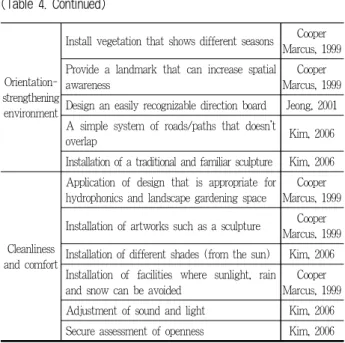
기존연구들을 토대로 안전 환경요소, 치료 환경요소, 보조적 환경요소, 지남력강화 환경요소, 쾌적성 환경요소, 사회적 환경 요소로 6가지 요소로 분류하여 기능적 계획요소들을 재정리하 도록 하였다. 선행연구를 통해 추출된 옥외공간의 기능적 치유 환경 요소는 Table 4와 같다.
Classification Content Reference
Safe environment
Installation of safe facilities for users Lee, 2012 A manager should be able to always monitor Jeong, 2004 Installation of non-toxic materials and vegetation Lee, 2012 Installation of soft and non-slippery material
for floors Cooper
Marcus, 1999
Installation of flat floors Cooper
Marcus, 1999
Therapeutic environment
Facilities and vegetations that promote thera-
peutic effects Lee, 2012
Vegetation with easily recognizable changes/
results such as flowers and fruits Shim, 1997 People being able to touch the facilities Shim, 1997 A plant that can endure frequent touches
from people Shim, 1997
Design a trail for taking a walk where people
can exercise Jeong, 2001
Plant/vegetation that makes sounds in wind Kang, 2002 Plant/vegetation with fragrance Lee, 2012 Plant different kinds of vegetation with rich
visuals Cooper
Marcus, 1999
Social environment
Installation of movable chairs(chairs that can
be relocated) Kim, 2006
Create a space for forming a small group Cooper Marcus, 1999 Provide a space for running/opening different
programs Cooper
Marcus, 1999
Auxiliary environment
Secure privacy Kim, 2006
Easier accessibility Shim, 1997
Installation of floor patterns that can lead/
induce movement Lee, 2012
Provide resting/relaxation area in regualr distance Cooper Marcus, 1999 If a road is made above water bodies, safety
handrail must be installed Shim, 1997 Introduce and apply Universal Design Park, 1992 Make it easier for people in a wheelchair or
medical equipments and elders Jeong, 2004 Design a passage’s width to be from 1.2m to
over 1.5m Cooper
Marcus, 1999 Install handrails that a person can grab to support
him/herself when sitting down or standing up Cooper Marcus, 1999 Secure a resting/relaxation area near the entrance Cooper
Marcus, 1999 Table 4. Environmental therapeutic factors
Orientation- strengthening environment
Install vegetation that shows different seasons Cooper Marcus, 1999 Provide a landmark that can increase spatial
awareness Cooper
Marcus, 1999 Design an easily recognizable direction board Jeong, 2001 A simple system of roads/paths that doesn’t
overlap Kim, 2006
Installation of a traditional and familiar sculpture Kim, 2006
Cleanliness and comfort
Application of design that is appropriate for
hydrophonics and landscape gardening space Cooper Marcus, 1999 Installation of artworks such as a sculpture Cooper
Marcus, 1999 Installation of different shades (from the sun) Kim, 2006 Installation of facilities where sunlight, rain
and snow can be avoided Cooper
Marcus, 1999 Adjustment of sound and light Kim, 2006 Secure assessment of openness Kim, 2006 (Table 4. Continued)
국내외 사례를 종합적으로 살펴볼 때, 적용공간은 병원, 요 양시설 등에 적용되고, 프로그램이 운영되고 있는 점을 통해
Category Major factors of a plan
Spatial planning
․Leading/inducing to connect to neighboring natural/green space
․Securing horizontally open spaces(lawn square, lake etc)
․Securing a small place of privacy in surroundings
․Appropriative landscape from inside of a building to outside
․Balanced scale of facilities in harmony with nature Planning of
a path’s circulation
(flow)
․Convenient circulation/flow of paths in all spaces
․Inducing a natural flow
․Promotion of convenience for elders(within 5% slope)
Pavement planning
․If it’s in its natural state, use it as it is(earth/sand, gravel, woodchip etc.)
․Usage of natural materials
․Think of visibility from surrounding buildings
Program ․Usage of space, outreach programs supporting different acti- vities(gardening therapy, gardening commentator/interpreter etc.)
․Regular events/special activities
Hydroponics planning
․Application of different types of water sound and form (lake, pond, streamlet etc.)
․Aquatic plant/vegetation near hydroponics
․Usage of biotope, existing swamp/wetland etc.
Vegetation planning
․Securing green vegetation in summer and sunlight in winter
․Open-vegetation for securing a clear view
․Border planting for distinguishing the outside of an apartment complex
․Vegetation that can stimulate all the five senses
․Vegetation that can show different seasons and change of time Facilities
planning
․Distinguishing exterior and interior space
․Promotion of convenience for different ages
․Designing facilities of integrating vegetation, vine, flowerpots etc.
․Multi-purpose facility
Table 5. Planned therapeutic elements deducted through case analysis
치유 및 치료효과를 정원 등 외부공간을 통해 얻고자 하는 것 을 엿볼 수 있다. 특히 정신질환자를 위한 치료프로그램의 일 환으로 옥외 레크레이션이 활동되었으며, 외부공간을 치료공간 으로써 정원은 독특한 개인공간과 종합적 사회공간을 제공함 으로써 육체적, 정신적 안정에 도움을 준 것으로 보고 있다 (Ahnet al., 2006).
지금까지 살펴본 치유특성을 고려한 조경계획을 공간계획, 동선계획, 포장계획, 수경계획, 식재계획, 시설계획, 프로그램계 획으로 분류하여 계획요소를 추출하였다. 사례분석을 통해 추 출된 치유계획요소는 Table 5와 같다.
2. 설문분석 1) 응답자 특성
설문 응답자 특성은 성별, 연령, 직업, 수입으로 구분하여 설 문조사를 실시하였다. 남자 48.5%, 여자 51.5%로 남녀비율은 유사하게 조사되었고, 연령은 20대 43.3%로 30대 23.2%, 40대 18.0%, 50대 9.3%, 60대 이상 6.2% 순으로 나타났다. 직업 및 수입은 Table 6과 같다.
2) 아파트단지 외부공간의 이용형태
Variable Category Frequency Percentage(100%)
Sex Male 94 48.5
Female 100 51.5
Age
20’s 84 43.3
30’s 45 23.2
40’s 35 18.0
50’s 18 9.3
Over 60’s 12 6.2
Job
Student 69 35.6
Specialized job 28 14.4
Office job 26 13.4
House wife 27 13.9
Technician 11 5.7
Service industrial employee 15 7.7
Sales position 4 2.1
Private business 12 6.2
Retired/unemployed 2 1.0
Income (in 1,000 KRW)
Less than 200 30 15.5
200~299 42 21.6
300~399 54 27.8
400~499 25 12.9
Over 500 43 22.2
Table 6. Respondents’ characteristics
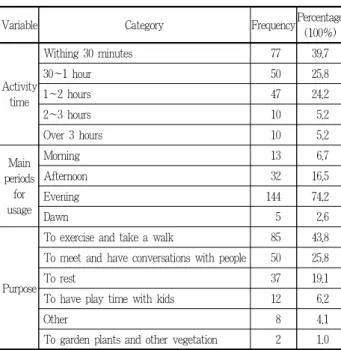
하루 평균 아파트 단지 외부공간의 이용시간, 외부공간의 이 용목적, 외부공간의 주 이용시간대에 대한 조사결과, 각 변수별 로 주로 하루 평균 아파트 단지 내 외부공간의 활동시간은 30 분 이내가 39.7%로 가장 많았고, 30분~1시간이 25.8%, 1~2시 간이 24.2%로 나타났다. 외부공간의 이용목적은 운동 및 산책 하기가 43.8%로 가장 많았고, 만남․담소를 나누기 25.8%, 휴 식이 19.1%, 아이 돌봄이 6.2%, 기타 4.1%, 경작 및 식물 가꾸기 가 1.0%로 가장 낮게 나타났다. 주 이용시간대는 저녁이 74.2%
로 가장 많았고, 점심 16.5%, 아침 6.7%, 새벽 2.6% 순으로 나 타났다. 이는 현대인이 일과시간 이후에 단지 내 외부공간을
Variable Category FrequencyPercentage
(100%)
Activity time
Withing 30 minutes 77 39.7
30~1 hour 50 25.8
1~2 hours 47 24.2
2~3 hours 10 5.2
Over 3 hours 10 5.2
periodsMain for usage
Morning 13 6.7
Afternoon 32 16.5
Evening 144 74.2
Dawn 5 2.6
Purpose
To exercise and take a walk 85 43.8
To meet and have conversations with people 50 25.8
To rest 37 19.1
To have play time with kids 12 6.2
Other 8 4.1
To garden plants and other vegetation 2 1.0 Table 7. Use-behavior analysis of respondents
Variable Requirements 1 Percentage
(100%) Requirements 2 Percentage
(100%) Therapeutic
function A facility and space for supporting promotion of
health through exercise 35.6 Space and facility for communication with neighbors
and families 26.8
Spatial planning A space available for taking a walk in nature 33.5 Enough space with resting facilities such as benches
and a gazebo 23.2
Vegetation planning Types of plants such as phytoncide that can calm
people 38.1 Vegetation that can show changes of seasons 23.2
Planning of a flow
of a path/road Installation of easily accessible resting facility in
walking paths 26.3 A flow of path for daily promotion of health such as a
walking path, accupressure trail, and etc. 25.8 Pavement planning Increase in usage of natural materials than synthetic
materials 38.7 Choosing non slippery materials 30.4
Planning of a space for water bodies/
facilities
Water facilities for meditation by designing a calm
atmosphere 32.5 Clean and urban-styled water facilities such as a fountain 25.3
Healing/therapeutic
program Meditation and silently relaxing programs within
nature of an apartment complex 38.7 Easy-exercise programs such as yoga, talking a walk
and physical training 27.3
Table 9. Direction of a plan for a “healing space”
이용하는 것을 알 수 있다(Table 7 참조).
3) 치유공간의 필요성
평소 스트레스를 받았을 때 아파트 외부공간의 산책로, 앉아 있기 등이 스트레스에 도움이 되는지와 아파트 단지 외부공간 에 치유기능․치유시설이 필요성을 분석하였다. 분석결과, 산 책이나 앉아있기 등이 스트레스에 도움이 된다가 69.6%로 나타 났고, 치유기능․치유시설의 필요 유무는 어느 정도 필요하다가 68.6%, 매우 필요하다가 26.8%로 응답자의 과반수가 치유기 능․치유시설을 필요로 하는 것으로 나타났다(Table 8 참조).
4) 치유공간의 계획방향
치유 공간의 계획방향은 아파트 단지 옥외공간의 치유환경 을 조성하기 위한 변수로 공간계획, 식재계획, 동선계획, 포장 계획, 수(水)공간 계획, 치유프로그램으로 각 변수별 중요한 사 항을 2가지 선택하도록 하였다.
분석결과, 치유기능으로는 운동을 통한 건강증진 지원 시설
Variable Category Frequency Percentage
(100%) Whether sitting,
taking a walk etc help in relieving
stress
Doesn’t help at all 1 0.5
Doesn’t help much 37 19.1
Does help 135 69.6
Does help a lot 21 10.8
Necessity of a
“healing”
space/facility
Don’t need at all 1 0.5
Don’t need much 8 4.1
Do need 133 68.6
Do need a lot 52 26.8
Table 8. Necessity of a “healing” space
이 35.6%, 이웃 또는 가족과의 교류를 위한 시설이 26.8%로 나 타났다. 공간계획에서는 자연 속 산책이 가능한 공간이 33.5%, 넉넉한 휴게시설이 23.2%로 자연 속 휴식할 수 있는 사색의 공 간을 필요로 하고, 식재계획으로는 심리적 안정요소를 배출하 는 식물이 38.1%, 사계절의 변화를 느낄 수 있는 수목 23.2%로 나타났다. 동선계획에서는 이동경로에 쉽게 이용하는 휴식시설 배치가 26.3%, 산책, 지압로 등 건강을 위한 동선이 25.8%로 나타났다. 포장계획에서는 자연형 재료 사용량 증대 38.7%, 미 끄럼방지를 위한 재료 30.4%로 안전한 환경을 요구하며, 수 공 간계획은 사색가능한 물시설 32.5%, 도시적 물시설 25.3%, 치 유프로그램은 휴식, 명상을 위한 프로그램이 38.7%, 요가, 산책 등 운동을 위한 프로그램이 27.3%로 나타났다(Table 9 참조).
5) 이용자 특성에 따른 계획요소
앞에서 설문조사 결과를 중심으로 이용자들이 요구하고 있 는 주요 계획요소들은 치유공간 조성시 쾌적한 환경제공, 심리 적 안정도모, 그리고 신체적 건강증진을 위한 공간과 시설도입 을 고려하는 것이 중요하다. 스트레스를 해소하고, 생활의 즐거 움과 건강회복에 도움을 줄 수 있도록 옥외공간을 조성한다.
치유기능을 높일 수 있도록 운동을 통한 건강증진 지원시설, 스트레스 해소를 위해 휴식 및 운동공간을 조성한다. 공용공간 에 설치된 치유공간 및 시설들은 타인에 의해 침해 우려가 있 으므로 프라이버시에 대한 고려가 필요하다.
설문조사를 통해 도출된 치유조경에 대한 이용자 특성과 인 식에 대한 분석결과를 토대로 공간배치계획, 식재, 동선, 포장, 수공간, 치유프로그램을 등의 분야별로 주요 계획요소를 종합 해 보면 Table 10과 같다.
Category Elements for the plan
Spatial planning ․Available space for talking a walk in nature
․Safe place from crimes or natural disasters
․Enough space with resting/relaxation facilities such as benches and a gazebo etc.
Vegetation planning ․Vegetation that shows the change of seasons
․Plants with calming-effects for people such as phytoncide
․Vegetation that can be designed with a natural view such as a forest
Flow of path planning ․A flow of path for daily promotion of health such as a walking path, accupressure trail, and etc.
․Installation of easily accessible resting/relaxation facilities in walking paths
․A walking path available for slowly-walking and viewing natural environments(ex. dirt path)
Pavement planning ․Choosing a non-slippery material that prevents from falling down or slipping
․Increase in use of natural materials instead of synthetic materials
․Pavement of floors that can create curiosity and enjoyment Planning of a space for water
bodies/facilities
․Facility available for experiencing refreshing sound of water
․Clean and urban-styled water facility such as a fountain
․Water facility available for meditation through designing calm waves of water
Healing program planning ․Meditation and silently-relaxing program within a natural environment of an apartment complex
․Easy-exercise programs such as yoga, taking a walk and physical training
․Nature-experiencing program available such as harvesting vegetable garden Table 10. Planning of a “healing” space
3. 공간유형별 계획요소
아파트 단지 내 공간은 시대의 변화에 맞추어 다양한 구성을 보이고 있으며, 최근에는 아파트 단지를 독특한 주제로 특화 시키는 경향이 있어 다수의 아파트 공간을 몇 개의 유형으로 분류하기에는 어려움이 따른다.
아파트 단지 조경공간의 영역으로 보행공간, 주차공간, 녹지 공간, 교류공간, 휴게공간, 체육공간, 기타공간으로 분류하고 있다(Kimet al., 2005). 종합노인주거단지의 외부공간 유형으 로는 단지출입영역, 건물입구영역, 내․외부전이영역, 주차영 역, 외부활동영역으로 분류하였다. 선행연구를 종합하여 본 연 구에서는 아파트 단지 내 공간유형의 물리적 특성에 의해 치유 조경계획을 적용할 수 있는 대상을 단지출입영역, 내․외부 전 이영역, 외부활동영역, 테마별 공간영역의 4가지 영역으로 분 류하였다. 본 연구에서는 실질적인 디자인 적용 가능한 공간을 외부활동영역, 테마별 공간영역으로 구분하여 적용하였다(Table 11 참조).
Ⅴ. 결론
본 연구는 최근 들어 건강과 삶의 질 향상에 대한 관심이 증 가하면서 조경계획에 치유효과를 높일 수 있는 방안의 적용에 대한 연구가 필요한 것을 인식하여 공동주택단지를 대상으로 치유조경계획 방안을 모색하고자 치유조경계획 요소와 가이드 라인을 제시하고자 하였다.
이를 위해 기존 국내․외의 문헌을 통하여 관련 개념을 정립 하고, 선행연구와 사례조사, 설문분석을 통해 치유조경계획 요
Division of space Characteristic Function Necessity factors Entrance/exit of an apartment
complex
․Transition area of an apartment complex’s exterior/interior space
․Symbolic exhibition area/passing activity
․Image of a brand
․Inducing direction and flow of path ․Symbolism
․Inducing direction and flow of path
Interior/exterior transition region․Transition region of a building’s exterior/
interior
․Usage of social communication area ․Functions of major activity space ․Transition region
Areas for outside activities
Square center
․Area for major activities
․Dynamic/kinetic space
․In need of comfortable atmosphere ․In charge of various spatial functions ․Symbolic element/factor․Functional spatial element/factor Resting area
Playing area Exercising area
Areas with different
themes
Sensory garden ․Connection to neighboring resting area, path of taking a walk, playing area
․Multi-purpose space
․Major elements of differentiation of an apartment complex
․Area for social communication
․Able to watch the change of seasons, increase in cleanliness, making a com- fortable atmosphere
․Surrounding view of resting/relaxation area
․Major elements of differentiation of an apartment complex
․Making a comfortable atmosphere
․Change of seasons Healing garden
Garden for learning and experiences Table 11. Types of exterior spaces
소를 도출했으며, 이를 토대로 치유조경계획 가이드라인을 제 시하였다.
연구결과, 첫째, 선행연구 분석 결과, 국내의 공동주택단지의 치유조경에 관한 연구는 전반적으로 미흡한 것으로 나타났다.
병원, 요양원, 실버타운 등의 시설에서의 치유정원으로의 방향 성을 가진 연구를 찾아볼 수 있었다. 선행연구를 통해 기존학 자들의 치유정원에 관한 특성을 분석하여 공통적인 환경 특성 요소를 도출하며, 이에 따라 계획의 구성요소를 6가지로 분류 하였다. 각 요소는 안전한 환경, 치료적 환경, 보조적 환경, 지 남력 강화환경, 쾌적성, 사회적 환경으로 나타났다.
둘째, 치유적용에 관한 국내․외 사례고찰로 병원, 요양원, 숲 등을 대상으로 하여 육체적, 정신적 안정에 도움을 주기 위 한 공간 및 시설을 도입하고 있는 것을 알 수 있었다. 도출된 결과 공간계획시 위요된 프라이버시 공간 확보, 자연공간과의 연계, 동선계획에서는 내부시설과 주요지점간의 동선 연계, 편 리한 동선 처리, 미끄럼방지를 위한 안전한 보행환경 제공 등 에 중점을 두고 있다. 포장계획의 경우, 자연소재를 활용하고 있으며, 수경공간 계획에서는 다양한 물 형태 및 소리를 활용 하고, 수경공간 주변의 생태적 측면을 강조하고 있는 것으로 나타났다. 식재계획에서는 오감 자극을 위한 수목과 텃밭에 꽃 과 채소를 식재하여 치유효과를 높이고, 계절감을 느낄 수 있 는 수종 도입, 장애우를 고려하여 플랜트 박스 식재를 도입하 였다. 원예치료 및 교류 프로그램 등을 활용하여 정서적, 심리 적 유대감과 안정감을 높여 치유효과를 얻고자 하는 것을 알 수 있었다.
셋째, 아파트 거주민을 대상으로 아파트단지 내 이용형태, 치유공간의 필요성, 치유공간의 계획방향, 치유조경 계획요소 에 대한 중요도를 설문분석하였다. 분석결과, 스트레스를 해소
하고, 생활의 즐거움과 건강회복에 도움을 줄 수 있도록 옥외 공간을 조성한다. 치유기능을 높일 수 있도록 운동을 통한 건 강증진 지원시설, 스트레스 해소를 위해 휴식 및 운동공간을 조성한다. 공용공간에 설치된 치유공간 및 시설은 타인에 의해 침해 우려가 있으므로 프라이버시에 대한 고려가 필요하다고 응답하였다.
선행연구와 사례조사, 설문조사분석을 통해 도출된 주요 계 획요소와 내용을 토대로 치유공간 조성을 위한 치유조경계획 가이드라인을 제시하였으나, 계획요소와 계획내용들이 치유기 능을 향상시키는데 효과가 있는지에 대한 정성적, 정량적 평가 가 제한되어, 이에 대한 연구가 추후 이루어질 필요가 있다.
본 연구를 통해 제안된 계획요소와 계획내용을 토대로 체크 리스트를 작성하여 연구대상지인 아파트 단지의 치유적 기능 을 평가해 볼 필요가 있다.
References
1. Ahn, Deug-Soo, Na-Ra Jeong and Young-Eun Choi(2006) Planning on the healing garden of a psychiatric hospital. Korea Institute of Forest Recreation Welfare 10(3): 9-19.
2. Choi, Gwang-seok and Gil-chae Gim(2002) A study on the supportive design conditions for the hospital stress in Korea. Korea Institute of Healthcare Architecture 8(1): 61-67.
3. Choi, Young-Mi and Nae-Won Yang(2007) A study on healing environ- ment factors according to spatial behaviors of residents with dementia.
Architectural Institute of Korea 23(5): 91-100.
4. Cooper Marcus, C.(1999) Introduction: Historical and cultural perspective on healing gardens. In Healing Gardens: Therapeutic Benefits and Design Recommendations, eds. Cooper Marcus, C. and Barnes, M., New York: John Wiley & Sons.
5. Hong, Gwang-ho(2007) A Study on the Design Guidelines and Case Evaluations of Outdoor Space in Senior Housings. Master's Thesis,