INTRODUCTION
The bothid fishes comprise approximately 163 species in 22 genera worldwide(Nelson et al., 2016). Among them, 37 species in 15 genera occur in Japan(Nakabo and Doiuchi, 2013) and 11 species in 9 genera distribute in Korea(Kim, 2011; Han et al., 2012).
Bothids are morphologically characterized by having pelvic fin base on ocular side longer than it on blind side (Amoaka, 1969; Hensley and Amaoka, 2001). Among genera of this family, the genus Kamoharaia compris- es a single species, Kamoharaia megastoma(Kamoha- ra, 1936), which is distributed in the Indo-West Pacific, including Japan, Taiwan, East and South China Seas, Philippines and north-western Australia(Amaoka, 1982;
Hutchins, 2001; Nakabo and Doiuchi, 2013). K. me- gastoma was originally described by Kamohara(1936) as Chascanopsetta megastoma on the basis of a single specimen collected from Tosa Bay, Japan. Subsequent- ly, Kuronuma(1940) placed the species in his new mo- no-typic genus Kamoharaia, which differed from Chas- canopsetta Alcock, 1894 in lacking a lateral line on the
blind side(vs. present in Chascanopsetta) and having several pairs of enlarged teeth on the anterior tip of the lower jaw(vs. absent in Chascanopsetta)(Amaoka, 1969;
Nakabo and Doiuchi, 2013).
Recently, we collected a rare bothid specimen during offshore bottom trawl survey in the southern Jejudo Is- land in Korea. It was identified as Kamoharaia megasto- ma(Kamohara, 1936), based on extremely large mouth.
We describe its morphological characteristics and newly added it to the Korean fish fauna.
MATERIALS AND METHODS
A single specimen of K. megastoma was collected by bottom trawl survey conducted by the National Institute of Fisheries Science(NIFS) in the southern Jejudo Island, Korea in 19 October 2016. This specimen was fixed in 10% formalin and preserved in 70% ethanol. Counts and measurements followed Hubbs and Lagler(2004) with a vernier caliper to the nearest 0.1 mm. The bottom tem- perature and salinity at the sampling location were mea- sured with CTD(SBE 9, Seabird, USA). This specimen was deposited in the Fisheries Resources Management Division in NIFS, Busan, Korea.
—175 — http://www.fishkorea.or.kr
* Corresponding author: Jeong-Ho Park Tel: 82-51-720-2292, Fax: 82-51-720-2277, E-mail: [email protected] ISSN: 1225-8598(Print), 2288-3371(Online)
Accepted: September 15, 2018
New Record of a Bothid, Kamoharaia megastoma (Pleuronectiformes), in Southern Jejudo Island, Korea
By Seo-Ha Jang, Jin-Koo Kim1,Yusim Heo2, Hyo Jae Yu1 and Jeong-Ho Park*
Fisheries Resource Research Division, National Institute of Fisheries Science (NIFS), Busan 46083, Republic of Korea
1Department of Marine Biology, Pukyong National University, Busan 48513, Republic of Korea
2Fisheries Resources Research Center, National Institute of Fisheries Science (NIFS), Tongyeong 53064, Republic of Korea
ABSTRACT A single bothid specimen(113.9mm in standard length) was collected by bottom trawl from southern Jejudo Island, Korea. It was easily identified as Kamoharaia megastoma(Kamohara, 1936), based on extremely large mouth. The species is characterized by maxillary extending beyond eyes, three pairs of long curved canines on lower jaw, tip of vomer projecting into mouth cavity, blackish pectoral fin, and blind side without lateral line. We described it as the first record to Korean fish fauna, and proposed the new Korean name, “Keun-ip-dung-geul-neop-chi” for this species.
Key words: Bothidae, Kamoharaia, Kamoharaia megastoma, new Korean record, Jejudo Island
RESULTS AND DISCISSION Genus Kamoharaia Kuronuma, 1940 (New Korean name: keun-ip-dung-geul-neop-chi-sok) Kamoharaia Kuronuma, 1940: 45(type species: Chas-
canopsetta megastoma)
Description. Body strongly compressed; mouth very large, oblique and front tip of upper jaw strongly protrud- ing beyond tip of snout; large canine teeth on anterior area of lower jaw; short gill rakers present; lateral line on ocular side curved at origin of pectoral fin; no lateral line on blind side.
Remarks. Kamohara(1936) was firstly described Chas- canopsetta megastoma, subsequently, Kuronuma(1940) placed this species in new genus Kamoharaia based on lat- eral line on blind side and shape of teeth on the lower jaw.
Kamoharaia megastoma(Kamohara, 1936) (Figs. 1, 2, Table 1)
(New Korean name: Keun-ip-dung-geul-neop-chi) Chascanopsetta megastoma Kamohara, 1936: 308, fig. 1
(Type locality: Mimase, Kochi Prefecture, Japan).
Kamoharaia megastoma: Kuronuma, 1940: 36, fig. 2 (Japan); Amaoka, 1969: 152, fig. 92(Japan); Amaoka in Okamura et al., 1982: 299, 406(Japan); Shen et al., 1993: 570, fig. 192-2(Taiwan); Li and Wang, 1995:
221(China); Hensley and Amaoka, 2001: 3801(West- ern Central Pacific); Hoese and Bray, 2006: 1820(Aus- tralia); Ho et al., 2009: 11(Taiwan); Nakabo and Doi- uchi in Nakabo, 2013(Japan); Matsunuma, 2016: 30, fig. 2(East China Sea).
Material examined. NIFS00003, one specimen, 113.9 mm in standard length(SL), 32°49.16ʹN, 126°45.11ʹN →
Fig. 1. Fresh specimen of Kamoharaia megastoma (Kamohara, 1936), NIFS00003, 113.9 mm SL, southwestern Jejudo Island, Korea (A: ocular, B:
blind side). Caudal fin damaged. Bar indicates 20 mm.
A
B
32°48.02ʹN, 126°43.33ʹN, 16.24℃, 34.37 psu, southern Jejudo Island, 111 m depth, 19 October 2016, R/V Tamgu 21, bottom trawl, collected by Y.S. Heo and H.J. Yu.
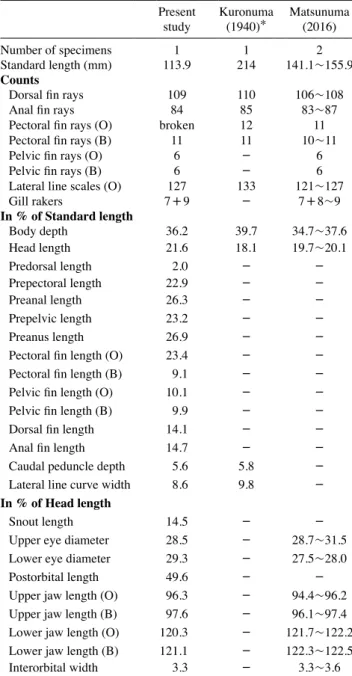
Description. Meristic and morphometric characters are shown in Table 1. Body oblong, strongly compressed, and slightly elongated. Body depth highest at posterior end of pectoral fin, more than 1/3 of standard length. Caudal peduncle very narrow, about 1/6 of body depth. Head small, anterior profile with a deep concavity in front of interorbital space. Snout short, pointed. Mouth extremely large; both jaws elongated, anterior tips of jaws projected from dorsal edge of snout. Eyes moderate, close to each other. Nostrils on ocular side closely set in front of inter- orbital area; anterior nostril tubular, posterior one simple.
Nostrils on blind side close to origin of dorsal fin; anteri- or nostril short and tubular, posterior nostril smaller than anterior one. Small, sharp, and pointed conical teeth in both jaws; three pairs of enlarged teeth on anterior tip of lower jaw, longer than about four times that of adjacent small teeth; three pairs of enlarged teeth on anterior tip of upper jaw, shorter than lower enlarged teeth. Tip of vom- er projecting into mouth cavity(Fig. 2). Gill rakers short, not serrate on posterior margin. Scales small and cycloid, covering surface of body and head with the exception of interorbital space and snout. A single lateral line on oc- ular side, beginning from upper origin of gill opening, curved dorsally above pectoral fin base, and extending onto caudal fin; no lateral line on blind side. Dorsal fin origin above posterior edge of snout; first ray longer than
those of anterior portion. Anal fin origin below pectoral fin origin; all rays not branched. Pectoral fins unequal;
that on blind side about equal to half that on ocular side, all rays not branched. Pelvic fin small on both sides; its origin on ocular side above posterior end of lower jaw;
that on blind side at level of 3rd ray base of ocular side pelvic fin. Caudal fin small, rounded posteriorly.
Coloration of specimen. Ocular side uniformly brown with small dark blotches, as large as eye(Fig. 1); free margin of dorsal and anal fins blackish; pectoral fin dark
Fig. 2. Shape of teeth on both jaws.
Table 1. Comparison of meristic and morphometric characters of Kamoharaia megastoma(O, ocular; B, blind side)
Present
study Kuronuma
(1940)* Matsunuma (2016)
Number of specimens 1 1 2
Standard length (mm) 113.9 214 141.1~155.9 Counts
Dorsal fin rays 109 110 106~108
Anal fin rays 84 85 83~87
Pectoral fin rays (O) broken 12 11
Pectoral fin rays (B) 11 11 10~11
Pelvic fin rays (O) 6 - 6
Pelvic fin rays (B) 6 - 6
Lateral line scales (O) 127 133 121~127
Gill rakers 7+9 - 7+8~9
In % of Standard length
Body depth 36.2 39.7 34.7~37.6
Head length 21.6 18.1 19.7~20.1
Predorsal length 2.0 - -
Prepectoral length 22.9 - -
Preanal length 26.3 - -
Prepelvic length 23.2 - -
Preanus length 26.9 - -
Pectoral fin length (O) 23.4 - -
Pectoral fin length (B) 9.1 - -
Pelvic fin length (O) 10.1 - -
Pelvic fin length (B) 9.9 - -
Dorsal fin length 14.1 - -
Anal fin length 14.7 - -
Caudal peduncle depth 5.6 5.8 -
Lateral line curve width 8.6 9.8 -
In % of Head length
Snout length 14.5 - -
Upper eye diameter 28.5 - 28.7~31.5
Lower eye diameter 29.3 - 27.5~28.0
Postorbital length 49.6 - -
Upper jaw length (O) 96.3 - 94.4~96.2
Upper jaw length (B) 97.6 - 96.1~97.4
Lower jaw length (O) 120.3 - 121.7~122.2 Lower jaw length (B) 121.1 - 122.3~122.5
Interorbital width 3.3 - 3.3~3.6
*re-examination of holotype
brown, its posterior half blackish; caudal fin dark brown, its middle portion blackish; blind side pinkish white ex- cept dorsal, anal, and caudal fins; pectoral fin on blind side transparent. After fixation, ocular side uniformly pale brown with small dark blotches; pectoral fin black, other fins dusky; middle part of caudal fin blackish; blind side uniformly whitish except dorsal, anal, and caudal fins; pectoral fin on blind side transparent.
Distribution. Jejudo Island, Korea(present study); Ja- pan(Kamohara, 1936; Amaoka, 1969; Amaoka, 1982;
Amaoka, 2016); East China Sea(Matsunuma, 2016);
Taiwan(Ho et al., 2009); South China Sea(Randall and Lim, 2000); Australia(Sainsbury et al., 1985, Hoese et al., 2006); Western Central Pacific(Hensley and Amao- ka, 2001).
Remarks. The present lefteye flounder specimen was easily identified as K. megastoma based on extreme- ly large mouth with projecting jaws, three pairs of long curved canines on anterior tip of the lower jaw, tip of vomer projecting, and blind side without lateral line(Ka- mohara, 1936, 1961; Kuronuma, 1940; Amaoka, 1969, 1982; Matsunuma, 2016). As shown in Table 1, most of the morphological characters of the specimen correspond well with those of the previous studies(Kuronuma, 1940;
Matsunuma, 2016). The species is easily distinguished from the other Korean bothids by maxillary extending far beyond posterior edge of lower eye and three pairs of long canines on lower jaw(Nakabo and Doiuchi, 2013). Although K. megastoma has been recorded from Japan, Taiwan, East and South China Seas, and the In- do-Australian Archipelago(Kamohara, 1936; Sainsbury et al., 1985; Randall and Lim, 2000; Matsunuma, 2016), the species has not been recorded from Korean waters.
Therefore, the present specimen represents the first re- cord of the species from Korea, and indicated a wide- spread distribution of the species, ranging from north- western Pacific to northern Australia. We propose a new Korean name, “Keun-ip-dung-geul-neop-chi-sok” for the genus Kamoharaia and “Keun-ip-dung-geul-neop-chi”
for K. megastoma.
ACKNOWLEGEMENTS
This work was supported by a grant from the National Institute of Fisheries Science(R2018033).
REFERENCES
Alock, A.W. 1894. An account of a recent collection of bathybial
fishes from the Bay of Bengal and from the Laccadive Sea. J.
Asiat. Soc. Bengal, 63: 115-137, pls. 6-7.
Amaoka, K. 1969. Studies on the sinistral flounders found in the waters around Japan - taxonomy, anatomy and phylogeny. J.
Shimonoseki Univ. Fish., 18: 65-340.
Amaoka, K. 1982. Bothidae. In: Okamura, O., K. Amaoka and F.
Mitani(eds.), Fishes of the Kyushu-Palau Ridge and Tosa Bay. Japan Fisheries Resource Conservation Association, Tokyo, pp. 296-299.
Amaoka, K. 2016. Flatfishes of Japan(Citharidae, Paralicthyidae, Bothidae, Pleuronectidae, Poecilopsettidae, Samaridae).
Tokai Univ. Press, Kanagawa, 229pp.(in Japanese) Han, S.H., M.J. Kim and C.B. Song. 2012. First record of the bothid
flounder, Asterorhombus intermedius(Bothidae, Pleuronec- tiformes) from Korea. Kor. J. Ichthyol., 24: 139-142.
Hensley, D. and K. Amaoka. 2001. Bothidae. In: Carpenter, K.E.
and V.H. Niem(eds.), FAO species identification guide for fishery purposes. The living marine resources of the west- ern Central Pacific 6, bony fishes part 4(Labridae to La- timeriidae), estuarine crocodiles, sea turtles, sea snakes and marine mammals, FAO, Rome, pp. 3799-3841.
Ho, H.C., C.C. Lin, Y.M. Ju, S.I. Wang, K.T. Shao and C.W. Chang.
2009. Specimen catalog of the National Museum of Marine Biology and Aquarium transferred from Tunghai Universi- ty.(I) Order Pleuronectiformes. Platax, 6: 1-16.
Hoese, D.F., D.J. Bray, J.R. Paxton and G.R. Allen. 2006. Fishes.
In: Beasley, O.L. AND A. Wells(eds.), Zoological cata- logue of Australia. Vol. 35, ABRS & CSIRO Publishing, Collingwood, 1472pp.
Hubbs, C.L. and K.F. Lagler. 2004. Fishes of the Great Lake Re- gion, revised edition. Michigan Univ. Press, Ann Arbor, 276pp.
Hutchins, J.B. 2001. Checklist of the fishes of western Australia.
Rec. W. Aust. Mus. Suppl., 63: 9-50.
Kamohara, T. 1936. Supplementary note on the fishes collected in the vicinity of Kochi-shi(IX). Zool. Mag., 48: 306-311.(in Japanese)
Kamohara, T. 1961. Notes on the type specimens of fishes in my laboratory. Reports USA Mar. Biol. Sta., 8: 1-9, pls. 1-7.
Kim, B.J. 2011. Fish species of Korea. In: National Institute of Bi- ological Resources(ed.), National list of species of Korea:
vertebrates. Natl. Inst. Biol. Res., Incheon, pp. 1-189.(in Korean)
Kuronuma, K. 1940. The heterosomate fishes collected in deep wa- ters of Japan. I. Bull. Biogeogr. Soc. Japan., 10: 29-61.
Li, S.Z. and H.M. Wang. 1995. Fauna Sinica. Osteichthyes, Pleu- ronectiformes. Science Press, Beijing, 433pp.(in Chinese) Matsunuma, M. 2016. First record of a wide-mouthed flounder Ka-
moharaia megastoma(Pleuronectiformes: Bothidae) from the East China Sea. Biogeogr., 18: 29-34.
Nakabo, T. and R. Doiuchi. 2013. Family Bothidae. In: Nakabo, T.
(ed.), Fishes of Japan with pictoral keys to the species, 3rd ed. Tokai Univ. Press, Kanagawa, pp. 1662-1674.(in Japa-
nese)
Nelson, J.S. 2016. Fishes of the world, 5th ed. John Wiley & Sons Inc., New Jersey, 707pp.
Randall, J.E. and K.K.P. Lim. 2000. A checklist of the fishes of the South China Sea. Raffles Bull. Zool. Natl., Suppl. 8: 569- 667.
Sainsbury, K.J., P.J. Kailola and G.G. Leyland. 1985. Continental
shelf fishes of the northern and north-western Australia.
CSIRO Division of Fisheries Research. Clouston & Hall and Peter Pownall Fisheries Information Service, Canberra, 375pp.
Shen, S.C., K.T. Shao, C.T. Chen, C.H. Chen, S.C. Lee and H.K.
Mok. 1993. Fishes of Taiwan. Taiwan Natl. Univ., Taipei, 960pp.(in Chinese)
한국산 둥글넙치과 1미기록종, Kamoharaia megastoma
장서하 · 김진구1· 허유심2· 유효재1· 박정호*
국립수산과학원 연근해자원과, 1국립부경대학교 자원생물학과, 2국립수산과학원 수산자원연구센터
요 약 : 가자미목 둥글넙치과에 속하는 1개체(표준체장 113.9mm)가 제주도 남방 해역에서 저층트롤로 채집되
었다. 매우 큰 입을 가지는 본 종은 주상악골의 후단이 눈보다 후방에 위치, 아래턱 전단에는 돌출된 3쌍의 날카로
운 송곳니, 구강으로 돌출된 서골 말단부, 검은 가슴지느러미 그리고 무안측에 측선이 없는 특징들로 Kamoharaia megastoma와 잘 일치한다. 따라서 이종은 한국 미기록종으로 국명은 “큰입둥글넙치”로 제안한다.
찾아보기 낱말 : 둥글넙치과, 큰입둥글넙치속, 큰입둥글넙치, 한국 미기록종, 제주도