Guo and Warwick, 2001 from the Bohai Sea, China and B. huanghaiensis Huang and Zhang, 2005, B. stenocepha- lum Huang and Zhang, 2005 and B. warwicki Huang and Zhang, 2005 from the Yellow Sea, China.
During a continuous ecological investigation on the biodiversity of the free-living marine nematofauna around the East Sea, Korea, one Belbolla nematode species was obtained from the washings of coarse sediments from a shallow subtidal benthic interstitial environment. Present paper deals with a new species of the genus Belbolla based on morphological study using a differential interference contrast(DIC) microscope. The new species is described and illustrated herein as Belbolla wonkimi sp. nov., and we discuss its taxonomic relationships with other valid species of the genus. This is the first taxonomic report of the genus Belbolla from the East Sea, Korea.
https://doi.org/10.11626/KJEB.2020.38.4.578
INTRODUCTION
The genus Belbolla Andrássy, 1973 is characterized by the presence or absence of ocelli, presence of a large and narrow buccal cavity divided into two parts by a sclero- tized transverse band, the presence of three teeth, of which one ventrosubdorsal is the largest, and the presence of a series of bulb-like muscular oesophageal swellings(4 to 10) in the posterior section of pharynx, which is the most important diagnostic characteristic of the genus within the family Enchelidiidae Filipjev, 1928(Smol et al. 2014). So far, the genus Belbolla contains 15 valid species found from various marine habitats(Huang and Zhang 2005; Nasira et al. 2014; Gagarin and Thanh 2016; Gagarin and Tu 2016).
Of these, four species of the genus Belbolla have been pre- viously described around the Korean waters, i.e. B. zhangi
Original article
A new free-living marine nematode species of the genus Belbolla (Enoplida, Enchelidiidae) from a subtidal zone of the East Sea, Korea, with some ecological and biogeographical information
Hyun Soo Rho*, Heegab Lee, Hyo Jin Lee and Wongi Min
East Sea Environment Research Center, Korea Institute of Ocean Science and Technology, Uljin 36315, Republic of Korea
Korean J. Environ. Biol.
38(4) : 578-585(2020) ISSN 1226-9999(print) ISSN 2287-7851(online)
* Corresponding author Hyun Soo Rho Tel. 054-780-5345 E-mail. [email protected]
Received: 12 November 2020 Revised: 17 November 2020
Revision accepted: 17 November 2020
Abstract: A new free-living marine nematode species of the genus Belbolla Andrássy, 1973 belonging to the family Enchelidiidae is described based on specimens collected from the sediment of a subtidal benthic environmental habitat in the East Sea, Korea.
Belbolla wonkimi sp. nov. differs from its congeners by the combination of the following characteristics: a relatively long body(3263-3396μm), the absence of ocelli, nine oesophageal bulbs in the posterior pharynx, well-developed two winged precloacal supplements, longer spicule length(115-130μm, 1.6-1.8 anal body diameter long), and a triangle-shaped shorter gubernacular apophysis(17-18μm). Comparative tables on the biogeographical and morphological characteristics of Belbolla species are presented.
A DIC(differential interference contrast) photomicrograph of the new species is also provided. This is the first taxonomic report on the genus Belbolla from Korean waters.
Keywords: marine nematodes, morphology, free-living, DIC photomicrographs, taxo-
nomy
MATERIALS AND METHODS Sampling of specimens
The marine nematodes were obtained from the wash- ings of subtidal sediments, which were collected at a depth of 104m using Smith McIntyre grab(OSIL, UK) at Gang- neung on the eastern coast of Korea.
Sample processing and preparation of specimens
Meiobenthos were roughly separated from the sediments by decantation methods using a 67μm mesh sieve in the survey field after freshwater rinsing for less than a few min- utes to reduce the attachment from the sediments(Kris- tensen 1989), and then fixed in 4% neutralized formalin in sea water. After the initial sampling, meiobenthos were extracted once again from the rough samples using the Ludox flotation method(Burgess 2001) in the laboratory, and the concentrated samples were subsequently fixed in 4% neutralized formalin solution. The marine nematodes were picked up under a high magnification of dissecting microscope(Leica M205 C; Leica Microsystems, Germa- ny). Specimens for morphological observation under a light microscope were dehydrated through a graded series of glycerin according to Seinhorst(1959) and mounted on a HS slide(Shirayama et al. 1993). The mounted nema- todes were examined and photographed using an Olympus BX53microscope equipped with an Olympus DP26 digital camera(Olympus, Japan). All drawings and measurements were made with the aid of a camera lucida.
Terminology and abbreviations
The terminology used for the description and measure- ments was followed by Huang and Zhang(2005). Abbre- viations used in the text are as follows: a=body length divided by maximum body diameter; a.b.d.=anal body diameter; b=body length divided by oesophagus length;
c=body length divided by tail length; c.d.=corresponding body diameter.
SYSTEMATIC ACCOUNTS Phylum Nematoda Potts, 1932 Class Enoplea Inglis, 1983 Order Enoplida Filipjev, 1929
Family Enchelidiidae Filipjev, 1918 Genus Belbolla Andrássy, 1973 Type species
Belbolla tenuidens (Cobb, 1920) Andrássy, 1973 Valid species of the genus Belbolla
B. asupplementata Juario, 1974
B. californica(Allgén, 1951) Andrássy, 1973 B. gallanachmorae(Inglis, 1961) Andrássy, 1973 B. gracilis Gagarin and Thanh, 2016
B. heptabulba(Timm, 1961) Andrássy, 1973 B. huanghaiensis Huang and Zhang, 2005 B. intarma Belogurov and Belogurova, 1980 B. longispiculata Nasira, Shahina and Shamin, 2014 B. stenocephalum Huang and Zhang, 2005
B. sundaensis(Micoletzky, 1930) Andrássy, 1973 B. teissieri(Luc and Coninck, 1959) Andrássy, 1973 B. tenuidens(Cobb, 1920) Andrássy, 1973
B. vietnamica Gagarin and Tu, 2016 B. warwicki Huang and Zhang, 2005 B. zhangi Guo and Warwick, 2001
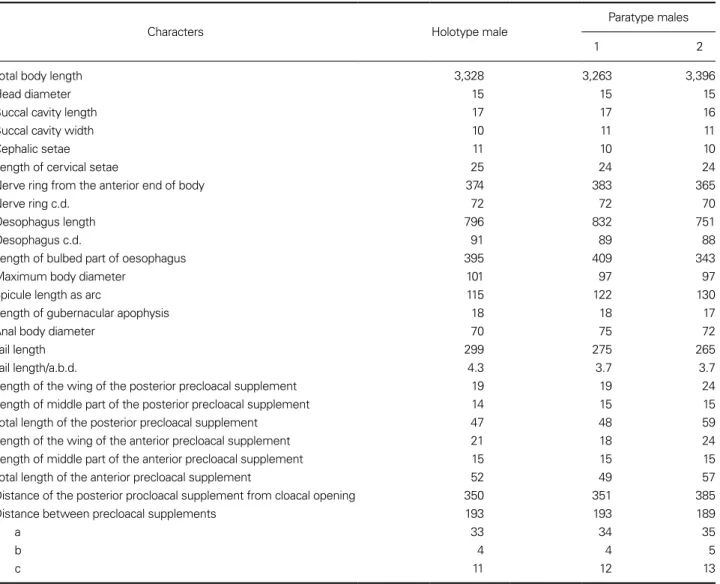
Belbolla wonkimi sp. nov.(Figs. 1, 2; Table 1)
Type material. Holotype male(NA00156498), in glycerin on HS slide, from Sacheon-myeon, 17 April 2018(leg. H Lee, HG Kim and HJ Lee) was deposited in the nematode collection at the specimen conservation room of the Ma- rine Biodiversity Institute of Korea(MABIK), Seochun, Korea. Two paratype males(KIOST NEM-1-2341, KIOST NEM-1-2342), mounted on HS slides, was deposited in the nematode collection at the specimen conservation room of the Bio-Resources Bank of Marine Nematodes (BRBNM), East Sea Research Institute, Korea Institute of Ocean Science & Technology(KIOST), Korea.
Etymology. The proposed specific name wonkimi is nam- ed after Prof. Won Kim of the School of Biological Scien ces at Seoul National University, in recognition of his excellent mentoring during the first author’s PhD research course(H. S.
Rho).
Type locality. Subtidal zone of Sacheon-myeon(37°
44ʹ16ʺN, 128°59ʹ05ʺE), Gangneung-si, Gangwon-do, Re- public of Korea.
Habitat. Subtidal sediments with tiny shell gravels and de- tritus collected at a depth of 104m.
Measurements. See Table 1 for measurements and mor- phometrics.
Diagnosis. Body relatively long(3,263-3,396μm in males); ocelli absent; nine well-developed oesophageal bul- bs in the posterior section of pharynx; well developed two winged precloacal supplements; triangle-shaped gubernac- ular apophysis short and thick.
Description. Male(Holotype). Body comparatively long (3,328μm), slender; anterior body region outstretched anteriorly and strongly tapered anteriorly from mid oe- sophagus to cephalic region; posterior body region often slightly curved ventrally in fixed specimen(Figs. 1C, 2A).
Head diameter 15μm distinctly narrowed. Body at level of end of posterior pharyngeal region 6.1 times as wide as head region width. Body cuticle, smooth, no lateral dif- ferentiation. Anterior parts of head around cephalic setae,
separated with slight constriction(Figs. 1A, 2B). Lip region not extruded in fixed specimen. Six short, thin labial setae on lip region arranged in one circle. Inner labial setae not observed. Ten cephalic setae(11μm long) inserted at level of amphideal fovea and arranged in one circle. Maximum body width 101μm. Buccal cavity wide(10μm) with thick wall 1.7 times as long(17μm) as wide. Buccal cavity with one large right dorsolateral tooth and two less prominent teeth, which are composed of dorsal and left ventrolateral in position(Fig. 1A). Buccal cavity large and wide and sep- arated into two buccal chambers by a cuticular ring, which is smooth with no denticles. Amphideal fovea located at level of stoma. Ocelli absent. Several cervical setae, 25μm in length. Oesophagus muscular and expands gradually
Table 1. Morphometrics of Belbolla wonkimi sp. nov. All measurements are in µm (a=body length divided by maximum body diameter;
b=body length divided by oesophagus length; c=body length divided by tail length)
Characters Holotype male Paratype males
1 2
Total body length 3,328 3,263 3,396
Head diameter 15 15 15
Buccal cavity length 17 17 16
Buccal cavity width 10 11 11
Cephalic setae 11 10 10
Length of cervical setae 25 24 24
Nerve ring from the anterior end of body 374 383 365
Nerve ring c.d. 72 72 70
Oesophagus length 796 832 751
Oesophagus c.d. 91 89 88
Length of bulbed part of oesophagus 395 409 343
Maximum body diameter 101 97 97
Spicule length as arc 115 122 130
Length of gubernacular apophysis 18 18 17
Anal body diameter 70 75 72
Tail length 299 275 265
Tail length/a.b.d. 4.3 3.7 3.7
Length of the wing of the posterior precloacal supplement 19 19 24
Length of middle part of the posterior precloacal supplement 14 15 15
Total length of the posterior precloacal supplement 47 48 59
Length of the wing of the anterior precloacal supplement 21 18 24
Length of middle part of the anterior precloacal supplement 15 15 15
Total length of the anterior precloacal supplement 52 49 57
Distance of the posterior procloacal supplement from cloacal opening 350 351 385
Distance between precloacal supplements 193 193 189
a 33 34 35
b 4 4 5
c 11 12 13
and evenly, 796μm long and posteriorly modified into nine oesophageal bulbs(length of oesophageal bulb 395 μm)(Figs. 1B, 2E). Oesophagus corresponding diameter 91μm. Nerve ring 374μm from anterior end with 72μm
corresponding body diameter and at 46.9% of oesophagus length. Cardia short, conoid. Male diorchic, testis opposed and outstretched, located left or right of intestine. Spicules long(115μm long or 1.6 times as long as a.b.d.) and cylin-
Fig. 1. Belbolla wonkimi sp. nov., holotype male. A, lateral view of male head end and cervical region; B, lateral view of male oesophageal region; C, lateral view of male posterior body region; and D, spicule and gubernaculum. Scale bars: A, D=10µm; B, C=50µm.
A B C
D
Fig. 2. Belbolla wonkimi sp. nov., holotype male, DIC photomicrographs. A, lateral view of male habitus; B, lateral view of male head end and cervical region; C, lateral view of precloacal supplements; D, lateral view of spicule and gubernaculum E, lateral view of male oesopha- geal region; and F, lateral view of male posterior body region. Scale bars: A=200µm; B, D=20µm; C, E, F=50µm.
A B E
C
D
F
drical, strongly arcuated ventrally with rounded open head and blunt distal end; proximal end slightly cephalated(Figs.
1D, 2D). Gubernaculum small and wide, 18μm long with triangle-shaped apophysis. Two winged precloacal supple- ments strongly developed; anterior precloacal supplement 543μm lies from cloacal opening and posterior precloacal supplement lies 350μm from cloacal opening(Figs. 1C, 2C). Tail long and slender, conico-cylindrical, 299μm long, 4.3 times anal body diameter, tapering with distal third cylindrical and with slightly swollen tip with three minute terminal setae(Figs. 1C, 2F).
Female. Unknown.
Remarks. The genus Belbolla Andrássy, 1973 was first erected as Bolbella by Cobb(1920) based on Bobella te- nuidens Cobb, 1920 as a type species of the genus(Andrássy 1973), and classified within the family Enchelidiidae Filipjev, 1928 belongs to the order Enoplida Filipjev, 1929 based on the following combination of characteristics: the presence or absence of ocelli, the presence of a large and narrow buccal cavity divided into two parts by a sclerotized transverse band, the presence of three teeth, of which one ventrosubdorsal is the largest, and the presence of a series
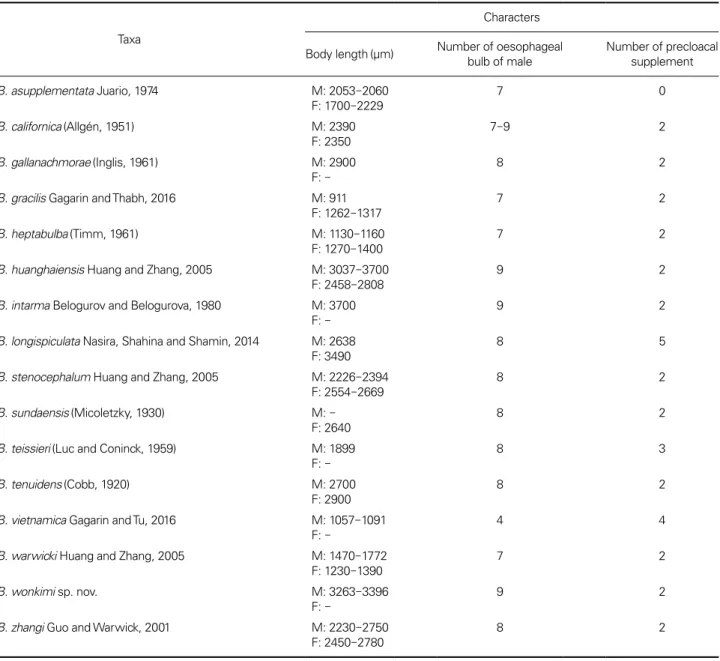
Table 2. Comparison of the characteristics of Belbolla wonkimi sp. nov. with its congeners
Taxa
Characters
Body length(µm) Number of oesophageal
bulb of male Number of precloacal supplement
B. asupplementata Juario, 1974 M: 2053-2060
F: 1700-2229 7 0
B. californica(Allgén, 1951) M: 2390
F: 2350 7-9 2
B. gallanachmorae(Inglis, 1961) M: 2900
F: - 8 2
B. gracilis Gagarin and Thabh, 2016 M: 911
F: 1262-1317 7 2
B. heptabulba(Timm, 1961) M: 1130-1160
F: 1270-1400 7 2
B. huanghaiensis Huang and Zhang, 2005 M: 3037-3700
F: 2458-2808 9 2
B. intarma Belogurov and Belogurova, 1980 M: 3700
F: - 9 2
B. longispiculata Nasira, Shahina and Shamin, 2014 M: 2638
F: 3490 8 5
B. stenocephalum Huang and Zhang, 2005 M: 2226-2394
F: 2554-2669 8 2
B. sundaensis(Micoletzky, 1930) M: -
F: 2640 8 2
B. teissieri(Luc and Coninck, 1959) M: 1899
F: - 8 3
B. tenuidens(Cobb, 1920) M: 2700
F: 2900 8 2
B. vietnamica Gagarin and Tu, 2016 M: 1057-1091
F: - 4 4
B. warwicki Huang and Zhang, 2005 M: 1470-1772
F: 1230-1390 7 2
B. wonkimi sp. nov. M: 3263-3396
F: - 9 2
B. zhangi Guo and Warwick, 2001 M: 2230-2750
F: 2450-2780 8 2
M: male; F: female; -: unknown
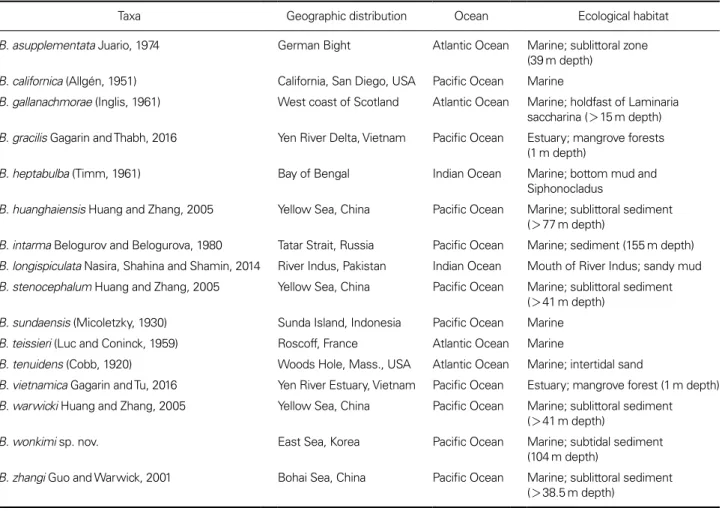
of bulb-like muscular oesophageal swellings(4 to 10) in the posterior section of pharynx, which is the most remark- able taxonomic key character of the genus within the fami- ly Enchelidiidae(Smol et al. 2014). So far, 15 species with- in the genus Belbolla have been described previously from various localities of the intertidal and shallow subtidal hab- itats in oceans all over the world(Huang and Zhang 2005;
Nasira et al. 2014; Gagarin and Thanh 2016; Gagarin and Tu 2016)(Table 3). Belbolla can be artificially subdivided into two groups on the basis of the number of oesophageal bulb, as adopted in the keys by Belogurov and Beloguro- va(1980) and Huang and Zhang(2005)(Table 2). The first group is characterized by having four, seven or eight oesophageal bulbs in male, and comprises 13 recorded spe- cies: B. asupplementata, B. californica, B. gallanachmorae, B.
gracilis, B. heptabulba, B. longispiculata, B. stenocephalum, B. sundaensis, B. teissieri, B. tenuidens, B. vietnamica, B. war- wicki, and B. zhangi. On the other hand, the second group is characterized by having nine oesophageal bulbs, and in-
cludes the remaining two species(B. huanghaiensis and B.
intarma), with the present new species. Belbolla wonkimi sp. nov. is characterized by the following combination of characteristics:(1) relatively long body(3,263-3,396μm);
(2) the absence of ocelli;(3) nine oesophageal bulbs in the posterior pharynx;(4) well developed two winged preclo- acal supplements;(5) longer spicule length(115-130μm, 1.6-1.8 a.b.d. long); and(6) triangle-shaped shorter guber- nacular apophysis length(17-18μm). In having the nine muscular oesophageal bulbs in the pharynx, which is the most remarkable diagnostic characteristic of the genus, Bel- bolla wonkimi sp. nov. is very similar to B. huanghaiensis and B. intarma among the congeners. However, the new species differs from B. huanghaiensis by:(1) the shape of guber- nacular apophysis(triangle-shaped vs. long dorso-caudally directed);(2) the very shorter gubernacular apophysis (17-18μm vs. 45-60μm);(3) the relatively longer tail in male(265-299μm vs. 230-252μm);(4) distance of the posterior precloacal supplement from cloacal opening in
Table 3. Ecological and biogeographical characteristics of the genus Belbolla including Belbolla wonkimi sp. nov.
Taxa Geographic distribution Ocean Ecological habitat
B. asupplementata Juario, 1974 German Bight Atlantic Ocean Marine; sublittoral zone (39m depth)
B. californica (Allgén, 1951) California, San Diego, USA Pacific Ocean Marine
B. gallanachmorae (Inglis, 1961) West coast of Scotland Atlantic Ocean Marine; holdfast of Laminaria saccharina (>15m depth) B. gracilis Gagarin and Thabh, 2016 Yen River Delta, Vietnam Pacific Ocean Estuary; mangrove forests
(1m depth)
B. heptabulba (Timm, 1961) Bay of Bengal Indian Ocean Marine; bottom mud and
Siphonocladus
B. huanghaiensis Huang and Zhang, 2005 Yellow Sea, China Pacific Ocean Marine; sublittoral sediment (>77m depth)
B. intarma Belogurov and Belogurova, 1980 Tatar Strait, Russia Pacific Ocean Marine; sediment (155m depth) B. longispiculata Nasira, Shahina and Shamin, 2014 River Indus, Pakistan Indian Ocean Mouth of River Indus; sandy mud B. stenocephalum Huang and Zhang, 2005 Yellow Sea, China Pacific Ocean Marine; sublittoral sediment
(>41m depth) B. sundaensis (Micoletzky, 1930) Sunda Island, Indonesia Pacific Ocean Marine B. teissieri (Luc and Coninck, 1959) Roscoff, France Atlantic Ocean Marine
B. tenuidens (Cobb, 1920) Woods Hole, Mass., USA Atlantic Ocean Marine; intertidal sand
B. vietnamica Gagarin and Tu, 2016 Yen River Estuary, Vietnam Pacific Ocean Estuary; mangrove forest (1m depth) B. warwicki Huang and Zhang, 2005 Yellow Sea, China Pacific Ocean Marine; sublittoral sediment
(>41m depth)
B. wonkimi sp. nov. East Sea, Korea Pacific Ocean Marine; subtidal sediment
(104m depth)
B. zhangi Guo and Warwick, 2001 Bohai Sea, China Pacific Ocean Marine; sublittoral sediment (>38.5m depth)
male(350-385μm vs. 210-255μm); and(5) distance be- tween precloacal supplements in male(189-193μm vs.
115-140μm). Belbolla wonkimi sp. nov. can be also easily distinguished from B. intarma by the relatively longer tail in male(265-299μm vs. 215μm), and the shape and relative length of spicules(smooth on the distal end of spicules, 115-130μm vs. hook on the distal end of spicule, 110μm).
ACKNOWLEDGEMENTS
The authors appreciate the anonymous reviewers for their helpful comments that greatly improved the man- uscript. This research was supported by the Marine Bio- technology Program of the Korea Institute of Marine Sci- ence and Technology Promotion(KIMST) funded by the Ministry of Oceans and Fisheries(MOF)(No. 20170431) (PM61960, PE99813).
REFERENCES
Allgén CA. 1951. Pacific freeliving marine nematodes.(Papers from Dr. Th. Mortensen’s Pacific Expedition 1914-16. LXXVI).
Vidensk. Meddr. fra Dansk naturh. Foren. 113:263-411.
Andrássy I. 1973. Über vier homonym Nematodengattungen.
Nematologica 19:403-404.
Belogurov OI and LS Belogurova. 1980. Morphology of Belbolla intarma sp. n., diagnosis and a table for the species of the genus Belbolla. Biol. Morya 4:74-77.
Burgess R. 2001. An updated protocol for separating meiofauna from sediments using colloidal silica sols. Mar. Ecol. Prog.
Ser. 214:161-165.
Cobb NA. 1920. One hundred new nemas(type species of 100 new genera). Contr. Sci. Nemat. 9:217-343.
Gagarin VG and ND Tu. 2016. Adoncholaimus minor sp. n. and Belbolla vietnamica sp. n.(Nematoda, Enoplida) from man- grove forest of the Yen River Estuary in Vietnam. Int. J. Nem- atol. 26:1-8.
Gagarin VG and NV Thanh. 2016. Two new nematode species (Nematoda) from the mangroves of the Yen River Delta, Viet-
nam. Inland Water Biol. 9:39-47.
Guo YQ and RM Warwick. 2001. Three new species of free-living nematodes from the Bohai Sea, China. J. Nat. Hist. 35:1575- 1586.
Huang Y and Z Zhang. 2005. Three new species of the genus Belbolla(Nematoda: Enoplida: Enchelidiidae) from the Yellow Sea, China. J. Nat. Hist. 39:1689-1703.
Inglis WG. 1961. Two new species of freeliving marine nem- atodes from the west coast of Scotland. Hydrobiologia 18:284-292.
Juario JV. 1974. Neue freilebende Nematoden aus dem sublitoral der Deutschen Bucht. Veröff. Inst. Meeresforsch. Bremerh.
14:275-303.
Kristensen RM. 1989. Marine Tardigrada from the southeastern United States coastal waters. I. Paradoxipus orzeliscoides n. gen., n. sp.(Arthrotardigrada, Halechiniscidae). Trans. Am.
Microsc. Soc. 108:262-282.
Luc M and LAP de Coninck. 1959. Travaux de la Station Bi- ologique de Roscoff, LII. Nematodes libres marins de la re- gion de Roscoff. Arch. Zool. Exp. Gen. 98:103-165.
Micoletzky H. 1930. Freilebende marine Nematoden von den Sunda-Inseln. I. Enoplidae.(Papers from Dr. Th. Mortenson’s Pacific Expedition 1914-16)(Ed. H. A. Kreis). Vidensk. Med- del. Dansk Naturhist. Foren. Kjøbenhavn 87:232-339.
Nasira K, F Shahina and S Shamin. 2014. Description of Bathy- eurystomina minima sp. n. and Belbolla longispiculata sp. n.
with observations on Pareurystomina vaughtae and Eurys- tomina indica(Enoplida: Enchelidiidae) from Pakistan. Int. J.
Nematol. 24:87-96.
Seinhorst JW. 1959. A rapid method for the transfer of nem- atodes from fixative to anhydrous glycerin. Nematologica 4:67-69.
Shirayama Y, T Kaku and RP Higgins. 1993. Double-slided micro- scopic observation of meiofauna using an HS-slide. Benthos Res. 44:41-44.
Smol N, A Muthumbi and J Sharma. 2014. Handbook of Zoology.
Gastrotricha, Cycloneuralia and Gnathifera. Vol 2. Nematoda.
7.3 Order Enoplida. Walter De Gruyter. pp. 193-246.
Timm RW. 1961. The marine nematodes of the Bay of Bengal.
Proc. Pakist. Acad. Sci. 1:1-88.