Kor. J. Hort. Sci. Technol. 28(6):1003-1013, 2010
장미속 유전자원의 유전적 관계와 국내 해당화의 유전적 다양성
정연화1ㆍ김성태2ㆍ김기준3ㆍ이자현1,4ㆍ기광연5ㆍ한태호1,4*
1전남대학교 식물생명공학과, 2국립원예특작과학원 화훼과, 3아시아종묘 육종연구소,
4전남대학교 농업과학기술연구소, 5전라남도농업기술원 원예연구소
Genetic Relationship of Genus Rosa Germplasm and Genetic Diversity of Rosa rugosa in Korea
Youn-Hwa Joung1, Seung-Tae Kim2, Gi-Jun Kim3, Ja-Hyun Lee1,4, Gwang-Yeon Gi5, and Tae-Ho Han1,4*
1Department of Plant Biotechnology, Chonnam National University, Gwangju 500-757, Korea
2Floriculture Research Division, National Institute of Horticultural & Herbal Science, Suwon 440-706, Korea
3Breeding Institution, Asia Seed Co. Ltd., Gwangju 464-863, Korea
4Institution of Agricultural Science and Technology, Chonnam National University, Gwangju 500-757, Korea
5Horticultural Research Division, Jeollam-do Agricultural Research & Extension Services, Naju 520-715, Korea
Abstract. Fifty-nine accessions of 23 species in genus Rosa were collected, and 15 accessions of Rosa rugosa were collected throughout 10 regions of Korea. Their genetic relationship was investigated by using morphological analysis and RAPD marker. The morphological analysis was measured for 7 quantitative and quantified for 4 qualitative traits. RAPD analysis obtained a total of 959 polymorphic bands by using twenty primers.
Morphological analysis classified most according to the rose section system except for several species. The cluster analysis of genus Rosa based on RAPD data could identify the subgenus Platyrhodon and Eurosa. The subgenus Eurosa separated five sections; Gallicanae, Cinnamomeae, Pimpinellifolia, Synstylae, and Caninae.
Correlation analysis between morphological and RAPD analysis showed low significance (r = 0.35). The accessions of R. rugosa belonged to the section Cinnamomeae clustered into three groups at genetic distance ranging from 0.28 on the base of RAPD analysis. In conclusion, the genetic relationship of the genus Rosa was consistent to the previously reported rose section system, and domestic collections of R. rugosa were separated from 3 groups on the base of RAPD marker.
Additional key words: mantel test, morphological analysis, random amplified polymorphic DNA (RAPD), rose, section, subgenus
*Corresponding author: [email protected]
※ Received 13 May 2010; Accepted 13 October 2010. 본 연구는 농촌진흥청 공동연구사업(과제번호:PJ006816)과 농업유전자원관리기관사업의 지원에 의해 이루어진 것임.
서 언
장미는 국내・외 화훼류 중 선호도와 시장점유율이 높은 절화 작물이다. 국내 재배 면적은 2006년까지 꾸준히 증가 하여 864ha였으나 유류비와 로열티 문제로 인해 2007년 이 후 579ha로 줄어드는 경향을 보인다(MIFAFF, 2008). 특히, 외국 품종에 의존하고 있는 국내 재배 농가의 로열티 지불 액은 2007년 기준으로 약 120억 원으로 추정되고 있어 국내 품종 육성과 보급이 시급하다(Kim 등, 2008). 국내 품종 육 성은 1990년 시작되어 육종의 역사가 짧고 재배 품종간의
단교잡이 이루어지고 있는데, 국외 품종에 비해 인지도와 보급률이 낮은 실정이다(Kim 등, 2008; KSVS, 2009; Lee 등, 2008).
현재까지 품종 개발에 이용된 장미 야생종은 140여 종 가 운데 10여종 이내에 불과하며 제한적인 유전적 배경을 가지 고 있는데, 품종 육성에 이용되지 않은 종들은 유전적으로 병해나 환경에 강한 유전자를 가지고 있으며 각 종마다 특 유의 형질을 보유하고 있어 앞으로 품종 육종에 있어서 잠 재된 자원으로 이용가치가 높다(Gudin, 2003; MIFAFF, 2007).
장미의 야생종은 Rosa 속에 포함되어 형태학적 특징에
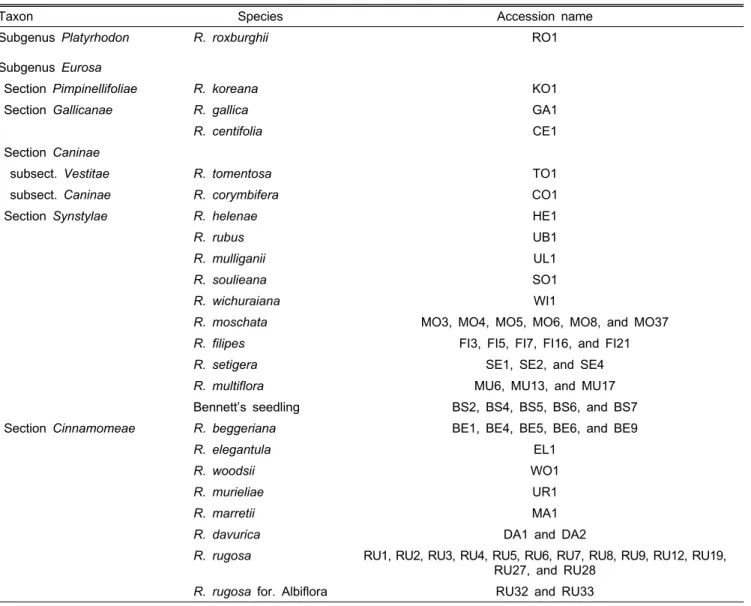
Table 1. Fifty-nine accessions of 23 species used to study genetic relationships in the genus Rosa.
Taxon Species Accession name
Subgenus Platyrhodon R. roxburghii RO1
Subgenus Eurosa
Section Pimpinellifoliae R. koreana KO1
Section Gallicanae R. gallica GA1
R. centifolia CE1
Section Caninae
subsect. Vestitae R. tomentosa TO1
subsect. Caninae R. corymbifera CO1
Section Synstylae R. helenae HE1
R. rubus UB1
R. mulliganii UL1
R. soulieana SO1
R. wichuraiana WI1
R. moschata MO3, MO4, MO5, MO6, MO8, and MO37
R. filipes FI3, FI5, FI7, FI16, and FI21
R. setigera SE1, SE2, and SE4
R. multiflora MU6, MU13, and MU17
Bennett’s seedling BS2, BS4, BS5, BS6, and BS7
Section Cinnamomeae R. beggeriana BE1, BE4, BE5, BE6, and BE9
R. elegantula EL1
R. woodsii WO1
R. murieliae UR1
R. marretii MA1
R. davurica DA1 and DA2
R. rugosa RU1, RU2, RU3, RU4, RU5, RU6, RU7, RU8, RU9, RU12, RU19, RU27, and RU28
R. rugosa for. Albiflora RU32 and RU33
의해 4개의 아속으로 분류되고, 그 중 많은 종이 포함된 아 속 Eurosa는 다시 10개의 section으로 나누어 진다(Rehder, 1949). 이들 종 가운데 우리나라에는 해당화, 찔레, 돌가시 나무 등이 자생하고 있다. 이 중 해당화는 병해충과 염 저항 성, 내한성이 있고 강한 수세를 가진 종으로 알려져 있으며 국외에서는 정원용 장미 품종으로 육성하여 이용하고 있다 (Bruun, 2005; Krussmann, 1981).
이러한 장미의 종들은 인위적 또는 자연적으로 종간 교배 가 빈번하게 이루어지면서 종의 수가 많고 가변성이 높아 종들간의 관계가 복잡하여 유전적 관계 연구에 있어서 어려 움이 있다(Matsumoto 등, 2000; Millan 등, 1996). 과거에 형태적 특징을 통한 분류가 이루어졌으나 다양하고 복잡한 종들을 이해하기에는 그 형질에 한계가 있다(Cubero 등, 1995). 이를 극복하고 효율적으로 종들의 유전적 관계를 분 석하고자 환경에 독립적인 DNA 분자 마커를 통한 연구들 이 수행되었다(Koopman 등, 2008; Millan 등, 1996; Wen
등, 2004). 다양한 분자 마커 중 RAPD 마커는 분석이 빠르 고 용이하며 비용이 적게 들고 소량의 DNA만을 사용하여 높은 다형성 분석이 가능하다(Williams 등, 1990).
본 연구는 다양한 장미 속 유전자원 및 해당화를 수집하 고 형태적인 특징과 유전적 관계를 분석함으로써 다양한 육 종 재료에 대한 기초적인 자료를 제공하고 육종 프로그램에 서 교배 조합 작성시 활용하고자 수행하였다.
재료 및 방법
식물 재료
전남대학교 장미 속 유전자원 관리기관에서는 2005년도 부터 장미 속의 종간 유전적 관계 연구를 위해 23종의 59계 통을 수집하여, 아속 Eurosa에서 5개의 section에 포함되는 22종과 아속 Platyrhodon에 속하는 1종을 본 연구에 사용하 였다(Table 1). 그 중 국립원예특작과학원에서 R. roxburghii,
Fig. 1. Sites of Rosa rugosa accessions collected at ten local regions in South Korea. Unknown collection sites: RU12, RU32, RU33.
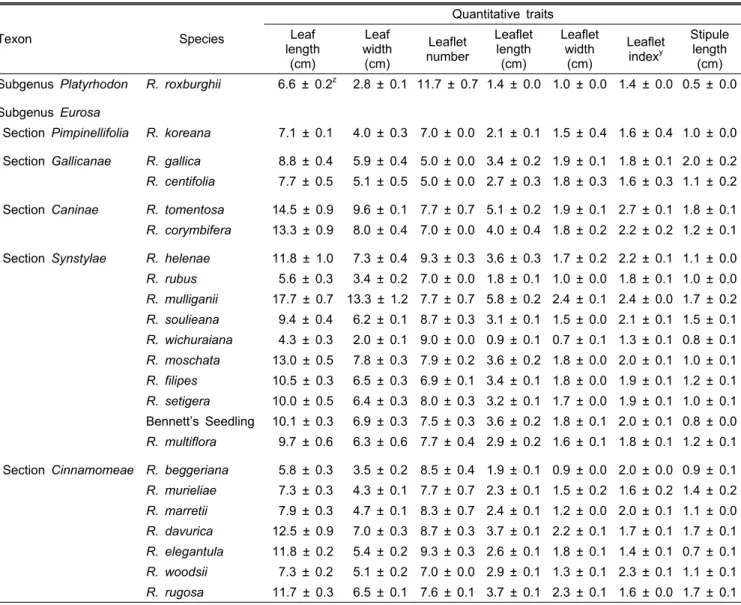
Table 2. Eleven morphological characters investigated in the genus Rosa.
Characters Classfication
Quantitative traits
Leaf length Length in centimeter
Leaf width Width in centimeter
Leaflet number
Leaflet length Length in centimeter
Leaflet width Width in centimeter
Leaflet index Leaflet length/Leaflet width
Stipule length Length in centimeter
Qualitative traits
Terminal leaflet: base shape acuminate (1), blunt (2), round (3), or cordate (4)
Stipule shape absence (1), parallel (2), parallel, meddle part enlarge, margin fringed with hairs (3), enlarged in the upper part, margin denticulate (4), or middle part narrowing downward, margin comb-shape (5)
Prickles shape absence (1), needle-shape (2), more or less curve and hook shape (3), wing-shape (4), bristles (5), bristles and prickles mix (6), or prickles of different sizes on the same stem (7)
Prickles color green (1), yellow (2), red (3), purple (4), dark brown (5), red-green (6), gray (7), or absence (8)
R. gallica, R. centifolia, R. tomentosa, R. corymbifera, R.
helenae, R. rubus, R. mulliganii, R. soulieana, R. elegantula, R. woodsii, R. murieliae를 수집하였으며, R. koreana, R.
wichuraiana, R. moschata, R. filipes, R. setigera, Bennett’s seedling, R. beggeriana, R. marretii는 개인 수집하고, R.
multiflora, R. davurica의 계통들은 국립원예특작과학원과
개인 수집하여 이용하였다. 해당화는 국내에서 유전적 다양 성을 확인하기 위해 10개의 지역에서 15계통을 수집하였다 (Fig. 1).
형태적 특성 조사
형태적 조사는 수집한 23종의 55계통을 이용하였으며, 종들을 구분한 특성을 선발하여 양적 형질 7항목과 질적 형 질 4항목을 작성하여 조사하였다(Table 2). 23종의 양적 형 질은 측정치를 SPSS program 17.0(SPSS Inc., USA)을 통해 평균과 표준오차로 나타냈으며, 질적 형질은 수치화하였다 (Table 3, 4).
RAPD 방법
각 식물에서 어린 신초를 채취하여 액체질소에 냉각시킨 후 작은 입자로 갈아서 DNeasyⓇ Plant Mini Kit(Qiagen Inc., USA)를 사용하여 DNA를 추출하였다. 농도는 분광광도 계 ND-100(Nanodrop Tech., USA)을 사용하여 측정하였다.
RAPD는 10bp primer 19개(Operon Technologies, USA;
Bioneer, Korea)와 12bp primer 1개(BEX, Japan)를 사용하였 다(Kim 등, 2006; Millan 등, 1996)(Table 5). RAPD 반응액 의 총 양은 20µL로 DNA 농도는 30ng・µL-1, primer 10pmol, dNTP 2µL, 10x i-TaqTM plus reaction buffer 2µL, i-TaqTM plus DNA polymerase 1.5unit(Intron Biotechnology, Korea) 을 혼합하여 사용하였다. 증폭은 PTC-200 Peltier Thermal Cycler(MJ Research, USA)을 사용하여, initial denaturation 는 95℃에서 5분, denaturation은 95℃에서 1분, annealing 은 32℃에서 1분, extension은 72℃에서 2분 동안 수행하고
Table 3. Seven quantitative traits of 23 species in the genus Rosa.
Texon Species
Quantitative traits Leaf
length (cm)
Leaf width
(cm)
Leaflet number
Leaflet length (cm)
Leaflet width (cm)
Leaflet indexy
Stipule length (cm) Subgenus Platyrhodon R. roxburghii 6.6 ± 0.2z 2.8 ± 0.1 11.7 ± 0.7 1.4 ± 0.0 1.0 ± 0.0 1.4 ± 0.0 0.5 ± 0.0 Subgenus Eurosa
Section Pimpinellifolia R. koreana 7.1 ± 0.1 4.0 ± 0.3 7.0 ± 0.0 2.1 ± 0.1 1.5 ± 0.4 1.6 ± 0.4 1.0 ± 0.0 Section Gallicanae R. gallica 8.8 ± 0.4 5.9 ± 0.4 5.0 ± 0.0 3.4 ± 0.2 1.9 ± 0.1 1.8 ± 0.1 2.0 ± 0.2 R. centifolia 7.7 ± 0.5 5.1 ± 0.5 5.0 ± 0.0 2.7 ± 0.3 1.8 ± 0.3 1.6 ± 0.3 1.1 ± 0.2 Section Caninae R. tomentosa 14.5 ± 0.9 9.6 ± 0.1 7.7 ± 0.7 5.1 ± 0.2 1.9 ± 0.1 2.7 ± 0.1 1.8 ± 0.1 R. corymbifera 13.3 ± 0.9 8.0 ± 0.4 7.0 ± 0.0 4.0 ± 0.4 1.8 ± 0.2 2.2 ± 0.2 1.2 ± 0.1 Section Synstylae R. helenae 11.8 ± 1.0 7.3 ± 0.4 9.3 ± 0.3 3.6 ± 0.3 1.7 ± 0.2 2.2 ± 0.1 1.1 ± 0.0 R. rubus 5.6 ± 0.3 3.4 ± 0.2 7.0 ± 0.0 1.8 ± 0.1 1.0 ± 0.0 1.8 ± 0.1 1.0 ± 0.0 R. mulliganii 17.7 ± 0.7 13.3 ± 1.2 7.7 ± 0.7 5.8 ± 0.2 2.4 ± 0.1 2.4 ± 0.0 1.7 ± 0.2 R. soulieana 9.4 ± 0.4 6.2 ± 0.1 8.7 ± 0.3 3.1 ± 0.1 1.5 ± 0.0 2.1 ± 0.1 1.5 ± 0.1 R. wichuraiana 4.3 ± 0.3 2.0 ± 0.1 9.0 ± 0.0 0.9 ± 0.1 0.7 ± 0.1 1.3 ± 0.1 0.8 ± 0.1 R. moschata 13.0 ± 0.5 7.8 ± 0.3 7.9 ± 0.2 3.6 ± 0.2 1.8 ± 0.0 2.0 ± 0.1 1.0 ± 0.1 R. filipes 10.5 ± 0.3 6.5 ± 0.3 6.9 ± 0.1 3.4 ± 0.1 1.8 ± 0.0 1.9 ± 0.1 1.2 ± 0.1 R. setigera 10.0 ± 0.5 6.4 ± 0.3 8.0 ± 0.3 3.2 ± 0.1 1.7 ± 0.0 1.9 ± 0.1 1.0 ± 0.1 Bennett’s Seedling 10.1 ± 0.3 6.9 ± 0.3 7.5 ± 0.3 3.6 ± 0.2 1.8 ± 0.1 2.0 ± 0.1 0.8 ± 0.0 R. multiflora 9.7 ± 0.6 6.3 ± 0.6 7.7 ± 0.4 2.9 ± 0.2 1.6 ± 0.1 1.8 ± 0.1 1.2 ± 0.1 Section Cinnamomeae R. beggeriana 5.8 ± 0.3 3.5 ± 0.2 8.5 ± 0.4 1.9 ± 0.1 0.9 ± 0.0 2.0 ± 0.0 0.9 ± 0.1 R. murieliae 7.3 ± 0.3 4.3 ± 0.1 7.7 ± 0.7 2.3 ± 0.1 1.5 ± 0.2 1.6 ± 0.2 1.4 ± 0.2 R. marretii 7.9 ± 0.3 4.7 ± 0.1 8.3 ± 0.7 2.4 ± 0.1 1.2 ± 0.0 2.0 ± 0.1 1.1 ± 0.0 R. davurica 12.5 ± 0.9 7.0 ± 0.3 8.7 ± 0.3 3.7 ± 0.1 2.2 ± 0.1 1.7 ± 0.1 1.7 ± 0.1 R. elegantula 11.8 ± 0.2 5.4 ± 0.2 9.3 ± 0.3 2.6 ± 0.1 1.8 ± 0.1 1.4 ± 0.1 0.7 ± 0.1 R. woodsii 7.3 ± 0.2 5.1 ± 0.2 7.0 ± 0.0 2.9 ± 0.1 1.3 ± 0.1 2.3 ± 0.1 1.1 ± 0.1 R. rugosa 11.7 ± 0.3 6.5 ± 0.1 7.6 ± 0.1 3.7 ± 0.1 2.3 ± 0.1 1.6 ± 0.0 1.7 ± 0.1
zValues of mean.
yLeaflet length/Leaflet width.
40 cycle 반복 후 final extension은 72℃에서 7분간 수행하 였다(Kim, 2008). PCR 산물은 1x TAE buffer에 ethidium bromide를 넣은 1.0%(w/v) 아가로스 젤에 100V에서 1시간 전기영동(Agaro-PowerTM, Bioneer, Korea)하였다. 증폭 밴드 의 분자량은 100bp DNA ladder(Bioneer, Korea)와 비교하여 추정하였다. 증폭 양상은 UV transilluminator(DUT-260, Core Bio, Korea)를 이용해서 확인하였다.
Data 분석
형태적 특성 분석은 조사 결과를 바탕으로 NTSYS-pc program ver. 2.0(Rohlf, 1998)을 사용하여 군집 분석은 유클 리디안 거리 계수와 비가중산술법을 통해 작성하였다. RAPD 분석은 밴드의 유무에 따라 ‘1’과 ‘0’로 표시하여 이진법 행 렬로 작성하였다. 유전적 거리는 Nei와 Li(1979)의 방법에
의해 추정되고, dendrogram은 TREECON program ver.
1.3b(Van de Peer와 De Wachter, 1993)을 사용하여 Nei의 유전적 거리지수를 바탕으로 비가중산술법으로 군집분석을 수행하였다. 각 분지의 신뢰도를 측정하기 위해 Bootstrap은 1000번 반복하였다. 형태적 분석과 RAPD 분석간의 상관관 계는 수집한 23종의 55계통을 이용하였으며, Mantel test(Mantel, 1967)는 NTSYS-pc program ver. 2.0(Rohlf, 1998)의 MXCOMP를 사용하여 분석하였다.
결과 및 고찰
장미 속 유전자원의 유전적 관계 형태적 특성 분석
형태적 특성 조사는 수집한 23종의 55계통을 사용하였고,
Table 4. Four qualtative traits of 23 species.
Texon Species
Qualitative trait Terminal leaflet
base shape
Stipule shape
Prickle shape
Prickle color
Subgenus Platyrhodon R. roxburghii 1 1 2 5
Subgenus Eurosa
Section Pimpinellifolia R. koreana 1 2 2 2
Section Gallicanae R. gallica 3 4 3 6
R. centifolia 3 4 1 8
Section Caninae R. tomentosa 2 2 3 3
R. corymbifera 2 4 4 3
Section Synstylae R. helenae 2 2 3 5
R. rubus 2 5 3 3
R. mulliganii 2 2 3 5
R. soulieana 2 2 4 6
R. wichuraiana 2 2 3 2
R. moschata 2 2 and 5 3 and 4 3 and 5
R. filipes 1 and 2 2 and 5 3 2, 3, and 5
R. setigera 2 2 and 5 3 5
Bennett’s Seedling 2 2 and 5 3 5
R. multiflora 1 5 1 and 3 5 and 8
Section Cinnamomeae R. beggeriana 2 2 2 2
R. murieliae 2 2 2 2
R. marretii 2 4 3 2
R. davurica 2 3 6 and 7 2
R. elegantula 3 2 2 2
R. woodsii 2 2 2 2
R. rugosa 3 3 2 and 6 2 and 7
7개의 양적 형질과 4개의 질적 형질을 조사하였으며 이를 통해 NTSYS-pc 프로그램에서 유클리디안 거리 계수를 이 용해 행렬을 작성한 후 비가중산술법으로 군집분석을 수행 하였다.
형태적 특성 조사 결과에서 양적 형질은 23종의 평균과 표준오차로 나타냈으며 질적 형질은 특성을 수치화하였다 (Table 3, 4). 이를 바탕으로 군집 분석을 수행한 결과, 유클 리디안 거리 4.4에서 종들이 6개의 그룹으로 나누어졌다 (Fig. 2).
대부분의 종들이 section의 특징으로 분류되었으며 특히 아속 Platyrhodon이 아속 Eurosa의 종들과 섞이지 않고 구분 되었다. 이는 아속 Platyrhodon의 소엽수가 다른 종보다 많고 턱잎이 좁게 붙어 있는 등의 특성들로 인한 것으로 생각된다.
또한 sect. Gallicanae는 소엽의 특성 등으로 다른 section들과 구분되었다. Sect. Cinnamomeae의 종들은 크게 두 개로 나누
어 졌는데, 가시의 형태 등 유사한 특성을 지는 R. rugosa 계통 과 R. davurica가 하나의 그룹을 형성하고, 나머지 종들이 두 번 째 그룹을 형성하였다. 두 번째 그룹에서 sect. Pimpinellifolia 의 종이 sect. Cinnamomeae에 포함되어 그룹을 형성하였 다. Sect. Synstylae의 종들은 형태적 유사성을 보이며 크게 하나의 그룹을 형성하였다. 그러나 그룹 내의 계통들은 형 태적으로 유사한 특성을 가지고 있어 분류되지 않았다. Sect.
Caninae의 두 종은 sect. Synstylae에 포함되어 그룹을 형성 하였는데, 이는 두 그룹이 잎과 턱잎의 특성에서 유사성을 보인 것으로 사료된다.
RAPD 유전적 다양성 분석
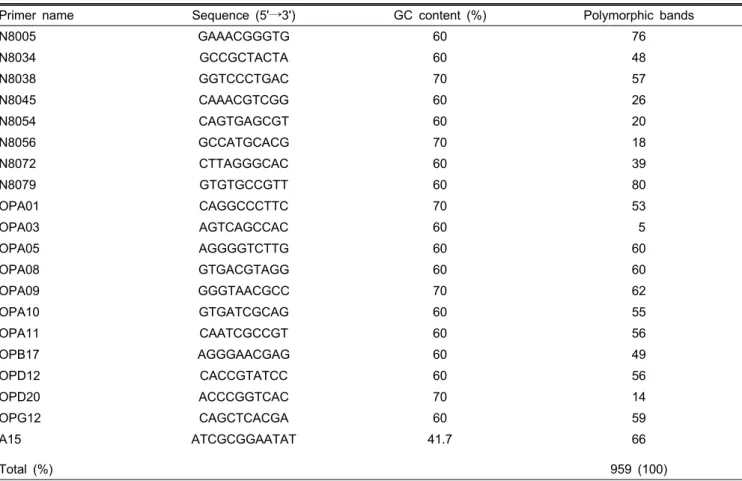
RAPD 분석은 수집한 23종의 59계통을 사용하였고, 20개 의 primer를 통해 다형성이 있는 총 959개의 밴드를 얻었다 (Table 5). 각각의 밴드는 scoring 한 후 TREECON program
Table 5. The 20 primers used for RAPD analysis of 23 germplasm collections in the genus Rosa.
Primer name Sequence (5'→3') GC content (%) Polymorphic bands
N8005 GAAACGGGTG 60 76
N8034 GCCGCTACTA 60 48
N8038 GGTCCCTGAC 70 57
N8045 CAAACGTCGG 60 26
N8054 CAGTGAGCGT 60 20
N8056 GCCATGCACG 70 18
N8072 CTTAGGGCAC 60 39
N8079 GTGTGCCGTT 60 80
OPA01 CAGGCCCTTC 70 53
OPA03 AGTCAGCCAC 60 5
OPA05 AGGGGTCTTG 60 60
OPA08 GTGACGTAGG 60 60
OPA09 GGGTAACGCC 70 62
OPA10 GTGATCGCAG 60 55
OPA11 CAATCGCCGT 60 56
OPB17 AGGGAACGAG 60 49
OPD12 CACCGTATCC 60 56
OPD20 ACCCGGTCAC 70 14
OPG12 CAGCTCACGA 60 59
A15 ATCGCGGAATAT 41.7 66
Total (%) 959 (100)
을 이용하여 유전적 거리는 Nei의 방법으로 이진 행렬을 작 성하고, 비가중산술법으로 군집분석을 수행하였다.
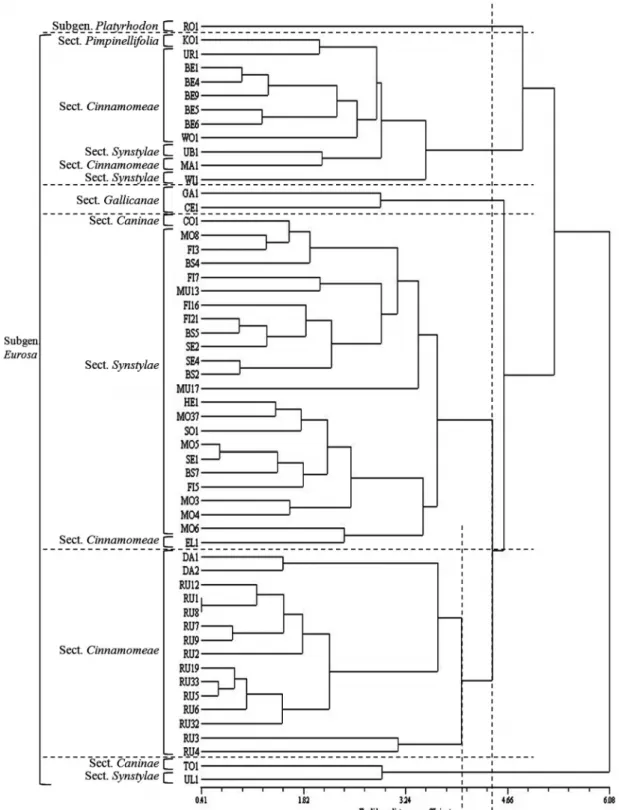
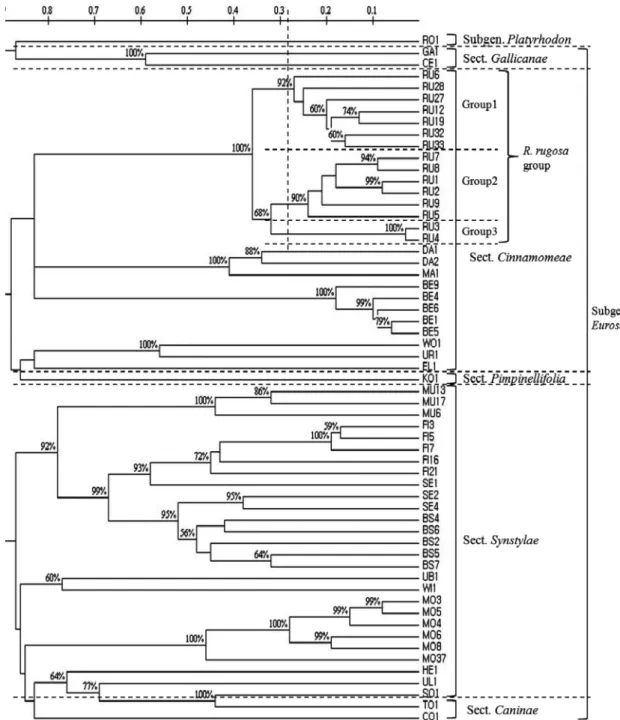
군집 분석의 결과, 아속 Eurosa의 sect. Gallicanae, Cinnamomeae, Pimpinellifolia, Synstylae, Caninae와 아속 Platyrhodon는 각각 분류되었고, bootstrap은 낮지만 크게 두 군집을 형성하였다. 아속 Platyrhodon과 sect. Gallicanae, Cinnamomeae, Pimpinellifolia가 하나의 그룹으로 나누어지고, sect. Caninae가 Synstylae에 포함되어 그룹을 형성하였다 (Fig. 3).
아속 Platyrhodon의 R. roxburghii는 형태적으로 아속 Eurosa 의 종들과 소엽수, 턱잎의 모양 등의 차이를 보이며 분류되었 으나 RAPD 분석 결과 유전적으로 아속 Eurosa와 분리되지 않았고, sect. Gallicanae와 그룹을 형성하였다. 이는 Koopman 등(2008)의 AFLP 분석 결과에서 아속 Platyrhodon이 아속 Eurosa 안에서 분리된 것과 일치하였다. 아속 Platyrhodon 과 sect. Gallicanae는 형태적으로 차이를 보였으나 RAPD 분석 결과 그룹을 형성하였다(Fig. 2). 이 두 분류군의 관계 는 밝혀진 바는 없으나, 기존 연구에서 sect. Gallicanae는 Synstylae, Caninae와 연관되어 있어 두 분류군의 관계는 좀 더 연구가 필요할 것으로 보인다(Koopman 등, 2008; Wissemann 와 Ritz, 2005). Sect. Pimpinellifoliae의 R. koreana는 형태
적 군집 분석 결과에서 sect. Cinnamomeae에 포함되어 그 룹을 형성하였으며 특히 R. murieliae와 유사성을 나타냈다 (Fig. 2). RAPD 분석 결과에서도 sect. Cinnamomeae의 R.
elegantura, R. murieliae, R. woodsii 종들과 그룹을 형성하였 다. Koopman 등(2008)의 AFLP 결과에서 sect. Pimpinellifolia 의 한 종인 R. hugonis는 아속 Platyrhodon의 R. roxburghii 와 그룹을 형성하여 두 분류군이 연관성을 보였으나 Bruneau 등(2007)의 엽록체 DNA 염기서열 분석을 통한 유연관계 연구에서는 sect. Pimpinellifoliae가 Cinnamomeae와 같은 그룹으로 연관되어 있다고 보고하였으며, 특히 본 연구에서 사용된 R. koreana가 sect. Cinnamomeae에 포함되어 있었 다. 뿐만 아니라 타 문헌들에서도 같은 결과를 보고하였으며 (Matsumoto 등, 1998; Wissemann와 Ritz, 2005), 이를 통해 두 section은 관련성이 있는 것으로 사료된다. Sect. Caninae 와 Synstylae의 종들은 잎과 턱잎의 특성에서 유사성을 보이 며 형태적으로 그룹을 형성하였다(Fig. 2). 이는 RAPD 결과 에서도 sect. Caninae가 Synstylae에 포함되어 하나의 큰 그룹 을 형성하였으며, 이와 같은 보고는 다수의 문헌에서 확인되 었다(Bruneau 등, 2007; Koopman 등, 2008; Wissemann와 Ritz, 2005). 이를 바탕으로 두 분류군이 형태적뿐만 아니라 유전적으로도 관련성이 있는 것으로 판단된다.
Fig. 2. Dendrogram obtained from morphological traits of 23 species in the genus Rosa, based on UPGMA clustering analysis and Euclidean distance coefficient using the NTSYS-pc program.
형태적 분석과 RAPD 분석간의 상관 관계
본 연구는 23종의 55계통을 이용하였으며, 형태적 그리 고 RAPD 분석 간 상관 관계는 NTSYS-pc 프로그램을 사용 하여 Mantel test를 통해 확인하였다.
Wen 등(2004)은 장미 속 종인 Rosa roxburghii Tratt의 종내 유전적 관계를 형태적 형질과 RAPD, AFLP 마커를
이용해 분석하고 이들간 상관관계에서 유의성이 있다고 보 고하였다. 그러나 본 연구에서 상관 관계 분석 결과, 형태적 조사의 유사도 거리와 RAPD 분석의 유전적 거리 간의 유의 성은 r값이 0.35로 낮았다(Fig. 4). 기존 연구는 종 내에서 36가지의 형질을 분석하였으나 본 연구는 23종 55계통의 넓은 범위를 11가지의 제한적인 형질을 통해 분석함으로써
Fig. 3. The dendrogram of 23 species based on UPGMA clustering analysis and the Nei’s distance matrix using the TREECON program. The 1000 bootstrap was performed in order to measure the reliability of each node in the dendrogram of the genus Rosa.
한계가 있었던 것으로 판단된다. 이는 형태적 특성 조사 항 목을 추가하고 체계화하여 분류되지 않은 종들의 관계를 확 인한다면 형태적 분석과 RAPD 분석의 신뢰도를 높일 수 있을 것으로 사료된다.
국내 해당화 유전적 다양성 형태적 특성 분석
자생종인 해당화는 국내 10개의 지역에서 15계통을 수집 하였으며, 형태적 특성 분석은 13계통을 사용하여 11가지
형질을 조사하고 유클리디안 거리 계수를 통해 비가중산술 법으로 군집분석을 수행하였다.
군집 분석 결과, 국내 해당화 계통은 유클리디안 거리 4.0 에서 2 그룹으로 나누어졌다(Fig. 2). 진도 수집 계통인 RU3 과 RU4는 다른 해당화와 분리되어 하나의 그룹을 형성하였 는데, 이 두 계통은 줄기에 털이 없고 가시와 잎의 모양에서 다른 계통과 차이를 보였다(자료 미제시). 두 번째 그룹은 RU32와 RU33을 포함하여 나머지 계통들이 그룹을 형성하 였는데, 이들은 형태적으로 크게 차이가 없는 것으로 생각
Fig. 4. Relationship between morphological and RAPD matrices using Mantel test of NTSYS-pc program ver. 2.0 in the genus Rosa.
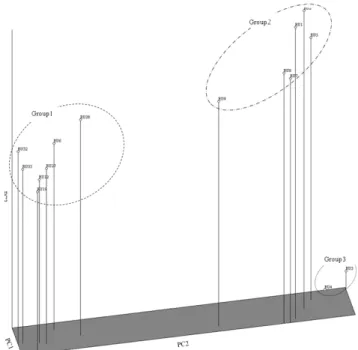
Fig. 5. Principal coordinate analysis of 15 accessions of Rosa rugosa based on Nei’s genetic distance obtained from RAPD analysis in NTSYS-pc program ver. 2.0. The total variation of three coordinates is 84.71%. PC1, PC2 and PC3 were 71.88%, 8.13% and 4.7%, respectively.
되며 그룹 내의 계통간 차이는 양적 형질 조사에 있어서 환 경의 영향을 받았을 것으로 사료된다. RU32와 RU33은 다 른 계통들과 달리 흰색 꽃을 가지고 있었는데(자료 미제시), 화색의 차이를 제외하고는 유사하여 같은 그룹을 형성한 것 으로 보인다.
RAPD 유전적 다양성 분석과 염기서열 분석
국내에서 수집한 15계통들의 유전적 다양성을 확인하고 자 RAPD 분석을 수행하였다. TREECON program을 사용 하여 Nei의 계수를 통해 유전적 거리를 이진 행렬로 작성하 고, 군집 분석은 비가중산술법으로 수행하여 확인하였다. 주 좌표 분석은 NTSYS-pc program을 통해서 3차원으로 작성 하였다.
군집 분석 결과, 지역적으로 수집한 국내 해당화는 유전 적 거리 0.28에서 크게 3그룹으로 분류되어 유전적 다양성 을 보였다(Fig. 3). 그룹1은 7계통을 포함하고, 그룹 내 유전 적 거리는 0.13-0.29로 가깝게 연관되었다(자료 미제시). 흰 색 해당화 계통인 RU32와 RU33은 그룹1에 포함되었다. 이 두 계통은 화색 외에 다른 해당화 계통과 형태적인 차이는 없었으며, 그룹1에서 나온 화색 변이 개체일 것으로 사료 된 다. 그룹2는 6계통이 포함되었으며 유전적 거리가 0.08-0.32 로 가깝게 나타났다(자료 미제시). 진도에서 수집한 RU3과 RU4는 다른 해당화 계통과 형태적인 차이를 보이면서 그룹 3으로 분류되었다. 두 계통은 유전적 거리가 0.03으로 매우 가까웠으며 다른 계통들과는 0.27-0.45로 다양성을 보였다.
이는 다른 형태의 해당화 변이 종으로 사료된다.
주 좌표 분석 결과, 세 좌표의 총 분산은 84.71%로 PC1, PC2, PC3가 각각 71.88%, 8.13%, 4.7%를 나타냈으며, 군 집 분석 결과와 같이 국내 해당화 계통이 3그룹으로 분류되 었다(Fig. 5). 흰색 꽃을 가진 RU32와 RU33은 그룹1에 포 함되었으며, 진도에서 수집한 RU3과 RU4 계통은 그룹3으 로 분류되었다.
특정 염기서열 분석을 통해 국내 해당화의 유전적 다양성 을 확인하고자 각 그룹에서 5계통을 선발하였으며, 핵 리보솜 DNA의 internal transcribed spacer 1(ITS 1) 지역은 22mer forward primer ‘ITS5’ 5’-GGAAGTAAAAGTCGTAACA AGG-3’와 19mer reverse primer ‘P2’ 5-CTCGATGGAAC ACGGGATTCTGC-3’를 사용하여 증폭하였고, 엽록체 DNA 의 atpB-rbcL intergenic spacer(IGS) 지역의 증폭은 20mer forward primer ‘2’ 5’-GAAGTAGTAGGATTGATTCT-3’과 22mer reverse primer ‘10’ 5’-CATCATTATTGTATACTC TTTC-3’를 사용하였다(Ochsmann, 2000; White 등, 1990;
Savolainen 등, 1994). 염기서열 분석 결과, 엽록체 DNA의 atpB-rbcL IGS과 핵 리보솜 DNA의 ITS 1 부위는 각각 379 와 360bp의 염기서열을 얻었다. 각 계통들간 염기서열을 비 교한 결과 차이가 없었다(자료 미제시). 따라서, 국내 해당 화는 엽록체 DNA의 atpB-rbcL IGS 지역과 핵 리보솜 DNA ITS 1 부위에서 염기서열 변이가 없는 것으로 보아
매우 보존적인 것으로 생각되며, 이는 다른 특정 염기서열 분석 등의 좀 더 깊이 있는 분석이 필요할 것으로 보인다.
본 연구를 통해 진도에서 수집한 계통은 형태적으로 차이 가 있었으나 해당화 그룹에 포함되고 그룹3으로 분류되었으 며 흰색 해당화 계통은 그룹1에서 나온 변이종으로 사료된 다. 엽록체 DNA의 atpB-rbcL IGS 지역과 핵 리보솜 DNA ITS 1 부위는 매우 보존적인 것으로 생각되며, 결과적으로 국내 해당화는 형태적으로 유사하지만 RAPD 분석을 통해 3 그룹으로 되어있는 것으로 판단된다.
초 록
장미 속에 포함된 23종의 59계통을 수집하고, 해당화의 15 계통은 국내의 10개 지역에서 수집하였다. 이 종들의 유전적 관계는 형태적 분석과 RAPD 마커를 이용하여 확인하였다.
형태적 분석은 7개의 양적 형질을 측정하고 4개의 질적 형질 은 수치화하였다. RAPD 분석은 20개의 primer를 사용하여 총 959개의 다형성 밴드를 얻었다. 형태적 특성 분석은 전반적 으로 종들이 section의 특성으로 분류되었으나, 부분적으로 몇 몇 종들은 분류에 어려움이 있었다. RAPD 결과를 바탕으로 장 미 속의 군집분석을 수행한 결과, 아속 Platyrhodon과 Eurosa 를 구분할 수 있었다. 그 중 아속 Eurosa는 5개의 section으 로 분리되었다; Gallicanae, Cinnamomeae, Pimpinellifoliae, Synstylae 그리고 Caninae. 형태적 분석과 RAPD 분석 간의 상관 관계는 유의성이 낮았다(r=0.35). Sect. Cinnmomeae에 속하는 해당화는 RAPD 분석을 통해 유전적 거리 0.28에서 3그룹으로 군집을 형성하였다. 결과적으로, 장미 속의 유전 적 관계는 이전에 보고된 rose section system과 일치하였으 며, 국내에서 수집한 해당화는 RAPD 마커 분석에 의해 3그 룹으로 구분되었다.
추가 주요어 : mantel test, 형태적 분석, RAPD, 장미, 절, 아속
인용문헌
Bruneau, A., J.R. Starr, and S. Joly. 2007. Phylogenetic relationships in the genus Rosa: new evidence from chloroplast DNA sequences and an appraisal of current knowledge. Syst. Bot.
32:366-378.
Bruun, H.H. 2005. Biological flora of the British Isles. No. 239.
Rosa rugosa Thunb. ex Murray. J. Ecol. 93:441-470.
Cubero, J.I., T. Millan, F. Osuna, A.M. Torres, and S. Cobos.
1995. Varietal identification in Rosa by using isozyme and RAPD markers. Acta Hort. 424:261-264.
Gudin, S. 2003. Breeding, p. 25-30. In: A.V. Roberts, T. Deberner,
and S. Gudin (eds.). Encyclopedia of rose science 1. Elsevier Acad. Press, Oxford.
Kim, G.J., J.K. Choi, G.Y. Gi, K.B. Lim, and T.H. Han. 2006.
Selection of RAPD primers for efficient fingerprinting in rose.
Kor. J. Hort. Sci. Technol. 24:253-257.
Kim, G.J. 2008. Use of RAPD markers for germplasm identifi- cation in rose. PhD. Diss., Chonnam Natl. Univ.
Kim, S.T., W.H. Kim, Y.J. Kim, E.K. Lee, P.M. Park, and K.Y.
Huh. 2008. Breeding of pink rose ‘Smoothy’ with powdery mildew resistance. Kor. J. Hort. Sci. Technol. 26:60-63.
Koopman, W.J.M., V. Wissemann, K.D. Cock, J.V. Huylenbroeck, J.D. Riek, G.J.H. Sabatino, D. Visser, B. Vosman, C.M. Ritz, B. Maes, G. Werlemark, H. Nybom, T. Debener, M. Linde, and M.J.M. Smulders. 2008. AFLP markers as a tool to reconstruct complex relationships: a case study in Rosa (Rosaceae). Amer. J. Bot. 95:353-366.
Korea Seed and Variety Service (KSVS) (Online). 2009. http://www.
seed.go.kr.
Krussmann, G. 1981. The Complete Book of Roses. Timber Press.
Portland. p. 69-296.
Lee, Y.S., S.D. Lee, and D.H. Kim. 2008. A new rose cultivar,
‘Goldden Dew’ with yellow-orange color flower and fragrance.
Kor. J. Hort. Sci. Technol. 26:56-60.
Mantel, N. 1967. The detection of disease clustering and a generalized regression approach. Cancer Res. 27:209-220.
Matsumoto, S., M. Kouchi, H. Fukui, and Y. Ueda. 2000.
Phylogenetic analyses of the subgenus Eurosa using the ITS nrDNA sequence. Acta Hort. 521:193-202.
Matsumoto, S., M. Kouchi, J. Yabuki, M. Kusunoki, Y. Ueda, and H. Fukui. 1998. Phylogenetic analyses of the genus Rosa using the matK sequence: molecular evidence for the narrow genetic background of modern roses. Sci. Hortic. 77:73-82.
Millan, T., F. Osuna, S. Cobos, A.M. Torres, and J.I. Cubero.
1996. Using RAPDs to study phylogenetic relationships in Rosa. Theor. Appl. Genet. 92:273-277.
Ministry for Food, Agriculture, Forestry and Fisheries (MIFAFF).
2007. Development of new rose varieties and fingerprint DB program for decision of cross-combination by RAPD markers.
Ministry for Food, Agriculture, Forestry and Fisheries (MIFAFF) (Online). 2008. http://www.mifaff.go.kr.
Nei, M. and W.H. Li. 1979. Mathematical model for studying genetic variation in terms of restriction endonuleases. Proc.
Natl. Acad. Sci. USA 76:5269-5273.
Ochsmann, J. 2000. Morphologische und molecular systematische untersuchungen an der Centaurea stoebe L. gruppe (Asteraceae- Cardueae) in Europa. Dossertatopmes Botanicae 324.
Rehder, A. 1949. Bibliography of cultivated trees and shrubs, hardy in the cooler temperate regions of the Northern Hemi- sphere. Jamaica Plain.
Rohlf, F.J. 1998. NTSYS-pc numerical taxonomy and multivariate analysis system, Version 2.0. Exter Publ., New York.
Savolainen, V., J.F. Manen, E. Douzery, and R. Spichiger. 1994.
Molecular phylogeny of families related to Celastrales based on rbcL 5’flanking sequences. Mol. Phylogenet. Evol. 3:27-37.
Van de Peer, Y. and R. De Wachter. 1993. TREECON: a software package for the construction and drawing of evolutionary trees.
Comput. Appl. Biosci. 9:177-182.
Wen, X.P., X.M. Pang, and X.X. Deng. 2004. Characterization of genetic relationships of Rosa roxburghii Tratt and its relatives using morphological traits, RAPD and AFLP markers.
J. Hort. Sci. Biotech. 79:189-196.
White, T.J., T. Bruns, S. Lee, and J. Taylor. 1990. Amplification and direct sequencing of fungal ribosomal RNA genes for phylogenetics. PCR protocols: a guide to methods and appli- cations. Acad. Press, New York.
Williams, J.G.K., A.R. Kubelik, K.J. Livak, J.A. Rafalski, and S.V. Tingey. 1990. DNA polymorphisms amplified by arbitrary primers are useful as genetic markers. Nucleic Acids Res.
18:6531-6535.
Wissemann, V. and C.M. Ritz. 2005. The genus Rosa (Rosoideae, Rosaceae) revisited: molecular analysis of nrITS-1 and atpB- rbcL intergenic spacer (IGS) versus conventional taxonomy.
Bot. J. Linn. Soc. 147:275-290.