Ecdysteroid 화합물들의 화학구조 특성에 대한 비교연구
황갑수† 군산대학교 환경공학과
A Comparative Study on the Chemicostructural Characteristics of Ecdysteroids
Gab-Soo Hwang†
Department of Environmental Engineering, Kunsan National University, Kunsan, Korea
ABSTRACT
Objectives: This study was conducted in order to investigate the specific correlation between physicochemical properties and bioactivity in ecdysteroids found in living organisms.
Methods: The examined steroidal compounds were classified into three groups according to their relevance to ecdysone activity. Each compound molecule was completely drawn to automatically calculate its physicochemical parameters and docked against 20-hydroxyecdysone to calculate the total distance. Electronic charge distribution was also observed for each molecule. All procedures were conducted using a computational chemistry program.
Results: Ecdysone agoinists showed different ranges of parameter values, such as log P, hydrophilic-lipophilic balance (HLB), solubility parameter (SP), hydrophilic surface (HPS), hydrogen bond (HB) and Kappa 2, when compared with antagonists and steroids without ecdysone activity. They also showed a similar electronic charge distribution that is significantly different from the electron charge distribution of antagonists and steroids without ecdysone activity. The total distance values of agonists, estimated by docking them with 20-hydroxyecdysone, were relatively small but showed no correlation with binding affinity with receptor ligand.
Conclusions: These results suggest that physicochemical properties such as steric and electronic effects, hydrophobicity and hydrogen bonding may operate in combination to determine the binding activity of ecdysteroids to the receptor protein.
Keywords: ecdysteroids, physicochemical properties, electronic charge distribution, docking, binding affinity, receptor protein
I. 서 론
지금까지 환경오염물질이 생물체의 내분비계에 미 치는 독성에 대한 연구들은 주로 척추동물의 성장 및 생식에 관여하는 호르몬물질들인 androgen, estrogen, thyroid hormone 등에 집중되어 왔다. 반 면 무척추동물에 있어서는 또 다른 생체분자들이 내 분비계에서 작동함이 명백히 밝혀져 왔는데 ecdysone
구조유사물질들인 ecdysteroids가 그 대표적인 물질 로 알려져 있다. Ecdysteroids는 절지동물에서 발견 되는 ecdysone 구조유사물질들의 총칭으로서 embryo 의 발육(embryonic development), 탈피(molting) 및 성장(growth), 생식(reproduction) 등에 관여하는 기 능들을 수행한다.1-3) Ecdysone은 곤충에서는 전흉선, 갑각류에서는 Y기관에서 각각 분비되는데 상대적으 로 불활성이 커서 대부분의 곤충에 있어 큰 활성을
†Corresponding author: Department of Environmental Engineering, Kunsan National University, Kunsan 573-701, Korea Tel: +82-63-469-4763, Fax: +82-63-469-4964, E-mail: [email protected]
Received: 29 April 2012, Revised: 4 July 2012, Accepted: 9 August 2012
나타내는 20-hydroxyecdysone의 전구물질로 간주되 어진다. 꿀벌(honeybee)과 반시류(Hemiptera)에서는 principal ecdysteroid로서 makisterone A가 발견되 고4,5) 누에나방(Bombyx) 난소에서는 ecdysone, 20- hydroxyecdysone이외에도 bombycosterol을 비롯한 수종의 ecdysteroid들이 생산되며6) 이외에도 식물체 에서는 ponasterone, cyasterone 등의 다수의 ecdysteroids이 발견되어 왔다.7,8)
현대산업사회에서 다양한 유해화학물질들의 생태 계에 미칠수 있는 위해성에 대한 인식으로부터 근래 무척추동물의 내분비 교란에 대한 관련연구들이 부 단하게 이루어져 왔다.9,10)
대표적으로 Daphnia magna에서 PCB29, arochlor1242, diethyl phthalate 등이 molting time을 지연시켰으 며11) tributyltin, bisphenol A, octyl phenol이 수서생 물에서 생식 및 발달독성을 유발함이 보고12-14)되었 다. 또한 Mu 등15)과 Hwang16)은 bisphenol A가 Daphnia magna에서 탈피를 지연시키고 embryo의 발육을 저해하는 anti-ecdysteroidal activity를 가지고 있음을 보고하였고 농업용 fungicides인 fenarimol과 propiconazole이 역시 anti-ecdysteroidal activity를 나 타냄이 보고17,18)되었다. 아울러 국내에서도 ecdysone 관련물질들의 생태위해성평가 및 분자생물학적 연구
들19-21)이 지속적으로 이루어져 왔으나 그들의 물리
화학적 구조특성과 생물학적 활성과의 연관성에 관 한 연구는 매우 부족한 실정으로 파악된다.
이와 같은 연구동향으로부터 국내에서도 향 후 화 학물질들의 생태계 교란능에 대한 평가를 정밀하게 수행할 수 있는 효율적인 검색체계가 수립될 수 있 도록 많은 관련연구들의 수행 및 그 결과들의 축적 이 절실히 요구되는 실정임을 알 수 있는 바 본 연 구에서는 생태독성 및 위해성평가 연구에 있어 ecdysone activity 평가의 중요성을 인식하고 생체기 원 steroid 화학물질들에 있어 주요 agonists와 antagonists 등의 물리화학적 특성 및 구조적차이를 비교분석함으로서 ecdysone activity와의 특이적 연 관성을 면밀히 고찰하고자 하였다.
II. 연구방법
본 연구에서는 먼저 steroid 고리 화합물들의 물리 화학적 특성과 생체내 ecdysone activity 와의 상관
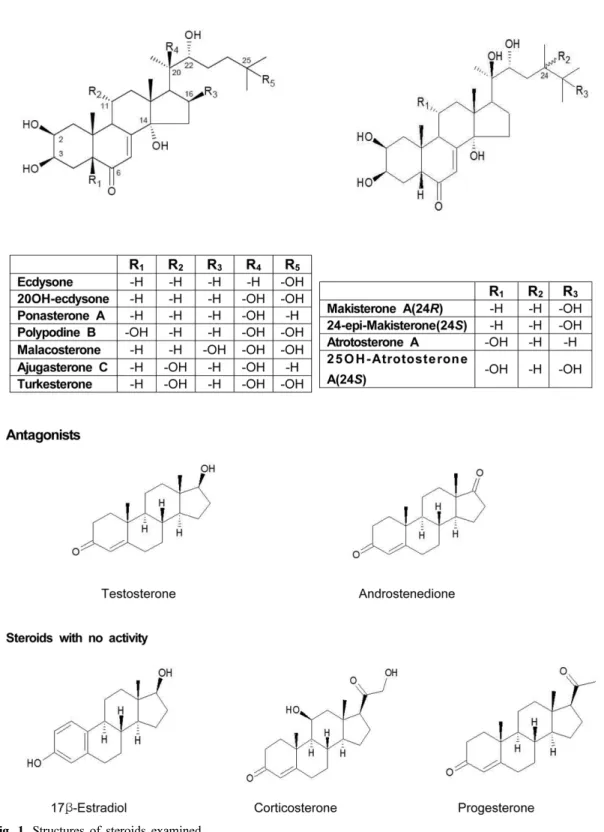
성을 검토하고자 steroid 고리 화합물들 중에서 ecdysone agonist 11종, antagonist 2종, ecdysone receptor와 반응성이 없는 no interacting compound 3종을 선정하고 각 화합물들에 대해 ecdysone receptor 와의 결합성에 영향을 미칠 수 있을 것으로 추정되 는 주요 물리화학적 parameter들을 산출하여 비교분 석하였다. 이를 위해 컴퓨터 프로그램을 사용하여 해 당 원자와 결합형태를 선택하면서(정확한 결합길이 와 결합각이 자동으로 제공됨) 대상 화합물들의 분 자구조를 작성하고 분자구조가 완성된 각 화합물들 에 대해 산정된 물리화학적 parameter 값들을 구하 였다. 특히 agonist group에 대해서는 생체내 ecdysone receptor와의 결합능에 대한 실제적 실험척도로서 널 리 인용되고 있는 Drosophila cell에 있어서의 pI5022-32)
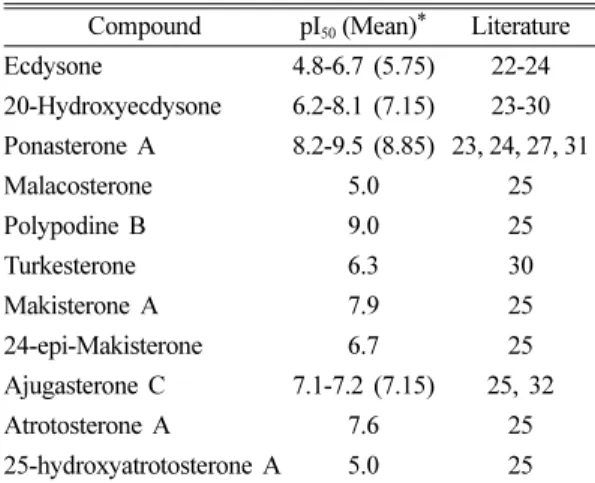
(Table 2)과 화합물들의 물리화학적 parameter들 및 각 화합물들에 있어 -OH, -CH3 등의 주요작용기들 의 결합여부와 위치에 따른 상관성을 면밀하게 검토 하였다.
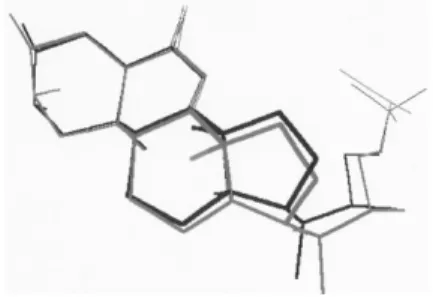
이와 함께 대상화합물들에 있어 전하분포 (Distribution of electronic charge)의 차이가 ecdysone receptor와의 결합능에 영향을 미칠 수 있음을 인식 하여 각 화합물 및 group들간의 전하분포차이를 비 교, 분석하였다. 또한 특정의 동일한 생물학적 활성 을 갖는 화합물들간의 화학구조적 연관성을 규명하 는데 활용되어온 docking법을 적용하여 대상 group 들간의 생체내 ecdysone receptor와의 결합능에 대 한 화학구조적 차이를 규명하고자 하였다(Fig. 3). 본 연구에서는 agonist들 중에서도 강력한 ecdysone activity를 나타내는 대표적인 steroid 물질로 알려져 있는 20-hydroxyecdysone을 기준물질로 하여 각 대 상화합물들에 대한 docking을 수행하고 그 결과를 total distance치로 산출하였다. 이러한 연구과정들은 화학용 컴퓨터프로그램인 Molecular Modeling ProTM (NorGwyn Montgomery SoftwareTM Inc. U.S.A.)을 이용하여 수행하였다.
III. 결 과
1. Ecdysteroids의 물리화학적 특성
Steroid 화합물들을 ecdysone activity와의 연관성 에 따라 분류하여 agonists, antagonists, 비활성 steroid 화합물들의 물리화학적 특성을 비교한 결과(Table 1,
Fig. 1. Structures of steroids examined.
Fig. 2) 옥탄올/물 분배계수인 Log P는 agonists에서 평균 −1.81로 antagonists의 평균 3.61, 비활성 steroid 화합물들의 평균 3.41에 비해 현저히 작았고 반면 hydrophilic-lipophilic balance(HLB), solubility parameter (SP), hydrophilic surface(HPS), hydrogen bond(HB) 등의 값들은 agonists가 개별화합물들 사이에서 큰 편차없이 antagonists와 비활성 steroid 화합물들에
비해 높은 수준으로 나타났다. 화합물들의 입체구조 특성을 나타내는 한 지표인 kappa2 값 역시 agonists 가 개별화합물들 사이에서 큰 편차없이 antagonists Table 1. Physicochemical properties of steroid compounds classified according to their relevance to ecdysone activity
M.W. Log P H.L.B. S.P. Polarity H.P.S.
(%) H.B. Dipole
moment Kappa2 Agonists
Ecdysone 464.6 -0.22 5.90 24.7 5.40 24.6 16.6 2.15 8.54
20-Hydroxyecdysone 480.6 -1.46 7.41 25.4 5.67 29.2 17.7 6.62 8.51
Ponasterone A 464.6 0.75 6.93 24.2 5.32 25.4 16.2 7.97 8.54
Malacosterone 496.6 -3.77 8.34 26.4 5.92 32.8 19.0 7.07 8.76
Polypodine B 496.6 -3.28 8.95 26.8 6.01 37.3 19.1 4.86 8.50
Turkesterone 496.6 -3.77 7.86 26.4 5.92 32.2 19.0 8.47 8.76
Makisterone A 494.7 -1.06 7.20 25.1 5.46 27.9 17.3 4.43 8.76
24-epi-Makisterone 494.7 -1.06 7.20 25.1 5.46 28.1 17.3 4.48 8.76
Ajugasterone C 480.6 -1.56 7.41 25.2 5.58 29.1 17.6 8.45 8.79
Atrotosterone A 494.7 -1.16 7.20 24.8 5.37 28.2 17.3 8.57 9.04
25OH-Atrotosterone A 510.7 -3.37 7.64 26.0 5.69 31.2 18.6 8.39 9.01
Antagonists
Testosterone 288.4 3.46 3.14 22.0 5.85 13.0 11.1 2.49 4.75
Androstenedione 286.4 3.75 3.07 20.2 5.63 11.5 6.74 1.56 4.75
Steroids with no activity
17β-Estradiol 272.4 4.16 3.38 23.7 6.21 15.8 13.6 3.60 4.75
Corticosterone 346.5 1.35 6.01 22.0 6.43 27.4 13.4 8.46 6.27
Progesterone 314.5 4.72 2.80 19.6 5.16 10.1 6.63 4.41 5.5
HLB: hydrophilic-lipophilic balance, SP: solubility parameter, HPS: hydrophilic surface, HB: hydrogen bond
Fig. 2. Comparison of physicochemical properties among groups of ecdysone related steroid compounds.
Table 2. Literature data on interaction of the ecdysone receptor and different ligands
Compound pI50 (Mean)* Literature
Ecdysone 4.8-6.7 (5.75) 22-24
20-Hydroxyecdysone 6.2-8.1 (7.15) 23-30 Ponasterone A 8.2-9.5 (8.85) 23, 24, 27, 31
Malacosterone 5.0 25
Polypodine B 9.0 25
Turkesterone 6.3 30
Makisterone A 7.9 25
24-epi-Makisterone 6.7 25
Ajugasterone C 7.1-7.2 (7.15) 25, 32
Atrotosterone A 7.6 25
25-hydroxyatrotosterone A 5.0 25
* pI50= Negative log of molar concentration needed for 50%
effect in the Drosophila melanogaster BII bioassay.
와 비활성 steroid 화합물들에 비해 높은 수치를 나 타내었고 분자내 dipole moment 값 또한 agonist들 의 평균치가 antagonist들과 비활성 steroid 화합물들 에 비해 높은 수준으로 나타났으나 agonists의 개별 화합물들 간에 비교적 큰 편차를 보였다. 그러나 분 자간의 반발력에 대한 평가지표인 polarity는 agonists 의 평균치가 5.62로 antagonists의 평균 5.74 및 비 활성 steroid 화합물들의 평균 5.93에 비해 큰 차이 가 없었다.
2. Ecdysteroids의 구조유사성
Ecdysteroids의 생체 수용체에 대한 분자구조의 유
사성을 비교평가하기 위해 대표적 ecdysteroid인 20- hydroxyecdysone을 기준으로 docking 기법을 사용 하여 total distance를 산출한 결과(Table 3) agonists 에 있어서는 0.062-0.590의 범위에서 평균이 0.258 이었으며 antagonists에 있어서는 0.494, 그리고 비 활성 steroid 화합물들에 있어서는 0.543의 평균치를 나타내었다.
3. Ecdysterois의 전하분포
본 연구의 대상 steroid 화합물들의 분자내 전하분 포를 검토한 결과(Fig. 4) agonists의 분자내 전하분 포는 antagonists와 비활성 steroid 화합물들의 전하 분포와 비교하여 매우 다른 분포형태를 보여주었으 며 agonists 사이에서는 그 구조유사성을 반영하여 steroid 고리를 중심으로 매우 유사한 분포형태를 Fig. 3. Docking of 2 ecdysteroids.
Table 3. Results of docking against 20-hydroxyecdysone Total distance value
(Min.-Max.)
Agonists 0.258 (0.062-0.590)
Antagonists 0.494 (0.419-0.568) Steroids with no activity 0.543 (0.387-0.748)
Fig. 4. Distribution of electronic charge: dark blue; most positive, light blue; somewhat positive, white; neutral, light red;
somewhat negative, dark red; most negative.
나타내었다. Agonists인 20-hydroxyecdysone과 ponasterone의 경우 steroid 고리의 2번, 3번, 6번, 14번 C들을 중심으로 양전하분포를 나타내었고 testosterone은 4번, 5번, 7번, 8번, corticosterone은 4번, 5번 C들을 중심으로 각 각 음전하 분포가 형 성되어 있음을 나타내었다.
IV. 고 찰
절지동물에서 탈피와 변태를 조절하는 ecdysone 구조유사물질들(ecdysteroids)은 식물들에서도 발견 되어지는데 이러한 ecdysteroids의 ecdysone activity 는 ecdysone receptor를 발현하는 Drosophila cell 등 을 이용한 다수의 bioassay들에 의해 평가되어 왔으 며 아울러 이들 유사체들의 구조적 차이와 활성과의 상관성(Structure-activity relationship)을 규명하고자 많은 연구노력들이 진행되어 왔다. 이에 따라 본 연 구에서는 생태위해성평가 및 환경적으로 보다 안전 한 살충제개발을 위한 연구등에 있어 ecdysone activity 관련연구의 중요성을 인식하고 생체기원 steroid 화 학물질들에 있어 agonists와 antagonists 등의 물리화 학적 특성 및 구조적차이를 비교분석함으로서 ecdysone activity와의 연관성을 검토, 고찰하고자 하였다.
본 연구의 결과에서 검토된 steroid 화합물들의 물 리화학적 특성은 전체적으로 agonists가 steroid 고리 와 side chain 부위에 -OH를 다수 결합하고 있는 구 조적 특성을 반영한 것으로 볼 수 있으며 이와 같 은 연구자료들은 향후 ecdysone activity를 갖는 비 steroid성 화합물들의 화학구조적 특성에 대한 관련 연구들에 있어 의미있는 기초자료들로서 활용될 수 있을 것으로 사료된다.
생체내 ecdysone 활성을 가진 steroid 화합물들에 대해서는 그들의 화학구조적 특성과 생체 활성도와 의 연관성을 규명하려는 노력들이 지속적으로 진행 되어 왔다. Cholesterol은 ecdysone receptor(EcR)와 의 결합능이 없지만 그 골격탄소에 -OH나 =O와 같 은 관능기가 도입됨에 따라 EcR과의 결합능을 갖게 된다. Arai 등33)은 30여개의 ponasterone analogs들 을 합성하고 그들에 대해 receptor binding activity 를 측정, 비교함으로서 도입된 관능기의 종류, 위치 및 입체배향에 따른 receptor binding activity에 미 치는 영향을 고찰하였는데 우선 steroid 골격에 OH
나 C=O와 같은 관능기가 없는 경우에는 side chain 에 -OH가 도입이 되어도 불활성을 나타내어 steroid 골격내 적절한 위치에 관능기가 도입됨이 수용체와 의 결합에 있어 매우 중요함을 명확히 제시하였다.
이와 같이 ecdysteroids와 생체 receptor간의 수소결 합 가능성이 고려되어 특히 분자내 -OH잔기의 존재 여부 및 결합위치가 활성도에 미치는 영향에 관해 가장 많은 관심들이 집중되어 왔는데 일반적으로 edysteroids에 있어 -OH 결합수의 증가는 생체 receptor와의 수소결합을 증가시켜 생체활성도를 증 가하는 것으로 예상할 수 있으며 ecdysone, 20- hydroxyecdysone, polypodine B의 경우들에서는 20 번 C와 5β 위치에 -OH가 존재함으로서 생체활성도 가 증가하였다. 이들 경우에 있어 -OH의 결합에 따 른 물리화학적 특성변화를 보면 20번 C와 5β 위치 에 -OH가 부가됨으로서 Log P가 감소되고 HLB, SP, polarity, HB가 증가되었다. 그러나 dipole moment 값은 20번 C에 -OH가 부가되었을 때는 증가되었으 나 5β 위치에 -OH가 부가되었을 때는 감소되는 상 반된 경향을 나타내었다. 한편 반대로 -OH의 존재 가 오히려 생체활성도를 감소시킬 수 있는 것으로 밝혀져 왔는데 대표적으로 11번 C, 16번 C, 25번 C 에 -OH가 결합된 경우들로 구체적으로 ponasterone A, 20-hydroxyecdysone, 24-epi-makisterone 등의 11 번 C에 -OH가 결합되는 경우, 20-hydroxyecdysone 의 16β 위치에 -OH가 결합된 경우, ponasterone A, ajugasterone C, atrotosterone A 등의 25번 C에 -OH 가 결합되는 경우들에 있어서는 생체활성도가 감소 함이 보고된 바 있다. 이들에 있어 11번 C, 16번 C, 25번 C에 -OH가 결합함으로서 -OH의 증가를 반영 하여 전반적으로 Log P의 감소, polarity의 증가, H.B.의 증가가 공통적으로 야기되었으나 dipole moment와 Kappa2의 값은 11번 C, 16번 C에 -OH 가 결합시에는 증가된 반면 25번 C에 -OH가 결합 시에는 거의 동일하거나 약간 감소하는 경향을 나타 낸 바 steroid 고리상에 -OH가 결합할 경우와 side chain상에 -OH가 결합할 경우 다소 상이한 물리화 학적 특성을 결과하는 것으로 판단된다. 이와 관련 하여 Wurtz 등34)은 ecdysteroids의 side chain에 있 어 25-OH의 제거는 ponasterone A와 muristerone에 서 처럼 ligand의 생물학적 활성도를 크게 증가시키 나나 구조모델링에 있어서는 receptor와의 수소결합
을 감소시킴을 보고한 바 이는 25-OH의 제거가 분 자내 구조적 유연성을 증가시켜33) 생체 receptor의 주위 아미노산과의 입체적 접촉을 증가시키는 결과 로 판단된다. 이러한 검토결과는 edysteroids에 있어 bioactivity는 단순히 -OH 결합수에 따른 생체 receptor 와의 수소결합 가능성에만 의존되지 않고35) -OH의 결합위치에 따라 오히려 수용체단백질과의 결합이 구조적 및 복합적인 물리화학적 특성의 변화에 의해 저해될 수 있음을 나타내며 앞으로 이와 관련된 보 다 심도있는 관련연구들이 필요할 것으로 사료된다.
Ecdysteroids의 생체 수용체에 대한 분자구조의 유 사성을 비교평가하기 위해 컴퓨터 프로그램 상에서 제공된 docking기법을 사용하여 Fig. 3에서와 같이 20-hydroxyecdysone을 기준으로 각 대상물질들에 대 해 docking을 수행하고 total distance를 산출한 본 연구결과 전체적으로 agonists의 구조유사성이 antagonists와 비활성 steroid 화합물들에 비해 큰 것 으로 나타났다. Total distance 값은 docking 수행 결 과 기준물질과의 구조적 유사성 및 그에 따른 생체 수용체에 대한 적합성을 비교, 평가할 수 있는 한 지표로서 그 수치가 작을수록 구조적 유사성이 큰 것으로 평가할 수 있다. 그러나 본 실험에서 makisterone A와 24-epi-makisterone 등의 일부 agonists에 있어 서는 오히려 antagonists와 비활성 steroid 화합물들 에 비해 큰 total distance 값을 나타내는 경우도 있 었으며 아울러 기대했던 agonists 사이에서의 pI50으 로 평가된 bioactivity(Table 2)와 total distance 사이 의 유의한 상관성은 보여지지 않았다.
본 연구에서의 대상 steroid 화합물들의 분자내 전 하분포는 agonists, antagonists, 비활성 steroid 화합 물들이 각 동일 group내에서는 유사한 분포형태를 나타내었으나 group들 사이에서는 agonists의 분자 내 전하분포형태가 antagonists, 비활성 steroid 화합 물들의 전하분포와 비교하여 매우 상이한 분포형태 를 가지는 것으로 나타났다. 특히 agonists의 steroid 골격내 첫 번째 및 두번째 고리와 side chain의 전 하분포형태가 antagonists, 비활성 steroid 화합물들 의 경우와 비교하여 특징적인 차이를 보여주었다. 이 러한 agonists 사이의 분자내 전하분포형태의 유사 성은 분자내 전하분포특성이 생체 receptor의 특정 아미노산들과의 정전기적 인력에 의한 결합 활성도 의 증가에 기여할 수 있음을 시사하는 것으로 이는
분자내 정전기적 분포특성이 ecdysteroids 분자들의 생체 수용체와의 결합 활성도를 결정하는 중요한 요 소가 될 수 있음을 제시한 Harada 등35)의 연구결과 와 일치하며 앞으로 비스테로이드성 ecdysone 활성 화합물등에 대한 비교연구등에 있어 이와 관련된 연 구검토가 필요할 것으로 사료된다.
V. 결 론
생태독성 및 위해성평가 연구에 있어 화학물질들 에 대한 ecdysone activity 평가의 중요성을 인식하 고 생체기원 주요 steroid 화합물들의 물리화학적 특 성과 생체내 ecdysone bioactivity와의 특이적 연관 성을 면밀히 고찰하고자 수행한 본 연구결과 edysteroids에 있어 bioactivity는 -OH 결합수에 따른 생체 receptor와의 수소결합 가능성에만 의존되지 않 고 ligand의 친수성, 작용기의 결합위치 및 입체적 배향, 정전기적 분포등의 영향과 같은 구조적, 물리 화학적 특성들이 복합적으로 ecdysteroids 분자들의 생체내 수용체 단백질과의 결합 활성도에 영향을 미 칠 수 있음을 확인할 수 있었다.
감사의 글
본 연구는 2012년 군산대학교 환경건설연구소에서 지원받아 수행된 과제로 이에 감사드립니다.
참고문헌
1. Lafont R. The endocrinology of invertebrates. Ecotox- icology. 2000; 9: 41-57.
2. Nakagawa Y, Vincent C, Henrich VC. Arthropod nuclear receptors and their role in molting. FEBS Journal. 2009; 276(21): 6128-6157.
3. Subramoniam T. Crustacean ecdysteroids in repro- duction and embryogenesis. Comparative Biochem- istry and Physiology C. 2000; 125: 135-156.
4. Feldlaufer MF, Herbert Jr EW, Svoboda JA, Thompson MJ. Biosynthesis of makisterone A and 20-hydroxyecdysone from labeled sterols by the honey bee. Apis Mellifera. Archives of Insect Bio- chemistry and Physiology. 1986; 3: 415-421.
5. Feldlaufer MF, Svoboda JA, Aldrich JR, Lusby WR. The neutral sterols of Megalotomus quinques- pinosus (say) (hemiptera: Alydidae) and identifica-
tion of makisterone a as the major free ecdysteroid.
Archives of Insect Biochemistry and Physiology.
1986; 3: 423-430.
6. Hiramoto M, Fujimoto Y, Kakinuma K, Ikekawa N, Ohnishi E. Ecdysteroid conjugates in the ovaries of the silkworm, Bombix mori: 3-phosphates of 2,22- dideoxy-20-hydroxyecdysone and of bombycos- terol. Experientia. 1988; 44(7): 623-625.
7. Rharrabe K, Sayah F, RaFont R. Dietary effects of four phytoecdysteroids on growth and development of the Indian meal moth. Plodia interpunctella. J Insect Sci. 2010; 10(13).
8. Okuzumi K, Hara N, Uekusa H, Fujimoto Y. Struc- ture elucidation of cyasterone stereoisomers iso- lated from Cyathula officinalis. Org Biomol Chem.
2005; 3(7): 1227-1232.
9. Oetken M, Bachmann J, Schulte-Oehlmann U, Oehlmann J. Evidence for endocrine disruption in invertebrates. International Review of Cytology.
2004; 236: 1-44.
10. Clubbs RL, Brooks BW. Daphnia magna responses to a vertebrate estrogen receptor agonist an antago- nist: A multigenerational study. Ecotoxicol Environ Saf. 2007; 67: 385-398.
11. Zou E, Fingerman M. Effects of estrogenic xenobi- otics on molting of the water flea, Daphnia magna.
Ecotoxicol Environ Saf. 1997; 38: 281-285.
12. Mizuhashi S, Ikegaya Y, Matsuki N. Pharmacolog- ical property of tributyltin in vivo and in vitro. Envi- ron Toxicol Pharmacol. 2000; 8: 205-212.
13. Oehlmann J, Schulte-Oehlmann U, Tillmann M, Markert B. Effects of endocrine disruptors on prosobranch snails (Mollusca: Gastropoda) in the laboratory. I. Bisphenol A and octylphenol as xeno- estrogens. Ecotoxicology. 2000; 9: 383-397.
14. Planella R, Martnez-Guitartea JL, Morcillo G. The endocrine disruptor bisphenol A increases the expression of HSP70 and ecdysone receptor genes in the aquatic larvae of Chironomus riparius.
Chemosphere. 2008; 71(10): 1870-1876.
15. Mu X, Rider CV, Hwang GS, Hoy H, LeBlanc GA.
Covert signal disruption: antiecdysteroidal activity of bisphenol A involves cross talk between signal- ing pathways. Environ Toxicol Chem. 2005; 24(1):
146-152.
16. Hwang GS. Embryotoxicity of bisphenol A in Daphnia magna. Korean J Environ Toxicol. 2006;
21(1): 81-86.
17. Mu X, LeBlanc GA. Environmental antiecdys- teroids alter embryo development in the Crustacean Daphnia magna. J Exp Zool. 2002; 292: 287-292.
18. Kast-Hutcheson K, Rider CV, LeBlanc GA. The fungicide propiconazole interferes with embryonic development of the Crustacean Daphnia magna.
Environ Toxicol Chem. 2001; 20(3): 502-509.
19. Kwak IS, Lee WC. Effects of the ecdysteroid ago- nist tebufenozide on freshwater chironomids. Korean Journal of Limnology. 2004; 37(1): 96-101.
20. Park BR, Kim YG. Exogenous JH and ecdysteroid applications alter initiation of polydnaviral replica- tion in an endoparasitoid wasp, Cotesia plutel- lae(Braconidae: Hymenoptera). Biochem Mol Biol.
Reports. 2011; 44(6): 393-398.
21. Kang KD, Lee EJ, Kamita SG, Maeda S, Seong SI.
Ecdysteroid stimulates virus transmission in larvae infected with Bombyx mori nucleopolyhedrovirus. J Biochem Mol Biol. 2000; 33(1): 63-68.
22. Talbot WS, Swyryd EA, Hogness DS. Drosophila tissues with different metamorphic responses to ecdysone express different ecdysone receptor iso- forms. Cell. 1993; 73: 1323-1337.
23. Nakagawa Y, Shimizu B, Oikawa N, Akamatsu M, Nishimura K, Kurihara N, Ueno T, Fujita T. Three- dimensional quantitative structure-activity analysis of steroidal and dibenzoylhydrazine-type ecdysone agonists. ACS Symposium Series. 1995; 606: 288- 301.
24. Roussel PG, Sik V, Turner NJ, Dinan LN. Synthe- sis and biological activity of side chain analogs of ecdysone and 20-hydroxyecdysone. J Chem Soc Perkin Trans. 1997; 1: 2237-2246.
25. Harmatha J, Dinan L. Biological activity of natural and synthetic ecdysteroids in the BII bioassay. Arch Insect Bioch Phys. 1997; 35: 219-225.
26. Mikitani K. A new nonsteroidal chemical class of ligand for the ecdysteroid receptor 3, 5-di-tert-butyl- 4-hydroxy-N-isobutyl-benzamide shows apparent insect molting hormone activities at molecular and cellular levels. Biochem. Biophys. Res. Commun.
1996; 227: 427-432.
27. Oikawa N, Nakagawa Y, Nishimura K, Kurihara N, Ueno T, Fujita T. Quantitative structure-activity analysis of larvicidal 1-(substitute benzoyl)-2benzoyl-1- tert-butylhydrazines against Chilo suppressalis. Pes- ticide Science. 1994; 41: 139-148.
28. Elbrecht A, Chen Y, Jurgens T, Hensens OD, Zink DL, Beck HT, Balick MJ, Borris R. 8-O-Acetylhar- pagide is a nonsteroidal ecdysteroid agonist. Insect Biochem Mol Biol. 1996; 26: 519-523.
29. Cottam DM, Milner MJ. The effect of several ecdysteroids and ecdysteroid agonists on two Drosophila imaginal disk cell lines. Cell Molecular
Life Scince. 1997; 53: 600-603.
30. Spindler-Barth M, Quack S, Rauch P, Spindler KD.
Biological effects of muristone A and turkesterone on the epithelial cell line from Chironomus tentans (D: Chironomidae) and correlation with binding affinity to the ecdysteroid receptor. Eur J Entomol.
1997; 94: 161-166.
31. Cherbas P, Cherbas L, Lee SS, Nakanishi K. 26- [125I]iodoponasterone A is a potent ecdysone and a sensitive radioligand for ecdysone receptors. Pro- ceedings of the National Academy of Sciences of the United States of America. 1988; 85: 2096-2100.
32. Odinokov VN, Galyautdinov IV, Nedopekin DV, Khalilov LM, Shashkov AS, Kachala VV, Dinan L, Lafont R. Phytoecdysteroids from the juice of Ser- ratula coronata L. (Asteraceae). Insect Biochem
Mol Biol. 2002; 32(2): 161-165.
33. Arai H, Watanabe B, Nakagawa, Y, Miyagawa H.
Synthesis of ponasterone A derivatives with vari- ous steroid skeleton moieties and evaluation of their binding to the ecdysone receptor of Kc cells. Ste- roids. 2008; 73: 1452-1464.
34. Wurtz JM, Guillot B, Fagart J, Moras D, Tietjen K, Schindler M. A new model for 20-hydroxyecdys- one and dibenzoylhydrazine binding: A homology modeling and docking approach. Protein Science.
2000; 9: 1073-1084.
35. Harada T, Nakagawa Y, Akamatsu M, Miyagawa H.
Evaluation of hydrogen bonds of ecdysteroids in the ligand-receptor interactions using a protein model- ing system. Bioorganic & Medical Chemistry. 2009;
17: 5868-5873.