
IEG 환경지질연구정보센터
14
0
0
전체 글
(2) 14. J. Paleont. Soc. Korea. Vol. 27, No. 1, 2011. have been reported from the Cretaceous strata of seven localities in Korea (Yun and Yang, 1997; Yang et al., 2000, 2006; Lee et al., 2000; Lee, 2003, 2004; Yun et al., 2004; Huh et al., 1999, 2000, 2006a). Recently Huh et al. (2006b) reviewed the occurrence of dinosaur eggs in Korea. Paik et al. (2006) reported localities of dinosaur eggs, occurrence of dinosaur egg fossil-bearing strata, and sedimentary environment of the Goseong Formation. During the 2008 survey on fossil sites of south coast of Korea, over 55 dinosaur eggs forming at least six egg nests were discovered from the Cretaceous Goseong Formation of Tongyeong area (Yang et al., 2008). The purpose of this paper is to describe these dinosaur eggs.. Geological Setting The Gyeongsang Supergroup is a ~9-km-thick succession of nonmarine, sedimentary and volcanic deposits accumulated in the Gyeongsang Basin which is the largest Cretaceous basin located in southeast of the Korean Peninsula (Fig. 1). Only terrestrial fossils such as plants, mollusks, algae, ostracodes, insects, tortoises, dinosaur skin impressions, bones and teeth, tracks of dinosaur, pterosaurs, and birds, charophytes and invertebrate trace fossils have been discovered from the Gyeongsang Supergroup (Yang, 1976b, 1982; Choi, 1990; Yi et al., 1993; Lee et al., 2000; Paik et al., 1988; 2001a, 2001b, 2001c; Kozai et al., 2005; Hayashi, 2006; Lockley et al., 2006; Kim et al., 2006, 2008, 2009, 2010). The Gyeongsang Supergoup is divided into three major lithostratigraphic units: the Sindong, Hayang, and Yucheon groups in ascending order (Chang, 1975). The Sindong and Hayang groups are composed of conglomerate, gravelly sandstone, sandstone, mudstone or shale, and some carbonate rocks deposited in fluvio-lacustrine environments with local alluvial fans along the basin margins (Choi, 1986; Jo et al., 1997; Rhee et al., 1998; Jo and Chough, 2001; Jo, 2003; Houck and Lockley, 2006; Paik and Kim, 2006). The Yucheon Group consists mainly of volcaniclastic rocks and rare epiclastic sedimentary rocks (Reedman et al., 1989; Kim et al., 1991; Hwang and Kim, 1994; Paik et al., 1996; Yun, 1998). The Goseong Formation (Chang et al., 1983) is distributed only in the Goseong area (Fig. 1). The Goseong Formation is characterized by thick beds (up to 1 m thick), intercalated purple beds, generally limited continuity of beds and volcaniclastic deposits which are not commonly observed in the underlying Jindong Formation, the uppermost formation of the Hayang Group (Paik et al., 2006). The strata of the Goseong Formation mainly composed of tuffaceous sandstone and fine-grained sandy to silty mudstone were interpreted to have been deposited in fluvial channel, crevasse splay, and floodplain environment during the Late Cretaceous (Campanian) (Paik et al., 2006). As shown in Fig. 1, dinosaur eggs were discovered from fine-grained floodplain deposits of the Goseong Formation in Yeondo (small island), Ddabakseom (small inhibited island), and southestern coastal areas of Pyeongri which belong to Dosanmyeon, Tongyeong City of South Gyeongsang Province. Especially giant dinosaur eggs from Ddabakseom were first discovered by Han, Seok Un and briefly reported by Han et al. (2008).. Occurrence of Dinosaur Eggs Dinosaur eggs occur at one site located in Yeondo, five sites located in southeastern coastal area of Pyeongri, and two sites located in Ddabakseom (Fig. 1). In the Yeondo egg site, fine-grained tuffaceous sandstone and siltstone intercalated with thin black mudstone (up to 20 cm thick). Two dinosaur egg nests.
(3) Kim et al. - Dinosaur Eggs from the Cretaceous Goseong Formation of Tongyeong City, Southern Coast of Korea 15. Fig. 1. Geologic map (A) and fossil localities (B).. composed of concentrated eggs in good preservation occur from the light green siltstone beds with strike of N60W and dip of 17SW (Fig. 2). In the southwest coast of Pyeongri, dinosaur egg-bearing strata are light green siltstone to mudstone which is intercalated with fine-grained sandstone. In this area twenty eight dinosaur eggs forming at least three egg nests were observed on the bedding plane or oblique to vertical section (Fig. 2). In a small inhibited island named Ddabakseom which is connected by land during the ebb.
(4) 16. J. Paleont. Soc. Korea. Vol. 27, No. 1, 2011. Fig. 2. Photograph (A) and sketch (B) of six giant theropod dinosaur eggs from Ddabakseom.. Fig. 3. Reconstruction of a giant theropod dinosaur egg nest on the basis of Fig. 2..
(5) Kim et al. - Dinosaur Eggs from the Cretaceous Goseong Formation of Tongyeong City, Southern Coast of Korea 17. Fig. 4. Occurrence of sauropod dinosaur eggs. A-C: Yeondo site 2, D: Pyeongri site 3, E: Pyeongri site 4, F: Pyeongri site 5.. tide, a dinosaur egg nest composed of six giant eggs in good preservation were found (Fig. 3). These dinosaur eggs preserved in floodplain purple mudstone are usually covered by thick beach sands and submerged during spring tide. Longitudinal sections of four nearly complete and two incomplete eggs in radial arrangement are observed on a bedding surface. 3D orientation of eggs is not exactly known. However, it may be possibly regarded that elongated eggs were originally distributed with an arrangement forming a very large circular nest on the basis of the occurrence of arranged six eggs with a radial angle about 60°.
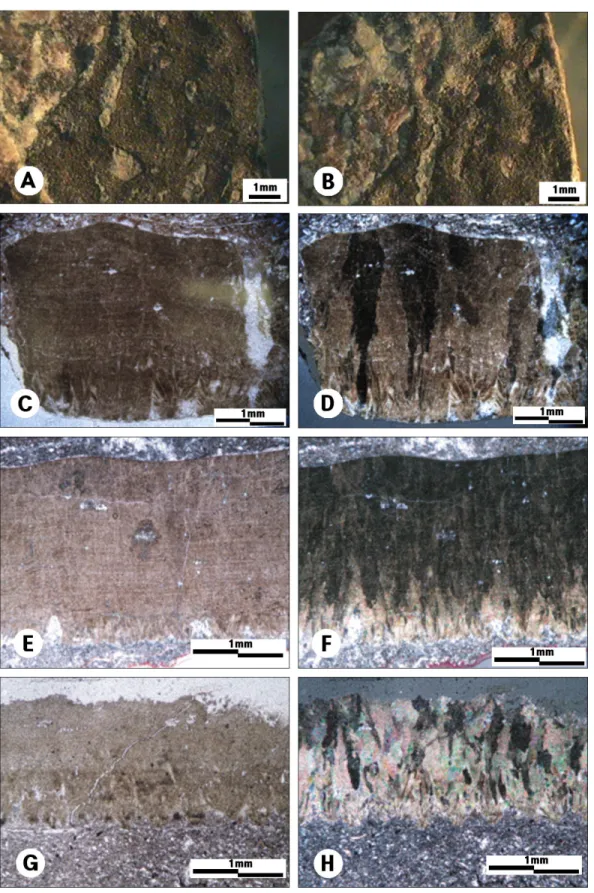
(6) 18. J. Paleont. Soc. Korea. Vol. 27, No. 1, 2011. (Fig. 3). This figure, if reconstruction is correct, is very comparable with Macroelongatoolithus nest reported from the Early Cretaceous of China (Carpenter, 1999).. Systemtic Paleontology Oofamily Elongatoolithidae Zhao, 1975 Oogenus Macroelongatoolithus Li, Yin, and Liu, 1995 Oolithes Young, 1965; Jensen, 1970, p. 62-63, pl. 1, figs. 1, 2, 4, 6; pl. 2, figs. 3, 5, 6; pl. 3, figs. 4, 7, 8; text fig. 5. Macroolithus Zhao, 1975, in part, p. 108. Boletuoolithus Bray, 1998, in part, p. 221-222, figs. 1-3, 4A, 4B. Type Oospecies: Macroelongatoolithus carlylei (Jensen, 1970) Other Oospecies : M. xixiaensis Li et al., 1995; M. zhangi Fang et al., 2000. Revised Diagonosis: Large, elongate eggs, 24-52 cm in length, possibly as long as 60 cm. Elongation index 1.6-3.4. Total range of shell thickness 1.38-3.2 mm. Continous to mammillary layer thickness ratio 1.5:1 to 6.5:1. Angusticanaliculate to oblequicanaliculate pore system. Typical elongatoolithid ornamentation with variable pattern over egg surface (slightly modified after Jin et al., 2007). Macroelongatoolithus goseongensis oosp. nov. Fig. 2, 5 Etymology: After the Goseong Formation from which type specimens were discovered. Materials: Dinosaur eggs (Fig. 2, Holotype KNUE 10101) Occurrence: Upper Cretaceous (Campanian) Goseong Formation, Ddabakseom, Pyeongri, Dosanmyeon, Tongyeong City, South Gyeongsang Province, Korea. Diagnosis: Large, elongate eggs, 39 cm in length. Elongation index 3.4. Shell thickness 2.3-3.1 mm. Continuous to mammillary layer ratio 2.5:1-4.8:1. Eggs arranged within ring-like clutch. Description: Long and short diameters of four nearly complete elongate eggs measure about 390 mm and 115 mm respectively, with an elongation index of about 3.4. The thickness of the egg fragments from the type locality ranges from 2.3 mm to 3.1 mm, which may indicate relatively thin shell around the equator of egg and relatively thick shell around the egg pole. The outer surface ornamentation of egg fragments corresponds to linearituberculate type composed of sinuous ridges. Individual ridges are about 3 mm long and about 0.5 mm high. Ridge are about 0.5 mm separated from adjacent ridges by depressed areas (Fig. 5A-B). Radial thin sections of eggshells show two ultrastructural layers composed of inner mammillary layer and outer continuous layer (Fig. 5C-H), which belong to the ratite morphology of the ornithoid basic type of eggshell structure (Mikhailov, 1991, 1997). The mammillary layers are thin and range from 0.4 to 0.8 mm in thickness. The mammillary layer exhibits closely packed, elongate cones with radiating acicular crystallites that originate from the former organic cores. A distinct contact separates the mammillary layer from the overlying continuous layer. The continuous layer varies from 1.9 mm to 2.0 mm in thickness. The continuous layer to mammillary layer thickness ratio ranges from 2.5:1 to 4.8:1. The continuous layer is characterized by undulose growth lines and columnar extinction patterns are also observed in the continuous layer. Overall microscopic structures of egg shells correspond to typical elongatoolithid microstructures (Zelenitsky et al., 2000; Jin et al., 2007)..
(7) Kim et al. - Dinosaur Eggs from the Cretaceous Goseong Formation of Tongyeong City, Southern Coast of Korea 19. Table 1. Comparison of Macroelongatoolithus species Oospecies. Locality. M. xixiaensis. Henan, China. Shell Egg Size No. of Elongation C/M Thickness (mm) Eggs Index Ratio (cm) Upper Cretaceous 393-516 2.0-3.2 26 (3.1:1)* 3.1 Zoumagang Fm. × 130-79 Geologic Age & Formation. M. xixiaensis. Zhejiang, Mid-Cretaceous 430 × 145 1.6-2.4 China Liangtoutang Fm.. M. zhangi. Zhejiang, Mid-Cretaceous 240 × 150 China Chichengshan Fm.. M. carlylei. ~2.0. 2. (3.0:1)*. unknown (1.8:1)*. Emery Co., Lower Cretaceous unknown 1.38-3.0 unknown unknown Utah Cedar Mountain Fm.. M. Tongyeong, Upper Cretaceous 390 × 115 2.3-3.1 goseongensis Korea Goseong Fm.. 6. 3.4:1. Authors Li et al., 1995. 1.6:1 to 2.3:1. Jin et al., 2007. 1.5:1. Fang et al., 2000. 2:1 Zelenisky et al., to 4:1 2000 2.5:1 to 4.8:1. This study. C/M ratio represents continuous to mammillary layer thickness ratio. * Estimated values measured from figures in references by authors.. Remarks: Only three oospecies of Macroelongatoolithus such as M. xixiaensis (Li et al., 1995; Jin et al., 2007), M. zhangi (Fang et al., 2000), and M. carlylei (Zelenitsky et al., 2000) have been reported from the Lower to Upper Cretaceous strata of China and USA (Table 1), though Zelenitsky et al. (2000) regarded M. xixiaensis as a junior synonym of M. carlylei. Amongst these, however, only M. xixiaensis and M. zhangi were described based on complete eggs and M. carlylei was described based on eggshell fragments. Therefore, egg size, elongation index, and number of eggs in a clutch, which are directly related with morphology of eggs and clutch, were not known. Like M. goseongensis, only M. xixiaensiswas described based on pairs of eggs in a clutch (Li et al., 1995). As shown in Table 1, M. goseongensis described herein is similar in geological age, egg size, shell thickness, and arrangement of eggs in a clutch to M. xixiaensis. Arrangement of six eggs forming an arc with a central angle about 60° allows to reconstruct a clutch more than 30 eggs arranged as a circle with a diameter of 2.4 m (Fig. 5). The reconstructed clutch is much lager than the that of M. xixiaensis which has been known as the largest clutch of dinosaurs (Carpenter, 1999). M. goseongensis is extremely different in egg size, shell thickness, and elongation index from M. zhangi. It is difficult to compare M. goseongensis with M. carlylei of which egg size and elongation index are not known. Range of shell thickness of M. goseongensis nearly falls within that of M. carlylei (See Table 1). Elongation index of M. goseongensis (3.0:1-3.1:1) is extremely larger than that of M. zhangi (1.8:1). In addition to elongation index, the continuous layer to mammillary layer ratio of M. goseongensis (2.5:1 to 4.8:1) is much larger than those of M. xixiaensis (1.6:1 to 3:1), M. zhangi (1.5:1), and M. carlylei (2:1 to 4:1) (See Table 1). In summary, M. goseongensis is different in macro- and micro-structural features from previouslyknown oospecies of Macroelongatoolithus, M. xixiaensis, M. zhangi, and M. carlylei. Oogenus Dictyoolithus Zhao, 1994 Diagnosis:Spherical eggs with a diameter of 120 mm, shell thickness 1.5-1.7 mm. Microstructure of radial thin section displays reticulate organization composed of superimposed shell units (Zhao, 1994). Remarks: Dictyoolithus belongs to dendrospherulitic morphology (Mikhailov, 1991, 1997). Dictyoolithus attributable to sauropods (Mikahailov, 1996) was previously reported only from the Lower Cretaceous.
(8) 20. J. Paleont. Soc. Korea. Vol. 27, No. 1, 2011. Fig. 5. Microscopic features of giant theropod dinosaur eggs. A, B: outer surface of shell, C-H: thin section view, C, E, G: open nicol, D, F, H: cross nicol.
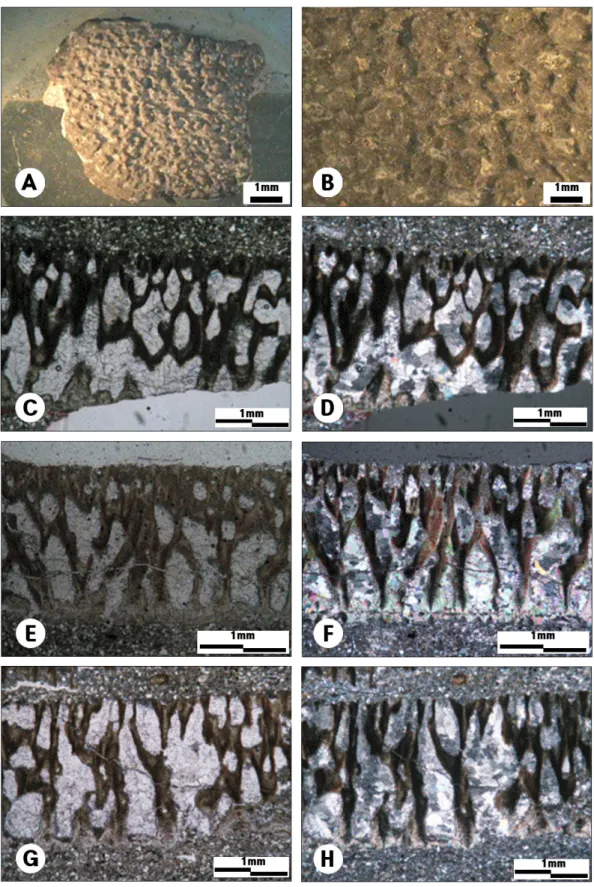
(9) Kim et al. - Dinosaur Eggs from the Cretaceous Goseong Formation of Tongyeong City, Southern Coast of Korea 21. Fig. 6. Microscopic features of sauropod dinosaur eggs. A, B: outer surface of shell, C-H: thin section view, C. E. G: open nicol, D, F, H: cross nicol..
(10) 22. J. Paleont. Soc. Korea. Vol. 27, No. 1, 2011. strata of China (Mikhailov, 1997). Dictyoolithus neixiangensis Zhao, 1994 Fig. 4, 6 Material: Dinosaur eggs (Fig. 4B, KNUE 10102) Occurrence: Upper Cretaceous (Campanian) Goseong Formation, Yeondo and southwest coast Pyeongri, Dosanmyeon, Tongyeong City, South Gyeongsang Province, Korea. Description: Spherical eggs with diameter ranging from 100 to 135 mm. Shell thickness varies between 1.0 mm and 1.7 mm. Outer surface ornamentation displays grainy appearance and generally smoothed form. Micro-sized grains about 0.3 mm are nearly uniformly distributed on the outer surface of shells (Fig. 6A-B). Radial thin sections of eggshells show inner mammillary layer. The inner mammillary layers are up to about 0.3 mm thick and exhibit well-preserved mammilla. The outer continuous layers are about 1.4 mm thick and characteristically display dendrospherulitic morphotype features. Irregular reticulates composed of three superimposed eggshell units are characteristic microstructure of continuous layer (Fig. 6C-H). Due to increasing of branches, reticulates become smaller toward outer surface of the shell. Pore channels are very irregular and very dense. Remarks: Egg size and shape, outer surface ornamentation and microstructures of radial thin sections of materials are nearly identical to those of Dictyoolithus neixiangensis from the Lower Cretaceous of Henan Province, China (Zhao, 1994). Until now, Dictyoolithus has been reported only from the Lower Cretaceous strata of South China (Zhao, 1994). Therefore, occurrence of Dictyoolithus from the Upper Cretaceous Goseong Formation provides an evidence for extending paleobiogeographic and stratigraphic range of Dictyoolithus.. Discussion The occurrence of Macroelongatoolithus goseongensis and Dictyoolithus neixixiangensis from the Upper Cretaceous (Campanian) Goseong Formation has important implications for paleobiogeography and biostratigraphy of dinosaur eggs. Macroelongatoolithus has been described from Middle to Upper Cretaceous of southeast China (Li et al., 1995; Fang et al., 2000; Jin et al., 2007) and Lower to Middle Cretaceous of Utah (Zelenitsky et al., 2000). The discovery of Macroelongatoolithus from the Goseong Formation of Korea represents the fourth record of this oogenus following its record from Henan, Zhejiang, and Utah. The occurrence of elongatoolithid oospecies is regarded to be suggestive of the presence of oviraptosaurs (Zelenitsky et al., 2000). In this respect, the presence of Macroelongatoolithus goseongensis in the Goseong Formation suggests that oviraptorosaurs or oviraptorosaurs-like theropods inhabited Korea during the Late Cretaceous . The occurrence of Dictyoolithus described from the Upper Cretaceous Goseong Formation represents the second record of this oogenus and the first record of this oogenus outside of type locality, southeast China. The record of Dictyoolithus from the Goseong Formation also allows to extend the paleobiogeographic distribution of the oogenus and widen the stratigraphic range of Dictyoolithus from Early Cretaceous to Late Cretaceous..
(11) Kim et al. - Dinosaur Eggs from the Cretaceous Goseong Formation of Tongyeong City, Southern Coast of Korea 23. Acknowledgement This study was financially supported by Research Fund (2011-0141) of Korea National University of Education. Authors thank Paik, I.S. of Pukyong National University and Lee, Y.N. of Korea Institute of Geology and Mineral Resources for useful comments and constructive suggestions. Authors thank Oh, M.S., Han, S.H., Kim, M.K., and Ahn, H.J. for help in preparation of this manuscript.. 남해안 통영시에 분포한 백악기 고성층의 공룡 알 화석 1,*. 2. 3. 4. 김정률 ․양승영 ․최현일 ․서승조 ․김경수. 4. 1. 363-791, 충북 청원군 한국교원대학교 지구과학교육과 706-010, 대구시 수성구 범어동 5-45, 킹덤오피스텔 805호 3 305-350, 대전광역시 유성구 가정동 30, 한국지질자원연구원 4 660-765, 경남 진주시 진주교육대학교 과학교육과 2. 요 약: 남해안 통영시에 분포한 상부 백악기 고성층에서 산출된 공룡 알 화석을 Macroelongatoolithus goseongensis oosp. nov.와 Dictyoolithus neixiangensis로 기재하였다. M. goseongsis는 길이가 39 cm에 이르는 크고 신장된 공룡 알 화석이다. 신장 지수(elongation index)는 0.3이고 알 껍데기의 두께는 2.3-3.1 mm이다. 연속층과 유상층의 비는 4.8:1 이다. M. goseongsis는 M. calylei와 연속층과 유상층의 비가 다르며, M. zhangi와 크기, 신장 지수 및 연속층과 유상층 의 비가 다르고, M. xixiaensis와는 신장 지수와 연속층과 유상층의 비가 다르다. D. neixiangensis는 120 mm의 직경을 갖는 둥근 공룡 알 화석이며, 알 껍데기의두께는 1.5-1.7 mm이다. 알의 외부 표면은 입상으로 매끄러운 상태이다. D. neixiangensis는 두개 또는 세개의 알 껍데기 단위(eggshell units)가 중첩된 불규칙한 망상 구조를 보이는 알 껍데기의 기본 미구조(basic microstructure)가 특징적이다. M. goseongnsis는 Macroelongtoolithus의 네번째 oospecies이며, 이 oogenus의 고생물지리적 분포를 확장시키는 증거이다. 또한 M. goseongnsis의 산출은 M. goseongnsis의 주인공으로 생각되는 오비랩토사우루 또는 오비랩토사우루와 유사한 수각류 공룡이 백악기의 경상 분지에 서식하였음을 지시한다. 상부 백악기(Campanian)의 고성층에서 산출된 Dictyoolithus neixiangensis는 Dictyoolithus의 표식지인 남동 중국 해 난 이외의 지역에서 처음으로 기록된 것이며, 이 알 화석 종류의 층서적 산출 범위를 전기 백악기에서 후기 백악기로, 그 리고 고생물지리적 분포를 남동 중국에서한국으로 확장하는 증거를 제공한다. 주요어: 공룡 알 화석, Macroelongtoolithus, Dictyoolithus, 고성층, 한국. REFERENCES Buffetaut, E. and Le Loeuff, J., 1994. The discovery of dinosaur eggshells in nineteenth-century France. In: Carpenter, K., Hirsch, K. F., and Horner, J. (eds.), Dinosaur Eggs and Babies, New York, Cambridge University Press, pp. 31-34. Carpenter, K., 1999. Eggs, Nests, and Baby Dinosaurs: A Look at Dinosaur Reproduction. Indiana University Press, 336 p. Chang, K. H., 1975. Cretaceous stratigraphy of southeast Korea. Journal of the Geological Society of Korea, 11, pp. 1-23. Choi, H. I., 1986. Sedimentation and evolution of the Cretaceous Gyeongsang Basin, southeastern Korea. Journal of Geological Society of London, 143, pp. 29-40. Choi, S. J., 1990. Some nonmarine fossils from the central part of Gyeongsang Basin, S. Korea. Journal of the Paleontological Society of Korea, 6, pp. 165-179. Fang, X., Wang, Y., and Jiang, Y., 2000. On the Late Cretaceous fossil eggs of Tiantai, Zhejiang. Geological Review,.
(12) 24. J. Paleont. Soc. Korea. Vol. 27, No. 1, 2011. 46, pp. 105-111. (In Chinese) Grellet-Tinner, G., Chiappe, L., Norel, M., and Bottjer, D., 2006. Dinosaur eggs and nesting behaviors: a palaeobiological investigation. Palaeogeography, Palaeoclimatology, Palaeoecology, 232, pp. 294-321. Hayashi, K., 2006. Nonmarine ostracode zonation and long-distance correlation based on analysis of regional ostracode successions in China, Korea, Japan, and Mongolia. Cretaceous Research, 27, pp. 168-188. Houck, K. J. and Lockley, M. G., 2006. Life in an active volcanic arc: Petrology and sedimentology of dinosaur track beds in the Jindong Formation (Cretaceous), Gyeongsang Basin, South Korea. Cretaceous Research, 27, pp. 102-122. Huh, M., Paik, I, S., Lee, Y. I., and Kim, H. K., 1999. Dinosaur eggs and nests from Bosung, Jeollanam-do, Korea. Journal of the Geological Society of Korea, 35, pp. 229-232. (in Korean) Huh, M., Paik, I, S., Lee, Y. I., Lee, Y. Y., Jeong, D. G., Jeong, C. H., and Zelenitsky, D., 2000. Report on the Bosung dinosaur egg site (Ⅰ). Korea Dinosaur Research Institute, Chonnam National University, Boseong-gun, p. 132. (in Korean) Huh, M., Paik, I, S., Park, J., Hwang, K. G., Lee, Y. I., Yang, S. Y., Lim, J. D., Lee, Y. U., Cheong, D. K., Seo, S. J., Park, K. H., and Moon, K. H., 2006a. Occurrence of dinosaur eggs in South Korea. Journal of the Geological Society of Korea, 42, pp. 523-547. (in Korean) Huh, M., Paik, I, S., Lockley, M. G., Hwang, K. G., Kim, B. S., and Kwak, S. K., 2006b. Well-preserved theropod tracks from the Upper Cretaceous of Hwasun County, Southwestern Korea and their paleobiological implications. Cretaceous Research, 27, pp. 123-138. Hwang, S. K. and Kim, S. W., 1994. Petrology of Cretaceous volcanic rocks in the Milyang-Yangsan area, Korea: Petrotectonic setting. Journal of the Geological Society of Korea, 30, pp. 229-241. (in Korean) Jensen, J. A., 1970. Fossil eggs in the Lower Cretaceous of Utah. Brigham Young University Geology Studies, 17, pp. 51-65. Jin, X., Azuma, Y., Jackson, F. K., and Varricchio, D. J., 2007. Giant dinosaur eggs from the Tiantai basin, Zhejiang Province, China. Canadaian Journal of Earth Science, 44, pp. 81-88. Jo, H. R., 2003. Depositional environments, architecture, and controls of Early Cretaceous non-marine successions in the northwestern part of Kyongsang Basin, Korea. Sedimentary Geology, 161, pp. 269-294. Jo, H. R., Rhee, C. W., and Chough, S. K., 1997. Distinctive characteristics of a streamflow-dominated alluvial fan deposit: Sanghori area, Kyongsang Basin (Early Cretaceous), southeastern Korea. Sedimentary Geology, 110, pp. 51-79. Jo, H. R. and Chough, S. K., 2001. Architectural analysis of fluvial sequences in the northweatern part of Kyongsang Basin (Early Cretaceous), SE Korea. Sedimentary Geology, 144, pp. 307-334. Kim, J. Y., Kim, S. H., Kim, K. S., and Lockley, M. G., 2006. The oldest record of webbed bird and pterosaur tracks from South Korea (Cretaceous Haman Formation, Changseon and Sinsu Islands): more evidence of high avian diversity in East Asia. Cretaceous Research, 27, pp. 56-69. Kim, J. Y., Kim, K. S., Lockley, M. G., Yang, S. Y., and Seo, S. J., 2008. New didactyl dinosaur footprints (Dromaeosauripus hamanensis ichnogen. et ichnosp. nov.) from the Early Cretaceous Haman Formation, south coast of Korea. Palaeogeography, Palaeoclimatology, Palaeoecology, 262, pp. 72-78. Kim, J. Y., Lockley, M. G., Kim, H. M., Lim, J. D., and Kim, K. S., 2009. New dinosaur tracks from Korea, Ornithopodichnus masanensis ichnogen. et ichnosp. nov. (Jindong Formation, Lower Cretaceous): Implications for polarities in ornithopod foot morphology. Cretaceous Research, 30, pp. 1387-1397. Kim, J. Y., Kim, K. S., Lockley, M. G., and Seo, S. J., 2010. Dinosaur skin impressions from the Cretaceous of Korea: New insights into modes of preservation. Palaeogeography, Palaeoclimatology, Palaeoecology, 293, pp. 167-174. Kim, S. W., Lee, J. Y., Kim, Y. K., and Koh, I.S., 1991. Petrology of the Cretaceous volcanic rocks in southern Yuchon minor basin. Journal of the Geological Society of Korea, 27, pp. 24-39. (in Korean) Kozai, T., Ishida, K., Hirsch, F., Park, S. O., and Chang, K. H., 2005. Early Cretaceous nonmarine mollusk faunas of Japan and Korea. Cretaceous Research, 26, pp. 97-112. Lee, Y. N., 2003. Dinosaur bones and eggs in South Korea. Memoir of the Fukui Prefectural Dinosaur Museum, 2, pp. 113-122. Lee, Y. N., Yang, S. Y., Seo, S. J., Baek, K. S., Lee, D. J., Park, E. J., and Han, S. W., 2000. Distribution and.
(13) Kim et al. - Dinosaur Eggs from the Cretaceous Goseong Formation of Tongyeong City, Southern Coast of Korea 25. paleobiological significance of dinosaur tracks from the Jindong Formation (Albain) in Kosong County, Korea. Journal of the Paleontological Society of Korea, Special Publication, 4, pp. 1-12. Li, Y., Yin, Z., and Liu, Y., 1995. The discovery of a new genus of dinosaur eggs from Xixia, Henan, China. Journal of Wuhan Institute of Chemical Technology, 17, pp. 38-41. Lockley, M. G., Houck, K., Yang, S. Y., Matsukawa, M., and Lim, S. K., 2006. Dinosaur-dominated footprint assemblages from the Cretaceous Jindong Formation, Hallyo Haesang National Park area, Goseong County, South Korea: evidence and implications. Cretaceous Research, 27, pp. 70-101. Mikhailov, K. E., 1991. Classification of fossil eggshells of amniote ertebrates. Acta Palaeontologica Polonica, 36, pp. 193-238. Mikhailov, K. E., 1996. New genera of fossil eggs from the Upper Cretaceous of Mongolia. Paleontological Journal (Moscow), 2, pp. 122-124. Mikhailov, K. E., 1997. Fossil and recent eggshell in amniotic vertebrates: Fine structure, comparative morphology and classification. Special Papers in Paleontological, 56, pp. 1-79. Paik, I. S. and Kim, H. J., 2006. Playa lake and sheetflood deposits of the Upper Cretaceous Jindong Formation, Korea: occurrences and palaeoenvironments. Sedimentary Geology, 187, pp. 83-103. Paik, I. S., Kim, H. J., Kim, J. Y., and Jin, S. I., 1996. Paleoenvironments of the Cretaceous lacustrine deposits (Yucheon Group), Mt. Hwangryeong, Pusan, Korea. Journal of the Paleontological Society of Korea, 12, pp. 181-202. Paik, I. S., Kim, H. J., Park, K. H., Song, Y. S., Lee, Y. I., Hwang, J. Y., and Huh, M., 2001a. Paleoenvironments and taphonomic preservation of dinosaur bone-bearing deposits in the Lower Cretaceous Hasandong Formation, Korea. Cretaceous Research, 22, pp. 627-642. Paik, I. S., Kim, J. H., and Lee, Y. I., 2001b. Dinosaur track-bearing deposits from the Cretaceous Jindong Formation, Korea: occurrence, paleoenvironments and preservation. Cretaceous Research, 22, pp. 79-92. Paik, I. S., Huh, M., and Kim, H. J., 2003. Dinosaur bone-bearing deposits (Upper Cretaceous) of Boseong, Korea: occurrence, paleoenvironments, taphonomy, and preseration. Palaeogeography, Palaeoclimatology, Palaeoecology, 205, pp. 155-168. Paik, I. S., Kang, H. C., Huh, M., and Yang, S. Y., 2006. Goseong Formation (Yucheon Group) in the southern part of Gyeongsang Basin, Korea: occurrences and stratigraphy. Journal of the Geological Society of Korea, 42, pp. 483-505. (in Korean) Paik, K. H., Kim, Y. K., Huh, M., 1988. Ostracodes from the Chinju Formation (Cretaceous, Non-marine) in Kyongsang Basin, Korea. Journal of the Paleontological Society of Korea 4, pp. 94-109. Reedman, A. J., Park, K. H., and Evans, J. A., 1989. The age of granitoid intrusions and related mineralization in the Chisulryeong Mountain area, south-east Korea: constraints on the age of the Chisulryeong Volcanic Formation and Yucheon Group volcanism. Journal of the Geological Society of Korea, 25, pp. 51-58. Rhee, C. W., Jo, H. R., and Chough, S. K., 1998. An allostratigraphic approach to a non-marine basin: the north-western part of Cretaceous Kyongsang Basin, SE Korea. Sedimentology, 45, pp. 449-472. Yang, S. Y., 1975. On a new non-marine pelecypod genus from the Upper Mesozoic Gyeongsang Group of Korea. Transactions and Proceedings of the Palaeontological Society of Japan, New Series 100, pp. 177-187. Yang, S. Y., 1976a. On the dinosaur eggs discovered from the Hasandong Formation of coastal area of Geumnammyeon, Hadong County, Gyeongnam. Proceedings of the Geological Society of Korea. (in Korean) Yang, S. Y., 1976b. On fossils trom the Gyeongsang Group: Especially on some of the molluscan fauna. Journal of the Geological Society of Korea, 12, pp. 23-30. (in Korean) Yang, S. Y., 1982. On the dinosaur’s footprints from the Upper Cretaceous Gyeongsang Group, Korea. Journal of the Geological Society of Korea, 18, pp. 138-142. (in Korean) Yang, S. Y., Choi, H. I., Seo, S. J., Kim, J. Y., and Kim, K. S., 2008. 2008 Research report on fossil sites of south coast (V). Cultural Heritage Administration of Korea, 133 pp. (in Korean) Yi, M. S., Choi, S. J., and Yun, H., 1993. Cretaceous palynomorphs from the Iljik Formation in the Euiseong area, Korea. Journal of the Paleontological Society of Korea, 9, pp. 166-179. Young, C. C., 1965. Fossil eggs from Nanhsiung, Kwangtung, and Kadchou, Kiangsi. Vertebrata Palasiatica, 9, pp 141-170. Yun, S. H., 1998. Volcanic activity and petrology of the Cretaceous volcanic complex in Yucheon volcanic field of.
(14) 26. J. Paleont. Soc. Korea. Vol. 27, No. 1, 2011. southeastern Korea. Journal of Korean Earth Science Society, 19, pp. 408-424. (in Korean) Yun, C. S., Yang, S. Y., 1997. Dinosaur eggshells from the Hasandong Formation, Gyeongsang Supergroup, Korea. Journal of the Paleontological Society of Korea, 13, pp. 21-36. (in Korean) Yun, C. S., Baek, G. S., and Jeong H. S., 2004. Dinosaur eggshells from Sinsudo, Sacheon City, Gyeonsangnam-do, Korea. Journal of the Paleontological Society of Korea, 20, pp. 31-37. (in Korean) Zelenitsky, D. K., Carpenter, K., and Currie, P. J., 2000. First record of elongatoolithid theropod eggshell from North America: the Asian oogenus Macroelongatoolithus from the Lower Cretaceous of Utah. Journal of Vertebrate Paleontology, 20, pp. 130-138. Zhao, Z. K., 1975.The microstructure of the dinosaurian eggshells of Nanxiong Basin, Guangdong, and the problems in dinosaur egg classification. Vertebrata Palasiatica, 13, pp. 105-117. Zhao, Z. K., 1994.The dinosaur eggs in China: On the structure and evolution of eggshells. In: Carpenter K., Hirsch, K. F. and Horner, J. R. (eds.), Dinosaur Eggs and Babies. Cambridge University Press, pp. 184-203. 투고일 : 2011년 4월 19일, 심사일 : 2011년 5월 18일, 게재확정일 : 2011년 5월 28일.
(15)
수치


관련 문서
[r]
자석 팽이는 볼록한 두 부분에는 고리 자석이 들어 있고, 받침대에는 팽이의 고 리 자석 위치와 일치하는 부분에 삼각형 모양의 자석이 네 개 들어 있다.. 그리고
– 간호행위에 대한 수가화가 필요한 이유 : 병원의 여러 부서 중에서 간호 부서가 소비를 하는 부서가 아닌 병원의 수익을
약국은 당초 수집 목적과 합리적으로 관련된 범위에서 정보주체에게 불이익이 발생하는지 여부, 암호화 등 안전성 확보에 필요한 조치를 하였는지 여부 등을
[r]
1 John Owen, Justification by Faith Alone, in The Works of John Owen, ed. John Bolt, trans. Scott Clark, "Do This and Live: Christ's Active Obedience as the
(Taekwondo, Weight Lifting Players) (90 min × 6 days/week) Warming
15) 세광음악출판사
