• 검색 결과가 없습니다.

Veterinary Science

N/A
N/A
Protected

Academic year: 2022

Share "Veterinary Science"

Copied!
7
0
0

로드 중.... (전체 텍스트 보기)

전체 글

(1)

Veterinary Science Comparative evaluation of phenobarbital-induced CYP3A and CYP2H1 gene expression by quantitative RT-PCR in Bantam, Bantamized White Leghorn and White Leghorn chicks

Harshad V. Goriya

1

, Anil Kalia

1

, Shailesh K. Bhavsar

1,

*, Chaitanya G. Joshi

2

, Dharamshibhai N. Rank

2

, Aswin M. Thaker

1

1

Department of Pharmacology and Toxicology and

2

Department of Animal Genetic and Breeding, College of Veterinary Science and Animal Husbandry, Anand Agricultural University, Anand 388 001, Gujarat State, India

The present work was to study induction of cytochrome P450 (CYP)3A and CYP2H1 gene by reverse transcriptase polymerase chain reaction (RT-PCR) and quantitative RT- PCR in Bantam, Bantamized White Leghorn and White Leghorn chicks. Out of 18 chicks total 3 from each group (Bantam, Bantamized White Leghorn and White Leghorn) were treated intraperitoneal with phenobarbital at the dose rate of 12 mg/100 g (body weight) while the control group was treated with the saline. Total RNA was extracted from the liver samples using Tri Reagent based method. First strand cDNA was synthesized using one step RT-PCR kit. The PCR was performed and the product was subjected to agarose gel electrophoresis.

Quantitative RT-PCR was conducted to quantify gene expression level of CYP3A and CYP2H1 genes. Relative expression ratio of CYP3A and CYP2H1 genes was calculated using relative expression software tool (REST). It was found that CYP3A is up regulated by factor of 1.34, 14.51 and 1.00 in Bantam, Bantamized White Leghorn and White Leghorn chicks, respectively. In Bantam and Bantamized White Leghorn chicks CYP2H1 gene was up regulated by factor 1.50 and 80.87, respectively but down regulated by a factor of 1.97 in White Leghorn chicks. The PCR efficiency ranged from 1.30 to 1.70, 0.86 to 1.70 and 0.91 to 1.58 for CYP3A, CYP2H1 and β -actin, respectively in Bantam, Bantamized White Leghorn and White Leghorn chicks.

Key words: cytochrome P450, CYP3A, CYP2H1, phenobar- bital, RT-PCR

Introduction

The superfamily of cytochrome P450 (CYP) comprises about 500 microsomal, mitochondrial and bacterial proteins that are involved in the metabolism of endogenous and exogenous compounds [15]. Cytochrome families 1, 2, and 3 play an essential role in the biotransformation of xenobiotics, which is critical in the first step of detoxication. The term induction denotes a dose-dependent increase in monooxygenase activity associated with an increase in the level of CYP protein. Induction of CYP-dependent activities enhances the metabolic activation of substrates, thus indirectly determining their toxic, mutagenic and pharmacologic effects. The level of induction and the clinical outcome varies depends on genetic, dietary, physiological and environmental factors.

CYP induction response influence CYP-dependent drug metabolism, pharmacokinetics, and drug-drug interactions, the toxicity and carcinogenicity of foreign chemicals, and the activity and disposition of endogenous hormones [3].

Five different classes of prototypical inducer-drugs that activates distinct but overlapping classes of CYPs have been confirmed. One of them is phenobarbital (PB), which is a prototype of a large group of structurally unrelated chemicals that induce a large subset of CYP genes like CYP2A, CYP2B, CYP2C, CYP2H, CYP3A, CYP6A, and CYP102/

106. In addition to CYPs, PB induces a large number of other enzymes such as NADPH CYP reductase and specific transferases, increasing metabolic capabilities [19]. These CYPs, as well as more than 50 other genes, are affected by PB and a number of structurally unrelated compounds classified as PB-like inducers [3]. PB induction is observed from a wide variety of species ranging from Bacillus megaterium to human [4]. In vertebrates, drug induction occurs predominantly in the liver, intestine while lesser extent extrahepatic tissues, such as skin, kidney, lung, and brain [2].

CYP3As are the predominant P450s expressed in mammalian

*Corresponding author

Tel: +91-2692-264688; Fax: +91-2692-261486

E-mail: [email protected]

(2)

liver. CYP3A4 catalyzes the metabolism of 40 to 60 % of all clinically used drugs. Four major classes of CYP3A inducers have been defined. They are steroids, including glucocorticoids and antiglucocorticoids (e.g. RU-486), barbiturates (e.g., PB), macrolide antibiotics (e.g., rifampicin), and antifungal agents (e.g., azoles and imidazoles).

Although CYP3A enzymes are well described in many mammalian species, little is known about these proteins in chicken. The present study was to compare induction and quantification of CYP3A and CYP2H1 gene by PB in Bantam, Bantamized White Leghorn and White Leghorn breeds of chicks.

Materials and Methods

Chemicals and Instruments

Chemicals and instruments for this study were as follows;

TRI reagent (Sigma Aldrich, USA), reverse transcriptase- polymerase chain reaction (RT-PCR) kit (Qiagen, India), EDTA (Sigma Aldrich, USA), MOPS (Sigma Aldrich, USA), agarose (Sigma Aldrich, USA), RNA later (Sigma Aldrich, USA), PB (Smarth Pharma, India), 2X PCR Master mix (Genetix, India), ethidium bromide (Sigma Aldrich, USA), Mastercycler gradient (Eppendorf, Germany), gel documentation systems (Gene Genius Bio Imaging;

Syngene, UK) and spectro-photometer (Unicam, UK).

Experimental animal

One week old chicks of Bantam, Bantamized White Leghorn and White Leghorn breeds were used in the present study. Out of 18 chicks of Bantam, Bantamized White Leghorn and White Leghorn, 3 from each group were treated intraperitoneal with PB at the dose of 12 mg/100 g (body weight) and control group were treated with same volume of 0.9% normal saline. After 24 hrs, they were sacrificed and liver samples were collected from each bird.

The samples were then immediately dipped for few seconds into 2 mM EDTA solution to remove all blood cells. To prevent RNA degradation they were then dipped in 1 ml RNA later solution. The excised samples were then immediately plunged and kept in liquid nitrogen until used.

RNA extraction

Total RNA from tissue samples was extracted using TRI reagent based protocol. RNA was quantified by spectro- photometric analysis using the convention as with 1 absorbance unit at 260 nm equals 40 µ g RNA per ml. The U.V. absorbance was checked at 260 and 280 nm for determination of sample concentration and purity. The quality of extracted RNA was assessed by 1% formaldehyde agarose gel electrophoresis using 1% MOPS as gel running buffer.

RT-PCR

First strand cDNAs were synthesized using one step RT-

PCR kit with gene specific primers CYP3A (F)-5' GAATAC CGCAAAGGCTTCTTGG 3', CYP3A (R)-5' GAACTCTT CTGGGTTTGGC 3', CYP2H1 (F)-5' GACACTTGACATC TCTTCCTC 3', CYP2H1 (R)-5' CTGGGCATTGACTATC ATT 3', β -actin (F)-5' CCCTGAACCCCAAAGCCAAC 3’

and β -actin (R)-5' GACTCCATACCCAAGAAAGA 3’ [17].

PCR was conducted in a final reaction volume of 25 ml using 0.2 ml thin wall PCR tube. A master mix for at least 10 samples was prepared and aliquoted in 22 ml quantities in each PCR tube. Three ml sample of cDNA was added in each tube to make the final volume of 25 ml. Thermocycling conditions was set as the followings, initial denaturation at 94

o

C for 60 sec, denaturation at 94

o

C for 45 sec, annealing temp 60

o

C for 45 sec, extension temp 72

o

C for 90 sec and final extension at 72

o

C for 300 sec.

To confirm PCR amplification, 5 ml of PCR product mixed with 1 ml of 6X gel loading dye from each tube were electrophoresed on 1% agarose gel (depending on the expected size of amplified product) containing 1% ethidium bromide (5 ml/100 ml) at constant voltage 80 V for 60 min in 0.5X TBE. The amplified product was visualized as a single compact band of expected size under UV light and documented by gel documentation system.

Quantitative RT-PCR

Quantitative RT-PCR was conducted with 1 µ g/ µ l concentration of RNA. First strand cDNA synthesis was carried out using the protocols. PCR was carried out in a final reaction volume of 25 ml using 0.2 ml thin wall PCR tube. A 100 µ l master mix for CYP3A was prepared and aliquoted in 25 ml quantities in 4 PCR tubes to carry out sampling at 26th, 31st, 36 th and 41st cycle. Other samples undergo same treatment as well. The above reaction is repeated for CYP2H1 and β - actin primers involving the same samples. Samples were then dropped at 26th, 31st, 36th and 41st cycles. Steps and conditions of thermocycling for PCR is same as previous.

To quantify the gene expression of CYP3A, CYP2H1 and

β -actin, the samples were run on 1% agarose gel electrophoresis. 5 ml PCR product of CYP3A, CYP2H1 and

β -actin for 26th cycle were mixed in 0.2 ml PCR tubes. To it 1 ml of 6X gel loading dye and 2 ml of gel star was added and incubated for 10 min. The mixture was then loaded in 1% agarose gel containing 1% ethidium bromide solution (5 ml/100 ml) and electrophoresed at constant voltage 80 V for 60 min in 0.5X TBE.

Data analysis

By using GeneTool software (Syngene, UK) quantitation

of quantity for CYP3A, CYP2H1 and β -actin with reference

to Standard 1 Kb DNA ladder Gene Ruler (Fermentas,

Canada) was determined. Relative expression ratio for

CYP3A and CYP2H1 gene was calculated by relative

expression software tool (REST) [18]. Relative expression

ratio of target gene CYP3A was calculated by REST using

(3)

following formula:

(E target )

CP target (Sample

Control)

R = (E ref )

CP ref (Sample

Control)

In this formula, R represent a relative expression ratio of target gene, E is PCR efficiency, CP is a crossing point difference of an unknown sample versus a control, and ref represent a reference gene. LingPCR software was used to

calculate PCR efficiency of CYP3A, CYP2H1 and β -actin genes.

Result

All the liver samples processed yielded reasonable quantity (1.8) of RNA. The ratio of absorbance values at 260 and 280 nm was close to 2 indicating low protein and DNA contamination with RNA. All the extracted RNA samples produced compact bands of 28 s, 18 s and 5 s rRNA subunits as shown in Fig. 1.

The PCR was performed at all the samples of Bantam, Bantamized White Leghorn, and White Leghorn chicks using CYP3A, CYP2H1 and β -actin gene specific primers.

Specificity of the desired PCR products (cDNA) was ascertained by high resolution agarose gel electrophoresis. It

Fig. 1. Formaldehyde agarose gel electrophoresis of RNA sample from phenobarbital treated Bantam chicks.

Fig. 2. PCR product run on 1% agarose gel electrophoresis of CYP3A, CYP2H1 and β -actin genes in control and phenobarbital treated (A) Bantam, (B) Bantamized White Leghorn and (C) White Leghorn chicks.

Fig. 3. Quantitative RT-PCR product run on 1% agarose gel

electrophoresis for CYP3A, CYP2H1 and β -actin genes in

control and phenobarbital treated (A) Bantam, (B) Bantamized

White Leghorn and (C) White Leghorn chicks.

(4)

revealed an amplicon of 1107 bp, 1576 and 486 bp for CYP3A, CYP2H1 and β -actin genes, respectively in all three breeds of chicks as shown in Fig. 2.

Quantitative RT-PCR was undertaken to quantify expression level of CYP3A, CYP2H1 and β -actin genes. PCR amplifications were sampled at 26th, 31st, 36th and 41st cycles. The PCR products were electrophoresed and the comparison in amplification for the three genes after each cycle was presented in Fig. 3. The quantity of CYP3A, CYP2H1 and

β -actin was calculated using Gene Tool software with 1 kb DNA ladder having concentration of 7.1 ng/0.5 µ l at 500 bp as reference. Quantity of expressed CYP3A, CYP2H1 and

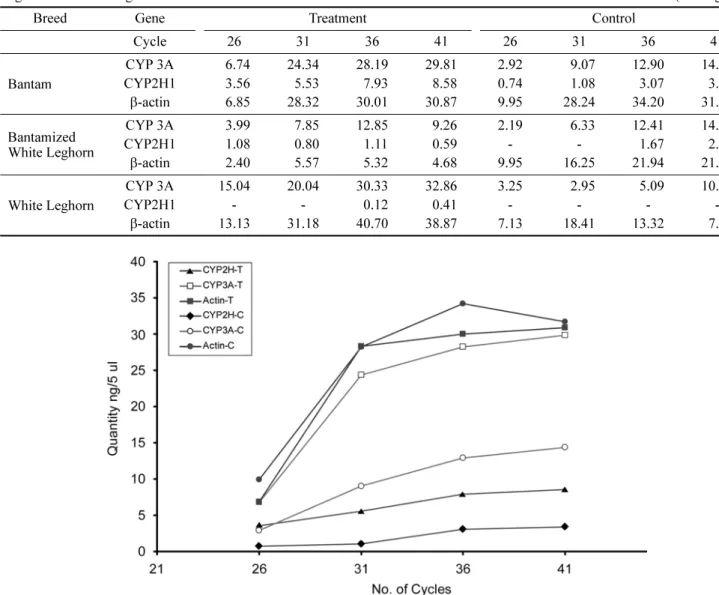
β -actin gene was presented in Table 1. The same figures for representation group of chicks were presented graphically in the Fig. 4. Relative expression ratio of CYP3A, CYP2H1 and β -actin genes was presented in Table 2. PCR efficiency

for each sample was calculated using the formula E = 10

(−1/slope)

. For CYP3A, CYP2H1 and β -actin 26th, 31st and 36th cycle points were considered and 41st cycle was omitted as amplification was not exponential from 36th to 41st cycle. The values of PCR efficiency were depicted in Table 3 for CYP3A and CYP2H1 genes. The PCR efficiency in all three breeds of chicks ranged from 1.30 to 1.70, 0.86 to 1.70 and 0.91 to 1.58 for CYP3A, CYP2H1 and β - actin genes, respectively.

Discussion

PB is one of the five prototypical inducer classes. PB and PB- type inducers affect the transcription of the CYP2B, CYP2C and CYP3A subfamily gene predominantly in addition to at least 50 other genes in the liver [3,13,19].

Table 1. Quantity of CYP3A, CYP2H1 and β -actin gene in phenobarbital treated and control groups of Bantam, Bantamized White Leghorn and White Leghorn chicks (unit: ng/5 µl)

Breed Gene Treatment Control

Cycle 26 31 36 41 26 31 36 41

Bantam CYP 3A 06.74 24.34 28.19 29.81 2.92 09.07 12.90 14.37

CYP2H1 03.56 05.53 07.93 08.58 0.74 01.08 03.07 03.38

β -actin 06.85 28.32 30.01 30.87 9.95 28.24 34.20 31.72

Bantamized White Leghorn

CYP 3A 03.99 07.85 12.85 09.26 2.19 06.33 12.41 14.34

CYP2H1 01.08 00.80 01.11 00.59 - - 01.67 02.72

β -actin 02.40 05.57 05.32 04.68 9.95 16.25 21.94 21.00

White Leghorn CYP 3A 15.04 20.04 30.33 32.86 3.25 02.95 05.09 10.73

CYP2H1 - - 00.12 00.41 - - - -

β -actin 13.13 31.18 40.70 38.87 7.13 18.41 13.32 07.52

Fig. 4. Quantity of CYP2H1, CYP3A and β -actin genes in phenobarbital treated and control Bantam chicks at 26, 31, 36 and 41 cycles

of quantitative PCR (T-treatment C-control).

(5)

Transcriptional induction of CYP by PB has been observed in different species such as mammals, birds and bacteria [13,19]. The inductive response can have a major influence on drug-drug interaction, toxicity and carcinogenicity of exogenous and endogenous compounds [3]. PB treatment increases the transcription on number of CYP genes in chicken (CYP2H1/2, CYP3A and CYP2C45), rat (CYP3A1 /2 and CYP2B1/2), mouse (CYP2b10/9), rabbit (CYP2C1/

2), dog (CYP 2B11), human (CYP3A) and B. Megaterium (CYP106 /102) [5,6,11,12,13,16,17].

RT-PCR product of desired amplicon (1107 bp and 1576 bp) was obtained for CYP3A and CYP2H1, which suggested that PB treatment in chicks caused induction of CYP3A and CYP2H1 genes in Bantam, Bantamized White Leghorn and White Leghorn chicks.

Barbiturates at high dose are well known inducer of CYP3A genes in several species of animals [13]. CYP3A gene was induced in chicken embryos followed by PB treatment. Metyrapone was strong inducer as compared to RU-486, dexamethasone, PCN and rifampicin in chicken [8]. CYP2H1 and CYP2H2 genes were induced in phenobarbital treated chicken embryo hepatocytes. CYP2H1 gene was highly induced by phenobarbital in chicken embryo hepatocytes and it was also found that RU-486 specifically inhibits PB induction of the CYP2H1 gene. Immunodection by a monoclonal antibody of dexamethasone or PCN induced CYP3A like protein in chicken embryo liver was reported by Kimmett et al . [14]. This observation suggested existence of an inducible CYP3A like enzyme in chicken.

Cloning and characterization of CYP3A37 avian cytochrome suggested that sequence of CYP3A37 was 60 % homologous compare to human CYP3A4. Metyrapone strongly induces CYP3A37 in both in ovo and cell culture. As an inducer PB,

dexamethasone and PCN are less potent and rifampicin was weak at 50 µM concentration [8]. In the chicken hepatoma cell line, induction occurred in CYP3A37 and the transcript level of CYP3A37 continued to increase regardless of 30 hrs of exposure of 600 µ M PB [10]. Elevation of transcript levels of CYP3A37 was also found after treating chicken hepatoma cells for 16 hrs with PB (400 µ M), forskolin (100 µ M) and 1, 9 dideoxyforskolin (100 µ M) [9]. Okaidaic acid inhibits induction of chicken CYP3A37 in chicken hepatoma cells [7,10]. Few reports in other species were also found regarding CYP3A subfamily induction. Steroid 6 β -hydroxylase activity was used as marker for CYP3A induction upon PB treatment in dog [1]. CYP3A subfamily gene expression was increased in the liver of PB treated sheep. Treatment of culture hepatocyte with PB resulted in induction of CYP3A12 activity [5].

Quantitative RT-PCR is highly sensitive and reliable technique in quantifying the gene expression. CYP3A was up regulated by a factor of 1.339, 14.507 and 1.004 in Bantam and Bantamized White Leghorn and White Leghorn chicks, respectively. Metyrapone was the most potent inducer of CYP3A showing 3.8 fold inductions much higher than the other classes of xenobiotics inducing CYP3A. RU- 486, dexamethasone, PCN and rifampicin induced CYP3A to less than 1.8 fold [8]. CYP3A37 and CYP2H1 expression was elevated after treatment with typical inducers such as metyrapone, PB, dexamethasone, and PCN. Chicken embryos treated with PB (6mg/egg) and metyrapone (6 mg/egg) in vivo resulted in approximately 100 fold CYP3A induction by metyrapone while PB showed only 5 fold induction of CYP3A. Chicken hepatoma cells ( in vitro ) treatment with PB resulted in approximately 15 fold induction of CYP3A whereas metyrapone induced up to 40 fold [17].

Table 2. Gene expression ratio of CYP 3A and CYP2H1 genes in Bantam, Bantamized White Leghorn and White Leghorn treated with phenobarbital

Breed CYP3A CYP2H1

Expression ratio Regulation of gene Expression ratio Regulation of gene

Bantam 1.34 Up regulation 1.50 Up regulation

Bantamized White Leghorn 14.51 Up regulation 80.870 Up regulation

White Leghorn 1.00 Up regulation 1.97 Down regulation

Table 3. PCR efficiency of CYP3A, CYP2H1 and β -actin genes in control group and phenobarbital treated Bantam, Bantamized White Leghorn and White Leghorn (WLH) chicks

Group Gene Bantam Bantamized WLH WLH

PCR efficiency R

2

PCR efficiency R

2

PCR efficiency R

2

Phenobarbital

treated group

CYP3A 1.575 0.700 1.737 0.842 1.318 0.947

CYP2H1 1.359 0.945 0.862 0.000 - -

β -Actin 1.580 0.646 0.917 0.931 1.761 0.915

Control Group CYP3A 1.671 0.826 1.347 0.945 1.511 0.820

CYP2H1 1.751 0.913 - - - -

β -Actin 1.443 0.671 1.289 0.817 1.367 0.420

(6)

Semi quantitative RT-PCR was conducted to assess the induction of CYP3A mRNA using rifampicin and dexamethasone.

Rifampicin treatment of HepG2 cells induced CYP3A in a dose and time dependent manner. Cells in culture for 48 hrs with 1 and 50 µ M rifampicin showed induction of 2.7 and 5.0 fold in CYP3A mRNA expression in comparison with untreated controls. Graham et al . [5] found that rifampicin induced CYP3A4 gene transcription 13 fold in vitro . CYP3A37 induction was less at 24 hrs of exposure to chicken embryos with PB but at 48 hrs of exposure, CYP3A37 was strongly and constantly up regulated. This finding suggested that PB had different potencies for induction with different time course profiles. Regulation of CYP2H1 gene expression was similar to CYP3A in chicken. Regulation of CYP2H1 of chicken also resembles to CYP2C of human [17]. The co-induction of CYP3A and multiple drug resistance (MDR1b) genes by dexamethasone in HepG2 cells for 72 hrs, 96 hrs and 120 hrs was studied and it was found that CYP3A and MDR1 genes were induced 5 and 2 folds, respectively. The maximum expression of CYP3A4 occurred after a 72hrs dexamethasone treatment whereas maximum of MDR1 gene expression was observed after 96 hrs treatment.

Hepatoma cells were treated with PB for 4 hrs and there was an increase of approximately 10 fold in the rate of CYP2H1 gene transcription. This rate is increased to a maximum of 36 fold after 12 hrs of PB treatment but gradually declined to 9 fold at 48 hrs [6]. CYP2H1 is up- regulated 25 fold in ovo and in vitro chicken hepatoma cells line treatment resulted in 7 fold up regulation [17]. PB and RU-486 moderately elevated CYP2H1 transcript levels approximately 12 fold but metyrapone elevated CYP2H1 transcript levels 18 -25 folds [8].

In conclusion, PB treatment caused induction of CYP3A and CYP2H1 genes in Bantam, Bantamized White Leghorn and White Leghorn breeds of chicks. Quantitative RT-PCR revealed that CYP3A was upregulated in Bantam, Bantamized White Leghorn and White Leghorn chicks. CYP2H1 was upregulated in Bantam, Bantamized White Leghorn chicks, and down regulated in White Leghorn chicks.

References

1. Ciaccio PJ, Halpert JR. Characterization of a phenobarbital- inducible dog liver cytochrome P450 structurally related to rat and human enzymes of the P450IIIA (steroid-inducible) gene subfamily. Arch Biochem Biophys 1989, 271 , 284-299.

2. Denison MS, Whitlock JP. Xenobiotic-inducible transcription of cytochrome P450 genes. J Biol Chem 1995, 270, 18175- 18178.

3. Frueh FW, Zanger UM, Meyer UA. Extent and character of phenobarbital mediated changes in gene expression in the liver. Mol Pharmacol 1997, 51 , 363-369.

4. Fulco AJ. P450BM-3 and other inducible bacterial P450 cytochromes: biochemistry and regulation. Annu Rev Pharmacol

Toxicol 1991, 31 , 177-203.

5. Graham RA, Downey A, Mudra D, Krueger L, Carroll K, Chengelis C, Madan A, Parkinson A. In Vivo and in Vitro

Induction of cytochrome P450 enzymes in Beagle dogs.

Drug Metab Dispos 2002, 30 , 1206-1213.

6. Hahn CN, Hansen AJ, May BK. Transcriptional regulation of the chicken CYP2H1 gene. Localization of a phenobarbital- responsive enhancer domain. J Biol Chem 1991, 266 , 17031- 17039.

7. Handschin C, Meyer UA. A conserved nuclear receptor consensus sequence (DR-4) mediates transcriptional activation of the chicken CYP2H1 gene by phenobarbital in a hepatoma cell line. J Biol Chem 2000, 275 , 13362-13369.

8. Handschin C, Podvinec M, and Meyer UA. CXR, a chicken xenobiotic-sensing orphan nuclear receptor, is related to both mammalian pregnane X receptor (PXR) and constitutive androstane receptor (CAR). Proc Natl Acad Sci USA 2000, 97, 10769-10774.

9. Handschin C, Podvinec M, Looser R, Amherd R, Meyer UA. Multiple enhancer units mediate drug induction of cyp2h1 by xenobiotic-sensing orphan nuclear receptor chicken xenobiotic receptor. Mol Pharmacol 2001, 60 , 681- 10. Handschin C, Podvinec M, Stockli J, Hoffmann K, Meyer 689.

UA. Conservation of signaling pathways of xenobiotic sensing orphan nuclear receptprs, chicken xenobiotic receptor, constitutive androstane receptor, and pragnane X receptor, from birds to human. Mol Endocrinol 2001, 15 , 1571-1585.

11. Hansen AJ, May BK, Elferink LA. Sequence of a chicken phenobarbital inducible cytochrome P450 cDNA: regulation of two P450 mRNAs transcribed from different genes. DNA 1989, 8 , 179-191.

12. Honkakoski P, Moore R, Gynther J, Negishi M.

Characterization of phenobarbital-inducible mouse Cyp2b10 gene transcription in primary hepatocytes. J Biol Chem 1996, 271 , 9746-9753.

13. Kemper B. Regulation of cytochrome P450 gene transcription by phenobarbital. Prog Nucleic Acid Res Mol Biol 1998, 61 , 23-64.

14. Kimmett SM, McNamee JP, Marks GS. Chick embryo liver microsomal steroid hydroxylations: induction by dexamethasone, phenobarbital, and glutethimide and inactivation following the in ovo administration of porphyrinogenic compounds. Can J Physiol Pharmacol 1996, 74 , 97-103.

15. Nelson DR, Koymans L, Kamataki T, Stegeman JJ, Feyereisen R, Waxman DJ, Waterman MR, Gotoh O, Coon MJ, Estabrook RW, Gunsalus IC, Nebert DW. P450 superfamily: update on new sequences, gene mapping, accession numbers and nomenclature. Pharmacogenetics 1996, 6 , 1-42.

16. Nemoto N, Sakurai J, Funae Y. Maintenance of phenobarbital-inducible Cyp2b gene expression in C57BL/6 mouse hepatocytes in primary culture as spheroids. Arch Biochem Biophys 1995, 316 , 362-369.

17. Ourlin JC, Baader M, Fraser D, Halpert JR, Meyer UA.

Cloning and functional expression of a first inducible avian

cytochrome P450 of the CYP3A subfamily (CYP3A37).

(7)

Arch Biochem Biophys 2000, 373 , 375-384.

18. Pfaffl MW, Horgan GW, Dempfle L. Relative expression software tool (REST) for group-wise comparision and statistical analysis of relative expression results in real-time

PCR. Nucleic Acids Res, 2002, 30 , e36.

19. Waxman DJ, Azaroff L. Phenobarbital induction of

cytochrome P-450 gene expression. Biochem J 1992, 281 ,

577-592.

수치

Fig. 3.  Quantitative RT-PCR product run on 1% agarose gel electrophoresis for CYP3A, CYP2H1 and  β -actin genes in control and phenobarbital treated (A) Bantam, (B) Bantamized White Leghorn and (C) White Leghorn chicks.
Table 1.  Quantity of CYP3A, CYP2H1 and  β -actin gene in phenobarbital treated and control groups of Bantam, Bantamized White Leghorn and White Leghorn chicks
Table 2.  Gene expression ratio of CYP 3A and CYP2H1 genes in Bantam, Bantamized White Leghorn and White Leghorn treated with phenobarbital

참조

관련 문서

Location Species No.. Agarose gel electophoresis of RT-PCR products for the detection of Hantaan virus of the wild rodents trapped in Jeollanam-do... 12) Ahlm C, Alexeyev OA,

Results: Using semi-quantitative reverse transcription-polymerase chain reaction (RT-PCR), the mRNA expression levels of these 7 genes were higher in human glioblastomas tissue than

To evaluate appropriate reference genes for the normalization of quantitative reverse transcription PCR (RT-qPCR) data with embryonic and larval samples from Russian

Semi-quantitative RT-PCR analysis of mRNAs specific for MCAK and GAPDH (A), western analysis of protein levels of MCAK, p53, p21 WAF1/Cip1 , and β-actin in continuously

In this study, we performed the PCR-denaturing gradient gel electrophoresis (DGGE) analysis targeting the 16S and 28S rRNA genes to characterize bacterial and fungal diversity

The object of this study was to investigate the modulation of antioxidant enzyme - coding genes using quantitative real time RT - PCR (qRT - PCR), enzyme activity and total

5×10 5 RAW264.7 cells were incubated with MPS or PS for 24 hr after activation of cells with 10 LPS for hr RT-PCR products were electrophorased in 1% agarose gel and the

The changes in the mRNA expression level of the hair loss and hair growth-related genes in dermal papilla cells by WEML treatment were confirmed by quantitative RT-PCR.. Results