• 검색 결과가 없습니다.

INTRODUCTION IdentificationofUp-RegulatedGenesinMalignantGliomawithSubtractionHybridization:PreliminaryScreeningStudies

N/A
N/A
Protected

Academic year: 2022

Share "INTRODUCTION IdentificationofUp-RegulatedGenesinMalignantGliomawithSubtractionHybridization:PreliminaryScreeningStudies"

Copied!
10
0
0

로드 중.... (전체 텍스트 보기)

전체 글

(1)

DOI 10.3349/ymj.2008.49.2.301

Purpose: This investigation is intended to obtain differ- entially expressed genes related to human malignant glioma using Subtractive hybridization. Materials and Methods:

Subtractive hybridization is potentially faster methods for identifying differentially expressed genes associated with a particular disease state. We identified 7 over-expressed genes which were not homologous to any of the known genes in the Genbank

TM

database. Results: Using semi-quantitative reverse transcription-polymerase chain reaction (RT-PCR), the mRNA expression levels of these 7 genes were higher in human glioblastomas tissue than in non-tumor brain tissue. In order to learn more about the expression profile of these genes, RT-PCR was performed using various commercially available human carcinoma cell lines. Some of these new genes were over-expressed in human glioma cell line, but not the expressed in other human cancer cell line. Conclusion: Theses cloned new genes may play a role in brain tumorigenesis.

Further studies including verification of oncogene, cancer protein, and glioblastoma induction in animal model are needed.

Key Words: Glioblastoma, gene, subtraction hybridization

INTRODUCTION

The development of cancer is a complex and multi-step process in which a series of progressive changes culminate in deregulation of all pro- liferation in nervous cells.

1

Alterations of gene expression and several genetic aberrations have

been shown to occur during malignant growth, transformation, and progression of glioblastoma.

1,2

The glioblastoma is the most common malignant brain tumor in adults.

3

Their distinct ability to invade the normal surrounding tissue makes them difficult to completely remove surgically, thus accounting for the extraordinarily high lethality associated with malignant gliomas.

4

A variety of genetic alterations in human gliomas comprise signal transduction and cell cycle arrest control of cellular processes.

Current methods for comparing gene-expression profile changes in different tissues or different pathological specimens include mRNA differential display, serial analysis of gene expression (SAGE), cDNA microarray, large-scale cDNA sequencing, expressed sequence tag (EST) database comparison, two-dimensional gel electrophoresis of cellular proteins, subtractive library construction, repre- sentational difference analysis (RDA) and sup- pression subtractive hybridization (SSH).

5-8

The mRNA differential display is complicated and labor-intensive, and both SAGE and cDNA array are limited for identifying unknown genes because they formerly require known genetic informa- tion.

2,9-11

The chip technology is highly efficient, but also requires formerly known genetic informa- tion and expensive equipment for making the analysis. Thus, chip technology is not yet widely available for the searching of unknown genes in glioblastoma study.

12-14

Suppression subtractive hybridization (SSH) is an efficient and versatile PCR-based method of identifying rare, tumor-specific transcripts.

2,11,13

Since the development of glioblastoma is a com-

Identification of Up-Regulated Genes in Malignant Glioma with Subtraction Hybridization: Preliminary Screening

Studies

Yong Jae Cho

Department of Neurosurgery, Ewha Womans University, School of Medicine, Seoul, Korea.

Received July 18, 2007 Accepted November 14, 2007

Reprint address: requests to Dr. Yong Jae Cho, Department of

Neurosurgery, Ewha Womans University Mok-Dong Hospital,

911-1 Mok-dong, Yangchun-gu, Seoul 158-710, Korea. Tel: 82-2-

2650-2658, Fax: 82-2-2655-0948, E-mail: [email protected]

(2)

plex process involving a large number of genes, we believe that it is important to identify addi- tional new genes, which might be involved in the formation of this tumor. To this end, we employed the SSH technique, which was originally designed to identify genomic differences between two complex genomes. SSH was later adapted to isolation of gene transcripts which are differ- entially expressed in one sample relative to another, allowing the detection of low-abundance transcripts in a sample. SSH is a powerful technique that enables researchers to compare two populations of mRNA and obtain clones of genes that are expressed in one population but not in the others.

15-20

In this report, over-expressed genes involved in glioblastoma were identified by SSH, charac- terized by RT-PCR and sequenced. The result obtained from SSH screen was confirmed by RT- PCR of non-neoplastic brain tissue, human glioma cell lines and other human cancer cell line. To know whether these genes are involved in the cell division, serum deprivation and stimulation were conducted.

MATERIALS AND METHODS Tissue materials

Through June 2004 to September 2005, glio- blastoma patients consented to use of their tissues. We investigated tissues from 15 patients in whom craniotomy and surgical removal were performed due to cerebral glioblastoma. Tumor and non-tumor brain tissues (tumor tissues; N = 15, non-tumor brain tissues; N = 15) were col- lected during the neurosurgical operations. The patients altogether consisted of 15 patients - 5 females and 10 males, aged 49 to 70 years. Mean age at diagnosis was 55.2 years ± 6.9 (SD). The histological diagnosis was made by two neuro- pathologists according to World Health Organiza- tion (WHO) classification of the astrocytic tumors.

Among 15 pairs of tissues (non-tumor brain tissue and glioblastoma tissue), 10 pairs was used for identification of new glioblastoma specific genes and remaining 5 pairs for expression of identified genes.

RNA extraction and SMART

TM

PCR cDNA synthesis

Total RNA of the non-tumor brain tissue and glioblastoma tissue was prepared using the Trizol reagent according to manufacturer’s instructions (Clontech, Mountain View, CA, USA). The con- centration and quality of each RNA sample were measured for the synthesis of high quality cDNA by spectrophotometrical determination of a 260/

280 ratio. About 1 g of total RNA samples was μ treated with DNase I at 37°C for 15 min and at 65°C for 10 min, to get rid of genomic DNA con- tamination. The RNA was dissolved in DEPC- treated water and total RNA was analyzed on 1.2% agarose gel. Total 1 g RNA was used for μ SMART cDNA synthesis and was reverse-trans- cribed in 10 L mixture with PowerScript μ

TM

Reverse transcriptase (BD Biosciences Clontech, Mountain View, CA, USA). The first-strand of cDNA was diluted to a final volume of 40 L with 1 μ × TE buffer (10 mM Tris-HCl, pH 8.0, 1 nM EDTA).

One L of the diluted cDNA was used to generate μ cDNA by long distance PCR with BD Advantage 2 polymerase mix (BD Biosciences Clontech, CA, USA), using PCR primer II A according to the manufacturer’s instructions. The final concentra- tion of digested second strand cDNA was 300 g/ μ

L.

μ

PCR-based suppression subtraction hybridization (SSH)

SSH was performed with the PCR-Select

cDNA Subtraction Kit according to the

manufacturer’s protocol. Driver ds cDNA was

synthesized from 1 g each of total RNA, using μ

SMART

TM

PCR cDNA Synthesis Kit user Manual

(Clontech, Mountain View, CA, USA). First- and

second- strand cDNA synthesis and blunt-ending

of DNA ends by T4 DNA polymerase were

carried out according to the manufacturer’s

protocol. The second double-stranded cDNA was

digested with 10 units/ul RsaI in a final volume

of 50 L at 37°C for 3 μ hr. After extraction and

precipitation of digested second strand cDNAs,

the pellet was dissolved in 7 L of sterile H μ

2

O,

precipitate was washed in 80% ethanol and

residual ethanol was evaporated after the

(3)

supernatant was removed. The final concen- tration of driver was 300 ng/ L. RsaI digested μ ds tester cDNA was prepared as described above for the driver. Digested tester cDNA (1 L) μ was diluted in 5 L of H μ

2

O. The diluted tester cDNA (2 L) was then ligated to 2 μ μ L of adaptor land adaptor 2R (10 LM) in separate ligation μ reactions in a total volume of 10 L at 16°C μ overnight, using 400 units/ L of T4 DNA ligase μ in the buffer supplied from the manufacturer.

After ligation, 1 L of 20(EDTA/glycogen was μ added and the samples were heated at 72°C for 5min to inactivate the ligase and stored at - 20°C.

cDNA hybridization was used with tester1-1 and tester1-2 that were, mixed with adaptor1 and adaptor 2R respectively. One and half L of μ tester1-1 with adaptor1 and tester1-2 with adaptor 2R were, respectively, hybridized with 1.5 L digested first stranded driver cDNA of μ brain tumor in 1 L of 4 μ × hybridization buffer solution at 68°C for 8 hr. Tester1 - 2 hybridiza- tion sample was drawn into the pipette tip.

Afterwards, 1 L of denatured mixture from 1 μ L of digested second stranded driver cDNA, 2 μ

L of H

μ

2

O, and 1 L of 4 μ × hybridization buffer solution at 98°C were drawn into pipette tip with a slight air space below the droplet of the above tester1-2 hybridization sample. The final hybridization was then diluted in 200 L of μ dilution buffer (20 mM HEPES/50 mM NaCl/0.2 mM EDTA), heated at 68°C for 7 min and stored at - 20°C. For each subtraction, we per- formed two PCR amplifications. The primary PCR was conducted in 25 L. It contained 1 μ μ L of diluted, subtracted cDNA, 1 L of PCR μ primer 1 (10 M), and 23 μ μ L of PCR master mixture prepared by using the 50 (Advantage cDNA polymerase PCR Kit (Clontech, Mountain View, CA, USA). PCR was performed with the following parameters: 75°C for 5 min; 30 cycle at 94°C for 25 sec, 94°C for 10 sec, 64°C for 30 sec, 72°C for 1.5 min. three L of primary PCR μ mixture was diluted in 27 L of water for the μ nested-PCR reaction for 11 cycle (94°C for 10 sec, 68°C for 30 sec, 72°C for 1.5 min) with the same reagent except the two nested primer1, 2R.

Transformation and sequencing of the subtracted cDNA

The subtracted cDNAs obtained after secondary PCR were cloned with a T/A Cloning Kit (Promega, Madison, WI, USA). The cDNAs were ligated into T/A vectors by incubating 3 L of μ the secondary PCR amplification and 1 L of the μ vector (50ng/ L) with 3Weiss units of T4 DNA μ ligase overnight at 4°C. Then, 5 L of ligated μ product was transformed into 50 L of com μ - petent JM109 cells for heat shock. Competent JM109 cells transformed by ligated product were grown on LB medium agar plates overnight at 37°C. White colonies containing inserts were obtained, following transformation of competent cells. White colonies were placed into LB medium and shaken overnight at 37°C. The plasmid DNA with inserted fragments was extracted, the extracted DNA was digested with EcoRI restriction enzyme, and the product was analyzed on 1.2% agarose gel. DNA sequencing was performed at Biotechnology Center Macrogen (Seoul, Korea). Nucleic acid homology was searched using the NCBI BLAST program (http://www.ncbi.nih.gov/BLAST).

RT-PCR

For expression of isolated seven genes' mRNA levels on glioblastoma tumor tissues and non- tumor brain tissue, RT-PCR was performed using previous primers. mRNA of glioblastoma tissue sample and non-tumor brain tissue which were mentioned above samples was reverse transcribed to cDNA using Superscript

TM

First- Strand Synthesis (Invitrogen, Carlsbad, CA, USA).

RT-PCR was performed on samples with 1 g of μ total RNA. The reaction mixture contained 1 L μ of SuperScript II reverse transcritase (50 units), 1

L

μ oligo dT (0.5 g/ L μ μ ), 2 L μ 10X RT buffer, 2 L μ of 0.1 M DTT, and 1 L μ each of 10 mM dNTP.

The reverse transcription was carried out for 50

min at 42°C. Semi-quantitative RT-PCR was used

to assess amounts of mRNA in glioblastoma

tissue sample and non-tumor brain tissue. PCR

amplification was performed with gene specific

primer, and 18srRNA was used as the reference

gene using the TaKaRa Ex Taq

TM

. Gene specific

(4)

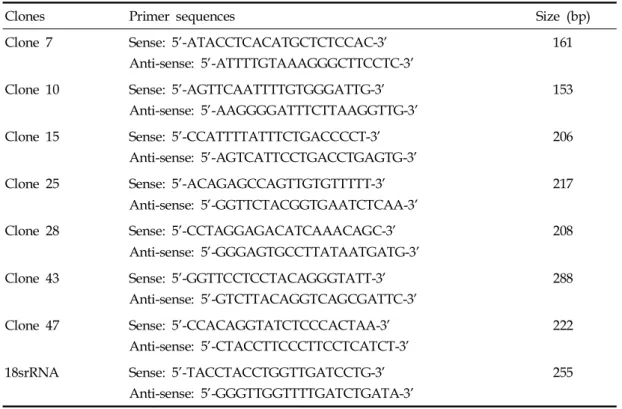
primers used in this study were designed from known sequences of the isolated genes, shown in Table 1. Amplification conditions were denatura- tion at 94°C for 5 min, followed by 35 cycles of denaturation at 94°C for 30 sec, annealing at 55°C for 30 sec and extension at 72°C for 30 sec.

A final extension was done at 72°C for 10 min, and the reaction mixtures were then run for 30 min at 100V on 1% agarose/EtBr gel with ethidium bromide staining. Densitometric analyses were performed including standardization from the control (18srRNA) band.

RT-PCR analyses were performed to identify genes in five human glioma cell lines (SF188, SF539, SF126, U87, and U251) (Seoul National University Cancer Research Center, Seoul, Korea).

The same methodology described above was used.

And also, RT-PCR was also done in other human cancer cell lines; lung (WI-38), colon (CCD-18Co), prostate (RWPE-1), SV40-immortalized cell line (WI-38 VA13), lung carcinoma (NCI-H596), colon carcinoma (KM1214) and prostate carcinoma (DU145). These cell lines were purchased from ATCC (Manassas, VA, USA) and Nikken Cell line bank (Japan).

Serum deprivation and stimulation test

WI-38 (8PDL) cells were routinely maintained in Eagle's minimal essential medium (E-MEM) supplemented with 10% fetal bovine serum and, essential and non-essential amino acids. Cells were seeded at a density of 2 × 10

6

cells in a 60-mm dish. The cultures were maintained at 37°C in a humidified 5% CO

2

atmosphere. They were cultured at a density of 60% cells, washed with PBS, and medium supplemented with 1% FBS was finally added. The cells were washed with PBS after 48 h and supplemented with 10% fresh FBS medium. Cells were then harvested at 0, 0.5, 1, 2, 4, 6, and 16 hr after the 10% FBS treatment. To identify the expression, "clones 7, 10, 15, 25, 28, 43, and 47" mRNA levels were analyzed by RT-PCR.

PCR was performed using the TaKaRa Ex Taq

TM

under the following conditions: first 3 min at 94°C, then 30 sec at 94°C, 30 sec at 55°C, 30 sec at 72°C for 35cycle, and 10 min at 72°C. After PCR, each of the PCR products was electrophore- tically resolved on 1.2% agarose gel and stained with ethidium bromide.

Table 1. The Primer Sequences of Genes of Interest

Clones Primer sequences Size (bp)

Clone 7 Sense: 5’-ATACCTCACATGCTCTCCAC-3’ 

Anti-sense: 5’-ATTTTGTAAAGGGCTTCCTC-3’ 

161

Clone 10 Sense: 5’-AGTTCAATTTTGTGGGATTG-3’

Anti-sense: 5’-AAGGGGATTTCTTAAGGTTG-3’

153

Clone 15 Sense: 5’-CCATTTTATTTCTGACCCCT-3’ 

Anti-sense: 5’-AGTCATTCCTGACCTGAGTG-3’ 

206

Clone 25 Sense: 5’-ACAGAGCCAGTTGTGTTTTT-3’

Anti-sense: 5’-GGTTCTACGGTGAATCTCAA-3’

217

Clone 28 Sense: 5’-CCTAGGAGACATCAAACAGC-3’ 

Anti-sense: 5’-GGGAGTGCCTTATAATGATG-3’  

208

Clone 43 Sense: 5’-GGTTCCTCCTACAGGGTATT-3’

Anti-sense: 5’-GTCTTACAGGTCAGCGATTC-3’

288

Clone 47 Sense: 5’-CCACAGGTATCTCCCACTAA-3’ 

Anti-sense: 5’-CTACCTTCCCTTCCTCATCT-3’  

222

18srRNA Sense: 5’-TACCTACCTGGTTGATCCTG-3’

Anti-sense: 5’-GGGTTGGTTTTGATCTGATA-3’

255

(5)

RESULTS

Identification of new over-expressed genes in glioblastoma using SSH

With this experimental design, 130 plasmid clones were obtained. The digested cDNA clones were searched for sequence homologies in the GenBank DNA database by BLAST. DNA

sequencing results of the digested 130 clones were found to have high homology to 14 genes known in the public database of the 14 kinds (Table 2).

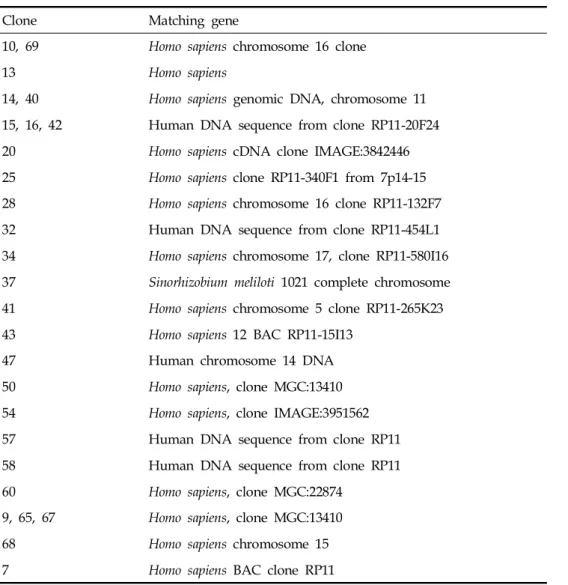
We identified 21 unknown genes, which were not homologous to any of the known genes in the Genbank database (Table 3). Among these 21 genes, we selected 7 genes which were over- ex- pressed in glioblastoma, compared to non-tumor brain tissue (Fig. 1). To be considered over-ex-

Fig. 1. RT-PCR analysis for differential expression of 21 clones between glioblastoma and non-tumor brain tissue. We selected seven genes for RT-PCR. N, non-tumor brain tissue; T, glioblastoma.

Table 2. Identification of Known Genes from SSH Libraries GeneBank accession number Matching gene AY034480

U28386 BC000260 AF267864 AF346971 NM_000980 BC056870 U94747 X64644 AF276948 AY335768 AF328729 X98294 AY327035

S100 calcium-binding protein A6 gene hSRP1 alpha (Karyopherin alpha 2) Aldo-keto reductase family 1 DC42 mRNA

Mitochondrion

Ribosomal protein L18a (RPL18A), mRNA Voltage dependent anion channel 3 WD repeat protein HAN11 mRNA C6.1B mRNA

HMG box containing protein (HBP2) Tumor rejection antigen 1gp96 (TRA1) CTCL tumor antigen

DNA double-strand break repair

Ixodes ricinus cytochrome oxidase subunit 1mRNA

(6)

pressed in glioblastomas, the genes tested had to show a threefold greater expression in tumor samples than in non-tumor brain tissue by semi- quantitative RT-PCR. In this study, we considered these genes as candidates for over-expressed genes in glioblastoma.

Different expression of genes in glioblastoma tissues and non-tumor brain tissue

To examine whether these new genes were ex- pressed specifically in glioblastoma tissues, the expression patterns of transcription were ex- amined by RT-PCR analysis for remaining 5 resected pairs of glioblastoma tissues and

non-tumor brain tissues. The expressions of clone 25 were found to be relatively over-expressed as compared with non-tumor tissues (Fig. 2). The remaining six clones were not clear.

Expression of genes in human glioma cell lines and other human cancer cell lines

In comparison of five commercial glioma cell lines, the expression profiles of various cell lines could be categorized into two groups (Fig. 3): (1) genes that were over-expressed by all cell lines (clone 7, 25, 28), (2) genes that showed weak expression across the cell lines without any distinct pattern (clone 10, 15, 43, 47).

Table 3. Unknown 21 Clones by BLAST Program

Clone Matching gene

10, 69 Homo sapiens chromosome 16 clone

13 Homo sapiens

14, 40 Homo sapiens genomic DNA, chromosome 11 15, 16, 42 Human DNA sequence from clone RP11-20F24

20 Homo sapiens cDNA clone IMAGE:3842446

25 Homo sapiens clone RP11-340F1 from 7p14-15 28 Homo sapiens chromosome 16 clone RP11-132F7 32 Human DNA sequence from clone RP11-454L1 34 Homo sapiens chromosome 17, clone RP11-580I16 37 Sinorhizobium meliloti 1021 complete chromosome 41 Homo sapiens chromosome 5 clone RP11-265K23

43 Homo sapiens 12 BAC RP11-15I13

47 Human chromosome 14 DNA

50 Homo sapiens, clone MGC:13410

54 Homo sapiens, clone IMAGE:3951562

57 Human DNA sequence from clone RP11

58 Human DNA sequence from clone RP11

60 Homo sapiens, clone MGC:22874

9, 65, 67 Homo sapiens, clone MGC:13410

68 Homo sapiens chromosome 15

7 Homo sapiens BAC clone RP11

(7)

Fig. 3. Expressions of seven genes' mRNA from glioma line by RT-PCR.

The expressions of mRNA of seven clones were significantly higher than those in non-tumor brain tissues. In glioma cell lines, two different types of gene expression profile were observed.

One type was genes that were over- expressed by all the cell lines (clone 7, 25, and 28), whereas the other was genes that showed variable expression across the cell lines without any distinct pattern (clone 10, 15, 43, and 47). 18srRNA (control) demonstrates equal expression across the panel. NBT, non-tumor brain tissue.

Fig. 2. Expression of seven genes’ mRNA levels from glioblastoma tissues by RT-PCR. The expressions of clone 7 were higher than those in non-tumor brain tissues. N, non-tumor brain tissues; T, glioblastoma tissues; 18srRNA, control.

The expressions of clones 7 and 28 were not specific to other cancer cell lines, except it was weakly expressed in lung cancer cell line. As shown in Fig. 4, the mRNA expressions of clones 10, 15, 25, 43, and 47 were determined to be over- expressed in human lung cancer, prostate cancer cells compared with human non-cancer cell lines.

Serum deprivation and stimulation

As shown in Fig. 5, the time course experiment showed that WI-38 cells starved in serum-free medium did not show mRNA expression at 0 hr.

After 10% FBS treatment, however, each clone

was found to express the mRNA.

DISCUSSION

Identification of genes that are differentially

expressed between brain tumor tissue and normal

brain tissue is very important for understanding

the molecular basis of these nervous tumors and

for defining possible targets for therapeutic

intervention.

3,21

Human glioblastoma, as with many

human cancers, is characterized by genetic and

phenotypic heterogeneity despite a fairly uniform

appearance by light microscopic findings.

1,22

Our

study was designed to identify genes with differ-

(8)

ential expression between glioblastomas cells and non-neoplastic brain cells.

To achieve our goal, we have used the SSH that is suited ideally for the identification of over- expressed genes. When we used the tester (glioblastoma tissue) and driver (non-tumor brain tissue) DNA fragments, the drives cDNA would eliminate the sequences common between the tester and driver cDNA samples during the first and second hybridization step. To determine the efficiency of the SSH, both the subtracted and unsubtracted cDNAs have to be amplified by PCR with GAPDH primers for different cycles:

18, 23, 28, and 33 cycle. The expression of GAPDH was observed in unsubtracted cDNA after 18 cycles and after 33 cycles in subtracted cDNA. In this result, the abundance of GAPDH decreased significantly after subtraction. It was important to confirm that individual clones indeed represent differentially expressed genes.

In the present study, we isolated known genes as well as new genes that were over-expressed in glioblastoma tissue as compared to non-tumor brain tissue.

Over 130 libraries were screened after SSH, from which 21 differentially regulated clones were identified. The percentage of up-regulated clones was, therefore, approximately 16%. Of the 21 clones identified, 6 clones were multiple hits, and we selected 7 genes for further evaluation. (Table 3) In most glioblastoma samples, the expression of mRNA of clone 25 was distinctly higher than that in non-tumor brain tissues (Fig. 2). On the whole, the expressions of six clones except clone 47 were relatively higher than non-tumor tissue. The uniform expression of control 18srRNA indicates equal template loading of the RNA from the tumor specimen.

The expression profiles of the 7 genes in five human glioma cell lines were categorized into two groups. In contrast to expressions of clones 10, 15, 43, and 47, those of clones 7, 25, and 28 were over- expressed by all the glioma cell lines. Especially, the clone 7 and 25 clearly showed over-expres- sions.

In various human cancer cell lines, the expres- sions of the clones 7, 25 and 28 were either weak or not detectable, however, those of clones 10, 15, 25, 28, 43, and 47 were relatively over-expressed

Fig. 4. Expressions of seven genes’ mRNA from various human cancer cell line by RT-PCR. Lane 1, normal lung (WI-38); Lane 2, SV40-immortalzed (WI-38 VA13); Lane 3, Lung carcinoma (NCI-H596); Lane 4, Normal colon (CCD-18CO); Lane 5, Colon carcinoma (KM 1214); Lane 6, Normal prostate (RWPE-1); Lane 7, Prostate carcinoma cell line (DU 145); and control (18srRNA).

Fig. 5. Serum deprivation and stimulation. The expres-

sions of seven genes were significantly increased 0.5 and

1 hr after 10% FBS treatment. After 2 hr of treatment,

the levels of seven genes' mRNA a drastically decreased.

(9)

in other cancer cell lines. Four out of 7 genes were up-regulated by immortalization in lung fibroblasts.

Those expressions in immortalized fibroblasts might suggest that the expressions of RT-PCR were due to proliferating state of dividing cells, but not due to quiescent cells. On the other hand, the rest of the genes were not up-regulated in immortalized fibroblasts. The weak expressions of the clones 7 and 28 were observed compared to normal lung line, but expression of these genes in glioma cell line was strong. It is highly likely that some genes of specific cancer would be involved also in other cancer, because of multiplicity of oncogene. In cancer cells, their expression is due to particular genes and shared with other genes in different degrees by in other cancers.

Clones 7 and 28, which were not or weakly expressed in the other cancer cell lines, were expressed in the glioma cell line suggesting that these genes may be related to glioblastoma.

Clones 10, 15, 28, 43, and 47 were expressed non-specifically in human glioma cell line and expressed variously in other human cancer cell lines, so these clones can represent genes that are related in a proliferate state regardless of tumor phenotype. In serum deprivation and stimulation, it is said that theses seven genes are related to cell division. But, the expressions of 5 out of 7 genes (clone 10, 15, 25, 43, 47) were increased by serum deprivation and stimulation, indicating some uncertainty of our experiments: It might have been influenced by culture medium condition. Clone 7 needs to be further functional studied.

Our present study is preliminary to derive any definite conclusion. We have cloned one or two over-expressed genes. Its significance and roles are unclear. Further studies are needed to charac- terize functional significance and roles of these genes in glioblastoma tumorigenesis and pro- gression.

REFERENCES

1. Dai C, Holland EC. Astrocyte differentiation states and gliomas formation. Cancer J 2003;9:72-81.

2. Sallinen SL, Sallinen PK, Haapasalo HK, Helin HJ, Helén PT, Schraml P, et al. Identification of differentially expressed genes in human gliomas by DNA microarray

and tissue chip techniques. Cancer Res 2000;60:6617-22.

3. Christensen HC, Kosteljanetz M, Johansen C. Incidences of gliomas and meningiomas in Denmark, 1943 to 1997.

Neurosurgery 2003;52:1327-33; discussion 1333-4.

4. Velculescu VE, Zhang L, Zhou W, Vogelstein J, Basrai MA, Bassett DE Jr, et al. Characterization of the yeast transcriptome. Cell 1997;88:243-51.

5. Chook YM, Blobel G. Karyopherins and nuclear import.

Curr Opin Struct Biol 2001;11:703-15.

6. Nutt CL, Zerillo CA, Kelly GM, Hockfield S. Brain enriched hyaluronan binding (BEHAB)/brevican in- creases aggressiveness of CNS-1 gliomas in Lewis rats.

Cancer Res 2001;61:7056-9.

7. Palackal NT, Lee SH, Harvey RG, Blair IA, Penning TM. Activation of polycyclic aromatic hydrocarbon trans-dihydrodiol proximate carcinogens by human aldo-keto reductase (AKR1C) enzymes and their func- tional overexpression in human lung carcinoma (A549) cells. J Biol Chem 2002;277:24799-808.

8. Rehman I, Cross SS, Azzouzi AR, Catto JW, Deloulme JC, Larre S, et al. S100A6 (Calcyclin) is a prostate basal cell marker absent in prostate cancer and its precursors.

Br J Cancer 2004;91:739-44.

9. Welsh J, Chada K, Dalal SS, Cheng R, Ralph D, McClelland M. Arbitrarily primed PCR fingerprinting of RNA. Nucleic Acids Res 1992;20:4965-70.

10. Smith JM, Bowles J, Wilson M, Koopman P. HMG box transcription factor gene Hbp1 is expressed in germ cells of the developing mouse testis. Dev Dyn 2004;

230:366-70.

11. van Nocker S, Ludwig P. The WD-repeat protein superfamily in Arabidopsis: conservation and divergence in structure and function. BMC Genomics 2003;4:50.

12. Porkka KP, Visakorpi T. Detection of differentially expressed genes in prostate cancer by combining sup- pression subtractive hybridization and cDNA library array. J Pathol 2001;193:73-9.

13. Wandrey M, Trevaskis B, Brewin N, Udvardi MK.

Molecular and cell biology of a family of voltage- dependent anion channel porins in Lotus japonicus.

Plant Physiol 2004;134:182-93.

14. Zeindl-Eberhart E, Haraida S, Liebmann S, Jungblut PR, Lamer S, Mayer D, et al. Detection and identifica- tion of tumor-associated protein variants in human hepatocellular carcinomas. Hepatology 2004:39;540-9.

15. Diatchenko L, Lau YF, Campbell AP, Chenchik A, Moqadam F, Huang B, et al. Suppression subtractive hybridization: a method for generating differentially regulated or tissue-specific cDNA probes and libraries.

Proc Natl Acad Sci U S A 1996;93:6025-30.

16. Hufton SE, Moerkerk PT, Brandwijk R, de Bruïne AP, Arends JW, Hoogenboom HR. A profile of differen- tially expressed genes in primary colorectal cancer using suppression subtractive hybridization. FEBS Lett 1999;463:77-82.

17. Ji W, Wright MB, Cai L, Flament A, Lindpaintner K.

Efficacy of SSH PCR in isolating differentially ex-

pressed genes. BMC Genomics 2002;3:12.

(10)

18. Lee SJ, Suh MC, Kim S, Kwon JK, Kim M, Paek KH, et al. Molecular cloning of a novel pathogen-inducible cDNA encoding a putative acyl-CoA synthetase from Capsicum annuum L. Plant Mol Biol 2001;46:661-71.

19. Shridhar V, Sen A, Chien J, Staub J, Avula R, Kovats S, et al. Identification of underexpressed genes in early- and late-stage primary ovarian tumors by suppression subtraction hybridization. Cancer Res 2002;62:262-70.

20. Swearingen ML, Sun D, Bourner M, Weinstein EJ.

Detection of differentially expressed HES-6 gene in

metastatic colon carcinoma by combination of suppres- sion subtractive hybridization and cDNA library array.

Cancer Lett 2003;198:229-39.

21. Liang P, Pardee AB. Differential display of eukaryotic messenger RNA by means of the polymerase chain reaction. Science 1992;257:967-71.

22. Dong Y, Zhang H, Hawthorn L, Ganther HE, Ip C.

Delineation of the molecular basis for selenium-

induced growth arrest in human prostate cancer cells

by oligonucleotide array. Cancer Res 2003;63:52-9.

수치

Table 1. The Primer Sequences of Genes of Interest
Table 2. Identification of Known Genes from SSH Libraries GeneBank accession number Matching gene AY034480 U28386 BC000260 AF267864 AF346971 NM_000980 BC056870 U94747 X64644 AF276948 AY335768 AF328729 X98294 AY327035
Table 3. Unknown 21 Clones by BLAST Program
Fig. 3. Expressions of seven genes' mRNA from glioma line by RT-PCR.
+2

참조

관련 문서

Reverse transcriptase-polymerase chain reaction (RT-PCR) test for protease-activated receptors (PARs) mRNA expression in nasal epithelial cells were performed.

(2011) ana- lyzed the transcript levels of eight putative genes related to calcification using quantitative reverse transcription polymerase chain reaction (qRT-PCR).

Methods: Reverse transcription-polymerase chain reaction (PCR), real-time PCR and Western blot analysis was used to measure expression levels of osteogenic marker genes and

Quantitative relationship of the circulating tumor burden assessed by reverse transcription-polymerase chain reaction for cyto- keratin 19 mRNA in peripheral blood

Immunocapture-reverse transcription polymerase chain reaction (IC-RT-PCR) detection of the Lily mottle virus (LMoV) coat protein in healthy and infected lily

Gene expression of osteonectin, osteopontin and osteoprotegrin were also evaluated using reverse transcriptase polymerase chain reaction (RT- PCR), which showed that the

HAS2 gene expression for the synthesis of HA was determined via Reverse transcription polymerase chain reaction (RT-PCR) while HYAL inhibition rate was

A total of 19 genes showed good amplification in capillary electrophoresis and were further analyzed through a reverse transcription quantitative polymerase chain reaction