Veterinary Science
Antimicrobial susceptibility and molecular detection of chloramphenicol and florfenicol resistance among Escherichia coli isolates from diseased chickens
Xin-Sheng Li
1,†, Gui-Qin Wang
2,†, Xiang-Dang Du
1,*, Bao-An Cui
1, Su-Mei Zhang
1, Jian-Zhong Shen
21
College of Animal Husbandry and Veterinary Science, Henan Agricultural University, Zhengzhou 450002, P.R. China
2
Department of Pharmacology and Toxicology, College of Veterinary Medicine, China Agricultural University, Beijing 100094, P.R. China
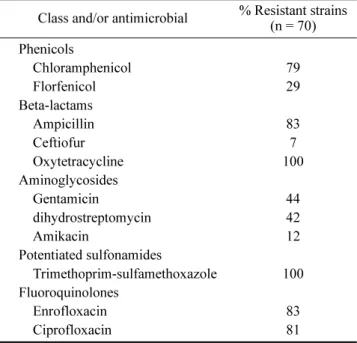
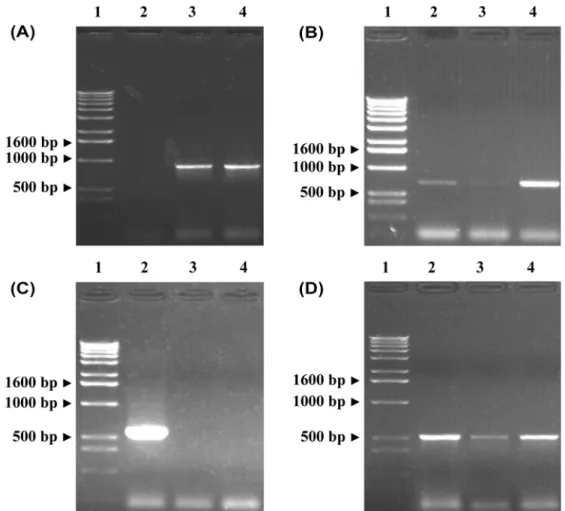
Seventy Escherichia coli isolates recovered from diseased chickens diagnosed with colibacillosis in Henan Province, China, between 2004 and 2005 were characterized for antimicrobial susceptibility profiles via a broth doubling dilution method. Overall, the isolates displayed resistance to trimethoprim-sulfamethoxazole (100%), oxytetracycline (100%), ampicillin (83%), enrofloxacin (83%), and ciprofloxacin (81%), respectively. Among the phenicols, resistance was approximately 79% and 29% for chloramphenicol and florfenicol, respectively. Molecular detection revealed that the incidence rates of the floR, cmlA, cat1, cat2 and cat3 were 29, 31, 16, 13, and 0%, respectively. Additionally, 10% of the isolates were positive for both floR and cmlA . As these antimicrobial agents may potentially induce cross-resistance between animal and human bacterial pathogens, their prudent use in veterinary medicine is highly recommended.
Key words: antimicrobial resistance, Escherichia coli , flo- rfenicol
Introduction
Diseases resulting from Escherichia coli ( E. coli ) infections, including colibacillosis, air sacculitis, and cellulitis, are responsible for high morbidity and mortality in poultry, and these diseases exert a significant economic influence on the poultry industry [1,6].
Antimicrobials are valuable tools for the treatment of clinical disease and for the maintenance of healthy, productive animals. However, recent reports have discovered increased resistance to the antimicrobial agents commonly utilized for treatment [1,4,25,27].
Florfenicol, a broad-spectrum antibiotic, belongs to the family of agents including thiamphenicol and chloramphenicol, which has played a hugely important role in reducing the enormous losses in the poultry industry resulting from certain bacterial diseases, including avian colibacillosis. However, Kim et al. [21] identified a novel plasmid-encoded gene ( pp- flo ) from Photobacterium piscicda in a study conducted in Japan [21]. More recently, florfenicol resistance conferred by the floR genes, referred to in the published literature as pp-flo, cmlA-like, floSt, flo, or floR , has also been detected in the Salmonella enteria serovar Typhimurium definitive phage type (DT) 104 [2,3,8-10,20], Salmonella enterica serovar Agona [9,14], E. coli [5,7,13,15,16,19,26], Klebsiella pneumoniae [12], Vibrio cholerae [17] and Pasteurella multocida [18], which mediate combined resistance to florfenicol and chloramphenicol.
Currently, very little data is available regarding the epidemiology and prevalence of antimicrobial-resistant veterinary pathogens in domestic animals, particularly in developing countries, including China, where antimicrobials are overused in veterinary medicine and domestic animals.
Thus, the principal objective of the present study was to determine the antimicrobial susceptibility profiles among a collection of E. coli isolates collected from diseased chickens that were diagnosed with colibacillosis in China between 2004 and 2005. In addition, due to the high incidence of emerging florfenicol resistance in tested E. coli isolates 5 to 6 years after its introduction into veterinary clinics and the limited information regarding phenicol resistance in China, the resistance determinants for the phenotypes of phenicol resistance observed in these isolates were identified. The results presented herein may provide surveillance information for this specific region.
Materials and Methods
Bacterial strains
70 E. coli isolates were recovered from the livers of diseased chickens raised on 12 different poultry farms in
†