
Geochemical Characteristics of Devonian Bitumen Carbonates in Alberta, Canada
11
0
0
전체 글
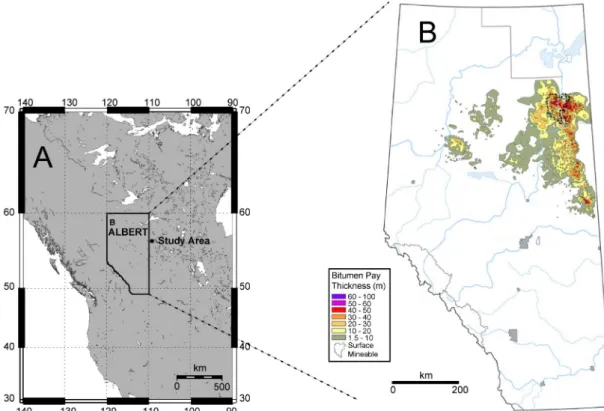
(2) 366. 길영우·김지훈·최지영·박명호. et al., 2007; Park et al., 2010; Choi et al., 2011). 세계 오일 부존량(약 9~13조 배럴) 중에 70%정도가 초중질유와 비투멘을 포함한 중질류이다. 이들 오일 중 약 1/3이 탄산염암에 부존되어져 있다(Briggs et al., 1998). 캐나다 앨버타와 베네수엘라 오리노코강 인근은 중질류을 함유한 탄산염암 퇴적체가 존재하며, 캐나다 앨버타 아싸바스카(Athabasca)에 가장 큰 탄산염암 퇴 적체가 존재한다. 이러한 이유에서 최근 탄산염암 저 류층에 대한 연구가 많은 국가들에서 진행되고 있다 (Potter, 2007; Park et al., 2010; Choi et al., 2011). 우리나라에서도 캐나다 앨버타 주의 비투멘을 함유 한 탄산염암에 대한 지화학적 연구가 한국석유공사와 한국지질자원연구원을 중심으로 수행되었다(Kim and Kil, 2009; Park et al., 2010; Kil and Kim, 2010; Choi et al., 2011). 이 연구의 주요 목적은 두 개의 캐 나다 CRC(Core Research Center) 시추코어(Saleski 03-34-88-20w4, Saleski 08-01-88-20w4)의 무기 지화 학적 특징을 규명하고, 획득한 지화학 자료를 바탕으 로 기존에 보고된 문헌 자료(Vandeginste et al., 2006, 2009; Köster et al., 2008) 및 캐나다 데본기. Cairn층 탄산염 저류암(Park et al., 2010) 지화학적 자료와 비교 연구하는데 있다.. 2. 지질 및 연구지역 두 시추코어 탄산염암들은 캐나다 서쪽 퇴적분지에 위치한 Grosmont층으로부터 채취되었다(Fig. 1). Grosmont층은 상부 데본기까지 비투멘을 함유한 탄산염 복합체로서 북부 앨버타 지역에 분포하며, 길이는 500 km이고 너비는 150 km에 달한다(Fig. 1). Grosmont 층은 주로 석회암과 돌로마이트로 구성되어 있으며, 미 량의 이질 돌로마이트, 실트스톤, 셰일로 구성되어 있 다(Buschkuehle et al., 2007). Grosmont층은 협재된 셰일층을 기준으로 천해, 아조간대, 조간대 환경에서 퇴적된 4개의 탄산염 단위체(LG, UG 1, UG 2, UG 3)로 나누어지며, 셰일층은 상부 Ireton 층준에 협재되 어 있다(Harrison and McIntyre, 1981)(Fig. 2). 돌로 마이트화 정도는 상부 Grosmont층 내에서 상부로 갈 수록 증가한다. 대부분의 탄화수소 저류암은 상부 Grosmont층(UG 2, UG 3)에 위치해 있으며, 저류암. Fig. 1. A) Map of the Alberta, Canada. B) Map of Alberta's bitumen pay thickness (revised from Alberta Geological Survey/ ERCB)..
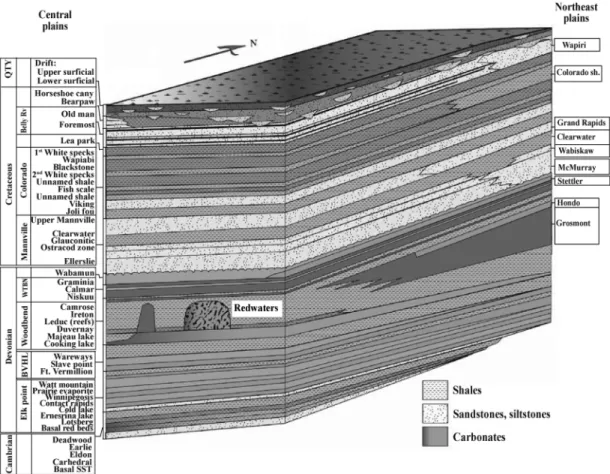
(3) 캐나다 데본기 비투멘 탄산염암의 지화학적 특성 연구. 367. Fig. 2. Stratigraphy of Devonian and Cretaceous periods in North Alberta (modified from Gunter et al., 2009).. 체는 공극률이 7~20%의 범위를, 투수율은 100~10,000 md의 범위를 가지고, 비투멘 포화도는 일반적으로 70%를 넘는다(Miller and Vandermeer, 1980; Harrison and Mcintyre, 1981; Harrison, 1982; Luo et al.,. Saleski 03-34-88-20w4 코어와 Saleski 08-01-8820w4 코어를 이용하였다(Table 1). Saleski 03-34-8820w4 코어의 위치는 56o 40.185833'N, 113o 6.3475'W 이며, Saleski 08-01-88-20w4 코어의 위치는 56o. 1994). Grosmont층에서 공극의 크기는 초현미정질 크 기의 공극부터 카르스트 지형의 동굴(cavern) 크기의 공극까지 매우 다양하게 존재한다(Dembicki, 1994; Dembicki and Machel, 1996; Huebscher, 1996;. 36.00375'N, 113o 2.359667'W이다. Saleski 03-34-8820w4 코어의 최상부 심도는 지표면으로부터 254.80 m 이고 최하부 심도는 354.63 m이며, Saleski 08-01-8820w4 코어의 최상부 심도는 지표면으로부터 263.00 m 이고, 최하부는 324.95 m이다. Saleski 03-34-8820w4 코어에서는 Grosmont층의 4개 탄산염 단위체인 LG, UG 1, UG 2, UG 3가 모두 관찰되었지만 Saleski 08-01-88-20w4 코어에서는 Grosmont층의 4개 탄산염 단위체 중 UG 2와 UG 3만 관찰되었다. 또한 이번 연구에서 Grosmont층과 지화학적으로 비교 연구를 위 해 캐나다 앨버타주 로키 산맥에 위치하고 있는 데본 기 탄산염층인 Cairn 층 시료들에 대한 지화학 분석을. Machel and Huebscher, 2001). 이 층에 존재하는 주 요 공극은 이차 공극이며 층 내에 존재하는 다양한 크 기의 공극으로 인해서 공극률, 투수율 등을 이용한 암 석물리학적 특징을 단순 대비하기가 어렵다(Dembicki, 1994; Luo et al., 1994). Grosmont층에서 비투멘의 축적은 동쪽 경계부를 따라서 주로 이루어졌으며, 층 내에 존재하는 다양한 공극을 채우는 형태로 나타난다. 비투멘 관련 생분해작용(biodegradation)은 서쪽에서 동 쪽으로 갈수록 증가한다(Hein, 2006). 이번 연구에서는 CRC에서 보관 중인 Grosmont층. 실시하였다 (Park et al., 2010). Cairn층의 전반적인 지질학적 특징과 채취한 시료 위치는 Park et al..
(4) 368. 길영우·김지훈·최지영·박명호. Table 1. The characteristics of CRC cores (Saleski 03-34-88-20w4, Saleski 08-01-88-20w4) from Alberta, Canada Sample No. 05 11 12 17 Saleski 18 03-34-88-20w4 19 21 22 25 1 3 5 6 8 Saleski 10 08-01-88-20w4 12 14 20 21 23 Core. Depth (m) 284.15 274.75 272.30 263.17 261.15 259.75 259.10 256.35 254.85 295.45 292.55 289.10 288.35 286.20 283.40 281.30 277.50 270.40 269.10 266.80. Characteristics carbonate bitumen saturated unconsolidated bitumen fully upper-light carbonate, lower-dark bitumen unconsolidated bitumen fully carbonate rock, light, no bitumen carbonate bitumen saturated inner-carbonate rock, outer-bitumen with <1 cm thickness carbonate bitumen saturated carbonate bitumen partial saturated bitumen carbonate saturated bitumen carbonate saturated bitumen carbonate saturated bitumen carbonate saturated bitumen carbonate saturated bitumen carbonate saturated bitumen carbonate saturated bitumen carbonate saturated bitumen carbonate saturated bitumen carbonate saturated bitumen carbonate saturated. Mineral association Dolomite, Quartz Dolomite, Dolomite, Dolomite, Dolomite, Dolomite, Dolomite,. Quartz Quartz Quartz Quartz Quartz Quartz. Dolomite, Dolomite, Dolomite, Dolomite, Dolomite, Dolomite, Dolomite, Dolomite, Dolomite, Dolomite,. Quartz, Calcite Quartz Quartz Quartz, Calcite Quartz Quartz Quartz Quartz Quartz Quartz. Fig. 3. Sample photos A) No. 18 (261.15 m) of Saleski 03-34-88-20w4, B) No. 19 (259.75 m) of Saleski 03-34-88-20w4, C) No. 8 (286.20 m) of Saleski 08-01-88-20w4, and D) No. 10 (283.40 m) of Saleski 08-01-88-20w4.. (2010)에서 자세히 기술되어 있다.. 3. 시료 전처리 및 분석방법 캐나다 CRC에서 보관 중인 Grosmont층에 해당하. 는 Saleski 03-34-88-20w4 코어와 Saleski 08-01-8820w4 코어에서 심도에 따라 각각 9개 및 11개의 시료 를 채취하였다(Table 1, Fig. 3). 채취된 시료의 일부는 분석을 위해 냉동건조기로 건조 후 절구(agate mortar) 로 분쇄하였다. 무기 지화학 분석을 위해 디클로 메탄.
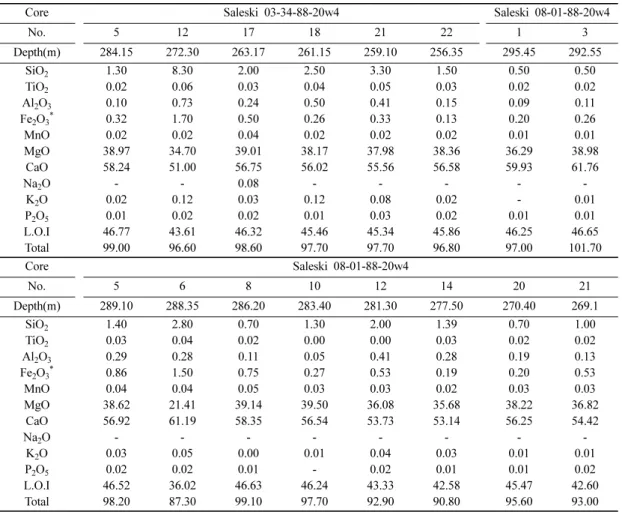
(5) 캐나다 데본기 비투멘 탄산염암의 지화학적 특성 연구. 369. Fig. 4. Sample powders A) before bitumen separation and B) after bitumen separation.. (Dichloromethane, CH2Cl2)과 메탄올(CH3OH)를 이용 하여 비투멘을 추출하였다(Fig. 4). 추출과정은 Choi et al. (2011)의 논문에 상세히 설명되어져 있다. 비투멘을 추출한 탄산염암 시료의 광물 구성은 한국 지질자원연구원의 X-선 회절분석기(X-ray Diffractometer; PHILIPS X'pert MPD)를 이용하여 분석하였다. 탄산 염암 시료의 전암 주성분원소는 시료와 Li2B4O7 용재 (flux)를 1:10의 비율로 섞어 1,200oC에서 비드(bead)를 만든 후 한국기초과학지원연구원 서울센터에서 X-선 형광분석기(X-Ray Fluorescence; Phillips Analytical B.V., PW 2404)로 측정하였다. 탄산염암 시료의 스트론튬(Sr) 동위원소는 한국기초 과학지원연구원의 열이온화 질량분석기(Thermal ionization mass spectrometer, VG54-30)로 측정하였 다. 시료는 양이온 교환칼럼화학(AG50W-X8, H+ form, 200-400#)을 적용하여 Sr를 분리한 후에 질량분별효과 를 보정하면서 동적인 모드(dynamic mode)로 측정하 였다. NBS 987 평균 87Sr/86Sr은 0.710243±0.000004 (N=30, 2s standard error)이다. 탄산염암 시료의 산소(O) 및 탄소(C) 동위원소는 한 국기초과학지원연구원의 안정동위원소 질량분석기(Stable Isotope Ratio Mass Spectrometer, GV Instruments. Isoprime)로 측정하였다. 실험실 표준시료(탄소동위원 소: VPDB, 산소동위원소: VSMOW)를 반복 측정하여 얻은 탄소와 산소 동위원소 분석정밀도는 약 ±0.2‰이다.. 4. 결과 및 토의 4.1. 구성광물 및 주성분원소 분석 X-선 회절 분석기를 이용하여 두 개의 CRC 코어 (Saleski 03-34-88-20w4, Saleski 08-01-88-20w4) 탄 산염암의 구성광물을 분석한 결과 Saleski 03-34-88-. 20w4 코어 탄산염암의 모든 시료에서 돌로마이트와 석 영이 분석되어졌다(Table 1). 그러나 석영의 피크가 매 우 낮아 대부분의 구성광물은 돌로마이트로 추정된다. Saleski 08-01-88-20w4 코어 탄산염암 시료에서는 모 든 시료에서 돌로마이트와 석영이 검출되었고 시료 No. 1, No. 6에서는 방해석이 검출되었다. 석영과 방해 석의 피크가 매우 낮아 Saleski 08-01-88-20w4 코어 시 료 대부분이 돌로마이트로 구성된 탄산염암임을 알 수 있다(Table 1). 편광현미경으로 관찰된 대부분의 돌로 마이트 입자 크기는 0.2 mm 이하이다(Kil and Kim, 2010). CRC 탄산염암 코어 시료의 전암 주성분 원소 함량을 알아보기 위하여 실시한 X-선 형광분석 결과는 Table 2 와 같다. 분석 결과 CaO, MgO 함량이 20.0 wt% 이 상이며, Al2O3, Fe2O3, SiO2 함량은 3.3 wt% 이하로 소량이고 Na2O, K2O, P2O5, TiO2, MnO는 0.1 wt% 이하로 매우 소량이다. L.O.I (Loss Of Ignition)의 함 량은 Saleski 08-01-88-20w4 No. 6 시료를 제외하고 모두 42.0 wt% 이상이다(Table 2). No. 6 시료의 CaO 함량은 61.19 wt%로 가장 높고 MgO 함량은 21.41 wt%로 가장 낮다. 이와 같은 결과들은 XRD 분석 결과와 유사하게 분석한 시료들이 방해석을 상대 적으로 많이 함유하고 있기 때문이다(Table 2). 탄산염암에 포함되어 있는 Al2O3, K2O, SiO2, Fe2O3* 함량은 쇄설성 퇴적물 함량을 지시한다(Verma et al., 2008). Fig. 5에 심도에 따른 이들 원소 함량을 도시하 였다. Saleski 03-34-88-20w4 코어 No. 12(272.30 m) 에서 이들 원소의 함량이 가장 높다(Fig. 5A). 이는 쇄설성 퇴적물 유입이 가장 많은 환경에서 No. 12 시 료가 퇴적되었다는 것을 의미한다. 이에 비하여 Saleski 08-01-88-20w4 코어에서는 이들 원소들이 대 부분 낮은 함량을 보이고 있어(Fig. 5B), Saleski 08-.
(6) 370. 길영우·김지훈·최지영·박명호. Table 2. Major element compositions (wt.%) of CRC core samples (Saleski 03-34-88-20w4, Saleski 08-01-88-20w4) from Alberta, Canada Core. Saleski 03-34-88-20w4. No.. 5. 12. 17. Depth(m) SiO2 TiO2 Al2O3 Fe2O3* MnO MgO CaO Na2O K2O P2O5 L.O.I Total Core. 284.15 1.30 0.02 0.10 0.32 0.02 38.97 58.24 0.02 0.01 46.77 99.00. 272.30 8.30 0.06 0.73 1.70 0.02 34.70 51.00 0.12 0.02 43.61 96.60. 263.17 2.00 0.03 0.24 0.50 0.04 39.01 56.75 0.08 0.03 0.02 46.32 98.60. 18. Saleski 08-01-88-20w4 21. 261.15 259.10 2.50 3.30 0.04 0.05 0.50 0.41 0.26 0.33 0.02 0.02 38.17 37.98 56.02 55.56 0.12 0.08 0.01 0.03 45.46 45.34 97.70 97.70 Saleski 08-01-88-20w4. 22. 1. 3. 256.35 1.50 0.03 0.15 0.13 0.02 38.36 56.58 0.02 0.02 45.86 96.80. 295.45 0.50 0.02 0.09 0.20 0.01 36.29 59.93 0.01 46.25 97.00. 292.55 0.50 0.02 0.11 0.26 0.01 38.98 61.76 0.01 0.01 46.65 101.70. No.. 5. 6. 8. 10. 12. 14. 20. 21. Depth(m) SiO2 TiO2 Al2O3 Fe2O3* MnO MgO CaO Na2O K2O P2O5 L.O.I Total. 289.10 1.40 0.03 0.29 0.86 0.04 38.62 56.92 0.03 0.02 46.52 98.20. 288.35 2.80 0.04 0.28 1.50 0.04 21.41 61.19 0.05 0.02 36.02 87.30. 286.20 0.70 0.02 0.11 0.75 0.05 39.14 58.35 0.00 0.01 46.63 99.10. 283.40 1.30 0.00 0.05 0.27 0.03 39.50 56.54 0.01 46.24 97.70. 281.30 2.00 0.00 0.41 0.53 0.03 36.08 53.73 0.04 0.02 43.33 92.90. 277.50 1.39 0.03 0.28 0.19 0.02 35.68 53.14 0.03 0.01 42.58 90.80. 270.40 0.70 0.02 0.19 0.20 0.03 38.22 56.25 0.01 0.01 45.47 95.60. 269.1 1.00 0.02 0.13 0.53 0.03 36.82 54.42 0.01 0.02 42.60 93.00. Fig. 5. Al2O3, Fe2O3, K2O and SiO2 variations according to core depth (m) of carbonates from A) Saleski 03-34-88-20w4 and B) Saleski 08-01-88-20w4 cores.. 01-88-20w4 코어는 상대적으로 낮은 쇄설성 퇴적물 유 입 환경에서 퇴적되었다는 것을 의미한다. 4.2. 동위원소 분석 CRC 코어(Saleski 03-34-88-20w4, Saleski 08-01-88-. 20w4) 탄산염암의 탄소와 산소 동위원소 (δ13C, δ18O) 값은 Table 3과 같다. Saleski 03-34-88-20w4 코어 시 료의 δ13C는 -4.00 ~ 2.04‰를, δ18O는 -4.77 ~ -2.10‰ 의 범위를 보이고, Saleski 08-01-88-20w4 코어 시료 δ13C는 -2.97 ~ 3.47‰를, δ18O는 -5.36 ~ -2.18‰의.
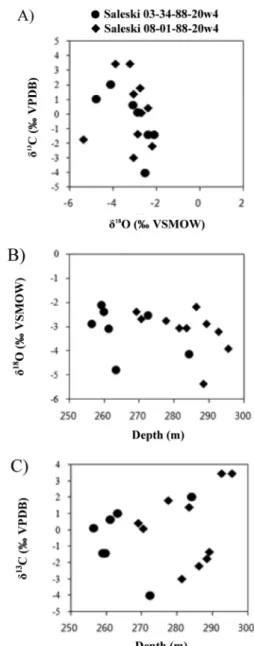
(7) 캐나다 데본기 비투멘 탄산염암의 지화학적 특성 연구. 371. Table 3. Carbon (δ13C) and oxygen (δ18O) isotope values of CRC cores (Saleski 03-34-88-20w4, Saleski 08-01-8820w4) and Cairn Formation carbonates from Alberta, Canada Core. No. Depth (m) 5 284.15 12 272.30 17 263.17 Saleski 18 261.15 03-34-88-20w4 19 259.75 21 259.10 22 256.35 1 295.45 3 292.55 5 289.10 6 288.35 8 286.20 Saleski 08-01-88-20w4 10 283.40 12 281.30 14 277.50 20 270.40 21 269.10 1 2-1L 2-1D 2-2 3 4 5-1 Cairn 5-2 Formation 5-3 5-4 5-6 6 7 8L 8D. δ13C(‰) δ18O(‰) 2.04 -4.12 -4.00 -2.53 1.05 -4.77 0.65 -3.08 -1.39 -2.38 -1.39 -2.10 0.15 -2.87 3.47 -3.90 3.46 -3.21 -1.34 -2.86 -1.72 -5.36 -2.19 -2.18 1.41 -3.06 -2.97 -3.04 1.81 -2.75 0.08 -2.68 0.45 -2.38 1.07 -5.46 1.71 -3.22 1.58 -3.04 4.19 -3.28 3.48 -4.97 3.17 -5.11 2.94 -3.80 3.19 -4.00 1.23 -2.66 2.40 -3.36 3.45 -3.29 3.62 -3.06 1.03 -4.20 1.43 -18.56 2.84 -4.22. 범위를 보인다(Table 3). 두 시추 코어의 δ13C, δ18O 분석 값 범위는 유사하나 Saleski 08-01-88-20w4 코 어가 약간 높은 δ13C 값을 보인다(Fig. 6A). 그림 6B 와 6C는 시추코어 심도에 따른 δ13C와 δ18O 변화를 도시한 것이다. 심도에 따라 Saleski 03-34-88-20w4, Saleski 08-01-88-20w4 코어 모두 뚜렷한 δ13C와 δ18O 변화를 보이지 않으나, 심도가 깊어질수록 δ13C 가 약간 증가하는 경향을, δ18O는 감소하는 경향을 보 인다. 분석한 δ13C와 δ18O의 안정동위원소 값들을 이 용하여 탄산염암 기원을 추적하면, 두 CRC 코어에서 얻어진 탄산염암 시료의 δ13C와 δ18O 값은 탄산염암이 일반적인 해양 탄산염암(common marine limestones;. Fig. 6. A) δ18O (‰) vs. δ13C (‰), B) sample depth (m) vs. δ18O (‰), and C) sample depth (m) vs. δ13C (‰) of CRC cores (Saleski 03-34-88-20w4, Saleski 08-01-88-20w4) carbonates from Alberta, Canada.. δ13C = -5 ~ 5‰, δ18O = -12 ~ -1‰)에서 기원하였다 (Hundson, 1977; Kil and Kim, 2010). 현생 돌로마이트의 δ18O 값은 약 2‰ 정도가 되고, 지질연대가 오래될수록 δ18O 값은 낮아진다(McKenzie, 1981; Saller, 1984; Hudson and Anderson, 1989). Saleski 03-34-88-20w4 코어와 Saleski 08-01-8820w4 코어에서 분석된 돌로마이트 δ18O 값은 현생 돌.
(8) 372. 길영우·김지훈·최지영·박명호 Table 4. Strontium isotope ratios (87Sr/86Sr) of CRC cores (Saleski 03-34-88-20w4, Saleski 08-01-88-20w4) and Cairn Formation carbonates from Alberta, Canada Core. Fig. 7. Crystallization temperatures of A) CRC cores (Saleski 03-34-88-20w4, Saleski 08-01-88-20w4) and B) Cairn Formation carbonates from Alberta, Canada (AlAsam et al., 2002). δ18Owater (‰) is δ18O (‰) of Upper Devonian seawater (-3 ~ -2‰) (Carpenter et al., 1991).. 로마이트 δ18O(약 2‰)에 비하여 낮은 값을 보인다 (Table 3). 분석한 돌로마이트의 δ18O과 속성수로 가정한 후기 데본기 해수의 δ18O (-3 ~ -2‰; Carpenter et al., 1991)을 이용하여 연구 코어의 돌로마이트 생성온도를 계산하였다. Fig. 7A와 같이 유사한 δ18O 동위원소 값 을 가지는 두 시추 코어 돌로마이트 생성온도는 약 40 ~ 55oC로서, Land (1985)가 제시한 이 지역 돌로마이 트 생성온도 40 ~ 70oC와 유사하다. 시추코어 심도가 깊어질수록 δ18O 값이 매우 작은 차이로 낮아지는데 (Fig. 6B), 이는 돌로마이트 생성온도가 심도가 깊어질 수록 미세한 정도로 높아졌다는 것을 의미한다(Fig. 7A). CRC 코어 탄산염암의 스트론튬 동위원소 값(87Sr/ 86 Sr)은 Table 4와 같다. Saleski 03-34-88-20w4 코어의 87 Sr/86Sr는 0.708085 ~ 0.708235이고, Saleski 08-0188-20w4 코어의 87Sr/86Sr는 0.708073 ~ 0.708318이다.. No. 5 12 17 Saleski 18 03-34-88-20w4 19 21 22 1 3 5 6 8 Saleski 08-01-88-20w4 10 12 14 20 21 1 2-1L 2-1D 2-2 3 4 5-1 Cairn 5-2 Formation 5-3 5-4 5-6 6 7 8L 8D. Depth 284.15 272.30 263.17 261.15 259.75 259.10 256.35 295.45 292.55 289.10 288.35 286.20 283.40 281.30 277.50 270.40 269.10. 87. Sr/86Sr 0.708194 0.708153 0.708235 0.708138 0.708085 0.708160 0.708130 0.708089 0.708124 0.708260 0.708318 0.708159 0.708073 0.708154 0.708190 0.708117 0.708116 0.709094 0.708761 0.708169 0.708837 0.708842 0.708656 0.708399 0.708352 0.708314 0.708180 0.708211 0.708190 0.708774 0.708647 0.708240. 2σ SE 0.000012 0.000011 0.000015 0.000019 0.000014 0.000015 0.000021 0.000014 0.000014 0.000012 0.000015 0.000015 0.000017 0.000012 0.000011 0.000011 0.000018 0.000017 0.000017 0.000015 0.000015 0.000014 0.000015 0.000012 0.000015 0.000015 0.000019 0.000011 0.000011 0.000021 0.000011 0.000012. 두 시추 코어 모두 87Sr/86Sr 값이 소수점 4자리까지 매우 유사하다(Table 4). 속성수의 기원을 알아보기 위 해서는 스트론튬 동위원소 값 (87Sr/86Sr)이 일반적으로 가장 많이 사용되며, 현재 해수의 87Sr/86Sr 값은 0.70906으로 전 세계적으로 일정하다. Saleski 03-3488-20w4와 Saleski 08-01-88-20w4 코어 탄산염암의 87 Sr/86Sr를 시추 심도에 따라 도시한 결과 심도에 따 라 87Sr/86Sr 값이 매우 일정하다(Fig. 8). 또한 이 값들 은 후기 데본기 해수 87Sr/86Sr 값(0.7080 ~ 0.7085)과 매우 유사하다(Burke et al., 1982; Vandeginste et al., 2009). 그러므로 CRC 두 코어 내 돌로마이트를 생성시킨 속성수는 데본기 해수로 해석된다..
(9) 캐나다 데본기 비투멘 탄산염암의 지화학적 특성 연구. 373. Fig. 8. Sample depth (m) vs. strontium isotope ratios (87Sr/ 86 Sr) of CRC cores from Alberta, Canada.. 4.3. Cairn층과의 비교 CRC 코어 탄산염암은 대부분 돌로마이트와 소량의 석영으로 구성되어있으나 Cairn층 탄산염암은 돌로마 이트만으로 구성되어있다(Kim and Kil, 2009). CRC 코어와 Cairn층 탄산염암 모두에서 일부 방해석이 소 량 관찰되는 시료가 있다(Kim and Kil, 2009). 탄산염암 시료에서 쇄설성 퇴적물의 유입정도를 잘 나타내는 Al2O3와 SiO2의 성분을 비교한 결과(Fig. 9), CRC 코어(Saleski 03-34-88-20w4, Saleski 08-01-8820w4) 탄산염암과 Cairn층 탄산염암 시료의 Al2O3과 SiO2의 성분 함량은 매우 유사하며, 두 시료들 모두 정의 상관관계를 잘 보여 주고 있다. 이는 두 지역에 서 모두 쇄설성 퇴적물의 유입이 있었고, 유입된 쇄설 성 퇴적물의 양이 유사하였음을 의미한다. 돌로마이트를 형성한 속성수의 기원과 돌로마이트 생성 온도를 알아보기 위해 CRC 코어와 동일하게 Cairn층 탄산염암에 대하여 δ18O와 87Sr/86Sr를 분석하. Fig. 9. Al2O3 vs. SiO2 compositions (wt %) of CRC cores and Cairn Formation carbonates from Alberta, Canada.. 였다(Table 3, 4). Cairn층 돌로마이트의 생성온도를 알 아보기 위해 후기 데본기 해수의 δ18O 값을 -3 ~ -2‰ 로 가정하였다(Carpenter et al., 1991). Fig. 7B와 같 이 Cairn층 돌로마이트 생성온도는 8L 시료(δ18O = -18.56)를 제외하고 약 40 ~ 55oC로서(Fig. 7B), CRC 코어(Saleski 03-34-88-20w4, Saleski 08-01-88-20w4) 돌로마이트 생성온도(약 40 ~ 55oC)와 Land (1985)에 의한 알버타 지역 돌로마이트 생성온도(40 ~ 70oC)와 매우 유사함을 보여준다. 그러므로 CRC 코어 탄산염 암과 Cairn층 탄산염암의 돌로마이트는 같은 온도 범 위 내에서 생성되었다고 판단된다. Cairn층 탄산염암의 속성수 기원을 알아보기 위하여 87 Sr/86Sr 값을 분석하였다(Fig. 10). Cairn층 돌로마이 트의 87Sr/86Sr 값은 CRC 코어(Saleski 03-34-8820w4, Saleski 08-01-88-20w4) 및 후기 데본기 해수. Fig. 10. Strontium isotope ratios (87Sr/86Sr) of Cairn Formation carbonates. Line indicates average strontium isotope ratio (87Sr/86Sr = 0.7082 ± 0.0001) of CRC cores (Saleski 03-34-88-20w4, Saleski 08-01-88-20w4). Dot lines indicate area of strontium isotope ratios (87Sr/86Sr = 0.7080 ~ 0.7085) of Upper Devonian seawater..
(10) 374. 길영우·김지훈·최지영·박명호. 87. Sr/86Sr 값(0.7080-0.7085)과 매우 유사하나 몇 개의 시료에서 87Sr/86Sr 값이 CRC 코어와 후기 데본기 해 수 87Sr/86Sr 값보다 약간 높게 제시된다(Fig. 10). 일 반적으로 대륙지각을 구성하는 암석들은 Rb 함량이 높 고, 이로 인하여 이들 암석은 87Sr/86Sr 비가 상대적으 로 높다. 따라서 Fig. 10과 같이 Cairn층 탄산염암 시 료들이 상대적으로 약간 높은 87Sr/86Sr 비를 갖는 이 유는 Cairn층 돌로마이트 생성 속성수가 순수한 후기 데본기 해수가 아닌 해수와 대륙기원의 암석들과 반응 하여 만들어진 새로운 속성수가 Cairn층 돌로마이트를 생성시켰다는 것을 의미한다.. 5. 결. 론. CRC 코어(Saleski 03-34-88-20w4, Saleski 08-0188-20w4)는 대부분 0.2 mm 이하 크기의 돌로마이트 로 구성되어져 있고, 소량의 석영을 함유한다. 일부 시 료에서는 방해석이 발견되기도 하나 그 양이 매우 적 다. 두 CRC 코어 탄산염암들은 매우 유사한 퇴적환경 과 돌로마이트화 과정을 경험하여 전반적으로 유사한 지화학적 특징을 가지나, Saleski 03-34-88-20w4 코어 탄산염암이 Saleski 08-01-88-20w4 코어 탄산염암보다 는 쇄설성 퇴적물 유입이 상대적으로 많은 환경에서 형성된 것으로 추정된다. 또한 두 코어의 산소 동위원 소 (δ18O)과 스트론튬 동위원소 (87Sr/86Sr) 분석 값은 돌로마이트의 생성온도가 약 40 ~ 55oC 범위이고 돌로 마이트 생성 속성수가 데본기 해수임을 지시한다. 캐나다 앨버타 데본기 Cairn층과 지화학적 분석 자 료를 비교하여본 결과 두 지역 모두 쇄설성 퇴적물 유 입의 양이 비슷하고, 돌로마이트 생성온도(약 40 ~ 55oC)도 유사했다. 그러나 돌로마이트 속성수는 CRC 코어의 경우 순수한 데본기 해수로 추정되나, Cairn층 은 약간의 대륙기원 암석과 반응한 속성수가 해수에 혼합되었을 가능성이 존재한다.. 사. 사. 이 논문은 지식경제부와 에너지기술평가원의 “상용 화를 위한 탄산염암 비투멘 및 중질오일 기술개발” 과 제의 지원에 의하여 이루어졌습니다. 또한 캐나다 CRC 코어 시료를 분석할 수 있도록 시료 제공을 해주 신 고려대학교 조석주 교수와 논문의 리뷰를 위하여 심사를 해주신 익명의 두 심사자에게 감사를 드립니다.. 참고문헌 Al-Asam, I.S., Lonnee, J. and Clarke, J. (2002) Multiple fluid flow events and the formaiton of saddle dolomite: case studies from the Middle Devonian of the Western Canada Sedimentary Basin. Marine and Petroleum Geology, v.19, p.209-217. Bachu, S. and Underschults, X. (1993) Hydrogeology of formation waters, northeastern Alberta Basin. AAPG Bull, v.77, p.1745-1768. Briggs, P.J., Beck, P.L., Black, C.J.J. and Bissell, R. (1988) Development of Heavy-oil Reservoirs. JPT, Feb., p.206-214. Burke, W.H., Denison, R.F., Hetherington, E.A., Koepnick, R.B., Nelson, H.F. and Otto, J.B. (1982) Variation of sea water 87Sr/86Sr throughout Phanerozoic time. Geology, v.10, p.516-519. Buschkuehle, B.E., Hein, F.J. and Grobe, M. (2007) An overview of the geology of the Upper Devonian Grosmont carbonate bitumen deposit, northern Alberta. Canada Nat. Resour. Res., v.16, p.3-15. Carpenter, S.J., Lohmann, K.C., Holden, P., Walter, L.M., Huston, T.J. and Halliday, A.N. (1991) δ18O values, 87 Sr/86Sr and Sr/Mg ratios of Late Devonian abiotic marine calcite: implications for the composition of ancient seawater. Geochim. Cosmochim. Acta., v.55, p.1991-2010. Choi, J., Kim, J.-H., Kil, Y., Lee, S.-D. and Park, M.-H. (2011) Inorganic and Organic Geochemical Characteristics of Devonian Bitumen Carbonate in Alberta, Canada. Econ. Environ. Geol., v.44, p.21-35. Dembicki, E.A. (1994) The Upper Devonian Grosmont Formation: Well-log evaluation and regional mapping of a heavy oil carbonate reservoir in northeastern, Alberta. MS Thesis, Univ. Alberta, Edmonton, 221p. Dembicki, E.A. and Machel, H.G. (1996) Recognition and delineation of paleokarst zones by the use of wireline logs in the bitumen-saturated Upper Devonian Grosmont Formation of northeastern Alberta, Canada. AAPG Bull., v.80, p.695-712. Gunter, W.D., Bachu, S., Buschkuehle, M., Michael, K., Ordorica-Garcia, G. and Hauck, T. (2009) Reduction of GHG emissions by geological storage of CO2: Anatomy of the Heartland Aquifer Red water Carbon Capture and Geological Storage Project (HARP), Alberta. Canada. Intern. J. Climate Change Strat. Manage., v.1, p.160-178. Harrison, R.S. (1982) Geology and production history of the Grosmont carbonate platform pilot project, Alberta: Proc. 2nd Intern. Conf. Heavy Crude and Tar Sands, UNITAR (Caracas, Venezuela), p.12. Harrison, R.S. and McIntyre, B.G. (1981) The geologic setting of the Grosmont thermal recovery project, northeastern Alberta: Alberta Oil Sands and Technology Research Authority (AOSTRA). Seminar on Advances in Petroleum Recovery and Upgrading Technology, Proc. (Calgary), p.11. Hein, F.J. (2006) Oil sands and heavy oil in North America: An overview and summary. Nat. Resour. Res., v.15, p.67-84..
(11) 캐나다 데본기 비투멘 탄산염암의 지화학적 특성 연구 Huebscher, H. (1996) Regional controls on the stratigraphic and diagenetic evolution of the Woodbend group carbonates, north-central Alberta. Ph. D Thesis, Univ. Alberta, Edmonton, p.231. Hudson, J.D. (1977) Stable isotopes and limestone lithification. Journal of the Geol. Soci. of Lond., v.133, p.637-660. Hudson, J.D. and Anderson, T.F. (1989) Ocean temperatures and isotopic compositions through time. Transactions of the Royal Society of Edingburgh: Earth Sciences, v.80, p.183-192. Kim, J.-H. and Kil, Y. (2009) Bitumen carbonate in the Canada. KIGAM report, p.97. Kil, Y. and Kim, J.-H. (2010) Bitumen carbonate of CRC core in the Canada. KIGAM report, p.109. Köster, J., Littke, L. and Machel, H.G. (2008) Devonian carbonates of the Nigel Peak Area, Rocky mountains, Canada: a fossil petroleum system? J. Petro. Geol., v.31, p.283-302. Land, L.S (1985) The origin of massive dolomite. J. Geol. Education, v.33, p.112-125. Luo, P., Machel, H.G. and Shaw, J. (1994) Petrophysical properties of matrix blocks of a heterogeneous dolostone reservoir-the Upper Devonian Grosmont Formation, Alberta, Canada. Can. Petrol. Geol. Bull., v.42, p.465-481. Machel, H.G. and Huebscher, H. (2001) The Devonian Grosmont heavy oil reservoir in Alberta, Canada. Zentra. Geol. Paleont. Teil 1, v.1/2, p.5-84. McKenzie, J. (1981) Holocene dolomitization of calcium carbonate sediments from the coastal sabkhas of Abudhabi, U.A.E.: A stable isotopic study. J. Geol., v.89, p.185-198.. 375. Miller, H. and Vandermeer, J. (1980) Grosmont-another energy giant for the future. Can. Soc. Petrol. Geol. Reser., v.7, p.1. Park, M.-H., Kim, J.-H., Lee, S.-D., Choi, J. and Kil, Y. (2010) Geochemical Characteristics of Devonian Cairn Formation in Alberta, Canada. Econ. Environ. Geol., v.43, p.85-100 Potter, I.J. (2007) Alberta Carbonates: Prime candidate for the 3rd Trillion and beyond. SPE 2007 Research & Development Conference, San Antonio, Texas, USA. Saller, A.H. (1984) Petrologic and geochemical constrains on the origin of subsurface dolomite, Emewetak Atoll: an example of dolomitization by normal seawater. Geology, v.12, p.217-220. Vandeginste, V., Swennen, R., Gleeson, S.A., Ellam, R.M., Osadetz, K., and Roure, F. (2006) Development of secondary porosity in the Fairholme carbonate complex (southwest Alberta, Canada). J. Geochem. Explo., v.89, p.394-397. Vandeginste, V., Swennen, R., Gleeson, S.A., Ellam, R.M., Osadetz, K. and Roure, F. (2009) Thermochemical sulphate reduction in the Upper Devonian Cairn Formation of the Fairholme carbonate complex (South-West Alberta, Canadian Rockies): evidence from fluid inclusions and isotopic data. Sedimentology, v.56, p.439-460. Verma, S.P., Quiroz-Ruiz, A. and Diaz-Gonzalez, L. (2008) Critical values for 33 discordancy test variants for outliers in normal samples up to sizes 1000, and applications in quality control in Earth Sciences: Revista Mexicana de Ciencias Geologica, v.25, p.82-96. 2012년 4월 16일 원고접수, 2012년 8월 20일 게재승인.
(12)
수치

+4


관련 문서
- 봉입제: Canada balsam(Xylene으로 점도 조절) - 슬라이드글라스,
Copyright 2005 by Nelson, a division of Thomson Canada Limited. 절대
Copyright 2005 by Nelson, a division of Thomson Canada Limited.. 단면법 (구조물을 절단하여
Payments Canada, Bank of Canada, and R3, “Project Jasper: A Canadian Experiment with Distributed Ledger Technology for Domestic Interbank Payments
Today, it will be cloudy in the afternoon, and it’s going to rain at night.. On Saturday, it will be colder, and the rain will
→ 관형어와 부사어는 다른 문장 성분을 수식하는 부속 성분인데, 관형어는 체언을 수식하므로 반드시 체언 앞에 와야 한다.. 그러나 부사어는 용언 이나 관형어,
문의하기 01 실시간 문의하기 02 이웃추가하고 소식받기 03 무료
at the Specific Conditions of Sputtering Power in the Preparation of CoSi 2 Thin Films by Using the Sputtering Method ……… 88 Fig.. 44 Carrier Concentration and Mobility of the
