Yonsei Med J http://www.eymj.org Volume 56 Number 4 July 2015 1155
Acute Respiratory Distress Syndrome after the Use of Gadolinium Contrast Media
Jihye Park,
1Il Hwan Byun,
2Kyung Hee Park,
1Jae-Hyun Lee,
1Eun Ji Nam,
3and Jung-Won Park
1Departments of 1Internal Medicine, 2Medicine, and 3Obstetrics and Gynecology, Yonsei University College of Medicine, Seoul, Korea.
Received: April 22, 2014 Revised: August 26, 2014 Accepted: August 29, 2014
Corresponding author: Dr. Jung-Won Park, Department of Internal Medicine, Severance Hospital, Yonsei University College of Medicine, 50-1 Yonsei-ro, Seodaemun-gu, Seoul 120-752, Korea.
Tel: 82-2-2228-1961, Fax: 82-2-2227-7932 E-mail: [email protected]
∙ The authors have no financial conflicts of interest.
© Copyright:
Yonsei University College of Medicine 2015 This is an Open Access article distributed under the terms of the Creative Commons Attribution Non- Commercial License (http://creativecommons.org/
licenses/by-nc/3.0) which permits unrestricted non- commercial use, distribution, and reproduction in any medium, provided the original work is properly cited.
Acute respiratory distress syndrome (ARDS) is a medical emergency that threatens life. To this day, ARDS is very rarely reported by iodine contrast media, and there is no reported case of ARDS induced by gadolinium contrast media. Here, we present a case with ARDS after the use of gadobutrol (Gadovist) as a magnetic resonance imaging (MRI) contrast medium. A 26 years old female without any medical histo- ry, including allergic diseases and without current use of drugs, visited the emergen- cy room for abdominal pain. Her abdominopelvic computed tomography with io- dine contrast media showed a right ovarian cyst and possible infective colitis.
Eighty-three hours later, she underwent pelvis MRI after injection of 7.5 mL (0.1 mL/kg body weight) of gadobutrol (Gadovist) to evaluate the ovarian cyst. She soon presented respiratory difficulty, edema of the lips, nausea, and vomiting, and we could hear wheezing upon auscultation. She was treated with dexamethasone, epi- nephrine, and norepinephrine. Her chest X-ray showed bilateral central bat-wing consolidative appearance. Managed with mechanical ventilation, she was extubated 3 days later and discharged without complications.
Key Words: Gadolinium, gadobutrol, acute respiratory distress syndrome
INTRODUCTION
Gadolinium-based contrast media have been used since 25 years ago because of their safety and low rates of side effects. Gadobutrol is a second-generation extra- cellular non-ionic macrocyclic gadolinium based contrast agents with high thermo- stability. Its gadolinium ion concentration is twice as high as other gadolinium agents, effectively resulting in high-quality images with low amount.1
Adverse reactions due to radiologic contrast media are not rare, but those accom- panied with acute respiratory distress syndrome (ARDS) by contrast media are ex- tremely rare. To our best knowledge, only two cases of noncardiogenic pulmonary edema induced by ionic computed tomography (CT) contrast media, such as diatri- zoate and iothalamatemeglumine, have so far been reported.2,3 Also, no case of ARDS induced by magnetic resonance imaging (MRI) gadolinium contrast media has been reported yet. Here, we present a young woman who developed ARDS af- ter the use of gadobutrol.
Case Report
http://dx.doi.org/10.3349/ymj.2015.56.4.1155pISSN: 0513-5796, eISSN: 1976-2437 Yonsei Med J 56(4):1155-1157, 2015
Jihye Park, et al.
Yonsei Med J http://www.eymj.org Volume 56 Number 4 July 2015 1156
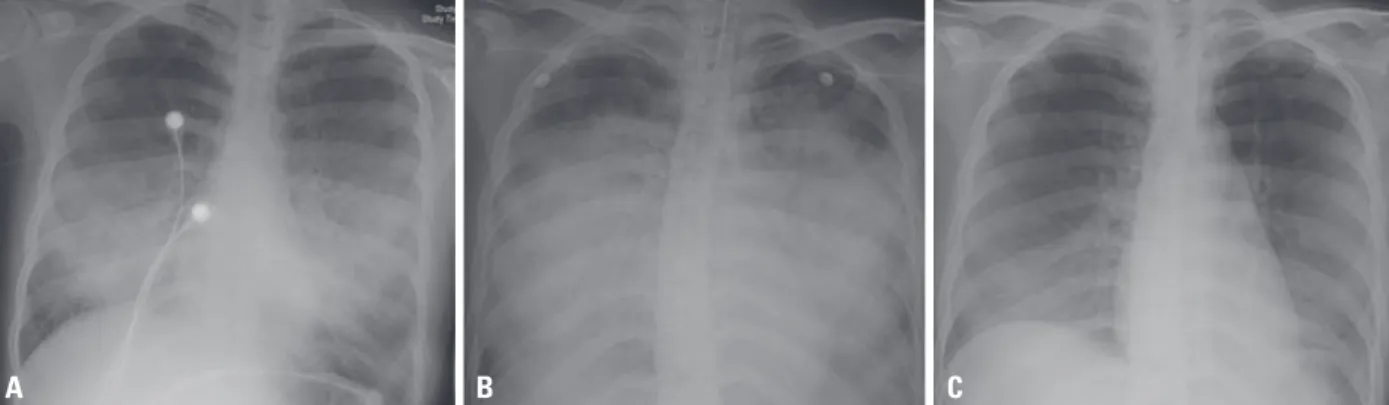
intubation, and the patient was extubated 3 days later and discharged without complications (Fig. 1C). She was diag- nosed with endometriotic cyst and underwent laparoscopic right ovarian cyst enucleation.
DISCUSSION
A recent study shows that gadobutrol is highly safe, with 0.55% of adverse drug reaction and less than 0.01% of seri- ous adverse drug reaction requiring admission such as ana- phylaxis.4 Besides minor adverse effects such as feeling of warmth and taste alteration, MRI contrasts could rarely in- duce nephrogenic systemic fibrosis.5 However, we could not find direct association between MRI contrasts and the lung adverse reactions, and this case has a meaningful value as the first reported case of ARDS after the use of gadobutrol.
Drug-induced ARDS is a progressive clinical condition when a drug causes alveolar degradation and flooding with protein-rich material and cellular debris with subsequent in- creases in pulmonary vascular resistance. A complex array of endothelial injury, epithelial injury, neutrophil-mediated damage, cytokine-mediated inflammation and injury, oxi- dant-mediated injury, ventilator-induced lung injury, and dysregulation of coagulation and fibrinolytic pathways are all implicated in the development.6
Risk of adverse reactions by MR contrast media have been reported to be lower than those of CT contrast media, and cross-reactivity between MR and CT contrast media has not yet been reported. Therefore, MR contrast study has been recognized as the safe alternative for iodide contrast media allergy patients.7 However, our patient did not show adverse reaction to CT contrast agent, suggesting the possi- bility of using CT contrast media as a safe alternative for MR contrast allergy patients.
CASE REPORT
A 26 years old female without allergic diseases or history of taking medical image studies by using contrast media visit- ed the emergency room for abdominal pain. Her abdomino- pelvic CT with contrast media showed a right ovarian cyst and possible infective colitis. Her chest X-ray and blood tests on the day of admission did not show anything significant.
To evaluate the ovarian cyst, she underwent pelvis MRI af- ter injection of 7.5 mL (0.1 mL/kg body weight) of gadobu- trol (Gadovist, Bayer Inc., Toronto, Canada) 83 hours after the CT examination. Fifty minutes after the injection of gado- butrol, she presented respiratory difficulty, edema of the lips, nausea, vomiting, and wheezing upon auscultation. Her blood pressure (124/75 mm Hg) and body temperature (37.2ºC) were normal, but she had tachycardia (pulse rate 109/min- ute) and tachypnea (respiratory rate 32/minute). Under the impression of anaphylaxis, she was given 0.5 mg of epi- nephrine 1:1000 intramuscularly and 5 mg of dexametha- sone twice intravenously. While applying 15 L/min of oxy- gen via mask, arterial blood gas analysis showed pO2 of 50.8 mm Hg and PaO2/FiO2 ratio of 63.5, and the chest X-ray showed bilateral central bat-wing consolidation (Fig. 1A).
She rapidly developed acute respiratory failure that required mechanical ventilation (Fig. 1B). Three hours after the injec- tion, she had hypotension (blood pressure 59/39 mm Hg) and tachycardia (pulse rate 112/min). Blood pressure did not recover after administration of 2 L of crystalloid and norepi- nephrine (10 mcg per minute). Six hours after the infusion, ARDS was improved on the X-ray, and transthoracic echo- cardiogram showed good left ventricular contractility with left ventricular ejection fraction of 60%. The ratio of mitral peak velocity of early filling to early diastolic mitral annular velocity was 9. Norepinephrine was stopped 16 hours after
Fig. 1. Chest X-ray features of the patient: (A) when the symptoms presented, (B) immediately after intubation, (C) before discharge from the intensive care unit.
A B C
ARDS by Gadolinium Contrast Media
Yonsei Med J http://www.eymj.org Volume 56 Number 4 July 2015 1157
consider the possibility of using CT contrast media as a safe alternative.
ACKNOWLEDGEMENTS
This research was supported by a grant from Ministry of Food and Drug Safety to operation of the regional pharma- covigilance center in 2015.
REFERENCES
1. Scott LJ. Gadobutrol: a review of its use for contrast-enhanced magnetic resonance imaging in adults and children. Clin Drug In- vestig 2013;33:303-14.
2. Boden WE. Anaphylactoid pulmonary edema (“shock lung”) and hypotension after radiologic contrast media injection. Chest 1982;
81:759-61.
3. Solomon DR. Anaphylactoid reaction and non-cardiac pulmonary edema following intravenous contrast injection. Am J Emerg Med 1986;4:146-9.
4. Herborn CU, Honold E, Wolf M, Kemper J, Kinner S, Adam G, et al. Clinical safety and diagnostic value of the gadolinium chelate gadoterate meglumine (Gd-DOTA). Invest Radiol 2007;42:58-62.
5. Nicholas BA, Vricella GJ, Smith M, Passalacqua M, Gulani V, Ponsky LE. Contrast-induced nephropathy and nephrogenic sys- temic fibrosis: minimizing the risk. Can J Urol 2012;19:6074-80.
6. Bakowitz M, Bruns B, McCunn M. Acute lung injury and the acute respiratory distress syndrome in the injured patient. Scand J Trauma Resusc Emerg Med 2012;20:54.
7. Brochow K, Sánchez-Borges M. Hypersensitivity to contrast me- dia anddyes. Immunol Allergy Clin N Am 2014;34:547-64.
8. Forsting M, Palkowitsch P. Prevalence of acute adverse reactions to gadobutrol--a highly concentrated macrocyclic gadolinium che- late: review of 14,299 patients from observational trials. Eur J Ra- diol 2010;74:e186-92.
9. Hasdenteufel F, Luyasu S, Renaudin JM, Paquay JL, Carbutti G, Beaudouin E, et al. Anaphylactic shock after first exposure to gadoterate meglumine: two case reports documented by positive allergy assessment. J Allergy Clin Immunol 2008;121:527-8.
10. Jung JW, Kang HR, Kim MH, Lee W, Min KU, Han MH, et al.
Immediate hypersensitivity reaction to gadolinium-based MR contrast media. Radiology 2012;264:414-22.
We diagnosed our patient with ARDS. She showed some clinical symptoms of anaphylaxis such as dyspnea and wheezing, but these can be explained by ARDS. Her clinical manifestations were not compatible to anaphylaxis; she de- veloped the symptoms 50 minutes after the injection of gado- butrol, and the blood pressure was normal at the early phase of the event and then dropped 3 hours after the administra- tion. Most cases of anaphylaxis after the use of contrast me- dia occur within 15 minutes, and a study on gadobustrol states that 82.4% of the side effects occur within 5 minutes after the injection and 95.7% in 10 minutes.8 The hypoten- sion episode was not corrected despite epinephrine and mas- sive administration of crystalloid fluid. The clinical feature of this patient was quite similar to the previously reported anaphylactoid pulmonary edema induced by ionic iodide contrast media.2,3 Intradermal skin test and the measurement of serum tryptase at the time of the episode might have helped the differentiation of the diagnosis, but they were not done. Some investigators suggest the usefulness of 1:10 di- luted intradermal skin test for IgE mediated gadolinium con- trast media allergy,9 but IgE mediated mechanism may not be critical for the development of ARDS. Furthermore, posi- tive and negative predictive values of skin test for the diag- nosis of IgE mediated gadolinium allergic diseases are yet unknown.
Besides gadobutrol, the MRI contrast media which our patient used, there are other gadolinium-based contrast me- dia such as gadoteric acid, gadobenate, and gadodiamide.
Controversy exists whether the allergic reactions of gado- linium contrast media are structure dependent. Several in- vestigators have reported higher rate of allergic reaction by gadomenate dimeglumine than other MR contrast media,10 suggesting the presence of specificities of gadolinium con- trast media for provoking adverse reactions.
Recently, increased need for health check-ups led to in- creased use of MRI with contrast media as well. Doctors and other practitioners should always keep in mind the risk of ARDS after the use of gadolinium contrast media and