Introduction
Acute respiratory distress syndrome (ARDS) is known as an acute systemic syndrome of lung inflammation characterized by increased permeability, which can result in severe hypoxia.
This syndrome is of major concern for critically ill patients with increasing morbidity and mortality
1. Although, inflam- mation is known to be involved in the pathogenesis of ARDS, several anti-inflammatory drugs have failed to improve ARDS outcomes.
The biguanide, metformin, is a widely used antidiabetic drug and recommended to newly diagnosed diabetes patients who have no contraindications
2-4. It is well known that in ad-
Effect of Preadmission Metformin Use on Clinical Outcome of Acute Respiratory Distress Syndrome among Critically Ill Patients with Diabetes
Yong Suk Jo, M.D., Sun Mi Choi, M.D., Jinwoo Lee, M.D., Young Sik Park, M.D., Chang-Hoon Lee, M.D., Jae-Joon Yim, M.D., Chul-Gyu Yoo, M.D., Young Whan Kim, M.D., Sung Koo Han, M.D.
and Sang-Min Lee, M.D.
Division of Pulmonary and Critical Care Medicine, Department of Internal Medicine, Seoul National University Hospital, Seoul National University College of Medicine, Seoul, Korea
Background: Acute respiratory distress syndrome (ARDS) is related to high mortality and morbidity. There are no proven therapeutic measures however, to improve the clinical course of ARDS, except using low tidal volume ventilation.
Metformin is known to have pleiotropic effects including anti-inflammatory activity. We hypothesized that pre-admission metformin might alter the progress of ARDS among intensive care unit (ICU) patients with diabetes mellitus (DM).
Methods: We performed a retrospective cohort study from January 1, 2005, to April 30, 2005 of patients who were admitted to the medical ICU at Seoul National University Hospital because of ARDS, and reviewed ARDS patients with DM. Metformin use was defined as prescribed within 3-month pre-admission.
Results: Of 558 patients diagnosed with ARDS, 128 (23.3%) patients had diabetes and 33 patients were treated with metformin monotherapy or in combination with other antidiabetic medications. Demographic characteristics, cause of ARDS, and comorbid conditions (except chronic kidney disease) were not different between metformin users and nonusers. Several severity indexes of ARDS were similar in both groups. The 30-day mortality was 42.42% in metformin users and 55.32% in metformin nonusers. On multivariable regression analysis, use of metformin was not significantly related to a reduced 30-day mortality (adjusted β-coefficient, –0.19; 95% confidence interval, –1.76 to 1.39; p=0.816).
Propensity score-matched analyses showed similar results.
Conclusion: Pre-admission metformin use was not associated with reduced 30-day mortality among ARDS patients with DM in our medical ICU.
Keywords: Respiratory Distress Syndrome, Adult; Diabetes Mellitus; Metformin
Address for correspondence: Sang-Min Lee, M.D.
Division of Pulmonary and Critical Care Medicine, Department of Internal Medicine, Seoul National University Hospital, Seoul National University College of Medicine, 101 Daehak-ro, Jongno-gu, Seoul 03080, Korea
Phone: 82-2-2072-0833, Fax: 82-2-762-9662E-mail: [email protected] Received: Jul. 11, 2016 Revised: Feb. 2, 2017 Accepted: Mar. 17, 2017
cc
It is identical to the Creative Commons Attribution Non-Commercial License (http://creativecommons.org/licenses/by-nc/4.0/).
Copyright © 2017
The Korean Academy of Tuberculosis and Respiratory Diseases.
All rights reserved.
dition to glucose-lowering effect and enhancement of insulin sensitivity, metformin has pleiotropic effects such as anti- inflammatory, antioxidant, endothelial barrier-enhancing, and antithrombotic effects
5-7. Several experimental animal models of acute lung injury showed that pretreatment with metfor- min preserves alveolar capillary permeability; therefore, met- formin decreases the occurrence and severity of acute lung injury in high-pressure ventilation
8. In a recent population- based cohort study, preadmission metformin use reduced 30- day mortality among medical and surgical intensive care unit (ICU) patients with diabetes
9. However, there are few studies regarding potential favorable effect of metformin focusing on patients with ARDS.
Therefore, we aimed to identify the beneficial effect of pre- admission use of metformin for patients with ARDS and dia- betes.
Materials and Methods
1. Patient eligibility
We retrospectively reviewed the medical records of patients who were admitted to the medical ICU and patients with ARDS were screened based on the International Classifica- tion of Disease 10 code at Seoul National University Hospital from January 1, 2005, to April 30, 2015. Then we confirmed adequacy of having ARDS by newly revised Berlin definition.
We identified type 2 diabetes among the ARDS patients by using an algorithm incorporating any previous inpatient or outpatient records for clinical diagnosis of diabetes, any filled prescription for an antidiabetic drug or a glycated hemoglobin A1c (HbA1c) level of 6.5% or more within 3 months of the ad- mission
2.
Demographic characteristics, laboratory findings, pread- mission antidiabetic drug usage, severity of illness, ventilator setting, steroid usage, interventions conducted in the ICU and clinical courses were reviewed. We excluded patients who were younger than 18 years of age clinically diagnosed as hav- ing ARDS, but who were not mechanically ventilated for vari- ous reasons, such as refusal of any invasive procedure includ- ing intubation. We also excluded patients who died within 48 hours after ICU admission.
2. Ethics statement
This study was approved by the Institutional Review Board (IRB) of Seoul National University Hospital (IRB No. 1511- 039-718). The requirement of informed consent from the patients was waived because of retrospective nature of the medical record review and anonymity of reporting.
3. Definition of preadmission metformin usage
For each patient, we identified all prescriptions for antidia- betic drugs within 3 months preceding admission. Prescrip- tion data were obtained from the Seoul National University Hospital electronic medical record database, or identified from medications prescribed at other hospitals. We defined metformin users as those who have taking metformin within 3 months before ICU admission; other patients with diabetes were defined as metformin nonusers.
4. Severity of ARDS
Severity of hypoxemia was classified as mild, moderate, or severe according to the Berlin definition
1. We considered oth- er clinical factors for the severity index of ARDS including lung injury score (LIS), degree of alveolar consolidation on chest radiograph, lung compliance, time to intubation and mechani- cal ventilation. Both LIS and degree of alveolar consolidation on chest radiograph were assessed by same qualified clinician who has specialty in respiratory medicine.
The LIS is composed of four components: (1) chest roent- genogram score; (2) hypoxemia score; (3) positive end- expiratory pressure (PEEP) score; and (4) respiratory system compliance score, in which each component was categorized from 0 to 4 with the higher score as worse
10. The total LIS was calculated by dividing the sum of each component score by the number of components used. The LIS is classified as no lung injury (0 point), mild-to-moderate lung injury (0.1–2.5 points), and severe lung injury (>2.5 points)
8. For LIS, static compliance of the respiratory system is used, but it has a restricted application in retrospective study. Therefore, we supplemented dynamic lung compliance as an alternative index of ARDS severity.
We utilized a bedside chest radiograph instead of computed tomography (CT) for evaluation of alveolar consolidation be- cause it is difficult to obtain chest CT from all patients in ICU.
In our medical ICU, we applied low tidal volume strategy (6 mL/predicted body weight) to ARDS patients and other pa- rameters of ventilator were adjusted for each patient.
We measured clinical outcomes of ARDS patients with diabetes depending on usage of metformin including mortal- ity, the primary outcome, and secondary outcomes such as ventilator-free days, ICU-free days and indicators of severity of ARDS.
5. Clinical outcomes
We calculated in-hospital mortality, ventilator-free day and
ICU-free day as clinical outcomes. And, we also evaluated in-
tervention in ICU such as extracorporeal membrane oxygen-
ation, renal replacement therapy, and tracheostomy.
6. Statistical analyses
Statistical tests were performed with STATA software ver- sion 13.1 (StataCorp, College Station, TX, USA). A chi-square test for comparison of categorical variables and a Student t test for continuous variables were applied. We performed univariable and thereafter multivariable logistic linear regres- sion analysis with adjustment by confounders. A propensity score was derived from a logistic regression model used as a dichotomous dependent variable. There were few patients in the metformin use group; therefore, we performed an exact lo- gistic regression analysis and used Firth’s penalized-likelihood approach to compensate for the small sample size when we analyzed the propensity-matched cohort. We used a Kaplan- Meier curve to analyze survival. p<0.05 was considered signifi- cant.
Results
1. Patients with ARDS and diabetes
A flow diagram for the study is presented in Figure 1.
Among 558 patients who met the Berlin definition of ARDS, 128 (23.3%) had diabetes. Among ARDS patients with diabe- tes, only three patients were treated with metformin mono- therapy, 30 patients used combination treatment, and other antidiabetic medications except metformin were prescribed to 69 patients. Twenty-six patients did not use any antidiabetic medications because of favorably controlled diabetes or un- awareness of diabetes until admission. Among the combina- tion treatment group including metformin, 14 patients (46.7%)
were treated with metformin and sulfonylurea, seven (23.3%) with metformin and dipeptidyl peptidase-4 inhibitor, and eight (26.7%) with more than the triple combination regimen, respectively. We divided patients into two groups: metformin users and metformin nonusers comprising patients who were treated with other antidiabetic drugs except metformin and untreated patients.
2. Comparison of clinical characteristics between metformin users and nonusers
The baseline characteristics of all 128 patients who were clinically diagnosed as having ARDS with diabetes are shown in Table 1. Mean age was 69.8 years and 72.7% of metformin users were male. The mean time interval between hospital admission and ICU admission was 8.9 days for metformin users and 7.7 days for nonusers. The most common cause of ARDS was direct lung injury, such as caused by pneumonia in both groups. The comorbid conditions were not significantly different between the groups. Only numbers of patients with chronic kidney disease were significantly high among metfor- min nonusers.
Severity indexes such as Acute Physiology and Chronic Health Evaluation II (APACHE II) and Sequential Organ Failure Assessment (SOFA) scores were not significantly dif- ferent from those for patients with or without metformin use (APACHE II: 31.8±8.7 vs. 31.0±7.6, p=0.61; SOFA: 9.9±4.2 vs.
9.6±3.5, p=0.73). The quality of blood glucose control was as- sessed by initial glucose level before insulin administration at the time of ICU admission and HbA1c. Although the mean ini- tial blood glucose level was significantly higher in metformin users (251.9±98.1 vs. 210.3±89.3, p=0.03), the mean HbA1c was
Patients with ARDS (n=549)
Patients with ARDS and type 2 diabetes (n=128, 23.3%)
Excluded:
no diabetes (n=421, 76.7%)
Metformin only (n=3, 2.3%)
Metformin combination (n=30, 23.4%)
Metformin nonuser (n=95, 74.2%)
Other treatment (n=69, 53.9%)
No treatment
(n=26, 20.3%)
Figure 1. Study flow. ARDS: acute respi-
ratory distress syndrome.
not different between the groups (7.3±1.0 vs. 7.3±1.4, p=0.84) (Table 2). To compare the severity of systemic inflammation, inflammatory markers including C-reactive protein, white blood cell count, and lactic acid were reviewed; however, there was no significant difference between the groups.
At the ICU admission, initial ventilator setting was not differ- ent between the groups. A large proportion of patients (>80%) had mild-to-moderate ARDS severity, and the severity was not significantly different between the groups. At the time of clini- cal diagnosis of ARDS, mean quadrant alveolar consolidation on chest radiographs (2.8±0.8 vs. 2.9±0.9, p=0.88) and mean LIS (2.2±0.5 vs. 2.2±0.6, p=0.95) were similar in both groups (Table 2).
1) Comparison of outcome between metformin users and nonusers
Among 128 ARDS patients with diabetes mellitus, 89 pa- tients (69.5%) died and 39 (30.5%) survived during hospital stay. Use of metformin did not significantly reduce the risk of in-hospital mortality in patients with ARDS (odds ratio
[OR], 0.69; 95% confidence interval, 0.30 to 1.61; p=0.394).
The 30-day mortality was higher in metformin nonusers than users, but this was not significant (Table 3, Figure 2). We also analyzed 60- and 90-day mortality, but the results were similar. At 30 days since ICU admission, mean ventilator-free days (19.9±6.5 vs. 18.4±7.2, p=0.33) and mean ICU-free days (17.1±7.1 vs. 16.1±7.5, p=0.53) were not significantly differ- ent between metformin users and nonusers. The mean total length of stay in hospital tended to be longer in nonusers (47.8±54.8 vs. 54.8±104.3, p=0.60) than users, but the differ- ence was not significant.
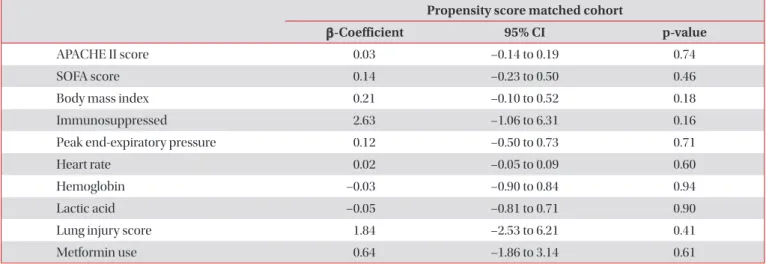
The relationship between 30-day mortality and the clinical parameters was modeled using logistic regression analysis.
The ORs of death within 30 days of ICU admission in un- matched and matched cohort are presented in Supplemen- tary Table S1. In a matched cohort, body mass index, immu- nosuppressed patients, tachycardia, hemoglobin, lactic acid, high PEEP were significantly related to 30-day mortality. But, none of variables showed significant association with 30 days mortality in propensity matched cohort (Table 4). Neither in Table 1. Demographic characteristics of enrolled patients
Characteristic
All ARDS patients with type 2 diabetes mellitus (n=128)
p-value
Propensity matched cohort
p-value Metformin users
(n=33) Metformin
nonusers (n=95) Metformin users
(n=33) Metformin nonusers (n=33)
Age, yr 69.8±11.4 66.6±9.6 0.12 69.8±11.4 69.4±11.2 0.90
Male sex 24 (72.7) 76 (80.0) 0.38 24 (72.7) 23 (69.7) 0.79
BMI, kg/m
222.8±3.4 22.1±3.9 0.36 22.8±3.4 22.5±3.6 0.75
Days before ICU admission, day 8.9±16.2 7.7±18.4 0.75 8.9±16.2 10.1±22.5 0.80
Cause of ARDS
Direct lung injury 25 (75.8) 72 (75.8) 0.83 25 (75.8) 25 (75.8) 0.15
Non-direct lung injury 8 (24.2) 23 (24.2) 8 (24.2) 8 (24.2)
Comorbidity
Hypertension 17 (51.5) 48 (50.5) 0.92 17 (51.5) 14 (42.4) 0.46
Ischemic heart disease 7 (21.2) 21 (22.1) 0.91 7 (21.2) 7 (21.2) 1.00
Chronic pulmonary disease 11 (33.3) 28 (29.5) 0.68 11 (33.3) 6 (18.2) 0.16
Cerebrovascular disease 5 (15.1) 21 (22.1) 0.39 5 (15.1) 8 (24.2) 0.35
Liver cirrhosis 1 (3.0) 6 (6.3) 0.47 1 (3.0) 3 (9.1) 0.30
History of cancer 4 (12.1) 12 (12.6) 0.94 4 (12.1) 3 (9.1) 0.69
Metastatic cancer 9 (27.3) 19 (20.0) 0.38 99 (27.3) 7 (21.2) 0.57
Hematologic malignancy 4 (12.1) 11 (11.6) 0.93 4 (12.1) 5 (15.2) 0.72
Chronic kidney disease 1 (3.0) 21 (22.1) 0.01 1 (3.0) 9 (27.3) 0.01
Immunosuppressed* 8 (24.2) 2 (28.4) 0.64 8 (24.2) 8 (24.2) >0.99
Values are presented as mean±standard deviation or number (%) (n=128).
*Patients who has hematologic malignancy, neutropenia and taking immunosuppressant because of autoimmune disease or post-transplant graft-versus-host disease prophylaxis were defined as immunosuppressed
20.
ARDS: acute respiratory distress syndrome; BMI: body mass index; ICU: intensive care unit.
the unmatched cohort nor the propensity matched cohort, was there any significant association between treatment with metformin and 30-day mortality.
Despite the significantly short time between initiation of mechanical ventilation and nitric oxide (NO) use in metfor- min users (0.7±1.5 days vs. 8.2±7.6 days, p≤0.01), there were only a small number who used NO (10 of 30 patients vs. 30 of 95 patients, p=0.89). We also assessed the utility of venove- nous extracorporeal membrane oxygenation, but only three metformin users and six nonusers were identified and there was no significant difference between them (Table 3). We also reviewed the usage of steroid during ICU care. In total, 67 patients (50.4%) were prescribed steroid after ICU admission.
There is no significant difference on use of steroid between metformin users (51.4% vs. 50.0%, p=0.88) and neither in dose (734.3±391.7 mg vs. 865.7±535.3 mg, p=0.34) nor duration (21.3±3.2 days vs. 32.4±100.1 days, p=0.64) compared with metformin nonusers (data are not shown).
Discussion
This study provides some support for the hypothesis that preadmission metformin could have protective effect for ARDS. We used propensity-matched analysis to overcome the weakness of our retrospective design. However, pretreatment with metformin in patients with diabetes did not show signifi- cant influence on the clinical outcome in ARDS patients.
Among 558 patients who met the Berlin definition of ARDS and were subsequently diagnosed as having ARDS, 128 (23.3%) had diabetes. This finding was consistent with the previously reported decreased incidence of ARDS in diabetic patients
11. Diabetes is regarded as protective factor for the development of ARDS even after adjustment for confounders, such as age and severity of illness
12. It is thought that diabetes may be involved in pathogenesis of ARDS and alter the de- velopment by altering the immune system and inflammatory response, such as adherence of neutrophils to endothelium or Table 2. Severity of illness and respiratory parameters at the time of intensive care unit admission
All ARDS patients with type 2 diabetes mellitus (n=128)
p-value
Propensity matched cohort
p-value Metformin users
(n=33) Metformin
nonusers (n=95) Metformin users
(n=33) Metformin nonusers (n=33) Severity of illness
APACHE II score 31.8±8.7 31.0±7.6 0.61 31.8±8.7 31.9±8.9 0.94
SOFA score 9.9±4.2 9.6±3.5 0.73 9.9±4.2 9.4±3.6 0.62
Glycemic control
Blood glucose level, mg/dL 251.9±98.1 210.3±89.3 0.03 251.9±98.2 219.2±100.1 0.19
HbA1c, % 7.3±1.0 7.3±1.4 0.84 7.3±1.0 7.2±1.4 0.83
Initial ventilator settings
PEEP, cm H
2O 6.2±2.7 6.6±2.2 0.44 6.2±2.7 6.4±2.0 0.71
Driving pressure, cm H
2O 19.5±4.7 18.7±4.5 0.38 19.5±4.7 19.1±4.9 0.72
PIP, cm H
2O 26.2±4.6 26.4±4.7 0.80 26.2±4.6 26.3±5.4 0.94
Tidal volume, mL/kg 7.4±2.6 8.0±2.2 0.48 7.4±2.6 7.4±2.5 0.98
FiO
2, % 83.1±22.0 80.9±19.4 0.59 83.1±22.0 81.7±19.7 0.79
Minute ventilation, L/min 10.4±3.5 10.4±3.8 0.98 10.4±3.5 9.6±3.9 0.39
Hypoxemia index (PaO
2/FiO
2ratio)
Mild 19 (57.6) 42 (44.2) 0.41 19 (57.6) 15 (45.4) 0.61
Moderate 11 (33.3) 41 (43.2) 11 (33.3) 14 (42.4)
Severe 3 (9.1) 12 (12.6) 3 (9.1) 4 (12.1)
Dynamic compliance, mL/cm H
2O 23.7±9.1 25.6±20.4 0.61 23.7±9.1 27.4±32.4 0.53
Extent of alveolar consolidation 2.8±0.8 2.9±0.9 0.88 2.8±0.8 2.8±0.9 0.69
Lung injury score 2.2±0.5 2.2±0.6 0.95 2.2±0.5 2.2±0.6 0.83
Values are presented as mean±standard deviation or number (%) (n=128).
ARDS: acute respiratory distress syndrome; APACHE II score: Acute Physiology and Chronic Health Evaluation II score; SOFA score:
Sequential Organ Failure Assessment score; HbA1c: glycated hemoglobin; PEEP: positive end expiratory pressure; PIP: peak inspiratory
pressure; FiO
2: fraction of inspired oxygen.
bactericidal activity of inflammatory cells
11,13. There are sev- eral studies suggest that pretreatment with metformin attenu- ates ventilator-induced lung injury by preventing increased pulmonary microvascular permeability in response to delete- rious mechanical ventilation in an animal model
8. Also, ben- eficial effect of metformin on decrease in inflammatory cyto- kines when added to intensive insulin therapy was reported
14. However, we could not identified inter-group differences of inflammatory markers (white blood cells, C-reactive protein, and lactic acid) between metformin users and nonusers and status of glycemic control by HbA1c level as well.
Most patients who clinically diagnosed as ARDS were re- sulted from direct lung injury and this might contributes no inter-group differences of inflammatory markers. In fact, be- cause metformin is switched to insulin upon ICU admission and this makes any effect of preadmission metformin use in our study more vague and difficult to interpret.
Along the lines of our study, Christiansen et al.
9reported that the preadmission use of metformin was associated with a lower mortality in ICU. Because they included medical and Table 3. Clinical outcomes according to metformin use
All ARDS patients with type 2 diabetes mellitus (n=128)
p-value
Propensity matched cohort
p-value Metformin users
(n=33) Metformin
nonusers (n=95) Metformin users
(n=33) Metformin nonusers (n=33) Mortality
30 Days 14 (42.4) 52 (55.3) 0.20 14 (42.4) 18 (56.2) 0.26
60 Days 20 (60.6) 63 (67.0) 0.50 20 (60.6) 21 (65.6) 0.67
90 Days 21 (63.6) 67 (71.3) 0.41 21 (63.6) 22 (68.7) 0.66
Ventilator-free day
Day 1 to 30 19.9±6.5 18.4±7.2 0.33 19.9±6.5 18.1±6.6 0.32
Day 1 to 60 46.4±11.4 46.5±0.8 0.99 46.4±11.4 46.6±0.7 0.94
ICU-free days
Day 1 to 30 17.1±7.1 16.1±7.5 0.53 17.1±7.1 15.8±6.8 0.48
Day 1 to 60 41.9±13.3 42.5±11.8 0.80 41.9±13.3 41.8±13.2 0.99
Total hospital stay 47.8±54.8 54.8±104.3 0.60 47.8±54.8 61.7±90.0 0.45
NO use 10 (30.3) 30 (31.6) 0.89 10 (30.3) 11 (33.3) 0.79
Time to NO gas, day 0.7±1.5 8.2±7.6 <0.01 0.7±1.5 8.1±9.1 0.02
Intervention in ICU
V-V ECMO 3 (9.1) 6 (6.3) 0.59 3 (9.1) 3 (9.1) 1.00
RRT 10 (30.3) 32 (33.7) 0.72 10 (30.3) 10 (30.3) 1.00
Tracheostomy 10 (30.3) 24 (25.3) 0.57 10 (30.3) 10 (30.3) 1.00
BIPAP apply 4 (12.1) 10 (10.5) 0.80 4 (12.1) 3 (9.1) 0.69
Readmission to ICU 3 (9.7) 9 (9.7) 1.00 3 (9.7) 6 (18.2) 0.33
Values are presented as number (%) or mean±standard deviation.
ARDS: acute respiratory distress syndrome; ICU: intensive care unit; NO: nitric oxide; V-V ECMO: veno-venous extracorporeal membrane oxygenation; RRT: renal replacement therapy; BIPAP: bilevel positive airway pressure.
Figure 2. The effect of preadmission metformin on 30-day mortality of acute respiratory distress syndrome patients with diabetes.
0 1.00
0.75
0.50
0.25
0
50 100 150
Days of hospital stay Kaplan-Meier survival estimates
Metformin nonuser Metformin user Log-rank p-value=0.35