ABSTRACT
There are no proven therapeutics for Coronavirus disease 2019 (COVID-19) pneumonia outbreak.
We observed and analyzed the clinical efficacy of the most used hydroxychloroquine (HCQ) for 30 days. In this study, administration of HCQ <5 days from diagnosis (odds ratio: 0.111, 95%
confidence interval: 0.034 - 0.367, P = 0.001) was the only protective factor for prolonging of viral shedding in COVID-19 patients. Early administration of HCQ significantly ameliorates inflammatory cytokine secretion by eradicating COVID-19, at discharge. Our findings suggest that patients confirmed of COVID-19 infection should be administrated HCQ as soon as possible.
Keywords:
Early; Hydroxychloroquine; Coronavirus disease 2019; Eradication
Coronavirus disease 2019 (COVID-19) pneumonia outbreak, caused by severe acute respiratory syndrome coronavirus 2 (SARS-CoV-2) infection emerged in Wuhan, China in December 2019, rapidly spread to produce a worldwide pandemic [1]. There are no proven therapeutics for COVID-19, and current toll estimate more than 2.7 million infected people and almost 200 thousand deaths worldwide as of April 24 2020, according to data compiled by Johns Hopkins University. Recent studies have reported factors in association with prolonged duration of viral RNA shedding [2, 3]. But so far, no study has demonstrated the effects of antiviral drug administration on the duration of viral shedding and clinical improvement in COVID-19 patients. We investigated the time of antiviral drug administration in COVID-19 patients with factors and inhibitors associated with prolonged viral shedding, clinical improvement and cytokine storm, respectively.
We enrolled 99 patients confirmed with SARS-CoV-2 infection at Yeungnam University Medical Center in Daegu, Korea. This study was reviewed and approved by the Institutional Review Board of Yeungnam University Hospital (YUH IRB 2020-03-057, 2020-05-031-001).
Brief Communication
Kyung Soo Hong
1, Jong Geol Jang
1, Jian Hur
2, Jong Ho Lee
3, Hong Nam Kim
4,*, Wonhwa Lee
5,*, and June Hong Ahn
1,*1 Division of Pulmonology and Allergy, Department of Internal Medicine, College of Medicine, Yeungnam University and Regional Center for Respiratory Diseases, Yeungnam University Medical Center, Daegu, Korea
2 Division of Infection, Department of Internal Medicine, College of Medicine, Yeungnam University, Yeungnam University Medical Center, Daegu, Korea
3 Department of Laboratory Medicine, College of Medicine, Yeungnam University, Yeungnam University Medical Center, Daegu, Korea
4 Center for BioMicrosystems, Brain Science Institute, Korea Institute of Science and Technology (KIST), Seoul, Korea
5Aging Research Center, Korea Research Institute of Bioscience and Biotechnology, Daejeon, Korea
Early Hydroxychloroquine
Administration for Rapid Severe Acute Respiratory Syndrome Coronavirus 2 Eradication
Received: May 23, 2020 Accepted: Jun 29, 2020 Corresponding Author:
Hong Nam Kim, PhD
Center for BioMicrosystems, Brain Science Institute Korea Institute of Science and Technology, 5, Hwarang-ro 14 gil, Seongbuk- gu, Seoul 02792, Korea.
Tel: +82-2-958-5617 Fax:+82-2-958-6910
E-mail: [email protected] Wonhwa Lee, PhD
Aging Research Center, Korea Research Institute of Bioscience and Biotechnology, 125 Gwahak-ro, Yuseong-gu, Daejeon 34141, Korea.
Tel: +82-42-879-8143 Fax: +82-42-879-8596
E-mail: [email protected] June Hong Ahn, MD, PhD Division of Pulmonology and Allergy, Department of Internal Medicine, College of Medicine, Yeungnam University and Regional Center for Respiratory Diseases, Yeungnam University Medical Center, 170 Hyeonchung-ro, Nam-gu, Daegu 42415, Korea.
Tel: +82-53-640-6577 Fax: +82-53-620-3849 E-mail: [email protected]
*Hong Nam Kim, Wonhwa Lee, and June Hong Ahn corresponded equally to the work.
Copyright © 2020 by The Korean Society of Infectious Diseases, Korean Society for Antimicrobial Therapy, and The Korean Society for AIDS
This is an Open Access article distributed under the terms of the Creative Commons Attribution Non-Commercial License (https://
creativecommons.org/licenses/by-nc/4.0/) which permits unrestricted non-commercial use, distribution, and reproduction in any medium, provided the original work is properly cited.
ORCID iDs Kyung Soo Hong
https://orcid.org/0000-0003-2931-6861 Jong Geol Jang
https://orcid.org/0000-0001-8040-5363 Jian Hur
https://orcid.org/0000-0003-3219-8368 Jong Ho Lee
https://orcid.org/0000-0002-6837-838X Hong Nam Kim
https://orcid.org/0000-0002-0329-0029 Wonhwa Lee
https://orcid.org/0000-0003-4336-5221 June Hong Ahn
https://orcid.org/0000-0001-7104-8325 Conflict of Interest
No conflicts of interest.
Author Contributions
Conceptualization: JHA, KSH, JH, HNK, WL.
Data curation: JHA, KSH, JGJ, JH, JHL, HNK, WL. Formal analysis: JHA, KSH, JGJ, HNK, WL.
Writing - original draft: JHA, WL, HNK. Writing - review & editing: JHA, WL.
The requirement for informed consent was waived because of the retrospective study design.
The primary outcome of this study was the viral clearance rates in the first 30 days after the diagnosis. The secondary outcome was time to clinical improvement. Clinical improvement was analyzed in two variables: (1) temperature recovery, defined as a patient with body temperature below 37.5°C and does not rise again afterwards; (2) radiologic recovery, defined as an improvement compared to initial imaging findings.
Patients were enrolled if they met one of the following criteria: (1) cured and discharged within 30 days without viral shedding; (2) remained in the hospital without viral shedding; (3) viral shedding at 30 days. Nine patients who died less than 30 days after the diagnosis with viral shedding were excluded. One patient was excluded as the patient were less than 30 days after the diagnosis with viral shedding. And 1 patient was excluded as the patient transferred to therapeutic living center. The final date of follow-up was April 17, 2020.
The patients were confirmed positive with real-time reverse transcriptase-polymerase chain reaction (RT-PCR) assay (Allplex
TM2019-nCoV Assay targeting E gene, RdRp gene, and N gene by Seegene Technologies Inc, Seoul, Korea) [4]. After the patient's symptoms improved, specimen sampling of the sputum, nasopharyngeal swab were conducted daily. We
conducted specimen collection according to the manufacturer's protocol. For each gene, a cycle threshold value (Ct-value) less than 40 was defined as a positive results, while a Ct-value of more than 40 was defined as negative. Specimen with a Ct-value of more than 40 in both E gene, RdRp gene, and N gene was defined as negative results.
All of the following criteria were required for quarantine release: (1) no fever with improved clinical symptoms for at least 3 days, (2) radiologic improvement assessed by chest X-ray or chest computed tomography, (3) two consecutive negative RT-PCR results obtained during a 24-hour interval sampling of nasopharyngeal swab and sputum.
The National Early Warning Score (NEWS) is an early warning score facilitating prompt detection in response to patient deterioration [5]. Acute respiratory distress syndrome (ARDS) was defined according to the Berlin definition [6]. Septic shock was defined according to the third international consensus definitions for sepsis and septic shock (Sepsis-3) [7].
Serum levels of inflammatory cytokines IL-1β, IL-6, TNF-α, and IFN-γ were determined in SARS-CoV-2-infected patients and discharged patients using Human IL-1β Quantikine enzyme-linked immunosorbent assay (ELISA) Kit (DLB50, R&D Systems, Minneapolis, MN, USA), Human IL-6 Quantikine ELISA Kit (D6050, R&D Systems, Minneapolis, MN, USA), Human TNF-α Quantikine ELISA Kit (DTA00D, R&D Systems, Minneapolis, MN, USA), and Human IFN-γ Quantikine ELISA Kit (DIF50, R&D Systems, Minneapolis, MN, USA) according to the manufacturer's instructions. The results were expressed as pg/mL.
Forty-three patients were determined as men (43.4%) and the median age was 59 years
(interquartile range [IQR], 45 - 68 years). The median duration of viral shedding was 33
days (IQR, 27 - 40 days) from the diagnosis. The time between the diagnosis and clinical
improvement was significantly longer in prolonged viral shedding groups (temperature
recovery, 3 days (IQR, 1 - 5 days) vs. 6 days (IQR, 2 - 9 days), P = 0.002; radiologic
recovery, 12 days (IQR, 10 - 16 days) vs. 21.5 days (IQR, 16 - 28 days), P <0.001). There
were no significant differences between prolonged viral shedding with age, sex, NEWS,
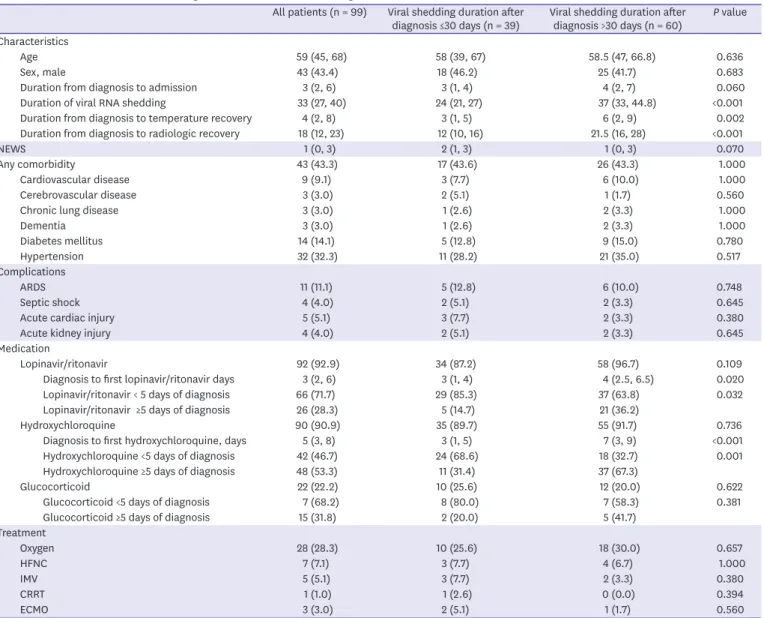
comorbidities, complications, and treatments. However, the time between the point of diagnosis and antiviral medication was significantly longer in prolonged viral shedding groups (lopinavir/ritonavir, 3 days (IQR, 1 - 4 days) vs. 4 days (IQR, 2.5 - 6.5 days), P = 0.020;
hydroxychloroquine (HCQ), 3 days (IQR, 1 - 5 days) vs. 7 days (IQR, 3 - 9 days), P <0.001).
When continuous variables were converted to categorical variables with a cut off of 5 days, early administration of lopinavir/ritonavir, and hyxroxychroloquine was associated with decreased rates of prolonged viral shedding. Glucocorticoid usage was not associated with prolonged viral shedding (Table 1). From multivariable logistic regression analysis, it was observed that HCQ <5 days from diagnosis (odds ratio [OR]: 0.111, 95% confidence interval [CI]: 0.034 - 0.367, P = 0.001) was the only protective factor for prolonging of viral shedding in COVID-19.
Table 1. Baseline characteristics according to the duration of viral shedding
All patients (n = 99) Viral shedding duration after
diagnosis ≤30 days (n = 39) Viral shedding duration after
diagnosis >30 days (n = 60) P value Characteristics
Age 59 (45, 68) 58 (39, 67) 58.5 (47, 66.8) 0.636
Sex, male 43 (43.4) 18 (46.2) 25 (41.7) 0.683
Duration from diagnosis to admission 3 (2, 6) 3 (1, 4) 4 (2, 7) 0.060
Duration of viral RNA shedding 33 (27, 40) 24 (21, 27) 37 (33, 44.8) <0.001
Duration from diagnosis to temperature recovery 4 (2, 8) 3 (1, 5) 6 (2, 9) 0.002
Duration from diagnosis to radiologic recovery 18 (12, 23) 12 (10, 16) 21.5 (16, 28) <0.001
NEWS 1 (0, 3) 2 (1, 3) 1 (0, 3) 0.070
Any comorbidity 43 (43.3) 17 (43.6) 26 (43.3) 1.000
Cardiovascular disease 9 (9.1) 3 (7.7) 6 (10.0) 1.000
Cerebrovascular disease 3 (3.0) 2 (5.1) 1 (1.7) 0.560
Chronic lung disease 3 (3.0) 1 (2.6) 2 (3.3) 1.000
Dementia 3 (3.0) 1 (2.6) 2 (3.3) 1.000
Diabetes mellitus 14 (14.1) 5 (12.8) 9 (15.0) 0.780
Hypertension 32 (32.3) 11 (28.2) 21 (35.0) 0.517
Complications
ARDS 11 (11.1) 5 (12.8) 6 (10.0) 0.748
Septic shock 4 (4.0) 2 (5.1) 2 (3.3) 0.645
Acute cardiac injury 5 (5.1) 3 (7.7) 2 (3.3) 0.380
Acute kidney injury 4 (4.0) 2 (5.1) 2 (3.3) 0.645
Medication
Lopinavir/ritonavir 92 (92.9) 34 (87.2) 58 (96.7) 0.109
Diagnosis to first lopinavir/ritonavir days 3 (2, 6) 3 (1, 4) 4 (2.5, 6.5) 0.020
Lopinavir/ritonavir < 5 days of diagnosis 66 (71.7) 29 (85.3) 37 (63.8) 0.032
Lopinavir/ritonavir ≥5 days of diagnosis 26 (28.3) 5 (14.7) 21 (36.2)
Hydroxychloroquine 90 (90.9) 35 (89.7) 55 (91.7) 0.736
Diagnosis to first hydroxychloroquine, days 5 (3, 8) 3 (1, 5) 7 (3, 9) <0.001
Hydroxychloroquine <5 days of diagnosis 42 (46.7) 24 (68.6) 18 (32.7) 0.001
Hydroxychloroquine ≥5 days of diagnosis 48 (53.3) 11 (31.4) 37 (67.3)
Glucocorticoid 22 (22.2) 10 (25.6) 12 (20.0) 0.622
Glucocorticoid <5 days of diagnosis 7 (68.2) 8 (80.0) 7 (58.3) 0.381
Glucocorticoid ≥5 days of diagnosis 15 (31.8) 2 (20.0) 5 (41.7)
Treatment
Oxygen 28 (28.3) 10 (25.6) 18 (30.0) 0.657
HFNC 7 (7.1) 3 (7.7) 4 (6.7) 1.000
IMV 5 (5.1) 3 (7.7) 2 (3.3) 0.380
CRRT 1 (1.0) 1 (2.6) 0 (0.0) 0.394
ECMO 3 (3.0) 2 (5.1) 1 (1.7) 0.560
Continuous variables are expressed as median (IQR) and were compared using a Student's t-test. Categorical variables were compared using the chi-squared test or Fisher's exact test. Multivariable logistic regression analysis was performed to identify risk factors for prolonged viral shedding using variables with P values <0.1 in univariable analyses.
RNA, ribonucleic acid; NEWS, national early warning score; ARDS, acute respiratory distress syndrome; HFNC, high flow nasal cannula; IMV, invasive mechanical ventilation; CRRT, continuous renal replacement therapy; ECMO, extracorporeal membrane oxygenation.
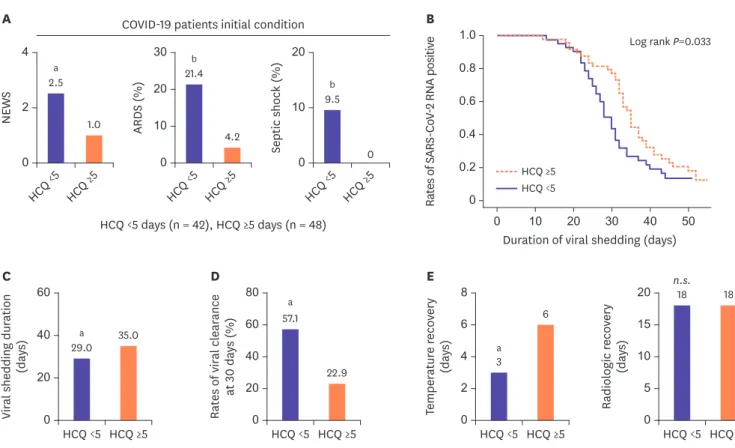
Patients were divided into two groups; one group of patients who took HCQ <5 days from diagnosis (n = 42), and another group of patients who took HCQ ≥5 days from diagnosis (n = 48). Early HCQ administration group had a higher initial NEWS (2.5 (IQR 0.75 - 5.0) vs. 1.0 (IQR 0 - 2.0), P = 0.002), and many had progressed toward ARDS (21.4% vs. 4.2%, P = 0.021) and septic shock (9.5% vs. 0.0%, P = 0.044) (Fig. 1A). Despite the severity of the disease, early administration group showed a significantly shorter viral shedding duration (29 days (IQR 24 - 34.8 days) vs. 35 days (IQR 31 - 41.8 days), P = 0.006), and a higher rate of viral clearance at 30 days (57.1% vs. 22.9%, P = 0.001) (Fig. 1B-1D) than later administration group. When it comes to clinical improvement indicators, early administration group showed a significantly shorter temperature recovery duration (3 days (IQR 0.75 - 5 days) vs. 6 days (IQR 1.25 - 9.75 days), P = 0.002). However, there were no significant difference in radiologic recovery duration between HCQ <5 days and HCQ ≥5 days patients (18 days (IQR 11.75 - 28 days) vs. 18 days (IQR 12 - 23 days), P = 0.563) (Fig. 1E).
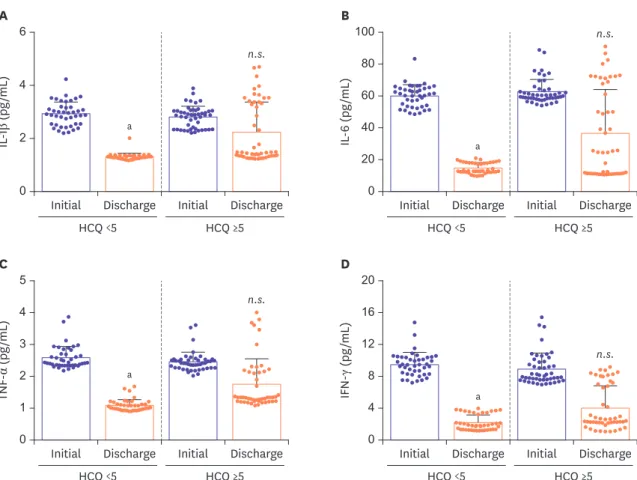
A recent study has reported that the cytokine storm is associated with progression towards ARDS and septic shock [8]. We investigated the level of secreted inflammatory cytokines (IL-1β, IL-6, TNF-α, and IFN-γ) in the plasma of COVID-19 patients according to the time of HCQ administered
NEWS
A
0 2
HCQ <5 HCQ ≥5 2.5a
1.0 4
ARDS (%)
0 10
HCQ <5 HCQ ≥5 21.4b
4.2 30
20
Septic shock (%)
0 10
HCQ <5 HCQ ≥5 9.5
b
0 20
Viral shedding duration (days) 0 40
20
HCQ <5
C D E
HCQ ≥5 29.0
a 35.0
60
Rates of viral clearance at 30 days (%) 0 40 20
HCQ <5 HCQ ≥5 57.1
a
22.9 80
Temperature recovery (days) 0 4 2
HCQ <5 HCQ ≥5 3
6 8
6
Radiologic recovery (days) 0 10 5
HCQ <5 HCQ ≥5 18
a
n.s. 18
20
60 15
HCQ <5 days (n = 42), HCQ ≥5 days (n = 48) COVID-19 patients initial condition
1.0
0.6
0 0
Rates of SARS-CoV-2 RNA positive
Duration of viral shedding (days)
B
0.2 0.8
0.4
50 40 30 20 10 HCQ ≥5 HCQ <5
Log rank P=0.033
Figure 1. Anti-infectious effects of early HCQ administration against COVID-19.
(A) Comparisons of initial NEWS, rates of ARDS, and septic shock early in hospitalization. (B) Cumulative proportion of patients with detectable viral RNA by day after diagnosis confirmed between HCQ <5 days and HCQ ≥5 days patients. (C, D) Comparisons of viral shedding duration, and rates of viral clearance at 30 days between HCQ <5 days and HCQ ≥5 days patients. (E) Comparisons of temperature recovery, and radiologic recovery between HCQ <5 days and HCQ ≥5days patients. Statistical analysis was performed using a two-tailed unpaired t-test. In all analyses, a two-tailed P-value <0.05 was considered to indicate statistical significance. Data are presented as median.
aP <0.01.
bP <0.05.
HCQ, hydroxychloroquine; COVID-19, coronavirus disease 2019; NEWS, national early warning score; ARDS, acute respiratory distress syndrome; SARS-CoV-2, severe acute respiratory syndrome coronavirus 2; RNA, ribonucleic acid; n.s., not significant.
All statistical analyses were performed using SPSS software (ver. 24.0; SPSS Inc., Chicago, IL, USA) and Graphpad Prism.
(Fig. 2). Based on the ELISA data, it was confirmed that early administration of HCQ significantly ameliorates inflammatory cytokine secretion by eradicating COVID-19, at discharge.
Recent observational study involving 1,446 COVID-19 patients revealed that there were no significant association between HCQ administration and intubation or death. HCQ also revealed no benefit as postexposure prophylaxis for COVID-19 in a randomized trial [9]. Food and Drug Administration (FDA) raises concerns about using HCQ with other medications known to prolong the QT interval. In this study, we only focused on the association between the time of HCQ administration and duration of viral shedding, and proinflammatory cytokine secretion at discharge. Our research alone cannot determine the impact of taking HCQ on clinical outcomes. There were no clinical side effects of obvious arrhythmia in this study.
Previous studies showed that age, male sex, time from illness onset to hospitalization, invasive mechanical ventilation, and severe disease are associated with persistent existence of SARS-CoV-2 [2, 10]. Here, administration of HCQ <5 days from diagnosis (OR: 0.111, 95%
CI: 0.034 - 0.367, P = 0.001) was the only protective factor for prolonging of viral shedding in COVID-19 patients. Our data reveals that early administration of HCQ is associated with shorter viral shedding duration and a higher rate of viral clearance after 30 days, despite the initial assessment of high disease severity.
C D
TNF-α (pg/mL)
0 2 1
Initial Discharge Initial Discharge 4
3 5
HCQ <5 HCQ ≥5
IFN-γ (pg/mL)
0 8 4
Initial Discharge Initial Discharge 16
12 20
HCQ <5 HCQ ≥5
A B
IL-1β (pg/mL)
0 2
Initial Discharge Initial Discharge 4
6
HCQ <5 HCQ ≥5
IL-6 (pg/mL)
0 40 20
Initial Discharge Initial Discharge 80
60 100
HCQ <5 HCQ ≥5
a
a
a
a
n.s.
n.s.
n.s.
n.s.
Figure 2. Series of comparisons of plasma cytokines levels in patients at initial and at discharge after HCQ administration. Statistical analysis was performed using a two-tailed unpaired t-test. In all analyses, a two-tailed P-value <0.05 was considered to indicate statistical significance. Data are presented as mean ± SEM.
aP <0.01.
bP <0.05.
HCQ, hydroxychloroquine; SEM, standard error of the mean; n.s., not significant.
All statistical analyses were performed using SPSS software (ver. 24.0; SPSS Inc., Chicago, IL, USA) and Graphpad Prism.
In a recent study, it was demonstrated that severe COVID-19 patients tend to have high viral load and prolonged viral shedding period, which correspond to poor clinical outcomes [10, 11].
Our results show that early HCQ administration leads to rapid clearance of viral load, and thus could help improve the clinical outcomes. Contrary to general concerns, glucocorticoid was not associated with delayed viral clearance.
In conclusion, after the diagnosis clinicians should consider early administration of HCQ, especially in severe COVID-19 patients. It suggested that the inhibitory and suppressive effect of HCQ on the virus and cytokine storm is an appropriate first-line treatment to COVID-19 infections in the absence of available treatments. Randomized, controlled trials of HCQ in COVID 19 patients are needed.
ACKNOWLEDGMENTS
This work was supported by the National Research Foundation of Korea (NRF) grant funded by the Korean Government (MSIT) (grant no. 2018R1A2A3075013 and NRF- 2016M3C7A1913845).
REFERENCES
1. Zhou F, Yu T, Du R, Fan G, Liu Y, Liu Z, Xiang J, Wang Y, Song B, Gu X, Guan L, Wei Y, Li H, Wu X, Xu J, Tu S, Zhang Y, Chen H, Cao B. Clinical course and risk factors for mortality of adult inpatients with COVID-19 in Wuhan, China: a retrospective cohort study. Lancet 2020;395:1054-62.
PUBMED | CROSSREF
2. Xu K, Chen Y, Yuan J, Yi P, Ding C, Wu W, Li Y, Ni Q, Zou R, Li X, Xu M, Zhang Y, Zhao H, Zhang X, Yu L, Su J, Lang G, Liu J, Wu X, Guo Y, Tao J, Shi D, Yu L, Cao Q, Ruan B, Liu L, Wang Z, Xu Y, Liu Y, Sheng J, Li L. Factors associated with prolonged viral RNA shedding in patients with COVID-19. Clin Infect Dis 2020.
[Epub ahead of print].
PUBMED | CROSSREF
3. Zhou B, She J, Wang Y, Ma X. The duration of viral shedding of discharged patients with severe COVID-19.
Clin Infect Dis 2020. [Epub ahead of print].
PUBMED | CROSSREF
4. Hong KH, Lee SW, Kim TS, Huh HJ, Lee J, Kim SY, Park JS, Kim GJ, Sung H, Roh KH, Kim JS, Kim HS, Lee ST, Seong MW, Ryoo N, Lee H, Kwon KC, Yoo CK. Guidelines for laboratory diagnosis of coronavirus disease 2019 (COVID-19) in Korea. Ann Lab Med 2020;40:351-60.
PUBMED | CROSSREF
5. Smith GB, Prytherch DR, Meredith P, Schmidt PE, Featherstone PI. The ability of the National Early Warning Score (NEWS) to discriminate patients at risk of early cardiac arrest, unanticipated intensive care unit admission, and death. Resuscitation 2013;84:465-70.
PUBMED | CROSSREF
6. ARDS Definition Task Force, Ranieri VM, Rubenfeld GD, Thompson BT, Ferguson ND, Caldwell E, Fan E, Camporota L, Slutsky AS. Acute respiratory distress syndrome: the Berlin Definition. JAMA 2012;307:2526-33.
7. Singer M, Deutschman CS, Seymour CW, Shankar-Hari M, Annane D, Bauer M, Bellomo R, Bernard GR, Chiche JD, Coopersmith CM, Hotchkiss RS, Levy MM, Marshall JC, Martin GS, Opal SM, Rubenfeld GD, van der Poll T, Vincent JL, Angus DC. The third international consensus definitions for sepsis and septic shock (Sepsis-3). JAMA 2016;315:801-10.
PUBMED | CROSSREF
8. Mehta P, McAuley DF, Brown M, Sanchez E, Tattersall RS, Manson JJ; HLH Across Speciality Collaboration, UK. COVID-19: consider cytokine storm syndromes and immunosuppression. Lancet 2020;395:1033-4.
PUBMED | CROSSREF
9. Boulware DR, Pullen MF, Bangdiwala AS, Pastick KA, Lofgren SM, Okafor EC, Skipper CP, Nascene AA, Nicol MR, Abassi M, Engen NW, Cheng MP, LaBar D, Lother SA, MacKenzie LJ, Drobot G, Marten N, Zarychanski R, Kelly LE, Schwartz IS, McDonald EG, Rajasingham R, Lee TC, Hullsiek KH. A randomized trial of hydroxychloroquine as postexposure prophylaxis for Covid-19. N Engl J Med 2020. [Epub ahead of print].
10. Du X, Yu X, Li Q, Li X, Qin T, Luo Q, Wang M, Jiang M, Bai L, Wang X, Pan Y. Duration for carrying SARS- CoV-2 in COVID-19 patients. J Infect 2020;81:e78-9.
PUBMED | CROSSREF
11. Liu Y, Yan LM, Wan L, Xiang TX, Le A, Liu JM, Peiris M, Poon LLM, Zhang W. Viral dynamics in mild and severe cases of COVID-19. Lancet Infect Dis 2020;20:656-7.
PUBMED | CROSSREF