• 검색 결과가 없습니다.

Establishment and Evaluation of a Simplified Evaluation System of Acute Respiratory Distress Syndrome

N/A
N/A
Protected

Academic year: 2022

Share "Establishment and Evaluation of a Simplified Evaluation System of Acute Respiratory Distress Syndrome"

Copied!
7
0
0

로드 중.... (전체 텍스트 보기)

전체 글

(1)

Establishment and Evaluation of a Simplified Evaluation System of Acute Respiratory Distress Syndrome

Shubiao Lu,

1

Shaoxi Cai,

1

Chunquan Ou,

2

and Haijin Zhao

1

1

Department of Respiratory and Critical Care Medicine, Nanfang Hospital, Southern Medical University, Guangzhou;

2

Department of Health Statistics, Southern Medical University, Guangzhou, China.

Received: February 24, 2012 Revised: May 10, 2012 Accepted: June 18, 2012

Corresponding author: Dr. Shaoxi Cai, Department of Respiratory and Critical Care Medicine, Nanfang Hospital,

Southern Medical University, Guangzhou 510515, China.

Tel: 86-20-61641571, Fax: 86-20-61641571 E-mail: [email protected]

∙ The authors have no financial conflicts of interest.

© Copyright:

Yonsei University College of Medicine 2013 This is an Open Access article distributed under the terms of the Creative Commons Attribution Non- Commercial License (http://creativecommons.org/

licenses/by-nc/3.0) which permits unrestricted non- commercial use, distribution, and reproduction in any medium, provided the original work is properly cited.

Purpose: In recent years, a variety of acute respiratory distress syndrome (ARDS) evaluation systems have been developed worldwide; however, they are not so con- venient for the doctors clinically, we decided to establish and evaluate a simplified evaluation system of ARDS (SESARDS). Materials and Methods: Data from 140 ARDS patients (derivation data set) were collected to screen for prognostic factors affecting outcomes in ARDS patients. By logistic regression analysis, scores were allocated to corresponding intervals of the variables, respectively, by means of analysis of the frequency distribution to establish a preliminary scoring system. Based on this primary scoring system, a definitive evaluation scheme was created through consultation with a panel of experts. The scores for the validation data set (92 cases) were assigned and calculated by their predictive mortality with the SESARDS and acute physiology and chronic health evaluation II (APACHE II). The performance of SESARDS was compared with that of APACHE II by means of statistical analysis. Results: The factors of age, pH, Glasgow coma scale (GCS), oxygenation index (OI), and the lobes of lung were associated with prog- nosis of ARDS respectively. The sensitivity and specificity of SESARDS for the validation data set were 96.43% and 58.33%, respectively. On the AUC, no signif- icant difference between APACHE II and SESARDS was detected. There were no significant differences between the prediction and the actuality obtained by SES- ARDS for the validation data set the SESARDS scores were positively correlated with the actual mortality. Conclusion: SESARDS was shown to be simple, accu- rate and effective in predicting ARDS progression.

Key Words: Acute respiratory distress syndrome, evaluation of severity, scheme evaluation

INTRODUCTION

Presently, the mortality for acute respiratory distress syndrome (ARDS) is high.

1,2

Ji-

ang and Hu

3

proposed that the currently available methods for evaluating ARDS dis-

ease severity are not reflective of the actual severity and can be inconsistent. However,

these evaluation systems can be effective in indicating the degree of critical illness as

well as in evaluating treatment and outcomes. In recent years, a variety of ARDS

(2)

posed at the American-European Consensus Conference on ARDS in 1994. In all 232 eligible patients, diagnostically, the ratio of the partial pressure of arterial oxygen (PaO

2

) to the fraction of inspired oxygen was less than 200 (adjusted if the altitude exceeded 1000 m), and bilateral infiltrations were evident on chest radiography, consistent with the pres- ence of pulmonary edema without evidence of left atrial hypertension.

5

Methods Data collection

Physiological measurements, age and previous health status were used to calculate APACHE II score. Clinical parameters for ARDS were obtained within the first 24 hours after the di- agnosis of ARDS was made, and included 1) age, sex, and comorbidities; 2) respiratory rate, blood pressure, body tem- perature, and heart rate; 3) white cell count and hematocrit;

4) serum level of sodium, potassium, creatinine and glucose;

5) arterial blood gas including pH, PaO

2

, PaCO

2

, and oxy- genation index (OI); 6) Glasgow coma scale (GCS); 7) pres- ence of ARDS (p); 8) number of risk factors for ARDS; 9) number of lobes involved; 10) amount of extra-pulmonary organ dysfunction or failure; and 11) vital status at discharge.

Assignment for indexes

In 1998, Gattinoni, et al.

6

reported that pathological chang- es in pneumonia-induced ARDS were significantly differ- ent, in addition to the effects on PEEP from ARDS caused by abdominal disease. Accordingly, he classified ARDS into two categories: ARDS (p) and ARDS (exp), and then assigned scores of 1 to the former and 0 to the latter, when applying them to statistical treatment. For our statistical purpose, likewise, we handled the score assignments in this study for the four lobes of the lung (left-up, left-down, right- up and right-down) according to the standards for evaluat- ing acute lung lesions. According to the scope of inflamma- tion on chest imaging, we assigned scores of 1-4 for the four lobes, respectively. Then, we assigned scores of 1-5 for the total number of indicators of nonpulmonary organ dys- function present, including alimentary tract hemorrhage, acute renal failure, liver function failure, nervous function failure, and function failure of the hematological system.

Statistical analysis

Statistical analysis was conducted based on the retrospec- tive case-control study, and results of the descriptive statis- evaluation systems, such as acute physiology and chronic

health evaluation (APACHE), simplified acute physiology score (SAPS), mortality probability models and multi-organ- dysfunction score, have been used worldwide; however, they are not so convenient for the doctors clinically, especially for those working in undeveloped and developing regions of the world. Recently, ARDS score was developed based on lung injury score at an American-European Consensus Conference in 1994; however, it has its limitations. On one hand, it is dif- ficult to assess early lung injury in ARDS patients without mechanical ventilation, while on the other hand, positive end expiratory pressure (PEEP) for improvement of an oxygenat- ed effect is dependent on time and the individual. Heffner, et al.

4

reported that both lung injury score and ARDS score are accurate and affirmative in the diagnosis of ARDS, but they are no more effective than SAPS score in predicting mortality.

Therefore, a more practical and simplified evaluation system for ARDS would be of great benefit.

MATERIALS AND METHODS


Subjects and grouping

From June 1999 to October 2008, data from the medical re- cords of 232 patients from the Department of Respiratory Diseases of Nanfang Hospital, Shunde First People’s Hospi- tal, Guangzhou Chest Hospital; Department of Respiratory Diseases of Huizhou People’s Central Hospital; Department of Respiratory Diseases, Pearl River Hospital, Southern Medical University; Xinhui People’s Hospital, the Fifth Af- filiated Hospital of Sun Yat-sen University; Xiangzhou Peo- ple’s Hospital of Zhuhai; Gaoming People’s Hospital of Foshan; Guizhou Hospital of Foshan and Shenzhen Third People’s Hospital were included in our study. Data were randomized into derivation data set (n=140) and validation data set (n=92). The derivation data set was subdivided into death group (n=90; male 67, female 23; averaged 41.85+

14.51 years) and survival group (n=50; male 35, female 15;

averaged 41.30+13.86 years); the validation data set was also divided into a death group (n=56; male 38, female 18;

averaged 49.05+20.54 years) and survival group (n=36;

male 26, female 10; averaged 46.56+18.36 years). Use pa- tient records for our study was approved by Nanfang Hos- pital and patient confidentiality was maintained.

Diagnosis criteria for ARDS patients

Diagnosis of ARDS was made according to the criteria pro-

(3)

significant in regards to age, sex, etiology of ARDS and mortality (Table 1).

Results of Univariate Logistic Regression Analysis (Table 2)

Factors influencing ARDS prognosis

After univariate logistic regression analysis, the variables of diastolic blood pressure, P(A-a)O

2

, pH, hematocrit, GCS, OI, the sum of lung field, amount of nonpulmonary organ dys- function and MBP were used in a logistic regression model to screen for factors influencing the prognosis of ARDS, which included age, pH, GCS, OI and lobes of the lung (Table 3).

Development of SESARDS Frequency analysis

The five factors for the derivation data set were treated with frequency analysis for their respective values when the per- centiles were set at 25%, 50% and 75%.

The results of frequency analysis were used to establish the grades of each factor, taking into consideration the actu- al values of all five factors. For the actual age and lobes of the lung, we assigned to 0-25% a score of 0, 25-50% a score of 1, 50-75% a score of 2 and to 75-100% a score of tics were presented as means±SD. The comparison between

two means was analyzed by independent-sample t-test, and the frequency distributions in categorized variables were compared using Pearson’s chi-square test. The risk factors af- fecting ARDS prognosis were screened by univariate logistic regression and multivariate logistic regression (forward con- ditional). Then, a probabilistic equation for a simplified eval- uation system of acute respiratory distress syndrome (SES- ARDS) was established by full-factor logistic regression, and thereafter, the quartile frequency distribution method was used to establish a preliminary valuation system, from which a definitive evaluation scheme of SESARDS was developed and revised after consultation with a panel of experts. Finally, SESARDS and APACHE II were compared in regarding to validity, sensitivity, and specificity using receiver operating characteristics curves (ROC) curves. SPSS software version 13.0 (SPSS Inc., Chicago, IL, USA) was used for statistical analysis and plotting of graphs, scatter plots and ROC curves, as well as calculation of the AUC of ROCs.

RESULTS

Baseline demographics

Statistically, the differences between the two sets were in- Table 1. Baseline Demographics for Both Data Sets

Variables Derivation data set (n=140) Validation data set (n=92) p value

Age (yrs) 46.05±16.24 48.08±19.66 0.409

Female sex 44 28 0.656

ARDS (p) 104 73 0.375

APACHE II score 20.48±7.09 21.92±9.80 0.064

Death 90 56 0.667

ARDS, acute respiratory distress syndrome; APACHE, acute physiology and chronic health evaluation.

Table 2. Results of Univariate Logistic Regression Analysis

Variables B Wald p value OR 95% CI

Lower Upper

Age (yrs) 0.026 5.513 0.023 1.027 1.004 1.050

GCS -0.148 5.958 0.015 0.862 0.765 0.971

pH -6.362 11.818 0.001 0.002 0.000 0.065

OI -0.013 8.519 0.004 0.987 0.979 0.996

lobes of lung 0.804 15.330 0.000 2.235 1.494 3.344

P(A-a)O

2

0.005 7.909 0.005 1.005 1.002 1.009

NONPORG* 0.471 7.643 0.006 1.601 1.147 2.235

DBP -0.026 4.981 0.026 0.975 0.953 0.997

Hct -3.998 4.428 0.035 0.018 0.000 0.760

MBP (mm Hg) -0.021 4.106 0.043 0.979 0.960 0.999

GCS, Glasgow coma scale; OI, oxygenation index; DBP, diastolic blood pressure; MBP, mean blood pressure; Hct, hematocrit.

*Amount of nonpulmonary organ dysfunction.

(4)

numbers: from number 1 (as the most important) to number 5 (as the least important). To calculate the weight of each variable, we combined the serial numbers (1 to 5) with the Weight Calculation Sheet and used the following formula:

F formulation: F=Σ[(n+1-i)fi], where n=5, i=serial num- ber and fi=the frequency of rank i (Table 6).

Establishment of SESARDS

All the weights of the variables together with their grades were revised to establish the final SESARDS (Table 7).

The probability of death equation

Subsequently, the scores of SESARDS, as an independent 3, for both variables. For the two variables of pH and OI,

we assigned to 0-25% a score of 3, 25-50% a score of 2, 50-75% a score of 1 and to 75-100% a score of 0. For the GCS variable we assigned to 0-75% a score of 1 and to 75- 100% a score of 0.

The weights of the variables

Referring to Wang,

7

based on the non-parametric statistics, we sent e-mails to 15 experienced experts asking them to sort these five variables according to their level of impor- tance as indicators on the prognosis of patients with ARDS.

The order of the sorted items was to be marked as serial Table 4. Results of Frequency Analysis

Variables 25th percentile 50th percentile 75th percentile

Age (yrs) 34 44 57.75

pH 7.281 7.372 7.447

GCS 14 14 15

OI (mm Hg) 86.19 120.72 149.77

Lobes of lung 2 3 4

GCS, Glasgow coma scale; OI, oxygenation index.

Table 5. The Initial SESARDS

Variables 0 1 2 3

Age (yrs) ≤34 35-44 45-58 ≥59

pH ≥7.447 7.372-7.446 7.281-7.371 ≤7.280

GCS 15 ≤14

OI (mm Hg) ≥149.77 120.73-149.76 86.20-120.72 ≤86.19

Lobes of lung ≤2 3 4

SESARDS, simplified evaluation system of acute respiratory distress syndrome; GCS, Glasgow coma scale; OI, oxygenation index.

Table 6. The Weights of the Variables

Variables 1 2 3 4 5 F Percentiles % Weights

Age 1 6 2 8 34 15.1 1.14

pH 1 4 5 4 30 13.3 1

OI 11 4 71 31.6 2.38

Lobes of lung 1 8 3 4 54 24.0 1.80

GCS 3 1 2 4 3 36 16.0 1.20

225 100

GCS, Glasgow coma scale; OI, oxygenation index.

Table 3. Factors Influencing ARDS Prognosis on Multivariate Logistic Regression Analysis

Variables B Wald p value OR 95%CI

Lower Upper

Age (yrs) 0.065 12.573 0.000 1.067 1.029 1.106

GCS -0.300 11.525 0.001 0.741 0.623 0.881

pH -10.422 19.227 0.000 0.000 0.000 0.003

OI (mm Hg) -0.027 14.827 0.000 0.973 0.960 0.987

Lobes of the lung 1.316 20.566 0.000 3.730 2.112 6.588

ARDS, acute respiratory distress syndrome; GCS, Glasgow coma scale; OI, oxygenation index.

(5)

variable, were applied to logistic regression using the possi- bility of death as a dependent variable, to work out the prob- ability of death equation:

R= e

-2.702+0.406×SESARDS

1+e

-2.702+0.406×SESARDS

Comparisons between SESARDS and APACHE II The Validity of SESARDS

The ROC curves of SESARDS and APACHE II

ROC was used to test the validity of SESARDS. The re- sults showed no significant differences between SESARDS and APACHE II, statistically (Fig. 1).

The sensitivities, specificities and accuracies of SESARDS and APACHE II

SESARDS and APACHE II were used on the validation data set for the comparisons of prediction of survival/death and actuality of survival/death (Table 8).

The reliability of SESARDS

Comparisons between SESARDS and APACHE II were made in regards to their reliability by way of Lemshow- Hosmer test.

The relationship between SESARDS score and actual mortality

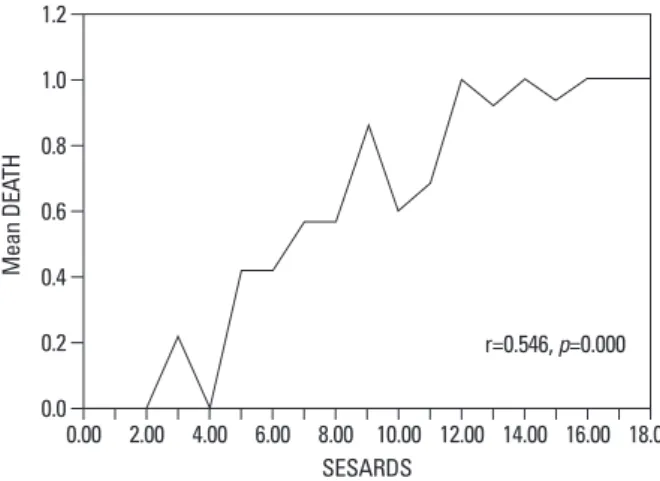
SESARDS was used to evaluate and score the cases studied from which actual mortalities were calculated. Finally, the SESARDS scores and the actual mortalities were com- pared, shown to be positively correlated (Table 10, Fig. 2).

Table 7. The SESARDS Severity of Disease Classification System

Variables 0 1 2 3 4 5 6 7

Age (yrs) ≤34 35-44 45-58 ≥59

pH ≥7.447 7.372-7.446 7.281-7.371 ≤7.280

GCS 15 ≤14

OI (mm Hg) ≥149.76 120.73-149.76 86.20-120.72 ≤86.19

Lobes of lung ≤2 3 4

GCS, Glasgow coma scale; OI, oxygenation index.

Table 8. Comparisons between SESARDS and APACHE II in Sensitivity, Specificity and Accuracy

Variables Sensitivity% Specificity% Accuracy% Kappa

SESARDS 96.43 58.33 81.52 0.585

APACHE II 67.86 91.67 77.17 0.554

SESARDS, simplified evaluation system of acute respiratory distress syndrome; APACHE, acute physiology and chronic health evaluation.

Table 9. The Reliabilities of SESARDS and APACHE II Via Lemshow-Hosmer Test

Variables χ

2

p value

SESARDS 8.543 0.382

APACHE II 13.369 0.100

SESARDS, simplified evaluation system of acute respiratory distress syn- drome; APACHE, acute physiology and chronic health evaluation.

Table 10. The Relationship between SESARDS Score and Actual Mortality

SESARDS score Actual mortality (%)

0-4 6.25

5-8 50.67

9-12 77.92

13-16 95.45

17-18 100

χ

2

=78.632 p=0.000

SESARDS, simplified evaluation system of acute respiratory distress syn- drome.

Fig. 1. ROC curves of SESARDS and APACHE II. ROC, receiver operating characteristics curves; SESARDS, simplified evaluation system of acute re- spiratory distress syndrome; APACHE, acute physiology and chronic health evaluation.

0.00 0.25 0.50 0.75 1.00

Se ns iti vit y

0.00 0.25 0.50 0.75 1.00

1-specificity ROC curve

Z=0.433 Source of the curve

Reference line

SESARDS

APACHE II

(6)

present. It is characterized by excellent performance in pre- dicting mortality in ARDS patients over lung injury score, focusing only on the severity of respiratory failure. APACHE II and SAPS II scores have been previously reported to be in- dependent predictors of hospital mortality in ARDS pa- tients.

9-12

According to Oh, et al.,

13

APACHE II score is close- ly related to mortality in patients in the Intensive Care Unit (r=0.81). However, APACHE II is obtained by dividing the aggregate sum by the number of components used, and the 14 components used in this system may make it more diffi- cult for doctors to use it clinically.

14

After development, we applied SESARDS to the valida- tion data set for evaluation of its reliability and validity in comparison to APACHE II, and found that there were no significant differences in accuracy in predicting ARDS inci- dence, nor sensitivity or specificity. Importantly, the AUC of the ROC for SESARDS was not different from that of APACHE II statistically. Moreover, it was found that there was no significant difference between the predictive results and the actual results when SESARDS was used on the val- idation data set, indicating that SESARDS was satisfactory in regards to goodness-of-fit. At last, our study provided ev- idence that SESARDS score was positively correlated with the actual mortality ratio. Moreover, SESARDS is relative- ly simpler than APACHE II (5 variables compared to 14).

It should be emphasized that in the first 24 hours SES- ARDS did not perfectly predict death rates in individual pa- tients. However, our data indicated that misclassification rates became smaller as the probability of death increased (Fig. 1).

Nevertheless, the specificity of SESARDS (58.33%) was un- satisfactory, though it is based on a larger number of samples, compared to several other ARDS-specific studies.

15,16

In conclusion, SESARDS was shown to be simple, accu- rate and effective in predicting ARDS progression.

REFERENCES

1. Luhr OR, Antonsen K, Karlsson M, Aardal S, Thorsteinsson A, Frostell CG, et al. Incidence and mortality after acute respiratory failure and acute respiratory distress syndrome in Sweden, Den- mark, and Iceland. The ARF Study Group. Am J Respir Crit Care

There were significant differences between the survival group and death group for both data sets, in view of SES- ARDS score (10.726±3.296 vs. 6.162±3.136)

Comparison between SESARDS and APACHE II (Table 11)

DISCUSSION

An effective prediction system can accurately predict chang- es in patients, but should consist of relatively simple vari- ables. This paper presents a newly developed SESARDS as well as the validation results thereof. As a severity of dis- ease classification system, SESARDS uses points based upon the initial values of age, pH, GCS, OI, and lobes of the lung. In this study, an increasing score (range 0 to 18) was shown to be closely related with subsequent risk of hos- pital death in ARDS. When SESARDS scores were evalu- ated for the ability to determine ARDS prognoses, the re- sults were strong and stable. Our data further indicated that classification could be made appropriately if done at an ear- ly point in time. This would allow for the severity classifi- cation to be more independent from treatment.

APACHE II, established by Knaus, et al.

8

in 1985, is one of the most widely used evaluation systems and also the most authoritative method for scoring critical illness at

Table 11. Comparison between SESARDS and APACHE II

System Variables AUC Lemeshow-Hosmer p value Accuracy (%)

SESARDS 5 0.884 0.382 81.52

APACHE II 14 0.861 0.100 77.17

SESARDS, simplified evaluation system of acute respiratory distress syndrome; APACHE, acute physiology and chronic health evaluation.

Fig. 2. The co-relationship line between SESARDS score and actual mortality.

SESARDS, simplified evaluation system of acute respiratory distress syn- drome.

0.0 0.2 0.4 0.6 0.8 1.0 1.2

M ea n DE AT H

0.00 2.00 4.00 6.00 8.00 10.00 12.00 14.00 16.00 18.00 SESARDS

r=0.546, p=0.000

(7)

10. Page B, Vieillard-Baron A, Beauchet A, Aegerter P, Prin S, Jardin F. Low stretch ventilation strategy in acute respiratory distress syndrome: eight years of clinical experience in a single center. Crit Care Med 2003;31:765-9.

11. Vieillard-Baron A, Girou E, Valente E, Brun-Buisson C, Jardin F, Lemaire F, et al. Predictors of mortality in acute respiratory dis- tress syndrome. Focus On the role of right heart catheterization.

Am J Respir Crit Care Med 2000;161:1597-601.

12. Brun-Buisson C, Minelli C, Bertolini G, Brazzi L, Pimentel J, Le- wandowski K, et al. Epidemiology and outcome of acute lung in- jury in European intensive care units. Results from the ALIVE study. Intensive Care Med 2004;30:51-61.

13. Oh TE, Hutchinson R, Short S, Buckley T, Lin E, Leung D. Veri- fication of the Acute Physiology and Chronic Health Evaluation scoring system in a Hong Kong intensive care unit. Crit Care Med 1993;21:698-705.

14. Knaus W, Wagner D, Draper E. APACHE III study design: analyt- ic plan for evaluation of severity and outcome in intensive care unit patients. Development of APACHE. Crit Care Med 1989;

17(12 Pt 2):S181-5.

15. Zilberberg MD, Epstein SK. Acute lung injury in the medical ICU: comorbid conditions, age, etiology, and hospital outcome.

Am J Respir Crit Care Med 1998;157(4 Pt 1):1159-64.

16. Doyle RL, Szaflarski N, Modin GW, Wiener-Kronish JP, Matthay MA. Identification of patients with acute lung injury. Predictors of mortality. Am J Respir Crit Care Med 1995;152(6 Pt 1):1818-24.

Med 1999;159:1849-61.

2. Qiu H, Chen D, Liu D. Investigation of acute respiratory distress syndrome: predictors of mortality and clinical therapeutic strate- gies. Chin Criti Care Med 1998;9:523.

3. Jiang X, Hu N. Chinese version of “critical illness scoring system”

computer software. Chin Criti Care Med 2000;4:246-7.

4. Heffner JE, Brown LK, Barbieri CA, Harpel KS, DeLeo J. Prospec- tive validation of an acute respiratory distress syndrome predictive score. Am J Respir Crit Care Med 1995;152(5 Pt 1):1518-26.

5. Bernard GR, Artigas A, Brigham KL, Carlet J, Falke K, Hudson L, et al. The American-European Consensus Conference on ARDS.

Definitions, mechanisms, relevant outcomes, and clinical trial co- ordination. Am J Respir Crit Care Med 1994;149(3 Pt 1):818-24.

6. Gattinoni L, Pelosi P, Suter PM, Pedoto A, Vercesi P, Lissoni A.

Acute respiratory distress syndrome caused by pulmonary and ex- trapulmonary disease. Different syndromes? Am J Respir Crit Care Med 1998;158:3-11.

7. Wang LD. Sort indicators, one of the methods to weigh the vari- ables. J Hubei Sports Sci (Chinese) 1993;4:51-4.

8. Knaus WA, Draper EA, Wagner DP, Zimmerman JE. APACHE II:

a severity of disease classification system. Crit Care Med 1985;

13:818-29.

9. Monchi M, Bellenfant F, Cariou A, Joly LM, Thebert D, Laurent I,

et al. Early predictive factors of survival in the acute respiratory

distress syndrome. A multivariate analysis. Am J Respir Crit Care

Med 1998;158:1076-81.

수치

Table 2. Results of Univariate Logistic Regression Analysis
Table 3. Factors Influencing ARDS Prognosis on Multivariate Logistic Regression Analysis
Table 7. The SESARDS Severity of Disease Classification System
Fig. 2. The co-relationship line between SESARDS score and actual mortality.

참조

관련 문서

An evaluation of marginal fit of three-unit fixed dental prostheses fabricated by direct metal laser sintering system.. Marginal accuracy and fracture strength

A clinical and radiographic evaluation of fixed partial dentures (FPDs) prepared by dental school students: a retrospective study.. A retrospective analysis

Factors affecting post-traumatic stress of general hospital nurses after the epidemic of Middle East respiratory syndrome infection: Journal of Korean Clinical

Based on the result of such assessment, this study attempted to establish a basis for establishment of physical epidemiology research evaluation system

Reference 7 contains a derivation (also by the Newtonian method) of a system of nonlinear equations for the elastic bending and rigid pitching motion of a cantilever rotor

- Apply finite control volume to get integral form of the continuity equation - Compare integral and point form equations.. - Derive the simplified equations

There are a lot of institutions for evaluation in the world, for example, Legislative Evaluation in the Continental Legal System, Regulatory Impact Analysis

Stimulates secretion of growth hormone Resistance to a wide variety of viruses Stimulates cell immune system. A bone-resorbing factor Sulfate