ABSTRACT
Background and Objectives: The Sapien 3 (S3) valve has not been compared to the Sapien XT (SXT) valve in Korea. We compared procedural and clinical outcomes between the 2 devices.
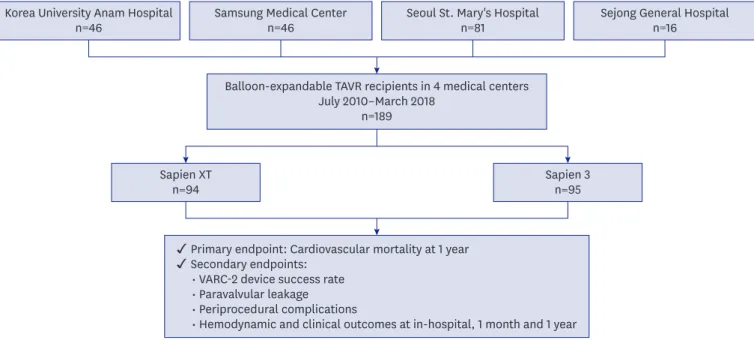
Methods: A total of 189 patients who underwent transcatheter aortic valve replacement (TAVR) with S3 (n=95) or SXT (n=94) valve was analyzed. The primary endpoint was cardiovascular mortality at 1 year. The median follow-up duration was 438 days.
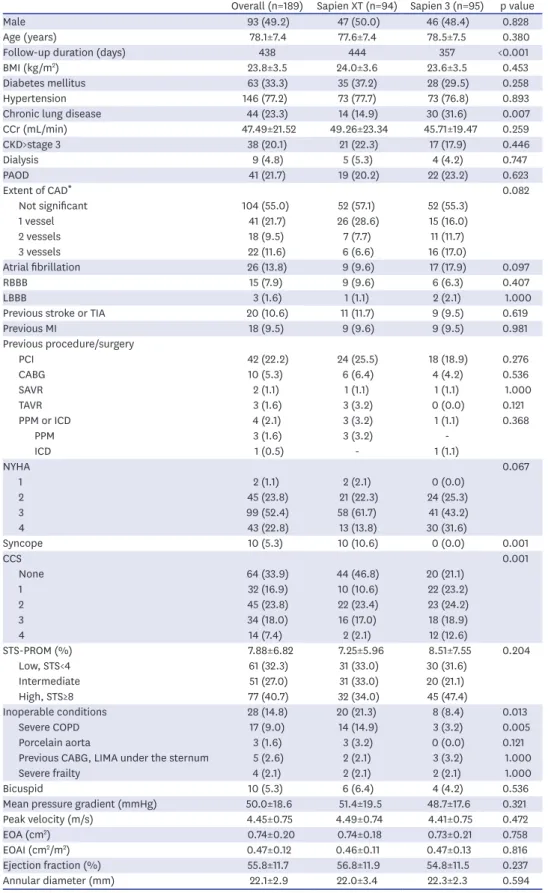
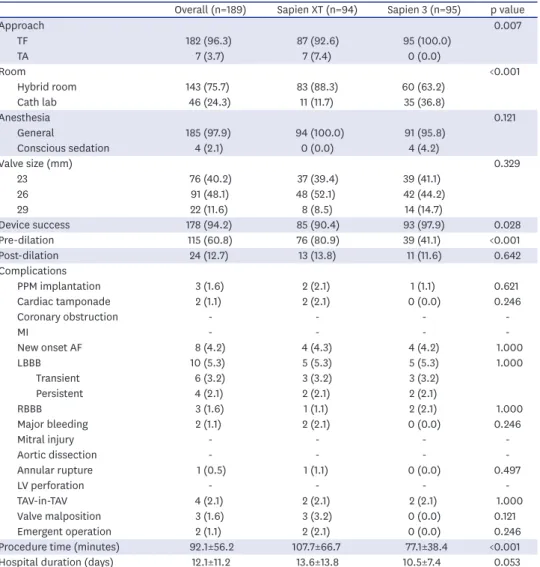
Results: The Society of Thoracic Surgeons score was similar between the 2 groups. The device success rate (90.4% vs. 97.9%; p=0.028) was higher in the S3 than in the SXT. The S3 showed significantly fewer cases of moderate or severe paravalvular leakage (PVL) (16.7% vs.
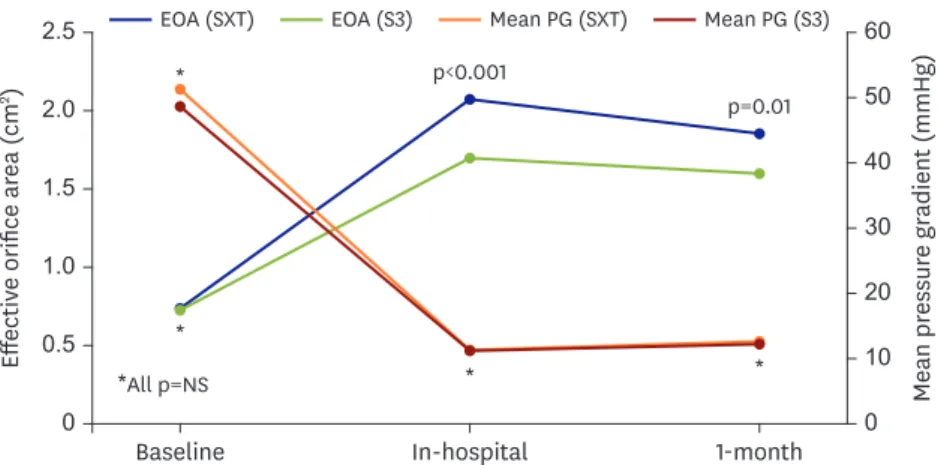
0.0%; p=0.001) than the SXT. However, effective orifice area (EOA) (2.07±0.61 vs. 1.70±0.49 cm
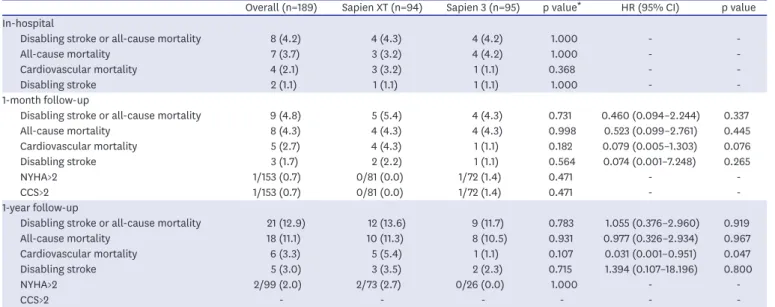
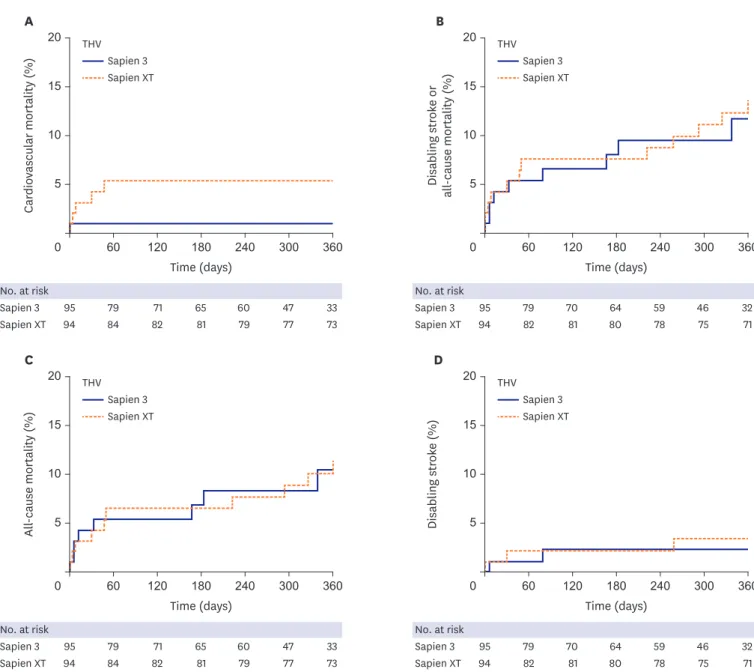
2; p<0.001) was smaller in the S3. Multivariable Cox regression analysis showed the S3 was associated with significantly fewer cardiovascular mortality at 1 year compared to the SXT (5.4% vs. 1.1%; hazard ratio, 0.031; 95% confidence interval, 0.001–0.951; p=0.047).
Periprocedural complication rates, composite of disabling stroke or all-cause mortality, all- cause mortality, and disabling stroke at 1 year were similar between the 2 groups.
Conclusions: Cardiovascular mortality was lower in the S3 group than in the SXT group over 1 year of follow-up. The reduction in PVL was attributed to the higher device success rate of TAVR with the S3 valve. However, the benefit of S3 obtained at the expense of reduced EOA should be meticulously re-evaluated in larger studies during long-term follow-up.
Keywords: Transcatheter aortic valve replacement; Aortic valve stenosis
Original Article
Received: Feb 12, 2020 Revised: Jun 5, 2020 Accepted: Jul 6, 2020 Correspondence to Cheol Woong Yu, MD
Division of Cardiology, Department of Internal Medicine, Korea University Anam Hospital, Korea University College of Medicine, 73, Goryeodae-ro, Seongbuk-gu, Seoul 02841, Korea.
E-mail: [email protected] Kiyuk Chang, MD
Division of Cardiology, Department of Internal Medicine, Seoul St. Mary's Hospital, College of Medicine, The Catholic University of Korea, 222 Banpo-daero, Seocho-gu, Seoul 06591, Korea.
E-mail: [email protected]
*Hyungdon Kook and Duck Hyun Jang equally attributed to this article.
Copyright © 2020. The Korean Society of Cardiology
This is an Open Access article distributed under the terms of the Creative Commons Attribution Non-Commercial License (https://
creativecommons.org/licenses/by-nc/4.0) which permits unrestricted noncommercial use, distribution, and reproduction in any medium, provided the original work is properly cited.
ORCID iDs Hyungdon Kook
https://orcid.org/0000-0003-1440-0462 Duck Hyun Jang
https://orcid.org/0000-0003-3542-8720 Kyung-Sook Yang
https://orcid.org/0000-0002-3960-6072
Hyungdon Kook , MD
1,*, Duck Hyun Jang , MD
2,*, Kyung-Sook Yang , PhD
3, Hyung Joon Joo , MD
1, Jae Hyoung Park , MD
1, Soon Jun Hong , MD
1, Do-Sun Lim , MD
1, Seung-Hyuk Choi , MD
4, Young Jin Choi, MD
5, Kiyuk Chang , MD
6, and Cheol Woong Yu , MD
11
Division of Cardiology, Department of Internal Medicine, Korea University Anam Hospital, Korea University College of Medicine, Seoul, Korea
2
Division of Cardiology, Department of Internal Medicine, Yuseong Sun Hospital, Daejeon, Korea
3
Department of Biostatistics, Korea University College of Medicine, Seoul, Korea
4
Division of Cardiology, Department of Internal Medicine, Samsung Medical Center, Sungkyunkwan University College of Medicine, Seoul, Korea
5
Division of Cardiology, Department of Internal Medicine, Sejong Heart Institute, Sejong General Hospital, Bucheon, Korea
6