ABSTRACT
Background and Objectives: There has been no nation-wide data on the outcomes of transcatheter aortic valve implantation (TAVI) after commercialization of TAVI in Korea. We report clinical features and outcomes of the first cohort of TAVI performed from Jun 2015 to Jun 2017 in Korea.
Methods: The first cohort of Korean-TAVI (K-TAVI) registry includes 576 consecutive patients with severe symptomatic aortic stenosis who underwent TAVI from 17 Korean hospitals for 2 years.
Results: Most of TAVI procedures were performed for septuagenarians and octogenarians (90.8%) through transfemoral approach (98.3%). The rate of device success was 92.5% and permanent pacemaker was implanted in 5.6%. In successive years, incidences of paravalvular leakage (PVL) and major bleeding declined. Society of Thoracic Surgeons (STS) score was 5.2 (3.0 to 9.0) and 34.7% of patients had high surgical risk (STS ≥8). One-year all-cause death occurred in 8.9% and was significantly lower in low to intermediate risk one than in high risk (5.4% vs. 15.5%, p<0.001). The independent predictors of 1-year mortality were age (hazard ratio [HR], 1.087;
95% confidence interval [CI], 1.036–1.141; p=0.001), moderate or severe PVL (HR, 4.631; 95% CI, 1.624–13.203; p=0.004) and end-stage renal disease (HR, 5.785; 95% CI, 2.717–12.316; p<0.001).
Conclusions: K-TAVI registry showed favorable 1-year outcomes with decreasing complication rate over time in real-world Korean patients. Two-thirds of patients were low to intermediate surgical risk and showed a significantly lower mortality than the high-risk patients, suggesting the promising future on the expanded indications of TAVI.
Keywords: Aortic valve stenosis; Transcatheter aortic valve replacement; Mortality; Koreans
Original Article
Cheol Woong Yu , MD, PhD1,*, Won-Jang Kim , MD, PhD2,*, Jung-Min Ahn , MD3,*, Hyungdon Kook , MD1, Se Hun Kang , MD2, Jung-Kyu Han , MD, PhD4,
Young-Guk Ko , MD, PhD5, Seung-Hyuk Choi , MD, PhD6,
Bon-Kwon Koo , MD, PhD4, Kiyuk Chang , MD, PhD7, and Hyo-Soo Kim , MD, PhD4
1 Department of Cardiology, Korea University Anam Hospital, Department of Internal Medicine, Korea University College of Medicine, Seoul, Korea
2 Department of Cardiology, CHA Bundang Medical Center, Department of Internal Medicine, CHA University School of Medicine, Seongnam, Korea
3 Department of Cardiology, Asan Medical Center, Department of Internal Medicine, University of Ulsan College of Medicine, Seoul, Korea
4 Department of Cardiology, Seoul National University Hospital, Department of Internal Medicine, Seoul National University College of Medicine, Seoul, Korea
5 Department of Cardiology, Severance Hospital, Department of Internal Medicine, Yonsei University College of Medicine, Seoul, Korea
6 Department of Cardiology, Samsung Medical Center, Department of Internal Medicine, Sungkyunkwan University School of Medicine, Seoul, Korea
7 Department of Cardiology, Seoul St. Mary's Hospital, Department of Internal Medicine, The Catholic University of Korea School of Medicine, Seoul, Korea
Trends and Outcomes of Transcatheter Aortic Valve Implantation (TAVI) in
Korea: the Results of the First Cohort of Korean TAVI Registry
Received: Apr 9, 2018 Revised: Apr 12, 2018 Accepted: Apr 14, 2018 Correspondence to Hyo-Soo Kim, MD, PhD
Department of Internal Medicine, Seoul National University Hospital, 101, Daehak-ro, Jongno-gu, Seoul 03080, Korea.
E-mail: [email protected] Kiyuk Chang, MD, PhD
Seoul St. Mary's Hospital, The Catholic University of Korea School of Medicine, 222 Banpo-daero, Seocho-gu, Seoul, Korea.
E-mail: [email protected]
*First 3 authors equally contributed to this article.
Copyright © 2018. The Korean Society of Cardiology
This is an Open Access article distributed under the terms of the Creative Commons Attribution Non-Commercial License (https://
creativecommons.org/licenses/by-nc/4.0) which permits unrestricted noncommercial use, distribution, and reproduction in any medium, provided the original work is properly cited.
ORCID iDs Cheol Woong Yu
https://orcid.org/0000-0002-5871-4562 Won-Jang Kim
https://orcid.org/0000-0002-9915-3722 Jung-Min Ahn
https://orcid.org/0000-0003-4031-391X Hyungdon Kook
https://orcid.org/0000-0003-1440-0462 Se Hun Kang
https://orcid.org/0000-0001-5876-1791
Jung-Kyu Han
https://orcid.org/0000-0002-0016-0747 Young-Guk Ko
https://orcid.org/0000-0001-6245-9544 Seung-Hyuk Choi
https://orcid.org/0000-0001-6716-4884 Bon-Kwon Koo
https://orcid.org/0000-0002-8188-3348 Kiyuk Chang
https://orcid.org/0000-0003-3456-8705 Hyo-Soo Kim
https://orcid.org/0000-0003-2977-6323 Conflict of Interest
The authors have no financial conflicts of interest.
Author Contributions
Conceptualization: Choi SH, Koo BK, Kim HS; Data curation: Yu CW, Ahn JM, Kang SH, Chang K, Kim HS; Formal analysis: Han JK;
Investigation: Ahn JM, Chang K; Methodology:
Han JK, Choi SH; Project administration:
Chang K; Supervision: Ko YG, Koo BK;
Validation: Kim WJ, Ko YG; Writing - original draft: Kim WJ, Kook H, Kang SH; Writing - review & editing: Yu CW, Koo BK, Kim HS.
INTRODUCTION
Transcatheter aortic valve implantation (TAVI) has become a valid option for patients with severe symptomatic aortic stenosis (AS) who are in inoperable condition or at intermediate or high-risk for conventional surgical aortic valve (AV) replacement.1-4) TAVI was first introduced into Korea in March 2010. Thereafter, the Korean Food and Drug Administration (KFDA) approved use of a device for TAVI, with Medtronic CoreValve in November 2011 and Edwards Sapien XT valve in April 2012 for the treatment of severe, symptomatic AS. The TAVI procedure is now being performed in 26 hospitals in Korea. Although several randomized controlled trials including Placement of Aortic Transcatheter Valves (PARTNER), PARTNER 2 and Surgical Replacement and Transcatheter (SURTAVI) trial demonstrated efficacy and safety of TAVI within a selected cohort of patients and hospitals, there have been no large-scale reports on the clinical outcomes of TAVI after marketing approval in Korea.1-4) The multicenter Korean- TAVI (K-TAVI) registry aims to investigate the outcomes of this emerging therapy in real-world clinical practice in Korea. Here we report the results of the first cohort of K-TAVI registry that is enrolled during June 2015 and June 2017, and analyzed the 1-year mortality and other clinical outcomes in overall and subgroups depending on the surgical risk.
METHODS
The first cohort of K-TAVI registry
The first cohort of K-TAVI registry is a retrospective registry that enrolls consecutive patients undergoing TAVI at 17 participating hospitals in Korea for 24 months during June 2015 and June 2017. The registry complies with the Declaration of Helsinki, and the relevant review boards at all participating hospitals approved the study protocol (approval number: SNU IRB 1706-150-863). All patients underwent TAVI were requested to be enrolled in this nation-wide K-TAVI registry.
The current study population consisted of 576 patients who had severe AS and underwent TAVI using the Sapien XT or Sapien 3 balloon-expandable valves (Edwards Lifesciences, Irvine, CA, USA), CoreValve or Evolut R self-expandable valve (Medtronic, Seoul, Korea), and Lotus valve (Boston Scientific, Marlborough, MA, USA) via transfemoral (TF) or transapical (TA) approach between Jun 1, 2015 and Jun 30, 2017. Participating centers have collected clinical information on patient demographics, comorbidities, functional status, hemodynamics, procedural details, and in-hospital, 30-day, and 1-year outcomes. Data quality checks were implemented at the steering committee meeting of K-TAVI registry, including data quality feedback reports and data range and consistency checks. If the patients did not visit the clinic, the attending physician contacted the patient and/or family members by telephone.
Patient selection for TAVI
Consecutive patients who underwent TAVI for severe symptomatic AS during June 2015 and June 2017 were included in this study. Patient eligibility for a TAVI procedure was decided in each center by a multidisciplinary team composed of interventional cardiologists, imaging cardiologists, cardiothoracic surgeons, radiologists and anesthesiologists. General criteria for severe AS included a mean gradient ≥40 mmHg, jet velocity ≥4.0 m/s, effective orifice area ≤1.0 cm2, or effective orifice area index ≤0.8cm2/m2. Valve annulus size was measured using both computed tomography (CT) and echocardiography. All patients underwent a
pre-procedural CT scan. Vascular access and pre-procedural balloon aortic valvuloplasty (BAV) were determined per site protocol. Access site was chosen prior to the procedure, in a step-wise manner based on anatomical considerations such as the angle of the aortic root, vessel diameter, and aortic calcification severity. Iliofemoral access was considered as the first option for all available patients. The local heart team of each institution evaluated each patient's preoperative data and selected patients for whom TAVI was deemed to be the best treatment option.
TAVI procedure
The TAVI procedures were conducted in a hybrid operating room or conventional catheterization laboratory room under general anesthesia or conscious sedation, with transesophageal echocardiography or bed side transthoracic echocardiography.
Premedication with aspirin (100 mg) and clopidogrel (75 mg) was administered unless particular contraindications exist. In a TF approach, a 14–20 Fr sheath was inserted into the femoral artery by puncture. In case of TA approach, a 16–20 Fr sheath was inserted in the left ventricular (LV) apex through a minimal left anterior thoracotomy. BAV was performed under rapid ventricular pacing when needed. Dual antiplatelet therapy (aspirin 100 mg and clopidogrel 75 mg) was usually administered for at least 6 months after the procedure.
Definitions and outcome measures
Device success was defined as: 1) successful vascular access, delivery, and deployment of the device, and successful retrieval of the delivery system; 2) correct position of the device in the proper anatomical location (placement in the annulus with no impedance on device function);(3) intended performance of the prosthetic valve without moderate or severe paravalvular leakage (PVL) assessed by echocardiography; and 4) only 1 valve implanted in a proper anatomical location.5-7) Procedural success was defined as device success with the absence of an in-hospital major adverse cardiovascular and cerebrovascular event (MACCE).
Procedure time was defined as time elapsed from the first vascular puncture or skin incision to final closure.
Primary outcome of the present study was death from any cause. The secondary outcomes were death from cardiac cause, death from non-cardiac cause, stroke, disabling stroke, major bleeding, and composite of death from any cause and disabling stroke. Death was considered cardiac unless an unequivocal non-cardiac cause could be established. Stroke, as indicated by neurological deficits, was confirmed by a neurologist on the basis of imaging modalities.
A disabling stroke is defined as a stroke with symptoms that last for more than 24 hours, leaving permanent disability. Major bleeding was defined according to the Valve Academic Research Consortium (VARC)-2 bleeding classification.6) All clinical events were based on clinical diagnoses assigned by the treating physician and centrally adjudicated according to the source documentation by an independent group of clinicians.
Statistical analysis
Categorical variables are presented as numbers and percentages and compared with the χ2 test or Fisher's exact test. Continuous variables are presented as mean±standard deviation and compared using Student's t-test or the Wilcoxon rank sum test. To assess whether there was any trend in the occurrence of complications by the year of operation, a χ2 test for trend was performed. Time-to-event data analysis was performed with the Cox proportional hazards model. Kaplan-Meier survival curves were drawn to assess differences between groups for the time to an event. A stepwise option was used to determine independent
predictors of the outcome variables. All tests were 2-tailed at the p-value of less than 0.05 as significance. All statistical analyses were conducted using the R statistical computing environment ver. 3.3.2 (R Development Core Team, Vienna, Austria) and the Statistical Package for Social Sciences, version 22 (IBM Corporation, Armonk, NY, USA).
RESULTS
The first cohort of K-TAVI
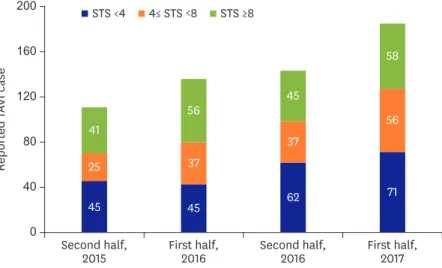
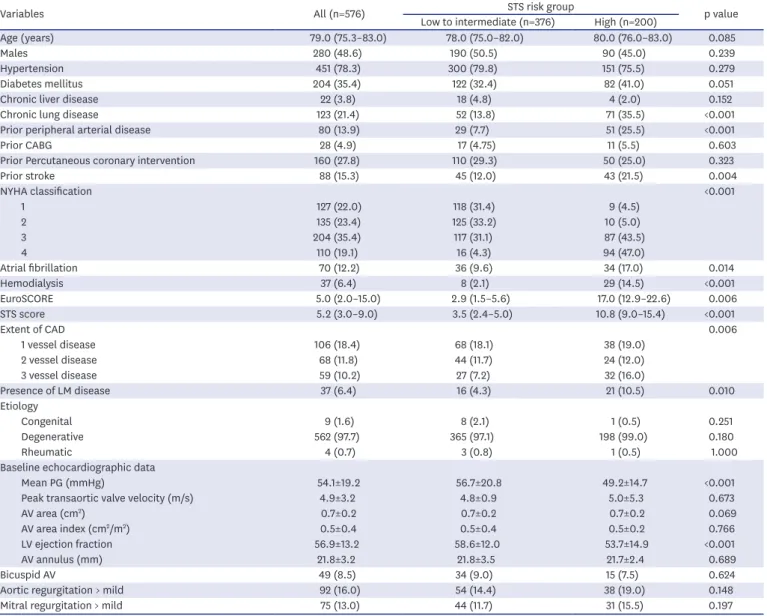
Total 576 TAVI cases were enrolled in the first cohort of K-TAVI registry and the case number increased throughout 2 years between June 2015 and June 2017 (Figure 1). Most of the TAVI procedures were done for septuagenarians and octogenarians (90.8%) and the median age was 79 years (Table 1). Median Society of Thoracic Surgeons (STS) predicted risk of mortality was 5.2 (3.0 to 9.0) and 144 patients (34.7%) had high surgical risk (STS ≥8). Mean effective orifice area of AV were 0.69±0.18 cm2 with mean pressure gradient (PG) of 54.0±19.2 mmHg.
AV morphology of bicuspid was 8.5% (n=49) (Table 1).
Procedural characteristics
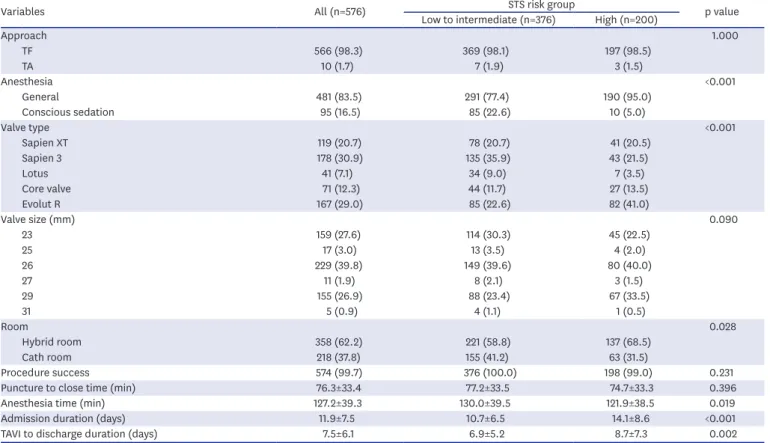
Most TAVI procedures were performed by the TF route (98.3%) and a total of 358 procedures (62.2%) were performed in hybrid rooms. The mean procedure time was 76.3±33.4 minutes and 83.5% of total procedures were performed under general anesthesia and (Table 2).
Patients with high-risk associated with longer duration whole hospitalization and longer hospital stay after TAVI (Table 2). Device success for TAVI was achieved in 533 cases (92.5%).
Seven cases required additional transcatheter heart valve implantation during the procedure.
Two cases were converted to open-heart surgery due to aortic dissection and LV perforation.
In-hospital and 30-day outcomes
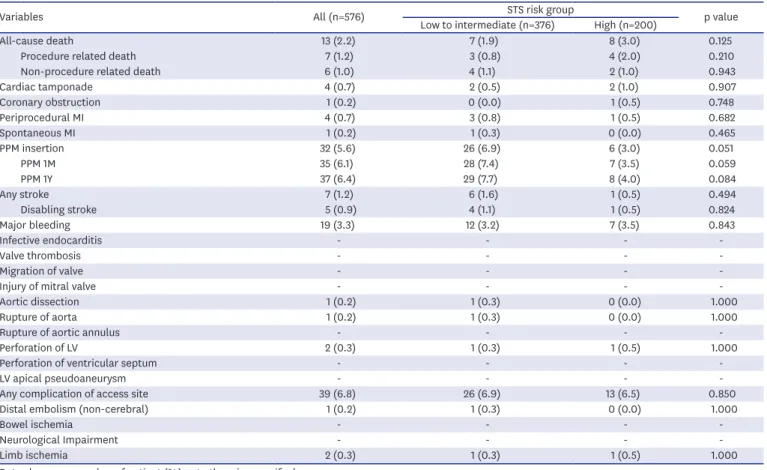
Ninety-eight percent of patients (n=563) were discharged alive (Table 3). There was no difference in the incidence of in-hospital complications between the high surgical risk group and the others. There were 19 cases of VARC major bleeding (3.3%), 7 cases of stroke (1.2%), 5 cases of myocardial infarction (0.9%) and 4 cases of cardiac tamponade (0.7%). Permanent pacemaker (PPM) was implanted in 5.6%. Major bleeding was significantly decreased in the
0 40 160
120
80 200
Reported TAVI case
Second half,
2015 First half,
2016 Second half,
2016 First half, 2017 45
25 41
45 37 56
62 37 45
71 56 58 STS ≥8
4≤ STS <8 STS <4
Figure 1. Reported TAVI cases over time in Korea.
STS = Society of Thoracic Surgeons; TAVI = transcatheter aortic valve implantation.
second year compared with the first year (5.7% vs. 1.5%; p=0.006). Among 567 patients with available in-hospital echocardiographic follow-up data, moderate or severe PVL at discharge was observed in 6.0% with no significant differences between the first and the second year.
Mean duration of hospitalization was 11.9±7.5 days with a trend of shortening over time (12.6±7.7 days vs. 11.4±7.2 days; p=0.060).
Among 532 patients who completed 30-day clinical follow-up, the incidences of all-cause death and the composite of all-cause death or disabling stroke were 2.6% and 3.5%, respectively (Table 4). The incidence of New York Heart Association (NYHA) class III or IV dyspnea 30-day after TAVI was only 0.6% (n=3). Among 399 patients with available 30-day echocardiographic follow-up data, moderate or severe PVL was observed in 6.0%. This incidence of moderate or severe PVL was significantly decreased in the second year (8.6% vs 3.7%; p=0.040).
Table 1. Baseline clinical and echocardiographic characteristics depending on the surgical risk profiles
Variables All (n=576) Low to intermediate (n=376)STS risk group High (n=200) p value
Age (years) 79.0 (75.3–83.0) 78.0 (75.0–82.0) 80.0 (76.0–83.0) 0.085
Males 280 (48.6) 190 (50.5) 90 (45.0) 0.239
Hypertension 451 (78.3) 300 (79.8) 151 (75.5) 0.279
Diabetes mellitus 204 (35.4) 122 (32.4) 82 (41.0) 0.051
Chronic liver disease 22 (3.8) 18 (4.8) 4 (2.0) 0.152
Chronic lung disease 123 (21.4) 52 (13.8) 71 (35.5) <0.001
Prior peripheral arterial disease 80 (13.9) 29 (7.7) 51 (25.5) <0.001
Prior CABG 28 (4.9) 17 (4.75) 11 (5.5) 0.603
Prior Percutaneous coronary intervention 160 (27.8) 110 (29.3) 50 (25.0) 0.323
Prior stroke 88 (15.3) 45 (12.0) 43 (21.5) 0.004
NYHA classification <0.001
1 127 (22.0) 118 (31.4) 9 (4.5)
2 135 (23.4) 125 (33.2) 10 (5.0)
3 204 (35.4) 117 (31.1) 87 (43.5)
4 110 (19.1) 16 (4.3) 94 (47.0)
Atrial fibrillation 70 (12.2) 36 (9.6) 34 (17.0) 0.014
Hemodialysis 37 (6.4) 8 (2.1) 29 (14.5) <0.001
EuroSCORE 5.0 (2.0–15.0) 2.9 (1.5–5.6) 17.0 (12.9–22.6) 0.006
STS score 5.2 (3.0–9.0) 3.5 (2.4–5.0) 10.8 (9.0–15.4) <0.001
Extent of CAD 0.006
1 vessel disease 106 (18.4) 68 (18.1) 38 (19.0)
2 vessel disease 68 (11.8) 44 (11.7) 24 (12.0)
3 vessel disease 59 (10.2) 27 (7.2) 32 (16.0)
Presence of LM disease 37 (6.4) 16 (4.3) 21 (10.5) 0.010
Etiology
Congenital 9 (1.6) 8 (2.1) 1 (0.5) 0.251
Degenerative 562 (97.7) 365 (97.1) 198 (99.0) 0.180
Rheumatic 4 (0.7) 3 (0.8) 1 (0.5) 1.000
Baseline echocardiographic data
Mean PG (mmHg) 54.1±19.2 56.7±20.8 49.2±14.7 <0.001
Peak transaortic valve velocity (m/s) 4.9±3.2 4.8±0.9 5.0±5.3 0.673
AV area (cm2) 0.7±0.2 0.7±0.2 0.7±0.2 0.069
AV area index (cm2/m2) 0.5±0.4 0.5±0.4 0.5±0.2 0.766
LV ejection fraction 56.9±13.2 58.6±12.0 53.7±14.9 <0.001
AV annulus (mm) 21.8±3.2 21.8±3.5 21.7±2.4 0.689
Bicuspid AV 49 (8.5) 34 (9.0) 15 (7.5) 0.624
Aortic regurgitation > mild 92 (16.0) 54 (14.4) 38 (19.0) 0.148
Mitral regurgitation > mild 75 (13.0) 44 (11.7) 31 (15.5) 0.197
Data shown are median (IQR), mean±standard deviation, or number of patient (%).
AV = aortic valve; CABG = coronary artery bypass graft; CAD = coronary artery disease; EuroSCORE = European System for Cardiac Operative Risk Evaluation; IQR
= interquartile range; LM = left main; LV = left ventricular; NYHA = New York Heart Association; PG = pressure gradient; STS, Society of Thoracic Surgeons.
One-year outcomes depending on the surgical risk profiles Overall patient
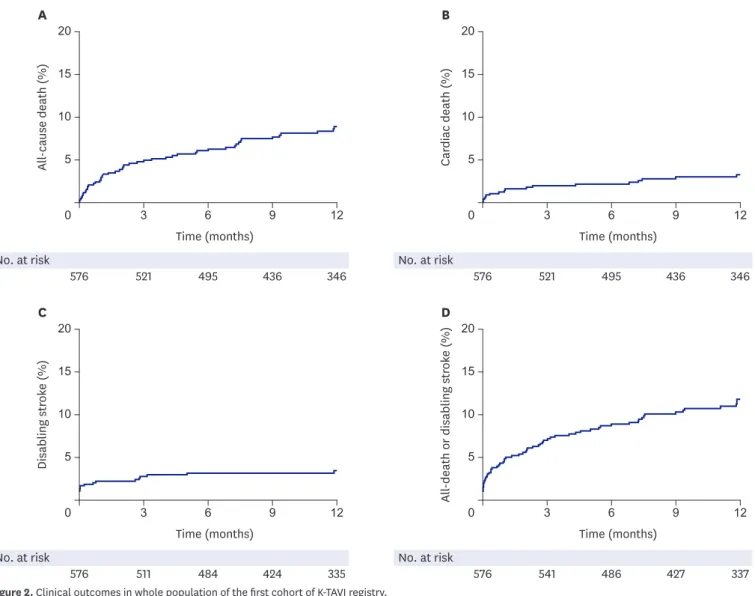
All-cause death occurred in 8.9% and cardiovascular death, in 3.3%. The cumulative incidence of the composite of all-cause death or disabling stroke was 10.8% (Figure 2 and Table 4). There was no difference in the risk of all-cause death or disabling stroke at 1-year between bicuspid and tricuspid AV (Supplementary Figure 1). In 192 patients who completed transthoracic echocardiography follow-up to 1 year, only 9.9% of patients had moderate or severe PVL (Figure 3A). Echocardiographic parameters regarding mean PG and effective orifice area were well maintained up to 1 year (Figure 3B). Cox multivariate analysis showed age (hazard ratio [HR], 1.087; 95% confidence interval [CI], 1.036–1.141; p=0.001), moderate or severe PVL (HR, 4.631; 95% CI, 1.624–13.203; p=0.004) and ESRD (HR, 5.785; 95% CI, 2.717–12.316; p<0.001) were the main contributors for all-cause death at 1 year.
STS scores and outcomes
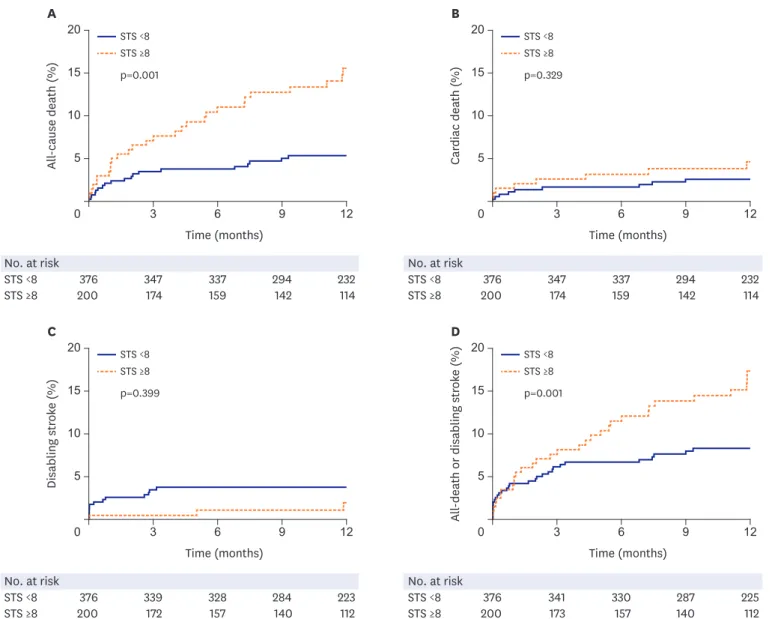
We analyzed the 1-year clinical outcomes depending on the surgical risk profiles, high-risk versus low to intermediate risk group (Table 4 and Figure 4). Total mortality at 1 year was significantly better in low to intermediate surgical risk group than high-risk one (5.4% vs.
15.5%, p<0.001). Cardiovascular death was also numerically lower in low to intermediate risk group than high-risk one, which did not reach statistical significance. Mortality differences emerged early after the procedure and maintained in follow-up period up to 1 year.
Table 2. Procedural characteristics in subgroups depending on the surgical risk profiles
Variables All (n=576) Low to intermediate (n=376)STS risk group High (n=200) p value
Approach 1.000
TF 566 (98.3) 369 (98.1) 197 (98.5)
TA 10 (1.7) 7 (1.9) 3 (1.5)
Anesthesia <0.001
General 481 (83.5) 291 (77.4) 190 (95.0)
Conscious sedation 95 (16.5) 85 (22.6) 10 (5.0)
Valve type <0.001
Sapien XT 119 (20.7) 78 (20.7) 41 (20.5)
Sapien 3 178 (30.9) 135 (35.9) 43 (21.5)
Lotus 41 (7.1) 34 (9.0) 7 (3.5)
Core valve 71 (12.3) 44 (11.7) 27 (13.5)
Evolut R 167 (29.0) 85 (22.6) 82 (41.0)
Valve size (mm) 0.090
23 159 (27.6) 114 (30.3) 45 (22.5)
25 17 (3.0) 13 (3.5) 4 (2.0)
26 229 (39.8) 149 (39.6) 80 (40.0)
27 11 (1.9) 8 (2.1) 3 (1.5)
29 155 (26.9) 88 (23.4) 67 (33.5)
31 5 (0.9) 4 (1.1) 1 (0.5)
Room 0.028
Hybrid room 358 (62.2) 221 (58.8) 137 (68.5)
Cath room 218 (37.8) 155 (41.2) 63 (31.5)
Procedure success 574 (99.7) 376 (100.0) 198 (99.0) 0.231
Puncture to close time (min) 76.3±33.4 77.2±33.5 74.7±33.3 0.396
Anesthesia time (min) 127.2±39.3 130.0±39.5 121.9±38.5 0.019
Admission duration (days) 11.9±7.5 10.7±6.5 14.1±8.6 <0.001
TAVI to discharge duration (days) 7.5±6.1 6.9±5.2 8.7±7.3 0.002
Data shown are number of patient (%) or mean±standard deviation.
STS = Society of Thoracic Surgeons; TA = transapical; TAVI = transcatheter aortic valve implantation; TF = transfemoral.
Table 3. Procedural complications and in-hospital outcomes depending on the surgical risk profiles
Variables All (n=576) Low to intermediate (n=376)STS risk group High (n=200) p value
All-cause death 13 (2.2) 7 (1.9) 8 (3.0) 0.125
Procedure related death 7 (1.2) 3 (0.8) 4 (2.0) 0.210
Non-procedure related death 6 (1.0) 4 (1.1) 2 (1.0) 0.943
Cardiac tamponade 4 (0.7) 2 (0.5) 2 (1.0) 0.907
Coronary obstruction 1 (0.2) 0 (0.0) 1 (0.5) 0.748
Periprocedural MI 4 (0.7) 3 (0.8) 1 (0.5) 0.682
Spontaneous MI 1 (0.2) 1 (0.3) 0 (0.0) 0.465
PPM insertion 32 (5.6) 26 (6.9) 6 (3.0) 0.051
PPM 1M 35 (6.1) 28 (7.4) 7 (3.5) 0.059
PPM 1Y 37 (6.4) 29 (7.7) 8 (4.0) 0.084
Any stroke 7 (1.2) 6 (1.6) 1 (0.5) 0.494
Disabling stroke 5 (0.9) 4 (1.1) 1 (0.5) 0.824
Major bleeding 19 (3.3) 12 (3.2) 7 (3.5) 0.843
Infective endocarditis - - - -
Valve thrombosis - - - -
Migration of valve - - - -
Injury of mitral valve - - - -
Aortic dissection 1 (0.2) 1 (0.3) 0 (0.0) 1.000
Rupture of aorta 1 (0.2) 1 (0.3) 0 (0.0) 1.000
Rupture of aortic annulus - - - -
Perforation of LV 2 (0.3) 1 (0.3) 1 (0.5) 1.000
Perforation of ventricular septum - - - -
LV apical pseudoaneurysm - - - -
Any complication of access site 39 (6.8) 26 (6.9) 13 (6.5) 0.850
Distal embolism (non-cerebral) 1 (0.2) 1 (0.3) 0 (0.0) 1.000
Bowel ischemia - - - -
Neurological Impairment - - - -
Limb ischemia 2 (0.3) 1 (0.3) 1 (0.5) 1.000
Data shown are number of patient (%) not otherwise specified.
LV = left ventricular; MI = myocardial infarction; PPM = permanent pacemaker; STS = Society of Thoracic Surgeons.
Table 4. Clinical outcomes at 1-month and 1-year depending on the surgical risk profiles
Variables All patients
(n=576) Low to intermediate (n=376) High (n=200)STS risk group p value* HR (95% CI) p value 1-month follow-up
All-cause death 15 (2.6) 8 (2.1) 7 (3.5) 0.324 1.22 (0.43–3.48) 0.706
Cardiac death 7 (1.2) 3 (1.1) 4 (1.5) 0.211 1.06 (0.93–1.22) 0.510
Non-cardiac death 8 (1.4) 5 (1.1) 3 (2.1) 0.859 0.88 (0.20–3.82) 0.863
Stroke 9 (1.6) 8 (2.2) 1 (0.5) 0.137 0.20 (0.02–1.69) 0.140
Disabling stroke 7 (1.2) 6 (1.6) 1 (0.5) 0.256 0.24 (0.03–2.22) 0.210
Bleeding, major 18 (3.1) 12 (3.2) 6 (3.0) 0.906 0.79 (0.28–2.19) 0.648
All-cause death or disabling stroke 20 (3.5) 12 (3.2) 8 (4.0) 0.614 0.96 (0.38–2.43) 0.931
1-year follow-up
All-cause death 47 (8.9) 19 (5.4) 28 (15.5) <0.001 2.51 (1.37–4.63) 0.003
Cardiac death 17 (3.3) 9 (2.6) 8 (4.6) 0.249 1.12 (0.44–3.28) 0.727
Non-cardiac death 30 (5.8) 10 (2.9) 20 (11.5) <0.001 3.94 (1.79–8.67) 0.001
Stroke 17 (3.2) 13 (3.6) 4 (2.5) 0.355 0.57 (0.18–1.80) 0.340
Disabling stroke 13 (2.2) 10 (2.8) 3 (2.0) 0.399 0.53 (0.14–2.01) 0.349
Bleeding, major 20 (3.6) 13 (3.5) 7 (3.8) 0.972 0.82 (0.31–2.18) 0.695
All-cause death or disabling stroke 57 (10.8) 26 (7.3) 31 (17.3) 0.001 2.12 (1.23–3.64) 0.007
Data shown are number of patient (%) not otherwise specified. Adjustment variables include age, sex, atrial fibrillation, bicuspid aortic valve, diabetes mellitus, hypertension, extent of coronary artery disease, and presence of left main disease.
CI = confidence interval; HR = hazard ratio; STS = Society of Thoracic Surgeons.
*Events rates were estimated with the use of Kaplan-Meier estimates and p value was derived from the log-rank test.
The reasons for TAVI in patients with low STS score and age <75
Table 5 summarizes the causes of TAVI in patients with low surgical risk and age less than 75 years. Among total 60 patients, 32% have several comorbid conditions unfavorable to surgery while 68% refused surgery. Half of them received heart-team agreement while the other half did not.
DISCUSSION
The major findings of this study were as follows. In the first cohort of K-TAVI registry between June 2015 and June 2017, total number of TAVI was growing during study period. In-hospital, 1-month, and 1-year all-cause mortality were low, which was comparable or better than other studies. The 65% of TAVI procedures are performed in low to intermediate surgical risk population. The 1-year mortality was significantly better in the low to intermediate risk patients than the high-risk ones.
Time (months) A
10
5
0 3 6 9 12
All-cause death (%)
15 20
Time (months) B
10
5
0 3 6 9 12
Cardiac death (%)
15 20
576 521 495 436 346 576 521 495 436 346
No. at risk No. at risk
Time (months) C
10
5
0 3 6 9 12
Disabling stroke (%) 15 20
Time (months) D
10
5
0 3 6 9 12
All-death or disabling stroke (%)
15 20
576 511 484 424 335 576 541 486 427 337
No. at risk No. at risk
Figure 2. Clinical outcomes in whole population of the first cohort of K-TAVI registry.
K-TAVI = Koran-transcatheter aortic valve implantation.
In this manuscript, we presented the result of the first cohort of K-TAVI program. In-hospital and 30-days all-cause death in our study were 2.3% and 2.6%, respectively. It was comparable with those in other reported registries.8-10) All-cause death and disabling stroke rate at 1-year was lower than those in other literatures.8-10)
In K-TAVI registry, the rate of peri-procedural complication was very low and VARC major bleeding was significantly decreased in the second year of study period. Introduction of a low-profile sheath and pre-procedural screening systems using multidetector CT can be the important contributing factors to these favorable outcomes. It is interesting to note that the rate of PPM implantation was only 5.6%. This may be due to the adequate device selection, meticulous procedure, high threshold for pacemaker implantation, relatively longer hospital stays, and low rate of pre-existing conduction disturbance. The association between post-procedural PVL and long-term prognosis has been widely reported. Our result
0 20 80
60
40 100
%
Discharge A
1 month 1 year
59.9 30.2 9.4 0.5
54.2 33.3 11.5 1.0
47.4 48.4 4.2
Moderate Severe Mild
None or trace B
0 0
2.5
2.0
1.5
1.0
0.5 20
10 60 50 40 30 70
Mean pressure gradient (mmHg) Effective orifice area (cm2)
Baseline In-hospital 1 month 1 year
Figure 3. (A) Changes in the degree of PVL till 1-year in the patients who underwent echocardiographic examinations all 3-time points, at discharge, 1-month, and 1-year (n=192). (B) Changes in mean PG and effective orifice area over time (orange line = mean PG; blue line = effective orifice area).
PG = pressure gradient; PVL = paravalvular leakage.
STS <8 STS ≥8 No. at risk
376 347 337 294 232
200 174 159 142 114
Time (months) A
10
5
0 3 6 9 12
All-cause death (%)
15
20 STS <8 STS ≥8
p=0.001 p=0.329
STS <8 STS ≥8 No. at risk
376 347 337 294 232
200 174 159 142 114
Time (months) B
10
5
0 3 6 9 12
Cardiac death (%)
15
20 STS <8 STS ≥8
p=0.001
STS <8 STS ≥8 No. at risk
376 339 328 284 223
200 172 157 140 112
Time (months) C
10
5
0 3 6 9 12
Disabling stroke (%) 15
20 STS <8 STS ≥8 p=0.399
STS <8 STS ≥8 No. at risk
376 341 330 287 225
200 173 157 140 112
Time (months) D
10
5
0 3 6 9 12
All-death or disabling stroke (%)
15
20 STS <8 STS ≥8
Figure 4. Kaplan-Meier curves of (A) all-cause death, (B) cardiac death, (C) disabling stroke, and (D) all-cause death or disabling stroke according to patient's STS risk score.
STS = Society of Thoracic Surgeons.
Table 5. The reasons for TAVI in patients with low STS score and age <75
Reasons No. (%)
Heart team agreement 21 (35.0)
Refuse surgery 20 (33.3)
Inoperable condition
Frailty 14 (23.3)
Severe COPD 3 (5.0)
Chest radiation 1 (1.7)
Prior CABG 1 (1.7)
Total 60
CABG = coronary artery bypass graft; COPD = chronic obstructive pulmonary disease; STS = Society of Thoracic Surgeons; TAVI = transcatheter aortic valve implantation.
also demonstrated that moderate or severe PVL was associated with 1-year mortality. The incidence of moderate or severe PVL decreased in the second year compared with the first which might be due to the development of devices with dedicated sealing skirts and improved valve selection process and procedural skill. Therefore, this issue will be of less clinical importance in the future.
The present analysis revealed significantly higher 1-year mortality rate in the high-risk patients than in the low to intermediate surgical risk ones. This phenomenon might be related with the higher prevalence of underlying co-morbidities such as high rates of hemodialysis which has been shown to be a very strong outcome predictor after TAVI.11) Previous studies that assessed the causes of death after TAVI have shown some variability of results; however, all agree that beyond the early period after TAVI, non-cardiac death account for a large proportion of all deaths.12),13) These non-cardiac deaths may be an important reason for the poor long- term survival of high-risk patients. Recent guidelines or expert opinions have expanded the indication of TAVI in patients with intermediate surgical risk or with age over 75. In the first cohort of K-TAVI registry, about 10% of patients were younger than 75 and had low-risk. The most frequent reason why non-high-risk patients underwent TAVI in K-TAVI registry was patients' refusal of surgery or comorbid conditions that were not well acknowledged in STS scoring system, such as chronic lung disease, frailty, or liver cirrhosis. In case of patients' refusal, the half got surgeons' agreement while the other half did not.
This study was a retrospective registry with a relatively small sample size. The follow-up duration was also short. However, as the K-TAVI registry is the ongoing program sponsored by Korean Society of Interventional Cardiology, the results of next cohorts will be presented in the future.
The first cohort of K-TAVI registry enrolled between June 2015 and June 2017 revealed that the 1-year outcomes of TAVI were favorable in real-world Korean patients demonstrating the very low rate of procedural complications and comparable mortality to other clinical studies.
Two-thirds of patients were low to intermediate surgical risk group and demonstrated a significantly lower mortality at 1 year than the high-risk group.
ACKNOWLEDGEMENTS
List of K-TAVI investigators: Asan Medical Center, University of Ulsan College of Medicine (Seung-Jung Park, MD, PhD), Seoul St. Mary's Hospital, The Catholic University of Korea College of Medicine (Kiyuk Chang, MD, PhD), Severance Hospital, Yonsei University College of Medicine (Myeong-Ki Hong, MD, PhD), Seoul National University Hospital, Seoul National University College of Medicine (Hyo-Soo Kim, MD, PhD), Samsung Medical Center, Sungkyunkwan University School of Medicine (Hyeon-Cheol Gwon, MD, PhD), Korea University Anam Hospital, Korea University College of Medicine (Cheol Woong Yu, MD, PhD), Chonnam National University Hospital, Chonnam National University College of Medicine (Ju Han Kim, MD, PhD), Sejong General Hospital (Young-Jin Choi, MD, PhD), Yeungnam University Medical Center, Yeungnam University College of Medicine (Jong- Sun Park, MD, PhD), Pusan National University Yangsan Hospital (June Hong Kim, MD, PhD), Chungnam National University Hospital (Jae–Hwan Lee, MD, PhD), Seoul National University Bundang Hospital (In Ho Choi, MD, PhD), CHA Bundang Medical Center, CHA University School of Medicine (Won-Jang Kim, MD, PhD), Yonsei University Gangnam
Severance Hospital (Young Won Yun, MD, PhD), Ajou University Hospital (Byeong-Joo Choi, MD, PhD), Gachon University Gil Medical center (Tae-Hoon Ahn, MD, PhD), and Pusan National University Hospital (Han-Cheol Lee, MD, PhD).
SUPPLEMENTARY MATERIALS
Supplementary Figure 1
Kaplan-Meier estimates of cumulative events for composite of disabling stroke or all-cause death for patients with bicuspid valve and with tricuspid valve.
Click here to view
Supplementary Figure 2
Change in NYHA classification over time for 226 patients who completed clinical follow-up to 1 year.
Click here to view
REFERENCES
1. Leon MB, Smith CR, Mack M, et al. Transcatheter aortic-valve implantation for aortic stenosis in patients who cannot undergo surgery. N Engl J Med 2010;363:1597-607.
PUBMED | CROSSREF
2. Smith CR, Leon MB, Mack MJ, et al. Transcatheter versus surgical aortic-valve replacement in high-risk patients. N Engl J Med 2011;364:2187-98.
PUBMED | CROSSREF
3. Leon MB, Smith CR, Mack MJ, et al. Transcatheter or surgical aortic-valve replacement in intermediate- risk patients. N Engl J Med 2016;374:1609-20.
PUBMED | CROSSREF
4. Reardon MJ, Van Mieghem NM, Popma JJ, et al. Surgical or transcatheter aortic-valve replacement in intermediate-risk patients. N Engl J Med 2017;376:1321-31.
PUBMED | CROSSREF
5. Grube E, Schuler G, Buellesfeld L, et al. Percutaneous aortic valve replacement for severe aortic stenosis in high-risk patients using the second- and current third-generation self-expanding CoreValve prosthesis:
device success and 30-day clinical outcome. J Am Coll Cardiol 2007;50:69-76.
PUBMED | CROSSREF
6. Kappetein AP, Head SJ, Genereux P, et al. Updated standardized endpoint definitions for transcatheter aortic valve implantation: the Valve Academic Research Consortium-2 consensus document. Eur Heart J 2012;33:2403-18.
PUBMED | CROSSREF
7. Sawa Y, Saito S, Kobayashi J, et al. First clinical trial of a self-expandable transcatheter heart valve in Japan in patients with symptomatic severe aortic stenosis. Circ J 2014;78:1083-90.
PUBMED | CROSSREF
8. Mack MJ, Brennan JM, Brindis R, et al. Outcomes following transcatheter aortic valve replacement in the United States. JAMA 2013;310:2069-77.
PUBMED | CROSSREF
9. Ludman PF, Moat N, de Belder MA, et al. Transcatheter aortic valve implantation in the United Kingdom:
temporal trends, predictors of outcome, and 6-year follow-up: a report from the UK Transcatheter Aortic Valve Implantation (TAVI) Registry, 2007 to 2012. Circulation 2015;131:1181-90.
PUBMED | CROSSREF
10. Takimoto S, Saito N, Minakata K, et al. Favorable clinical outcomes of transcatheter aortic valve
implantation in Japanese patients- first report from the Post-Approval K-TAVI Registry. Circ J 2016;81:103-9.
PUBMED | CROSSREF
11. Sinning JM, Ghanem A, Steinhauser H, et al. Renal function as predictor of mortality in patients after percutaneous transcatheter aortic valve implantation. JACC Cardiovasc Interv 2010;3:1141-9.
PUBMED | CROSSREF
12. Van Mieghem NM, van der Boon RM, Nuis RJ, et al. Cause of death after transcatheter aortic valve implantation. Catheter Cardiovasc Interv 2014;83:E277-82.
PUBMED | CROSSREF
13. Barbash IM, Finkelstein A, Barsheshet A, et al. Outcomes of patients at estimated low, intermediate, and high risk undergoing transcatheter aortic valve implantation for aortic stenosis. Am J Cardiol 2015;116:1916-22.
PUBMED | CROSSREF