• 검색 결과가 없습니다.

Long-term Survival in Korean Elderly Patients with Symptomatic Severe Aortic Stenosis Who Refused Aortic Valve Replacement

N/A
N/A
Protected

Academic year: 2022

Share "Long-term Survival in Korean Elderly Patients with Symptomatic Severe Aortic Stenosis Who Refused Aortic Valve Replacement"

Copied!
10
0
0

로드 중.... (전체 텍스트 보기)

전체 글

(1)

ABSTRACT

Background and Objectives: Aortic valve replacement (AVR) is the treatment of choice in severe symptomatic aortic stenosis (AS) patients. However, a substantial number of elderly patients refuse AVR and treated medically. We investigated their long-term prognosis.

Methods: From January 2005 to December 2016, we analyzed elderly patients with severe symptomatic AS who refused to have AVR.

Results: After screening of total 534 patients, we analyzed total 180 severe symptomatic AS patients (78±7 years old, 96 males). Hypertension was the most common cardiovascular risk factor (72%) and the most common symptom was dyspnea (66%). Calculated aortic stenosis area was 0.73±0.20 cm

2

and mean left ventricular ejection fraction (LVEF) was 57.8±12.2%.

Total 102 patients died during follow-up period (39.1±31.0 months). One-, 3-, and 5-year all-cause mortality rate was 21.1±3.0%, 43.1±3.8%, and 56.5±4.2%, respectively. Of them, 87 died from cardiac causes, and 1-, 3-, and 5-year cardiac mortality rate was 18.0±2.9%, 38.2±3.8%, and 50.7±4.3%, respectively. Their all-cause mortality and cardiac mortality were significantly higher than those of controls. Univariate analysis showed that age, anemia, LVEF, and Log N-terminal pro B-type natriuretic peptide (NT-proBNP) were significant parameters in all-cause mortality (p<0.001, p=0.001, p=0.039, and p=0.047, respectively) and in cardiac mortality (p<0.001, p<0.001, p=0.046, and p=0.026, respectively).

Multivariate analysis showed that age and anemia were significant prognostic factors for cardiac and all-cause mortality.

Conclusions: In elderly severe symptomatic AS patients who treated medically, their 1-, 3- and 5-year all-cause mortality rate was 21.1±3.0%, 43.1±3.8%, and 56.5±4.2%, respectively. Age and anemia were significant prognostic factors for cardiac and all-cause mortality.

Keywords: Aortic valve stenosis; Survival; Prognosis; Drug therapy

Original Article

Received: Jun 21, 2018 Revised: Aug 29, 2018 Accepted: Sep 18, 2018 Correspondence to Jae-Hyeong Park, MD, PhD

Department of Cardiology in Internal Medicine, Chungnam National University Hospital, Chungnam National University School of Medicine, 282, Munhwa-ro, Jung-gu, Daejeon 35015, Korea.

E-mail: [email protected]

Copyright © 2019. The Korean Society of Cardiology

This is an Open Access article distributed under the terms of the Creative Commons Attribution Non-Commercial License (https://

creativecommons.org/licenses/by-nc/4.0) which permits unrestricted noncommercial use, distribution, and reproduction in any medium, provided the original work is properly cited.

ORCID iDs Jin Kyung Oh

https://orcid.org/0000-0001-8371-9704 Jae-Hyeong Park

https://orcid.org/0000-0001-7035-286X Jin Kyung Hwang

https://orcid.org/0000-0002-9378-0311 Chang Hoon Lee

https://orcid.org/0000-0002-1622-272X Jong Seon Park

https://orcid.org/0000-0003-3176-7661 Joong-Il Park

https://orcid.org/0000-0001-5668-9052 Hoon-Ki Park

https://orcid.org/0000-0001-9333-981X

Jin Kyung Oh , MD 1 , Jae-Hyeong Park , MD, PhD 1 , Jin Kyung Hwang , MD 2 , Chang Hoon Lee , MD 2 , Jong Seon Park , MD 2 , Joong-Il Park , MD 2 , Hoon-Ki Park , MD 2 , Jung Sun Cho , MD 3 , Bong-suk Seo , MD 1 ,

Seok-Woo Seong , MD 1 , Byung Joo Sun , MD, PhD 1 , Jae-Hwan Lee , MD, PhD 1 , and In-Whan Seong , MD, PhD 1

1

Department of Cardiology in Internal Medicine, Chungnam National University Hospital, Chungnam National University School of Medicine, Daejeon, Korea

2

Division of Cardiology, Department of Internal Medicine, Veterans Health Service Medical Center, Seoul, Korea

3
Division of Cardiology, Department of Internal Medicine, Daejeon St. Mary's Hospital, The Catholic University of Korea College of Medicine, Daejeon, Korea

Long-term Survival in Korean Elderly

Patients with Symptomatic Severe

Aortic Stenosis Who Refused Aortic

Valve Replacement

(2)

Jung Sun Cho

https://orcid.org/0000-0002-0308-0021 Bong-suk Seo

https://orcid.org/0000-0002-6576-2925 Seok-Woo Seong

https://orcid.org/0000-0003-3267-4192 Byung Joo Sun

https://orcid.org/0000-0001-6019-4343 Jae-Hwan Lee

https://orcid.org/0000-0002-6561-7760 In-Whan Seong

https://orcid.org/0000-0003-4628-0258 Conflict of Interest

The authors have no financial conflicts of interest.

Author Contributions

Conceptualization: Lee JH, Seong IW, Sun BJ;

Data curation: Hwang JK, Lee CH, Park JS, Park JI, Park HK, Cho JS, Seo BS, Seong SW, Lee JH; Writing - original draft: Oh JK.

INTRODUCTION

Aortic stenosis (AS) is the most common valvular heart disease especially in elderly patients and its incidence is growing with the increase of elderly population.

1)

In the US population- based study in 2005, the extrapolated prevalence of aortic valve (AV) disease was 1.8%

(approximately 5.2 million people) and the prevalence was 10.7% in persons aged ≥65 years.

2)

In the previous studies, symptom onset is major determinant of poor clinical outcomes in patients with severe AS.

3)4)

Usually surgical or percutaneous aortic valve replacement (AVR) is the treatment of choice in patients with symptomatic AS. However, there are substantial portion of symptomatic AS patients who do not receive AVR for various reasons especially in elderly patients. In Korea, prevalence of non-rheumatic degenerative AV disease was 72 patients per 100,000 persons.

5)

Because AV disease increases with aging, increasing aged- population would be associated with increase of its incidence in Korea. Moreover, there can be a substantial number of symptomatic elderly AS patients who requiring AVR. However, the transcatheter aortic valve replacement (TAVR) has not been covered by the National Health Insurance Service in Korea, and TAVR has been performed in limited cases. Thus, there should be many elderly patients with symptomatic AS who treated with medically. However, we have no long-term prognosis data about these patients. So, we investigated long-term clinical outcomes of elderly patients with symptomatic severe AS who refused taking AVR.

METHODS

This is a retrospective observational study in three tertiary referral hospitals in Korea. We screened all severe AS from January 2005 to December 2016. We included all elderly patients (age over 65 years old) with symptomatic AS who refused undertaking AVR and treated conservatively. We excluded patients without symptoms, patients who underwent surgical or percutaneous AVR within 6 months interval from the diagnosis, patients with concomitant moderate to severe valvular diseases other than AS and patients with other obvious causes of developing symptoms other than AS.

Baseline clinical data were collected from their medical records including age, sex, history of hypertension, diabetes and presence of coronary artery diseases (CADs). Hypertension was defined with the use of antihypertensive medications or average office blood pressure >140–

90 mmHg. Diabetes was defined as the use of hypoglycemic agents or fasting glucose level

>126 mg/dL and/or 200 mg/dL at 2 hours after meal. CAD was identified with a history of

myocardial infarction, percutaneous coronary intervention, or angiographically documented

coronary artery stenosis. The presence of heart failure (HF) was defined with signs or

symptoms of HF with either pulmonary congestion, or objective findings of left ventricular

(LV) systolic dysfunction or structural heart disease. LV systolic dysfunction was defined as

left ventricular ejection fraction (LVEF) less than 50%, and structural heart disease defined as

previous diagnosis of ischemic heart disease, dilated cardiomyopathy, valve dysfunction (mild

valvular stenosis and regurgitation were not included), or primary myocardial structural

disease. Patients were classified into 1 category, including dyspnea, angina, syncope, and HF,

according to their initial symptom. To compare the natural history of our study group, we

included normal controls who had national health examination and included age- and sex-

matched controls 5 times more than our study population.

(3)

All echocardiographic examinations were done with the standardized guidelines using commercially available ultrasound systems by the American Society of Echocardiography.

6)

The standard echocardiographic examinations included M-mode, 2-dimensional and Doppler measurements. We measured peak trans-AV velocity by continuous-wave (CW) Doppler using multiple imaging windows including an apical 5 chamber, apical 3 chamber, right parasternal and suprasternal views. Mean trans-AV pressure gradient (PG) was calculated using the Bernoulli equation with tracing of the CW Doppler tracing of AV. Aortic stenosis area (AVA) was calculated by the continuity equation. LVEF was measured by the biplane Simpson's method with apical 4-chamber and apical 2-chamber views. Severe AS was defined with calcified AV with peak AV velocity ≥4.0 m/sec, mean trans-AV PG ≥40 mmHg or AVA <1.0 cm

2

by the continuity equation. We classified our patients as their LVEF and mean transvalvular gradient. Low LVEF was defined as LVEF less than 50% and a low mean transvalvular gradient was regarded as gradient less than 40 mmHg. Patients were categorized into 4 groups; high gradient severe AS with preserved LVEF (HGpEF), high gradient severe AS with reduced LVEF (HGrEF), low gradient severe AS with preserved LVEF (LGpEF), and low gradient severe AS with reduced LVEF (LGrEF).

We checked all-cause mortality with their medical records in patients with regular clinical follow up and data from the Ministry of Public Administration and Security in patients without regular follow-up. The study complied with the Declaration of Helsinki principles. The study protocol was approved by the Institutional Review Board (IRB) of each hospital (2016-12-041).

The IRBs waved the need for a written informed consent from the study patients.

Quantitative data are expressed as mean±standard deviation and categorical variables are summarized as numbers and frequencies. For comparison of 2 groups according to the presence of all-cause mortality, we used the Student's t-test for continuous variables and the χ

2

test for categorical variables. Survival analysis was done using the Kaplan-Meier method, and time to clinical events was analyzed using the multivariate Cox-proportional hazard analysis. We performed multivariate analysis with all variables as covariates found to be statistically significant (p<0.05) in the univariate analysis or variables known to be clinically important, excluding those with multicollinearity with others. The data were analyzed using SPSS version 22 (IBM Corp., Armonk, NY, USA) and MedCalc version 18 (MedCalc Software, Ostend, Belgium). A 2-sided p value of <0.05 was considered statistically significant.

RESULTS

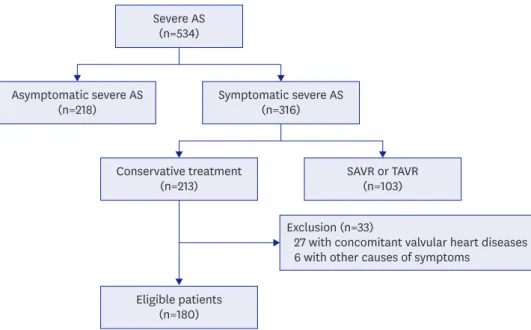
Initially we screened a total of 534 patients (age over 65 years old) with severe AS. We excluded 218 patients without symptoms, 103 patients who underwent surgical or

percutaneous AVR, 27 patients with other concomitant significant valvular heart disease and 6 patients with obvious causes of symptoms other than AS. Thus, we analyzed a total of 180 patients with severe symptomatic AS. The scheme of this study population was summarized in the Figure 1.

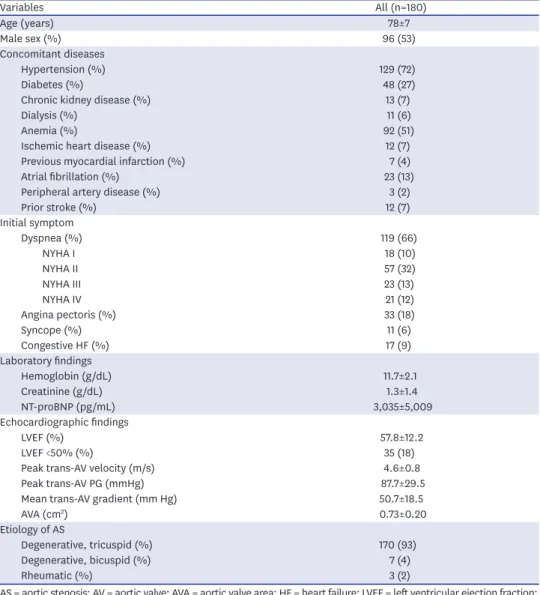
Baseline characteristics were summarized in the Table 1. Mean age was 78±7 years old and 96 were male (53%). Hypertension was the most common cardiovascular risk factor (72%), and anemia and atrial fibrillation were in 92 patients (51%) and 23 patients (13%), respectively.

Calculated AVA was 0.73±0.20cm

2

, peak trans-AV Vmax was 4.6±0.8 m/s and mean trans-AV

PG was 50.7±18.5 mmHg. Thirty-three patients (18%) had LVEF less than 50%.

(4)

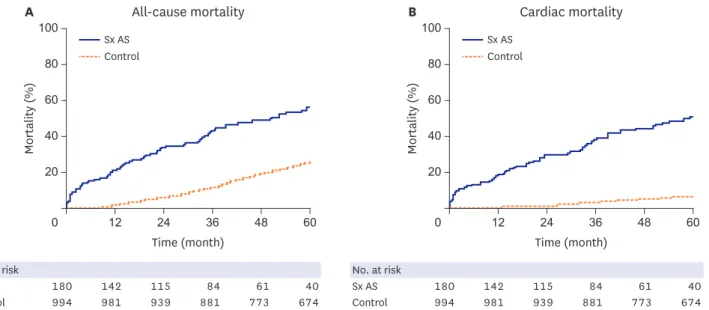
A total of 102 patients died during the follow-up period of 39.1±31.0 months. One-, 3-, and 5-year mortality rates were 21.1±3.0%, 43.1±3.8%, and 56.5±4.2%, respectively (Figure 2A).

All-cause mortality was much higher than that of normal controls; 1-, 3-, and 5-year mortality rates were 1.3±0.4%, 11.4±1.0%, and 25.7±1.4%, respectively (p<0.001, p=0.010, and p=0.014, respectively). Of them, 87 died from cardiac causes and 15 had non-cardiac causes of death (pneumonia and chronic obstructive pulmonary disease in 8 patients, cancer in 3 patients, sepsis in 2 patients, chronic kidney disease in 1 patient, and fracture in 1 patient).

One-, 3-, and 5-year cardiac mortality rate was 18.0±2.9%, 38.2±3.8%, and 50.7±4.3%, respectively (Figure 2B). Cardiac mortality was much higher than that of normal controls; 1-, 3-, and 5-year mortality rate was 0.2±0.1%, 3.0±0.6%, and 6.4±0.8%, respectively (p=0.005, p=0.008, and p=0.010, respectively).

Among 4 presenting symptoms including dyspnea, angina, syncope and HF, dyspnea was the most common symptom (66%). When we analyzed mortality curve according to their initial symptoms, there was no difference among the groups in all-cause mortality (p=0.415, Figure 3A) and cardiac mortality (p=0.767, Figure 3B). However, in the dyspnea group, severely symptomatic patients (defined as New York Heart Association [NYHA] III–IV) had significantly higher rate of all-cause mortality (hazard ratio [HR], 2.41; 95% confidence interval [CI], 1.49–3.90; p<0.001) and cardiac mortality (HR, 2.59; 95% CI, 1.52–4.40;

p<0.001) compared with minimally symptomatic patients (defined as NYHA I–II). All-cause mortality and cardiac mortality were observed in 65 (58%) and 57 (51%) in the HGpEF group, 13 (65%) and 10 (50%) in the HGrEF group, 18 (50%) and 15 (42%) in the LGpEF group, and 6 (50%) and 5 (42%) in the LGrEF group, respectively. In Cox proportional hazards analysis, there was no significant difference in all-cause mortality (p=0.545, Figure 4A) and cardiac mortality (p=0.838, Figure 4B) among the 4 groups.

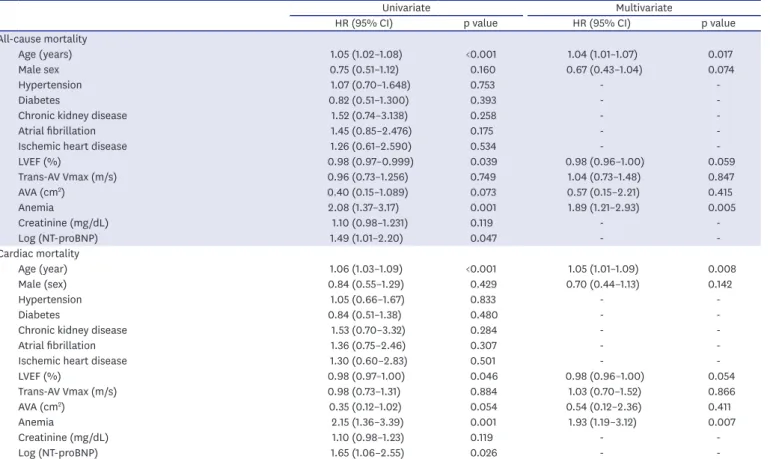
Univariate Cox proportional hazard analysis (Table 2), age, anemia, LVEF and log N-terminal pro B-type natriuretic peptide (NT-proBNP) were significant parameters in the prediction of all- cause mortality (p<0.001, p<0.001, p=0.039, and p=0.047, respectively) and cardiac mortality

Severe AS (n=534)

Asymptomatic severe AS

(n=218) Symptomatic severe AS

(n=316)

Conservative treatment (n=213)

Exclusion (n=33)

27 with concomitant valvular heart diseases 6 with other causes of symptoms

Eligible patients (n=180)

SAVR or TAVR (n=103)

Figure 1. Scheme of study population.

AS = aortic stenosis; SAVR = surgical aortic valve replacement; TAVR = transcatheter aortic valve replacement.

(5)

(p<0.001, p=0.001, p=0.046, and p=0.026, respectively). AVA had tendency to have clinical significance in the prediction of cardiac mortality (HR, 0.35; 95% CI, 1.12–1.02; p=0.054).

After multivariable adjustment (Table 2), age and anemia were significant parameters in the prediction of all-cause mortality (HR, 1.04; 95% CI, 1.01–1.07; p=0.017 and HR, 1.89; 95% CI, 1.21–2.93; p=0.005) and cardiac mortality (HR, 1.05; 95% CI, 1.01–1.09; p=0.008 and HR, 1.93;

95% CI, 1.19–3.12;p=0.0074, respectively.

DISCUSSION

In this study, we showed 57% of our elderly study population died during the follow-up period. Their 1-, 3-, and 5-year all-cause mortality rate was 21.1±3.0%, 43.1±3.8%, and 56.5±4.2%, respectively, and 1-, 3-, and 5-year cardiac mortality rate was 18.0±2.9%,

38.2±3.8%, and 50.7±4.3%, respectively. Age and anemia were significant prognostic factors in the prediction of all-cause mortality and cardiac mortality in the multivariate analysis.

Table 1. Baseline clinical and echocardiographic characteristics

Variables All (n=180)

Age (years) 78±7

Male sex (%) 96 (53)

Concomitant diseases

Hypertension (%) 129 (72)

Diabetes (%) 48 (27)

Chronic kidney disease (%) 13 (7)

Dialysis (%) 11 (6)

Anemia (%) 92 (51)

Ischemic heart disease (%) 12 (7)

Previous myocardial infarction (%) 7 (4)

Atrial fibrillation (%) 23 (13)

Peripheral artery disease (%) 3 (2)

Prior stroke (%) 12 (7)

Initial symptom

Dyspnea (%) 119 (66)

NYHA I 18 (10)

NYHA II 57 (32)

NYHA III 23 (13)

NYHA IV 21 (12)

Angina pectoris (%) 33 (18)

Syncope (%) 11 (6)

Congestive HF (%) 17 (9)

Laboratory findings

Hemoglobin (g/dL) 11.7±2.1

Creatinine (g/dL) 1.3±1.4

NT-proBNP (pg/mL) 3,035±5,009

Echocardiographic findings

LVEF (%) 57.8±12.2

LVEF <50% (%) 35 (18)

Peak trans-AV velocity (m/s) 4.6±0.8

Peak trans-AV PG (mmHg) 87.7±29.5

Mean trans-AV gradient (mm Hg) 50.7±18.5

AVA (cm

2

) 0.73±0.20

Etiology of AS

Degenerative, tricuspid (%) 170 (93)

Degenerative, bicuspid (%) 7 (4)

Rheumatic (%) 3 (2)

AS = aortic stenosis; AV = aortic valve; AVA = aortic valve area; HF = heart failure; LVEF = left ventricular ejection fraction;

NT-proBNP = N-terminal pro B-type natriuretic peptide; NYHA = New York Heart Association; PG = pressure gradient.

(6)

Traditionally, the presence of symptoms was the most important prognostic factor.

When severe AS patients present even mild symptoms, their survivals are poor unless the obstruction is relieved. The approximate survival interval from the onset of symptoms to the time of death is about 2 years in patients with HF, 3 years in patients with syncope and 5 years in those with angina.

3)

However, these data came from very old retrospective study. Thus, we need more recent study data.

No. at risk

Sx AS 180 142 115 84 61 40

Control 994 981 939 881 773 674

No. at risk

Sx AS 180 142 115 84 61 40

Control 994 981 939 881 773 674

Mortality (%)

0

B

Time (month) A

0 24 48 60

Mortality (%)

100

60

20 80

40

100

60

20 80

40

12 36

Sx AS Control

Time (month)

All-cause mortality Cardiac mortality

24 48 60

12 36

Sx AS Control

Figure 2. All-cause mortality and cardiac mortality. One-, 3- and 5-year mortality rate is 21.1±3.0%, 43.1±3.8% and 56.5±4.2%, respectively (A) All-cause mortality of our study population is much higher than that of normal controls (1-, 3-, and 5-year survival rate was 1.3±0.4%, 11.4±1.0%, and 25.7±1.4%, respectively (p<0.001, p=0.010, and p=0.014, respectively). One-, 3- and 5-year cardiac mortality rate is 18.0±2.9%, 38.2±3.8% and 50.7±4.3%, respectively (B).

Which is much higher than that of normal controls (1-, 3-, and 5-year survival rate was 0.2±0.1%, 3.0±0.6%, and 6.4±0.8%, respectively (p=0.005, p=0.008, and p=0.010, respectively).

Sx AS = symptomatic aortic stenosis.

No. at risk

Dyspnea 119 89 74 52 36 27

Angina 33 32 25 20 16 7

Syncope 11 7 5 3 2 1

HF 17 14 11 9 7 5

No. at risk

Dyspnea 119 89 74 52 36 27

Angina 33 32 25 20 16 7

Syncope 11 7 5 3 2 1

HF 17 14 11 9 7 5

Mortality (%)

0

B

Time (month) A

0 24 48 60

Mortality (%)

100

60

20 80

40

100

60

20 80

40

12 36

Dyspnea Angina Syncope HF

Dyspnea Angina Syncope HF

Time (month) All-cause mortality

p=0.415 p=0.767

Cardiac mortality

24 48 60

12 36

Figure 3. All-cause mortality (A) and cardiac mortality (B) according to their initial presenting symptoms. There is no significant difference among groups in all-cause mortality (p=0.415) and cardiac mortality (p=0.767).

HF = heart failure.

(7)

No. at risk

HGpEF 111 92 73 58 41 30

HGrEF 19 14 12 8 4 2

LGpEF 35 28 23 16 14 7

LGrEF 11 8 7 2 2 1

No. at risk

HGpEF 111 92 73 58 41 30

HGrEF 19 14 12 8 4 2

LGpEF 35 28 23 16 14 7

LGrEF 11 8 7 2 2 1

Mortality (%)

0

B

Time (month) A

0 24 48 60

Mortality (%)

100

60

20 80

40

100

60

20 80

40

12 36

HGpEF HGrEF LGpEF LGrEF

HGpEF HGrEF LGpEF LGrEF

Time (month) All-cause mortality

p=0.545 p=0.838

Cardiac mortality

24 48 60

12 36

Figure 4. All-cause mortality (A) and cardiac mortality (B) according to PG and LVEF, such as HGpEF, HGrEF, LGpEF, and LGrEF. There is no significant difference among the 4 groups in all-cause mortality and cardiac mortality.

HGpEF = high gradient severe aortic stenosis with preserved left ventricular ejection fraction; HGrEF = high gradient severe aortic stenosis with reduced left ventricular ejection fraction; LGpEF = low gradient severe aortic stenosis with preserved left ventricular ejection fraction; LGrEF = low gradient severe aortic stenosis with reduced left ventricular ejection fraction; LVEF = left ventricular ejection fraction; PG = pressure gradient.

Table 2. Univariate and multivariate analysis in the prediction of all-cause mortality and cardiac mortality

Univariate Multivariate

HR (95% CI) p value HR (95% CI) p value

All-cause mortality

Age (years) 1.05 (1.02–1.08) <0.001 1.04 (1.01–1.07) 0.017

Male sex 0.75 (0.51–1.12) 0.160 0.67 (0.43–1.04) 0.074

Hypertension 1.07 (0.70–1.648) 0.753 - -

Diabetes 0.82 (0.51–1.300) 0.393 - -

Chronic kidney disease 1.52 (0.74–3.138) 0.258 - -

Atrial fibrillation 1.45 (0.85–2.476) 0.175 - -

Ischemic heart disease 1.26 (0.61–2.590) 0.534 - -

LVEF (%) 0.98 (0.97–0.999) 0.039 0.98 (0.96–1.00) 0.059

Trans-AV Vmax (m/s) 0.96 (0.73–1.256) 0.749 1.04 (0.73–1.48) 0.847

AVA (cm

2

) 0.40 (0.15–1.089) 0.073 0.57 (0.15–2.21) 0.415

Anemia 2.08 (1.37–3.17) 0.001 1.89 (1.21–2.93) 0.005

Creatinine (mg/dL) 1.10 (0.98–1.231) 0.119 - -

Log (NT-proBNP) 1.49 (1.01–2.20) 0.047 - -

Cardiac mortality

Age (year) 1.06 (1.03–1.09) <0.001 1.05 (1.01–1.09) 0.008

Male (sex) 0.84 (0.55–1.29) 0.429 0.70 (0.44–1.13) 0.142

Hypertension 1.05 (0.66–1.67) 0.833 - -

Diabetes 0.84 (0.51–1.38) 0.480 - -

Chronic kidney disease 1.53 (0.70–3.32) 0.284 - -

Atrial fibrillation 1.36 (0.75–2.46) 0.307 - -

Ischemic heart disease 1.30 (0.60–2.83) 0.501 - -

LVEF (%) 0.98 (0.97–1.00) 0.046 0.98 (0.96–1.00) 0.054

Trans-AV Vmax (m/s) 0.98 (0.73–1.31) 0.884 1.03 (0.70–1.52) 0.866

AVA (cm

2

) 0.35 (0.12–1.02) 0.054 0.54 (0.12–2.36) 0.411

Anemia 2.15 (1.36–3.39) 0.001 1.93 (1.19–3.12) 0.007

Creatinine (mg/dL) 1.10 (0.98–1.23) 0.119 - -

Log (NT-proBNP) 1.65 (1.06–2.55) 0.026 - -

AV = aortic valve, AVA = aortic valve area; CI = confidential interval, HR = hazard ratio; LVEF = left ventricular ejection fraction; NT-proBNP = N-terminal pro

B-type natriuretic peptide.

(8)

In our study, 1-year all-cause mortality was 21.1±3.0%. This result seems similar to that of recent studies. Bach et al.

7)

reported their data of severe symptomatic AS patients from 3 large tertiary care centers. They reported 1-year mortality rate was 33.5±4.7% in unoperated severe symptomatic AS patients. However, in the Placement of AoRTic TraNscathetER Valve Trial (PARTNER) trial, 1-year all-cause mortality rate in the medically treated group was 50.9% and 2-year mortality rate was 68.0%.

8)9)

These were significantly higher than that of patients receiving TAVR treatment (HR, 0.58; 95% CI, 0.43–0.78; p<0.001), Their mortality rates look higher than those of our study. However, age of the study population in our study was much lower than that of the PARTNER trial (mean difference, 5.2 years; p<0.001). Age is a well-known bad prognostic factor. In 1 study, age over 80 was strongly associated with perioperative mortality even in patients underwent surgical AVR.

7)

Beside age, the incidence of CAD was much prevalent in the PARTNER trial than that of ours. Moreover, proportion of obese or overweight and ethnic difference might influence the survivals.

10)

Traditionally, the presence of HF symptoms has been regarded as the poorest prognostic factor in the symptomatic AS patients. However, there was no significant difference among symptoms in our study. Although there could be a bias and limitations in the definition of symptoms, our study can emphasize that patients with even mild symptoms had poor long- term prognosis.

Although peak trans-AV velocity did not have statistical significance, LVEF was another prognostic marker in our study. When the LV begins to fail, the cardiac output and trans-AV gradient are getting decreased. In our study, 48 (27%) patients had a low gradient severe AS, and these patients had a high rate of clinical events during follow-up; 50% and 41.7% of patients had experienced all-cause death or cardiac death, respectively. For these reasons, trans-AV velocity and PG did not have clinical significance for all-cause mortality or cardiac mortality. However, AVA had tendency to predict cardiac mortality in our study population.

The presence of anemia and NT-proBNP levels were well established prognostic factors of

severe AS. Because anemia results in decreased tissue perfusion, increased LV hypertrophy

and interstitial fibrosis. Similarly, AS results in LV hypertrophy, increased systemic vascular

resistance, and reduced cardiac output. Thus, the concomitant presence of anemia and

severe AS will lead to reduced myocardial perfusion and increased oxygen demand, causing

myocardial ischemia and potentially exacerbate HF, increased all-cause mortality.

11)

The risk of sudden death is high in patients with symptomatic severe AS. In our study, 66 of

87 (75.9%) patients might die suddenly. Also, there are many recurrent hospitalizations for

decompensated HF and/or angina pectoris in severe symptomatic AS patients who refused

surgical or percutaneous intervention.

12)

Clark et al.

12)

reported their data from Medicare in the

US. They included 2,150 patients with medically managed severe AS. The mean age of their

cohort was 82 years, estimated European System for Cardiac Operative Risk Evaluation score

was 17%. During 5-year follow-up, overall mortality rate was 88.4% with a mean survival time

was 1.8 years. During this time, patients had an average of 4.4 hospital admissions and the total

5-year costs were $63,844 per patients. Although there are several different medical systems, the

pattern of recurrent hospitalization should be similar in Korea. Recent study showed the clinical

outcomes of TAVR in Korean registry and in Asian population, including Koreans were favorable

compared with those of studies from western countries.

13)14)

Moreover, there are favorable result

of suture-less AVR in elderly patients.

15)

Thus, physicians should pay attention to undergoing

prompt treatment to relieve the PG such as TAVR to prevent significant consumption of health

care resources associated with recurrent hospitalizations of these patients.

(9)

This study has several limitations mainly came from the nature of study. This study is a retrospective study with review of medical records and data from the Ministry of Public Administration and Security. Thus, there might be a selection bias, and we had missing data about hospitalization of them. Second, the prevalence of CAD might be underestimated in this study because only 76 (42.2%) of our patients underwent coronary evaluation. Third, we did not include outcomes of patients who underwent surgical or percutaneous AVR. Moreover, there is no data about the medical cost of patients undergo surgical AVR or TAVR versus medical treatment only in our patients. If with these data, the comparison of survival will be much better.

To overcome these limitations, well designed registry data should be needed in near future.

In conclusion, in elderly patients who treated medically, their 1-, 3-, and 5-year all-cause mortality rate was 21.1±3.0%, 43.1±3.8%, and 56.5±4.2%, respectively and 1-, 3-, and 5-year cardiac mortality rate was 18.0±2.9%, 38.2±3.8%, and 50.7±4.3%, respectively. The mortality rates were much higher than those without AS.

REFERENCES

1. Nkomo VT, Gardin JM, Skelton TN, Gottdiener JS, Scott CG, Enriquez-Sarano M. Burden of valvular heart diseases: a population-based study. Lancet 2006;368:1005-11.

PUBMED | CROSSREF

2. Bach DS, Radeva JI, Birnbaum HG, Fournier AA, Tuttle EG. Prevalence, referral patterns, testing, and surgery in aortic valve disease: leaving women and elderly patients behind? J Heart Valve Dis 2007;16:362-9.

PUBMED

3. Ross J Jr, Braunwald E. Aortic stenosis. Circulation 1968;38 1 Suppl:61-7.

PUBMED | CROSSREF

4. Frank S, Johnson A, Ross J Jr. Natural history of valvular aortic stenosis. Br Heart J 1973;35:41-6.

PUBMED | CROSSREF

5. Jang SY, Ju EY, Seo SR, et al. Changes in the etiology of valvular heart disease in the rapidly aging Korean population. Int J Cardiol 2014;174:355-9.

PUBMED | CROSSREF

6. Lang RM, Badano LP, Mor-Avi V, et al. Recommendations for cardiac chamber quantification by echocardiography in adults: an update from the American Society of Echocardiography and the European Association of Cardiovascular Imaging. J Am Soc Echocardiogr 2015;28:1-39.e14.

7. Bach DS, Siao D, Girard SE, Duvernoy C, McCallister BD Jr, Gualano SK. Evaluation of patients with severe symptomatic aortic stenosis who do not undergo aortic valve replacement: the potential role of subjectively overestimated operative risk. Circ Cardiovasc Qual Outcomes 2009;2:533-9.

PUBMED | CROSSREF

8. Leon MB, Smith CR, Mack M, et al. Transcatheter aortic-valve implantation for aortic stenosis in patients who cannot undergo surgery. N Engl J Med 2010;363:1597-607.

PUBMED | CROSSREF

9. Makkar RR, Fontana GP, Jilaihawi H, et al. Transcatheter aortic-valve replacement for inoperable severe aortic stenosis. N Engl J Med 2012;366:1696-704.

PUBMED | CROSSREF

10. Ávila-Vanzzini N, Fritche-Salazar JF, Vázquez-Castro NM, et al. Echocardiographic and histologic correlations in patients with severe aortic stenosis: influence of overweight and obesity. J Cardiovasc Ultrasound 2016;24:303-11.

PUBMED | CROSSREF

11. Ng AC, Kong WK, Kamperidis V, et al. Anaemia in patients with aortic stenosis: influence on long-term prognosis. Eur J Heart Fail 2015;17:1042-9.

PUBMED | CROSSREF

12. Clark MA, Arnold SV, Duhay FG, et al. Five-year clinical and economic outcomes among patients with medically managed severe aortic stenosis: results from a medicare claims analysis. Circ Cardiovasc Qual Outcomes 2012;5:697-704.

PUBMED | CROSSREF

(10)

13. Yoon SH, Lefèvre T, Ahn JM, et al. Transcatheter aortic valve replacement with early- and new-generation devices in bicuspid aortic valve stenosis. J Am Coll Cardiol 2016;68:1195-205.

PUBMED | CROSSREF

14. Yu CW, Kim WJ, Ahn JM, et al. Trends and outcomes of transcatheter aortic valve implantation (TAVI) in Korea: the results of the first cohort of Korean TAVI registry. Korean Circ J 2018;48:382-94.

PUBMED | CROSSREF

15. Shinn SH, Altarabsheh SE, Deo SV, Sabik JH, Markowitz AH, Park SJ. A systemic review and meta-analysis of sutureless aortic valve replacement versus transcatheter aortic valve implantation. Ann Thorac Surg 2018;106:924-9.

PUBMED | CROSSREF

수치

Figure 1. Scheme of study population.
Table 1. Baseline clinical and echocardiographic characteristics
Figure 2. All-cause mortality and cardiac mortality. One-, 3- and 5-year mortality rate is 21.1±3.0%, 43.1±3.8% and 56.5±4.2%, respectively (A) All-cause  mortality of our study population is much higher than that of normal controls (1-, 3-, and 5-year sur
Table 2. Univariate and multivariate analysis in the prediction of all-cause mortality and cardiac mortality

참조

관련 문서

Clinical long-term outcomes in patients with moderate-to-severe ulcerative colitis who exhibited evidence of cytomegalovirus (CMV) reactivation at the time of the initial

This report evaluated long-term changes in clinical severity and laboratory parameters in 3 adult patients with severe recalcitrant atopic dermatitis (AD) who were treated

Long-Term Survival Analysis and Clinical Follow-Up in Acral Lentiginous Malignant Melanoma Undergoing Sentinel Lymph Node Biopsy in Korean Patients.. Su-Young Jeon, Jin-Woo Hong,