46(3) : 243∼ 249 (2015)
243
몰약 당귀 오미자 혼합제제 HPM-1의 Scopolamine에 의해 유도된 기억력 감퇴에 대한 개선 효과
안지운1·김대성3·조형권3·김윤철1,2·김성연1,2·오현철1,2·서정원1,2*
1원광대학교 약학대학, 2원광대학교 약품연구소, 3(유)한풍제약
Ameliorating Effects of HPM-1 on Scopolamine-induced Memory Impairments in Mice
Jeewoon Ahn1, Dae-Sung Kim3, Hyoung-Kwon Cho3, Youn-Chul Kim1,2, Sung Yeon Kim1,2, Hyuncheol Oh1,2 and Jungwon Seo1,2*
1College of Pharmacy, Wonkwang University, Iksan 570-749, Korea
2Institute of Pharmaceutical Research and Development, College of Pharmacy, Wonkwang University, Iksan 570-749, Korea
3Hanpoong Pharm & Foods Co., Ltd., Jeonju 561-841, Korea
Abstract − Myrrh, Angelicae Radix, and Schisandrae Fructus have been used to treat diverse diseases including neurological disorder in the traditional Korean medicine. In the present study, we investigated the ameliorating effects of HPM-1, a combined extract of Myrrh, Angelicae Radix and Schisandrae Fructus, on scopolamine-induced memory impairments in mice. First, we assessed HPM-1, HPM-2 and HPM-3, in which Myrrh was extracted with water, 30% ethanol, and 30% ethanol/3% vinegar, respectively. The oral administration of HPM-1, HPM-2, or HPM-3 significantly reversed scopolamine-induced reduction of spontaneous alternation in the Y-maze task. In the passive avoidance task, HPM-1 or HPM-3 restored the decreased latency time of the retention trial by scopolamine treatment, but in terms of efficacy, HPM-1 showed more beneficial effects than HPM- 3. In addition, HPM-1 administration reversed scopolamine-induced reduction of spontaneous alternation in the Y-maze task and scopolamine-decreased latency time in the passive avoidance in a dose-dependent manner. These results suggest that HPM- 1 has the therapeutic potential in memory impairments.
Key words − Myrrh, Angelicae Radix, Schisandrae Fructus, Memory, Passive avoidance task, Y-maze task
의학의 발달로 평균 수명이 증가되는 현대 사회에서 알츠 하이머 치매를 비롯한 만성 퇴행성 뇌질환의 발병률은 급 격히 증가하고 있다. 우리나라 65세 이상 고령인구의 급격 한 증가와 더불어 치매의 유병률 또한 가파르게 증가하여 2027년에는 100만명, 2050년에는 212만명에 이를 것으로 전망된다.1) 치매와 같은 퇴행성 뇌질환에서 나타나는 기억 력과 인지 능력, 지각 능력의 감퇴는 사회 생활 자체를 불 가능하게 할 수 있다. 또한, 인지 기능과 기억력은 학습량 이 많은 청소년에게도 주요 관심의 대상이 되고 있다.
알츠하이머성 치매 등과 같은 퇴행성 뇌질환에서 기억력 과 인지 능력 저하의 중요한 원인 중의 하나는 콜린성 신경 세포 퇴화에 의한 acetylcholine의 부족이다. 이러한 현상은
acetylcholine 분해효소인 acetylcholinesterase(AChE)의 활성 증가로 더욱 심화된다.2) 따라서 그 동안 tacrine, donepezil, galantamine, rivastigmine 등의 AChE 억제제가 알츠하이머 질환의 치료제로 개발되어 왔다.3)하지만 아직 뇌세포 손상 을 억제하거나 직접 뇌세포를 재생시키는 약물이 개발되지 않았기 때문에, 효과적이면서도 안전한 기억력 및 인지기능 개선제를 개발하는 것은 치매 환자의 증상 호전 뿐만 아니 라 정상인의 치매 예방 차원에서도 중요하다.
합성 약품을 이용한 기억력 개선제 개발에는 한계가 있을 뿐만 아니라 부작용도 존재한다. 따라서, 최근 천연물을 이 용한 기억력 및 인지기능 개선제의 개발이 주목 받고 있다.
대표적으로 은행잎, 인삼 추출물 등이 개발되었으며, 이러 한 천연 의약품들은 쉽게 접할 수 있고, 생산에 많은 비용 이 들지 않으며, 부작용이 적어 각광 받고 있다.4)하지만 천
*교신저자(E-mail): [email protected] (Tel): +82-63-850-6819
연물을 통한 기억력 개선제들은 대부분 합성 의약품인 AChE 억제제보다 효과가 약하기 때문에 아직 더 많은 개발이 이 루어져야 한다.5)
몰약(Myrrh)은 몰약수(沒藥樹) Commiphora myrrha Engler 또는 합지수(哈地樹) Commiphora molmol Engler(감 람나무과 Burseraceae)에서 얻은 고무수지로서, 엷은 황색에 서 어두운 갈색의 고르지 않은 덩어리이며, 방향성의 냄새 가 있고 맛은 쓰며 약간 떫고 맵다. 몰약은 고대 이집트의 미라제작에 방부제로 사용된 이래 지금까지 오랫동안 향료 와 의약용으로 사용되고 있다. 몰약은 항염 진통 효과,6) 항 암 효과,7)지질 강하 효과,8)항미생물 활성9)등이 보고되어 왔다. 몰약은 30-60 %의 water-soluble gum과 25-40 %의 alcohol-soluble resins, 3-8 %의 essential oil로 구성되어 있 다.10) 주요 성분으로는 furanoelemanes, furanoeudesmanes, furanogermancranes 등의 furanosesquiterpene이 있다.11) 선 행 연구 결과에 의하면, 몰약의 resin으로부터 분리한 sesquiterpene들은 SH-SY5Y 세포에서 MPP+에 의해 유도된 신경세포 사멸에 대한 신경 보호 효과를 보였다.12)그러나, 몰약의 기억력 개선에 대한 효과는 아직 밝혀지지 않았다.
당귀(Angelicae Radix)는 산형과(Umbelliferae)의 식물인 당 귀(Angelica gigas)의 뿌리를 건조한 것으로, 당뇨 개선 효 과,13) 항암 효과,14) 항산화 효과,15) 항미생물 효과,16) 신경보 호 효능17) 등이 보고되었다. 주요 성분으로는 decursinol이 나 decursin과 같은 pyranocoumarin 계와 isoimperatorin, nodakenin등의 furanocoumarin 계가 알려져 있다.18)특히, 선행 동물 실험 결과에 의하면 당귀추출물이나 당귀coumarin 유도체들은 scopolamine19)이나 β-amyloid20)로 유도된 기억 손상 모델에서 기억력 개선 효과가 확인되었고, 최근에는 허혈성 뇌혈관 질환에 대한 신경보호 효과가 입증되었다.21) 오미자(五味子, Schisandrae Fructus)는 목련과(Magnoliaceae) 의 낙엽덩굴식물인 오미자(Schisandra chinensis Baill.)의 열 매를 건조한 것으로, 당뇨,22)간질환,23)심혈관 질환,24)신경 학적 증상25)의 치료에 사용되어 왔다. 특히, 선행 동물 실험 결과들에 의하면 오미자는 기억력 감퇴를 개선26)하고 신경 독성을 감소27)시킨다고 알려져 있다. 주요 성분은 schisandrin, deoxyschisandrin, schisandrol, gomisin, citric acid, and β- sitosterol 등이 있다.28) 특히 schisandrin A나 schisandrin B 와 같은 dibenzocyclooctadiene-type lignan류는 오미자에서 보여지는 신경보호효과,29) 항신경염증효과,30) 기억력 개선31) 에 기여하는 중요한 구성성분으로 알려져 있다.
본 실험에서는 몰약, 당귀, 오미자 혼합제제의 기억력 개 선 효과를 알아보기 위해 scopolamine으로 기억력 감퇴를 유발시킨 후, 수동 회피 시험(passive avoidance task)과 Y- 미로 시험(Y-maze task)을 실시하였다. 특히, 몰약의 추출법 에 따른 기억력 개선 효능에서의 차이를 분석하였다.
재료 및 방법
실험동물 − ICR 마우스 6주령 수컷을 주식회사 오리엔트 (경기도 성남시 중원구)에서 공급받아 사용하였다. 실험동물 은 원광대학교 약학대학 동물실에서 7일간 적응시켰으며 적 응기간 동안 동물실의 온도는 23±2oC, 습도 50±10 % 내외, 조명은 12시간 주기로 일정하게 유지 하였다. 실험동물은 사료와 물을 제한 없이 공급 받았다. 실험은 원광대의 동물 실험윤리위원회의 승인을 받아 실시하였다.
실험재료 − 본 실험에 사용한 몰약, 당귀, 오미자는 동경 종합상사(서울특별시 동대문구)를 통해 구입하였다. 몰약은 남아프리카산을 사용하였으며, 당귀는 경북 영천, 오미자는 전북 장수 산을 사용하였다.
시료제조 − HPM-1의 몰약은 몰약에 20배수의 물을 넣어 95~105oC에서 3시간씩 2회 추출 후 여과하여 감압농축 후 건조하여 제조하였다. HPM-2의 몰약은 몰약에 20배의 30 % 에탄올을 넣어 85~95oC에서 3시간씩 2회 추출 후 여과하여 감압농축 후 건조하여 제조하였다. HPM-3의 몰약은 몰약에 20배의 30 % 에탄올과 3 % 식초를 넣어 85~95oC에서 3시 간씩 2회 추출 후 여과하여 감압농축 후 건조하여 제조하 였다. 당귀는 약전 통칙 중 절도에 따라 조절로 한 후 10배의 30 % 에탄올을 넣어 85~95oC에서 3시간씩 2회 추출 후 여 과하여 감압농축 후 건조하여 제조하였다. 오미자는 10배의 30 % 에탄올을 넣어 85~95oC에서 3시간씩 2회 추출 후 여 과하여 감압농축 후 건조하여 제조하였다. HPM-1, HPM-2, HPM-3는 각각 다른 제법의 몰약에 같은 제법의 당귀와 오 미자를 5:2:1의 비율로 혼합하였다.
시험물질 − 본 실험에 사용한 scopolamine과 tacrine은 Sigma Aldrich사(St. Louis, MO, USA.)의 제품을 사용하였 으며, 나머지 기타 시약은 시중에서 구입할 수 있는 최상급 을 사용하였다.
Y-미로 시험(Y-maze task) − HPM-1, HPM-2, HPM-3각 200 mg/kg 및 tacrine 10 mg/kg은 saline에 녹인 후 경구 투 여하였고, 대조군에는 saline을 같은 용량으로 경구 투여하 였다. 30분 후에 saline에 녹인 scopolamine을 1 mg/kg의 용 량으로 복강 투여하여 기억력 감퇴 모델을 유도하였다.
Scopolamine 투여 30분 후, Y-미로 시험을 실시하였다. Y- 미로 시험에 이용되는 기구(정도비앤피, 서울특별시 노원구) 는 3개의 가지로 구성되어 있으며 각 가지(arm)의 길이는 40 cm, 넓이는 3 cm, 높이는 12 cm이고 세 팔의 각도는 각 120도였다. 각 가지를 A, B, C로 정한 후 한쪽 가지에 마우 스를 조심스럽게 놓고 8분 동안 자유롭게 움직이게 한 다 음 마우스가 들어간 가지를 기록하였다. 이 때 꼬리까지 완 전히 들어갔을 경우만을 기록하였으며, 갔던 가지에 다시 들어간 경우에도 기록하였다. 세 개의 서로 다른 가지에 차
례로 들어간 경우(ABC, CAB, BCA; 실제 변경, actual alternation) 1점씩을 부여하였다. 변경 행동력(alternation behavior)은 3가지 모두에 차례로 들어가는 것으로 정의되 며, 다음의 수학식에 의해 계산하였다.
자발적 변경률(spontaneous alternation)(%)=실제변경 (actual alternation)/최고변경(maximum alternation=총 출입 수 - 2)×100
수동회피 시험(passive avoidance task) − 약물 투여는 Y-미로 시험에서와 같은 방법으로 실시하였다. Scopolamine 투여 30분 후, 마우스를 조명을 비춘 밝은 쪽 방에 놓고 10 초간 탐색시킨 후 길로틴문(guillotin door)을 열어 어두운 방으로 들어갈 수 있게 하였다. 각 방의 구획은 20×20×20 cm의 공간(정도비앤피)이다. 이때 길로틴문이 열린 후 60초 이내에 어두운 방으로 들어가지 않는 마우스는 실험에서 제 외시켰다. 길로틴문이 열린 후 마우스가 어두운 방으로 들 어갈 때까지의 시간을 측정하였으며 이를 학습 시험 (acquisition trial)이라고 정의하였다. 일단 마우스가 어두운 쪽으로 들어가면 길로틴문이 닫히고 1 mA의 전기 자극을 3초 동안 grid 바닥을 통해 흐르게 하였으며 마우스가 이를 기억하도록 하였다. 학습 시험(acquisition trial)이 끝난 지 24시간 후에 장기기억에 미치는 HPM의 효과를 확인하고자 정체 시험(retention trial)을 시행하였다. 10초의 탐색시간 후 길로틴문이 열리고 어두운 방으로 마우스의 4발이 다 들어 가는데 걸리는 시간(latency time; 머무름 시간)을 300초까 지 측정하였다. 어두운 방으로 가는데 걸리는 시간이 길수 록 쥐의 학습과 기억이 좋음을 나타낸다.
통계처리 − 모든 실험 결과는 one-way analysis of variance(ANOVA)를 이용하여 통계처리 하였고, 다중분석을 위하여 Tukey’s test를 사후검정으로 실시하여 95 % 신뢰 수 준에서 유의성 검정을 실시하였다.
결과 및 고찰
HPM-1, HPM-2, HPM-3의 Y-미로 시험에서의 효과 − 몰약의 제법의 차이에 따른 쥐에서의 기억력 개선 효과의 차이를 시험하기 위하여, HPM-1, HPM-2, HPM-3 각 200 mg/kg을 경구 단회 투여한 후, scopolamine (1 mg/kg, i.p.) 을 투여하고 Y-미로 시험을 실시하였다.
Scopolamine(1 mg/kg, i.p.)의 투여에 의해 spontaneous alternation이 대조군에 비해 통계적으로 유의성 있게 감소 하였고(p<0.05), 이는 학습 및 기억 능력의 저하를 의미한 다. HPM-1, HPM-2, HPM-3 모두에서 scopolamine군과 비 교하여 spontaneous alternation이 유의적으로 증가함을 확인 하였다(Fig. 1A). 이러한 spontaneous alternation의 증가는
학습 및 기억력이 회복되었다는 것을 의미한다.32) 그 중 HPM-1군의 평균 spontaneous alternation은 tacrine(10 mg/
kg, p.o.)군보다 높았다. 반면 각 구역으로 들어가는 총 횟수 를 나타내는 total entry에서는 변화가 없는 것으로 보아 HPM에 의해 유도되는 spontaneous alternation의 증가는 마 우스의 활동성 변화에 의한 것이 아님을 알 수 있었다(Fig.
1B).
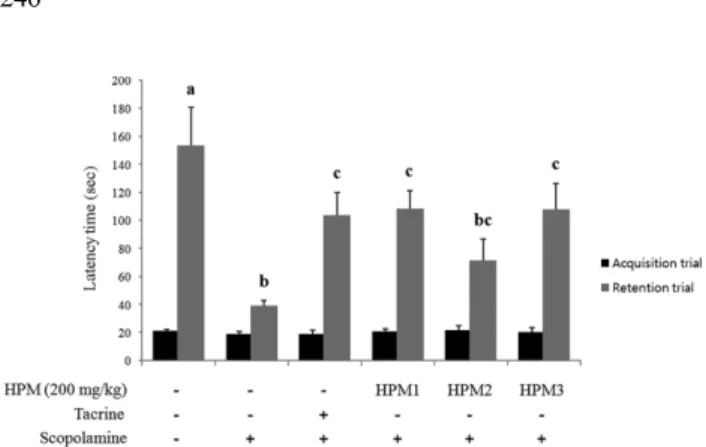
HPM-1, HPM-2, HPM-3의 수동회피 시험에서의 효과 − HPM-1, HPM-2, HPM-3 각 200 mg/kg을 경구 단회 투여한 후, 수동회피 시험을 실시하여 장기 기억 능력에 미치는 영 향을 확인하였다. Scopolamine(1 mg/kg, i.p.)의 투여에 의해 정체 시험(retention trial) 시의 latency time이 대조군에 비 해 유의적으로 감소하였는데(p<0.01), 이는 학습 시험 (acquisition trial) 시의 전기 자극을 기억하지 못함을 의미하 여 기억력 감퇴모델이 잘 만들어졌다고 판단되었다. 또한, Fig. 1. Effect of HPMs on scopolamine-induced memory def- icits in the Y-maze task. The mice divided in different groups were administered with equivalent volume of saline, tacrine (10 mg/kg, p.o.), HPM-1, HPM-2, or HPM-3 (200 mg/kg, p.o.) 30 min before scopolamine treatment. Scopolamine (1 mg/kg, i.p.) was given to all the groups except control group 30 min before trial. The spontaneous alternation score (A) and numbers of arm entries (B) were recorded. Data are repre- sented as mean±S.D. (n=8~11) and all differences were con- sidered significant at a p<0.05.
모든 실험군에서 학습 시험(acquisition trial) 시의 latency time에는 큰 차이가 없었다. HPM-1군과 HPM-3군은 scopolamine군과 비교하여 정체 시험(retention trial)에서의 latency time이 유의적으로 증가함을 확인하였다(Fig. 2).
latency time의 증가는 학습 시험(acquisition trial) 시의 전기 자극을 24시간 동안 기억하였음을 의미하여 장기 기억력의 회복을 나타낸다. 반면에 HPM-2의 경우, Y-미로 시험에서 는 유의적으로 학습 및 기억력이 증가하였으나, 수동회피 시험에서는 유의적인 증가를 확인할 수 없었다.
Y-미로 시험과 수동회피 시험의 결과, 몰약의 제법의 차 이에 의해 기억력 개선 효과에 큰 차이가 있음을 확인하였 고, 3가지 제법 중 몰약을 물 추출한 HPM-1의 학습 및 기 억력 개선 효과가 가장 뛰어남을 확인하였다.
HPM-1의 Y-미로 시험에서의 용량의존적 효과 − 가장 큰 효과를 보인HPM-1의 용량의존적 기억력 개선 효과를 확인 하기 위하여, HPM-1 50, 100, 200, 400 mg/kg 또는 tacrine 10 mg/kg을 7일 간 경구 투여한 후, scopolamine(1 mg/kg, i.p.)을 투여하고 Y-미로 시험을 실시하였다. Scopolamine 처 리군과 비교하여 HPM-1 처리군에서 spontaneous alternation 이 용량의존적으로 증가함을 확인하였다(Fig. 3A). HPM-1 100 mg/kg군부터는 통계학적으로 유의적인 학습 및 기억력 개선 효과를 나타내었다. 각 구역으로 들어가는 총 횟수를 나타내는 total entry에서는 변화가 없는 것으로 나타나 spontaneous alternation이 마우스의 활동성 변화에 의해 나 타난 것이 아님을 알 수 있었다(Fig. 3B).
HPM-1의 수동회피 시험에서의 용량의존적 효과 − 다음 으로 HPM-1 50, 100, 200, 400 mg/kg 또는 tacrine 10 mg/
kg을 7일 간 경구 투여한 후, scopolamine(1 mg/kg, i.p.)을 투여하고 수동회피 시험을 실시하였다. 모든 실험군에서 학 습 시험(acquisition trial) 시의 latency time에는 큰 차이가 없었으며, scopolamine 처리군과 비교하여 HPM-1처리군에 서는 정체 시험(retention trial)에서의 latency time이 용량의 존적으로 증가함을 확인하였다(Fig. 4). HPM-1의 50, 100, 200, 400 mg/kg 군 모두에서 통계학적으로 유의적인 장기 기억력 개선 효과를 나타내었다.
본 실험을 통해 몰약, 당귀, 오미자 혼합제제인 HPM-1은 scopolamine으로 유도된 기억력 감퇴 모델에서 경구 투여했 을 때 용량의존적으로 기억력 개선 효과를 나타내는 것을 확인하였다. 몰약의 추출법으로는 30 % 에탄올 추출이나 30 % 에탄올, 3 % 식초 추출보다 물 추출에서 더 좋은 효 Fig. 2. Effect of HPMs on scopolamine-induced memory def-
icits in the passive avoidance task. The mice divided in dif- ferent groups were administered with equivalent volume of saline, tacrine (10 mg/kg, p.o.), HPM-1, HPM-2, or HPM-3 (200 mg/kg, p.o.) 30 min before scopolamine treatment. Sco- polamine (1 mg/kg i.p.) was given to all the groups except control group 30 min before acquisition trial. At 24 h after acquisition trial, a retention trial was performed 1 h after oral administration of saline, tacrine, or HPMs. And latency time in the acquisition trial and retention trial was recorded. Data are represented as mean±S.D. (n=8~11) and all differences were considered significant at a p<0.05.
Fig. 3. Effect of HPM-1 on scopolamine-induced memory def- icits in the Y-maze task. The mice divided in different groups were administered with equivalent volume of saline, tacrine (10 mg/kg, p.o.), or HPM-1 (50, 100, 200, or 400 mg/kg, p.o.) for seven days. Scopolamine (1 mg/kg, i.p.) was given to all the groups except control group 30 min before trial. The spon- taneous alternation score (A) and numbers of arm entries (B) were recorded. Data are represented as mean±S.D. (n=9~11) and and all differences were considered significant at a p<0.05.
과를 나타냄을 알 수 있었다. 30 % 에탄올 추출물의 경우, Y-미로 시험에 의한 단기 기억에는 효과적이었으나, 수동회 피 시험에 의한 장기 기억력의 개선에서는 효과를 나타내 지 않았다.
당귀의 추출물과 그 주요 성분인 decursin은 AChE의 억 제를 통하여 scopolamine에 의해 유도된 기억력 감퇴 모델 에서의 개선 효과가 알려져 있다.19) 오미자의 경우, 주요 성 분인 schisandrin B가 scopolamine에 의해 유도된 기억력 감 퇴 모델에서 기억력 개선 효과가 있음이 보고되었다.31) 또 한 당귀 추출물에 오미자와 삼백초를 8:1:1로 혼합한 ESP- 102 또한 scopolamine 기억력 감퇴 모델에서 기억력 개선 효과가 보고되었다.33) 몰약의 기억력 개선 효과는 본 연구 팀에서 처음으로 밝혔다. 몰약의 경구 투여는 뇌 해마에서 scopolamine에 의해 억제된 ERK와 AKT의 인산화를 증가 시키는 것을 통해서 기억력 개선 효과를 나타내었다 (Unpublished data).
기억력과 관련된 주요한 신경계는 cholinergic 신경계로 알려져 있다.34) Scopolamine은 muscarine 수용체에 대한 길 항제이기 때문에 이 모델에서 효과가 있는 약물은 cholinergic 신경계를 경유하여 효능을 나타낼 것이라 생각할 수 있다.
당귀의 decursin19,35)과 오미자의 gomisin, schisandrol36) 등 의 성분은 AChE의 억제 활성을 나타낸다고 알려져 있다.
하지만 몰약 추출물은 세포에 처리하였을 때, AChE활성의
억제 작용을 나타내지 않았다(data not shown). 반면에 몰약 추출물은 쥐의 해마에서 기억력의 생성과 신경 유연성에 중 요한 장기 강화(long-term potentiation)에 필수적인 ERK를 활성화시켰다. 따라서, HPM-1의 기억력 개선 작용은 당귀 와 오미자의 AChE활성을 억제하는 경로와 몰약의 장기 강 화와 같은 기억력의 생성과 관련된 신호전달경로 둘 다를 통해서 기억력을 향상시키는 기전을 갖는 것으로 추측된다.
결 론
본 연구에서는 몰약, 당귀, 오미자 혼합제제인 HPM-1을 이용하여 기억력 개선 효과를 실험하고자 하였다.
Scopolamine으로 기억력 감퇴를 유발하고, Y-미로 시험과 수동회피 시험을 통하여 기억력 개선 효과를 측정하였다.
그 결과, 몰약의 제법을 달리하여 제조한 혼합제제들 중 물 추출물이 Y-미로 시험과 수동회피 시험에서 가장 좋은 기 억력 개선 효과를 나타내었다. 또한 HPM-1의 기억력 개선 효과는 용량의존적으로 증가하여, 400 mg/kg에서 최대 효 과를 나타내었다. 본 연구 결과와 선행 연구들을 토대로 HPM-1을 인지기능 개선제 및 기억력 증진제로 개발 할 수 있을 것으로 사료된다.
사 사
본 연구는 산업통상자원부와 한국산업기술진흥원의 지역 특화산업육성사업 (R0002267)으로 수행된 연구결과입니다.
인용문헌
1. Kim, K. W., Park, J. H., Kim, M. H., Kim, M. D., Kim, B.
J., Kim, S. K., Kim, J. L., Moon, S. W., Bae, J. N., Woo, J.
I., Ryu, S. H., Yoon, J. C., Lee, N. J., Lee, D. Y., Lee, D. W., Lee, S. B., Lee, J. J., Lee, J. Y., Lee, C. U., Chang, S. M., Jhoo, J. H. and Cho, M. J. (2011) A nationwide survey on the prevalence of dementia and mild cognitive impairment in South Korea. J. Alzheimers Dis. 23: 281-291.
2. Kuhl, D. E., Koeppe, R. A., Minoshima, S., Snyder, S. E., Ficaro, E. P., Foster, N. L., Frey, K. A. and Kilbourn, M. R.
(1999) In vivo mapping of cerebral acetylcholinesterase activ- ity in aging and Alzheimer's disease. Neurology 52: 691-691.
3. Lahiri, D. K., Farlow, M. R., Greig, N. H. and Sambamurti, K. (2002) Current drug targets for Alzheimer’s disease treat- ment. Drug Dev. Res. 56: 267-281.
4. Kennedy, D. O. and Scholey, A. B. (2006) The psychop- harmacology of European herbs with cognition-enhancing properties. Curr. Pharm. Des. 12: 4613-4623.
5. Howes, M. J., Perry, N. S. and Houghton, P. J. (2003) Plants with traditional uses and activities, relevant to the manage- Fig. 4. Effect of HPM-1 on scopolamine-induced memory
deficits in the passive avoidance task. The mice divided in dif- ferent groups were administered with equivalent volume of saline, tacrine (10 mg/kg, p.o.), or HPM-1 (50, 100, 200, or 400 mg/kg, p.o.) for seven days. Scopolamine (1 mg/kg i.p.) was given to all the groups except control group 30 min before acquisition trial. At 24 h after acquisition trial, a reten- tion trial was performed 1 h after oral administration of saline, tacrine, or HPM-1 and latency time in the acquisition trial and retention trial was recorded. Data are represented as mean±S.D. (n=9~11) and all differences were considered sig- nificant at a p<0.05.
ment of Alzheimer's disease and other cognitive disorders.
Phytother. Res. 17: 1-18.
6. Su, S., Wang, T., Duan, J.-A., Zhou, W., Hua, Y.-Q., Tang, Y.- P., Yu, L. and Qian, D.-W. (2010) Anti-inflammatory and analgesic activity of different extracts of Commiphora myr- rha. J. Ethnopharmacol. 134: 251-258.
7. Shoemaker, M., Hamilton, B., Dairkee, S. H., Cohen, I. and Campbell, M. J. (2005) In vitro anticancer activity of twelve Chinese medicinal herbs. Phytother. Res. 19: 649-651.
8. Wang, X., Greilberger, J., Ledinski, G., Kager, G., Paigen, B.
and Jurgens, G. (2004) The hypolipidemic natural product Commiphora mukul and its component guggulsterone inhibit oxidative modification of LDL. Atherosclerosis 172: 239- 246.
9. Omer, S. A., Adam, S. E. I. and Mohammed, O. B. (2011) Antimicrobial Activity of Commiphora myrrha against some Bacteria and Candida albicans Isolated from Gazelles at King Khalid Wild life Research Centre. Res. J. Med. Plant 5: 65- 71.
10. Tucker, A. O. (1986) Frankincense and myrrh. Econ. Bot. 40:
425-433.
11. Shen, T., Li, G.-H., Wang, X.-N. and Lou, H.-X. (2012) The genus Commiphora: a review of its traditional uses, phy- tochemistry and pharmacology. J. Ethnopharmacol. 142:
319-330.
12. Xu, J., Guo, Y., Zhao, P., Xie, C., Jin, D.-q., Hou, W. and Zhang, T. (2011) Neuroprotective cadinane sesquiterpenes from the resinous exudates of Commiphora myrrha. Fitot- erapia 82: 1198-1201.
13. Park, M.-J., Kang, S.-J. and Kim, A.-J. (2009) Hypoglycemic effect of Angelica gigas naki extract in streptozotocin-induced diabetic rats. Korean J. Food Nutr. 22: 246-251.
14. Lee, S., Lee, Y. S., Jung, S. H., Shin, K. H., Kim, B.-K. and Kang, S. S. (2003) Anti-tumor activities of decursinol ange- late and decursin from Angelica gigas. Arch. Pharm. Res. 26:
727-730.
15. Heo, S. J., Yang, M. O. and Cho, E. J. (2001) Analysis of Umbelliferaceae wild plants and antioxidative activity of pork meat products added with wild plants. Korean J. Soc.
Food Cookery Sci. 17: 456-463.
16. Lee, S., Shin, D.-S., Kim, J. S., Oh, K.-B. and Kang, S. S.
(2003) Antibacterial coumarins from Angelica gigas roots.
Arch. Pharm. Res. 26: 449-452.
17. Kim, Y. O., Ha, N. N., Bu, Y. M., Park, S. Y., Park, J. Y., Yu, Y. B., Sin, J. S., Kim, H. C. and An, D. G. (2002) Neu- roprotective effect of Angelica gigas extracts on the brain ischemia induced by four-vessel occlusion in rats. Korea J.
Herbol. 17: 151-157.
18. Kang, S. Y. and Kim, Y. C. (2007) Neuroprotective coumarins from the root of Angelica gigas: Structure-activity relation- ships. Arch. Pharm. Res. 30: 1368-1373.
19. Kang, S. Y., Lee, K. Y., Park, M. J., Kim, Y. C., Markelonis,
G. J., Oh, T. H. and Kim, Y. C. (2003) Decursin from Angel- ica gigas mitigates amnesia induced by scopolamine in mice.
Neurobiol. Learn. Mem. 79: 11-18.
20. Yan, J.-J., Kim, D.-H., Moon, Y.-S., Jung, J.-S., Ahn, E.-M., Baek, N.-I. and Song, D.-K. (2004) Protection against β-amy- loid peptide-induced memory impairment with long-term administration of extract of Angelica gigas or decursinol in mice. Prog. Neuropsychopharmacol. Biol. Psychiatry 28: 25- 30.
21. Yan, B. C., Park, J. H., Shin, B. N., Ahn, J. H., Kim, I. H., Lee, J.-C., Yoo, K.-Y., Hwang, I. K., Choi, J. H. and Park, J.
H. (2013) Neuroprotective effect of a new synthetic aspirin- decursinol adduct in experimental animal models of ischemic stroke. PLoS One 8: e74886.
22. Qu, Y., Chan, J. Y., Wong, C. W., Cheng, L., Xu, C., Leung, A. W. and Lau, C. B. (2015) Antidiabetic Effect of Schisan- drae Chinensis Fructus Involves Inhibition of the Sodium Glucose Cotransporter. Drug Dev. Res. 76: 1-8.
23. Wang, S. Y., Fu, L. L., Zhang, S. Y., Tian, M., Zhang, L., Zheng, Y. X., Wang, J. H., Huang, J. and Ouyang, L. (2015) In silico analysis and experimental validation of active com- pounds from fructus Schisandrae chinensis in protection from hepatic injury. Cell Prolif. 48: 86-94.
24. Li, P. C., Poon, K. T. and Ko, K. M. (1996) Schisandra chin- ensis-dependent myocardial protective action of sheng-mai- san in rats. Am. J. Chin. Med. 24: 255-262.
25. Hsieh, M.-T., Tsai, M.-L., Peng, W.-H. and Wu, C.-R. (1999) Effects of Fructus schizandrae on cycloheximide-induced amnesia in rats. Phytother. Res. 13: 256-257.
26. Jeong, E. J., Lee, H. K., Lee, K. Y., Jeon, B. J., Kim, D. H., Park, J. H., Song, J. H., Huh, J., Lee, J. H. and Sung, S. H.
(2013) The effects of lignan-riched extract of Shisandra chin- ensis on amyloid-beta-induced cognitive impairment and neurotoxicity in the cortex and hippocampus of mouse. J.
Ethnopharmacol. 146: 347-354.
27. Ma, C. J., Kim, S. H., Lee, K. Y., Oh, T., Kim, S. Y., Sung, S. H. and Kim, Y. C. (2009) ESP-102, a combined extract of Angelica gigas, Saururus chinensis and Schizandra chinensis, protects against glutamate-induced toxicity in primary cul- tures of rat cortical cells. Phytother. Res. 23: 1587-1591.
28. Kim, J. H., Jeong, C. H., Choi, G. N., Kwak, J. H., Choi, S.
G. and Heo, H. J. (2009) Antioxidant and neuronal cell pro- tective effects of methanol extract from Schizandra chinensis using an in vitro system. Korean J. Food Sci. Technol. 41:
712-716.
29. Wang, C. P., Li, G. C., Shi, Y. W., Zhang, X. C., Li, J. L., Wang, Z. W., Ding, F. and Liang, X. M. (2014) Neuropro- tective effect of schizandrin A on oxygen and glucose dep- rivation/reperfusion-induced cell injury in primary culture of rat cortical neurons. J. Physiol. Biochem. 70: 735-747.
30. Zeng, K.-W., Zhang, T., Fu, H., Liu, G.-X. and Wang, X.-M.
(2012) Schisandrin B exerts anti-neuroinflammatory activity
by inhibiting the Toll-like receptor 4-dependent MyD88/IKK/
NF-κB signaling pathway in lipopolysaccharide-induced microglia. Eur. J. Pharmacol. 692: 29-37.
31. Giridharan, V. V., Thandavarayan, R. A., Sato, S., Ko, K. M.
and Konishi, T. (2011) Prevention of scopolamine-induced memory deficits by schisandrin B, an antioxidant lignan from Schisandra chinensis in mice. Free Radic. Res. 45: 950-958.
32. Sarter, M., Bodewitz, G. and Stephens, D. N. (1988) Atten- uation of scopolamine-induced impairment of spontaneous alteration behaviour by antagonist but not inverse agonist and agonist beta-carbolines. Psychopharmacology (Berl). 94: 491- 495.
33. Kang, S. Y., Lee, K. Y., Koo, K. A., Yoon, J. S., Lim, S. W., Kim, Y. C. and Sung, S. H. (2005) ESP-102, a standardized
combined extract of Angelica gigas, Saururus chinensis and Schizandra chinensis, significantly improved scopolamine- induced memory impairment in mice. Life Sci. 76: 1691-1705.
34. Blokland, A. (1995) Acetylcholine: a neurotransmitter for learning and memory? Brain Res. Rev. 21: 285-300.
35. Kang, S. Y., Lee, K. Y., Sung, S. H., Park, M. J. and Kim, Y.
C. (2001) Coumarins isolated from angelica g igas inhibit acetylcholinesterase: structure-activity relationships. J. Nat.
Prod. 64: 683-685.
36. Hung, T. M., Na, M., Min, B. S., Ngoc, T. M., Lee, I., Zhang, X. and Bae, K. (2007) Acetylcholinesterase inhibitory effect of lignans isolated from Schizandra chinensis. Arch. Pharm.
Res. 30: 685-690.
(2015. 8. 27 접수; 2015. 9. 17 심사; 2015. 9. 21 게재확정)