43
정신신체의학 24(1) : 43-53(2016) 종 설
서 론
스트레스는 심리 혹은 신체적으로 감당하기 어려운 상황 에 처했을 때 느끼는 불안과 위협에 대한 반응을 의미한다.1) 심리외상(psychological trauma)은 특정 스트레스 요인인 죽 음, 심각한 부상, 또는 성폭력이 실제 일어났거나 거의 그럴
뻔한 외상사건(traumatic event)이나 이러한 사건이 지속되 는 상항에 의해 발생한다.2) 심리외상에 적응하지 못하게 되 면 그 외상사건 연관된 과각성이 지속되고 이런 기전은 외상 기억에 의해 강화되며, 이를 통해 평온한 상태에서 극심한 불안, 동요, 분노, 과도한 경계 상태로 급격하게 변하게 된다.
따라서 심리외상은 극심한 만성 스트레스반응의 한 형태로 볼 수 있으며 이로 인한 가장 대표적인 질환이 외상후스트레
Received: March 28, 2016 / Revised: June 6, 2016 / Accepted: June 8, 2016
This work was supported by the National Research Foundation of Korea Grant funded by the Korean Government (NRF-2014S1A3A2038236).
Corresponding author: Won-Hyoung Kim, Department of Psychiatry, Inha University, College of Medicine, 27 Inhang-ro, Jung-gu, Incheon 22332, Korea
Tel:032) 890-3540·Fax:032) 890-3558·E-mail:[email protected]
심리외상 이후의 신체증상
계요병원 정신건강의학과,1 이화여자대학교 심리학과,2 인하대병원 정신건강의학과3
박주언1·안현의2·김원형3
Somatic Symptoms after Psychological Trauma
Joo Eon Park, M.D., Ph.D.,1 Hyun-Nie Ahn, Ph.D.,2 Won-Hyoung Kim, M.D.3
1Department of Psychiatry, Keyo Hospital, Uiwang, Korea
2Department of Psychology, Ewha Womans University, Seoul, Korea
3Department of Psychiatry, Inha University Hospital, Incheon, Korea
ABSTRACT
Objectives:Somatic symptoms after the exposure of psychological trauma frequently developed. However, the somatic symptoms are not covered under the diagnostic criteria of posttraumatic stress disorder(PTSD) in detail, although they are often associated with social and occupational functioning and patient-doctor relation- ships. The aim of this article is to highlight the potential mechanisms, the common manifestations, and the treat- ment of the somatic symptoms.
Methods:This article studied the somatic symptoms searched using academic search engines like PubMed, Scopus, Google Scholar, KoreaMed and KISS from the earliest available date of indexing to March 31, 2016.
Results:The mechanism of somatic symptoms after the exposure was described as psychological and physi- ological aspects. Psychological mechanism consisted of psychodynamic theory, cognitive behavioral theory, and others. Physiological mechanism involved changes in neuroendocrine and immune system, autonomic nervous system and central nervous system. Somatization associated with psychological trauma manifested various health conditions on head and neck, chest, abdominal, musculoskeletal, and dermatological and immune system.
Few studies described the standardization of treatment for the somatic symptoms.
Conclusions:Clinicians and disaster behavioral health providers should think of the accompanying somatic symptoms during intervention of psychological trauma and PTSD. Further studies are needed on the somatic symptoms seen in psychological trauma and PTSD.
KEY WORDS:Posttraumatic stress disorder ㆍPsychological trauma ㆍSomatic symptoms ㆍSomatization.
44
스장애(posttraumatic stress disorder, PTSD)이다. 정신장애 진단 및 통계편람 5판(Diagnostic and Statistical Manual of Mental Disorders, fifthedition, DSM-5)2)에 따르면 PTSD는 외상사건을 경험한 이후에 발생하는 일련의 스트레스반응이 한 달 이상 지속되는 상태이다
하지만, 기존의 PTSD 진단기준 뿐만 아니라 DSM-5에서 개정된 PTSD 진단기준에서도 다양한 종류의 심리외상 경험 자의 증상과 반응 양상을 모두 반영하지 못하는 실정이다.3) 이 때문에 일부 연구자들은 아동폭력, 가정폭력, 난민, 성매 매 또는 인신매매 등에서 일어날 수 있는 대인간 폭력의 성격 을 띤 복합외상(complex trauma)의 반복 노출로 인해 나타나 는 증후군을 복합PTSD(complex PTSD) 또는 달리 분류되지 않은 극단적스트레스장애(disorders of extreme stress not otherwise specified)로 소개하였다.4) 정서조절 기능 변화, 주 의력 및 의식 기능 변화, 신체화(somatization), 성격특성 변 화, 의미체계 변화 등이 포함된 복합PTSD 및 달리 분류되지 않은 극단적스트레스장애의 공통적인 진단기준에는 DSM-5 의 PTSD 진단기준과 달리 신체화가 포함되어 있는 것이 특 징적이다. 이런 신체화는 해결되지 않은 심리적 스트레스를 신체로 표현하는 방어기제이자 기질적인 소견이나 설명되지 않는 신체증상을 포괄하는 개념으로 다양한 증상을 수반한 다.5) PTSD 진단기준에 생리적 각성이나 수면장애 등 생리 변화가 포함되었고2) 심리외상을 받은 환자들이 신체증상 (somatic symptom)도 많이 호소한다고 알려져 있지만,6-8) 심 리외상의 전형적인 증상으로 여겨지지 않는 경향이 있었다.9) 반면 외상 이후 신체증상이 외상기억에 사로잡히거나 재 경험하는 것을 감소시켜 PTSD 증상을 완화시킨다는 보고도 있다.10) 아시아 문화권에서는 신체증상이 도움을 요청하는 행위로 여겨져 외상으로 인한 고통을 신체증상으로 표현하 기도 한다.11) 외상사건 이후 놓칠 수 있는 외상후스트레스 연 관 증상들을 두통, 식욕변화, 어지러움증, 수면 문제의 신체 증상의 선별검사를 통해 찾아 낼 수 있다는 Westermeyer 등5)
의 연구는 외상후스트레스의 이해와 진단에 있어 신체증상 의 임상적 중요성을 일깨우는 보고였다.
대부분의 신체화장애 자체도 외상과 밀접하게 연관되었음 이 일관되게 보고되고 있다.12-15) 어린 시절 오랫동안 겪었던 외상이 신체화와 연관이 있을 거라는 이론4)과 달리, 외상을 받은 연령과 상관 없이 외상 후 언제든지 신체증상은 발생할 수 있다고 보고되었다.13,16,17) 또한 외상 이후 신체증상이 사회 기능 및 직업기능에 직접적으로 영향을 미치고,18) 치료환경에 도 영향을 미쳐 때로 환자는 자신의 신체증상에 신경을 쓰지 않는 정신건강의학과의사에 대해 자신을 이해하지 못한다고 실망을 하고 정신건강의학과의사는 환자가 자신의 진단을 인 정하지 않고 치료순응도가 떨어져 좌절하기도 한다.19)
본 논문에서는 심리외상 이후에 발생할 수 있는 신체증상 의 기전에 대해 고찰하고 PTSD 진단을 고려하여 심리외상 후 발생한 신체증상을 설명하고자 한다. 또한 외상 발생 후 시행되는 치료들이 신체증상에 미치는 영향을 알아보고자 한다. 이를 위해 somatic symptoms(신체증상), somatization (신체화), psychological trauma(심리외상), traumatic event (외상사건), posttraumatic stress disorder(외상후스트레스장 애)를 주요 주제어로 선정하였다. PubMed, Scopus, Google Scholar를 기본적인 검색엔진으로, 대한의학회(KoreaMed) 와 한국학술정보(KISS)를 보조적인 검색엔진으로 사용하여 2016년 3월 31일까지 검색된 자료를 바탕으로 고찰하였다.
심리외상 후 발생하는 신체증상 기전
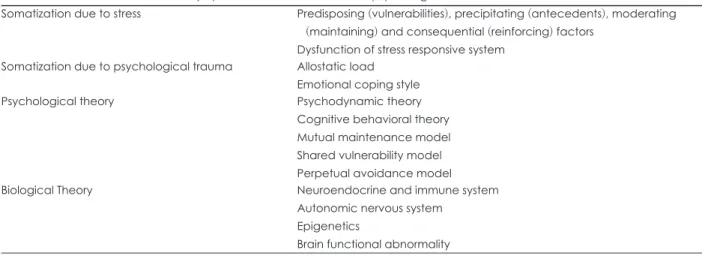
심리외상에 의한 신체증상 기전을 설명하기 위해 스트레 스에 의한 신체화 기전, 심리외상에 의한 신체화 기전, 심리 외상에 의한 신체증상의 심리기전, 심리외상에 의한 신체증 상의 생리기전으로 나누었고 각각에 대해 아래에 상술하였 다(Table 1).
Table 1. The mechanism of somatic symptoms and somatization after psychological trauma
Somatization due to stress Predisposing (vulnerabilities), precipitating (antecedents), moderating (maintaining) and consequential (reinforcing) factors
Dysfunction of stress responsive system Somatization due to psychological trauma Allostatic load
Emotional coping style
Psychological theory Psychodynamic theory
Cognitive behavioral theory Mutual maintenance model Shared vulnerability model Perpetual avoidance model
Biological Theory Neuroendocrine and immune system
Autonomic nervous system Epigenetics
Brain functional abnormality
45 1. 스트레스에 의한 신체화 기전
스트레스와 심리외상 기전은 비슷한 부분이 있어 먼저 스 트레스에 의한 신체화 기전에 대한 이해가 필요하다. 스트레 스에 의한 신체화의 기전이 명확하게 확립된 것은 아니지만, 취약인자, 유발인자 및 지속인자로 설명할 수 있다.20) Tak21) 에 따르면, 유전적 소인, 유아기 시절 부모 질병 경험, 유아기 시절 성학대나 방임과 같은 취약인자를 가진 경우 민감화 (sensitization), 급성 심리외상, 감염, 신체외상, 만성 심리외 상, 주의력 장애 등의 유발인자로 인해 신체화가 진행된다.
이후 과도한 신체 귀인 성향(somatic attribution style), 역기 능적 건강 인지 방식, 진단검사 등에 의해 발생하는 의인성 신 체 고착(iatrogenic somatic fixation), 역기능적 적응방식이 나 사회적 재강화(social reinforcement) 등으로 인해 신체증 상이 지속될 수 있다고 제시하였다. 결국 다양한 스트레스요 인과 그것에 의해 발생하는 주관적인 스트레스 경험을 통해 신체증상이 발생하게 된다.20) 스트레스반응체계(stress resp- onsive system)의 기능 이상이 신체화를 야기할 수 있다는 점도 잘 알려져 있다.22,23) 즉 시상하부(hypothalamus) 및 편 도(amygdala)가 피질구조(cortical structures)와 내장 및 신체 구심성 신경(visceral and somatic afferents)으로부터 신호를 받고 시상하부-뇌하수체-부신축(hypothalamic-pituitary- adrenal axis ; HPA)과 자율신경계(autonomic nervous syst- em)를 매개하는 뇌영역으로 신호를 보내게 되는데, 이를 통 해 신체증상이 발생한다는 것이다.21,24) 또한 스트레스로 인 해 코르티코트로핀분비호르몬(corticotropin-releasing hor- mone)의 변화가 일어나고 이로 인해 통증과 피로를 쉽게 느 끼도록 바뀌게 된다.22,23) 면역체계에도 교란이 생겨 호염증 성 사이토카인(pro-inflammatory cytokines)들의 변화에 의 해 피로, 무력감, 통각 과민, 자신의 신체증상에 집착하게 되 는 등의 비특이적 반응이 일어날 수 있다.25)
2. 심리외상에 의한 신체화 기전
D’Andrea 등26)에 따르면 심리외상 경험으로 인한 신체화 기전을 정신과적 고통(psychiatric distress) 유무에 따라 2가 지로 나누어 설명하였다. 첫 번째가 PTSD, 우울증, 불안장애 등 정신과적 고통이 명백한 경우 만성 스트레스에 의한 적응 부하(allostatic load) 이론으로 설명되었다. 즉, 심리외상을 통해 외상과 비슷한 자극에 민감하게 됨으로써 지속적으로 스트레스 반응을 촉진시키고, 이를 통해 일련의 관련된 급성 스트레스요인들이 반복적으로 나타나는 것이다. 결국 만성 스트레스 경험에 의한 적응부하와 매우 유사하게 신체증상 을 일으키게 된다.27) 두 번째, 정신과적 고통을 느끼지 못하 는 상태에서도 심리외상을 입은 경우 신체화가 진행될 수 있 다는 것이다. 이 기전은 심각한 스트레스 반응이 없는 상태
라도 심리외상과 연관된 자극에 자율신경계 반응이 반드시 일어난다는 가정에서 출발한다. 자율신경계 반응으로 발생 하는 고통은 있지만 스스로 느낄 수 없는 역치 이하 상태이 거나 스트레스를 줄이기 위해 사용하는 적응 방식이 신체화 이기 때문에 다른 스트레스 반응 없이도 신체증상을 나타낼 수 있다고 제안하였다.26) 이 부분이 만성 스트레스와 연관이 없는 신체화에 대한 심리외상 이론으로 적합하다.
3. 심리외상에 의한 신체증상의 심리기전 1) 정신역동이론
정신역동이론에 따르면 자아가 위협받는 상황에서 무의식 적으로 자신을 속이거나 상황을 다르게 해석하여, 감정적 상 처로부터 자신을 보호하는 방어기제를 사용하게 된다. 심리 외상 이후 흔히 억압, 부정, 반동형성, 취소와 같은 방어기제 가 사용되지만28) 신체화도 다른 방어기제처럼 정신내적 스 트레스를 낮추기 위해 사용될 수 있다.29,30) 또한 방어기제로 서 신체화는 외상경험 및 해리와 밀접하게 연관되어 있다는 이론은 신체화장애를 가진 사람들에게 외상경험이나 해리의 과거력이 많다는 연구들로 입증이 되었다.31) 외상 이후의 신 체화는 강렬한 정서상태에 압도되어 외상 경험과 현재의 자 극을 구별하지 못하는 상태와도 밀접하게 연관되었다는 보 고도 있다.32) 외상 이후 복잡한 감정 상태를 실제보다 과장하 거나 더 실제처럼 보이도록 구체화하는 과정 또는 과거 신체 경험을 재현하는 과정에서 신체증상이 나타내게 된다는 것 이다.
2) 인지행동이론
외상경험이 위협적인 잠재 자극을 인식하는 과정에 영향 을 미친다는 신체화의 인지행동이론도 있다. 신체증상 발생 에 있어서 심리외상의 중요성을 강조한 Brown33)은 심리외 상이 유발인자로 작용하여 신체증상을 발생시킨다고 주장하 였다. 예를 들어 외상사건 동안 방어기제로 발생한 부동 (freezing)이나 통각상실(analgesia)과 같은 증상들이 기억에 표상(representation)으로 남겨진다는 것이다. 외상경험 이후 일어난 생리 변화가 외상 이전으로 회복되지 못할 때 주의감 독체계(supervisory attentional system)는 신체에 집중하게 되고 인지의 왜곡을 초래하는 것이다. 이런 경험들이 기억에 남겨진 강렬한 체성감각의 표상들로 하여금 질병경험의 확 대로 이어지게 하고 이를 통해 최종적으로 신체증상을 유발 하게 되는 것이다.
3) 상호유지모델
상호유지모델(mutual maintenance model)에 따르면 외상 에 대한 주의편향은 외상으로 인한 통증 발생 가능성을 과도 하게 평가하고,34) 불안민감성으로 인해 통증에 취약해지도록
46
한다.35) 심지어 주의편향으로 인해 신체증상의 파국반응까지 나타날 수 있다.36) 또한 외상으로 인한 우울증, 활동수준 감 소, 불안 등에 의해 발생하는 주의편향으로 인해 통증 자각 이 증가한다는 주장도 있다.37)
4) 취약성공유모델
상호유지모델에서와 같이 외상으로 인해 불안민감성이 증 가되어 신체증상이 발생한다는 취약성공유모델(shared vuln- erability model)로도 설명된다. 불안민감성으로 인해 신체증 상과 관련된 경험이 발생하게 되면, 공포, 불안, 회피반응이 증가하고, 이로 인해 시간이 지남에 따라 통증이 점차 증가 하여 지속된다는 것이다.38,39)
5) 영구회피모델
악화된 신체증상이 회피반응의 증가로 이어져 활동성 저하 와 우울감과 연결된다는 영구회피모델(perpetual avoidance model)도 외상경험 후 신체증상을 설명하는데 유용하다.40)
4. 심리외상에 의한 신체증상의 생리기전 1) 신경내분비계 및 면역계
심리외상 이후에 발생하는 주된 생리반응의 핵심은 HPA 의 활성화이다. HPA 활성화는 신경내분비 및 면역 기능, 중 추신경계, 그리고 말초기관에 대한 영향을 통해 신체증상을 일으킨다. HPA 활성화에 직접적으로 영향을 받은 중추신경 계를 통해 전환장애, 운동장애, 마비, 감각박탈과 같은 가성 신경 증상(pseudoneurological symptoms)을 초래할 수 있다.
또한 HPA 활성화가 주로 심뇌혈관계나 면역계에 영향을 미 쳐 신체증상이 만들어지게 된다.41)
2) 자율신경계
더불어 자율신경계의 변화로도 외상 이후의 신체증상을 설명할 수 있다. 즉, 위협이나 심리외상에 노출되면 교감신 경계의 과각성과 부교감신경계의 저각성을 통해 생존반응이 일어난다.42) 위협이 그친 이후에도 외상경험자들은 지속적으 로 직간접적인 외상과 관련되어 자극을 받는 자율신경계의 민감성으로 인해 고통을 겪게 되는 것이다. 이로 인해 신체 감각의 마비나 고통스러운 신체반응의 강화와 같은 형태로 나타나게 된다.43) 이를 더 발전시킨 Porges의 다미주신경이 론(polyvagal theory)44)에 따르면, 의문핵(nucleus ambiguus) 의 복측미주복합체(ventral vagal complex)을 통해 사회참여 (social engagement)라는 첫 반응이 일어난 이후 배측미주복 합체(dorsal vagal complex)에서 매개된 교감신경계의 도 피-투쟁-부동(flight-fight-freeze) 반응과 부교감신경계의 고정-허탈(immobilization-collapse) 반응이 나타난다. 심리 외상 이후에 나타나는 이런 반응들의 연장선상에서 신체증
상이 나타나게 된다. 복측미주복합체는 심장, 식도, 기관지, 후두, 인두와 같은 횡경막 상부기관에서 나가는 신경섬유로 이루어져 있고, 배측미주복합체는 신경섬유, 미주가지(vagal branch), 고립로핵(solitary nucleus)으로 구성되어 있다. 신 경섬유는 심장, 기관지와 소화기관을 포함한 횡경막 하부기 관을 관장하는 뇌하수체로부터 들어오고, 미주가지는 심장 으로 나가며, 고립로핵은 위장관과 폐에 존재하는 화학수용 체와 압력수용체로 들어온다. 따라서 심리외상 이후 자율신 경계의 변동은 심혈관계, 호흡기계, 위장관계, 또한 미주신경 이 관장하는 장기를 통해 여러 신체증상을 만들 수 있다.
3) 후성유전학
외상 이후에 발생하는 신체증상을 설명하기 위해서 후성 유전학적(epigenetic) 관점도 필요하다. 후성유전학의 관점 에서 디옥시리보핵산(deoxyribonucleic acid ; DNA)의 메틸 화는 중요한 작용 기전이다. 심리외상 이후의 DNA 메틸화 는 유전자 발현과 역의 관계를 가지는데45) 유소년기의 스트 레스나 심리외상은 해마에 있는 글루코코르티코이드 수용체 유전자와 혈액 세포의 DNA 메틸화를 증가시킨다.46,47) 반면 외상사건은 면역 관련 유전자들의 메틸화를 감소시켜 면역 계를 활성화시킴으로써,48) 염증 생체표지자인 인터루킨(int- erleukin-1β, interleukin-6), 종양괴사인자(tumor necrosis factor-α), C-반응단백질(C-reactive protein) 등이 상승된다 는 보고도 있다.49,50) 결국 신경내분비 및 면역 기능의 교란으 로 인해 신체증상이 나타나게 된다고 할 수 있다.41)
4) 뇌영상연구
최근 발표된 Su 등51)의 연구에서 기존 뇌영상연구를 분석 한 것을 보면, 신체화와 관련된 뇌 영역에 내측전전두엽 (medial prefrontal cortex), 쐐기앞소엽(left precuneus), 우측 아래측두피질(right inferior temporal gyrus), 전뇌섬(anteri- or insula), 복측전대상이랑(ventral anterior cingulate gyrus), 소뇌, 후대상피질(posterior cingulate cortex), 미상핵(caud- ate nuclei), 편도(amygdala) 등을 소개하였다. 결국 편도, 내 측전전두엽, 전대상피질(anterior cingulated cortex), 해마(hi- ppocampus), 뇌섬 등 공포의 신경회로 대부분이 신체화에도 영향을 미친다는 것을 알 수 있다. 특히 불안과 동반된 신체 화가 감소된 전뇌섬의 대사와 연관이 있다는 Brody 등52)의 연구와 PTSD를 포함한 불안장애에서 높은 뇌섬의 활성화를 발표한 기능뇌영상 메타연구53)를 고려하면, 심리외상 이후 뇌섬의 활성 변화가 신체증상과 연관이 높을 것이라 생각된 다. 뇌섬의 활성화를 통해 근육, 피부 및 관절의 통증, 작열 통, 혈관운동성 홍조, 심박수 증가, 오심, 방광의 충만감이나 소화기관의 포만감, 공복감, 호흡곤란 등 다양한 신체증상이 나타난다는 보고도 이를 지지하고 있다.54-56)
47
주요 신체증상
외상의 종류에 따라 신체증상의 형태나 빈도가 달라질 수
있다.57-59) 전쟁을 경험한 미국 군인들에서 흔한 신체증상은
수면장애(32.8%), 근골격계통증(32.7%), 피로(32.3%), 허리 통증(28.1%) 순으로 보고되었다.57) 반면 르완다에서 집단 학 살 14년 이후 PTSD로 고통을 받고 있는 생존자의 신체증상 에 대한 연구에서는 허리통증(74.1%), 두통(72.5)% 순으로 보고되었다.58) 국내 소방공무원을 대상으로 한 연구에서는 수면장애, 근신경계장애, 소화기장애, 심혈관계 순이었다.59) 아래는 각각 세부 신체증상을 임상에서 증상을 보고하는 순 서대로 기술하였다.
1. 두경부 증상
외상사건 이후 두통은 매우 흔하게 나타나는 증상이다.60) 유아기에 학대를 받은 사람도 두통을 많이 호소하는 것으 로 알려져 있다.61) PTSD 환자들은 만성 편두통을 삽화성 편 두통보다 더 많이 호소한다고 보고되었다.62) 직접적인 외상 사건보다는 가족 및 연인의 죽음이나 심각한 질병으로 발생 하는 심리외상으로 인해 두통이 더 잘 발생한다는 보고도 있다.63)
외상 이후 가장 흔하게 나타나는 안과 증상은 시야흐림 (blurred vision)이다.64,65) PTSD 치료에서 흔히 처방되는 세 로토닌재흡수억제제, 삼환계항우울제, 벤조다이아제핀 등 의 부작용으로 인해 시야흐림이 발생할 수도 있어 감별이 필요하다.65) 재향군인 대상 연구에서는 높은 비율의 안구건 조증(약 12%)을 보고하였고 이 연구에서 PTSD가 있는 군 이 없는 군보다 약 2배 정도 안구건조증을 더 호소하였다고 밝혔다.66)
이명도 외상과 밀접하게 연관되어 있다고 알려져 있고,10) 이명을 갖고 있는 재향군인 대상 연구에서는 PTSD를 겪고 있는 재향군인들의 이명이 더 심각하였고 사소한 자극에도 쉽게 악화되었다.67) 또한 청력저하도 외상 이후 잘 발생할 수 있는 증상으로 알려져 있다.64)
2. 흉부 증상
Pietrzak 등68)은 심리외상의 수가 많을수록 동맥경화, 고혈 압, 협심증, 빈맥, 심근경색과 고콜레스테롤혈증이 더 많이 발생하고, PTSD 환자가 협심증, 고혈압, 관상동맥질환, 빈 맥, 고콜레스테롤혈증 및 심부전 등 기타 심장질환을 더 많 이 갖고 있다고 보고하였다.68-70) PTSD로 인해 심근병증이나 중증의 가역적 좌심실부전이 발생했다는 보고도 있다.71,72) 심장질환 자체뿐만 아니라 심장질환으로 인한 사망률도 더 높은 것으로 조사되었다.69)
유년기의 부정적 경험, 신체 및 성적학대는 PTSD가 발생 하지 않더라도 만성 기관지염, 폐기종 및 만성 폐질환과 연 관이 있었다.73,74) 베트남전쟁 당시의 쌍둥이 연구에서 천식 이 많이 발생하였다고 보고되었다.75) 2001년 발생한 9.11테 러 연구에 따르면 PTSD에 동반하여 주관적인 천식 증상이 많이 호소하였고,76) PTSD의 증상 심각도가 주관적인 천식 증상 심각도의 예측 인자라는 보고도 있다.77)
3. 복부 증상
성폭행 이후 과민성대장증후군과 같은 기능성소화기장애 의 위험이 증가한다는 것은 잘 알려진사실이다.14,60,78) 많은 연구들에서 일관적으로 PTSD 환자들이 과민성대장증후군, 변비, 기능성소화장애, 역류성식도염, 비경화성 간질환의 위 험성이 높았다고 보고되었다.68,79-81) 반면, 유년기에 부정적 경험이나 신체 및 성적학대가 있었던 경우 PTSD의 유무와 상관 없이 위염, 위궤양, 비경화성 간질환과 밀접하게 연관 이 있었다는 보고도 있다.68) 또한 PTSD를 겪은 환자들이 시 간이 지남에 따라 알라닌 아미노전이효소(alanine aminotr- ansferase)나 알칼리성 인산분해효소(alkaline phosphatase) 와 같은 간효소가 증가한다는 보고가 있다.82)
성폭행이란 외상사건은 골반통, 외음부 통증, 성교통증, 간 질성 방광염, 자궁내막증, 생리불순과 같은 비뇨생식기계 증 상도 야기할 수 있다.83-87) 약 700명의 만성 골반통을 호소하 는 여성을 조사한 Meltzer-Brody 등88)은 연구대상자의 약 46%가 성폭행이나 신체학대의 과거력이 있었으며 2번 이상 의 외상경험이 있었고 약 3분의 1에서 PTSD에 해당되는 상 태로 보고하였다. 이를 통해 만성 골반통이 외상경험의 횟수 와 PTSD 여부와 밀접한 연관이 있다는 점을 밝혔다. 또한 외상사건이 성병의 위험을 증가시키는 것으로 보고되었다.68)
4. 기타 근골격계 증상
성폭행과 같은 외상사건으로 인해 PTSD가 발병하지 않아 도 허리통증과 같은 국소 통증이 발생할 수 있다.89) 악관절 통증의 경우 그 질환 유병률이 PTSD 증상이 심해질수록 증 가한다고 보고되었다.90) 또한 성폭행 이후 섬유근육통60,89,91) 이나 만성통증증후군92)과 같은 전신 통증이 발생하기도 한 다. PTSD도 섬유근육통이나 만성통증증후군과 밀접하게 연 관이 있는 것으로 보고되고 있다.93,94) 반면 외상사건으로 인해 통각(pin prick), 가벼운 촉각(light tough), 냉감각(cold per- ception)과 같은 체성감각(somatosensory)의 박탈이 일어난 다는 보고도 있다.95)
유년기 시절의 방치, 신체 및 성적학대가 관절염의 위험을 증가시킬 수 있다.68,74) 또한 PTSD가 있을 경우 외상경험 후 PTSD가 발생하지 않은 군보다 관절염의 위험이 더 증가하 는 것으로 보고되었다.68)
48
5. 피부 및 면역계 증상
스트레스의 빈도 및 강도에 따라 면역 반응의 교란이 심해 지는 것처럼 외상경험이 체액성 면역과 세포성 면역을 모두 억제된다고 알려져 있다.96) 유년기의 성적학대는 자가면역질 환의 위험을 4배 이상 높이며, 성폭력을 당한 여성 또한 자가 면역질환의 위험이 5배 이상 높다고 알려져 있다.74) PTSD로 고통을 겪는 베트남전쟁 참전자들에게서 T세포 증가, 지연 성 피부과민증 검사에서 보고된 증가된 면역 반응, 면역글로 불린-M의 농도 상승 등이 알려져 있어 만성 PTSD 환자는 건선과 같은 자가면역질환의 위험이 높다고 할 수 있다.97)
외상 이후 피부는 비만세포 활성도 및 히스타민의 증가로 인해 가려움과 긁힘에 취약하게 되어 상처를 입기 쉬운 상태 가 된다.98) 또한 각성과 반응성의 증가로 인해 가려움증, 발 모광, 다한증, 피부묘기증이나, 특발성 두드러기와 같은 피부 계통 증상이 나타나기도 한다.43) PTSD의 과각성 상태가 피 부묘기증, 특발성 두드러기, 혈관부종과 연관이 있다는 보고 도 있다.99) 발모광, 인공 피부염(dermatitis artefacta), 손톱 물 어뜯기, 신경증성 긁은 상처(neurotic excoriation)와 같은 모 습이 불안감을 낮추기 위한 행동으로 인해 나타날 수 있다는 점도 고려해야 한다.98)
한편, 외상경험 자체가 인간면역결핍바이러스(HIV)에 감 염될 확률을 높이지는 않지만 PTSD 환자의 경우 인간면역 결핍바이러스에 감염될 위험이 높다는 보고도 있다.68)
6. 기타 전신 증상
심인성 비간질발작(psychogenic nonepileptic seizures)도 일반적인 심리외상이나, 신체 및 성적학대, 그리고 PTSD을 가진 집단에서 대조집단보다 많이 나타나는 증상이다.60,100,101)
또한 진전, 근긴장이상, 파킨슨증, 운동이상증과 같은 심인성 운동장애는 외상사건 이후에 잘 발생하고,102) 특히 심인성 진 전은 PTSD에 동반된 가장 흔한 심인성 운동장애이다.103)
외상 이후 비만,73) 대사증후군, 고지혈증, 고혈압104)의 위험 이 증가 한다고 알려져 있다. PTSD도 비만, 이상지질혈증 등 대사증후군105,106)의 위험을 높이고, 당뇨 발생97,105)과 밀접 하게 연관되어 있다고 보고되었다. 또한 총 삼요드티로닌 (total triiodothyronine ; T3), 유리 티록신(free thyroxine ; T4), 갑상선결합 글로불린(thyroid binding globulin), 총 T3/
유리 T4 비율의 경우 PTSD 비환자군에 비해 PTSD 환자군 에서 더 높았다고 보고되었다.107,108)
심리외상에 의한 신체증상의 치료
심리외상이나 PTSD와 연관된 신체증상에 대한 문헌은 많 이 있지만 이런 신체증상의 표준화된 치료에 대한 연구는 거
의 존재하지 않는다. 캄보디아 난민을 대상으로 한 연구109)는 PTSD에 동반된 시야흐림, 이명, 두통, 경추 통증, 수족냉증, 팔다리 통증 및 악화와 같은 증상이 PTSD 약물치료 3개월 이후에 좋아졌다고 보고하였다. 신체학대나 성폭력으로 인 한 여성의 만성 PTSD 환자에서 지속노출치료와 인지재구성 을 통해 PTSD증상, 우울증상과 함께 신체증상의 호전이 나 타났다는 보고도 있다.110) 90명의 참전용사를 대상으로 한 후 향적 연구111)에서는 약물치료 및 그룹치료 후 통증이 유의하 게 감소하였다고 보고하였다. 인지행동치료(cognitive beh- avioral therapy; CBT)와 함께 신체활동을 하도록 처방 받은 군이 CBT만을 받은 군보다 통증이 감소 하였으나,112) 만성 PTSD 환자들에게 실시한 외상초점(trauma-focused) CBT 에서는 통증 감소가 제한적이었다고 보고되었다.113) 소방관 을 대상으로 한 횡단연구114)에서 마음챙김 기술(mindfulness skills)과 신체증상이 역의 관계라고 보고되었지만, PTSD 진 단을 받은 재향군인을 대상으로 마음챙김 기반 스트레스 완 화(mindfulness based stress reduction) 프로그램을 시행한 연구115)에서는 신체건강에 현저한 호전을 밝히지 못한 상태 이다. 운동을 통해 PTSD 이후 발생하는 만성 통증의 통증 민감도를 낮춘다는 예비연구 결과도 보고되었다.116)
정신치료에서 외상 이후 신체화 증상을 외상 이후에 발생 하는 해리 증상의 일종으로 이해하여 외상기억과의 통합이 필요하다는 주장도 있다.117) 이를 통한 자기 조절과 자아 재 구성이 치료의 핵심이며 치료를 통해 안정감과 예측 가능성 을 회복해야 한다는 것이다.118) 특히 치료시 외상경험에 대한 느낌(the feeling of the experience)과 현실감각(the sense of reality)에 집중해야 효과가 있다는 것이다.118) 안구운동 민감 소실 및 재처리요법(eye movement desensitization and repr- ocessing)은 언어 표현보다 신체 감각에 집중하며 감정적 경 험(emotional experience)이 새로운 묘사(emerging narrat- ive)로 통합하기 때문에 신체증상을 호소하는 환자에게 유용 한 치료로 알려져 있다.118)
결 론
심리외상 이후와 PTSD에서 보이는 신체증상은 매우 흔하 며 두경부, 흉부, 복부, 근골격계, 피부 및 면역계, 신경계, 내 분비계에 이르기까지 매우 다양하게 나타난다. 외상후스트 레스반응과 PTSD의 경과와 기능장애를 고려할 때, 동반된 신체증상은 외상후스트레스반응과 PTSD의 중요한 고려 대 상이다. 심리외상 이후와 PTSD에서 신체증상이 발생하게 되는 기전은 심리학적 관점과 생리학적 관점에서 다양한 기 전이 복합적으로 관여된 것으로 여겨진다. 현재까지 심리외 상 및 PTSD 연관 신체증상의 표준화된 치료에 대한 연구는
49 거의 존재하지 않고 PTSD 자체의 치료에 집중하는 것으로
도 연관되는 신체증상이 좋아진다는 보고만 존재하는 실정 이다. 향후 좀더 많은 연구가 심리외상과 PTSD에서 보이는 신체증상에 대해 진행되어야 하며 임상의와 재난정신건강지 원 실무자는 심리외상에 대한 개입이나 PTSD에 대한 치료 시 신체증상의 동반을 항상 염두에 두어야 하겠다.
REFERENCES
(1) Lazarus RS. From psychological stress to the emotions: a history of changing outlooks. Annu Rev Psychol 1993;44:1- 21.
(2) APA. Diagnostic and Statistical Manual of Mental Disorders.
fifth edition ed: American Psychiatric Association;2013.
(3) van der Kolk BA, Roth S, Pelcovitz D, Sunday S, Spinaz- zola J. Disorders of extreme stress: The empirical foundation of a complex adaptation to trauma. J Trauma Stress 2005;18:
389-399.
(4) Taylor S, Asmundson GJ, Carleton RN. Simple versus complex PTSD: a cluster analytic investigation. J Anxiety Disord 2006;20:459-472.
(5) 5Westermeyer JJ, Campbell R, Lien R, Spring M, Johnson DR, Butcher J, Hyland J, Thuras P, Jaranson JM. HADStress:
a somatic symptom screen for posttraumatic stress among So- mali refugees. Psychiatr Serv 2010;61:1132-1137.
(6) 6Burton C. Beyond somatisation: a review of the understand- ing and treatment of medically unexplained physical symp- toms (MUPS). Br J Gen Pract 2003;53:231-239.
(7) Escobar JI, Hoyos-Nervi C, Gara M. Medically unex- plained physical symptoms in medical practice: a psychiatric perspective. Environ Health Perspect 2002;110 Suppl 4:631- 636.
(8) Osorio C, Carvalho C, Fertout M, Maia A. Prevalence of post-traumatic stress disorder and physical health complaints among Portuguese Army Special Operations Forces deployed in Afghanistan. Mil Med 2012;177:957-962.
(9) North CS. Somatization in survivors of catastrophic trauma: a methodological review. Environ Health Perspect 2002;110 Suppl 4:637-640.
(10) Hinton DE, Otto MW. Symptom Presentation and Symptom Meaning Among Traumatized Cambodian Refugees: Rele- vance to a Somatically Focused Cognitive-Behavior Therapy.
Cogn Behav Pract 2006;13:249-260.
(11) Chung R, Bemak F. Handbook of Asian American psycholo- gy 2nd ed ed. Thousand Oaks, CA: Sage Publications Inc;2007.
(12) Ang DC, Peloso PM, Woolson RF, Kroenke K, Doebbeling BN. Predictors of incident chronic widespread pain among veterans following the first Gulf War. Clin J Pain 2006;22:554- 563.
(13) Ciccone DS, Elliott DK, Chandler HK, Nayak S, Raphael KG. Sexual and physical abuse in women with fibromyalgia syndrome: a test of the trauma hypothesis. Clin J Pain 2005;21:
378-386.
(14) Delvaux M, Denis P, Allemand H. Sexual abuse is more fre- quently reported by IBS patients than by patients with organic digestive diseases or controls. Results of a multicentre inquiry.
French Club of Digestive Motility. Eur J Gastroenterol Hepatol 1997;9:345-352.
(15) Dobie DJ, Kivlahan DR, Maynard C, Bush KR, Davis TM, Bradley KA. Posttraumatic stress disorder in female veterans:
association with self-reported health problems and functional impairment. Arch Intern Med 2004;164:394-400.
(16) Anderberg UM, Marteinsdottir I, Theorell T, von Knorring L. The impact of life events in female patients with fibromyal- gia and in female healthy controls. Eur Psychiatry 2000;15:295- 301.
(17) Doyle JP, Frank E, Saltzman LE, McMahon PM, Fielding BD. Domestic violence and sexual abuse in women physi- cians: associated medical, psychiatric, and professional diffi- culties. J Womens Health Gend Based Med 1999;8:955-965.
(18) Choi HK. Effects of traumatic events on posttraumatic stress disorder, burnout, physical symptoms, and social and occupa- tional functions in Korean fire fighters. Ajou University 2010.
(19) Rohlof HG, Knipscheer JW, Kleber RJ. Somatization in refu- gees: a review. Soc Psychiatry Psychiatr Epidemiol 2014;49:
1793-1804.
(20) Deary V, Chalder T, Sharpe M. The cognitive behavioural model of medically unexplained symptoms: a theoretical and empirical review. Clin Psychol Rev 2007;27:781-797.
(21) Tak LM. Dysfunction of stress responsive systems in somati- zation. University of Groningen 2009.
(22) Lariviere WR, Melzack R. The role of corticotropin-releasing factor in pain and analgesia. Pain 2000;84:1-12.
(23) Fries E, Hesse J, Hellhammer J, Hellhammer DH. A new view on hypocortisolism. Psychoneuroendocrinology 2005;30:
1010-1016.
(24) Dishman RK, Nakamura Y, Garcia ME, Thompson RW, Dunn AL, Blair SN. Heart rate variability, trait anxiety, and perceived stress among physically fit men and women. Int J Psychophysiol 2000;37:121-133.
(25) Dantzer R. Somatization: a psychoneuroimmune perspective.
Psychoneuroendocrinology 2005;30:947-952.
(26) D’Andrea W, Sharma R, Zelechoski AD, Spinazzola J.
Physical health problems after single trauma exposure: when stress takes root in the body. J Am Psychiatr Nurses Assoc 2011;17:378-392.
(27) McEwen BS, Wingfield JC. The concept of allostasis in biol- ogy and biomedicine. Horm Behav 2003;43:2-15.
(28) RJ M. Kaplan & Sadock’s Comprehensive Textbook of psy- chiatry. 9th ed. Philadelphia: Lippincott Williams &
Wilkins;2009.
(29) Janet P. The Major Symptoms of Hysteria. New York: McMil- len;1920.
(30) Vaillant GE. Theoretical hierarchy of adaptive ego mecha- nisms: a 30-year follow-up of 30 men selected for psychologi- cal health. Arch Gen Psychiatry 1971;24:107-118.
(31) Pribor EF, Yutzy SH, Dean JT, Wetzel RD. Briquet's syn- drome, dissociation, and abuse. Am J Psychiatry 1993;150:
50
1507-1511.
(32) Goodsitt A. Self-regulatory disturbances in eating disorders.
International Journal of Eating Disorders 1983;2:51-60.
(33) Brown RJ. Psychological mechanisms of medically unex- plained symptoms: an integrative conceptual model. Psychol Bull 2004;130:793-812.
(34) McCracken LM, Gross RT, Sorg PJ, Edmands TA. Predic- tion of pain in patients with chronic low back pain: effects of inaccurate prediction and pain-related anxiety. Behav Res Ther 1993;31:647-652.
(35) McFarlane AC, Atchison M, Rafalowicz E, Papay P. Physi- cal symptoms in post-traumatic stress disorder. J Psychosom Res 1994;38:715-726.
(36) Crombez G, Eccleston C, Baeyens F, Eelen P. When somat- ic information threatens, catastrophic thinking enhances atten- tional interference. Pain 1998;75:187-198.
(37) Sharp TJ, Harvey AG. Chronic pain and posttraumatic stress disorder: mutual maintenance? Clin Psychol Rev 2001;21:857- 877.
(38) Asmundson GJ, Coons MJ, Taylor S, Katz J. PTSD and the experience of pain: research and clinical implications of shared vulnerability and mutual maintenance models. Can J Psychia- try 2002;47:930-937.
(39) Muris P, Vlaeyen JW, Meesters C, Vertongen S. Anxiety sensitivity and fear of pain in children. Percept Mot Skills 2001;92:456-458.
(40) Liedl A, Knaevelsrud C. Chronic pain and PTSD: the Perpet- ual Avoidance Model and its treatment implications. Torture 2008;18:69-76.
(41) Gupta MA. Review of somatic symptoms in post-traumatic stress disorder. Int Rev Psychiatry 2013;25:86-99.
(42) Porges SW. The Polyvagal Theory: phylogenetic contributions to social behavior. Physiol Behav 2003;79:503-513.
(43) Corrigan FM, Fisher JJ, Nutt DJ. Autonomic dysregulation and the Window of Tolerance model of the effects of complex emotional trauma. J Psychopharmacol 2011;25:17-25.
(44) Porges SW. The polyvagal theory: new insights into adaptive reactions of the autonomic nervous system. Cleve Clin J Med 2009;76 Suppl 2:S86-90.
(45) Toyokawa S, Uddin M, Koenen KC, Galea S. How does the social environment ‘get into the mind’? Epigenetics at the in- tersection of social and psychiatric epidemiology. Soc Sci Med 2012;74:67-74.
(46) Skelton K, Ressler KJ, Norrholm SD, Jovanovic T, Bradley- Davino B. PTSD and gene variants: new pathways and new thinking. Neuropharmacology 2012;62:628-637.
(47) Perroud N, Paoloni-Giacobino A, Prada P, Olie E, Salz- mann A, Nicastro R, Guillaume S, Mouthon D, Stouder C, Dieben K, Huguelet P, Courtet P, Malafosse A. Increased methylation of glucocorticoid receptor gene(NR3C1in adults with a history of childhood maltreatment: a link with the se- verity and type of trauma. Transl Psychiatry;2011 1:e59.
(48) Uddin M, Aiello AE, Wildman DE, Koenen KC, Pawelec G, de Los Santos R, Goldmann E, Galea S. Epigenetic and im- mune function profiles associated with posttraumatic stress
disorder. Proc Natl Acad Sci U S A 2010;107:9470-9475.
(49) Baker DG, Nievergelt CM, O’Connor DT. Biomarkers of PTSD: neuropeptides and immune signaling. Neuropharma- cology 2012;62:663-673.
(50) Pace TW, Wingenfeld K, Schmidt I, Meinlschmidt G, Hellhammer DH, Heim CM. Increased peripheral NF-kap- paB pathway activity in women with childhood abuse-related posttraumatic stress disorder. Brain Behav Immun 2012;26:
13-17.
(51) Su Q, Yao D, Jiang M, Liu F, Long L, Dai Y, Yu M, Zhang Z, Zhang J, Liu J, Xiao C, Zhao J, Guo W. Decreased inter- hemispheric functional connectivity in insula and angular gy- rus/supramarginal gyrus: Significant findings in first-episode, drug-naive somatization disorder. Psychiatry Res 2016;248:48- 54.
(52) Brody AL, Saxena S, Mandelkern MA, Fairbanks LA, Ho ML, Baxter LR. Brain metabolic changes associated with symptom factor improvement in major depressive disorder.
Biol Psychiatry 2001;50:171-178.
(53) Etkin A, Wager TD. Functional neuroimaging of anxiety: a meta-analysis of emotional processing in PTSD, social anxiety disorder, and specific phobia. Am J Psychiatry 2007;164:1476- 1488.
(54) Craig AD. How do you feel--now? The anterior insula and hu- man awareness. Nat Rev Neurosci 2009;10:59-70.
(55) Craig AD. The sentient self. Brain Struct Funct 2010;214:563- 577.
(56) Oppenheimer SM, Gelb A, Girvin JP, Hachinski VC. Car- diovascular effects of human insular cortex stimulation. Neu- rology 1992;42:1727-1732.
(57) Toblin RL, Riviere LA, Thomas JL, Adler AB, Kok BC, Hoge CW. Grief and physical health outcomes in U.S. soldiers returning from combat. J Affect Disord 2012;136:469-475.
(58) Munyandamutsa N, Mahoro Nkubamugisha P, Gex-Fabry M, Eytan A. Mental and physical health in Rwanda 14 years after the genocide. Soc Psychiatry Psychiatr Epidemiol 2012;
47:1753-1761.
(59) Ahn KH. A study on analysis of job-related physical and mental symptoms, posttraumatic stress of firefigthers. Mok- won University;2015.
(60) Paras ML, Murad MH, Chen LP, Goranson EN, Sattler AL, Colbenson KM, Elamin MB, Seime RJ, Prokop LJ, Zi- rakzadeh A. Sexual abuse and lifetime diagnosis of somatic disorders: a systematic review and meta-analysis. JAMA 2009;
302:550-561.
(61) Romans S, Belaise C, Martin J, Morris E, Raffi A. Child- hood abuse and later medical disorders in women. An epide- miological study. Psychother Psychosom 2002;71:141-150.
(62) Peterlin BL, Tietjen G, Meng S, Lidicker J, Bigal M. Post- traumatic stress disorder in episodic and chronic migraine.
Headache 2008;48:517-522.
(63) de Leeuw R, Schmidt JE, Carlson CR. Traumatic stressors and post-traumatic stress disorder symptoms in headache pa- tients. Headache 2005;45:1365-1374.
(64) Cwikel J, Abdelgani A, Goldsmith JR, Quastel M, Yevel-
51
son, II. Two-year follow up study of stress-related disorders among immigrants to Israel from the Chernobyl area. Environ Health Perspect 1997;105 Suppl 6:1545-1550.
(65) Trachtman JN. Post-traumatic stress disorder and vision. Op- tometry 2010;81:240-252.
(66) Galor A, Feuer W, Lee DJ, Florez H, Carter D, Pouyeh B, Prunty WJ, Perez VL. Prevalence and risk factors of dry eye syndrome in a United States veterans affairs population. Am J Ophthalmol 2011;152:377-384. e2.
(67) Fagelson MA. The association between tinnitus and posttrau- matic stress disorder. Am J Audiol 2007;16:107-117.
(68) Pietrzak RH, Goldstein RB, Southwick SM, Grant BF.
Medical comorbidity of full and partial posttraumatic stress disorder in US adults: results from Wave 2 of the National Epi- demiologic Survey on Alcohol and Related Conditions. Psy- chosom Med 2011;73:697-707.
(69) Edmondson D, Kronish IM, Shaffer JA, Falzon L, Burg MM. Posttraumatic stress disorder and risk for coronary heart disease: a meta-analytic review. Am Heart J 2013;166:806-814.
(70) Tulloch H, Greenman PS, Tasse V. Post-Traumatic Stress Disorder among Cardiac Patients: Prevalence, Risk Factors, and Considerations for Assessment and Treatment. Behav Sci Basel2014;5:27-40.
(71) Bartoli CR, Nadar MM, Loyd GE, Kasdan ML. An atypi- cal case of reverse Takotsubo cardiomyopathy during general anesthesia in a 30-year-old male with post-traumatic stress disorder. J Cardiothorac Vasc Anesth 2011;25:1116-1118.
(72) Wittstein IS, Thiemann DR, Lima JA, Baughman KL, Schulman SP, Gerstenblith G, Wu KC, Rade JJ, Bivalacqua TJ, Champion HC. Neurohumoral features of myocardial stunning due to sudden emotional stress. N Engl J Med 2005;352: 539-548.
(73) Felitti VJ, Anda RF, Nordenberg D, Williamson DF, Spitz AM, Edwards V, Koss MP, Marks JS. Relationship of child- hood abuse and household dysfunction to many of the leading causes of death in adults. The Adverse Childhood Experiences ACEStudy. Am J Prev Med 1998;14:245-258.
(74) Goodwin RD, Stein MB. Association between childhood trauma and physical disorders among adults in the United States. Psychol Med 2004;34:509-520.
(75) Goodwin RD, Fischer ME, Goldberg J. A twin study of post-traumatic stress disorder symptoms and asthma. Am J Respir Crit Care Med 2007;176:983-987.
(76) Brackbill RM, Hadler JL, DiGrande L, Ekenga CC, Farfel MR, Friedman S, Perlman SE, Stellman SD, Walker DJ, Wu D, Yu S, Thorpe LE. Asthma and posttraumatic stress symptoms 5 to 6 years following exposure to the World Trade Center terrorist attack. JAMA 2009;302:502-516.
(77) Fagan J, Galea S, Ahern J, Bonner S, Vlahov D. Relation- ship of self-reported asthma severity and urgent health care utilization to psychological sequelae of the September 11, 2001 terrorist attacks on the World Trade Center among New York City area residents. Psychosom Med 2003;65:993-996.
(78) Rimsza ME, Berg RA, Locke C. Sexual abuse: somatic and emotional reactions. Child Abuse Negl 1988;12:201-208.
(79) Mason HJ, Serrano-Ikkos E, Kamm MA. Psychological morbidity in women with idiopathic constipation. Am J Gas- troenterol 2000;95:2852-2857.
(80) Savas LS, White DL, Wieman M, Daci K, Fitzgerald S, La- day Smith S, Tan G, Graham DP, Cully JA, El-Serag HB.
Irritable bowel syndrome and dyspepsia among women veter- ans: prevalence and association with psychological distress.
Aliment Pharmacol Ther 2009;29:115-125.
(81) Li J, Brackbill RM, Stellman SD, Farfel MR, Miller-Archie SA, Friedman S, Walker DJ, Thorpe LE, Cone J. Gastro- esophageal reflux symptoms and comorbid asthma and post- traumatic stress disorder following the 9/11 terrorist attacks on World Trade Center in New York City. Am J Gastroenterol 2011; 106:1933-1941.
(82) von Känel R, Abbas CC, Begré S, Gander ML, Saner H, Schmid JP. Association between posttraumatic stress disorder following myocardial infarction and liver enzyme levels: a prospective study. Dig Dis Sci 2010;55:2614-2623.
(83) Collett BJ, Cordle CJ, Stewart CR, Jagger C. A comparative study of women with chronic pelvic pain, chronic nonpelvic pain and those with no history of pain attending general prac- titioners. Br J Obstet Gynaecol 1998;105:87-92.
(84) Ehlert U, Heim C, Hellhammer DH. Chronic pelvic pain as a somatoform disorder. Psychother Psychosom 1999;68:87- 94.
(85) Heim C, Ehlert U, Hanker JP, Hellhammer DH. Abuse-re- lated posttraumatic stress disorder and alterations of the hypo- thalamic-pituitary-adrenal axis in women with chronic pelvic pain. Psychosom Med 1998;60:309-318.
(86) Lampe A, Doering S, Rumpold G, Solder E, Krismer M, Kantner-Rumplmair W, Schubert C, Sollner W. Chronic pain syndromes and their relation to childhood abuse and stressful life events. J Psychosom Res 2003;54:361-367.
(87) Weaver TL. Impact of rape on female sexuality: review of se- lected literature. Clin Obstet Gynecol 2009;52:702-711.
(88) Meltzer-Brody S, Leserman J, Zolnoun D, Steege J, Green E, Teich A. Trauma and posttraumatic stress disorder in women with chronic pelvic pain. Obstet Gynecol 2007;109:902-908.
(89) Buskila D, Cohen H. Comorbidity of fibromyalgia and psy- chiatric disorders. Curr Pain Headache Rep 2007;11:333- 338.
(90) Afari N, Wen Y, Buchwald D, Goldberg J, Plesh O. Are post-traumatic stress disorder symptoms and temporomandib- ular pain associated? Findings from a community-based twin registry. J Orofac Pain 2008;22:41-49.
(91) Walker EA, Keegan D, Gardner G, Sullivan M, Bernstein D, Katon WJ. Psychosocial factors in fibromyalgia compared with rheumatoid arthritis: II. Sexual, physical, and emotional abuse and neglect. Psychosom Med 1997;59:572-577.
(92) Raphael KG, Widom CS, Lange G. Childhood victimization and pain in adulthood: a prospective investigation. Pain 2001;92:283-293.
(93) Sharp TJ. The prevalence of post-traumatic stress disorder in chronic pain patients. Curr Pain Headache Rep 2004;8:111-115.
52
(94) Moeller-Bertram T, Keltner J, Strigo IA. Pain and post trau- matic stress disorder-review of clinical and experimental evi- dence. Neuropharmacology 2012;62:586-597.
(95) Mailis-Gagnon A, Nicholson K. On the nature of nonderma- tomal somatosensory deficits. Clin J Pain 2011;27:76-84.
(96) Segerstrom SC, Miller GE. Psychological stress and the hu- man immune system: a meta-analytic study of 30 years of in- quiry. Psychol Bull 2004;130:601-630.
(97) Boscarino JA. Posttraumatic stress disorder and physical ill- ness: results from clinical and epidemiologic studies. Ann N Y Acad Sci 2004;1032:141-153.
(98) Gupta MA. Emotional regulation, dissociation, and the self- induced dermatoses: clinical features and implications for treatment with mood stabilizers. Clin Dermatol 2013;31:110- 117.
(99) Gupta MA, Gupta AK. Chronic idiopathic urticaria and post- traumatic stress disorder(PTSD): an under-recognized comor- bidity. Clin Dermatol 2012;30:351-354
(100) Dikel TN, Fennell EB, Gilmore RL. Posttraumatic stress dis- order, dissociation, and sexual abuse history in epileptic and nonepileptic seizure patients. Epilepsy Behav 2003;4:644-650.
(101) Salmon P, Al-Marzooqi SM, Baker G, Reilly J. Childhood family dysfunction and associated abuse in patients with non- epileptic seizures: towards a causal model. Psychosom Med 2003;65:695-700.
(102) Ellenstein A, Kranick SM, Hallett M. An update on psycho- genic movement disorders. Curr Neurol Neurosci Rep 2011;11:
396-403.
(103) Thomas M, Jankovic J. Psychogenic movement disorders: di- agnosis and management. CNS Drugs 2004;18:437-452.
(104) Magnavita N. Work-Related Psychological Injury Is Associat- ed with Metabolic Syndrome Components in Apparently Healthy Workers. PLoS One 2015;10:e0130944.
(105) Dedert EA, Calhoun PS, Watkins LL, Sherwood A, Beck- ham JC. Posttraumatic stress disorder, cardiovascular, and metabolic disease: a review of the evidence. Ann Behav Med 2010;39:61-78.
(106) Heppner PS, Crawford EF, Haji UA, Afari N, Hauger RL, Dashevsky BA, Horn PS, Nunnink SE, Baker DG. The as- sociation of posttraumatic stress disorder and metabolic syn- drome: a study of increased health risk in veterans. BMC Med 2009;7:1.
(107) Friedman MJ, Wang S, Jalowiec JE, McHugo GJ, Mc- Donagh-Coyle A. Thyroid hormone alterations among wom-
en with posttraumatic stress disorder due to childhood sexual abuse. Biol Psychiatry 2005;57:1186-1192.
(108) Stam R. PTSD and stress sensitisation: a tale of brain and body Part 1: human studies. Neurosci Biobehav Rev 2007;31:530-557.
(109) Hinton DE, Hinton AL, Eng KT, Choung S. PTSD and key somatic complaints and cultural syndromes among rural Cam- bodians: the results of a needs assessment survey. Med An- thropol Q 2012;26:383-407.
(110) Rauch SL, Drevets WC. Stress-induced and Fear Circuitry Disorders, Refi ning the Research Agenda for DSM-V Arling- ton, VA: American Psychiatric Association;2009.
(111) Shipherd JC, Keyes M, Jovanovic T, Ready DJ, Baltzell D, Worley V, Gordon-Brown V, Hayslett C, Duncan E. Veterans seeking treatment for posttraumatic stress disorder: what about comorbid chronic pain? J Rehabil Res Dev 2007;44:153-166.
(112) Liedl A, Muller J, Morina N, Karl A, Denke C, Knaevelsrud C. Physical activity within a CBT intervention improves cop- ing with pain in traumatized refugees: results of a randomized controlled design. Pain Med 2011;12:234-245.
(113) Dunne RL, Kenardy J, Sterling M. A randomized controlled trial of cognitive-behavioral therapy for the treatment of PTSD in the context of chronic whiplash. Clin J Pain 2012;28:755- 765.
(114) Smith BW, Ortiz JA, Steffen LE, Tooley EM, Wiggins KT, Yeater EA, Montoya JD, Bernard ML. Mindfulness is associ- ated with fewer PTSD symptoms, depressive symptoms, phys- ical symptoms, and alcohol problems in urban firefighters. J Consult Clin Psychol 2011;79:613-617.
(115) Kearney DJ, McDermott K, Malte C, Martinez M, Simpson TL. Effects of participation in a mindfulness program for vet- erans with posttraumatic stress disorder: a randomized con- trolled pilot study. J Clin Psychol 2013;69:14-27.
(116) Scioli-Salter E, Forman DE, Otis JD, Tun C, Allsup K, Marx CE, Hauger RL, Shipherd JC, Higgins D, Tyzik A, Ras- musson AM. Potential neurobiological benefits of exercise in chronic pain and posttraumatic stress disorder: Pilot study. J Rehabil Res Dev 2016;53:95-106.
(117) Van der Kolk BA. The body keeps the score: Memory and the evolving psychobiology of posttraumatic stress. Harvard Re- view of Psychiatry;1994 Jan/Feb.
(118) Rodríguez Vega B, Fernández Liria A, Bayón Pérez C. Trau- ma, dissociation and somatization Annuary of Clinical and Health Psychology 2005;1:27-38.