Received: 7 February, 2017 Revised: 24 February, 2017 Accepted: 24 February, 2017
Ⓒ The Korean Society of Mycology
This is an Open Access article distributed under the terms of the Creative Commons Attrib- ution Non-Commercial License (http://creative- commons.org/licenses/by-nc/4.0/) which permits unrestricted non-commercial use, distribution, and reproduction in any medium, provided the original work is properly cited.
Kor. J. Mycol. 2017 March, 45(1): 31-42 https://doi.org/10.4489/KJM.20170004
pISSN : 0253-651X eISSN : 2383-5249
OPEN ACCESS
RESEARCH ARTICLE
대둔산과 칠갑산 나뭇잎에서 야생효모들의 분리 및 특성
한상민, 이상엽, 김하근, 이종수*
배재대학교 바이오 · 의생명공학과
Characterization of Wild Yeasts Isolated from Leaves Obtained from Mt. Daedun and Mt.
Chilgap, Korea
Sang-Min Han, Sang-Yeop Lee, Ha-Kun Kim, Jong-Soo Lee
*Department of Biomedicinal Science and Biotechnology, Paichai University, Daejeon 35345, Korea
*Corresponding author: [email protected]
Abstract
Several yeast strains were isolated from leaves collected from Mt. Daedun and Mt. Chilgap in Korea. A total of 79 strains of 32 species were isolated from 44 leaves obtained from Mt.
Daedun. Cryptococcus spp., including Cryptococcus magnus, were found to be dominant, while 16 strains of Aureobasidium pullulans were isolated. Among the strains isolated from Mt.
Daedun, Asterotremella humicola JSL502, Barnettozyma californica JSL503, Bullera unica JSL501, Bulleromyces albus JSL505, and Candida vaccinii JSL507 are considered rare yeast species in Korea. All of these rare strains, except for Bulleromyces albus JSL505, formed ascospores. Bullera unica JSL501 was able to grow in yeast extract-peptone-dextrose (YPD) medium containing 10% NaCl. Twenty-five yeast strains of 18 species were isolated from 43 leaves obtained from Mt. Chilgap. Six strains of Pseudozyma spp., including three strains of Pseudozyma aphidis, were isolated in the dormant state. Of these strains, the occurrence of Rhodotorula phylloplana JSL515, Rhodotorula pinicola JSL516, Schwanniomyces vanrijiae JSL517, and Sporisorium loudetiae JSL518 is rare in Korea. Only Sporisorium loudetiae JSL518 formed ascospores, while Rhodotorula pinicola JSL516 and Sporisorium loudetiae JSL518 formed pseudomycelia. The halophilic yeast Schwanniomyces vanrijiae JSL517 was isolated and observed to grow in YPD medium containing 5% NaCl.
Keywords: Chilgap Mt., Daedun Mt., Isolation, Leaves, Yeasts
서 론
효모는 자낭포자 또는 담자포자를 생성하는 유성세대와 출아법 등으로 영양생식만 유지하
는 무성세대를 갖는 진균류의 일종으로 오래 전부터 전통 주류와 장류 제조 등에 주로 이용되
어왔다[1].
지금까지 효모는 주로 발효식품과 이들의 원료 등에서 분리, 동정되어 보고되었으나[1, 2]
최근 필자 등이 우리나라 자연 환경의 효모 종 다양성을 확립하기 위하여 우리나라 주요 산과 섬, 논밭과 과수원, 수목원, 하천 등지의 다양한 야생화들로부터 야생효모들을 분리, 동정하 였다[3-10]. 또한 각종 산림 토양[11, 12]이나 담수 주변 토양[13]으로부터 야생 효모들을 분 리, 동정 하였고 이들 중 국내 미기록 효모들을 선별하여 미생물학적 특성 등을 조사하여 보 고하였다.
이들 야생효모 중 약 38%가 Cryptococcus속 균들이었고 Candida속 균들도 많이 분리 되 었으며 지역간, 야생화 종류간의 효모 종 다양성이 있음을 보고하였다.
본 연구에서는 국내 나뭇잎들의 효모 종 다양성 조사 연구의 일환으로 먼저 충청남도 남부 와 전라북도 북부에 걸쳐있는 대둔산과 충청남도 청양군에 있는 칠갑산의 나뭇잎들로부터 야생효모들을 분리, 동정하였고 이들 중 국내 희귀 효모들을 선별하여 이들의 균학적, 배양적 특성을 조사하였다.
재료 및 방법
야생효모의 분리 및 동정
충청남도 금산군과 전라북도 완주군에 있는 대둔산 북쪽과 남쪽 지역에 서식하고 있는 소 나무(Pinus densiflora), 신갈나무(Quercus mongolica), 굴참나무(Quercus variabilis), 졸참 나무(Quercus serrata), 서어나무(Carpinus laxiflora) 등과 충청남도 청양군 대치면 대치리 에 있는 칠갑산에 서식하고 있는 소나무, 편백(Chamaecyparis obtusa), 자작나무(Betula platyphylla), 밤나무(Castanea crenata), 잣나무(Pinus koraiensis) 등의 나뭇잎들을 2016년 6 월과 8월 사이에 무균적으로 채취하여 멸균 튜브에 넣고, 3 mL의 멸균수를 첨가한 후 1시간 동안 진탕하였다. 이들 현탁액 일부를 스트렙토마이신(100 µg/mL)과 앰피실린(100 µg/mL) 이 들어 있는 yeast extract peptone dextrose 한천배지에 도말하고 30에서 48시간 배양한 후 형성된 효모 집락들을 분리하였다[5].
효모의 동정을 위하여 26S rDNA의 D1/D2 부위의 염기서열을 분석하여 결정하였으며 결 정된 염기서열들을 NCBI의 BLAST를 사용하여 데이터베이스에 등록되어 있는 효모들과의 상동성을 비교하였고 분자생물학적 유연관계를 분석하여 동정하였다[5].
국내 희귀 효모의 균학적 특성
전보[4, 6, 11, 14]에서 대둔산과 칠갑산 나뭇잎들로부터 분리한 야생효모들 중 당시에 국 내에 보고되지 않은 희귀 효모들에 대하여 일반 미생물 실험방법 등을 이용하여 형태학적, 배 양학적 특징 등을 조사하였다[10, 11].
결과 및 고찰
대둔산 나뭇잎들로부터 야생효모의 분리 및 동정
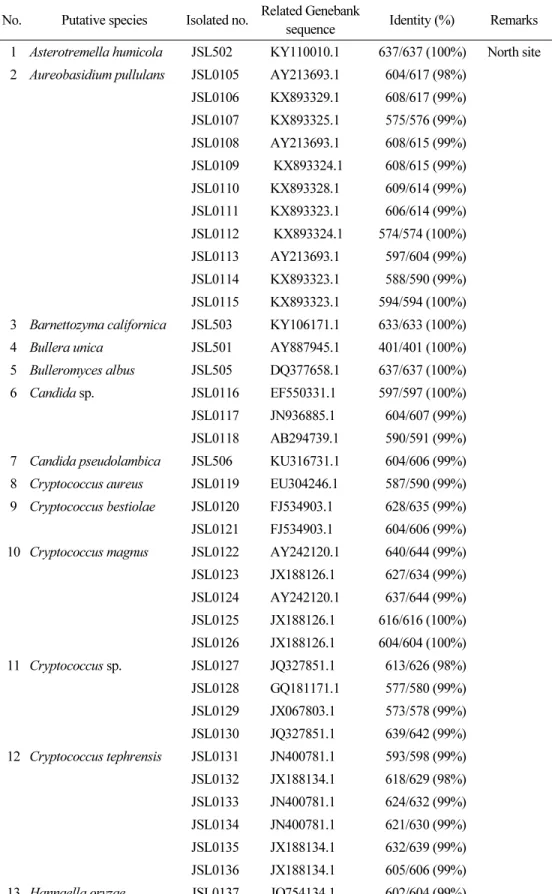
Table 1. Yeast isolated from leaves of Daedunsan Mountain in Korea
No. Putative species Isolated no. Related Genebanksequence Identity (%) Remarks 1 Asterotremella humicola JSL502 KY110010.1 637/637 (100%) North site 2 Aureobasidium pullulans JSL0105 AY213693.1 604/617 (98%)
JSL0106 KX893329.1 608/617 (99%) JSL0107 KX893325.1 575/576 (99%) JSL0108 AY213693.1 608/615 (99%) JSL0109 KX893324.1 608/615 (99%) JSL0110 KX893328.1 609/614 (99%) JSL0111 KX893323.1 606/614 (99%) JSL0112 KX893324.1 574/574 (100%) JSL0113 AY213693.1 597/604 (99%) JSL0114 KX893323.1 588/590 (99%) JSL0115 KX893323.1 594/594 (100%) 3 Barnettozyma californica JSL503 KY106171.1 633/633 (100%) 4 Bullera unica JSL501 AY887945.1 401/401 (100%) 5 Bulleromyces albus JSL505 DQ377658.1 637/637 (100%) 6 Candida sp. JSL0116 EF550331.1 597/597 (100%) JSL0117 JN936885.1 604/607 (99%) JSL0118 AB294739.1 590/591 (99%) 7 Candida pseudolambica JSL506 KU316731.1 604/606 (99%) 8 Cryptococcus aureus JSL0119 EU304246.1 587/590 (99%) 9 Cryptococcus bestiolae JSL0120 FJ534903.1 628/635 (99%) JSL0121 FJ534903.1 604/606 (99%) 10 Cryptococcus magnus JSL0122 AY242120.1 640/644 (99%) JSL0123 JX188126.1 627/634 (99%) JSL0124 AY242120.1 637/644 (99%) JSL0125 JX188126.1 616/616 (100%) JSL0126 JX188126.1 604/604 (100%) 11 Cryptococcus sp. JSL0127 JQ327851.1 613/626 (98%) JSL0128 GQ181171.1 577/580 (99%) JSL0129 JX067803.1 573/578 (99%) JSL0130 JQ327851.1 639/642 (99%) 12 Cryptococcus tephrensis JSL0131 JN400781.1 593/598 (99%) JSL0132 JX188134.1 618/629 (98%) JSL0133 JN400781.1 624/632 (99%) JSL0134 JN400781.1 621/630 (99%) JSL0135 JX188134.1 632/639 (99%) JSL0136 JX188134.1 605/606 (99%) 13 Hannaella oryzae JSL0137 JQ754134.1 602/604 (99%)
Table 1. (Continued)
No. Putative species Isolated no. Related Genebank
sequence Identity (%) Remarks 14 Microstroma juglandis JSL0138 EU069497.1 637/642 (99%)
JSL0139 EU069497.1 637/644 (99%) 15 Plowrightia periclymeni JSL0140 FJ215702.1 589/606 (97%) JSL0141 FJ215702.1 600/616 (97%) JSL0142 FJ215702.1 605/615 (98%) 16 Pseudozyma prolifica JSL0143 KU316746.1 633/638 (99%) JSL0144 KU316746.1 643/649 (99%) 17 Starmerella bombicola JSL0145 U45705.1 510/516 (99%)
1 Aureobasidium pullulans JSL0146 KX893328.1 637/638 (99%) South site JSL0147 KX893325.1 604/606 (99%)
JSL0148 AY213693.1 605/606 (99%) JSL0149 KX893324.1 546/550 (99%) JSL0150 KX893328.1 637/639 (99%) 2 Candida sp. JSL0151 AB294739.1 548/553 (99%) JSL0152 EF621560.1 616/616 (100%) JSL0153 JN936885.1 604/604 (100%) JSL0154 EF550331.1 604/604 (100%) 3 Candida vaccinii JSL507 U45708.1 449/450 (99%) 4 Cryptococcus aureus JSL0155 FJ534903.1 578/578 (100%)
JSL0156 EU304246.1 584/585 (99%) JSL0157 EU304246.1 587/590 (99%) JSL0158 EU304246.1 589/591 (99%) JSL0159 EU304246.1 593/593 (100%) 5 Cryptococcus bestiolae JSL0160 FJ534903.1 594/597 (99%) 6 Cryptococcus flavescens JSL0161 AB698750.1 590/591 (99%) JSL0162 FJ743610.1 598/602 (99%) 7 Cryptococcus magnus JSL0163 AY242120.1 594/594 (100%) JSL0164 JX188126.1 597/597 (100%) JSL0165 JX188126.1 604/607 (99%) 8 Cryptococcus sp. JSL0166 GQ181171.1 613/613 (100%) JSL0167 AY508880.1 639/639 (100%) 9 Cryptococcus tephrensis JSL0168 JX188134.1 588/590 (99%) 10 Cryptococcus terrestris JSL0169 KC006535.1 595/600 (99%) 11 Metschnikowia reukaufii JSL0170 FJ455114.1 513/517 (99%)
JSL0171 JX067756.1 519/523 (99%) JSL0172 JX067756.1 519/525 (99%) 12 Metschnikowia sp. JSL0173 JX257178.1 648/648 (100%) 13 Rhodotorula mucilaginosa JSL0174 HE660055.1 573/575 (99%) 14 Rhodotorula slooffiae JSL0175 EU583485.1 595/596 (99%) JSL0176 AB566328.1 596/600 (99%)
15 Yarrowia lipolytica JSL0177 HF545658.1 510/512 (99%)
대둔산에서 수집한 소나무 등의 나뭇잎들로부터 야생효모들을 분리, 동정한 결과는 Table 1 과 같다. 먼저 대둔산의 북쪽 지역인 충남 금산군 진산면 대둔산 기슭의 나뭇잎 22점으로부 터 모두 17종 46균주의 효모를 분리, 동정하였다. 분리 균주 중 Aureobasidium pullulans가 11 균주로 가장 많았고 Cryptococcus tephrensis가 6균주, Cryptococcus magnus 5균주 순이 었다. 또한 전체 분리 균주 중 Cryptococcus속 균이 18균주로 거의 40%를 차지하여 가장 많 이 분리 되었다.
대둔산의 남쪽 지역인 전라북도 완주군의 대둔산 기슭에 서식하고 있는 나뭇잎 22점에서 는 Cryptococcus aureus와 Aureobasidium pullulans가 각각 5균주를 포함하여 모두15종 33 균주의 야생효모가 분리되었고 대둔산 북쪽에서와 같이 Cryptococcus속 균이 15주로 가장 많았다.
이상의 결과를 종합하면 대둔산 북쪽과 남쪽 지역 나뭇잎들에서 가장 많이 분리된 야생효 모는 Cryptococcus속 균이었고 종 수준에서는Aureobasidium pullulans가 16균주로 가장 많 았으며 공통으로 분리된 효모들은 Cryptococcus magnus 등 7종이었다. 또한 남쪽 지역보다 는 북쪽 지역에 서식하고 있는 나무들의 잎에서 야생효모 2종 13균주가 더 분리되었다.
지금까지 대둔산의 미생물 종 다양성에 대한 연구는 Cho와 Kim[15]이 대둔산 도립공원의 균류 다양성에 관한 연구에서 풀귀버섯, 주황귀버섯, 다색귀버섯, 부채버섯, 졸각버섯 등의 버섯균류들이 다양하게 분포하고 있음을 보고하였을 뿐 곰팡이와 효모 등의 다양성에 관한 연구는 실시 되지 않았다. 따라서 대둔산의 효모 종 다양성 연구 결과들은 대둔산의 생물 종 다양성 확립과 유용자원 개발 등에 귀중한 자료로 활용 될 수 있을 것으로 생각된다.
대둔산 야생효모 중 국내 희귀 효모들의 선별 및 특성
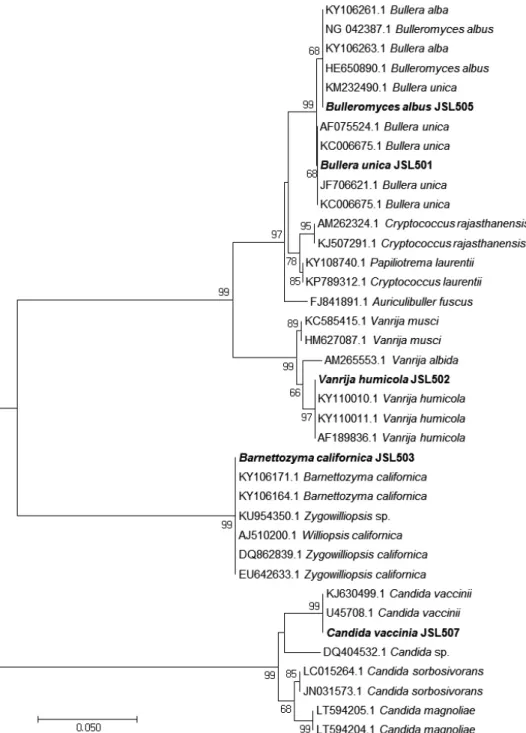
대둔산에서 분리, 동정한 야생효모 중 전보[4, 6, 11]에서 당시 국내 미기록 효모들이었던 Asterotremella humicola JSL502, Barnettozyma californica JSL503, Bullera unica JSL501, Bulleromyces albus JSL505, Candida vaccinii JSL507 국내 희귀 효모 종들의 phylogenetic tree 는 Fig. 1과 같고 이들의 형태적 특징을 조사한 결과는 Table 2와 같다.
이들 균주들중 Bulleromyces albus JSL505만이 포자를 형성하지 않았고 Asterotremella
humicola JSL502 와 Barnettozyma californica JSL503들은 의균사를 형성하였다. 또한
Barnettozyma californica JSL503 만이 비타민이 없는 배지에서 잘 생육하였고 Bullera
unica JSL501 과 Bulleromyces albus JSL505는 10% NaCl을 함유한 yeast extract-peptone-
dextrose (YPD) 배지에서 생육하는 호염성 효모로서 이들로부터 내염성 효소 생산 등의 산
업적 응용에 관한 추가 연구가 요구된다. 이들 국내 희귀 효모들에 대한 외국 학술지 보고로
는 Cadete 등[16]은 아마존 숲 보존 지역의 썩은 목재 시료들로부터 분리한 224주의 야생효
모들 중 xylitol를 생성하는 균주로 Asterotremella humicola를 선별하여 이들의 특성을 보고
하였고 Barnettozyma californica은 포도나 포도주에서 처음 분리되었으며[17], D-xylose를
발효시켰고 xylanase 생산하는 효모로도 보고되었다[18]. Bullera unica에 관한 국외 연구로
Golubev 와 Nakase[19]는 Bullera unica가 균체 외로 생산하는 killer toxin의 항진균활성과
이들의 표현형 등에 대하여 보고 하였고 Nakase[20]는 1980년에서 2000년까지 아시아-태평
양 연안 국가들의 엽권(phyllosphere)에 서식하고 있는 Ballistosporous 효모로 Bullera
unica 를 보고한 바 있다.
Moriyama 등[21]은 Bulleromyces albus가 생산하는 decaprenyl diphosphate synthase 유 전자를 대장균에 형질전환시켜 Co Q 10 과 Co Q 8 을 생산하였다고 보고 하였고 Sampaio 등 [22] 은 포르투갈의 Arrabida 자연공원에서 분리한 Bullera alba와 Bulleromyces albus이 분 류학적으로 완전히 다른 분자생물학적 특성이 있음을 보고 하였다. Candida vaccinii에 관한
Fig. 1. Phylogenetic tree of rare yeasts isolated from Daedunsan Mountain based on the
nucleotide sequences of large subunit 26S ribosomal DNA D1/D2 region. The tree was
generated by the neighbor-joining method, using MEGA7.
국외 연구로 Sipiczki[23]는 Syria의 Malva 꽃에서 분리한, 내염성 Starmerella syriaca가 Candida vaccinii 와 가장 근연의 균임을 보고하였다.
칠갑산 나뭇잎들로부터 야생효모의 분리 및 동정
충남 청양군 대치면 대치리에 위치한 칠갑산 일대의 소나무, 밤나무, 잣나무 등의 나뭇잎 43 점으로부터 야생효모들을 분리, 동정한 결과는 Table 3과 같다.
칠갑산에서는 18종의 효모 25균주 분리하였고 이 중 Pseudozyma aphidis 3균주를 포함하 는 Pseudozyma속 균들이 6균주로 가장 많았고 Debaryomyces hansenii와 Kuraishia capsulate, Schwanniomyces vanrijiae 가 각각 2균주씩 분리 되었다.
칠갑산 야생 효모 중 국내 희귀 효모들의 특성
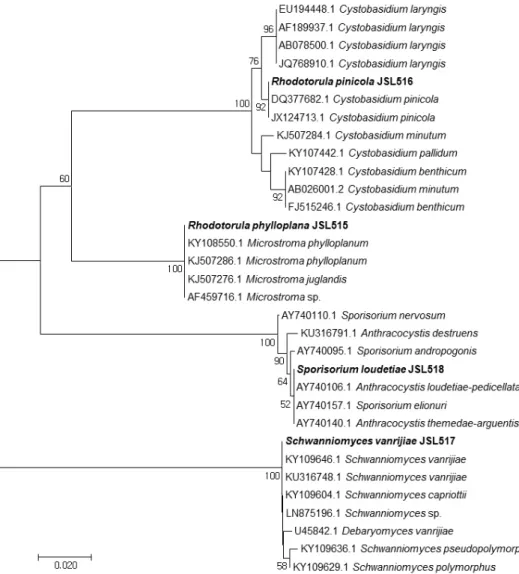
칠갑산 일대 나뭇잎들로부터 분리한 야생효모들 중 전보[11, 14]에서 당시 국내 미기록 효모 들이었던 Rhodotorula phylloplana JSL515와 Rhodotorula pinicola JSL516, Schwanniomyces vanrijiae JSL517 과 Sporisorium loudetiae JSL518의 phylogenetic tree는 Fig. 2와 같고 이 들의 형태적, 배양적 특성을 조사한 결과는 Table 4와 같다. 세포의 형태는 구형~타원형으로
Table 2. Characteristics of the rare yeast species from leaves of Daedunsan Mountain in Korea
Asterotremella humicola JSL502
Barnettozyma californica
JSL503
Bullera unica JSL501
Bulleromyces albus JSL505
Candida vaccinii JSL507 Morphological
characteristics
Shape E E O O O
Vegetative reproduction B B B B B
Size (µm) 0.2 × 0.8 0.3 × 0.7 1.3 × 1.7 0.7 × 1.1 1.9 × 1.2
Ascospore + + + - +
Pseudomycelium + + - - -
Cultural characteristics Growth on
YPD/YM/PD media +++/++/+ +++/+++/+ ++/+++/++ ++/+/++ ++/+/+++
Color on YPD medium P C W C C
Growth on Vitamin-free
medium - ++ - - -
Growth on 50%
glucose-YPD medium - - - - -
Growth on 5%/10%/20%
NaCl-YPD medium -/-/- -/-/- ++/+/- +/+/- -/-/-
Growth on temp/pH range
25~37°C /pH 6~7
25~37°C /pH 4~7
25~30°C /pH 6~7
25~30°C /pH 6~7
25~30°C /pH 6~10
YM, yeast extract-malt extract; YPD, yeast extract-peptone-dextrose; PD, potato-dextrose; E, ellipsoidal; O, oval;
B, budding; +++, very good growth; ++ or +, good growth; -, no growth; P, pink color; C, cream color; W,
white color.
출아에 의해 영양증식을 하였고 Sporisorium loudetiae JSL51은 자낭포자를 형성하는 유포 자 효모이었으며 Sporisorium loudetiae JSL518과 Rhodotorula pinicola JSL516은 의균사 를 형성하였다.
균주 모두 YPD 배지와 yeast extract-malt extract 배지, potatoes dextrose 배지에서 잘 생 육하였고 Schwanniomyces vanrijae JSL517과 Rhodotorula phylloplana JSL515는 비타민 이 없는 배지에서도 잘 생육하였다. 특히 Rhodotorula pinicola JSL516과 Schwanniomyces vanrijiae JSL517 은 5% NaCl을 함유한 YPD 배지에서도 생육하는 호염성 효모이었다. 또한 이들 희귀 효모 균주들은 20~30와 pH 4.0~7.0에서 생육하였다.
이들 효모들에 대한 외국 학술지 발표로 Janisiewicz 등[24]은 자두 표면에서 분리된 Rhodotorula phylloplana 이 핵과류의 균핵병을 생물학적으로 방제하기 위한 유용 효모임을 보고 하였고 Zhou 등[25]은 등골나물(Eupatorium adenophorum)의 병이 없는 잎에서 분리 한 Ustilaginomycetes 균들이 Rhodotorula phylloplana와 근연균임을 보고 하였다. 또한 Vaca 등[26]은 남극 해안 해면동물에서 저온내성 효모로서 Rhodotorula pinicola를 분리하
Table 3. Yeasts isolated from leaves of Chilgapsan Mountain in Korea
No. Putative species Isolated No. Genebank No. Identity (%) 1 Aureobasidium pullulans JSL619 EF595769.1 602/616 (98%) 2 Cystobasidium minutum JSL623 JQ768913.1 628/642 (98%) 3 Debaryomyces hansenii JSL613 KU316714.1 607/613 (99%) JSL612 KU316714.1 608/614 (99%) 4 Kluyveromyces yarrowii JSL616 AF313367.1 569/575 (99%)
5 Kuraishia capsulata JSL605 DQ409142.1 597/606 (99%)
JSL621 DQ409142.1 598/606 (99%) 6 Lachancea thermotolerans JSL608 CU928180.1 607/614 (99%) 7 Meyerozyma guilliermondii JSL609 KU316708.1 605/613 (99%) JSL618 LC134306.1 604/614 (98%) 8 Moesziomyces antarcticus JSL606 LC176928.1 444/444 (100%)
9 Ogataea naganishii JSL611 EU011601.1 567/571 (99%)
10 Plowrightia periclymeni JSL622 FJ215702.1 604/618 (98%)
11 Pseudozyma aphidis JSL614 JN940519.1 637/648 (98%)
JSL615 JN940519.1 633/649 (98%) JSL602 JN940519.1 640/648 (99%) 12 Pseudozyma hubeiensis JSL617 XR_001099828.1 636/649 (98%) 13 Pseudozyma tsukubaensis JSL603 LC177041.1 593/596 (99%)
JSL610 JQ219313.1 605/616 (98%) 14 Rhodotorula phylloplana JSL515 KY108550.1 609/613 (99%) 15 Rhodotorula pinicola JSL516 DQ377682.1 600/601 (99%) 16 Schwanniomyces vanrijiae JSL607 KU316748.1 600/613 (98%) JSL517 KY109646.1 601/603 (99%) 17 Sporisorium loudetiae JSL518 KY109604.1 615/618 (99%) 18 Wickerhamomyces silvicola JSL604 KJ410349.1 606/615 (99%)
여 이들의 균체 외 효소 생성 유무를 확인한 결과 전분과 단백질, 지질 분해 활성이 있어 이들 이 산업적으로 매우 중요한 자원이 될 것으로 보고하였다. Maksimova 등[27]은 러시아 Novosibirsk 근처의 Birch-Pine Grass 숲의 Anthill material에서 우점균 효모로 본 연구의 희 귀 효모인 Schwanniomyces vanrijiae를 보고하였고 Ingold[28]는 Sporisorum loudetiae- pedicellatae 를 남아프리카 북부 Chippind에서 분리하여 이들의 특이적인 동포자(teliospore) 의 발아에 대하여 보고하였다.
적 요
충청남도와 전라북도에 걸쳐있는 대둔산과 충청남도 청양군 칠갑산의 각종 나뭇잎 87점 을 수집하여 야생효모들을 분리, 동정하였다. 대둔산 나뭇잎들에서는 Cryptococcus tephrensis JSL0131 를 포함하는 Cryptococcus속 균이 18균주로 가장 많이 분리되었고
Fig. 2. Phylogenetic tree of rare yeasts isolated from Chilgapsan Mountain based on the
nucleotide sequences of large subunit 26S ribosomal DNA D1/D2 region. The tree was
generated by the neighbor-joining method, using MEGA7.
Aureobasidium pullulans 도 16균주가 분리되었다. 이들 중에서 Asterotremella humicola JSL502, Barnettozyma californica JSL503, Bullera unica JSL501, Bulleromyces albus JSL505 와 Candida vaccinia JSL507이 국내 희귀 효모들이었고 Bulleromyces albus JSL505 와 Bullera unica JSL501은 10%의 NaCl을 함유한 배지에서도 생육하는 호염성 효 모였다. 칠갑산 나뭇잎에서는 Pseudozyma aphidis JSL614를 포함하는 Pseudozyma속 균이 가장 많이 분리 되었다. Rhodotorula phylloplana JSL515, Rhodotorula pinicola JSL516과 Schwanniomyces vanrijiae JSL517 과 Sporisorium loudetiae JSL518 등 4균주들이 국내 희 귀 종이었고 Sporisorium loudetiae JSL518은 포자와 의균사를 형성하였으며 Rhodotorula pinicola JSL516 과 Schwanniomyces vanrijiae JSL517은 5% NaCl을 함유한 YPD 배지에서 생육하는 호염성 효모이었다.
Acknowledgements
This work was supported by a grant from the National Institute of Biological Resources, funded by the Ministry of Environment of the Republic of Korea.
Table 4. Characteristics of the rare yeasts species from leaves of Chilgapsan Mountain in Korea
Rhodotorula phylloplana JSL515
Rhodotorula pinicola JSL516
Schwanniomyces vanrijiae JSL517
Sporisorium loudetiae JSL518 Morphological
characteristics
Shape O O G E
Vegetative reproduction B B B B
Size (µm) 0.9 × 1.2 1.3 × 1.9 1.1 × 1.2 0.8 × 0.2
Ascospore - - - +
Pseudomycelium - + - +
Cultural characteristics Growth on YPD/YM/PD
media ++/+/++ +++/++/++ ++/++/+++ ++/+/++
Color on YPD medium C C P C
Growth on Vitamin-free
medium ++ - ++ -
Growth on 50%
glucose-YPD medium - - - -
Growth on 5%/10%/20%
NaCl-YPD medium -/-/- +/-/- ++/-/- -/-/-
Growth on temp/pH
range 25~30°C/pH 4~7 20~30°C/pH 6~7 20~30°C/pH 4~7 25~30°C/pH 6~7
YM, yeast extract-malt extract; YPD, yeast extract-peptone-dextrose; PD, potato-dextrose; O, oval; G, global; E,
ellipsoidal; B, budding; +++, very good growth; ++ or +, good growth; -, no growth; C, cream color; P, pink
color; W, white color.
REFERENCES