Characteristics of Hydrolytic Enzymes that Produced by Bacillus subtilis CK-2 Isolated from Doenjang
Sang-Hyup Lee and Chul-Ho Kim*
Dept. of Pharmaceutical Engineering, Gyeongnam National University of Science and Technology, Jinju 660-758, Korea Received March 8, 2017 /Revised April 24, 2017 /Accepted July 19, 2017
In the previous paper, we isolated a bacterium that can hydrolyze various organic materials from soy- bean paste, including cellulose, lipids, starch, and protein. The activity and chemical properties of the crude enzymes produced by the isolate Bacillus subtilis CK-2 were further investigated. Cellulase showed the highest activity at pH 5.0 and 55℃. The stability of cellulase was maintained within the ranges of pH 5.0~10.0 and 20~50℃. Cellulolytic enzymes were activated by a Co
2+ion, demonstrating the highest activity at a 0.45%(w/v) concentration of Co
2+. The optimal conditions for amylase were pH 5.0 and 50℃. The activity of amylase was stable within the ranges of pH 4.0~5.0 and 20~50℃.
The Co
2+ion was also necessary for amylase activity, which was the highest at a 0.2%(w/v) concen- tration of Co
2+. The optimal pH and temperature conditions of protease were pH 8.0 and 50℃. The activity of protease was stable within the ranges of pH 7.0~8.5 and 20~50℃. Protease activity was cat- alyzed by Mn
2+, which was the highest at a 0.125%(w/v) concentration of Mn
2+. The isolate B. subtilis CK-2 demonstrated a high activity of autolysin. Based on these results, we identified and suggested the optimal pH, temperature, and metal ion concentration in the use of the hydrolytic enzymes of B.
subtilis CK-2 for industrial purposes.
Key words : Amylase, Bacillus subtilis, cellulase, optimal condition, protease
*Corresponding author
*Tel : +82-55-751-3395, Fax : +82-55-751-3399
*E-mail : [email protected]
This is an Open-Access article distributed under the terms of the Creative Commons Attribution Non-Commercial License (http://creativecommons.org/licenses/by-nc/3.0) which permits unrestricted non-commercial use, distribution, and reproduction in any medium, provided the original work is properly cited.
Journal of Life Science 2017 Vol. 27. No. 7. 805~811 DOI : https://doi.org/10.5352/JLS.2017.27.7.805
서 론
농수임산 폐기물과 음식물 폐기물은 대표적인 유기성 폐기 물로 자원순환이 가능한 물질임에도 불구하고 육상매립 및 해양배출 등의 방법으로 무분별하게 투기되어 환경오염의 대 표적인 물질로 인식되어 왔다. 버섯 재배 과정에서 배지에 함 유되어 있는 각종 영양분의 약 20%만이 이용되고, 나머지는 폐배지 내에 남는다고 보고되고 있으며[36], 재배되는 버섯 종 류에 따라 버섯균이 분비한 각종 생리활성물질과 단백다당류 를 함유한 균사체를 포함하고 있어 다양한 방법으로 높은 이 용가치를 지니고 있다[11].
유기성 폐기물을 구성하는 섬유소, 녹말, 단백질 등을 효과 적으로 분해하는 미생물로는 곰팡이, 효모 등의 진균류와 세 균 등이 있으며, 이들은 모두 자연계의 유기물을 분해하여 물 질의 순환에 기여할 뿐만 아니라, 특히 세균이 분비하는 여러 가지 유기물 분해효소들은 산업적으로 다양하게 활용되고 있 다[15, 16, 18].
최근 농수산물 폐기물과 음식물 폐기물 등의 유기성 폐기물 을 미생물을 이용한 퇴비화 또는 사료화 하는 연구가 활발하 게 진행되고 있지만[3, 28], 섬유소, 녹말, 단백질, 지질 등 각각 의 유기물을 분해하는 세균에 대한 연구는 많이 이루어졌으 나, 이들 모두에 대한 분해능을 갖는 세균에 대한 연구는 미흡 하다.
본 연구에서는 섬유소, 녹말, 단백질, 지질 등 다양한 유기물 을 분해하는 것으로 확인된 Bacillus subtilis CK-2 [19]가 분비 하는 각종 가수분해효소들의 특성을 확인함으로써 이 균주의 산업적 활용을 위한 기초 자료를 마련하고자 하였다
재료 및 방법
사용균주
본 연구에서 사용한 균주는 기존의 연구에서 섬유소, 녹말, 단백질 및 지질에 대한 분해능을 가지는 것으로 확인된 B. sub- tilis CK-2를 사용하였다[19].
사용배지 및 배양방법
분리균주를 NB (nutrient broth, Difco) 배지에 접종하여 200 rpm, 35℃ 배양기에서 배양하였다.
조효소액 제조
각종 가수분해 효소의 활성을 측정하기 위하여 다음과 같이
조효소액(crude enzyme extract) 시료를 준비하였다. 대수생
장기에 있는 B. subtilis CK-2 배지를 6,000× g에서 10분간 원심 분리한 후 상등액을 membrane filter (Φ 0.22 μm)로 2회 여과 하여 각종 효소 활성 측정을 위한 시료로 사용하였다[14].
효소의 활성 측정
각 분해효소의 활성은 다음과 같이 흡광도법으로 측정하였다.
Cellulase 활성 측정
섬유소분해효소의 활성은 3, 5-dinitrosalicylic acid (DNS) 법에 의거하여 CMC로부터 유리되는 환원당의 농도로 측정하 였다[4, 5]. DNS solution은 Na K tartarate 182 g, NaOH 10 g, DNS 10 g, phenol 2 g, NaSO
40.5 g을 증류수 600 ml에 녹인 후 1,000 ml로 정용하여 갈색병에 넣어 4℃에 보관하면서 사용하였다. 기질용액은 완충용액(0.2 M phosphate buffer, pH 7.0)에 1%(w/v) CMC를 녹인 기질용액 0.9 ml를 55℃에서 5분간 예열 시킨 후 조효소액 0.1 ml을 가하여 55℃에서 10분 간 반응 시킨 후 DNS solution 3 ml을 넣어 반응을 정지시켰 다. 이를 끓는 물에 5분간 중탕하여 발색시킨 후 550 nm에서 흡광도를 측정한 다음 얻어진 흡광도 값은 glucose 표준곡선 을 이용하여 생산된 환원당의 양을 계산하였다. Cellulase의 효소활성은 1분간 1 μg의 glucose를 생산하는 효소의 양을 1 unit로 정의하였다.
Amylase 활성 측정
녹말분해효소의 활성은 3, 5-dinitrosalicylic acid (DNS) 법 에 의거하여 녹말이 분해될 때 유리되는 환원당의 농도로 측 정하였다[28, 29]. 기질용액은 완충용액(0.2 M phosphate buf- fer, pH 7.0)에 1%(w/v) soluble starch를 사용하였으며, amy- lase 효소활성은 1분간 1 μg의 glucose를 생산하는 효소의 양 을 1 unit로 정의하였다.
Protease활성 측정
단백질분해효소의 활성 측정은 Anson 방법에 따라서 실시 하였다[2]. 기질용액은 0.5%(w/v) casein을 0.2 M phosphate buffer (pH 7.0)에 가열하여 녹인 후 식힌다. 기질용액 1 ml에 조효소액 1 ml를 넣어 40℃에서 20분간 반응시킨 후, 0.4 M Trichloroacetic acid (TCA)를 2 ml 가하여 반응을 정지시킨 후 25분간 실온에서 방치시킨 다음 여과(Whatman No.2)한 여액 1 ml를 취하여 0.4 M Na
2CO
3용액 5 ml를 첨가한 후 folin 시약 1 ml를 첨가하여 40℃에서 20분간 발색시켜서 660 nm에서 흡광도를 측정하였다. Protease 효소활성은 1분간 1 μg의 tyrosine를 생산하는 효소의 양을 1 unit로 정의하였다.
효소 반응의 최적 조건 최적온도
Cellulase, amylase 및 protease의 반응 온도를 확인하기 위 해서 기질과 효소 혼합액을 35~75℃ 범위에서 20분간 반응시 켜 각 효소의 활성을 측정하였다.
최적 pH
각 효소반응의 최적 pH를 확인하기 위하여 0.2 M sodium citrate buffer (pH3.0, 5.0), 0.2 M phosphate buffer (pH 6.0, 7.0), 0.2 M Tris-HCI buffer (pH 8.0~12.0)를 사용하여 pH 3~12 범위로 조정한 기질에 효소를 첨가하여 반응시킨 후 효 소 활성을 측정하였다.
효소의 열안정성
효소의 열에 대한 안정성을 확인하기 위해서 조효소액 0.1 ml를 25~100℃ 온도 범위에서 60분간 처리한 후 각 효소의 활성을 측정하였다.
효소 활성에 미치는 금속이온의 영향
효소의 종류에 따라 특정 금속은 효소 활성에 영향을 미치 는 것으로 알려져 있는데[10], 본 연구에서는 B. subtilis CK-2가 생성하는 각 분해효소에 대한 각종 금속 이온의 영향을 확인 하고, 적정 농도를 측정하였다.
금속이온의 종류별 효소활성
효소 활성에 미치는 금속이온의 종류별 영향을 확인하기 위하여 MgSO
4, ZnSO
4, CaCl
2, KCl, CuSO
4, Co(NO
3)
2, MnCl
2의 금속염을 0.1%(w/v) 농도가 되게 제조한 기질용액 0.9 ml 에 조효소액 0.1 ml를 넣어 교반하고 55℃에서 10분간 반응시 킨 후 각 효소의 활성을 측정하였다.
금속이온의 농도에 따른 효소활성
Cellulase와 amylase의 활성을 촉진시키는 것으로 나타난 Co
2+이온과 protease의 활성을 촉진시키는 Mn
2+이온의 농도 에 따른 효소활성에 대한 영향을 조사하기 위해 Co(NO
3)
2를 0.05~0.5%(w/v)까지의 농도로 0.05%(w/v) 간격으로, MnCl
2를 0.025~0.15%(w/v) 범위 농도로 0.05%(w/v) 간격으로 기질 용액 0.9 ml에 조효소액 0.1ml를 넣어 교반하고 반응 온도 5 5℃, 50℃, 40℃에서 10분간 반응 시킨 후 효소 활성을 측정하 였다.
결과 및 고찰
효소의 최적 활성 온도
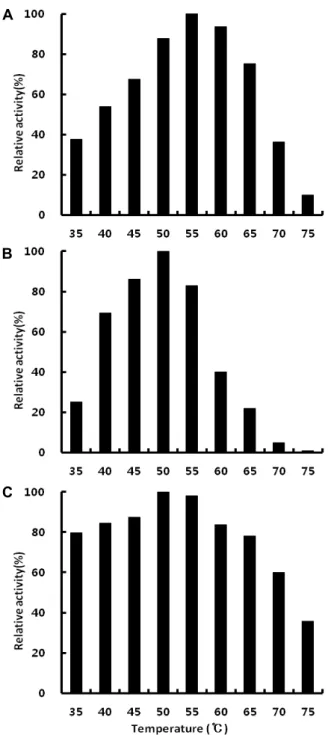
Cellulase, amylase 및 protease의 최적 활성 온도는 Fig.
l에 나타낸 바와 같다. Cellulase는 55℃에서 5.34 units/mg protein으로 가장 높은 활성을 나타내었으며, 35~65℃ 범위에 서 비교적 높은 활성을 보였다. 이러한 결과는 이러한 결과는 대부분의 다른 Bacillus sp.가 생성하는 cellulase가 50℃ 이하 에서 최적 온도를 나타내는 것 보다는 높았으며[21, 31, 34], Bacillus licheniformis [32] 의해 생성된 cellulase의 최적 활성 온도가 55℃라고 한 결과와 일치하였다.
Amylase의 최적 활성 온도는 50℃에서 9.98 units/mg pro- tein으로 가장 높게 나타났다. 이러한 결과는 Bacillus sp.
SUH4-2 (38)이 생산하는 α-amylase와 Bacillus circulans F-2 (8)
A
B
C
Fig. 1. Effects of temperature on activity of hydrolytic enzymes produced by Bacillus subtilis CK-2. A; cellulase, B; amy- lase, C; protease.
생산하는 α-amylase, Bacillus sp. TR-25 (33)가 생산하는 α- amylase의 최적 활성 온도가 60~65℃라는 보고 보다는 낮고, Lee 등[26]의 Bacillus circulans에 의해 생성된 호산성 α-amy- lase, Park 등[30]의 Bacillus subtilis에 의해 생성된 α-amylase 의 최적 활성 온도가 45℃라는 보고 보다 높았으며, Bacillus licheniformis [6]에 의해 생성된 α-amylase의 최적 활성 온도는 48℃ 라는 보고와 유사하였다.
Protease의 최적 활성 온도도 50~55℃에서 0.55~0.56 units/
mg protein으로 높게 나타났으며, 60℃ 이상에서는 온도 상승 에 따라 활성이 급격하게 감소한다는 사실을 확인할 수 있었 다. 이러한 결과는 Bacillus subtilis PANH765 [22]에 의해 생성 된 protease의 최적 활성 온도가 30℃, Shin 등[35]의 Bacillus megaterium에 의해 생성된 protease의 최적 활성 온도가 35℃, Bacillus sp. KUN-17 [14]에 의해 생성된 protease의 최적 활성 온도가 40℃라는 보고 보다 높았다. 반면 Kim 등[23]의 Bacillus sp.에 의해 생성된 protease의 최적 활성 온도 60℃, Chung [9]의 Bacillus subtilis에 의해 생성된 protease의 최적 활성 온 도가 70℃라는 보고 보다 낮았다. Ahn 등[1]의 Bacillus sp.에 의해 생성된 protease, Bacillus subtilis LY-353 [24]에 의해 생성 된 protease의 최적 활성 온도가 55℃, Bacillus subtilis CCKS- 111 [7]이 생성하는 protease 최적 활성 온도가 50℃라는 보고 와 유사하였다.
열에 대한 안정성
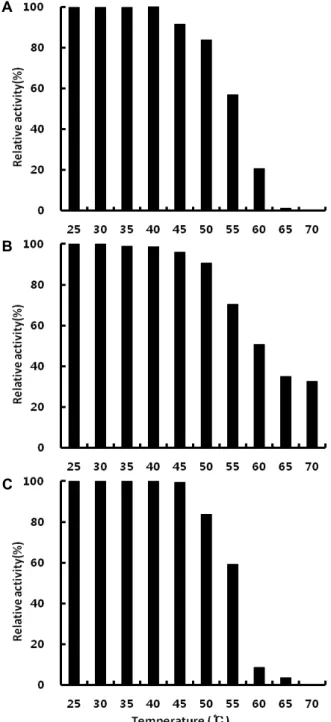
Cellulase, amylase 및 protease 효소반응의 열에 대한 안정 성을 확인하기 위해서 조효소액 0.1 ml를 25~70℃ 온도 범위 에서 20분간 열처리하여 배양용액 중에 잔존하는 각 효소 활 성을 측정한 결과는 Fig. 2과 같았다.
Cellulase, amylase, protease 모두 40℃까지는 각각 7.06 units/mg protein, 5.62 units/mg protein, 0.51 units/mg pro- tein로서 안정하였으며, 50℃ 까지 80% 이상의 활성을 유지하 는 것을 확인하였다. Cellulase는 40℃ 이후 활성이 줄어들고, 65℃에서 활성이 거의 소멸하였다. Amylase는 40℃까지 5.62 units/mg protein의 높은 활성을 보이다가 이후부터 활성이 점차 감소하였다. Protease의 활성은 45℃까지 0.51 units/mg protein 정도로 높게 유지되다가 50℃ 이후 활성이 급격하게 떨어지는 것을 확인하였다.
Cellulase의 경우 Kim 등[20]이 보고한 Bacillus sp., Park 등[31]이 보고한 Bacillus licheniformis, Hwang 등[13]이 보고한 Bacillus licheniformis B1에 의해 생성된 cellulase의 열 안정성 과 유사하였다.
Amylase의 경우에는 Bacillus sp. SUH4-2 [38]가 생산하는 α-amylase가 60℃에서 가장 높은 온도 안전성을 보였다는 것 과는 차이가 있지만, Yi [37]의 Bacillus lentus에 의해 생성된 α-amylase가 48℃ 이하의 온도에서 안정하다는 보고와 유사 하였다.
Protease의 경우에는 Bacillus subtilis JK-1 [20]과 Bacillus subtilis LY-353 [25]에 의해 생성되는 protease에 비해 비교적 낮은 열 안정성을 나타내었고, Ahn 등[1]의 Bacillus sp.에 의해 생성된 protease와 유사한 열 안정성을 보였다.
금속이온의 종류에 따른 효소활성
금속이온이 각 효소 활성에 미치는 영향은 Table 1에 나타
낸 바와 같다. 실험에 사용한 모든 금속이온은 cellulase 활성
Table. 1. Effect of metal ions on activity of hydrolytic enzymes produced by Bacillus subtilis CK-2
Ion Metal Relative activity (%)
Cellulase Amylase Protease Mg++
Zn++
Ca++
K+ Cu++
Co++
Mn++
-
MgSO4․7H2O ZnSO4․7H2O CaCO3
KCl
CuSO4․5H2O Co(NO3)2․6H2O MnCl2․4H2O NONE
66.0 55.6 69.1 71.0 113.4 186.4 159.3 100.0
99.0 78.4 120.1 91.2 92.8 167.1 91.8 100.0
121.3 85.1 97.9 100 117.0 91.5 376.6 100.0
A
B
C
Fig. 2. Temperature stability of hydrolytic enzymes produced by Bacillus subtilis CK-2. A; cellulase, B; amylase, C;
protease.
을 촉진하는 것을 확인하였으며, 특히 Co
2+이온을 첨가하였을 때 12.23 units/mg protein로서 무처리구의 6.56 units/mg protein에 비하여 2배 정도 높은 효소 활성을 나타내었다.
Mg
2+와 Cu
2+이온은 각각 10.45 units/mg protein, 7.44 units/
mg protein로서 효소 활성을 촉진하는 것을 확인하였다. 이러 한 결과는 다른 논문에서 Bacillus sp.가 생성하는 cellulase가 Co
2+이온[21]과 Cu
2+이온[32]에 의해 활성이 촉진된다는 보 고와 유사함을 알 수 있다. 반면 Zn
2+이온을 처리하였을 때는
효소활성이 가장 현저한 저해 효과를 나타내었고, Mg
2+과 Ca
2+, 그리고 K
+도 효소 활성을 저해한다는 사실을 확인하였다.
Amylase 활성은 조효소액에 Co
2+와 Ca
2+를 첨가 하였을 때 활성이 증가하였으며, 특히 Co
2+를 첨가하였을 때 10.21 units/
mg protein으로, 무처리구의 6.11 units/mg protein에 비하여 훨씬 높은 효소 활성을 나타내었다. Zn
2+을 첨가하였을 때는 효소활성이 20% 이상 감소하였고, Mg
2+이온은 영향이 거의 없었으며, K
+, Cu
2+, 그리고 Mn
2+에 의해서는 효소활성이 약 10% 저해되는 것을 확인하였다. 이러한 결과는 Roh 등[35]이 보고한 Bacillus sp. TR-25에 의해 생성된 α-amylase의 경우 Ca
2+에 의해 효소 활성이 촉진되고, Mn
2+과 Cu
2+는 효소 활성 에 영향을 미치지 않았다는 보고와 차이가 있다.
Protease 활성은 Mg
2+, Cu
2+, 그리고 Mn
2+을 첨가하였을 때 효소활성이 높았으며, 특히 Mn
2+이온을 처리하였을 때에는 1.77 units/mg protein로서 무처리구의 0.47 units/mg protein 에 비하여 3배 이상 효소 활성을 촉진시키는 것으로 나타냈다.
이러한 결과는 Choi 등[7]의 Bacillus subtilis CCKS-111와 Kim 등[24]의 Bacillus sp.가 생성하는 protease가 Cu
2+에 의해 활성 이 가장 높았다는 보고와 차이가 있다. 반면 Zn
2+을 첨가 하였 을 때 약 15%, Co
2+를 첨가하였을 때 약 9% 효소활성이 억제 되었는데, 이는 Chung 등[9]의 Bacillus subtilis가 생성하는 protease의 경우 Zn
2+에 의해 활성이 촉진된다는 보고와 차이 가 있다. K
+이온은 protease 활성에 영향이 미치지 않는 것으 로 확인되었다.
금속이온의 농도에 따른 효소활성
Cellulose와 amylase의 활성을 높여준 금속이온 중 활성이 가장 높았던 Co
2+이온과 protease의 활성을 촉진하는 것으로 확인된 Mn
2+이온을 대상으로 농도에 따른 각 효소활성에 대 한 영향을 측정한 결과는 Fig. 3, Fig. 4, 그리고 Fig. 5와 같다.
Cellulase의 경우 Co
2+이온에 의해 활성이 촉진되는 것을
확인할 수 있었는데, 무처리구에서 6.43 units/mg protein인 반
면 0.35% 이상의 Co(NO
3)
2를 처리하였을 때 16.50 units/mg
protein 정도의 활성을 나타냄으로써 250% 이상 활성이 촉진
Fig. 3. Effect of cobalt ion concentrations on the activity of cellu- lase from Bacillus subtilis CK-2. █, relative activity; ♦, cel- lulase activity.
Fig. 4. Effect of cobalt ion concentrations on the activity of amy- lase from Bacillus subtilis CK-2. █, relative activity; ♦, amylase activity.
Fig. 5. Effect of manganese ion concentrations on the activity of protease from Bacillus subtilis CK-2. █, relative activ- ity; ♦, protease activity.
A
B
C
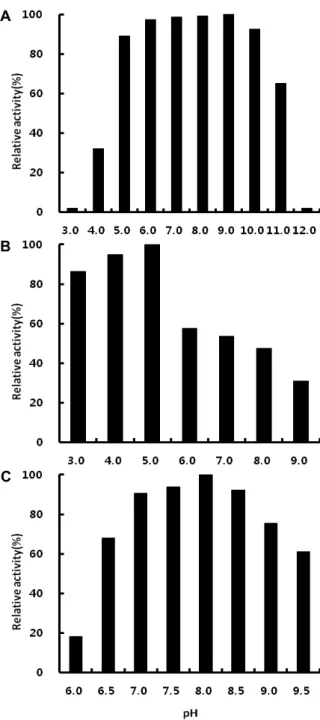
Fig. 6. Effect of pH on the activity of hydrolytic enzymes pro- duced by Bacillus subtilis CK-2. A; cellulase, B; amylase, C; protease.
되었다. Amylase의 경우에는 무처리구에서는 4.62 units/mg protein 정도의 활성을 나타낸 반면 0.1% 이상의 Co(NO
3)
2를
처리하였을 때는 6.90 units/mg protein 정도로 150% 이상 활성이 촉진되는 것을 확인하였다. Protease의 경우에는 무처 리구에서 0.49 units/mg protein의 활성을 나타낸 반면 0.025% 이상의 MnCl
2를 처리하였을 때 활성이 촉진되었으며, 0.75% 이상 처리하였을 때 최고 1.82 units/mg protein로서 370% 정도로 활성이 촉진되는 것을 확인하였다.
효소반응의 최적 pH
Cellulase, amylase 및 protease의 pH에 따른 효소활성은
Fig. 6와 같이 나타났다. Cellulase 효소활성은 pH 5.0~10.0의 넓은 범위에서 거의 유사하게 나타남으로써 pH에 대한 안정 성이 매우 높은 것을 확인할 수 있었고, pH 4.0 이하 및 pH 11.0 이상에서는 효소활성은 급격하게 감소하는 것을 알 수 있었다. 다른 보고[12, 18, 33, 35]에서 확인된 Bacillus sp.의 경우와 비교할 때 Bacillus subtilis CK-2가 생성하는 cellulase 는 매우 넓은 pH 범위에서 높은 활성을 유지한다는 사실을 알 수 있었다.
Amylase의 경우에는 pH 5.0에서 7.00 units/mg protein으 로 가장 높은 활성을 나타내었으며, pH 4.0에서도 비교적 높은 활성을 보인 반면 pH 6.0에서는 효소 활성이 57% 정도로 낮아 지는 것을 확인할 수 있었다. 이러한 결과는 이전의 많은 연구 [8, 27, 31, 34]에서 Bacillus sp.가 생성하는 amylase의 경우 산성의 최적 pH를 나타내는 것과 유사한 결과이다.
Protease는 pH 7.0~8.5의 범위에서 높은 활성을 나타내었으 며, pH 8.0에서 0.74 units/mg protein으로 가장 높은 활성을 보였다. pH 6.0 이하에서는 효소활성이 거의 나타나지 않았으 며, pH 9.5에서도 60% 정도의 효소활성이 나타났다. 기존의 보고[7, 14, 25, 35]에서 Bacillus sp.의 protease는 다양한 pH 조건에서 최적 활성을 나타내는 것으로 확인되었다.
이러한 결과를 바탕으로 B. subtilis CK-2는 식품, 사료 등의 개발 뿐만 아니라 유기성 폐기물의 활용 및 처리에 중요한 자원으로의 개발이 가능할 것으로 판단된다.
감사의 글
본 논문은 경남과학기술대학교 연구비의 지원으로 수행한 연구 결과입니다.
References
1. Ahn, J. W., Oh, T. K., Park, Y. H. and Park, K. H. 1989.
Partial purification and characterization of the alkaline pro- tease from Bacillus sp. Kor. J. Microbiol. Biotech. 18, 344-351.
2. Anson, M. L. 1939. The estimation of pepsin, trypsin, papain and cathepsin with haemoglobin. J. Gen. Physiol. 22, 79-89.
3. Ariffin, H., Abdullah, N., Kalsom, M. S. U., Shirai, Y. and Hassan, M. A. 2006. Production and characterisation of cel- lulase by Bacillus pumilus EB3. J. Engineer. Technol. 3, 47-53.
4. Bailey, M. J., Biely, P. and Poutanen, K. 1992. Inter-labo- ratory testing of methods for assay of xylanase activity. J.
Biotechnol. 23, 257-270.
5. Bernfeld, P., Colowick, S. P. and Kaplan, N. O. 1955. Methods in Enzymology, pp. 149-154, Acad. Press: New York.
6. Chandra, A. K., Medda, S. and Bhadra, A. K. 1980. Production of extracellular thermostable α-amylase by Bacillus lichen- iformis. J. Ferment. Technol. 58, 1-10.
7. Choi, C., Choi, K. S., Cho, Y. J., Lim, S. I. and Kim, S. 1996.
Characteristics and action pattern of protease from Bacillus subtilis CCKS-111 in korean traditinal soy sauce. J. Kor. Soc.
Food Sci. Nutr. 25, 915-921.
8. Chung, M. J., Taniguchi, H., Maruyama, Y. and Lee, M. J.
1982. Studies on α-amylase of Bacillus circulans F-2. PartⅡ.
Enaymatic characteristics of the purified α-amylase. Kor. J.
Microbiol. Bioeng. 10, 123-132.
9. Chung, S. J., Kim, Y. S., Sung, H. C., Choi, Y. J. and Yang, H. C. 1988. A study on the alkaline protease produced from Bacillus subtilis. J. Kor. Agric. Chem. Soc. 31, 356-360.
10. Cowan, D., Daniel, R. and Moran, H. 1985. Thermophilic protease, properties and potential applications. Trends Bio- technol. 3, 68.
11. Hiyama, R., Gisusi, S. and Harada, A. 2011. Evaluation of waste mushroom medium from cultivation of shiitake mushroom (Lentinula edodes) as feedstock of enzymic saccharification. J. Wood Sci. 57, 429-435.
12. Horikoshi, K., Nakao, M., Kurono, Y. and Sashihara, N.
1984. Cellulases of an alkalophilic Bacillus strain isolated from soil. Can. J. Microbiol. 30, 774-779.
13. Hwang, J. S., Yoo, H. J., Kim, S. J. and Kim, H. B. 2008.
Characterization of β-1,4-glucanase activity of Bacillus li- cheniformis B1 in Chungkookjang. Kor. J. Microbiol. 44, 69-73.
14. Hwang, S. Y. 1995. Purification and Characterization of An extracellula serine protease from Bacillus sp. strain KUN-17.
Kor. J. Microbiol. Biotechnol. 23, 53-59.
15. Im, M. 1982. Fish protein hydrolysates. Process Biochemistry 1, 26.
16. Ishede, K. I. and Nagasaki, M. 1989. Effect of protease on textural properties of wheat flour dough. Nippon Shocuhin Kogyo Gakkaishi 36, 1003.
17. Ito, S., Shikata, S., Ozaki, K., Kawai, S., Okamoto, K., Inoue, S., Takei, A., Ohta, Y. and Satoh, T. 1989. Alkaline cellulase for laundry detergents: production by Bacillus sp. KSM-635 and enzymatic properties. Agric. Biol. Chem. 53, 1275-1281.
18. Johansson, T. and Nyman, P. O. 1993. Isoenzymes of lignin peroxidase and manganese peroxidase from the white-rot Basidiomycete. Arch. Biochem. Biophys. 300, 49-56.
19. Kim, C. H. and Lee, S. H. 2011. Isolation of Bacillus subtilis CK-2 hydrolysing various organic materials. J. Life Sci. 21, 1716-1720.
20. Kim, J. Y. 2007. Isolation and characterization of an alkaline peotease produced by Bacillus subtilis JK-1. Kor. J. Microbiol.
43, 331-336.
21. Kim, J. Y., Hur, S. H. and Hong, J. H. 2004. Isolation and characterization of an alkaline cellulase produced by alka- lophilic Bacillus sp. HSH-810. Kor. J. Microbiol. 40, 139-146.
22. Kim, K. P., Kim, N. H., Rhee, C. H., Woo, C. J. and Bae, D. H. 2002. Isolation and characterization of protease pro- ducing bacteria from soil. J. Kor. Soc. Food Sci. Nutr. 31, 754-759.
23. Kim, T. H., Park, S. H., Lee, D. S., Kwon, E. K., Kim, J.
K. and Hong, S. D. 1990. Properties of alkaline protease pro- duced by an alkalophilic Bacillus sp. Kor. J. Appl. Microbiol.
Biotech. 18, 159-164.
24. Kim, T. I., Han, J. D., Jeon, B. S., Ha, S. W., Yang, C. B.
and Kim, M. K. 1999. Isolation and characterization of Bacillus subtilis CH-10 secreting cellulase from cattle manure.
초록:된장으로부터 분리한
Bacillus subtilisCK-2가 생산하는 가수분해효소의 활성 특성 이상협․김철호*
(경남과학기술대학교 제약공학과)
이전의 논문에서 된장으로부터 섬유소와 지질, 녹말, 그리고 단백질을 포함하는 다양한 유기물을 가수분해하는 세균을 분리한 바 있다. 본 연구에서는 분리균주인 Bacillus subtilis CK-2가 생산하는 각종 가수분해효소의 조효소 특성을 확인하였다. 섬유소분해효소의 경우 적정 수소이온농도는 pH 5.0, 적정온도는 55℃로 확인되었으며, pH 5.0~10.0과 20~50℃의 범위에서 높은 활성을 나타내었다. 섬유소분해효소는 Co
2+이온에 의해 활성이 높아지며, 0.45%(w/v)의 Co
2+이온 농도에서 가장 높은 활성을 보였다. 녹말분해효소의 경우 적정 수소이온농도는 pH 5.0, 적정온도는 50℃로 확인되었으며, pH 4.0~5.0과 20~50℃의 범위에서 높은 활성을 나타내었다. 녹말분해효소는 Co
2+이온에 의해 활성이 높아지며, 0.2%(w/v)의 Co
2+이온 농도에서 가장 높은 활성을 보였다. 단백질분해효소의 경우 적정 수소이온농도는 pH 8.0, 적정온도는 50℃로 확인되었으며, pH 7.0~8.5과 20~50℃의 범위에서 높은 활 성을 나타내었다. 섬유소분해효소는 Mn
2+이온에 의해 활성이 높아지며, 0.125%(w/v)의 Mn
2+이온 농도에서 가 장 높은 활성을 보였다. 이러한 결과로부터 B. subtilis CK-가 생산하는 가수분해효소를 산업적으로 이용하기 위해 서는 효소의 종류에 따라 수소이온농도와 온도, 그리고 금속이온을 적절하게 조절할 필요가 있다는 것을 알 수 있다.
Kor. J. Microbiol. 35, 277-282.
25. Lee, B. W., You, Y. S., Im, G. H. and Choi, X. U. 1991.
Purification and properties of protease from Bacillus subtilis LY-353. J. Kor. Soc. Food Sci. Nutr. 20, 21-26.
26. Lee, J. S., Kim, J. Y., Kim, H. B. and Lee, D. S. 2000. Cloning and expression of an acidophilic α-amylase gene from Bacillus circulans in Escherichia coli. J. Microbiol. 36, 112-118.
27. Miller, G. L. 1959. Use of dinitrosalicylic acid reagent for determination of reducing sugar. Anal. Chem. 31, 426-428.
28. Nakasaki, K. and Akiyama, T. 1988. Effect of seeding on thermophilic composting of household organic waste. J.
Ferment. Technol. 66, 37-42.
29. Oh, D. H., Lee, K. P., Pyun, Y. R. and Yu, J. H. 1981. Studies on the production of thermostable amylase. Kor. J. Appl.
Microbiol. Bioeng. 9, 91-97.
30. Park G. W., Kim, M. D., Ahn, J. W., Kim, Y. B. and Seo, J. H. 1998. Characterzation of enzymatic properties of Sterptomyces albus amylase expressed in recombinant Bacillus subtilis. Kor. J. Food Sci. Technol. 30, 1426-1431.
31. Park, C. S., Kang, D. O. and Choi, N. S. 2012. Characteriza- tion of cellulase and xylanase from Bacillus subtilis NC1iIsolated from environmental soil and determination of its genes. J. Life Sci. 22, 912-919.
32. Park, J. D., Kim, Y. A. and Yoon, K. H. 2009. Properties of a Bacillus licheniformis cellulase produced by Recombinant Escherichia coli. Kor. Microbiol. 45, 257-262.
33. Roh, S. B., Son, H. J. and Lee, J. K. 1997. Thermodtable α- amylase production by thermophilic Bacillus sp. TR-25 Isolated from extreme environment. J. Life Sci. 7, 30-38.
34. Shikata, S. K., Saeki, H., Okoshi, T., Yoshimatsu, K., Ozaki, S. and Ito, S. 1990. Alkaline cellulases for laundry de- tergents: production by alkalophilic strains of Bacillus and some properties of the crude enzymes. Agric. Biol. Chem.
54, 91-96.
35. Shin, S. U., Kwon, M. A., Jang, M. S., Jung, K. J. and Seo, H. J. 2004. Production conditions of alkaline protease by Bacillus megaterium. Kor. J. Food Preser. 11, 227-232.
36. Williams B. C., Mcmullan, J. T. and McCahey, S. 2001. An initial assessment of spent mushroom compost as a potential energy feedstock. Bioresour. Technol. 79, 227-230.
37. Yi, Y. P. 2003. Study on the produces of Bacillus lentu α- amylase. MS thesis, Chongju University.
38. Yun, S. H., Kim, M. J., Kim, J. W., Kwun, G. S., Lee, I. W.
and Park, K. H. 1995. Purification and characterization of a novel maltooligosaccharide forming α-amylase from Bacillus sp. SUH4-2. Kor. J. Microbiol. Biotechnol. 23, 573-579.