• 검색 결과가 없습니다.

Frontier Leadership Program for Engineering Students in Gunma University

N/A
N/A
Protected

Academic year: 2021

Share "Frontier Leadership Program for Engineering Students in Gunma University"

Copied!
5
0
0

로드 중.... (전체 텍스트 보기)

전체 글

(1)

Frontier Leadership Program for Engineering Students in Gunma University

Shunichi Ishijima

*

․ Naoto Shimizu

*

․ Tsuyoshi Masuda

*

․ Yoichi Seki

**

․ Seiji Tobita

*

**

Department of Chemistry and Chemical Biology, Faculty of Engineering, Gunma University

**

Department of Computer Science, Faculty of Engineering, Gunma University

ABSTRACT

In this paper, the purpose and overview of the “Frontier Leadership Program for Engineering Students through Joint Participation of Higher Education and the Industrial Sector” (FLC: Frontier Leadership Course) in Gunma University is reported together with our achievements during the last three years. The purpose of this special educational program is to promote and educate selected students who are highly motivated to learn science & mathematics and to become an active leader in industrial sectors or research institutes. The activity can be divided into two categories: “Student-Proposed Stream” and “Advanced Research Stream”.

These activities were found to be useful to cultivate student’s leadership and global communication ability. Furthermore, most of the FLC students cultivated the excellent academic performance and five students among them will be allowed to skip their fourth undergraduate year and enter directly into our graduate school.

Keywords: Engineering education, Frontier Leader, Global communication skills, Leadership

I. Introduction 1)

The educational program “Frontier Leadership Program for Engineering Students through Joint Participation of Higher Education and the Industrial Sector”[1,2] in Gunma University has been adopted by the Japanese Ministry of Education, Culture, Sports, Science and Technology in 2009 as a “Support Project for Students of Science and Mathematics”.

This program aims at cultivating “frontier leadership”

in engineering students. The students who have frontier leadership will exercise leadership in creative projects in industrial sectors or research institutes. Here “frontier leadership” means an ability exercising leadership in creative projects in industrial sectors or research institutes. To show such leadership the following five abilities will be required of the students:

To intensely investigate one aspect of science and technology through independent investigation

Received 4 October, 2011; Revised 12 June, 2012 Accepted 17 July, 2012

† Corresponding Author: [email protected]

1. Extensive understanding and proficiency in the student’s major field

2. To be able to creatively plan and synthesize original ideas.

3. Communicate ideas with an international audience in English

4. To attain goals by working effectively in groups To this end, we developed the following FLC program.

II. Overview of the FLC Program

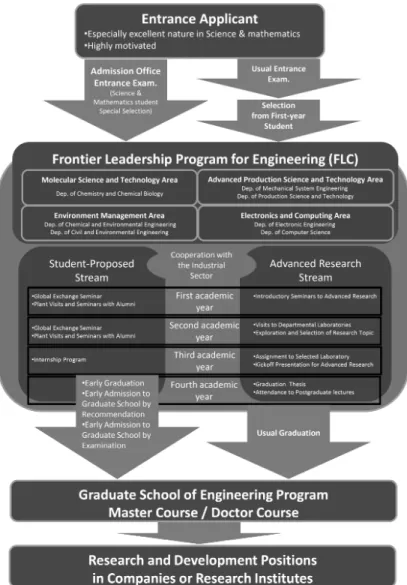
The conceptual diagram of FLC is shown in Fig. 1. The activity can be divided into two categories: Student- Proposed Stream and Advanced Research Stream. The former activity includes Global Exchange Seminar, Institute Visits and Seminars with Alumni, and Internship Program.

The Advanced Research Stream includes Introductory

Seminars to Advanced Research, Visits to Departmental

Laboratories, Exploration and Selection of Research Topic,

Early Assignment to Selected Laboratory and Kickoff

Presentation for Advanced Research.

(2)

Fig. 1 Conceptual diagram of Frontier Leadership Program for Engineering Students

1. Student-Proposed Stream

The Student-Proposed Stream is aimed at cultivating the ability to make plans with original ideas and improve international communication skills.

A. Plant Visits and Seminars with Alumni

Students in each research area propose plans for plant visit and seminars with alumni, in cooperation with faculty and student advisors. The companies and research la- boratories to visit, as well as leaders for each visit, are decided through discussions with advisors. The preparation for the visit, including contact with the alumni, is made by each leader. After the plant visit, a meeting is held to

discuss the students’ impressions of their visit with alumni.

During the last three years we visited 8 facilities and plants related to scientific technology, including the Japan Aerospace Exploration Agency (JAXA), the National Maritime Research Institute (NMRI) and RIKEN (the institute of physical and chemical research).

B. Global Exchange Seminar

In Global Exchange Seminar we invite a foreign researcher and his students to make presentations at Gunma University.

This invited researcher belongs to a university that has

an international agreement with our university. During their

stay in our university, the FLC students introduce our

university and Japanese culture. Through communicating

(3)

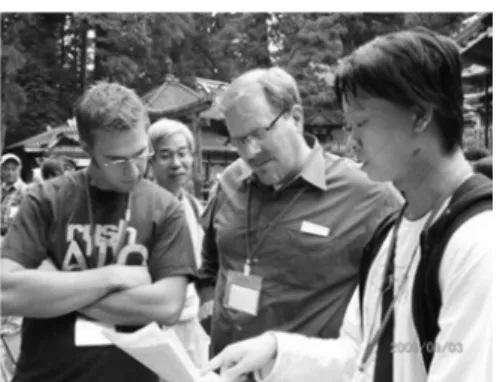
Fig. 2 Visit to Nikko with Prof. Schulz and his students

Fig. 3 Visit to Dalian University of Technology

with the foreign researcher and his students in English, our students can practice their English communication skills and be exposed to international perspectives. In 2009 we invited Professor D. L. Schulz and his two graduate stu- dents from the North Dakota State University in the United States (Fig. 2). In 2010 we visited the Dalian University of Technology in China to attend the 4th International Conference on Advanced Science and Technology for Materials, Manufacturing and Measurement (Fig. 3).

2. Advanced Research Stream

The Advanced Research Stream is aimed at giving younger students opportunities to get in touch with advanced re- search, while cultivating the ability to propose new research themes.

A. Visits to Departmental Laboratories

In the Visits to Departmental Laboratories, students visit laboratories associated with their interest and discuss with professors about the research topics of their laboratory.

Fig. 4 Exploration and Selection of Research Topic

B. Exploration and Selection of Research Topic On the basis of the discussions in the Visits to De- partmental Laboratories, students propose research subjects on which they want to investigate in the latter term of their second year. The tentative assignment to a laboratory is made to advance investigations on the proposed subject.

In the assigned laboratory, students research their subject under the aid of laboratory teachers and teaching assistants, in order to prepare for the start of the actual study in the third year. In the end of the year, a small symposium is held to present the preliminary results of the investi- gation (Fig. 4).

3. After the Assignment

Starting in the third year, students start actual studies in the laboratory assigned through the Visits to Departmental Laboratories.

A. Kickoff Presentation for Advanced Research

In the end of the third year, a Kickoff Presentation for Advanced Research is held to present the student’s current work and to outline future experiments. This meeting is generally open to the public, and active discussions are expected.

B. Early Graduation

In addition to usual graduation, early graduation, or

early admission to graduate school by recommendation,

is possible for FLC students who receive excellent grades

in the usual educational curriculum and exercise leadership

in the achievement of the goals of the FLC program.

(4)

III. Outcome of FLC

These activities were found to be useful to cultivate students’ leadership and global communication ability.

Furthermore, most of the FLC students achieved excellent academic performance and five students among them will be allowed to skip their fourth undergraduate year and enter directly into our graduate school. Finally, we show student responses to FLC activities.

1. Students’ Response to Plant Visits and Seminars with Alumni

Following response was received our students following Plant Visits and Seminars with Alumni “Through activities of Plant Visits and Seminars with Alumni, we have learned about various fields of advanced technology, including energy-efficient engines, maritime safety, environmentally friendly materials and construction. Also, we learned about engineers’ roles in society and their mental attitudes.

By taking initiative to perform activities, we were able to practice our leadership skills. Group leaders were able to acquire their independence through planning factory tours with various companies. We also learned about advanced technology and got an introduction to engineers’ ways of thinking through seminars with alumni. Almost all of the students thought that this activity had made positive in- fluence on them. We also realized that ‘technology supports our society’, ‘technology has been advancing’ and ‘Learning basic knowledge is very useful for the future’. Through the whole activity, it was very meaningful that we acted voluntarily, actually saw and touched technology.

We think, however, there is room for improvement in these activities. Many of the members pointed out the lack of their knowledge of the technology companies they visited were using, because there were some institutes outside of their fields of study. It would be better to study a little about the technology that company uses before the institute visit and hold a study session after the institute visit.”

2. Students’ Response to Global Exchange Seminar

“Through Global Exchange seminar we felt the diffe- rences of idea, attitude to things, and culture between two countries. It gave us an opportunity to expand the international perspective. Also, we felt lack of communication skill in English. Through this activity, we could understand poor communication level in English. When our foreign guests could understand our English and we talked with each other, we had a big sense of accomplishment. Such an experience will improve our communication skills in English and give us an opportunity to expand our inter- national perspective.”

“Through this activity, we felt students in China are making an effort to study hard and to exchange positively in English. We have differences in ideas, in attitude to things, and in culture. But the Chinese students thought their relationship with Japan was important. To understand each other is important in developing global communication skills in English and international understanding.”

Reference

1. Faculty of engineering of Gunma University (2010), Annual commissioned projects report on Frontier Leadership Program for Engineering Students through Joint Participation of Higher Education and the Industrial Sector. (in Japanese).

2. Faculty of engineering of Gunma University (2011), Annual

commissioned projects report on Frontier Leadership

Program for Engineering Students through Joint Participation

of Higher Education and the Industrial Sector. (in Japanese)

(5)

石嶋 駿一 (Shunichi Ishijima)

History: Student of the Department of Chemistry and Chemical Biology, Faculty of Engineering, Gunma University, Japan.

Phone: +81-277-30-1270 E-mail: [email protected]

清水 直登 (Naoto Shimizu)

History: Student of the Department of Chemistry and Chemical Biology, Faculty of Engineering, Gunma University, Japan.

Phone: +81-277-30-1285 E-mail: [email protected]

増田 剛 (Tsuyoshi Masuda)

History: Student of the Department of Chemistry and Chemical Biology, Faculty of Engineering, Gunma University, Japan.

Phone: +81-277-30-1213 E-mail: [email protected]

関 庸一 (Yoichi Seki)

History: Professor at the Department of Computer Science, Faculty of Engineering, Gunma University, Japan. He received a Doctoral Degree from the Graduate School of Science and Engineering at Waseda University in 1982.

His teaching and research interests include data mining and applied statistics.

Phone: +81-277-30-1806 Fax: +81-277-30-1806 E-mail: [email protected]

飛田 成史

History: Professor of the Department of Chemistry and Chemical Biology, Faculty of Engineering, Gunma University, Japan. He received a Doctoral Degree from Tokyo Institute of Technology in 1983. His teaching and research interests include physical chemistry and photochemistry.

Phone: +81-277-30-1210

Fax: +81-277-30-1213

E-mail: [email protected]

수치

Fig.  1  Conceptual  diagram  of  Frontier  Leadership  Program  for  Engineering  Students
Fig.  2  Visit  to  Nikko  with  Prof.  Schulz  and  his  students

참조

관련 문서

Programs such as the Retail Product Program in the midstream sector , the Home Energy Efficiency Program in the household sector, and the EnergySmart Grocer Program in

The purpose of this study is to examine industrial specialized high school students’ recognition on career and the status of career instruction, and analyze

In the university, the university conducted a survey of 400 persons and college students, conducted a questionnaire survey of 400 people through

This study analysed diverse data on colors and the current statues of actual education, and suggested an emotional coloring program which can motivate

Therefore, this study investigated the interest, satisfaction and participation in STEAM of middle school students centering on programs where music education

The purpose of this research is to the development and effect of the anthroposophy group art therapy program for improvement of creativity and reduction

As the importance of education through play in modern children's education is emphasized, this study aims to propose an art education program through play

Therefore, the execution of Eco-STEAM program using Arduino can expect the students’ changes in perception of environmental problems, motivation for them