1. Introduction1)
Aphanizomenon 속(Genus Aphanizomenon Morren.ex Bornet et Flahault 1888; type species: Aph. flos-aquae)은 남조강 (Cyanophyceae) 연쇄체목(Nostocales) 염주말과(Nostocaceae) 에 속하는 남조류의 일종으로 담수 및 연안에서 주로 출현 한다(Pirjo et al., 2005). 이 속은 생태적으로 다양한 생존 전략을 확보하여 경쟁력을 높이는 것으로 알려져 있으며, 대표적으로 불리한 생장조건에서 생존율을 높일 수 있는 휴면포자(Akinete)와 질소고정능력을 가진 이형세포(Hetero- cyst)를 형성한다(Komárek and Komárková, 2006). Aphani-
zomenon 속은 이러한 생존전략을 통해 부영양화된 담수생
태계에서 과다증식하여 녹조현상(Harmful cyanobacterial
†To whom correspondence should be addressed.
This is an Open-Access article distributed under the terms of the Creative Commons Attribution Non-Commercial License (http://creativecommons.org/
licenses/by-nc/3.0) which permits unrestricted non-commercial use, distribution, and reproduction in any medium, provided the original work is properly cited.
bloom)을 유발하며(Baryosef et al., 2010; McDonald and Lehman, 2013), 최근 낙동강에서는 중 하류 구간을 중심으 로 그 출현빈도와 양이 증가하고 있다(Park et al., 2015;
Yu et al., 2014). Aphanizomenon 속은 독소와 취기물질을 생산하는 남조류로 알려져 있으며(Juttner and Watson 2007;
Zhang et al., 2015), 특히 대표적인 녹조현상 유발 남조류 인 Microcystis 속이 증식하지 않는 시기에 Aphanizomenon 속에 의한 대량발생이 보고되고 있어 하천과 호수 등의 지표 수를 이용하는 경우, 수자원관리 측면에서 Aphanizomenon 속 의 발생은 주요 관심대상이 된다(Ma et al., 2015; Yamamoto 2009). 그러나 국내에서 Aphanizomenon 속의 환경요인에 따른 발생특성이나 종간경쟁 등에 대한 연구는 부족한 실 정이다.
낙동강은 총 길이 525 km, 유역면적 23,859 km2로서 국 내에서 가장 길고, 유역면적이 전 국토의 24.1%를 차지하 는 넓은 강이다. 낙동강 본류에는 2012년까지 진행된 낙동 강 살리기 사업으로 총 8개의 보가 건설되었으며, 이 중 상주보는 낙동강 본류에 설치된 다기능 보 중 가장 상류에
낙동강 상류 수역에서 남조류 발생과 천이패턴 - Aphanizomenon 속을 중심으로 -
류희성․박혜경†․이혜진․신라영․천세억 국립환경과학원 낙동강물환경연구소
Occurrence and Succession Pattern of Cyanobacteria in the Upper Region of the Nakdong River : Factors Influencing Aphanizomenon Bloom
Hui-Seong Ryu Hae-Kyung Park† Hae-Jin Lee Ra-Young Shin Se-Uk Cheon
Nakdong River Environment Research Center, National Institute of Environmental Research (Received 24 November 2015, Revised 23 December 2015, Accepted 28 December 2015)
Abstract
This study investigated the occurrences and succession patterns of harmful cyanobacteria, as well as environmental factors, during a 3-year period (September 2012 to August 2015) in the upper region of the Nakdong River around Sangju weir. A total of 27 cyanobacterial taxa were observed in this study, and classified into 26 species and 1 variety belonging to 11 genera, 5 families, and 3 orders. Cell density ranged from 24 to 42,001 cells/ml, with a geometric mean of 33 cells/ml, during the survey period. The dominant orders differed depending on the survey year; order Oscillatoriales in 2013, Chroococcales in 2014 and Nostocales in 2015. An Aphanizomenon bloom occurred in June 2015 at which time the highest cell density of 36,873 cells/ml was detected in the upper region of the Nakdong River, where as the Aphanizomenon spp. cell density (190-1,704 cells/ml) had been low prior to that time. An Aphanizomenon bloom also occurred at around the same time downstream in the Young River, a major inflow branch of the Nakdong River. The Aphanizomenon cell density along the Nakdong River increased markedly after joining of the YoungRiver, indicating that the Aphanizomenon bloom in the YoungRiver caused a bloom in the Nakdong River. Meteorological and environmental parameters, such as very low precipitation, higher water temperature, pH, and TP concentration, and lower TN/TP ratio, in May and June of 2015 than in 2013 and 2014 exerted marked effects on the Aphanizomenon bloom in June 2015 in the Young River.
Key words : Aphanizomenon bloom, Cyanobacteria, Nakdong River, Nostocales
위치하고 있다. 상주보가 위치한 낙동강 상류 수역은 낙동 강에 위치한 보 구간 수역 중에 비교적 수질이 양호하고, 수환경이 청정한 것으로 알려져 있다(NRERC, 2014). 낙동 강에서 식물플랑크톤의 종조성 및 군집구조, 녹조현상에 대 한 연구는 주로 중 하류를 중심으로 이루어져왔으며(Park et al., 2015; Son, 2013; Yu et al., 2014), 상류수역에서의 식물플랑크톤 특히 녹조현상 유발 남조류를 중심으로 한 연구는 매우 미비한 실정이다(Hur et al., 2013).
녹조현상을 유발하는 남조류의 발생과 천이, 감소의 원리 에 대한 이해는 남조류에 의한 녹조현상을 관리하는 측면 에서 필수적이라 할 수 있다(Ma et al., 2015). 본 연구에서 는 상주보 상류의 낙동강 본류 수역과 주요 유입하천을 대 상으로 녹조현상 유발 남조류의 발생과 천이양상을 알아보 고, 특히 Aphanizomenon 속의 출현 특성에 대해 파악하고 자 하였다. 본 연구 결과는 낙동강 상류수역에서의 유해남 조류 관리를 위한 기초자료로 활용될 수 있을 것이다.
2. Material and Methods
2.1. 조사 지점 및 조사 시기
본 연구는 낙동강 상류 수계에 위치한 상주보 상류 수역 을 중심으로 일반조사와 집중조사를 구분하여 실시하였다.
일반조사는 상주보 상류 500m 지점(SJ)을 대상으로 2012 년 9월부터 2015년 8월까지 매주 1회 조사를 실시하였으 며, 집중조사는 Aphanizomenon 속의 대량증식이 발생한
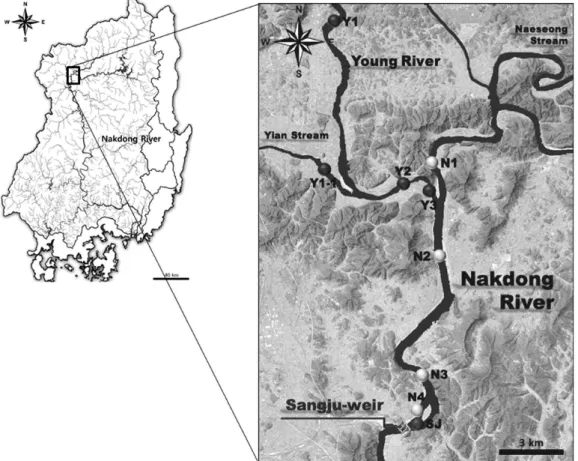
2015년 6월 1일부터 15일간 낙동강 본류 및 주요 지천을 대상으로 조사를 실시하였다. 집중조사의 조사지점은 낙동 강 본류의 유하방향에 따라 N1, N2, N3, N4 등 4개 지점 을 선정하였고, 영강 수계에는 영강 본류의 Y1, Y2, Y3 등 3개 지점과 유입 지천인 이안천 말단부에 Y1-1 지점을 선 정하였다(Fig. 1)
2.2. 식물플랑크톤 및 환경요인 분석
현장에서 채수된 식물플랑크톤 시료는 Lugol 용액으로 고정하였으며, 실험실로 시료를 옮겨 현미경(Zeiss, Axio Scope.
A1)으로 검경하여 출현 조류종을 동정하였다. 정량분석은 Sedwick-Rafter chamber를 사용하여 출현 세포수를 ml당 세포수로 계수하였다(MOE, 2011). 식물플랑크톤의 동정은 한국의 조류(담수산 남조류 I, II) (NIBR, 2012a; 2012b)와 Komárek and Anagnostidis(1999, 2005)를 참고하였다. 이화 학적 환경요인 중 수온, 전기전도도(EC), pH, 용존산소농도 (DO)는 현장수질측정기(YSI556MPS)를 이용하여 현장에서 측정하였으며, 채수한 시료는 실험실로 운반하여 수질오염 공정시험방법(MOE, 2011)에 따라 SS, TN, TP, Chl-a를 분 석하였다. 조사지점의 기상과 수리 수문에 대한 자료는 기 상청(KMA, 2015) 및 한국수자원공사(Kwater, 2015)에서 제 공하는 자료를 각각 참고하여 활용하였으며, 주간 누적 및 평균값을 산출하여 적용하였다. 영강 수계의 과거년도(2013 년, 2014년) 수질 자료는 환경부 물환경정보시스템(MOE, 2015)를 이용하여 분석하였다.
Fig. 1. Map showing the sampling stations in the upper region of Nakdong River.
3. Results and Discussion
3.1. 낙동강 상류 수역에서 3년간 남조류 발생과 천이 양상 상주보가 위치한 상주 지역의 조사 기간 연평균 총강수 량은 1,033 mm로 연간 강수량의 60% 이상이 하절기(6~9월) 에 집중되어 나타나는 몬순 강우의 특징을 가지고 있었으 며, 이로 인하여 상주보의 유입량 및 방류량 또한 하절기 에 집중되고 동절기에 감소하는 변화패턴을 보이는 것으로 나타났다. 그러나 집중 강우의 시기와 빈도에 의한 변화는 연도별로 차이를 보였는데, 최대 유입량이 1,000 m3/sec를 초 과하는 시기가 2013년에는 이른 장마로 인하여 초여름(6월)
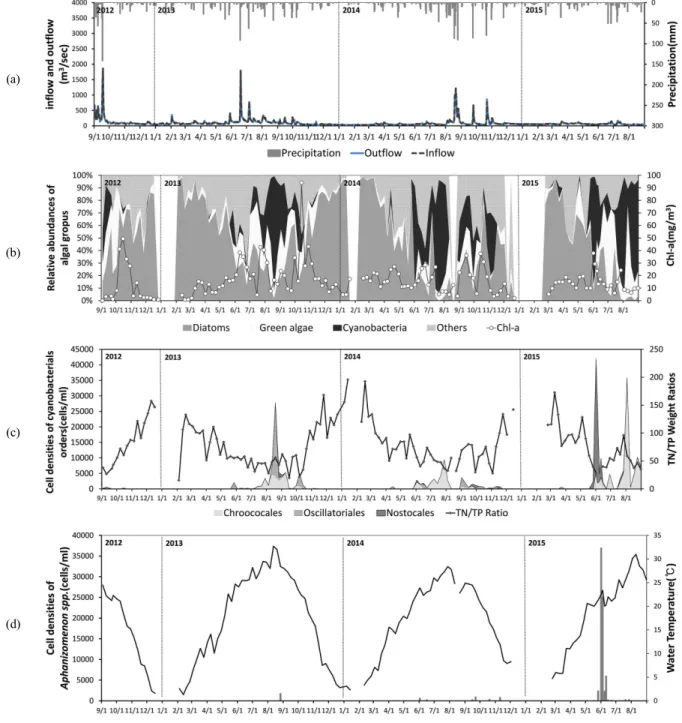
에 시작된 반면, 2012년과 2014년에는 늦여름(8월)에 시작 되는 특성을 보였다. 한편 2015년은 강수량 부족으로 인하여 8월까지 상주 지역의 누적강수량이 537.5 mm (2013년 685.3 mm, 2014년 822.5 mm)에 불과하였으며, 상주보의 월평균 최대 유입량이 79.9 m3/sec를 초과하지 못하였다(Fig. 2(a)).
조사기간 동안 SJ 지점에서 조류 분류군별 분포는 봄과 겨울에 규조류가 우점하고, 이른 여름을 중심으로 녹조류와 기타조류가 출현하며, 늦여름에 남조류가 우점하는 전형적 인 온대 수계 천이패턴을 보였으나, 남조류 발생 및 천이 패턴에는 연도별로 차이를 보였다(Fig. 2(b)). 이른 장마가 시작된 2013년에는 늦은 여름(8월 이후)부터 남조류의 우
(a)
(b)
(c)
(d)
Fig. 2. Temporal variations in (a) the amount of daily precipitation, inflow and outflow, (b) relative abundances of algal groups and chl-a, (c) cell densities of cyanobacterial orders and TN/TP weight ratios, and (d) cell densities of Aphanizomenon spp. and water temperature from September 2012 to August 2015 at SJ station
점이 확인되었으나, 2014년과 2015년에는 초여름(6월)부터 남조류의 우점이 지속적으로 관찰되는 특성을 보였다. 한 편, 유사지점에서 조사된 선행연구 결과를 보면 2000년의 조류 분류군별 분포는 연중 규조류(Encyonema silesiaca, Nitzschia fonticola, Aulacoseira granulata, Asterionella for- mosa, Navicula cryptotenella)에 의한 우점이 지속되었던
것으로 나타나(Lee et al., 2002), 온대 수계 천이패턴을 보 인 본 연구결과와는 차이를 보였다.
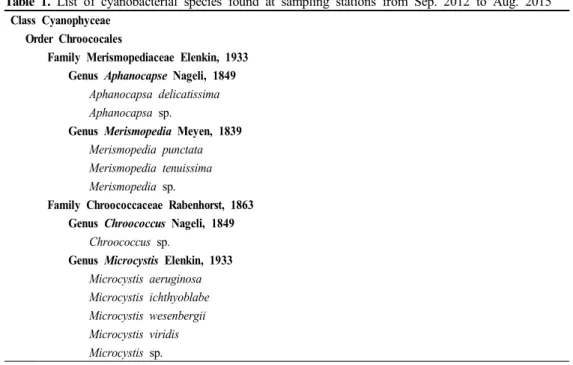
본 연구에서 출현이 확인된 분류군 중 남조류는 총 3목 5과 11속 26종 1변종으로 분류되었으며(Table 1), 총 조사 기간 동안 출현 개체밀도는 24~42,001 cells/ml (기하평균 22 cells/ml)의 범위로 확인되었다. 분류군별 개체밀도는 Chroo-
Table 1. List of cyanobacterial species found at sampling stations from Sep. 2012 to Aug. 2015 Class Cyanophyceae
Order Chroococales
Family Merismopediaceae Elenkin, 1933 Genus Aphanocapse Nageli, 1849
Aphanocapsa delicatissima Aphanocapsa sp.
Genus Merismopedia Meyen, 1839 Merismopedia punctata Merismopedia tenuissima Merismopedia sp.
Family Chroococcaceae Rabenhorst, 1863 Genus Chroococcus Nageli, 1849
Chroococcus sp.
Genus Microcystis Elenkin, 1933 Microcystis aeruginosa Microcystis ichthyoblabe Microcystis wesenbergii Microcystis viridis Microcystis sp.
Order Osciallatoriales
Family Pseudanabaenaceae Anagnostidis & Komárek, 1988
Genus Geitlerinema (Anagnostidis & Komárek) Anagnostidis, 1989 Geitlerinema amphibium
Geitlerinema sp.
Genus Limnothrix Meffert, 1988 Limnothrix redekei
Genus Pseudanabaena Lauterborn, 1915 Pseudanabaena catenata
Pseudanabaena sp.
Family Phormidiaceae Anagnostidis & Komárek, 1988 Genus Phormidium Kützing ex Gomont, 1892
Phormidium valderianum var. tenuis Phormidium sp.
Genus Oscillatoria Vaucher ex Gomont, 1892 Oscillatoria limnetica
Oscillatoria limosa Oscillatoria sp.
Order Nostocales
Family Nostocaceae Eichler, 1886
Genus Anabaena Bory de Saint-Vincent ex Bornet & Flahault, 1886 Anabaena crassa
Anabaena flos-aquae Anabaena planktonica Anabaena sp.
Genus Aphanizomenon A. Morren ex Bornet & Flahault, 1886 Aphanizomenon flos-aquae
Aphanizomenon sp.
coccales 목이 64~35,741 cells/ml (기하평균 9 cells/ml), Oscil- latoriales 목이 52~23,464 cells/ml (기하평균 7 cells/ml), Nos- tocales 목이 24~36,873 cells/ml (기하평균 3 cells/ml)로 각각 확인되어, Microcystis 속과 Merismopedia 속을 포함하는 구형의 Chroococcales 목의 출현밀도가 높은 것으로 나타 났다. 남조류 우점분류군별 출현양상은 연도별로 차이를 보 였는데, 2013년에는 Oscillatoriales 목(8월, 23,464 cells/ml), 2014년에는 Chroococcales 목(7월, 9,470 cells/ml), 2015년 에는 Nostocales 목(6월, 36,873 cells/ml)이 최대 현존량을 보인 분류군으로 각각 확인되었다(Fig. 2(c)). 우점분류군별 출현과 환경요인의 변화를 살펴보면, Chroococcales 목은 수리 수문의 변동이 적고 수온이 25°C를 초과하는 시기부 터 주요 분류군으로 확인되며, Oscillatoriales 목의 경우 집 중강우 이후에 주로 나타나는 특징을 보였다. 특히 100 mm 이상의 집중강우가 지속되었던 2013년 7월하순과 2014년 8월중순의 경우, 집중강우 1~2주후에 저서성 조류로 많이 알려진 Oscilatoria 속과 Phormidium 속이 일시적으로 우점 하였다(NIBR 2012a; 2012b). 집중강우시의 SS 농도가 11.4 mg/L (2013년8월5일), 17.5 mg/L (2014년8월21일)로 높은 값 을 보여 강우시 상류하천과 유입지천에서 퇴적층의 교란이 있었던 것으로 추정되며, 따라서 집중강우 이후의 일시적인 Oscillatoriales 목의 우점은 퇴적층 교란에 따른 저서성 조 류의 수체중 유입 증식의 영향이 있었을 것으로 추정된다.
조사기간 동안 SJ지점에서 Nostocales 목에 의한 우점은 2015년 6월에 처음으로 확인되었으며, 이 시기의 우점종은 Aphanizomenon 속이었다. 조사기간 중 Aphnaizomenon 속 의 출현은 2013년 8월에 1회(1,704 cells/ml), 2014년 6월, 9월, 10월, 11월에 총 6회(190~860 cells/ml) 등 낮은 빈도 와 개체수로 확인되었으며, 출현 시기에 수온의 분포는
11.9~28.4°C로 광범위하게 나타났다. 그러나 2015년에는 5 월 4일에 처음으로 출현하여(26 cells/ml, 20.6°C) 낮은 현 존량을 유지하다가, 2015년 6월 1일에 일시적으로 대량발 생(36,873 cells/ml, 22.5°C)하여 최대 현존량을 보였으며, 이후 6월 29일까지 빠르게 감소하였다(Fig. 2(d)). 낙동강에 서 Aphanizomenon 속의 대량발생은 주로 중 하류에서 보 고되어 왔으며(Park et al., 2015; Yu et al., 2014), 낙동강 상류 수역에서의 대량발생은 본 연구 이전에는 보고된 사 례가 없었다.
3.2. 집중조사 기간 Aphanizomenon 속의 증식 및 감소 추이
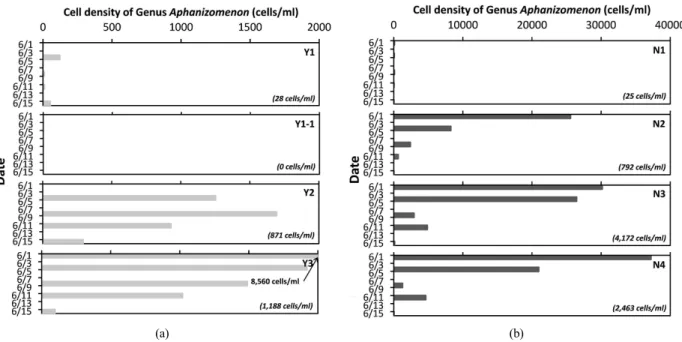
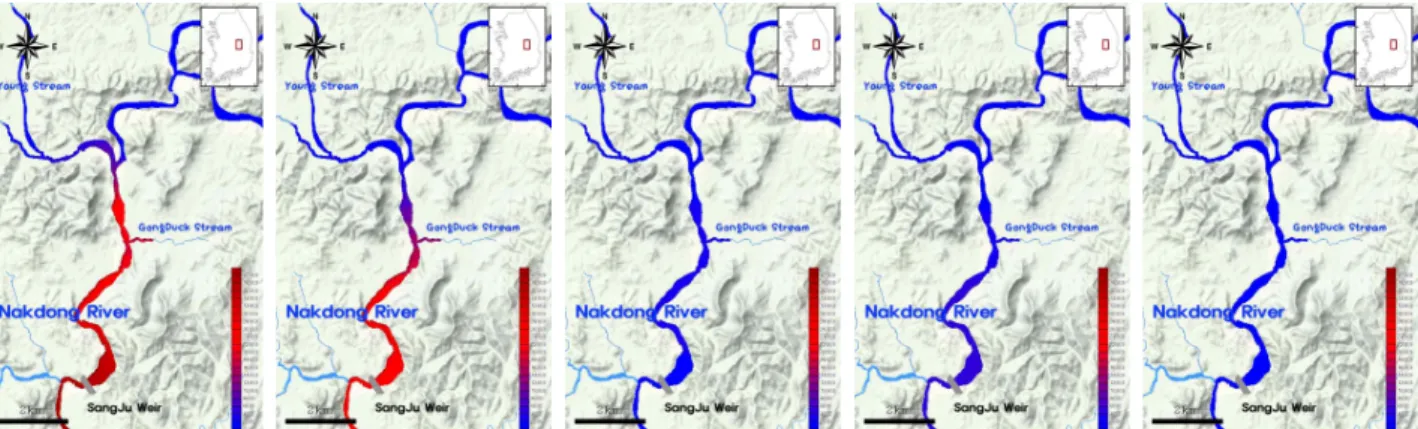
낙동강 상류 수역에서 Aphanizomenon 속의 급격한 증식 이 확인된 2015년 6월 1일부터 15일간 8개 지점을 대상으 로 Aphanizomenon 속의 현존량을 분석한 결과, 영강 수계 에서는 조사기간 동안 Aphanizomenon 속의 기하평균 현존 량은 Y1에서 28 cells/ml, Y2에서 871 cells/ml, Y3에서 1,188 cells/ml로 하류로 갈수록 현존량이 증가하는 경향을 보였으며, 영강의 주요 지천인 이안천(Y1-1)에서는 조사기 간 동안 Aphanizomenon 속의 출현이 확인되지 않았다(Fig. 3).
영강 수계에서는 낙동강과 합류점을 기준으로 12 km 상류 지점까지 출현이 확인된 반면, 영강으로 유입되는 이안천에 서는 Aphanizomenon 속의 출현이 전혀 확인되지 않아, 유 속이 감소하는 하류 말단 지점에서 주로 증식한 것으로 추 정되었다. 한편 낙동강 본류에서는 조사기간 동안 Aphani- zomenon 속의 지점별 기하평균 개체수는 N1에서 50 cells/ml, N2에서 792 cells/ml, N3에서 4,172 cells/ml, N4에서 2,463 cells/ml로 영강 합류 이후 Aphanizomenon 속의 현존량이 뚜렷하게 증가하는 것으로 나타났다. 결과적으로 낙동강 상
(a) (b)
Fig. 3. Temporal variations in Aphanizomenon spp. cell densities over 15 days (a) at four stations in the Young River and (b) four stations in the Nakdong River. Values in parentheses refer to geometric mean cell densities during the survey period at each station.
류 수역에서 일시적이며 이례적인 Aphanizomenon 속의 발 생 현상은 영강 말단부에서 증식된 개체들이 낙동강 본류 로 유입되어 본류 수역의 현존량 변화에 영향을 미친 것으 로 추정된다. 따라서 낙동강 상류수역에서의 남조류 관리를 위해서는 본류로 유입되는 하천의 관리가 우선되어야 할 것으로 판단된다.
Aphanizomenon 속은 일시적인 증가 이후 빠르게 감소하
였는데, 조사기간 동안 최대 현존량을 보인 N4 지점에서 2015년 6월 1일 37,200 cells/ml에서 15일 이후 20 cells/ml 로 감소하였다(Fig. 4). 이 시기 동안 수온(23.2~25.6°C)이 나 강우(3.5 mm) 등 Aphanizomenon 속의 성장에 유리한 호 조건이 유지되었음에도 불구하고, 급격한 현존량의 변화는 상류에 위치한 대규모 인공호에서 방류량 증가에 따른 영 향으로 추정된다. Aphanizomenon 속이 대량 발생한 2015 년 6월 1일을 기점으로 상류에 위치한 안동댐의 방류량이 26.5 m3/sec에서 49.5 m3/sec로 크게 증가한 것으로 나타났으 며, 여기에 영향을 받는 상주보의 유입량 또한 43.7 m3/sec 에서 60.2 m3/sec로 증가하였고(Fig. 5), 그 결과 상주보의 수리학적 체류시간이 7.4일에서 5.6일로 감소하였다. 유입 량의 증가는 체류시간의 감소를 유발하여 식물플랑크톤의
증식을 방해하는 것으로 알려져 있다(Park et al., 2005). 낙 동강 상류 수역에서 Aphanizomenon 속의 급격한 발생 이 후 빠른 현존량의 감소는 상주보 유입량에 가장 큰 영향을 주는 안동댐의 방류량 증가로 인해 상주보의 체류시간이 감소됨에 따라 증식이 억제되고 또한 증식된 개체의 빠른 하류유출 때문으로 판단된다.
3.3. 영강에서 Aphanizomenon 속의 발생원인 분석 본 연구를 통해, 낙동강 상류 수역에서 2015년 6월에
Aphanizomenon 속의 발생은 주요 지류인 영강 말단부에서
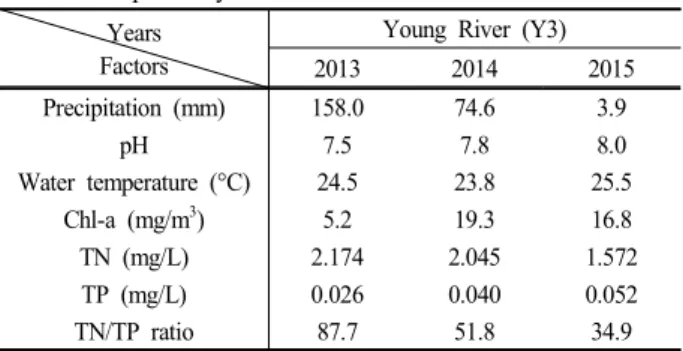
증식된 개체들의 유입이 원인으로 판단되었다. 영강에서 2015년 Aphanizomenon 속의 출현과 증식이 가능했던 원인 을 분석하기 위하여, 6월 1일을 기준으로 4주간(2015년 5 월 3주차부터 2015년 6월 2주차까지) 환경요인 변화를 과 거년도(2013년, 2014년)와 비교 검토하였다.
영강의 조사기간 평균 수온과 pH는 2015년에 25.5℃와 pH 8.0으로 각각 나타나, 2013년(24.5°C, pH 7.5)과 2014 년(23.8°C, pH 7.8)에 비해 높았던 것으로 확인되었다. 하 절기의 빠른 수온 증가와 pH의 변화는 저층에 침전되어 있는 Aphanizomenon 속의 akinete 발아율을 높이는 것으로
Fig. 4. Map of spatial changes in Aphanizomenon spp. cell densities (cells/ml) for 15 days in the upper region of the Nakdong River.
Fig. 5. Temporal variations in daily precipitation (black bar), inflow of Sangju weir (solid line) and outflow of Lake Andong (black bar with white dots) and Lake Imha (gray dashed bar) over a 30-day period.
Table 2. Precipitation and physicochemical parameters at Y3 station during the Aphanizomenon bloom event (third week of May to second week of June 2015).
The precipitation and physicochemical parameter values are total amounts and averages for 4 weeks, respectively
Years Factors
Young River (Y3)
2013 2014 2015
Precipitation (mm) 158.0 74.6 3.9
pH 7.5 7.8 8.0
Water temperature (°C) 24.5 23.8 25.5
Chl-a (mg/m3) 5.2 19.3 16.8
TN (mg/L) 2.174 2.045 1.572
TP (mg/L) 0.026 0.040 0.052
TN/TP ratio 87.7 51.8 34.9
알려져 있다(Yamamoto and Nakahara, 2009). 따라서 영강 에서 이러한 수온과 pH의 변화도 akinete에 의한 발아에 유리한 조건을 제공했을 것으로 추정된다. Aphanizomenon 속의 증식에 영향을 주는 TN/TP ratio(weight)를 살펴보면, 영강에서 34.9 (17.9~69.4)로 연중 가장 낮아지는 시기에 해 당하였으며, 동일 시기의 2013년(87.7)과 2014년(51.8)과 비 교할 경우에도 2/3 수준에 불과하였다. 실제로 동일 기간 TN의 평균 농도는 2013년에 2.174 mg/L에서 2015년에 1.572 mg/L로 꾸준히 감소한 반면, TP 농도의 경우 2015년 에 0.052 mg/L로 오히려 증가한 것으로 확인되었다. TN/TP ratio는 남조류 증식에 중요한 환경요인이며, 낮은 TN/TP ratio(weight)는 N2 고정능이 있는 Aphanizomenon 속과 같 은 분류군에게 유리한 증식조건으로 작용한다(Lehman et al., 2009). 한편 식물플랑크톤의 성장은 수리 수문학적 특 성에 밀접한 영향을 받게 되는데, 유수생태계에서 수리 수 문의 변동은 강수량에 밀접한 영향을 받는다. 영강 수계가 위치한 문경 지역의 강수량은 2015년 조사기간 동안 3.9 mm로 2013년(158 mm)과 2014년(74.6 mm)에 비하여 매우 적은 것으로 나타났으며, 이를 통해 영강 수계에서 안정적 인 수리 수문학적 환경이 조성되었음을 간접적으로 추론할 수 있었다.
결과적으로 2015년의 영강에서는 안정적인 수리 수문학 적 환경과 akinete의 발아율을 높일 수 있는 pH, 성장에 유리 한 수온과 TN/TP ratio 등의 환경조건으로 Aphanizomenon 속의 출현과 성장이 가능했던 것으로 추정된다.
4. Conclusion
상주보가 위치한 낙동강 상류 수역에서 2012년 9월부터 2015년 8월까지 3년간 남조류의 출현양상과 수환경 요인을 조사하고, Aphanizomenon 속의 발생특성에 대해 분석하여 다음과 같은 결론을 도출하였다.
1) 출현이 확인된 남조류 분류군은 총 3목 5과 11속 26종 1변종으로 분류되었으며, 출현 개체밀도는 24~42,001 cells/ml (기하평균 33 cells/ml)의 범위로 확인되었다. 분
류군별 개체밀도는 Chroococcales 목이 64~35,741 cells/ml (기하평균 9 cells/ml), Oscillatoriales 목이 52~23,464 cells/ml (기하평균 7 cells/ml), Nostocales 목이 24~36,873 cells/ml (기하평균 3 cells/ml)로 각각 확인되었다. 우점분 류군별 출현양상은 2013년에 Oscillatoriales 목, 2014년 에 Chroococcales 목, 2015년에 Nostocales 목이 최대 현존량을 보인 분류군으로 각각 확인되었다.
2) Nostocales 목에 의한 우점은 2015년 6월에 처음으로 확인되었으며, 그 중 우점종은 Aphanizomenon 속으로 확인되었다. Aphanizomenon 속의 출현은 2013년 8월에 1회(1,704 cells/ml), 2014년 6월, 9월, 10월, 11월에 총 6회(190~860 cells/ml) 등 낮은 빈도와 개체수로 확인되 었으나, 2015년 6월 1일에 일시적으로 크게 증가(36,873 cells/ml)하여 최대 현존량을 보였고, 이후 6월 29일까지 빠르게 감소하였다.
3) 낙동강 상류 수역에서의 일시적이며 이례적인 Aphanizo-
menon 속의 발생 현상은 영강 말단부에서 증식된 개체
들이 본류 수역의 현존량 변화에 영향을 주었기 때문으 로 판단되며, 이러한 현상은 안정적인 수리 수문 환경과 수온, pH, TN/TP ratio 등이 Aphanizomenon 속의 발아 율과 성장률을 높이는 환경요인으로 작용했기 때문으로 추정된다.
References
Boayosef, Y., Sukenik, A., Hadas, O., Viner-Mozzini, Y., and Kaplan, A. (2010). Enslavement in the Water Body by Toxic Aphanizomenon ovalisporum, including Alkaline Phosphatase in Phytoplankotn, Current Biology, 20(17), pp. 1557-1661.
Hur, M. S., Lee, I. J., Tak, B. M., Lee, H. J., Yu, J. J., Cheon, S. U., and Kim, B. S. (2013). Temporal Shifts in Cyano- bacterial Communities at Different Site on the Nakdong River in Korea, Water Research, 47(19), pp. 6973-6982.
Juttner, F. and Watson, S. B. (2007). Biochemical and Eco- logical Control of Geosmin and 2-methylsoborneol in Source Waters, Apllied and Environmental Microbiology, 73(14), pp.
4395-4406.
Komárek, J. and Anagnostidis, K. (1999). Cyanoprokaryota 1.
Teil: Chroococcales, In: Ettl, H., G. Gärtner, H. Heying and D. Mollenhauer, (eds.), Süßwasserflora von Mutteleuropa, 19/1. Gustav Fisher, Jena-Stuttgart-Lübeck-Ulm, pp. 548.
Komárek, J. and Anagnostidis, K. (2005). Cyanoprokaryota 2.
Teil/2nd Part: Oscillatoriales. In: Büdel, B., Krienitz, L., Gärtner, G. and M. Schagerl, (eds.) Süßwasserflora von Mut- teleuropa, 19/2. Elsevier/Spektrum, Heidelberg, pp. 759.
Komárek, J. and Komárková, J. (2006). Diversity of Aphanizome- non-like Cyanobacteria, Czech Phycology, Olomouc, 6, pp. 1-32.
Korea Meterological Administration (KMA). (2015). Climate Infor- mation, http://www.kma.go.kr/weather/climate/past_table.jsp (acc- essed Dec. 2015)
K-water. (2015). Water Information, http://www.kwater.or.kr/info/
sub02/sub01/sub01/dam/hydr.do?s_mid=1332 (accessed Dec.
2015).
Lee, J. H., Kwon, J. N., and Yang, S. Y. (2002). Seasonal
Variation of Phytoplankton Community in the Naktong River, Algae, 17(4): 267-273. [Korean Literature]
Lehman, E. M., Mcdonald, K. E., and Lehman, J. T. (2009).
Whole Lake Selective Withdrawal Experiment to Control Harmful Cyanobacteria in an Urban Impoundment, Water Research, 43, pp. 1187-1198.
Ma, H., Wu, Y., Gan, N., Zheng, L., Li, T., and Song, L.
(2015). Growth Inhibitory Effect of Microcystis on Aphani- zomenon flos-aquae isolated from cyanobacteria bloom in Lake Dianchi, China, Harmful Algae, 42, pp. 43-51.
McDonald, K. E. and Lehman, J. T. (2013). Dynamics of Aphani- zomenon and Microcystis (cyanobacteria) During Experimental Manipulation of an Urban Impoundment, Lake Reservoir Management, 29(2), pp. 272-276.
Ministry of Environment (MOE). (2011). Standard Method for the Examination of Water Pollution, Ministry of Environ- ment. [Korean Literature]
Ministry Of Environment (MOE). (2015). Water Environment Information System (WEIS), http://water.nier.go.kr/waterMea- surement/selectWater.do (accessed Dec. 2015).
Nakdong River Environment Research Center (NRERC). (2014).
Aquatic Ecosystem Monitoring in Weir of the Nakdong River, Nakdong River Environment Research Center, pp. 33-50.
[Korean Literature]
National Institute of Biological Resources (NIBR). (2012a). Algal Flora of Korea, Freshwater Cyanoprokaryota I, National Institute of Biological Resources.
National Institute of Biological Resources (NIBR). (2012b). Algal Flora of Korea, Freshwater Cyanoprokaryota II, National Institute of Biological Resources.
Park, H. K., Lee, H. J., Kim, E. K., and Jung, D. I. (2005).
Characteristics of Algal Abundance and Statistical Analysis of Environmental Factors in Lake Paldang, Journal of Korean
Society on Water Environment, 21(6), pp. 584-594. [Korean Literature]
Park, H. K., Shin, R. Y., Lee, H. J., Lee, K. L., and Cheon, S.
U. (2015). Spatio-temporal Characteristics of Cyanobacterial Communities in the Middle-downstream of Nakdong River and Lake Dukdong, Journal of Korean Society on Water Environment, 31(3), pp. 286-294. [Korean Literature]
Pirjo, R., Hrouzek, P., Kaštovska, K., Willame, R., Rantala, A., Hoffmann, L., Komárek, J., and Sivonen, K. (2005). Phyloge- netic and Morphological Evaluation of the Genera Anabaena, Aphanizomenon, Trichormus and Nostoc (Nostocales, Cyano- bacteria), International Journal of Systematic and Evolu- tionary Microbiology, 55, pp. 11-26.
Son, H. J. (2013). The Analysis of Phytoplankton Community Structure in the Middle-Lower Part of the Nakdong River, Journal of Korean Society of Environmental Engineers, 35(6), pp. 430-435. [Korean Literature]
Yamamoto, T. (2009). Environmental Factors that Determine the Occurrence and Seasonal Dynamics of Aphanizomenon flos- aquae, Journal of Limnology, 68(1), pp. 122-132.
Yamamoto, Y. and Nakahara, H. (2009). Life Cycle of Cyanobac- terium Aphanizomenon flos-aquae, Taiwania, 54(2), pp. 113-117.
Yu, J. J., Lee, H. J., Lee, K. L., Lyu, H. S., Hwang, J. H., Shin, L. Y., and Chen, S. U. (2014). Relations between Distribution of the Dominant Phytoplankton Species and Water Tempera- ture in the Nakdong River, Korea, Korean Journal of Ecology and Environment, 47(4), pp. 247-257. [Korean Literature]
Zhang, D. L., Liu, S. Y., Zhang, J., Hu, C. X., Li, D. H., and Liu, Y. D. (2015). Antioxidative Reponses in Zebrafish Liver exposed to Sublethal Doses Aphanizomenon flos-aquae DC-1 Aphantoxins, Ecotoxicology and Environmental Safety 113, pp. 425-432.