• 검색 결과가 없습니다.

Early and Midterm Outcome of Redo Coronary Artery Bypass Grafting: On-Pump versus Off-Pump Bypass

N/A
N/A
Protected

Academic year: 2021

Share "Early and Midterm Outcome of Redo Coronary Artery Bypass Grafting: On-Pump versus Off-Pump Bypass"

Copied!
8
0
0

로드 중.... (전체 텍스트 보기)

전체 글

(1)

http://dx.doi.org/10.5090/kjtcs.2014.47.3.225 ISSN: 2233-601X (Print) ISSN: 2093-6516 (Online)

Department of Thoracic and Cardiovascular Surgery, Yonsei Cardiovascular Center, Yonsei University College of Medicine Received: August 16, 2013, Revised: October 15, 2013, Accepted: October 16, 2013, Published online: June 5, 2014

Corresponding author: Kyung-Jong Yoo, Department of Thoracic and Cardiovascular Surgery, Yonsei Cardiovascular Center, Yonsei University College of Medicine, 50 Yonsei-ro, Seodaemun-gu, Seoul 120-749, Korea

(Tel) 82-2-2228-8485 (Fax) 82-2-313-2992 (E-mail) [email protected]

C

The Korean Society for Thoracic and Cardiovascular Surgery. 2014. All right reserved.

CC
This is an open access article distributed under the terms of the Creative Commons Attribution Non-Commercial License (http://creative- commons.org/licenses/by-nc/3.0) which permits unrestricted non-commercial use, distribution, and reproduction in any medium, provided the original work is properly cited.

Early and Midterm Outcome of Redo Coronary Artery Bypass Grafting: On-Pump versus Off-Pump Bypass

Yu Rim Shin, M.D., Sak Lee, M.D., Ph.D., Hyun Chel Joo, M.D., Young-Nam Youn, M.D., Ph.D., Jong Gun Kim, R.N., Kyung-Jong Yoo, M.D., Ph.D.

Background: Redo coronary artery bypass grafting (CABG) is still associated with increased morbidity and mortality as compared to the first-time operation. Further, the application of the off-pump technique to redo CABG is limited due to technical difficulties. The aim of this retrospective study was to analyze early and midterm results after re- do CABG and compare the outcome of redo on-pump and off-pump CABG. Methods: From June 1996 to October 2011, elective redo CABG was performed in 32 patients. Mean age was 64.8 years (on pump 64.3 years vs. off pump 65.5 years; p=0.658), and 21 patients were male. Among these patients, 14 (43.8%) underwent on-pump CABG, and 18 (56.2%) underwent off-pump CABG. Results: Internal thoracic artery was used in 22 patients (68.8%), and total arterial revascularization was achieved in 17 patients (53.1%). The average number of distal anastomoses was 2.13, and the rate of incomplete revascularization was 43.8%. The rate of total arterial re- vascularization was higher in the off-pump group (14.3% vs. 83.3%, p<0.001), and the use of saphenous vein graft was more in the on-pump group (78.6% vs. 16.7%, p<0.001). Overall hospital mortality was 3.1% (n=1) and was comparable in both groups (on pump 7.1% vs. off pump 0%; p=0.249). Postoperative complications occurred in 9 patients (64.2%), and the rate of complications was high in the on-pump group without statistical significance (64.2% vs. 33.3%, p=0.082). The mean follow-up duration was 5.4 years, and overall survival at 10 years was 86.0%±10.5%. There was no significant difference in the 10-year survival rate between the two groups (79.6% vs.

100%, p=0.225). Conclusion: Redo CABG can be safely performed with acceptable mortality. Redo off-pump coro- nary artery bypass is feasible with low mortality and morbidity, comparable target vessel bypass grafting, and long-term survival. The off-pump technique might be considered a safe option for redo CABG in high-risk patients.

Key words: 1. Reoperation

2. Coronary artery bypass

3. Coronary artery bypass, off-pump

INTRODUCTION

The use of reoperative coronary artery bypass grafting (CABG) steadily increased during the two decades of 1980 and 1990. Since the early 2000s, however, the prevalence of redo CABG has reached a plateau as the time interval be-

tween the first operation and the reoperation has lengthened.

This was mainly due to the higher patency of saphenous vein grafts owing to the routine postoperative use of aspirin and statins and wide use of left internal thoracic artery (ITA) [1].

In various studies, perioperative mortality of redo CABG re-

mains markedly high, ranging from 3.4% to 12.5%, compared

(2)

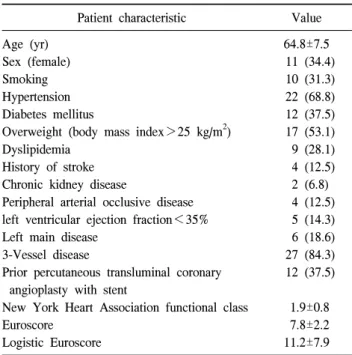
Table 1. Baseline characteristics (n=32)

Patient characteristic Value

Age (yr) Sex (female) Smoking Hypertension Diabetes mellitus

Overweight (body mass index>25 kg/m

2

) Dyslipidemia

History of stroke Chronic kidney disease

Peripheral arterial occlusive disease left ventricular ejection fraction<35%

Left main disease 3-Vessel disease

Prior percutaneous transluminal coronary angioplasty with stent

New York Heart Association functional class Euroscore

Logistic Euroscore

64.8±7.5 11 (34.4) 10 (31.3) 22 (68.8) 12 (37.5) 17 (53.1) 9 (28.1) 4 (12.5) 2 (6.8) 4 (12.5) 5 (14.3) 6 (18.6) 27 (84.3) 12 (37.5)

1.9±0.8 7.8±2.2 11.2±7.9 Values are presented as mean±standard deviation or number (%).

with that of the first-time CABG [1-12]. To overcome the technical difficulty and to lower the mortality rate of redo CABG, surgical techniques have evolved such as minimizing the dissection before bypass, routine use of femoral vessels for cannulation, use of antegrade and retrograde blood car- dioplegia, and performance of all vascular anastomoses under a single aortic cross clamp. This has led to a slight improve- ment in the surgical outcome in on-pump CABG, but the suboptimal mortality and morbidity rates still remain a challenge.

Complex difficulties of reoperative CABG lead to a poorer outcome than those of first-time CABG. The patients under- going redo CABG are older with more comorbidity, left ven- tricular dysfunction, and myocardial infarction. Redo CABG poses problems on the approach for re-entry, potential for cardiac and conduit injury during dissection, availability of conduit, management of patent grafts, myocardial protection, and use of blood products [2]. To overcome the afore- mentioned problems and difficulties, off-pump CABG could be an alternative method. Clarifying the feasibility of the off-pump technique in redo CABG seems to be important.

Therefore, the aim of this retrospective study was to analyze

early and midterm results after redo CABG and compare the outcome of redoing the procedure on pump and off pump.

METHODS 1) Patients’ characteristics

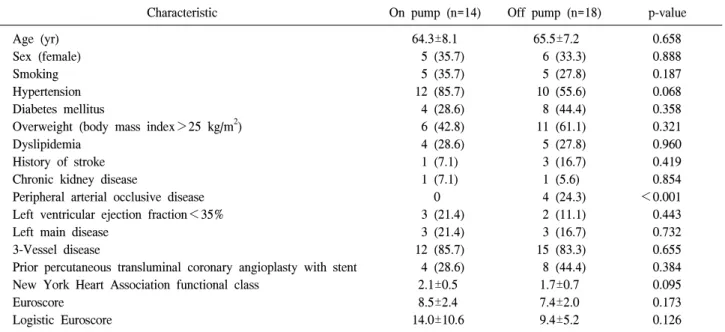
From June 1996 to October 2011, elective redo CABG was performed in 32 patients. The mean duration from the first CABG to redo CABG was 12.2±8.4 years. The mean age of the patients was 64.8±7.5 years (on pump 64.3±8.1 years vs.

off pump 65.5±7.2 years; p=0.658), and 21 patients (65.6%) were male. Among these patients, 14 (43.8%) underwent on-pump CABG and 18 (56.2%) underwent off-pump CABG.

In Severance Cardiovascular Hospital, on-pump CABG had been performed as the standard procedure for redo CABG until 2001. Since 2002, off-pump CABG has been performed as the first choice. Six patients (6.8%) had chronic kidney disease, and 5 patients (14.3%) had significant left ventricular dysfunction (left ventricular ejection fraction<35%). The pa- tient demographics are listed in Table 1. The reasons for redo CABG included previous graft failure in 26 patients (81.2%) and progressed native coronary artery disease in 6 patients (18.7%).

The patients who underwent on-pump CABG and off-pump CABG had similar demographics and preoperative cardiac function. There was no significant difference in the pre- operative risk factors except the presence of peripheral artery obstructive disease (on pump 0% vs. off pump 24.3%; p

<0.001) between the two groups (Table 2). The mean fol- low-up duration was 6.1±5.1 years in the on-pump group and 3.8±2.8 years in the off-pump group (Fig. 1).

2) Operative technique

(1) Off-pump technique: All operations were performed

via a full mid-sternotomy incision under normothermia. Stan-

dard intraoperative monitoring methods including Swan-Ganz

catheterization and transesophageal echocardiogram were

used. The choice of the grafts to be used was made in-

dividually based on the location of the diseased vessel, pre-

vious grafting, and the surgeon’s preference. The ITA was

harvested in a semi-skeletonized fashion. The non-dominant

side radial artery was harvested with a Harmonic scalpel

(3)

Table 2. Comparison of preoperative characteristics between on-pump and off-pump

Characteristic On pump (n=14) Off pump (n=18) p-value

Age (yr) Sex (female) Smoking Hypertension Diabetes mellitus

Overweight (body mass index>25 kg/m

2

) Dyslipidemia

History of stroke Chronic kidney disease

Peripheral arterial occlusive disease Left ventricular ejection fraction<35%

Left main disease 3-Vessel disease

Prior percutaneous transluminal coronary angioplasty with stent New York Heart Association functional class

Euroscore Logistic Euroscore

64.3±8.1 5 (35.7) 5 (35.7) 12 (85.7) 4 (28.6) 6 (42.8) 4 (28.6) 1 (7.1) 1 (7.1) 0 3 (21.4) 3 (21.4) 12 (85.7) 4 (28.6) 2.1±0.5 8.5±2.4 14.0±10.6

65.5±7.2 6 (33.3) 5 (27.8) 10 (55.6) 8 (44.4) 11 (61.1) 5 (27.8) 3 (16.7) 1 (5.6) 4 (24.3) 2 (11.1) 3 (16.7) 15 (83.3) 8 (44.4) 1.7±0.7 7.4±2.0 9.4±5.2

0.658 0.888 0.187 0.068 0.358 0.321 0.960 0.419 0.854

<0.001 0.443 0.732 0.655 0.384 0.095 0.173 0.126 Values are presented as mean±standard deviation or number (%).

Fig. 1. The mean follow-up duration was 6.1±5.1 years in on-pump group and 3.8±2.8 years in off-pump group.

(Ethicon Endosurgery, Cincinnati, OH, USA) as a pedicle. In case of using ITA, heparin and papaverine were injected through ITA. Intravenous calcium channel blocker was used to prevent vasospasm of the radial artery. Anticoagulation was achieved with 100 U/kg of intravenous heparin to main- tain the activated clotting time at more than 300 seconds. For cardiac stabilization and displacement, Octopus tissue stabil- izer (Medtronic Inc., Minneapolis, MN, USA) was used dur- ing the anastomosis. Intracoronary shunt was used for left an-

terior descending artery (LAD) anastomosis and the proximal snaring technique for the other vessels.

(2) On-pump technique: Standard cardiopulmonary bypass using cannulation on ascending aorta and right atrium were established under moderate systemic hypothermia. Transeso- phageal echocardiography was used to evaluate postoperative cardiac function and existence of significant atheroma on as- cending aorta. The aorta was cross clamped, and myocardial protection was achieved with intermittent antegrade, or simul- taneous antegrade and retrograde infusion of blood cardiop- legia. The ITA was harvested in a semi-skeletonized fashion.

In case of using the saphenous vein graft, distal anastomosis was made at first, and the ITA was anastomosed last during rewarming.

3) Data collection and analysis

Preoperative and perioperative data were collected pro- spectively at Severance Cardiovascular Hospital in the cardiac research database. We compared the overall and annual mor- tality and morbidity of all the patients, and according to the surgical techniques. Patient follow-up was performed by pa- tient interview in an outpatient clinic or by telephone.

Perioperative myocardial infarction was defined as a sig-

nificant increase in creatine kinase (CK)-MB with the appear-

(4)

Table 3. Types of grafts

Variable On pump

(n=14)

Off pump (n=18) p-value Left internal thoracic artery

Right internal thoracic artery Radial artery

Saphenous vein Gastroepiploic artery

Bilateral internal thoracic arteries

5 (35.7) 4 (28.6) 7 (50.0) 11 (78.6)

0 0

7 (38.9) 7 (38.9) 13 (72.2) 3 (16.7) 2 (11.1) 1 (5.6)

0.854 0.542 0.198

<0.001 0.198 0.370 Values are presented as number (%).

Table 4. Composition of grafts

Configuration On pump (n=14) Off pump (n=18)

ITA only LITA+aorta LITA+Y composite RITA+aorta RITA+Y composite Aorta only

GEA only (GEA-right postero-descending artery)

0 3 2 (RA-2)

2 2 (RA)

5 (SVG-3, both-2)

5 (LITA-1, RITA-3, bilateral ITA-1) 2

3 (RA-2, SVG-1) 1 2 (RA)

4 (RA-2, SVG-0, both-2) 1

ITA, internal thoracic artery; LITA, left internal thoracic artery; RITA, right internal thoracic artery; RA, radial artery; SVG, saphe- nous vein graft; GEA, gastroepiploic artery.

ance of a new Q-wave or S-T segment elevation of more than 2 mm on the electrocardiogram. Complete revasculariza- tion was defined when the number of revascularized vessels was the same or greater than the number of diseased vessels.

For statistical analysis, continuous variables were expressed as mean±standard deviation. For comparison of two variables, the Student t-test and the chi-square test were used. A sig- nificant level of 0.05 was used throughout the tests. For sur- vival, the Kaplan-Meier method was used, and the differences were assessed with the log-rank test. Statistical analyses were performed using the SPSS ver. 12.0 software package (SPSS Inc., Chicago, IL, USA).

RESULTS 1) Operative data

One of the patients underwent concomitant mitral valve an- nuloplasty, and the rest underwent isolated redo CABG. ITA was used in 15 patients (48.9%) in the first operation. For re- do CABG, ITA was used in 22 patients (68.8%): 12 left

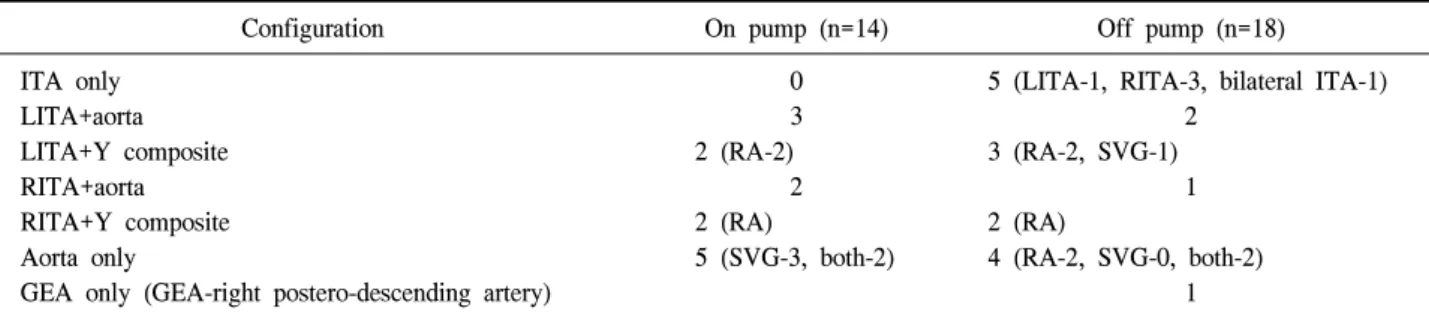
ITAs, 10 right ITAs, and 1 using both of them. The in- cidence of composite Y graft and aorta grafts was similar, and total arterial revascularization was achieved in 17 patients (53.1%). Incomplete revascularization occurred in 14 patients (43.8%), and the causes of incomplete revascularization were small native coronary arteries that were not suitable for target vessels in 9 patients and the inability to expose the target vessel in 4 patients.

The average number of distal anastomoses was 2.13±0.9.

The types of grafts used and the composition of grafts are described in Tables 3, 4. Comparing the on-pump group and off-pump groups, we found that the number of distal anasto- moses and the types of grafts used were similar. The rate of total arterial revascularization was higher in the off-pump group (14.3% vs. 83.3%, p<0.001); therefore, saphenous vein grafts were less frequently used in this group (78.6% vs.

16.7%, p<0.001). Operation time was significantly longer in the on-pump group (on pump 437.9±93.6 minutes vs. off pump 327.7±57.1 minutes, p<0.001) (Table 5). Cardiopul- monary bypass time of the on-pump group was 168.3±68.5 minutes, and the aortic cross-clamping time was 121.3±66.3 minutes.

2) Postoperative outcome

There was one in-hospital death. The patient underwent

on-pump CABG with concomitant valve surgery and died

from the acute respiratory distress syndrome. The overall hos-

pital mortality was 3.1% (n=1) and was comparable in both

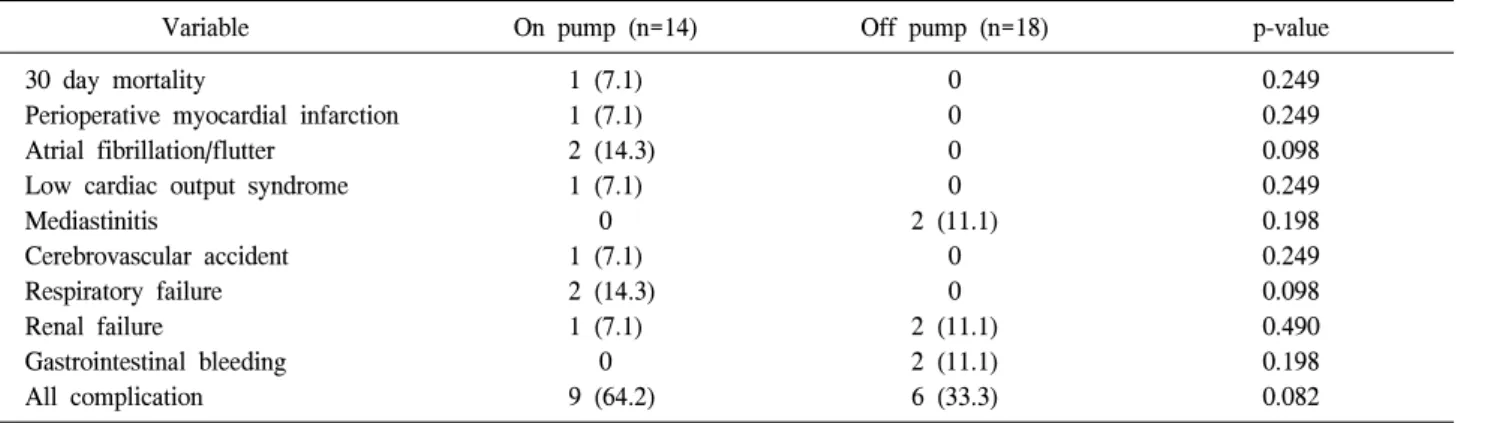
groups (on pump 7.1% vs. off pump 0%, p=0.249). Postope-

rative complications occurred in 12 patients, and the rate of

complications was higher in the on-pump group without stat-

(5)

Table 5. Operative and postoperative data

Variable On pump (n=14) Off pump (n=18) p-value

Anastomoses/patient

Total arterial revascularization Incomplete revascularization Operation time (min) Intensive care unit stay (day) Hospital stay (day)

2.36±0.9 2 (14.3) 8 (57.1) 437.9±93.6

5.5±7.9 17.1±9.5

1.94±0.9 15 (83.3) 6 (33.3) 327.7±57.1

2.7±1.0 12.5±6.9

0.224

<0.001 0.178

<0.001 0.356 0.129 Values are presented as mean±standard deviation or number (%).

Table 6. Mortality and complications

Variable On pump (n=14) Off pump (n=18) p-value

30 day mortality

Perioperative myocardial infarction Atrial fibrillation/flutter

Low cardiac output syndrome Mediastinitis

Cerebrovascular accident Respiratory failure Renal failure

Gastrointestinal bleeding All complication

1 (7.1) 1 (7.1) 2 (14.3)

1 (7.1) 0 1 (7.1) 2 (14.3)

1 (7.1) 0 9 (64.2)

0 0 0 0 2 (11.1)

0 0 2 (11.1) 2 (11.1) 6 (33.3)

0.249 0.249 0.098 0.249 0.198 0.249 0.098 0.490 0.198 0.082 Values are presented as mean±standard deviation or number (%).

Fig. 2. Kaplan-Meier estimated survival curve shows overall sur- vival at 10-year rate of 86.1%±10.5%.

istical significance (64.2% vs. 33.3%, p=0.082) (Table 6).

The length of the intensive care unit stay and the hospital stay did not differ between the on-pump and off-pump group (Table 5).

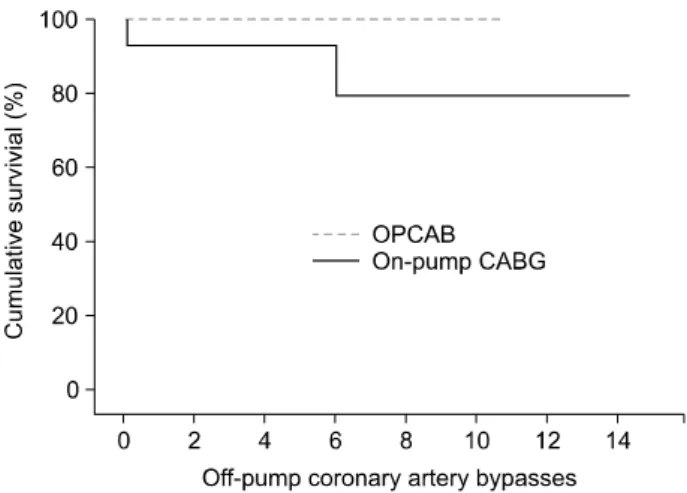
The mean follow-up duration was 5.4±4.1 years, and over- all survival at 10 years was 86.0%±10.5%. Kaplan-Meier es- timated survival at 5 and 10 years was 92.9%±6.9% and 79.61%±13.6% in the on-pump group, and 100% and 100%

in off-pump group, respectively, and there was no significant difference in the 10-year survival rate in both groups (p=0.225) (Figs. 2, 3).

DISCUSSION

Reoperative coronary artery bypass grafting has been

known to be a firm predictor of increased mortality and mor-

bidity in previous studies [13]. Reoperation per se carries ad-

ditional risks including the issues of the second sternotomy

and mediastinal dissection, and technical difficulties. In addi-

tion, comparatively higher age and impaired left ventricular

function of the patients have been contributive [1]. Early

mortality of reoperative CABG has been reported in a wide

range from 1.8% to 16.7% [14]. Our study demonstrated

(6)

Fig. 3. Kaplan-Meier estimated survival at 5 and 10 years were 92.9%±6.9%, and 79.6.1%±13.6% in on-pump group, and 100%

and 100% in off-pump group, and there was no significant differ- ence in 10-year survival rate in both groups (p=0.225). CABG, coronary artery bypass graft.

30-day mortality of 3.1%, which is acceptable as compared to previous studies.

Mack [8] performed 86 redo off-pump coronary artery by- passes (OPCABs) among 87 patients who were planned on redo CABG on an ‘intention to treat’ basis. Only one patient had converted to on-pump CABG. Mishra and associates [9]

performed 332 redo OPCABs among 538 patients, and the patients who underwent on-pump CABG had worse hemody- namic status, increased urgency, and worse quality of distal coronary target vessels. In contrast, Vohra et al. [3] did not consider small targets and intramyocardial vessels as con- tra-indications to the off-pump technique. Contrasting views on the feasibility of redo OPCAB are similar to those of the first-time OPCAB in the earlier days between the mid-1980s and the late 1990s. To clarify the feasibility of redo OPCAB, a comparison between the off-pump technique and the on-pump technique regarding the following issues is benefi- cial because the on-pump technique is the mainstay of redo CABG.

1) Completeness of revascularization

The ultimate goal of coronary bypass grafting is complete revascularization irrespective of the techniques used. Comp- lete revascularization is associated with better long-term sur- vival than incomplete revascularization. However, the defi-

nition of complete revascularization differs by surgeon or institution. In redo CABG, there is wide variation on the def- inition of complete revascularization giving consideration to particular issues such as senile vein grafts. This leads to the controversy on the optimal revascularization and diverse em- phasis on complete revascularization [15-17]. The complete revascularization rate after redo OPCAB is lower than that of first-time CABG. There are few reports on the complete re- vascularization rate after redo CABG. Di Mauro et al. [1] re- ported a lower complete revascularization rate in redo CABG patients using either on-pump or off-pump techniques (on pump 59.8% and off pump 40.2%) as compared to first-time CABG (93.3% vs. 85.4%). The patients with incomplete re- vascularization showed higher incidence of cardiac-related death, acute myocardial infarction, and cardiac events.

Tugtekin et al. [12] reported a lower complete revasculariza- tion rate of 48.6% after off-pump CABG compared with 86.9% after on-pump CABG in reoperation. On the other hand, Mishra et al. [9] reported a rather high rate of com- plete revascularization after redo OPCAB (75%). Some others have reported similar complete revascularization rate of on-pump and off-pump techniques by propensity score match- ing [3,6]. In our study, the incomplete revascularization rate was higher in the on-pump group than in the off-pump group, although there was no statistically significant difference. In conclusion, the complete revascularization rate after redo OPCAB seems to be comparable with that of on-pump redo CABG and is largely affected by myocardial function and the surgeon’s experience.

2) Operative morbidity and mortality

Schutz et al. [6] reported preferable results for redo OPCAB in terms of platelet transfusion and the length of in- tensive care unit stay by comparing 20 patients from each group. There was no hospital death in either group. Trehan et al. [10] showed a mortality rate of 4% in redo OPCAB pa- tients, and the others reported a mortality rate of 2.9% after redo OPCAB and 3.8% after redo on-pump CABG although there was no statistical significance [12]. Mishra et al. [9]

showed a mortality rate of 3.3% after redo OPCAB and 5.5%

after redo on-pump CABG without any significant difference.

However, in terms of the length of ventilator care and in-

(7)

otropic use, the off-pump technique showed superior outcomes. Vohra et al. [3] also reported a lower mortality rate in patients undergoing redo OPCAB but did not reach the statistical difference (off pump 2.3% and on pump 6.9%).

Stamou et al. [7] reported a significantly lower mortality rate in the off-pump group than in the on-pump group (1% vs.

10%, p=0.03), and even better outcomes in terms of post- operative transfusion, incidence of atrial fibrillation, duration of ventilator care, and length of hospital stay. Di Mauro et al.

[1] suggested the use of the off-pump technique in reoper- ative patients because the off-pump technique was associated with lower postoperative CK-MB level. The higher CK-MB level after CABG is known to have association with poor 5-year survival. As a result, the off-pump technique is asso- ciated with similar or rather lower operative mortality rate and morbidities, which was also demonstrated in our study.

3) Long-term survival

There is a lack of long-term data comparing two techni- ques in reoperative CABG. Vohra et al. [3] reported a 5-year survival rate of 95% after redo OPCAB and 87% after redo on-pump CABG (p=0.17), when the others reported 88.6% in the off-pump group and 83.8% in the on-pump group [12].

Even though the data are limited, the long-term survival rates after redo CABG using the two techniques are similar to that of first-time CABG.

In redo cases, the off-pump technique showed acceptable outcomes compared with the on-pump technique with similar graft patency, 5-year survival rate, and lower morbidity and mortality rates. However, the complete revascularization rate of redo OPCAB was lower than that of redo on-pump CABG as in the case of first-time CABG. This can be overcome by using various surgical approaches. In the case of multi-vessel disease, for example, a hybrid technique can be considered when the lesion is located too posterior to approach or to vis- ualize via a mid-sternotomy incision. Devices to avoid aortic clamping during proximal anastomosis can be used in some cases such as dense adhesion around the aorta or severe atherosclerosis. Furthermore, minimally invasive direct coro- nary artery bypass via antero-lateral thoracotomy can be the optimal surgical strategy when the lesion is confined to the LAD territory. In a circumflex system, the descending aorta

can be used as the proximal anastomosis site under a post- ero-lateral thoracotomy incision.

4) Limitation of the study

This study is limited by its retrospective nature. The limi- tation of the present study includes a small number of pa- tients, retrograde single-institution methodology, and different follow-up period and operation time of two groups.

5) Conclusions

In conclusion, redo CABG can be safely performed with acceptable mortality. The off-pump technique in the redo cas- es is feasible with low mortality and morbidity, and com- parable target vessel bypass grafting, and long-term survival.

The off-pump technique might be considered a safe option for redo CABG in high-risk patients in highly experienced centers. A large-population study with a longer follow-up du- ration is needed to clarify the safety and effectiveness of off-pump redo CABG.

CONFLICT OF INTEREST

No potential conflict of interest relevant to this article was reported.

REFERENCES

1. Di Mauro M, Iaco AL, Contini M, et al. Reoperative coro- nary artery bypass grafting: analysis of early and late outcomes. Ann Thorac Surg 2005;79:81-7.

2. Cosgrove DM 3rd. Is coronary reoperation without the pump an advantage? Ann Thorac Surg 1993;55:329.

3. Vohra HA, Bahrami T, Farid S, et al. Propensity score anal- ysis of early and late outcome after redo off-pump and on-pump coronary artery bypass grafting. Eur J Cardiothorac Surg 2008;33:209-14.

4. Sisillo E, Marino MR, Juliano G, Beverini C, Salvi L, Alamanni F. Comparison of on pump and off pump coronary surgery: risk factors for neurological outcome. Eur J Cardiothorac Surg 2007;31:1076-80.

5. Masroor S, Katariya K, Yassin S, Tehrani H, Salerno T.

Redo-OPCAB via left thoracotomy using symmetry aortic connector system: a report of two cases. J Card Surg 2004;19:51-3.

6. Schutz A, Mair H, Wildhirt SM, et al. Re-OPCAB vs. Re-

(8)

CABG for myocardial revascularization. Thorac Cardiovasc Surg 2001;49:144-8.

7. Stamou SC, Pfister AJ, Dangas G, et al. Beating heart ver- sus conventional single-vessel reoperative coronary artery bypass. Ann Thorac Surg 2000;69:1383-7.

8. Mack MJ. Off-pump surgery and alternatives to standard op- eration in redo coronary surgery. J Card Surg 2004;19:

313-9.

9. Mishra YK, Collison SP, Malhotra R, Kohli V, Mehta Y, Trehan N. Ten-year experience with single-vessel and multi- vessel reoperative off-pump coronary artery bypass grafting.

J Thorac Cardiovasc Surg 2008;135:527-32.

10. Trehan N, Mishra YK, Malhotra R, Sharma KK, Mehta Y, Shrivastava S. Off-pump redo coronary artery bypass graf- ting. Ann Thorac Surg 2000;70:1026-9.

11. Czerny M, Zimpfer D, Kilo J, et al. Coronary reoperations:

recurrence of angina and clinical outcome with and without cardiopulmonary bypass. Ann Thorac Surg 2003;75:847-52.

12. Tugtekin SM, Alexiou K, Kappert U, et al. Coronary reop-

eration with and without cardiopulmonary bypass. Clin Res Cardiol 2006;95:93-8.

13. Yau TM, Borger MA, Weisel RD, Ivanov J. The changing pattern of reoperative coronary surgery: trends in 1230 con- secutive reoperations. J Thorac Cardiovasc Surg 2000;120:

156-63.

14. Teodori G, Iaco AL, Di Mauro M, et al. Reoperative coro- nary surgery with and without cardiopulmonary bypass. J Card Surg 2000;15:303-8.

15. Vander Salm TJ, Kip KE, Jones RH, et al. What constitutes optimal surgical revascularization?: answers from the Bypass Angioplasty Revascularization Investigation (BARI). J Am Coll Cardiol 2002;39:565-72.

16. BARI Investigators. The final 10-year follow-up results from the BARI randomized trial. J Am Coll Cardiol 2007;49:

1600-6.

17. Valgimigli M, Agostoni P, Biondi Zoccai GG. Complete my-

ocardial revascularization: between myth and reality. Eur

Heart J 2005;26:1809-10.

수치

Table 1. Baseline characteristics (n=32)
Table 2. Comparison of preoperative characteristics between on-pump and off-pump
Table 4. Composition of grafts
Table 6. Mortality and complications
+2

참조

관련 문서

Changes in jugular bulb oxygen saturation during off-pump coronary artery bypass graft surgery Ji Young Kim.. Department

ies have reported that the long-term patency rates of saphenous vein (SV) grafts are lower than those of internal mammary artery (IMA) grafts. 1)2) Furthermore, there is a

This study evaluated the outcomes of off-pump coronary artery bypass surgery (OPCAB) with severe left ventricular dysfunction using composite bilateral internal thoracic artery

The Recovery of Left Ventricular Function after Coronary Artery Bypass Grafting in Patients with Severe Ischemic Left Ventricular Dysfunction: Off-pump Versus On-pump.. Jae Hyun

We evaluated the early clinical outcome and the angiographic patency of the saphenous vein composite graft based on the left in- ternal thoracic artery, and compared these results

In off-pump coronary artery bypass grafting (CABG), multiple proximal anastomosis may increase the risk of cerebral embolism (air, debris) and aortic injury

All of the patients underwent anaortic off-pump CABG (OPCAB) using the in situ left or right internal thoracic arteries (ITA); 3 patients had severe stenosis of the proximal

Compared with conventional coronary artery bypass graft (CABG), off-pump coronary artery bypass (OPCAB) has ad- vantages for performing transfusion-free surgery,