JCS
Journal of Chest SurgeryClinical Research Mid-Term Outcomes and Angiographic Patency of Redo
Coronary Artery Bypass Grafting: A Comparison between Off- Pump and On-Pump Surgery
Suk Ho Sohn, M.D., Seung Hyun Kim, M.D., Ho Young Hwang, M.D., Ph.D., Ki-Bong Kim, M.D., Ph.D.
Department of Thoracic and Cardiovascular Surgery, Seoul National University Hospital, Seoul National University College of Medicine, Seoul, Korea
ARTICLE INFO
Received September 23, 2020 Revised November 11, 2020 Accepted November 17, 2020 Corresponding author Ki-Bong Kim
Tel 82-2-2072-3482 Fax 82-2-747-5245 E-mail [email protected] ORCID
https://orcid.org/0000-0002-4918-7262
Background: We evaluated the mid-term outcomes and angiographic patency of redo coronary artery bypass grafting (CABG).
Methods: Of 2,851 patients who underwent isolated CABG at Seoul National University Hospital from 2000 to 2017, 88 underwent redo CABG. Patients’ mean age at redo CABG was 66.0±8.0 years. The mean interval between the first-time and redo CABG was 113.0±62.4 months. The mean follow-up duration was 86 months. Early and mid-term clinical out- comes were evaluated. Angiographic patency rates were evaluated early (1–2 days), 1 year, and 5 years after surgery. Comparative analyses between on-pump and off-pump CABG were also performed.
Results: The culprits for reoperation were previous grafts (65.6%), native coronary vessels (17.8%), and both (16.7%). Off-pump CABG was performed in 75 cases (85.2%), and the mean number of distal anastomoses was 1.8±0.8. The saphenous vein (39.7%) was used most frequently, followed by the right internal thoracic artery (28.4%), right gastroepiploic artery (21.3%), left internal thoracic artery (7.8%), and radial artery (2.8%). Operative mor- tality was 1.1%. The overall survival, cumulative incidence of cardiac death, and cumulative incidence of major adverse cardiac events were 71.3%,12.0%, and 23.3% at 5 years after surgery, respectively. The overall angiographic patency rates were 95.7%, 90.1%, and 92.2%
on early, 1-year, and 5-year angiograms, respectively. The angiographic patency rates of sa- phenous vein grafts were 93.1%, 85.6%, and 91.3% on early, 1-year, and 5-year angiograms, respectively. No significant differences in clinical outcomes or angiographic patency rates were observed between the on-pump (n=13) versus off-pump (n=75) groups. Multivari- able analysis revealed that age (hazard ratio [HR], 1.07; p=0.005) and chronic kidney disease (HR, 3.85; p=0.001) were risk factors for all-cause mortality.
Conclusion: Redo CABG could mostly be performed using the off-pump technique and did not show increased operative mortality and morbidities.
Keywords: Coronary artery bypass, Reoperation, Coronary angiography
Copyright©The Korean Society for Thoracic and Cardiovascular Surgery. 2021. All right reserved.
This is an Open Access article distributed under the terms of the Creative Commons Attribution Non-Commercial License (http://creativecommons.org/licenses/
Introduction
It has been estimated that 10%–20% of patients with pre- vious coronary artery bypass grafting (CABG) require a second revascularization procedure within 10 years due to the progression of atherosclerosis [1,2]. For these patients, both the American (2011) and European (2014) guidelines suggest percutaneous coronary intervention (PCI) as the first-line treatment for repeat revascularization [3,4], while the European (2018) guidelines recommend redo CABG
only for patients without a patent internal mammary ar- tery (IMA) graft to the left anterior descending artery (LAD) [5].
Currently, we are confronted with a pronounced drop in the number of redo CABGs, as well as a decrease in the number of isolated CABGs. One reason for this decrease is that redo CABG is one of the most challenging cardiac surgical procedures. The major factors that make these op- erations very complicated are sternal reentry and intraperi- cardial dissection, which should be performed to avoid in-
https://doi.org/10.5090/jcs.20.122 pISSN: 2765-1606 eISSN: 2765-1614 J Chest Surg. 2021;54(2):106-116
Suk Ho Sohn, et al. Redo CABG
JCS
jury to the patent grafts; poor access to the target vessels, which usually lie on the thickened epicardium; a shortage of available grafts owing to a previous operation; and sub- optimal cardiac function with other comorbidities [6,7]. In addition, some surgeons are unwilling to perform redo CABG because it is known to be associated with increased early mortality, with reported rates as high as 16% [8]. Fi- nally, optimal medical therapy with antiplatelets and statins [9], advancements in PCI, and the progress in surgi- cal techniques with the use of the IMA during first-time CABG have contributed to the reduced frequency of redo CABG [6].
Previous studies have reported higher surgical complexi- ty and inferior clinical outcomes, with increased operative mortality and morbidities, in redo CABG than in first- time CABG; however, some other studies have shown im- provements in hospital mortality rates after redo CABG, despite deterioration in patients’ risk profiles [6,10,11]. Fur- thermore, few studies have described the long-term out- comes of redo CABG patients in the recent era.
Thus, the aims of the present study were (1) to evaluate the early- and mid-term clinical outcomes and angiograph- ic patency of redo CABG and (2) to compare the outcomes between on-pump and off-pump redo CABG.
Methods
The study protocol was reviewed by the Institutional Re- view Board of Seoul National University Hospital and was approved as a minimal-risk retrospective study (approval no., H-2006-195-1138) that did not require individual con- sent based on the institutional guidelines for waiving con- sent.
Patient characteristics
Of 2,851 patients who underwent isolated CABG be- tween 2000 and 2017 in Seoul National University Hospi- tal, redo CABG, which was defined as a repeat CABG per- formed at least 30 days after the previous CABG, was performed in 90 patients (3.2%) (Fig. 1). Among 90 redo CABG patients, 2 patients who underwent a second redo CABG were excluded from the analysis, and a total of 88 patients were included in this study. The mean age of the patients at the time of redo CABG was 66.0±8.0 years. Hy- pertension (66.7%), diabetes mellitus (57.8%), and dyslipid- emia (33.3%) were the most frequently observed comorbid- ities in the overall population. Previous PCI was performed in 34 patients (37.8%); among them, 20 patients received PCI in the period between the first-time and the redo CABGs. The culprit lesions leading to redo CABG were graft occlusion (65.6%), native disease progression (17.8%), and both (16.7%). The time interval between the first-time and redo operations was 113.0±62.4 months (Table 1).
Surgical techniques and revascularization strategies
The basic surgical techniques for redo CABG followed the institutional principles of CABG as previously de- scribed [12]. Most of the operations were performed by a single surgeon (K.B.K.). Off-pump CABG was initially at- tempted in most of the patients; in some patients, however, cardiopulmonary bypass was required during the opera- tion due to hemodynamic instability or poor exposure caused by severe adhesions. Intraoperative intra-aortic bal- loon pump (IABP) therapy was performed in patients who
250
200
150
100
50
2000 2017
No.ofpatients
0
Isolated CABG Redo CABG
Isolated CABG Redo CABG
2001 2002 2003 2004 2005 2006 2007 2008 2009 2010 2011 2012 2013 2014 2015 2016 119 155 158 160 124 169 173 197 211 183 165 154 177 132 147 145 154 128
3 4 2 0 5 3 2 10 11 5 9 8 4 5 3 6 5 5
Fig. 1. Number of overall isolated CABG and redo CABG procedures performed from 2000 to 2017 at Seoul National University Hos
pital. CABG, coronary artery bypass grafting.
https://doi.org/10.5090/jcs.20.122
JCS
developed hemodynamic instability during cardiac manip- ulation or coronary anastomosis although adhesiolysis had been completed without cardiopulmonary bypass. The tar- get coronary arteries for bypass grafting were determined by a comprehensive evaluation of the patient, including se- rial angiographic results, myocardial single-photon emis- sion computed tomography, echocardiography, and symp- toms. The choice of the graft to use for redo CABG was determined based on (1) excluding previously used grafts, (2) the number and location of the target coronary arteries, and (3) the surgeon’s preference. All anastomoses were per- formed using a high-power magnification loupe (×4.5 magnification) and checked with a flowmeter after com- pletion of revascularization and just before pericardial clo- sure.
All the patients received aspirin therapy (100 mg daily) until the day of surgery and resumed the therapy as soon as possible after surgery, usually 1 day postoperatively.
Clopidogrel (75 mg daily) was combined simultaneously with aspirin for 1 year postoperatively. For patients with high serum levels of low-density lipoprotein cholesterol (>100 mg/dL), drug therapy was started.
Evaluation of clinical outcomes
Operative mortality was defined as any death within 30 days after surgery or during the same hospital admission.
After discharge, all patients regularly received postopera- tive follow-up at the outpatient clinic at 3- or 4-month in- tervals and were interviewed by telephone to confirm their Table 1. Preoperative characteristics and risk factors of the study population
Characteristic Total (n=88) Onpump (n=13) Offpump (n=75) pvalue
Age (yr) 66.0±8.0 67.0±6.1 65.9±8.3 0.629
Female 22 (25.0) 2 (15.4) 20 (26.7) 0.504
Body surface area (m2) 1.71±0.16 1.66±0.22 1.72±0.15 0.253
Body mass index (kg/m2) 24.6±2.9 23.8±3.4 24.8±2.8 0.259
Risk factors
Smoking 27 (30.7) 5 (38.5) 22 (29.3) 0.527
Hypertension 58 (65.9) 10 (76.9) 48 (64.0) 0.529
Diabetes mellitus 51 (58.0) 9 (69.2) 42 (56.0) 0.372
Dyslipidemia 30 (34.1) 6 (46.2) 24 (32.0) 0.353
History of stroke 14 (15.9) 4 (30.8) 10 (13.3) 0.210
Chronic kidney disease 14 (15.9) 0 14 (18.7) 0.117
LVEF <35% 10 (11.4) 1 (7.7) 9 (12.0) >0.999
Preoperative diagnosis
Unstable angina 54 (61.4) 6 (46.2) 48 (64.0) 0.222
Stable angina 24 (27.3) 5 (38.5) 19 (25.3) 0.330
Postinfarct angina 10 (11.4) 2 (15.4) 8 (10.7) 0.638
Type of vessel disease
LMD+3VD 7 (8.0) 1 (7.7) 6 (8.0) >0.999
LMD+2VD 12 (13.6) 3 (23.1) 9 (12.0) 0.375
LMD+1VD 2 (2.3) 0 2 (2.7) >0.999
LMD 1 (1.1) 0 1 (1.3) >0.999
3VD 14 (15.9) 0 14 (18.7) 0.117
2VD 33 (37.5) 7 (53.8) 26 (34.7) 0.223
1VD 19 (21.6) 2 (15.4) 17 (22.7) 0.726
History of PCI 33 (37.5) 5 (38.5) 28 (37.3) >0.999
PCI after first CABG 20 (22.2) 3 (20.0) 17 (22.7) 0.562
Culprit for reoperation 0.319
Graft 58 (65.9) 7 (53.8) 51 (68.0)
Native vessel 16 (18.2) 2 (15.4) 14 (18.7)
Both (graft+native vessel) 14 (15.9) 4 (30.8) 10 (13.3)
Interval between operations (mo) 113.0±62.4 87.5±69.2 117.5±60.6 0.110
Values are presented as mean±standard deviation or number (%).
LVEF, left ventricular ejection fraction; LMD, left main disease; VD, vessel disease; PCI, percutaneous intervention; CABG, coronary artery bypass grafting.
Suk Ho Sohn, et al. Redo CABG
JCS
condition if the last clinic visit had not been conducted as scheduled. For patients who were lost to follow-up, nation- al health insurance data and information from Statistics Korea, a central organization for statistics under the Min- istry of Strategy and Finance, were utilized to confirm their survival or their date of death. The clinical and an- giographic follow-up was closed on June 30, 2020. The fol- low-up data were complete in 98.9% (87 of 88) of patients, with a mean follow-up duration of 85.7±55.8 months.
Cardiac death was defined as any death related to cardi- ac events, including sudden death during follow-up. Major adverse cardiac events (MACE) included acute myocardial infarction, coronary reintervention, and cardiac death.
Evaluation of angiographic patency
Early, 1-year, and 5-year follow-up coronary angiograms were performed regardless of the patients’ anginal symp- toms. Patients who died, refused angiographic evaluation, or had renal function impairment were excluded from an- giographic follow-up. However, patients receiving renal re- placement therapy were included in the angiographic fol- low-up.
Early (1 day; interquartile range [IQR], 1–2 months) pa- tency rates were evaluated by coronary angiograms in 100.0% (88 of 88) of the patients. One-year (12.6 months;
IQR, 12.0–13.5 months) and 5-year (62.3 months; IQR, 60.4–70.1 months) angiograms were performed in 87.5%
and 54.5% of the patients, respectively. Patients who were reluctant to undergo coronary angiography received multi- detector computed tomography (MDCT) angiography as an alternative evaluation method. Twenty-five and 20 pa- tients underwent MDCT angiography instead of coronary angiography for their 1-year and 5-year patency evalua- tions, respectively. If an MDCT examination suggested oc- cluded or stenotic grafts when compared with the patient’s previous angiograms, coronary angiography was then per- formed to confirm the status of graft patency. Two blinded specialists reviewed all coronary angiograms, and 2 spe- cialists reviewed all MDCT angiograms. Each set of spe- cialists reached a consensus in their interpretations of graft patency. Graft patency was graded in the manner described by FitzGibbon et al. [13]. Grade A (excellent) and B (fair) grafts were considered to be patent. Grade O grafts, which included stenosis of ≥75% of the grafted coronary artery or a totally occluded graft, were classified as occluded.
Operative data included graft usage, grafting strategy, the graft for target vessel anastomosis, the target native coronary artery (LAD, diagonal branch, obtuse marginal
artery [OM], right coronary artery [RCA], posterior de- scending artery [PDA], and posterolateral branch [PLB]), and revascularized areas of the heart (LAD, left circumflex artery [LCx], or RCA territory), and whether complete re- vascularization had been accomplished. Complete revascu- larization was defined as accomplishment of distal anasto- moses to each territory with angiographically significant stenosis.
Statistical analysis
Statistical analysis was conducted with IBM SPSS soft- ware ver. 25.0 (IBM Corp., Armonk, NY, USA) and SAS soft- ware ver. 9.3 (SAS Institute Inc., Cary, NC, USA). Continuous variables are presented as the mean±standard deviation for normally distributed data or as the median with interquar- tile range for data that were not normally distributed, while categorical variables are presented as the number and percentage of subjects. Comparisons of baseline demo- graphics, operative data, and early clinical outcomes be- tween the 2 groups were performed using the chi-square test or Fisher exact test for categorical variables, the Stu- dent t-test or Wilcoxon rank sum test for continuous vari- ables, and the generalized estimating equation (GEE) method for operative data with multiple data points per subject. Overall survival was estimated using the Ka- plan-Meier method, and comparisons between the 2 groups were performed using a Cox proportional-hazard model. For the analysis of cardiac death and MACE, cu- mulative incidence curves were estimated while consider- ing competing events. Noncardiac death was considered as a competing event for cardiac death and MACE. A Fine and Gray regression model was used to compare cumula- tive incidence between the groups [14]. The proportional hazards assumption was checked by log-minus-log plots of survival functions for categorical variables or time-depen- dent covariates in the Cox model and the Fine and Gray model. Restricted cubic splines were used to check the as- sumption of linearity between each continuous variable and its log hazard. For risk factor analysis, preoperative variables and operative factors with a p-value of <0.1 in the univariate analysis were included in the multivariable anal- ysis, and these variables were also used to adjust the com- parison of mid-term outcomes. The graft patency rates were compared using logistic regression with GEE to ac- count for multiple measurements per subject or using a lo- gistic regression with the Firth penalized-likelihood bi- as-reduction method in cases where GEE failed to converge because 1 of the groups (the on-pump group) had no
https://doi.org/10.5090/jcs.20.122
JCS
events. Preoperative variables and operative factors with a p-value <0.05 in the univariate analysis were used to adjust the comparison of patency rates.
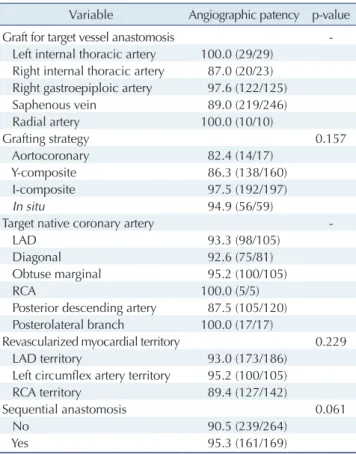
Operative factors, including the graft for target vessel anastomosis, grafting strategy, target coronary artery, re- vascularized myocardial territory, and sequential anasto- mosis, were analyzed to determine their effects on angio- graphic patency. All angiographic data from early, 1-year, and 5-year angiograms were integrated, and logistic re- gression analysis using GEE was used to consider correla-
tions of multiple grafts within 1 patient. The analysis was adjusted for the time at which angiography was performed.
Results
Operative data
Off-pump CABG was performed in 75 cases (85.2%);
there were 13 conversions (14.8%) to cardiopulmonary by- pass during off-pump CABG due to hemodynamic insta-
Table 2. Operative data
Variable Total (n=88) Onpump (n=13) Offpump (n=75) pvalue
Types of surgery
Elective 79 (89.8) 13 (100.0) 66 (88.0) 0.345
Urgent 9 (10.2) 0 9 (12.0) 0.345
Intraaortic balloon pump
Preoperative 37 (42.0) 1 (7.7) 36 (48.0) 0.007
Intraoperative 7 (8.0) 2 (15.4) 5 (6.7) 0.275
Postoperative 1 (1.1) 0 1 (1.3) >0.999
Complete revascularization 63 (71.6) 12 (92.3) 51 (68.0) 0.099
Distal anastomoses per patient 1.9±0.8 2.0±0.4 1.8±0.8 0.232
Graft usage
LITA 11 (7.8) 0 11 (8.9) 0.270
RITA 40 (28.4) 5 (27.8) 35 (28.5) 0.677
RGEA 30 (21.3) 0 30 (24.4) 0.011
SV 56 (39.7) 13 (72.2) 43 (35.0) 0.001
RA 4 (2.8) 0 4 (3.3) 0.819
Grafting strategy
Aortocoronary 6 (4.3) 0 6 (4.9) 0.596
Ycomposite 36 (25.5) 8 (44.4) 28 (22.8) 0.078
Icomposite 41 (29.1) 5 (27.8) 36 (29.3) 0.488
In situ 58 (41.1) 5 (27.8) 53 (43.1) 0.004
Graft for target vessel anastomosis
LITA 9 (5.5) 0 9 (6.6) 0.255
RITA 7 (4.3) 0 7 (5.1) 0.377
RGEA 41 (25.2) 0 41 (29.9) <0.001
SV 102 (62.0) 26 (100.0) 75 (54.7) <0.001
RA 5 (3.1) 0 5 (3.6) 0.557
Target native coronary artery
LAD 42 (25.8) 2 (7.7) 40 (29.2) 0.034
Diagonal 29 (17.8) 4 (15.4) 25 (18.2) 0.542
Obtuse marginal 38 (23.3) 10 (38.5) 28 (20.4) 0.011
RCA 2 (1.2) 1 (3.8) 1 (0.7) 0.231
Posterior descending artery 44 (27.0) 6 (23.1) 38 (27.7) 0.665
Posterolateral branch 8 (4.9) 3 (11.5) 5 (3.6) 0.089
Revascularized myocardial territory
LAD territory 57 (64.8) 6 (46.2) 51 (68.0) 0.352
Left circumflex artery territory 33 (37.5) 9 (69.2) 24 (32.0) 0.143
RCA territory 51 (58.0) 9 (69.2) 42 (56.0) 0.841
Values are presented as number (%) or mean±standard deviation.
LITA, left internal thoracic artery; RITA, right internal thoracic artery; RGEA, right gastroepiploic artery; SV, saphenous vein; RA, radial artery; LAD, left anterior descending artery; RCA, right coronary artery.
Suk Ho Sohn, et al. Redo CABG
JCS
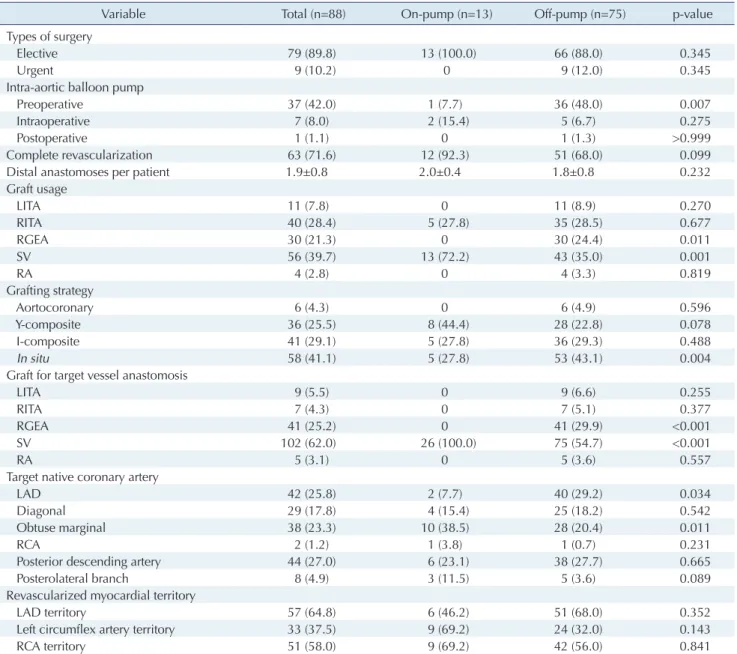
bility or poor exposure caused by severe adhesions. Twelve cases were performed in an on-pump beating fashion with- out aortic cross-clamping, while 1 case required aortic cross-clamping with cardioplegic arrest. Perioperative IABP support was needed in 45 patients (51.1%). Among them, 37 patients (42.0%) underwent IABP insertion pre- operatively, 7 patients (8.0%) received IABP support intra- operatively, and 1 patient (1.1%) received IABP support postoperatively. Urgent surgery was performed in 9 pa- tients (10.2%) out of the overall cohort (Table 2).
Overall, 141 grafts were used in 88 redo CABG patients.
In terms of graft usage, the saphenous vein (SV) was the most frequently used graft (63.3%), followed by right inter- nal thoracic artery (RITA) (46.7%), right gastroepiploic ar- tery (RGEA) (33.3%), left internal thoracic artery (LITA) (11.1%), and radial artery (RA) (5.6%). In terms of the grafting strategy, in situ grafting was the most frequently used strategy (41.7%), followed by I-composite grafting (29.2%), Y-composite grafting (25.0%), and aortocoronary grafting (4.2%).
A total of 164 anastomoses (1.9±0.8 distal anastomoses
per patient) were performed in the overall study popula- tion. Anastomoses were performed with the SV (62.0%), RGEA (25.2%), LITA (5.5%), RITA (4.3%), and RA (3.1%).
The target coronary arteries were the LAD (25.8%), diago- nal branch (17.8%), OM (23.3%), RCA (1.2%), PDA (27.0%), and PLB (4.9%). The LAD territory was revascularized in 57 patients, the LCx territory was revascularized in 33 pa- tients, and the RCA territory was revascularized in 51 pa- tients (Table 2).
Early clinical outcomes
There was only 1 case of operative mortality (1.1%) among the study population; this event did not occur within 30 postoperative days. The postoperative morbidities were atrial fibrillation (30.0%), acute kidney injury (9.1%), reop- eration for bleeding (3.4%), stroke (3.4%), and mediastinitis (1.1%). The patients were extubated at 19 hours (IQR, 17–24 days) and stayed in the intensive care unit (ICU) for 24 hours (IQR, 21–45 hours). The patients were discharged on postoperative day 8 (IQR, 7–14 days). When the patients
100
80
60
40
20
13
Overallsurvival(%)
Duration (yr) Patients at risk
On-pump Off-pump 0
On-pump Off-pump
13 75
1 2 3 4 5 6 7 8 9 10 11 12 p=0.958
12 68
12 63
11 58
11 51
11 40
10 37
10 33
9 28
7 24
5 21
1 19
1 13
0 8
A B
C
100
80
60
40
20
13 Cumulativeincidenceof cardiacdeath(%)
Duration (yr) Patients at risk
On-pump Off-pump 0
On-pump Off-pump
13 75
1 2 3 4 5 6 7 8 9 10 11 12 p=0.229
12 68
12 63
11 58
11 51
11 40
10 37
10 33
9 28
7 24
5 21
1 19
1 13
0 8
100
80
60
40
20
13 Cumulativeincidenceof MACE(%)
Duration (yr) Patients at risk
On-pump Off-pump 0
On-pump Off-pump
13 75
1 2 3 4 5 6 7 8 9 10 11 12 p=0.087
12 64
12 55
11 49
11 43
11 34
9 31
9 26
8 21
6 16
4 13
1 11
1 8
0 5
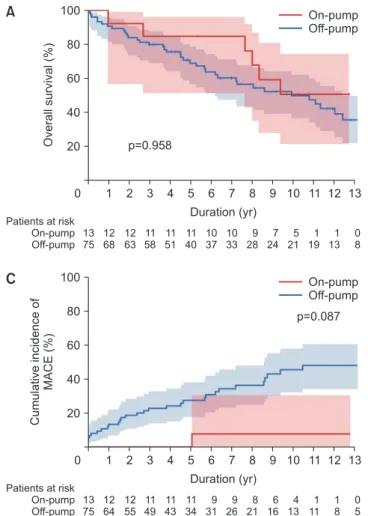
Fig. 2. (A) Comparison of overall survival between the onpump group and offpump group in the study population. (B) Compar
ison of the cumulative incidence of cardiac death between the onpump group and offpump group. (C) Comparison of the cu
mulative incidence of MACE between the onpump group and offpump group. MACE, major adverse cardiac events.
https://doi.org/10.5090/jcs.20.122
JCS
were classified into off-pump versus on-pump groups, there was no difference regarding mortality or morbidities between the groups. However, hospital course-related vari- ables, including extubation time, ICU stay, and hospital stay, were longer in the on-pump group than in the off- pump group, although statistical significance was only found for ICU stay (Supplementary Table 1).
Mid-term clinical outcomes
During the mid-term follow-up, all-cause mortality oc- curred in 45 patients (51.1%), including 18 cardiac deaths.
Overall survival, cumulative incidence of cardiac death, and cumulative incidence of MACE were 71.3%, 12.0%, and 23.3% at 5 years after surgery, respectively. There were
no significant differences in overall survival (p=0.958), cu- mulative incidence of cardiac death (p=0.229), and MACE (p=
0.087) between the on-pump and off-pump groups (Fig. 2).
Multivariable analysis revealed that age (hazard ratio [HR], 1.07; p=0.005) and chronic kidney disease (HR, 3.85;
p=0.001) were risk factors for all-cause mortality, and age (HR, 1.08; p=0.030) was a risk factor for cardiac death (Ta- ble 3, Supplementary Tables 2–4). No statistically signifi- cant risk factors were found for MACE (Supplementary Ta- bles 5, 6).
Early, 1-year, and 5-year angiographic patency
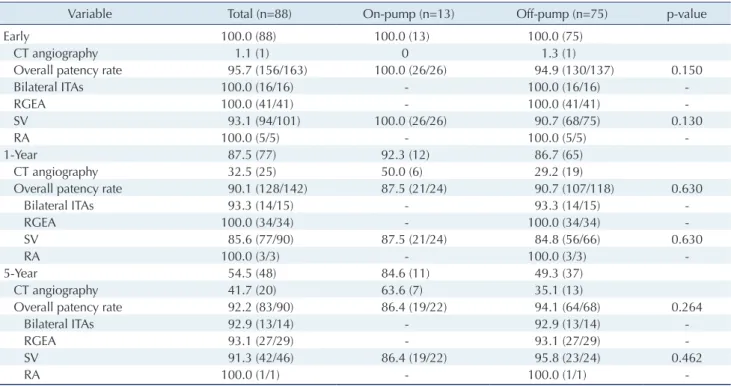
Early, 1-year, and 5-year postoperative angiograms were obtained from 100%, 87.5%, and 54.5% of the study pa- tients, respectively, and demonstrated 95.7%, 90.1%, and 92.2% overall patency rates (Table 4). There was no evi- dence that overall patency rates were different between the on-pump and off-pump groups. Aortocoronary grafting (among 4 grafting strategies), the RCA territory (among the 3 myocardial territories), and nonsequential anastomo- sis appeared to be associated with inferior angiographic patency, although the results failed to reach statistical sig- nificance (Table 5).
Table 3. Multivariable analysis of factors associated with cardiac death
Variable Hazard ratio (95%
confidence interval) pvalue
Offpump group 6.14 (0.81–786.82) 0.229
Age (yr) 1.08 (1.01–1.17) 0.030
Urgent operation 2.06 (0.62–5.62) 0.208
Incomplete revascularization 2.65 (0.96–7.14) 0.060
Table 4. Early, 1-year, and 5-year angiographic patency rates
Variable Total (n=88) Onpump (n=13) Offpump (n=75) pvalue
Early 100.0 (88) 100.0 (13) 100.0 (75)
CT angiography 1.1 (1) 0 1.3 (1)
Overall patency rate 95.7 (156/163) 100.0 (26/26) 94.9 (130/137) 0.150
Bilateral ITAs 100.0 (16/16) 100.0 (16/16)
RGEA 100.0 (41/41) 100.0 (41/41)
SV 93.1 (94/101) 100.0 (26/26) 90.7 (68/75) 0.130
RA 100.0 (5/5) 100.0 (5/5)
1Year 87.5 (77) 92.3 (12) 86.7 (65)
CT angiography 32.5 (25) 50.0 (6) 29.2 (19)
Overall patency rate 90.1 (128/142) 87.5 (21/24) 90.7 (107/118) 0.630
Bilateral ITAs 93.3 (14/15) 93.3 (14/15)
RGEA 100.0 (34/34) 100.0 (34/34)
SV 85.6 (77/90) 87.5 (21/24) 84.8 (56/66) 0.630
RA 100.0 (3/3) 100.0 (3/3)
5Year 54.5 (48) 84.6 (11) 49.3 (37)
CT angiography 41.7 (20) 63.6 (7) 35.1 (13)
Overall patency rate 92.2 (83/90) 86.4 (19/22) 94.1 (64/68) 0.264
Bilateral ITAs 92.9 (13/14) 92.9 (13/14)
RGEA 93.1 (27/29) 93.1 (27/29)
SV 91.3 (42/46) 86.4 (19/22) 95.8 (23/24) 0.462
RA 100.0 (1/1) 100.0 (1/1)
Values are presented as % (number).
CT, computed tomography; ITA, internal thoracic artery; RGEA, right gastroepiploic artery; SV, saphenous vein; RA, radial artery.
Suk Ho Sohn, et al. Redo CABG
JCS
Discussion
The present study demonstrated 3 main findings. First, the early and mid-term outcomes of redo CABG were ex- cellent compared with those of other previously published studies. Second, the angiographic patency results, which were comparable with the outcomes generally observed in first-time CABG, were also acceptable. Third, early out- comes, mid-term outcomes, and angiographic patency rates were comparable between the on-pump and off-pump redo CABG groups.
In the present study, operative mortality was 1.1%, whereas it was reported to be between 4% and 6% in previ- ous studies [6,15,16]. In addition to the competent surgical technique and perioperative medical management, active support with IABP might have led to the excellent early outcomes observed. In this study, more than 40% of pa- tients were supported with IABP as early as the preopera- tive period, which is a larger percentage than reported in other studies. Yau et al. [10] reported rates of 6.8% for 30- day mortality and 16.1% for IABP insertion in their redo
CABG population, and Maltais et al. [17] reported rates of 6% for in-hospital mortality and 20% for IABP application.
In general, patients with de novo coronary lesions or angi- na after CABG tend to be initially managed with medical therapy or PCI. If patients are not suitable to receive PCI due to complex lesions or if patients manifest with progres- sive myocardial ischemia, such as unstable vital signs, on- going ischemia, or intractable angina, they are designated to undergo redo CABG; in such cases, medical stabiliza- tion with the aid of IABP is preferred at our institution rather than performing emergent surgery, and this strategy has been mostly successful for achieving satisfactory post- operative outcomes. Although patients who require preop- erative IABP are generally in a worse condition than those who do not, IABP support provides major advantages for the operation and postoperative course. Intraoperatively, IABP enables further manipulation of the heart with ac- ceptable hemodynamics. If hemodynamic instability oc- curred during the operation, we usually inserted the IABP before conversion to cardiopulmonary bypass. The fre- quency of intraoperative IABP therapy during redo CABG at our institution was 8.0%, which was higher than the proportion of intraoperative IABP therapy during first- time CABG (2.4%). IABP also guarantees an uneventful postoperative course by giving the myocardium more time to recover from perioperative ischemia and reperfusion in- jury. Aggressive perioperative management with IABP might have been a factor that influenced our excellent early outcomes.
Previous studies reported mid-term survival at 5 years to be between 60% and 85% [15-19], and 1 study stated that the 10-year overall survival rate was approximately 68% in redo CABG patients [20]. The present study showed a 71.3% 5-year overall survival rate, which is consistent with previous studies.
Most previous studies did not investigate the culprits for reoperation; our study showed that stenosis or occlusion of a previous graft alone accounted for approximately two- thirds of the reoperations, while progression of native ves- sel lesions alone and mixed (graft and native vessel) lesions each accounted for approximately one-sixth of the reoper- ations. We could infer that advances in graft selection, sur- gical techniques, and medical management will reduce the need for redo CABG by improving graft patency and pre- venting the occurrence of culprit lesions.
Off-pump redo CABG has been widely regarded to be comparable or better than on-pump redo CABG in terms of early outcomes. If off-pump CABG is technically feasi- ble, it has many strengths compared with on-pump CABG.
Table 5. Relationships between operative factors and overall patency rates
Variable Angiographic patency pvalue
Graft for target vessel anastomosis
Left internal thoracic artery 100.0 (29/29) Right internal thoracic artery 87.0 (20/23) Right gastroepiploic artery 97.6 (122/125)
Saphenous vein 89.0 (219/246)
Radial artery 100.0 (10/10)
Grafting strategy 0.157
Aortocoronary 82.4 (14/17)
Ycomposite 86.3 (138/160)
Icomposite 97.5 (192/197)
In situ 94.9 (56/59)
Target native coronary artery
LAD 93.3 (98/105)
Diagonal 92.6 (75/81)
Obtuse marginal 95.2 (100/105)
RCA 100.0 (5/5)
Posterior descending artery 87.5 (105/120) Posterolateral branch 100.0 (17/17)
Revascularized myocardial territory 0.229
LAD territory 93.0 (173/186)
Left circumflex artery territory 95.2 (100/105)
RCA territory 89.4 (127/142)
Sequential anastomosis 0.061
No 90.5 (239/264)
Yes 95.3 (161/169)
Values are presented as % (number).
LAD, left anterior descending artery; RCA, right coronary artery.
https://doi.org/10.5090/jcs.20.122
JCS
In patients with marginal cardiac function, off-pump CABG, which needs neither aortic cross-clamping nor car- dioplegic arrest, would be beneficial in terms of myocardi- al protection. A lower dose of heparin during off-pump CABG than on-pump CABG would lead to fewer postop- erative bleeding complications. Indeed, previous studies showed a trend toward a decrease in mortality and mor- bidity in the off-pump redo CABG groups. Dohi et al. [21]
reported a 13.6%p reduction (22.9% versus 9.3%) in the composite 30-day mortality or major morbidity rate in the unadjusted study population and a 10.5%p reduction (21.5%
versus 11%) in the adjusted population after propensity matching; both of these results favor off-pump redo CABG.
Bruno et al. [20] showed a reduction in the composite of in-hospital mortality, acute kidney injury, stroke, and se- vere low cardiac output requiring IABP in the off-pump group.
In this study, mid-term outcomes, including overall sur- vival, cardiac death, and MACE, showed no significant difference between the off-pump and on-pump redo CABG groups. These findings are consistent with a previous study that showed that the mid-term survival of off-pump redo CABG was comparable to that of on-pump redo CABG [20]. However, we found a tendency toward a higher inci- dence of MACE in the off-pump group in our study, and we speculate that this finding might originate from the achievement of complete revascularization.
Completeness of coronary revascularization has been widely known to be associated with long-term outcomes [16,22,23]; thus, in general, complete revascularization is the goal of CABG. In most studies, the rate of incomplete revascularization has been reported to be higher in the off- pump redo CABG group than in the on-pump redo CABG group [20,22-24]. Similarly, in the operative data of the present study, complete revascularization and LCx territo- ry revascularization were achieved more frequently in the on-pump group. In our patients, if lateral wall revascular- ization was indispensable, on-pump conversion was chosen when it was difficult to achieve adhesiolysis, exposure, and anastomosis without cardiopulmonary bypass support.
However, if a limited approach without cardiopulmonary bypass, such as the transabdominal approach for RGEA to PDA, was planned, only the culprit lesion was revascular- ized, and intermediate lesions were left without interven- tion, resulting in incomplete revascularization. In terms of complete revascularization, these findings might have re- flected the tendency toward better long-term outcomes in the on-pump group.
In the multivariable analysis, age and chronic kidney
disease were identified as risk factors for all-cause mortali- ty, but the clinical significance of this finding is limited because these are universal risk factors for mortality after any type of cardiac surgery.
There are several limitations to this study. First, this was a retrospective observational study with a small sample size at a single center; hence, statistically significant differ- ences were difficult to derive because of the small study population. Second, the patient cohort was formed over a long time period; thus, many confounding factors, such as changes in clinical practice over time, might have influ- enced the study results. Third, an assessment of the severi- ty of coronary disease was not performed. Fourth, angio- graphic patency rates were most likely underestimated considering the number of patients who did not undergo follow-up angiography. Fifth, graft usage was not included in the risk factor analysis for mid-term clinical outcomes.
Sixth, operative techniques according to the kind of inflow graft were not considered for the analysis of clinical out- comes and angiographic patency. Finally, the comparison between the off-pump and on-pump groups may have been affected by bias because the conversion from off-pump to on-pump took place during the procedure freeing the heart from adhesions, and these selective patients were included in the on-pump group for the final analysis.
In conclusion, despite surgical complexity and underly- ing comorbidities, redo CABG demonstrated low operative mortality and morbidity, with excellent mid-term out- comes and angiographic patency. The comparison between on-pump and off-pump redo CABG showed no significant difference in early and mid-term outcomes. A surgeon does not need to hesitate to perform cardiopulmonary by- pass when the technical complexity occurs during redo CABG procedures.
Conflict of interest
No potential conflict of interest relevant to this article was reported.
Acknowledgments
The authors thank the Medical Research Collaborating Center, Seoul National University Hospital for their statis- tical support.
ORCID
Suk Ho Sohn: https://orcid.org/0000-0001-7391-3415
Suk Ho Sohn, et al. Redo CABG
JCS
Seung Hyun Kim: https://orcid.org/0000-0003-3999-8229 Ho Young Hwang: https://orcid.org/0000-0002-8935-8118 Ki-Bong Kim: https://orcid.org/0000-0002-4918-7262
Supplementary materials
Supplementary materials can be found via https://doi.
org/10.5090/jcs.20.122. Supplementary Table 1. Early clin- ical outcomes. Supplementary Table 2. Univariate analysis of factors associated with all-cause mortality. Supplemen- tary Table 3. Multivariable analysis of factors associated with all-cause mortality. Supplementary Table 4. Univari- ate analysis of factors associated with cardiac death. Sup- plementary Table 5. Univariate analysis of factors associ- ated with major adverse cardiac events. Supplementary Table 6. Multivariable analysis of factors associated with major adverse cardiac events.
References
1. Carey JS, Cukingnan RA, Singer LK. Quality of life after myocardial revascularization: effect of increasing age. J Thorac Cardiovasc Surg 1992;103:108-15.
2. Cosgrove DM, Loop FD, Lytle BW, et al. Predictors of reoperation after myocardial revascularization. J Thorac Cardiovasc Surg 1986;
92:811-21.
3. Hillis LD, Smith PK, Anderson JL, et al. 2011 ACCF/AHA guideline for coronary artery bypass graft surgery: executive summary: a re- port of the American College of Cardiology Foundation/American Heart Association Task Force on Practice Guidelines. Circulation 2011;
124:2610-42.
4. Authors/Task Force members, Windecker S, Kolh P, et al. 2014 ESC/
EACTS guidelines on myocardial revascularization: the Task Force on Myocardial Revascularization of the European Society of Cardi- ology (ESC) and the European Association for Cardio-Thoracic Sur- gery (EACTS) developed with the special contribution of the Euro- pean Association of Percutaneous Cardiovascular Interventions (EAPCI). Eur Heart J 2014;35:2541-619.
5. Sousa-Uva M, Neumann FJ, Ahlsson A, et al. 2018 ESC/EACTS guidelines on myocardial revascularization. Eur J Cardiothorac Surg 2019;55:4-90.
6. Ghanta RK, Kaneko T, Gammie JS, Sheng S, Aranki SF. Evolving trends of reoperative coronary artery bypass grafting: an analysis of the Society of Thoracic Surgeons Adult Cardiac Surgery Database. J Thorac Cardiovasc Surg 2013;145:364-72.
7. Sabik JF 3rd, Blackstone EH, Houghtaling PL, Walts PA, Lytle BW.
Is reoperation still a risk factor in coronary artery bypass surgery?
Ann Thorac Surg 2005;80:1719-27.
8. Rufa MI, Ursulescu A, Nagib R, et al. Off-pump versus on-pump
redo coronary artery bypass grafting: a propensity score analysis of long-term follow-up. J Thorac Cardiovasc Surg 2020;159:447-56.
9. Brilakis ES, Held C, Meier B, et al. Effect of ticagrelor on the out- comes of patients with prior coronary artery bypass graft surgery: in- sights from the PLATelet inhibition and patient outcomes (PLATO) trial. Am Heart J 2013;166:474-80.
10. Yau TM, Borger MA, Weisel RD, Ivanov J. The changing pattern of reoperative coronary surgery: trends in 1230 consecutive reopera- tions. J Thorac Cardiovasc Surg 2000;120:156-63.
11. Spiliotopoulos K, Maganti M, Brister S, Rao V. Changing pattern of reoperative coronary artery bypass grafting: a 20-year study. Ann Thorac Surg 2011;92:40-7.
12. Kim KB, Choi JW, Oh SJ, et al. Twenty-year experience with off- pump coronary artery bypass grafting and early postoperative angi- ography. Ann Thorac Surg 2020;109:1112-9.
13. FitzGibbon GM, Burton JR, Leach AJ. Coronary bypass graft fate:
angiographic grading of 1400 consecutive grafts early after operation and of 1132 after one year. Circulation 1978;57:1070-74.
14. Austin PC, Fine JP. Practical recommendations for reporting Fine- Gray model analyses for competing risk data. Stat Med 2017;36:
4391-400.
15. Yap CH, Sposato L, Akowuah E, et al. Contemporary results show repeat coronary artery bypass grafting remains a risk factor for oper- ative mortality. Ann Thorac Surg 2009;87:1386-91.
16. Di Mauro M, Iaco AL, Contini M, et al. Reoperative coronary artery bypass grafting: analysis of early and late outcomes. Ann Thorac Surg 2005;79:81-7.
17. Maltais S, Widmer RJ, Bell MR, et al. Reoperation for coronary ar- tery bypass grafting surgery: outcomes and considerations for ex- panding interventional procedures. Ann Thorac Surg 2017;103:1886- 92.
18. Cole JH, Jones EL, Craver JM, et al. Outcomes of repeat revascular- ization in diabetic patients with prior coronary surgery. J Am Coll Cardiol 2002;40:1968-75.
19. Varghese I, Samuel J, Banerjee S, Brilakis ES. Comparison of percu- taneous coronary intervention in native coronary arteries vs. bypass grafts in patients with prior coronary artery bypass graft surgery.
Cardiovasc Revasc Med 2009;10:103-9.
20. Bruno VD, Zakkar M, Rapetto F, et al. Early health outcome and 10- year survival in patients undergoing redo coronary surgery with or without cardiopulmonary bypass: a propensity score-matched analy- sis. Eur J Cardiothorac Surg 2017;52:945-51.
21. Dohi M, Miyata H, Doi K, et al. The off-pump technique in redo cor- onary artery bypass grafting reduces mortality and major morbidities:
propensity score analysis of data from the Japan Cardiovascular Sur- gery Database. Eur J Cardiothorac Surg 2015;47:299-308.
22. Tugtekin SM, Alexiou K, Kappert U, et al. Coronary reoperation with and without cardiopulmonary bypass. Clin Res Cardiol 2006;
95:93-8.
https://doi.org/10.5090/jcs.20.122
JCS
23. Czerny M, Zimpfer D, Kilo J, et al. Coronary reoperations: recur- rence of angina and clinical outcome with and without cardiopulmo- nary bypass. Ann Thorac Surg 2003;75:847-52.
24. Kara I, Cakalagaoglu C, Ay Y, et al. Reoperative coronary artery by-
pass surgery: the role of on-pump and off-pump techniques on fac- tors affecting hospital mortality and morbidity. Ann Thorac Cardio- vasc Surg 2013;19:435-40.