Outcomes of Off-Pump Coronary Bypass Grafting with the
Bilateral Internal Thoracic Artery for Left Ventricular Dysfunction
This study evaluated the outcomes of off-pump coronary artery bypass surgery (OPCAB) with severe left ventricular dysfunction using composite bilateral internal thoracic artery grafting. From January 2001 to December 2008, 1,842 patients underwent primary isolated OPCAB with composite bilateral internal thoracic artery grafting. A total of 131 of these patients were diagnosed with a severely depressed preoperative left ventricle ejection fraction (LVEF) (≤ 0.35). These patient outcomes were compared with the outcomes of 830 patients that had mildly or moderately depressed LVEF (0.36 to 0.59) and 881 patients with normal LVEF (> 0.6). The early mortality for patients with severe LVEF was 2.3%. The 3-yr and 7-yr survival rate for patients with severe LV dysfunction was 86.0% and 82.8%, respectively. Multivariate analysis showed that severe LV dysfunction EF increased the risk of all-cause death (P = 0.012; hazard ratio [HR],2.14; 95% confidence interval [CI],1.19- 3.88) and the risk of cardiac-related death (P = 0.008; HR,3.38; 95% CI, 1.37-8.341). The study identified positive surgical outcomes of OPCAB, although severe LVEF was associated with two-fold increase in mortality risk compared with patients who had normal LVEF.
Keywords: Coronary Artery Bypass, Off-Pump; Ventricular Dysfunction; Internal Mammary Artery
Suryeun Chung,1 Wook Sung Kim,1 Dong Seop Jeong,1 Jaejin Lee,2 and Young Tak Lee1
1Department of Thoracic and Cardiovascular Surgery, Samsung Medical Center, Sungkyunkwan University School of Medicine, Seoul; 2Department of Thoracic and Cardiovascular Surgery, Seoul Adventist Hospital, Seoul, Korea
Received: 28 June 2013 Accepted: 12 November 2013 Address for Correspondence:
Wook Sung Kim, MD
Department of Thoracic and Cardiovascular Surgery, Samsung Medical Center, Sungkyunkwan University School of Medicine, 81 Irwon-ro, Gangnam-gu, Seoul 135-710, Korea Tel: +82.2-3410-3486, Fax: +82.2-3410-0089 E-mail: [email protected]
http://dx.doi.org/10.3346/jkms.2014.29.1.69 • J Korean Med Sci 2014; 29: 69-75
INTRODUCTION
Coronary artery bypass surgery in patients with severe left ven- tricular (LV) dysfunction remains challenging to cardiac sur- geons. However, advances in surgical technique and stabilizing instruments have allowed off-pump coronary artery bypass surgery (OPCAB) to be an effective alternative to conventional cardiopulmonary bypass-supported grafting, even in patients with left ventricular dysfunction (1, 2). In addition, bilateral in- ternal thoracic arterial grafting outcomes have been reported to be better than those of single internal thoracic arterial grafting (3, 4). Although OPCAB with bilateral internal thoracic arterial grafting can be an effective strategy for patients with severe left ventricular dysfunction, little is known about the outcomes of this strategy.
The purpose of this study was to compare the outcomes of patients with severe left ventricular dysfunction who underwent OPCAB and bilateral internal thoracic arterial grafting to those of patients with impaired and normal left ventricular function.
MATERIAL AND METHODS Patients
From January 2001 to December 2008, 2,684 patients under- went isolated coronary artery bypass grafting (CABG) at Sam- sung Medical Center in Seoul, Korea. Among these patients,
1,842 (68.6%) underwent OPCAB with composite bilateral in- ternal thoracic arterial grafting and were retrospectively re- viewed. Patients that required emergent operation or a con- comitant valve or other major cardiac operation were excluded from the study.
Operative technique
A standard midline sternotomy incision was used to expose the heart. The internal thoracic arteries were prepared by skeletoni- zation with sharp dissection and branch clipping, and the OP- CAB technique used in this study was described previously (5).
The technique applied a continuous running 8-0 Prolene su- ture (Ethicon, Piscataway, NJ, USA) to all anastomoses with the exception of the proximal aorta anastomosis, which was con- structed with a 6-0 Prolene continuous suture (Ethicon).
Our strategy was to revascularize the lesion that received dis- tal blood flow from collateral branch because severe obstruc- tion at proximal site firstly. However, in most cases, the majority of the procedures first anastomosed the left internal thoracic artery to the left anterior descending artery and its branches, then the right internal thoracic artery was anastomosed to the circumflex artery, and the right coronary artery was revascular- ized (Fig. 1). The proximal anastomosis on the aorta was con- structed after completion of the distal anastomosis on the right coronary artery. All of the patients received left coronary artery bypasses with composite bilateral internal thoracic artery grafts.
However, the right coronary arteries were bypassed with the distal extension of right internal thoracic artery grafts in 666 pa- tients, in-situ right gastroepiploic arterial grafts in 418 patients, saphenous venous grafts in 286 patients and radial arterial grafts in 38 patients (Fig. 2).
Follow-up
An early event was defined as an event that occurred within the first 30 days after the operation, and a late event refers to all oc- currences after the designated 30 postoperative days. Cardiac death included in-hospital mortality, cardiogenic death, and sudden death. A cardiac event was defined as a cardiac death, myocardial infarction, heart failure, reintervention, return of
angina, and sudden death. The left ventricular ejection fraction (LVEF) was stratified according to the following designations:
severely impaired (0.35 or less), impaired (0.36 to 0.59), and normal (0.6 or more). Preoperative renal dysfunction was de- fined as a preoperative serum creatinine level greater than or equal to 1.5 mg/dL. Postoperative atrial fibrillation was defined as a new atrial fibrillation that lasted more than 2 hr and was documented with an electrocardiogram. Myocardial infarction was defined by new Q waves in electrocardiogram or a peak creatine kinase-MB level greater than 50 ng/mL. A postopera- tive stroke was defined as a central neurologic deficit that per- sisted for more than 72 hr and was confirmed by computed to- mography or magnetic resonance imaging. Follow-up informa- tion was obtained either by direct patient contact or through a telephone questionnaire.
Patient survival was ascertained by National Death Index in- formation provided to our institution by the Korea Statistics Promotion Institute for use in medical research. Late follow-up was available for 96.6% of the surviving patients, and the mean follow-up duration was 50.1 ± 26.2 (maximum 107) months.
Statistical analysis
Continuous variables are reported as the mean ± standard de- viation. Categorical data were analyzed using the chi-square statistic and with Fisher’s exact test where appropriate. Univari- ate variables with a P value less than or equal to 0.2 were in- cluded in a multivariate logistic regression analysis for opera- tive mortality. The Kaplan-Meier method was used to calculate freedom from overall death, freedom from cardiac death and freedom from cardiac events. All statistical analyses were per- formed using SPSS version 12.0 (SPSS Inc., Chicago, IL, USA).
Fig. 1. A photograph of the operative field showing the exposure aided by a stabiliz- ing device and the internal thoracic artery composite grafts after completion of all anastomosis (20).
A B C
Fig. 2. Different strategies for grafting the right coronary artery or its branches: (A) with the right internal thoracic artery as a part of the Y-composite graft (n = 666), (B) with the in situ right gastroepiploic artery (n = 418), (C) with a saphenous vein aorto-coronary graft (n = 286).
Ethics statement
The study was approved by the Samsung Medical Center insti- tutional review board on March 17, 2010.
RESULTS
Early clinical outcomes
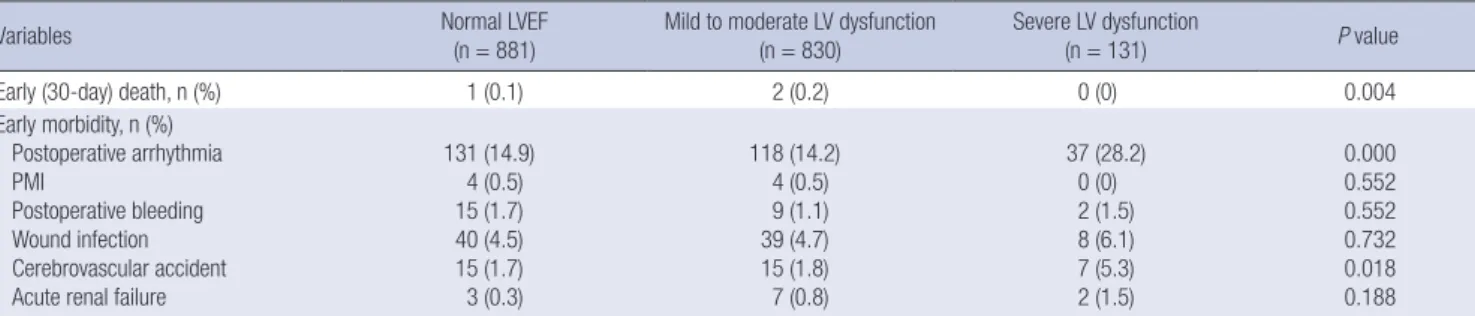
The preoperative patient characteristics are summarized in Ta- ble 1. Patients with severe LV dysfunction showed higher inci- dence of NYHA or CCS class IV, onset of acute myocardial in- farction within 14 days. Also more cases were diagnosed with triple vessels disease and needed preoperative intra-aortic bal- loon pump (IABP) in severe LV dysfunction group. Three pa- tients diagnosed with severely impaired LVEF died within 30 days (2.3%). The causes of death were multi-organ failure due to low cardiac output in one patient and small bowel infarction in the other two patients. One patient (0.1%) was from the nor- mal LVEF group and the other two patients (0.2%) who died were in the mild to moderate LV dysfunction patient group. The
mortality rate in severely impaired LVEF patients was signifi- cantly higher than those in the impaired and normal LVEF pa- tient groups (P = 0.004). The incidences of new arrhythmia and neurologic complication were significantly higher in the se- verely impaired LVEF patients (P < 0.001). Deep sternal wound infection occurred in 13 patients (0.7%), and an increased risk of deep sternal wound infection was found in patients with his- tory of myocardial infarction (2.3%) or a postoperative cerebro- vascular accident (5.4%). The results did not indicate a statisti- cal difference between patients with diabetes and patients who underwent reoperation due to bleeding (Table 2). However, the independent predictors of 30 day mortality included reopera- tion for bleeding (hazard ratio [HR] 26.17, P = 0.013) and post- operative neurologic complication (HR 21.02, P < 0.001).
Late clinical outcomes
There were 19 late deaths, including eight cardiac deaths and 11 non-cardiac deaths in the severely impaired LVEF patient group. The causes of non-cardiac deaths included cancer in
Table 1. Preoperative parameters
Parameters Normal LVEF
(n = 881) Mild to moderate LV dysfunction
(n = 830) Severe LV dysfunction
(n = 131) P value
Age 63.39 ± 9.20 62.08 ± 9.20 63.34 ± 9.40 0.001
Age ≥ 70, n (%) 217 (24.6) 165 (19.9) 37 (28.2) 0.019
Female, n (%) 280 (31.8) 207 (24.9) 30 (22.9) 0.003
Mean EF 66.82 ± 5.04 50.45 ± 6.50 30.34 ± 4.89 0.000
NYHA class IV, n (%) 11 (1.2) 17 (2.0) 11 (8.4) 0.000
CCS class IV, n (%) 43 (4.9) 60 (7.2) 11 (8.4) 0.000
Hypertension, n (%) 584 (66.3) 476 (57.3) 72 (55.0) 0.000
Diabetes mellitus, n (%) 361 (41.0) 390 (47.0) 63 (48.1) 0.028
Smoking, n (%) 219 (24.9) 259 (31.2) 44 (33.6) 0.006
AMI < 14 days, n (%) 56 (6.4) 140 (16.9) 34 (26.0) 0.000
Previous PCI, n (%) 147 (16.7) 144 (17.3) 14 (10.7) 0.161
Cerebrovascular disease, n (%) 139 (15.8) 133 (16.0) 30 (22.9) 0.112
Hyperlipidemia, n (%) 217 (24.6) 185 (22.3) 32 (24.4) 0.507
COPD, n (%) 25 (2.8) 30 (3.6) 7 (5.3) 0.288
CRF, n (%) 53 (6.0) 78 (9.4) 30 (22.9) 0.000
Peripheral vascular disease, n (%) 69 (7.8) 61 (7.3) 23 (17.6) 0.000
Triple vessels disease, n (%) 641 (72.8) 649 (78.2) 116 (88.5) 0.000
Preoperative IABP, n (%) 1 (0.1) 5 (0.6) 5 (3.8) 0.000
NYHA, New York Heart Association; CCS, Canadian Cardiovascular Society; PCI, percutaneous coronary intervention; COPD, chronic obstructive pulmonary disease; CRF, chronic renal failure; IABP, intra-aortic balloon pump; SD, standard deviation; PMI, perioperative myocardial infarction.
Table 2. Early postoperative data
Variables Normal LVEF
(n = 881) Mild to moderate LV dysfunction
(n = 830) Severe LV dysfunction
(n = 131) P value
Early (30-day) death, n (%) 1 (0.1) 2 (0.2) 0 (0) 0.004
Early morbidity, n (%) Postoperative arrhythmia PMI
Postoperative bleeding Wound infection Cerebrovascular accident Acute renal failure
131 (14.9) 4 (0.5) 15 (1.7) 40 (4.5) 15 (1.7) 3 (0.3)
118 (14.2) 4 (0.5) 9 (1.1) 39 (4.7) 15 (1.8) 7 (0.8)
37 (28.2) 0 (0) 2 (1.5) 8 (6.1) 7 (5.3) 2 (1.5)
0.000 0.552 0.552 0.732 0.018 0.188 PMI, postoperative myocardial infarct.
four patients, cerebral hemorrhage in three patients, stroke in one patient and other causes in three patients.
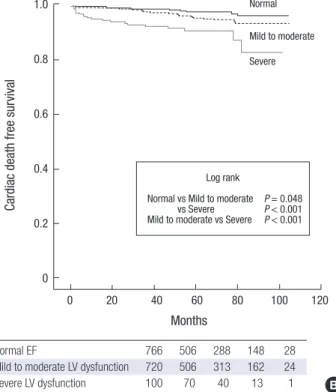
The survival rate at 3 and 7 yr was 86.0% and 82.8%, respec- tively (Fig. 1A), freedom from cardiac death was 93.2% and 92.0%
(Fig. 1B), and freedom from cardiac event was 84.6% and 78.9%
(Fig. 1C), respectively, in the severely impaired LVEF patient group.
The risk of all-cause mortality attributable to severe left ven-
tricular dysfunction, when adjusted for all covariates, increased two-fold compared with normal LVEF patients (HR, 2.14; 95%
C, 1.19-3.88; P = 0.012). Although this was not the case for pa- tients with moderately impaired LVEF (HR ,1.40; 95% CI, 0.95- 2.06; P = 0.090).
The multivariate Cox proportional hazard model revealed that other independent predictors of overall mortality were old age, hypertension, peripheral vascular disease, chronic renal failure,
Fig. 3. Survival curves according to left ventricular function: (A) overall survival, (B) survival free from cardiac death, (C) survival free from cardiac events.
Overall survival
Months
0 20 40 60 80 100 120
1.0
0.8
0.6
0.4
0.2
0
Normal
Mild to moderate
Severe
Log rank Normal
vs Severe P < 0.001 Mild to moderate
Normal EF 766 506 288 148 28
Mild to moderate LV dysfunction 720 506 313 162 24
Severe LV dysfunction 100 70 40 13 1
Cardiac death free survival
Months
0 20 40 60 80 100 120 1.0
0.8
0.6
0.4
0.2
0
Normal
Mild to moderate Severe
Log rank
Normal vs Mild to moderate P = 0.048 vs Severe P < 0.001 Mild to moderate vs Severe P < 0.001
Normal EF 766 506 288 148 28
Mild to moderate LV dysfunction 720 506 313 162 24
Severe LV dysfunction 100 70 40 13 1
Cardiac event free survival
Months
0 20 40 60 80 100 120
1.0
0.8
0.6
0.4
0.2
0
Normal
Mild to moderate Severe
Log rank Normal vs Severe P = 0.012
Normal EF 766 506 288 148 28
Mild to moderate LV dysfunction 720 506 313 162 24
Severe LV dysfunction 100 70 40 13 1
A B
C
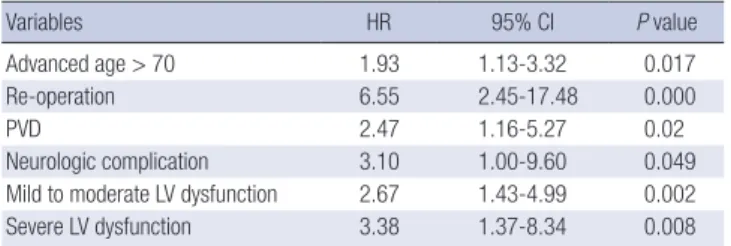
postoperative new arrhythmia, neurologic complication and chronic obstructive pulmonary disease (Table 3). The risk of all- cause mortality increased significantly for patients with severe- ly impaired LVEF compared to patients with impaired LVEF (P = 0.017). The independent predictors of cardiac-death free survival were impaired LVEF, severely impaired LVEF, old age, reoperation for bleeding, neurologic complication and periph- eral vascular disease (Table 4). Additionally, impaired LVEF, se- verely impaired LVEF and NYHA class IV were independent predictors of cardiac event-free survival.
Change of LV function
Early postoperative echocardiography was performed on all patients prior to discharge, with the exception of patients who died in the hospital. Early mean LVEF improvement was 4.5 ± 9.5% in patients with severe LV dysfunction (131 patients, P <
0.001). Late mean LVEF improvement was 7.8 ± 11.2% on late echocardiography, which was performed 29.4 ± 25.6 months after surgery in 109 patients with severe LV dysfunction (P <
0.001). Severe LV dysfunction patients showed improvement in LV dysfunction at last follow up.
DISCUSSION
Surgical revascularization in severe left ventricular dysfunction remains challenging for cardiac surgeons. Extracorporeal circu- lation can activate inflammatory mediators, which can affect the preservation of interventricular septal movement and exac- erbate myocardial damage in compromised LV (6).
A recent study reported that revascularization with a drug- eluting stent implantation offered comparable outcomes to coronary artery bypass surgery in patients with severe left ven- tricular dysfunction (7). However, the study did not describe the application of a bilateral internal thoracic graft. Herz et al.
(8) reported that surgical revascularization with the bilateral in- ternal thoracic artery indicated better midterm clinical outcomes than a drug-eluting stent, but Jegaden et al. (9) reported that Table 3. Factors associated with 30-day mortality
Variables HR 95% CI P value
Advanced age > 70 1.62 1.11-2.36 0.012
Hypertension 1.67 1.11-2.51 0.014
PVD 1.91 1.17-3.12 0.001
COPD 2.13 1.06-4.25 0.033
Arrhythmia 1.54 1.02-2.32 0.041
Neurologic complication 2.36 1.05-5.31 0.038
Chronic renal failure 2.96 1.14-7.67 0.026
LV dysfunction None Mild to moderate Severe
- 1.40 2.14
- 0.95-2.06 1.19-3.88
- NS 0.012 HR, hazard ratio; CI, confidence interval; PVD, peripheral vascular disease; COPD, chro- nic obstructive pulmonary disease; LVEF, left ventricular ejection fraction.
Table 4. Factors associated with cardiac death
Variables HR 95% CI P value
Advanced age > 70 1.93 1.13-3.32 0.017
Re-operation 6.55 2.45-17.48 0.000
PVD 2.47 1.16-5.27 0.02
Neurologic complication 3.10 1.00-9.60 0.049
Mild to moderate LV dysfunction 2.67 1.43-4.99 0.002
Severe LV dysfunction 3.38 1.37-8.34 0.008
HR, hazard ratio; CI, confidence interval; PVD, peripheral vascular disease; LVEF, left ventricular ejection fraction.
the extended use of arterial grafts could significantly affect the long-term myocardial recovery. The study by Jegaden et al. also reported that the postoperative LVEF improvement was less than 1% in patients with bilateral internal thoracic arterial graft- ing and concluded that the extended use of arterial grafts was not correlated with significant myocardial recovery. In our study, there was significant LVEF improvement on early echocardiog- raphy. The study by Jegaden et al. did not describe the internal thoracic artery harvesting technique and involved conventional coronary artery bypass surgery. The technique in this study harvested skeletonized internal thoracic arterial grafts because the free blood flow from the skeletonized internal thoracic ar- tery has been reported to be almost twice as high as that from a non-skeletonized artery (10). Based on these results, higher free blood flow from skeletonized internal thoracic arterial grafts with OPCAB to avoid global ischemic damage to the myocardi- um may prove to be beneficial for early myocardial recovery.
There are few reports about long-term survival of patients with severe left ventricular dysfunction that have undergone OPCAB. Goldstein et al. (1) concluded that multi-vessel off- pump revascularization in patients with severe left ventricular dysfunction is a safe and effective alternative to conventional grafting. However, their study did not report any long-term re- sults. In this study, the actuarial survival for severe left ventricu- lar dysfunction was 86.0% and 82.8% at 3 and 7 yr, respectively, and these findings are comparable to other recent studies. For example, Endo et al. (4) reported a 67.4% survival rate after eight years in patients with a preoperative LVEF of 40% or less with the use of bilateral internal thoracic arterial grafts. Ahmed et al.
(11) reported 69% and 48% survival at 5 and 10 yr, respectively, in a study of 162 patients with severe left ventricular dysfunc- tion that underwent conventional coronary artery bypass sur- gery. The study by Ahmed et al. defined severe left ventricular dysfunction as a preoperative LVEF of 30% or less. In our study, the survival rate of patients with a preoperative LVEF of 35% or less was 82.8% five years after the procedure. In addition, the 30-day mortality of patients in this study with severe left ven- tricular dysfunction was 2.3%, which is comparable to other re- cent reports (12, 13).
Harvesting the bilateral internal thoracic arteries is generally a major risk factor for sternal infection, especially in patients
with diabetes mellitus. Pevni et al. (14) reported that indepen- dent risk predictors for deep sternal infection included chronic obstructive pulmonary disease, repeated operations, and dia- betic mellitus regardless of insulin dependence. However, some authors reported that bilateral internal thoracic artery harvest- ing in patients with diabetic mellitus was not associated with an increase in the rate of deep wound infections (15, 16). In this study, we harvested the bilateral internal thoracic arteries with the skeletonizing technique and determined that deep sternal wound infections presented in 13 of the patients (0.7%). Statis- tically, an increased risk of deep sternal infection was associat- ed with previous myocardial infarction and a postoperative cere- brovascular accident. In addition, the multivariable logistic re- gression analysis results did not indicate that diabetes was as- sociated with nor was an independent predictor of deep sternal wound infection.
Numerous patients with severe left ventricular dysfunction experienced troublesome ventricular arrhythmia after surgery.
Currently, the application of an intra-aortic balloon pump, mag- nesium and amiodarone are effective for patients with ventric- ular arrhythmia (17).
This study identified several independent predictors of late survival which included chronic renal failure, peripheral vascu- lar disease, chronic obstructive pulmonary disease, neurologic complication, postoperative new arrhythmia, postoperative re- nal failure, hypertension and old age. Previous studies have documented the importance of renal impairment in patient outcomes, especially in patients with left ventricular dysfunc- tion (18).
In addition, a few studies have reported the independent predictors of long-term survival of patients with severe left ven- tricular dysfunction coronary artery disease. Ahmed et al. (11) reported that old age, emergency, mitral competence, smoking, respiratory disease, diabetes, postoperative renal failure, pleu- ral effusion, left internal thoracic artery impairment, cerebro- vascular disease and prolonged intubation were independent risk factors for an increased long-term mortality risk. In addi- tion, Filsoufi et al. (19) reported that reoperation, peripheral vascular disease, congestive symptoms and being female were independent predictors of long-term survival in patients with an LVEF less than 30%. However, all covariates in this study were included in a multivariable Cox proportional hazard model with- out univariate analysis.
There were several limitations to this present study. First, this study had a retrospective and non-random design. Second, the authors did not routinely perform invasive coronary angiogra- phy and therefore could not evaluate the patency of all grafts.
Third, the follow-up duration could be insufficient to evaluate the long-term outcomes of coronary revascularization; there- fore, additional research studies are needed to address these aspects of the study design.
In conclusion, the results of this study indicated that OPCAB using composite bilateral internal thoracic artery grafts in pa- tients with severe left ventricular dysfunction had outcomes comparable to or better than those reported after other surgical strategies. The analysis indicates that OPCAB using composite bilateral internal thoracic artery grafts could be used as safe and effective strategy for patients with severe left ventricular dys- function.
DISCLOSURE
The authors have no conflicts of interest to disclose.
REFERENCES
1. Goldstein DJ, Beauford RB, Luk B, Karanam R, Prendergast T, Sardari F, Burns P, Saunders C. Multivessel off-pump revascularization in patients with severe left ventricular dysfunction. Eur J Cardiothorac Surg 2003;
24: 72-80.
2. Pande S, Agarwal SK, Kundu A, Kale N, Chaudhary A, Dhir U. Off-pump coronary artery bypass in severe left ventricular dysfunction. Asian Car- diovasc Thorac Ann 2009; 17: 54-8.
3. Lytle BW, Blackstone EH, Sabik JF, Houghtaling P, Loop FD, Cosgrove DM. The effect of bilateral internal thoracic artery grafting on survival during 20 postoperative years. Ann Thorac Surg 2004; 78: 2005-12.
4. Endo M, Nishida H, Tomizawa Y, Kasanuki H. Benefit of bilateral over single internal mammary artery grafts for multiple coronary artery by- pass grafting. Circulation 2001; 104: 2164-70.
5. Kim WS, Lee J, Lee YT, Sung K, Yang JH, Jun TG, Park PW. Total arterial revascularization in triple-vessel disease with off-pump and aortic no- touch technique. Ann Thorac Surg 2008; 86: 1861-5.
6. Akins CW, Boucher CA, Pohost GM. Preservation of interventricular septal function in patients having coronary artery bypass grafts without cardiopulmonary bypass. Am Heart J 1984; 107: 304-9.
7. Gioia G, Matthai W, Gillin K, Dralle J, Benassi A, Gioia MF, White J. Re- vascularization in severe left ventricular dysfunction: outcome compari- son of drug-eluting stent implantation versus coronary artery by-pass grafting. Catheter Cardiovasc Interv 2007; 70: 26-33.
8. Herz I, Moshkovitz Y, Loberman D, Uretzky G, Braunstein R, Hendler A, Zivi E, Ben-Gal Y, Mohr R. Drug-eluting stents versus bilateral internal thoracic grafting for multivessel coronary disease. Ann Thorac Surg 2005;
80: 2086-90.
9. Jegaden O, Bontemps L, de Gevigney G, Eker A, Montagna P, Chatel C, Itti R, Mikaeloff P. Does the extended use of arterial grafts compromise the myocardial recovery after coronary artery bypass grafting in left ven- tricular dysfunction? Eur J Cardiothorac Surg 1998; 14: 353-9.
10. Deja MA, Woś S, Gołba KS, Zurek P, Domaradzki W, Bachowski R, Spyt TJ. Intraoperative and laboratory evaluation of skeletonized versus ped- icled internal thoracic artery. Ann Thorac Surg 1999; 68: 2164-8.
11. Ahmed WA, Tully PJ, Baker RA, Knight JL. Survival after isolated coro- nary artery bypass grafting in patients with severe left ventricular dys- function. Ann Thorac Surg 2009; 87: 1106-12.
12. Jones RH, Velazquez EJ, Michler RE, Sopko G, Oh JK, O’Connor CM, Hill JA, Menicanti L, Sadowski Z, Desvigne-Nickens P, et al. Coronary
bypass surgery with or without surgical ventricular reconstruction. N Engl J Med 2009; 360: 1705-17.
13. Nardi P, Pellegrino A, Scafuri A, Colella D, Bassano C, Polisca P, Chiari- ello L. Long-term outcome of coronary artery bypass grafting in patients with left ventricular dysfunction. Ann Thorac Surg 2009; 87: 1401-7.
14. Pevni D, Uretzky G, Mohr A, Braunstein R, Kramer A, Paz Y, Shapira I, Mohr R. Routine use of bilateral skeletonized internal thoracic artery grafting: long-term results. Circulation 2008; 118: 705-12.
15. Agrifoglio M, Trezzi M, Barili F, Dainese L, Cheema FH, Topkara VK, Ghislandi C, Parolari A, Polvani G, Alamanni F, et al. Double vs single internal thoracic artery harvesting in diabetic patients: role in perioper- ative infection rate. J Cardiothorac Surg 2008; 3: 35.
16. Momin AU, Deshpande R, Potts J, El-Gamel A, Marrinan MT, Omigie J, Desai JB. Incidence of sternal infection in diabetic patients undergoing bilateral internal thoracic artery grafting. Ann Thorac Surg 2005; 80:
1765-72.
17. Gupta S, Pressman GS, Fiqueredo VM. Incidence of, predictors for, and mortality associated with malignant ventricular arrhythmias in non-ST elevation myocardial infarction patients. Coron Artery Dis 2010; 21: 460-5.
18. Hillis GS, Zehr KJ, Williams AW, Schaff HV, Orzulak TA, Daly RC, Mul- lany CJ, Rodeheffer RJ, Oh JK. Outcome of patients with low ejection frac- tion undergoing coronary artery bypass grafting: renal function and mor- tality after 3.8 years. Circulation 2006; 114: I414-9.
19. Filsoufi F, Rahmanian PB, Castillo JG, Chikwe J, Kini AS, Adams DH.
Results and predictors of early and late outcome of coronary artery by- pass grafting in patients with severely depressed left ventricular function.
Ann Thorac Surg 2007; 84: 808-16.
20. Lee YT, Park KH. Characteristic and harvesting technique of bypass con- duits: concise coronary artery bypass. 1st ed. Seoul: Korea Medical Book Publicher, 2008, p50-1.