• 검색 결과가 없습니다.

Effect of Postoperative Constrictive Physiology on Early Outcomes after Off-Pump Coronary Artery Bypass Grafting

N/A
N/A
Protected

Academic year: 2021

Share "Effect of Postoperative Constrictive Physiology on Early Outcomes after Off-Pump Coronary Artery Bypass Grafting"

Copied!
5
0
0

로드 중.... (전체 텍스트 보기)

전체 글

(1)

http://dx.doi.org/10.5090/kjtcs.2013.46.1.22 ISSN: 2233-601X (Print) ISSN: 2093-6516 (Online)

Division of Cardiovascular Surgery, Yonsei Cardiovascular Hospital, Yonsei University College of Medicine

†This article was presented at the 43th Autumn Academic Meeting of the Korean Society for Thoracic and Cardiovascular Surgery.

Received: August 10, 2012, Revised: September 22, 2012, Accepted: October 9, 2012

Corresponding author: Kyung-Jong Yoo, Department of Thoracic and Cardiovascular Surgery, Yonsei Cardiovascular Hospital, Yonsei University College of Medicine, 50 Yonsei-ro, Seodaemun-gu, Seoul 120-749, Korea

(Tel) 82-2-2228-8485 (Fax) 82-2-313-2992 (E-mail) [email protected]

C

The Korean Society for Thoracic and Cardiovascular Surgery. 2013. All right reserved.

CC

This is an open access article distributed under the terms of the Creative Commons Attribution Non-Commercial License (http://creative- commons.org/licenses/by-nc/3.0) which permits unrestricted non-commercial use, distribution, and reproduction in any medium, provided the original work is properly cited.

Effect of Postoperative Constrictive Physiology on Early Outcomes after Off-Pump Coronary Artery Bypass Grafting

Jung-Hwan Kim, M.D., Yoo-Hwa Hwang, M.D., Young-Nam Youn, M.D., Kyung-Jong Yoo, M.D., Ph.D.

Background: Constrictive pericarditis after coronary artery bypass surgery has been known to affect cardiac output by limiting diastolic ventricular filling. We aimed to assess the influence of postoperative constrictive physiology on the early outcomes of patients undergoing off-pump coronary artery bypass grafting (OPCAB). Materials and Methods: Between January 2008 and July 2011, 903 patients underwent an isolated OPCAB and postoperative transthoracic-echocardiography. The patient cohort was classified into two groups: group A, constrictive physiology and group B, control group without constrictive physiology. Early outcomes were analyzed between the two groups.

Results: Of the total 903 patients, group A consisted of 153 patients (16.9%). The amount of blood loss in group A during the postoperative 24 hours was greater than that of group B, but this was not statistically significant (p=0.20). No significant differences were found in the mortality rates (group A, 0.6%; group B, 1.4%; p=0.40) and 30-day major adverse cardiac and cerebrovascular events (MACCEs; group A, 3.3%; group B, 6.1%; p=0.42).

Conclusion: Postoperative constrictive physiology does not affect 30-day MACCEs or other major complications after OPCAB. The results of this study suggest that patients with early postoperative constrictive physiology do not need medical or surgical treatment, and that conservative care is sufficient.

Key words: 1. Constrictive pericarditis

2. Coronary artery bypass, off-pump

INTRODUCTION

Constrictive pericarditis is a progressive condition that is characterized by pericardial fibrosis with or without calcifica- tion, and impairs ventricular filling. This leads to venous con- gestion and diminished cardiac output [1]. The most common cause of constrictive pericarditis is previous cardiac surgery, followed by thoracic radiation, previous myocardial infarction, idiopathic disease, and infection [2]. In the past, the develop- ment of constrictive pericarditis was believed to be irrever- sible, but recent studies have reported the resolution of a

transient form of constrictive pericarditis without surgical in- tervention [3,4]. Moreover, approximately 60% of patients with constrictive pericarditis caused by cardiac surgery have been shown to have constrictive physiology on postoperative echocardiography [3].

The prognosis and natural history of constrictive physiology

after pericardiotomy is unclear. Therefore, we aimed to assess

whether constrictive physiology based on early postoperative

echocardiography after off-pump coronary artery bypass graft

(OPCAB) may require medical or surgical treatment to prevent

constrictive pericarditis and whether it would have an effect on

(2)

early mortality and morbidity of patients undergoing OPCAB.

MATERIALS AND METHODS 1) Study population

Between January 2008 and July 2011, 903 patients underwent isolated OPCAB at Yonsei Cardiovascular Hospital and were en- rolled in this single center, randomized, retrospective study. All of the patients received tissue Doppler transthoracic echocardiog- raphy at postoperative day 7. The 903 patients were divided into two groups. Group A consisted of patients who showed con- strictive physiology on postoperative echocardiography, and group B was the control group that consisted of the patients without evidence of constrictive physiology. Mortality, 30-day major adverse cardiac and cerebrovascular events (MACCEs), surgical characteristics, and other complications were compared between the two groups. Two patients who showed acute con- strictive pericarditis were excluded from the study.

2) Surgical technique and postoperative management

All the patients underwent surgical bypass using the off-pump method and median sternotomy. Systemic heparin- ization was administered to maintain an activated clotting time of 250 seconds during the operation. A commercially available cardiac stabilizer and an apex vacuum device were used for cardiac displacement and stabilization. The internal mammary artery (IMA) was harvested using a semi-skeleton- ized technique. In most cases, the left IMA was anastomosed to the left anterior descending artery. For the other left coro- nary artery regions, a radial artery or saphenous vein graft was used as a composite graft. For right coronary artery by- pass, the radial artery or a saphenous vein free graft attached to the left IMA was used in the majority of the cases de- pending on the degree of native coronary artery stenosis and the degree of aortic atherosclerosis. Postoperative dual anti- platelet therapy was maintained for at least 9 months unless contraindicated. Statins were routinely used during the study period, and a small dose of diuretics was administrated until the patients were discharge according to their conditions.

3) Follow-up, data collection, and definitions

All of the patients’ charts were reviewed, and data were

collected retrospectively from the reviewed charts. The pa- tients’ preoperative baseline characteristics, surgical record, postoperative complications including 30-day MACCEs, renal failure, respiratory complications, early postoperative echo- cardiography, intensive care unit (ICU) stay, and hospital stay were reviewed. Constrictive physiology was defined as septal bouncing and flattening of the left ventricular posterior wall during diastole, respiratory variation in ventricular size (inferior vena cava plethora), respiratory variation of 25% or more in the mitral inflow E velocity, increased diastolic flow reversal with expiration in the hepatic vein, E’ ≥7–8 cm/sec with respiratory variation of E’, and absence of pericardial thickness and calcification. A MACCE was defined as the oc- currence of death by any cause, nonfatal myocardial in- farction, a stroke, or the need for target vessel revasculariza- tion. Myocardial infarction was defined as creatine kinase muscle-brain elevation with the appearance of a new Q-wave or S-T segment elevation greater than 2 mm on an electro- cardiogram. The diabetic patients were defined as patients re- ceiving an oral hypoglycemic agent or insulin. The chronic renal failure patients were defined as those who required he- modialysis, peritoneal dialysis, or whose preoperative serum creatinine level exceeded 2.0 mg/dL. The primary endpoint of the study was cardiac death and MACCEs.

4) Statistical analysis

Statistical analyses were performed using statistical soft- ware SPSS ver. 13.0 (SPSS Inc., Chicago, IL, USA). The values for continuous variables were displayed as mean±stand- ard deviation. For the comparison of two variables, the Student's t-test and χ

2

test were used. Statistical significance was defined as a p-value less than 0.05.

RESULTS 1) Patient characteristics

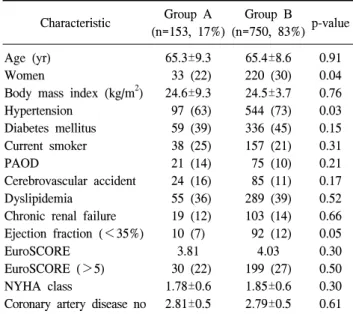
Among the 903 patients included in this study, 153 (17%) were diagnosed with constrictive physiology (group A). None of these patient displayed typical symptoms of pericarditis.

They were not given specific treatment for constrictive physi-

ology, and 1-year follow-up echocardiography showed com-

plete resolution of the constrictive physiology in all 153

(3)

Table 1. Baseline demographics and clinical characteristics Characteristic Group A

(n=153, 17%)

Group B

(n=750, 83%) p-value Age (yr)

Women

Body mass index (kg/m

2

) Hypertension

Diabetes mellitus Current smoker PAOD

Cerebrovascular accident Dyslipidemia

Chronic renal failure Ejection fraction (<35%) EuroSCORE

EuroSCORE (>5) NYHA class

Coronary artery disease no

65.3±9.3 33 (22) 24.6±9.3 97 (63) 59 (39) 38 (25) 21 (14) 24 (16) 55 (36) 19 (12) 10 (7)

3.81 30 (22) 1.78±0.6 2.81±0.5

65.4±8.6 220 (30) 24.5±3.7 544 (73) 336 (45) 157 (21) 75 (10) 85 (11) 289 (39) 103 (14) 92 (12)

4.03 199 (27) 1.85±0.6 2.79±0.5

0.91 0.04 0.76 0.03 0.15 0.31 0.21 0.17 0.52 0.66 0.05 0.30 0.50 0.30 0.61 Values are presented as mean±standard deviation or number (%).

PAOD, peripheral artery occlusive disease; EuroSCORE, Euro- pean System for Cardiac Operative Risk Evaluation; NYHA, New York Heart Association.

Table 2. Operative and postoperative data

Group A Group B p-value Anastomosis per patient

Operative time (min) Blood loss

a)

(mL) Transfusion amount

a)

(mL) ESR

b)

CRP

b)

ICU stays (hr) Hospital stay (day)

3.21±0.8 241.0±44.6

834.7 267.7 53.1±25.5 44.7±42.5 66.43±5.6 11.9±11.1

3.18±0.9 239.3±44.5

789.8 162 54.2±26.4 44.9±41.2 62.54±5.9

13.5±13.8 0.74 0.69 0.20 0.93 0.65 0.96 0.37 0.52 Values are presented as mean±standard deviation or number (%).

ESR, erythrocyte sedimentation rate; CRP, C-reactive protein;

ICU, intensive care unit.

a)

During postoperative 24 hours.

b)

At postoperative 7th day.

Table 3. Adverse events after surgery

Group A Group B p-value Thirty-day MACCEs

Mortality Perioperative MI Stroke

Renal failure

Respiratory complications Prolonged hospitalization

a)

1 (0.6) 5 (3.3) 2 (1.3) 14 (9.2) 5 (3.3) 53 (34)

11 (1.5) 46 (6.1) 5 (0.7) 70 (9.3) 37 (4.9) 225 (30)

0.41 0.27 0.97 0.82 0.86 0.31 Values are presented as number (%).

MACCEs, major adverse cardiac and cerebrovascular event; MI, myocardial infarction.

a)
Over 12 days.

patients. The baseline demographics and preoperative clinical characteristics are shown in Table 1. Group A showed a low representation of women (p=0.04), a low incidence of hyper- tension (p=0.03), and low ejection fraction (p=0.05) compared to group B. Other reviewed data showed no significant differ- ences between the two groups.

2) Operative and postoperative results

There were no significant differences between the two groups in the number of distal anastomosis and in the oper- ative time (Table 2). Increased blood loss and transfusion volumes during the first postoperative 24 hours were ob- served in group A compared to group B, but these differ- ences were not statistically significant (p=0.20). Other post- operative comparisons such as hospital stay and ICU stay showed no significant differences between the two groups (Table 3).

3) Early mortality and major adverse cardiac and cerebrovascular events

Thirty-day MACCEs including death by any cause, non- fatal myocardial infarction, and stroke were not significantly

different between the two groups. There were also no sig- nificant differences in respiratory complications (such as pneumonia, prolonged ventilator care, or acute respiratory dis- tress syndrome) and renal failure (such as the need for renal replacement treatment). Admissions for more than 12 days and prolonged hospitalizations were also not significantly dif- ferent between the two groups.

DISCUSSION

Constrictive pericarditis, a compressed ventricle, and im-

paired ventricular filling have been shown to occur because of

tuberculosis, uremia, previous thoracic irradiation, and past

chest trauma; however, recently the most common cause of

(4)

constrictive pericarditis has been shown to be previous cardiac surgery [1,2]. Pericardiotomy with concurrent cardiac surgery leads to a transiently thickened and inelastic pericardium, result- ing from edema, fibrin deposition, or inflammation. Moderate amounts of pericardial effusion then develop without evidence of constriction. Approximately 1 to 2 weeks later, constrictive physiology develops. In the last phase, pericardial effusion re- solves or decreases in size, and the hemodynamics normalize with no evidence of constriction recurrence in most patients.

However, in some patients, pericardial inflammation continues and pericardial fibrosis and calcification subsequently develop, leading to chronic constrictive pericarditis [3-5].

The common symptoms of constrictive pericarditis have been dyspnea on exertion, chest pain, fever and a sign of right heart failure consistent with edema, abdominal swelling, and jugular venous distension [3,6]. As mentioned above, a transient form of constrictive pericarditis can be resolved with medical treatments including a nonsteroidal anti-inflammatory drug (NSAID), steroids, and diuretics without surgical inter- vention [3]. However, refractory chronic constrictive peri- carditis often needs pericardiectomy.

Approximately 60% of the patients with constrictive peri- carditis caused by cardiac surgery have shown constrictive physiology on postoperative echocardiography [3]. Specifically, constrictive pericarditis after coronary artery bypass graft (CABG) has been reported in a few studies where symptoms developed from myocardial ischemia because of graft occlu- sion derived from diastolic dysfunction of constrictive pericarditis. These cases had required repeat CABG including extensive decortication of the left ventricle, right atrium, and right ventricle [7,8]. Constrictive pericarditis following coro- nary bypass surgery is an unusual complication with an oc- currence rate of 0.2% to 0.3% [9], but as mentioned earlier, serious negative results can develop.

In the same way, postoperative constrictive pericarditis can have an unfavorable effect on the prognosis of patients under- going cardiac surgery, especially CABG. However, the prog- nosis and natural history of constrictive physiology after peri- cardiotomy is unclear. Therefore, we analyzed whether con- strictive physiology seen on early postoperative echocardiog- raphy after OPCAB may require treatment to prevent con- strictive pericarditis and whether it would have an effect on

early mortality and morbidity of patients undergoing OPCAB.

In our study, constrictive physiology on postoperative echo- cardiography was observed in 153 (17%) patients with iso- lated OPCAB. No patient displayed any typical symptoms of pericarditis, and no patient received preventive medication or specific treatments for constrictive pericarditis. After 1 year, follow-up echocardiography showed complete resolution of constrictive physiology in all the patients. There were no sig- nificant differences in the postoperative mortality and morbid- ity rates between the two groups. Therefore, we suggest that if a patient showing constrictive physiology on early post- operative echocardiography is hemodynamically stable and has no symptoms, specific medication is not needed and a follow-up echocardiography should be considered.

Transient constrictive pericarditis was originally described in the English literature by Sagrista-Sauleda et al. [4] in 1987. They reported the development of objective evidence for constrictive physiology occurring in 16 of 177 patients (9%) with effusive acute idiopathic pericarditis, which sub- sequently resolved with conservative treatment. The interval of time until the first echocardiogram showing pericardial ef- fusion ranged from 5 to 30 days. The time to normalization of the noninvasive recordings for all the patients ranged from 7 days to 58 months. At a mean follow-up of 31 months, none of the patients had presented with a recurrence of constriction. The authors suggested that the mechanism re- sponsible for the findings in these patients was a transiently thickened and inelastic pericardium resulting from edema, fi- brin deposition, or inflammation. Similarly, we thought that constrictive physiology does not accompany pericardial fib- rosis, calcification rarely progresses to constrictive pericarditis, and resolution occurs with conservative treatment.

In the cases of constrictive physiology followed by peri- cardiotomy, pericardial effusion plays a major role in the pathophysiology. Therefore, we assumed that postoperative bleeding, tube drainage volumes, and ICU stay duration that disturb ambulation are risk factors for constrictive physiology.

In our study, group A had more blood loss and a longer ICU

stay, but these were not statistically significant. Therefore, we

were unable to identify the risk factors for constrictive

pericarditis. Matsuyama et al. [6] reported the clinical charac-

teristics of 11 patients that developed postoperative con-

(5)

strictive pericarditis among a total of 463 CABG patients.

Ten patients (91%) had evidence of pericardial effusion, which was the primary risk factor for postoperative con- strictive pericarditis. In addition, left ventricular ejection frac- tion and warfarin administration were risk factors for post- operative constrictive pericarditis based on multivariate analysis. Effler [10] reported that residual blood elements within the pericardial sac, especially in the areas of major in- volvement, were found at the time of cardiac surgery in most of the patients with chronic constrictive pericarditis of various etiologies. Cohen and Greenberg [11] also explained that or- ganized hematomas, loculated clots, and unclotted viscous blood within the pericardial space were the most important causes of constrictive pericarditis after cardiac surgery.

Most of the studies until now, and those cited above, are studies of on-pump CABG, and a study on constrictive peri- carditis after OPCAB can only be found in one case report [12]. Elena [13] reported that a prolonged cardiopulmonary bypass time is an independent risk factor for pericardial effu- sion after cardiac surgery because of the systemic inflam- matory response. Although no study has compared on-pump CABG with OPCAB, the on-pump CABG can be a risk fac- tor for constrictive pericarditis compared with OPCAB be- cause on-pump CABG has a risk for pericardial effusion caused by a systemic inflammatory response.

The main limitation of this study is the retrospective design. Pericardial effusion is the most important factor in constrictive physiology, but we were unable to find the ap- propriate factors that represent the effectiveness and factors disturbing tube drainage that affect pericardial effusion.

Because our follow-up duration was limited to the immediate postoperative period, the clinical symptoms were mixed, with postoperative chest pain, fever, and other symptoms. Therefore, we cannot evaluate the clinical symptoms of constrictive physiology. Lastly, because our follow-up period was short, a study with a long term follow-up period and repeated echo- cardiographic data is necessary to confirm our conclusions.

CONCLUSION

Postoperative constrictive physiology does not affect 30-day MACCEs or other complications after OPCAB. The results of

this study suggest that patients with early postoperative con- strictive physiology do not need medical or surgical treat- ment, and that conservative care is sufficient.

CONFLICT OF INTEREST

No potential conflict of interest relevant to this article was reported.

REFERENCES

1. Song JM. Constrictive pericarditis. Curr Pract Cardiol 2010;

4:24-32.

2. Talreja DR, Edwards WD, Danielson GK, et al. Constrictive pericarditis in 26 patients with histologically normal peri- cardial thickness. Circulation 2003;108:1852-7.

3. Haley JH, Tajik AJ, Danielson GK, Schaff HV, Mulvagh SL, Oh JK. Transient constrictive pericarditis: causes and natural history. J Am Coll Cardiol 2004;43:271-5.

4. Sagrista-Sauleda J, Permanyer-Miralda G, Candell-Riera J, Angel J, Soler-Soler J. Transient cardiac constriction: an unrecognized pattern of evolution in effusive acute idiopathic pericarditis. Am J Cardiol 1987;59:961-6.

5. Heidecker J, Sahn SA. The spectrum of pleural effusions af- ter coronary artery bypass grafting surgery. Clin Chest Med 2006;27:267-83.

6. Matsuyama K, Matsumoto M, Sugita T, et al. Clinical char- acteristics of patients with constrictive pericarditis after cor- onary bypass surgery. Jpn Circ J 2001;65:480-2.

7. Anderson CA, Rodriguez E, Shammas RL, Kypson AP.

Early constrictive epicarditis after coronary artery bypass surgery. Ann Thorac Surg 2009;87:642-3.

8. Raheb JG, Tripp HF. Constrictive pericarditis after bypass leading to internal mammary graft failure. Ann Thorac Surg 2000;69:951-3.

9. Fowler NO. Constrictive pericarditis: its history and current status. Clin Cardiol 1995;18:341-50.

10. Effler DB. Chronic constrictive pericarditis treated with pericardiectomy. Am J Cardiol 1961;7:62-8.

11. Cohen MV, Greenberg MA. Constrictive pericarditis: early and late complication of cardiac surgery. Am J Cardiol 1979;43:657-61.

12. Kigawa I, Miura S, Fukuda S, Miyairi T. Constrictive peri- carditis after minimally invasive coronary artery bypass grafting: report of a case. Kyobu Geka 2009;62:1175-7.

13. Elena AA. Pericardial effusion after cardiac surgery: risk

factors, patient profiles, and contemporary management. Ann

Thorac Surg 2010;89:112-8.

수치

Table 2. Operative and postoperative data

참조

관련 문서

Combined percutaneous transluminal coronary angioplasty and minimally invasive coronary arterial bypass grafting (Hybrid CABG).. artery bypass with complete avoidance

Total arterial revascula- rization using Y-composite graft for isolated left main coronary artery disease. Coronary artery bypass grafting using the gastroepiploic

Off pump coronary artery bypass (OPCAB) can reduced the postoperative bleeding because there is no surgical in-.. The patients were divided into transfusion group

Purpose: New-onset postoperative atrial fibrillation (POAF) is associated with poor short- and long-term outcomes after isolated coronary artery bypass graft (CABG) surgery..

(2017) Effects of preoperative aspirin on perioperative platelet activation and dysfunction in patients undergoing off-pump coronary artery bypass graft surgery:

OPCAB, off-pump coronary artery bypass graft surgery; T1, after induction of anesthesia; T2, during obtuse marginal artery anastomosis; T3, after peri- cardial closure; RVEF,

CABG, Coronary Artery Bypass Grafting; Preop., preoperative; NYHA, New York Heart Association; AMI, acute myocardial infarction; IABP, Intraaortic balloon pump; CPR,

Background: This study aimed to review the long-term clinical outcomes and graft patency of coronary artery bypass grafting (CABG) using arterial grafts in patients with Kawasaki