http://dx.doi.org/10.5090/kjtcs.2014.47.4.350 ISSN: 2233-601X (Print) ISSN: 2093-6516 (Online)
Department of Thoracic and Cardiovascular Surgery, Hallym University College of Medicine
†This article was presented at 44th Fall Meeting of Korean Society for Thoracic and Cardiovascular Surgery, November 1, 2012.
Received: November 14, 2013, Revised: November 28, 2013, Accepted: November 30, 2013, Published online: August 5, 2014
Corresponding author: Won Yong Lee, Department of Thoracic and Cardiovascular Surgery, Hallym University Sacred Heart Hospital, Hallym University College of Medicine, 22 Gwanpyeong-ro 170beon-gil, Dongan-gu, Anyang 431-796, Korea
(Tel) 82-31-380-3815 (Fax) 82-31-380-3815 (E-mail) [email protected]
C The Korean Society for Thoracic and Cardiovascular Surgery. 2014. All right reserved.
CC This is an open access article distributed under the terms of the Creative Commons Attribution Non-Commercial License (http://creative- commons.org/licenses/by-nc/3.0) which permits unrestricted non-commercial use, distribution, and reproduction in any medium, provided the original work is properly cited.
Hemoglobin Level to Facilitate Off-Pump Coronary Artery Bypass without Transfusion
Kun Il Kim, M.D., Won Yong Lee, M.D., Ho Hyun Ko, M.D., Hyoung Soo Kim, M.D., Jae Han Jeong, M.D.
Background: Conservation of blood during cardiac surgery is important because of the shortage of donor blood, risks associated with transfusion, and the costs of allogeneic blood products. This retrospective study explored the feasibility of off-pump coronary artery bypass (OPCAB) without transfusion. Methods: One hundred and two consec- utive patients underwent OPCAB from January 2007 to June 2012 at Hallym University Sacred Heart Hospital.
Excluding 10 chronic renal failures patients, 102 patients were enrolled. Their characteristics, clinical data, and labo- ratory data were analyzed. We investigated the success rate of OPCAB without transfusion according to pre- operative hemoglobin (Hb), and the cutoff point of the Hb level and the risk factors for transfusion. We im- plemented multidisciplinary blood-saving protocols. Results: The overall operative mortality and the success rate of OPCAB without transfusion were 2.9% (3/102) and 73.5% (75/102). The success rates in patients with Hb<11, 11
<Hb<14, and 14<Hb were 35.0%, 79.2%, and 89.7% (p=0.01), respectively. The risk factors for transfusion are age>70 years, diagnosis of acute myocardial infarction, preoperative Hb and creatinine levels, and operation time.
The events precipitating the need for transfusion were low Hb level in 9 patients and hypotension or excessive bleeding in 18 patients. Conclusion: The preoperative Hb level of >11 facilitates OPCAB without transfusion.
These results suggest that transfusion-free OPCAB can be performed by modifying the risk factors and correctable causes of transfusion and improving various blood salvage methods.
Key words: 1. Blood transfusion
2. Off-pump coronary artery bypass 3. Anemia
INTRODUCTION
Conservative use of transfusion in cardiac surgery is war- ranted because of the infectious and non-infectious complica- tions of allogeneic blood products. Current shortages of donor blood and costs of these products need a careful application of the transfusion. Blood transfusion in cardiac surgery has been strictly regulated in western countries, but there is no general consensus or guideline on the appropriate use of allo-
geneic blood products in Korea [1,2].
Recent studies described the preoperative hemoglobin (Hb) level as a risk factor for transfusion, morbidity, and mortality, but few trials have been conducted to evaluate the appropriate Hb level required to facilitate transfusion-free cardiac surgery.
Compared with conventional coronary artery bypass graft (CABG), off-pump coronary artery bypass (OPCAB) has ad- vantages for performing transfusion-free surgery, such as re- duction of blood loss and relatively less hemodilution related
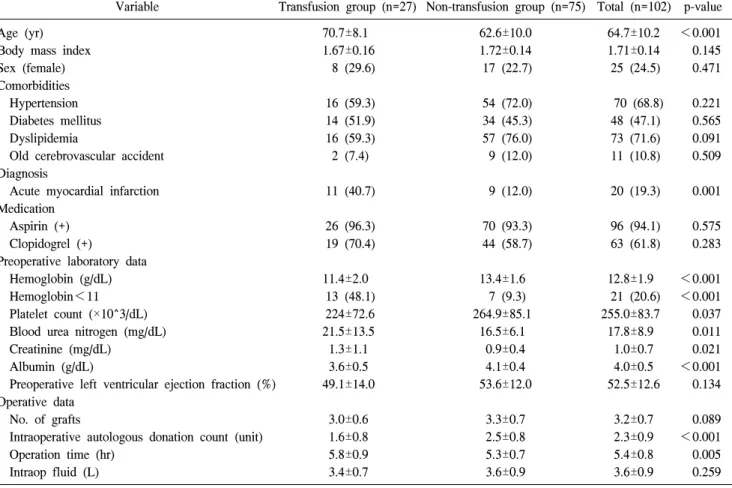
Table 1. Demographic, preoperative, and operative characteristics
Variable Transfusion group (n=27) Non-transfusion group (n=75) Total (n=102) p-value Age (yr)
Body mass index Sex (female) Comorbidities Hypertension Diabetes mellitus Dyslipidemia
Old cerebrovascular accident Diagnosis
Acute myocardial infarction Medication
Aspirin (+) Clopidogrel (+)
Preoperative laboratory data Hemoglobin (g/dL) Hemoglobin<11 Platelet count (×10^3/dL) Blood urea nitrogen (mg/dL) Creatinine (mg/dL)
Albumin (g/dL)
Preoperative left ventricular ejection fraction (%) Operative data
No. of grafts
Intraoperative autologous donation count (unit) Operation time (hr)
Intraop fluid (L)
70.7±8.1 1.67±0.16 8 (29.6)
16 (59.3) 14 (51.9) 16 (59.3) 2 (7.4)
11 (40.7)
26 (96.3) 19 (70.4)
11.4±2.0 13 (48.1) 224±72.6 21.5±13.5 1.3±1.1 3.6±0.5 49.1±14.0
3.0±0.6 1.6±0.8 5.8±0.9 3.4±0.7
62.6±10.0 1.72±0.14 17 (22.7)
54 (72.0) 34 (45.3) 57 (76.0) 9 (12.0)
9 (12.0)
70 (93.3) 44 (58.7)
13.4±1.6 7 (9.3) 264.9±85.1 16.5±6.1 0.9±0.4 4.1±0.4 53.6±12.0
3.3±0.7 2.5±0.8 5.3±0.7 3.6±0.9
64.7±10.2 1.71±0.14 25 (24.5)
70 (68.8) 48 (47.1) 73 (71.6) 11 (10.8)
20 (19.3)
96 (94.1) 63 (61.8)
12.8±1.9 21 (20.6) 255.0±83.7 17.8±8.9 1.0±0.7 4.0±0.5 52.5±12.6
3.2±0.7 2.3±0.9 5.4±0.8 3.6±0.9
<0.001 0.145 0.471
0.221 0.565 0.091 0.509
0.001
0.575 0.283
<0.001
<0.001 0.037 0.011 0.021
<0.001 0.134
0.089
<0.001 0.005 0.259 Values are presented as mean±standard variation for continuous variables and count (%) for categorical variables.
(+), administration.
to cardiopulmonary bypass (CPB) [3-5].
This retrospective study were undertaken to investigate the success rate for OPCAB without transfusion according to the preoperative Hb level; an appropriate cutoff point of the Hb level, which could facilitate transfusion-free surgery; and the risk factors for the need for transfusion.
METHODS 1) Patient selection
One hundred and two consecutive patients underwent OPCAB at Hallym University Sacred Heart Hospital from January 2007 to June 2012 by a single surgeon. Excluding 10 chronic renal failures, 102 patients were enrolled in this retro- spective study, which was approved by our institutional re- view board, and the need for an informed consent from the
patients was waived. We collected the following data from our institutional database.
(1) Preoperative demographics: Age, sex, and body mass index (BMI); laboratory data: Hb, platelet, blood urea nitro- gen (BUN), creatinine (Cr), albumin values, and left ven- tricular ejection fraction; medication: aspirin and clopidogrel;
comorbidity: hypertension, diabetes, dyslipidemia, and cere- brovascular accident (CVA); and diagnosis: acute myocardial infarction (AMI).
(2) Operative characteristics: Number of grafts, operation time, number of intraoperative autologous donation (IAD), and total amount of intraoperative fluid infusion (Table 1).
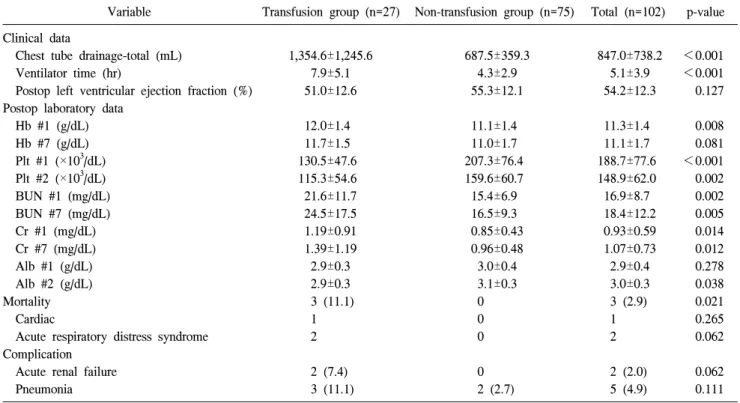
(3) Postoperative characteristics: Total amount of chest tube drainage; ventilator time; left ventricular ejection frac- tion; Hb, platelet, BUN, Cr, and albumin values; and compli- cations (Table 2).
Table 2. Postoperative characteristics and clinical outcome
Variable Transfusion group (n=27) Non-transfusion group (n=75) Total (n=102) p-value Clinical data
Chest tube drainage-total (mL) Ventilator time (hr)
Postop left ventricular ejection fraction (%) Postop laboratory data
Hb #1 (g/dL) Hb #7 (g/dL) Plt #1 (×103/dL) Plt #2 (×103/dL) BUN #1 (mg/dL) BUN #7 (mg/dL) Cr #1 (mg/dL) Cr #7 (mg/dL) Alb #1 (g/dL) Alb #2 (g/dL) Mortality Cardiac
Acute respiratory distress syndrome Complication
Acute renal failure Pneumonia
1,354.6±1,245.6 7.9±5.1 51.0±12.6
12.0±1.4 11.7±1.5 130.5±47.6 115.3±54.6 21.6±11.7 24.5±17.5 1.19±0.91 1.39±1.19 2.9±0.3 2.9±0.3 3 (11.1) 1 2
2 (7.4) 3 (11.1)
687.5±359.3 4.3±2.9 55.3±12.1
11.1±1.4 11.0±1.7 207.3±76.4 159.6±60.7 15.4±6.9 16.5±9.3 0.85±0.43 0.96±0.48 3.0±0.4 3.1±0.3 0 0 0
0 2 (2.7)
847.0±738.2 5.1±3.9 54.2±12.3
11.3±1.4 11.1±1.7 188.7±77.6 148.9±62.0 16.9±8.7 18.4±12.2 0.93±0.59 1.07±0.73 2.9±0.4 3.0±0.3 3 (2.9) 1 2
2 (2.0) 5 (4.9)
<0.001
<0.001 0.127
0.008 0.081
<0.001 0.002 0.002 0.005 0.014 0.012 0.278 0.038 0.021 0.265 0.062
0.062 0.111 Values are presented as mean±standard variation for continuous variables and count (%) for categorical variables.
Hb, hemoglobin; Plt, platelet; BUN, blood urea nitrogen; Cr, creatinine; Alb, albumin; #, day.
2) Anesthesia, fluid, and heparin management
The anesthesia technique was standardized for all patients.
In brief, this consisted of intravenous anesthesia with propo- fol, etomidate, and sodium thiopental. Neuromuscular block- ade was achieved with rocuronium bromide. Anesthesia was maintained by the use of a fentanyl-midazolam solution and the inhalation of sevoflurane. Intraoperative fluid admin- istration was implemented together with normal saline, hy- droxyethyl starch solution, and plasma solution-A.
After induction of anesthesia and before systemic heparin- ization, blood was drawn by gravity through the proximal port of the sheath of a Swan-Ganz catheter (Baxter Healthcare Co., Irvine, CA, USA) placed into the internal jugular vein and was collected into a sterile bag containing citrate–phosphate–dextrose (Baxter Healthcare Co., Deerfield, IL, USA). IAD was performed according to the intraoperative Hb level. One unit of fresh whole blood was collected from the patients with Hb level<11, 2 units from patients with 11
<Hb<13, and 3 units from patients with 13>Hb. A crys-
talloid and colloid solution was infused at the two-fold amount of the withdrawn blood in order to maintain the sys- tolic blood pressure at above 90 mmHg. Reinfusion of the harvested autologous blood was started after administering protamine and confirming the absence of major surgical bleeding.
A trigger point of the Hb level for the transfusion was 7.0 g/dL in the operating theater, postoperatively 8.0 g/dL in sta- ble patients, and 10.0 g/dL in cases of hypotension or ex- cessive bleeding. Heparin was given at a dose of 300 IU/kg to achieve the target activated clotting time (ACT) of 400 seconds or above before dividing the internal mammary artery. It was reversed with protamine sulfate in the pro- portion of 1:0.7.
3) Surgical technique
Conventional median sternotomy and preparation of con- duits were undertaken by using a standard technique. In all the cases, the left internal mammary artery was anastomosed to the left anterior descending artery. For additional grafts,
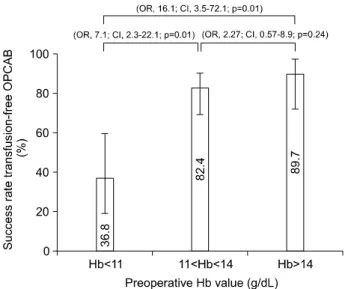
Fig. 1. Success rate of OPCAB without transfusion according to pre- operative Hb level. Descriptive analysis by modified Wald test used for calculating success rate of transfusion-free OPCAB. Log regression analysis performed to compare the success rate. OR, odds ratio; CI, confidence interval; OPCAB, off-pump coronary artery bypass; Hb, hemoglobin.
the radial artery and the greater saphenous vein were used.
Cardiac exposure and stabilization was achieved by Octopus Tissue Stabilizer (Medtronic Inc., Minneapolis, MN, USA).
The target vessels were exposed and snared above the anasto- motic site by using a 4.0 prolene suture (Ethicon Inc., Somerville, NJ, USA) with a pledget to prevent coronary in- jury and reduce blood loss. An intracoronary shunt (Anastoflo Intravascular Shunt; Research Medical Inc., Salt Lake City, UT, USA) was used only in cases of hemodynamic instability. A cell-saving device was used routinely with fre- quent infusions of the salvaged blood as collected.
4) Postoperative management
Two chest tubes were placed in the mediastinum, and addi- tional tubes were left in the pleura as needed. Indications for reopening were a blood loss of greater than 600 mL over the first 2 hours, greater than 400 mL for 2 consecutive hours, and then, greater than 300 mL for 3 consecutive hours.
Additional protamine sulfate of 25 to 50 mg/dose was infused in relation to the prolonged ACT or excessive bleeding.
Postoperative fluid management consisted of 5% dextrose and colloid solutions including pentastarch and normal saline in the case of diabetes. Artificial ventilators were weaned from patients as soon as they were fully awake and recovered from anesthesia.
5) Statistics
All data are presented as number with percentage for cate- gorical variables and mean with standard deviation for con- tinuous variables. Differences between groups were tested us- ing the chi-square test, Fisher’s exact test, and Student t-test.
The univariate association between the risk factors and the transfusion was tested using a logistic regression analysis, generating an odds ratio with a 95% confidence interval (CI).
We included all the factors at a probability value of less than 0.1 in the multivariable analysis.
To explore the cutoff value for transfusion-free OPCAB, we used the descriptive analysis of the modified Wald test according to the preoperative Hb level. Patients were divided into groups on the basis of their preoperative Hb level. Their success rates of transfusion-free OPCAB were expressed with percentage±95% CI. We confirmed no existence of the over-
lapping of the bars expressing the percentage of the success rate (mean±95% CI) among groups. In addition, we tested the success rate in relation to the preoperative Hb level by using a logistic regression analysis (Fig. 1).
A probability value of less than 0.05 was considered sig- nificant for all the statistical tests. Statistical calculations were performed using a computerized statistical program, SPSS ver. 13.0 (SPSS Inc., Chicago, IL, USA).
RESULTS
From January 2007 to June 2012, 102 patients were en- rolled in this study on whom consecutive OPCAB had been performed at Hallym University Sacred Heart Hospital.
Tables 1 and 2 show the patients’ characteristics, co- morbidity, diagnosis, preoperative antiplatelet therapy, labo- ratory data, left ventricular ejection fraction, operative data, and complications. Three patients died in the hospital for an overall mortality of 2.9% (3/102). One patient suffered from cardiogenic shock and acute renal failure, and died on post- operative day 3. Two patients experienced excessive bleeding and massive transfusion without reopening, and died of pneu-
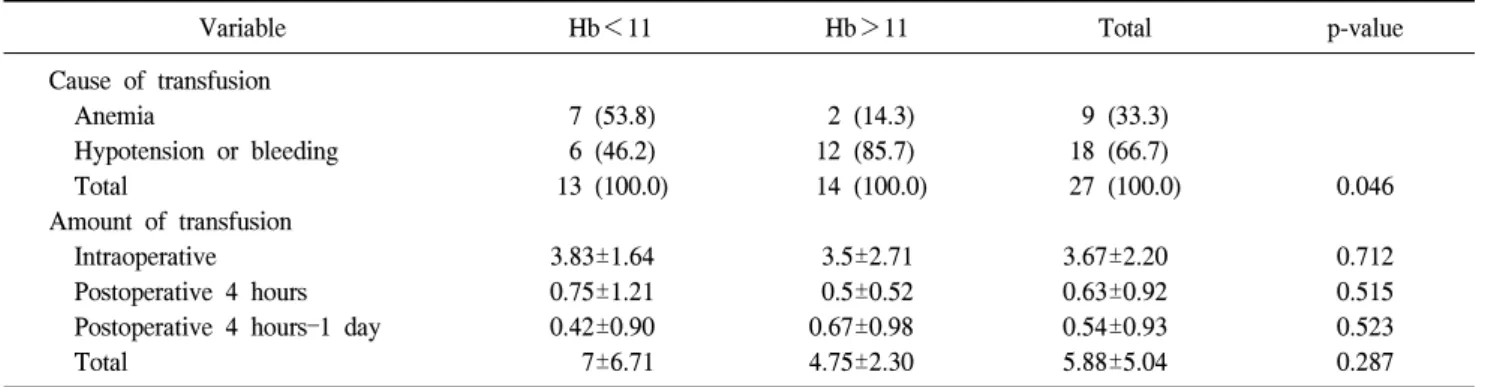
Table 3. Transfusion profile
Variable Hb<11 Hb>11 Total p-value
Cause of transfusion Anemia
Hypotension or bleeding Total
Amount of transfusion Intraoperative Postoperative 4 hours Postoperative 4 hours–1 day Total
7 (53.8) 6 (46.2) 13 (100.0)
3.83±1.64 0.75±1.21 0.42±0.90 7±6.71
2 (14.3) 12 (85.7) 14 (100.0)
3.5±2.71 0.5±0.52 0.67±0.98 4.75±2.30
9 (33.3) 18 (66.7) 27 (100.0)
3.67±2.20 0.63±0.92 0.54±0.93 5.88±5.04
0.046
0.712 0.515 0.523 0.287 Values are presented as number (%) or mean±standard deviation.
Hb, hemoglobin.
Fig. 2. Serial changes in Hb. Hb, hemoglobin; Postop, postoperative.
a)p<0.05.
Table 4. Multivariate analysis of perioperative predictors associated with transfusion
Variable Odds ratio 95% confidence interval p-value
Age (>70 yr)
Acute myocardial infarction
Preoperative hemoglobin (<11 g/dL) Preoperative creatinine (>1.3 mg/dL) Operation time (hr)
5.1 4.7 14.7 6.8 3.1
1.3–19.8 1.1–19.6 3.0–71.8 1.2–39.0 1.2–8.1
0.02 0.04 0.01 0.03 0.02
monia and acute respiratory distress syndrome on day 22 and 29. They all received allogenic-packed red blood cells (RBC) of 4, 24, and 17 U, respectively. Complications were acute renal failure in 2 patients and pneumonia in 5 patients. No reopening for bleeding or wound infection was done. No CVA occurred.
The overall success rate of OPCAB without transfusion
was 73.5% (75/102). To investigate the cutoff value of Hb for transfusion-free OPCAB, the patients were separated ac- cording to the preoperative Hb level of 11 and 14 g/dL, and examined by the descriptive analysis of the modified Wald test. The success rate of OPCAB without transfusion was sig- nificantly lower in patients with an Hb level of 11 or less, compared with patients with 11<Hb<14 and Hb>14 (35.0%; Hb<11, 79.2%; 11<Hb<14, 89.7%; Hb>14, p=0.01 in Pearson’s chi-square test) (Fig. 1). We note a cut- off value of the Hb level of 11 g/dL should facilitate OPCAB without transfusion.
The causes of transfusion were anemia in 9 patients, and hypotension or excessive bleeding in 18 patients. The leading cause of transfusion was preoperative anemia in patients with an Hb level of <11, compared with hypotension or excessive bleeding in patients with Hb>11 (53.5%; 85.7%; p=0.046).
The total amounts of packed RBC transfusion were mean 5.88±5.04 U (Table 3). Fig. 2 shows the serial changes in the Hb level. Hb levels in postoperative month 3 tended to re- cover to the preoperative levels irrespective of the transfusion amount.
To analyze the risk factors of the transfusion, we compared the data between the transfusion and the non-transfusion groups. The univariate analysis is shown in Tables 1 and 2.
The predictors for transfusion are age, diagnosis of AMI, pre- operative Hb level, platelet, and albumin level, BUN, Cr val- ue, operation time, amount of IAD, total amount of chest tube drainage, and ventilator time. Table 4 reveals that age of
>70 years, diagnosis of AMI, preoperative Hb level of <11 g/dL, preoperative Cr value of >1.3 mg/dL, and operation time are the independent predictors for transfusion in a multi- variate logistic regression analysis.
DISCUSSION
Despite improvements in the donor-screening methods, there is still an important risk related to the transfusion of al- logeneic blood products, such as the transmission of viral in- fections, the induction of immunologic reactions, and the sup- pression of the immune system. Moreover, a shortage of do- nor blood has been a major social issue in Korea. Thus far, there has been no general consensus on using allogeneic blood products in cardiac surgery.
Conventional CABG patients with CPB are at increased risk of perioperative blood loss requiring a transfusion of blood products. CPB leads to thrombocytopenia and platelet dysfunction, dilution and consumption of coagulation factors, hyperfibrinolysis, and a residual heparin effect [6]. Recently, there has been an increasing interest in OPCAB with the sug- gestion that this may avoid the complication of CPB and re- duce postoperative blood loss and morbidity [7].
Preoperative anemia has been identified as the single-most important determinant of transfusion, particularly when the platelet count is low, and has been shown to increase the risk of acute kidney injury [8]. Further, anemic patients are at a higher risk for postoperative bleeding and mortality [9].
Preoperative anemia was defined by the World Health Organization (WHO) using a gender-based definition of Hb
<12.0 g/dL for women and Hb<13.0 g/dL for men. We found that the cutoff point of the Hb level was 11.0 g/dL for OPCAB without transfusion in the descriptive analysis of the modified Wald test and a regression analysis. This corre- sponds to the preoperative anemic criteria in both genders
from the WHO. Nonetheless, we were able to perform OPCAB with an overall transfusion rate of 26.5%. This might have been feasible by using a multidisciplinary blood-saving protocol, such as the restrictive use of a trans- fusion triggered by the Hb level of 8.0 g/dL, IAD, cell sal- vage device, medication including iron agents and various vi- tamins, and meticulous hemostasis. However, we did not use erythropoietin, aprotinin, epsilon-aminocaproic acid, or tra- nexamic acid.
Historically, an Hb level of 10 g/dL and a hematocrit of 30% were common triggers for an RBC transfusion. The Society of Thoracic Surgeons (STS) guidelines suggest that for patients after cardiac operations with Hb levels of <6 g/dL, RBC transfusion is reasonable and can be lifesaving, while the transfusion of RBCs is reasonable in most surgical patients with a Hb level of 7 g/dL or less, but no high-level evidence supports this recommendation [10]. Many recent studies show larger differences in transfusion in practice [11,12]. A survey of nearly 25,000 CABG patients in in- stitutions across the United States revealed large inter-institu- tional differences. The allogeneic blood use ranged from 50%
to 100% of the patients according to the institutions.
Seventy-eight point five percent of the male and 93.6% of the female patients received allogeneic blood products during their hospital stay [13].
We found that the patients, particularly old and female pa- tients, complained of tachycardia, dyspnea, orthostatic hypo- tension, pleural effusion, and elevated BUN and Cr values in spite of an Hb level of 8.0 g/dL or more. Currently, our trig- ger point of transfusion is an Hb level of 8.0 g/dL in typical cases and 10.0 g/dL in patients with hypotension or excessive bleeding. Despite a more liberal use of allogeneic blood prod- ucts with respect to the STS guidelines, we reached an over- all success rate of OPCAB without transfusion of 73.5%.
Our success rate can partly be attributed to IAD. It pro- vides benefits by sheltering patients’ blood from heparin and saving their platelet and coagulation factors, and complement systems. This also avoids their exposure to inflammatory re- actions and nourishes the fresh platelet and coagulation fac- tors postoperatively to enhance hemostasis [10,14]. Fig. 2 shows similar levels of the lowest Hb level in the transfusion and the non-transfusion patients, in spite of the different
amounts of IAD. These resulted from a calculated autologous donation according to the preoperative Hb levels. The re- cently released guidelines on myocardial revascularization from the European Society of Cardiology and European Association of Cardiothoracic Surgery suggest postponing ex- ercise tests in patients who have undergone CABG if the Hb value is less than 10 g/dL at the onset of rehabilitation [15].
Our patients recovered the preoperative Hb level of >10 g/dL in postoperative month 3 irrespective of the transfusion amount. We transfused the blood salvaged by cell-saving de- vices in multiple doses as collected in order to avoid an in- traoperative crystalloid fluid overload [10,16].
The causes of transfusion in our study were preoperative anemia, hypotension, and excessive bleeding. The latter two factors might be correctable. Our patients received 5.88±5.04 U of packed RBCs, excluding mortality patients. A few pa- tients were transfused massively because of hemodynamic in- stability or bleeding, but small quantities of packed RBCs were administered to most of the stable patients in this study.
We can reduce the total amount of packed RBCs and the number of transfused patients by modifying the correctable causes, mainly excessive bleeding.
As the risk factors in the univariate and multivariate analy- ses, preoperative Hb and Cr levels, age of >70 years, diag- nosis of AMI, and operation time were independent predictors of a transfusion. In recent studies, several authors described small BMI, women, comorbidities such as diabetes, low left ventricular ejection fraction, and antiplatelet agents as in- dependent predictors of a transfusion [17-20]. However, we did not find their correlation because of the small population of this study. This analysis has more limitations similar to those of any retrospective database-generated observational study. Our data lack some important coagulation profiles and laboratory data. The study period is also too short to con- clude the long-term outcomes.
Since 2007, we started to implement a multidisciplinary blood-saving protocol, and this study was conducted in our early experience era. We can expect to increase the success rate in the future by modifying several blood-saving techni- ques and guidelines.
In conclusion, we performed OPCAB without transfusion with a success rate of 73.5%. The cutoff point of the Hb lev-
el to facilitate transfusion-free OPCAB was 11 g/dL. The in- dependent predictors of the transfusion were preoperative Hb and Cr levels, age of >70 years, diagnosis of AMI, and op- eration time. Some causes of transfusion might be avoidable by improving multidisciplinary blood-saving techniques.
CONFLICT OF INTEREST
No potential conflict of interest relevant to this article was reported.
REFERENCES
1. Karkouti K, Cohen MM, McCluskey SA, Sher GD. A multi- variable model for predicting the need for blood transfusion in patients undergoing first-time elective coronary bypass graft surgery. Transfusion 2001;41:1193-203.
2. Snyder-Ramos SA, Mohnle P, Weng YS, et al. The ongoing variability in blood transfusion practices in cardiac surgery.
Transfusion 2008;48:1284-99.
3. Liu B, Belboul A, Larsson S, Roberts D. Factors influencing haemostasis and blood transfusion in cardiac surgery.
Perfusion 1996;11:131-43.
4. Van Dijk D, Nierich AP, Jansen EW, et al. Early outcome after off-pump versus on-pump coronary bypass surgery: re- sults from a randomized study. Circulation 2001;104:1761-6.
5. Angelini GD, Taylor FC, Reeves BC, Ascione R. Early and midterm outcome after off-pump and on-pump surgery in Beating Heart Against Cardioplegic Arrest Studies (BHACAS 1 and 2): a pooled analysis of two randomised controlled trials. Lancet 2002;359:1194-9.
6. Ranucci M, Aronson S, Dietrich W, et al. Patient blood man- agement during cardiac surgery: do we have enough evidence for clinical practice? J Thorac Cardiovasc Surg 2011;142:
249.e1-32.
7. Khuri SF, Valeri CR, Loscalzo J, et al. Heparin causes pla- telet dysfunction and induces fibrinolysis before cardiopulmo- nary bypass. Ann Thorac Surg 1995;60:1008-14.
8. Ng RR, Chew ST, Liu W, Shen L, Ti LK. Identification of modifiable risk factors for acute kidney injury after coronary artery bypass graft surgery in an Asian population. J Thorac Cardiovasc Surg 2014;147:1356-61.
9. Ranucci M, Baryshnikova E, Castelvecchio S, Pelissero G;
Surgical and Clinical Outcome Research (SCORE) Group.
Major bleeding, transfusions, and anemia: the deadly triad of cardiac surgery. Ann Thorac Surg 2013;96:478-85.
10. Society of Thoracic Surgeons Blood Conservation Guideline Task Force, Ferraris VA, Ferraris SP, et al. Perioperative blood transfusion and blood conservation in cardiac surgery:
the Society of Thoracic Surgeons and The Society of Cardiovascular Anesthesiologists clinical practice guideline.
Ann Thorac Surg 2007;83(5 Suppl):S27-86.
11. Goodnough LT, Johnston MF, Toy PT. The variability of trans- fusion practice in coronary artery bypass surgery. Transfusion Medicine Academic Award Group. JAMA 1991;265:86-90.
12. Stover EP, Siegel LC, Body SC, et al. Institutional variability in red blood cell conservation practices for coronary artery bypass graft surgery. Institutions of the MultiCenter Study of Perioperative Ischemia Research Group. J Cardiothorac Vasc Anesth 2000;14:171-6.
13. Rogers MA, Blumberg N, Saint S, Langa KM, Nallamothu BK. Hospital variation in transfusion and infection after cardiac surgery: a cohort study. BMC Med 2009;7:37.
14. Reents W, Babin-Ebell J, Misoph MR, Schwarzkopf A, Elert O. Influence of different autotransfusion devices on the qual- ity of salvaged blood. Ann Thorac Surg 1999;68:58-62.
15. Task Force on Myocardial Revascularization of the European Society of Cardiology (ESC) and the European Association for Cardio-Thoracic Surgery (EACTS); European Association
for Percutaneous Cardiovascular Interventions (EAPCI), Kolh P, et al. Guidelines on myocardial revascularization. Eur J Cardiothorac Surg 2010;38 Suppl:S1-S52.
16. Goel P, Pannu H, Mohan D, Arora R. Efficacy of cell saver in reducing homologous blood transfusions during OPCAB surgery: a prospective randomized trial. Transfus Med 2007;
17:285-9.
17. Moskowitz DM, Klein JJ, Shander A, et al. Predictors of transfusion requirements for cardiac surgical procedures at a blood conservation center. Ann Thorac Surg 2004;77:626-34.
18. Parr KG, Patel MA, Dekker R, et al. Multivariate predictors of blood product use in cardiac surgery. J Cardiothorac Vasc Anesth 2003;17:176-81.
19. Magovern JA, Sakert T, Benckart DH, et al. A model for predicting transfusion after coronary artery bypass grafting.
Ann Thorac Surg 1996;61:27-32.
20. Chung ES, Park KH, Lim C, Choi J. Risk factors of red blood cell transfusion in isolate off pump coronary artery bypass surgery. Korean J Thorac Cardiovasc Surg 2012;45:
301-7.