ISSN: 2233-601X (Print) ISSN: 2093-6516 (Online)
Received: August 29, 2016, Revised: September 29, 2016, Accepted: October 17, 2016, Published online: August 5, 2017
Corresponding author: Sung-Ho Jung, Department of Thoracic and Cardiovascular Surgery, Asan Medical Center, University of Ulsan College of Medicine, 88 Olympic-ro 43-gil, Songpa-gu, Seoul 05505, Korea
(Tel) 82-2-3010-3580 (Fax) 82-2-3010-6966 (E-mail) [email protected]
© The Korean Society for Thoracic and Cardiovascular Surgery. 2017. All right reserved.
This is an open access article distributed under the terms of the Creative Commons Attribution Non-Commercial License (http://creativecommons.org/
licenses/by-nc/4.0) which permits unrestricted non-commercial use, distribution, and reproduction in any medium, provided the original work is properly cited.
Comparison of the Outcomes between Surgical Aortic Valve Replacement and Transcatheter Aortic Valve Replacement
in Patients Aged above 80
Jeong-Woo Lee, M.D., Jihoon Kim, M.D., Ph.D., Sung-Ho Jung, M.D., Ph.D., Cheol Hyun Chung, M.D., Ph.D., Jae Won Lee, M.D., Ph.D.
Department of Thoracic and Cardiovascular Surgery, Asan Medical Center, University of Ulsan College of Medicine
Background: Transcatheter aortic valve replacement (TAVR) has been suggested as a less invasive treatment for high-risk patients with aortic valve disease. I n this study, we compared the outcomes of conventional surgical aortic valve replacement (AVR) and TAVR in elderly patients aged over 80. Methods: A total of 108 patients aged 80 years or older who underwent isolated AVR (n=35) or TAVR (n=73) from 2010 through 2015 at Asan Medical Center were identified. Early and late clinical outcomes, including echocardiographic findings, were evaluated in both groups. The mean follow-up duration was 766.4±528.7 days in the AVR group and 755.2±546.6 days in the TAVR group, and the average timing of the last follow-up echocardiog- raphy was at 492.6±512.5 days in the AVR group and 515.7±526.8 days in the TAVR group. Results: The overall early mortality was 2.8% (0 of 35, 0% in the AVR group vs. 3 of 73, 4.1% in the TAVR group).
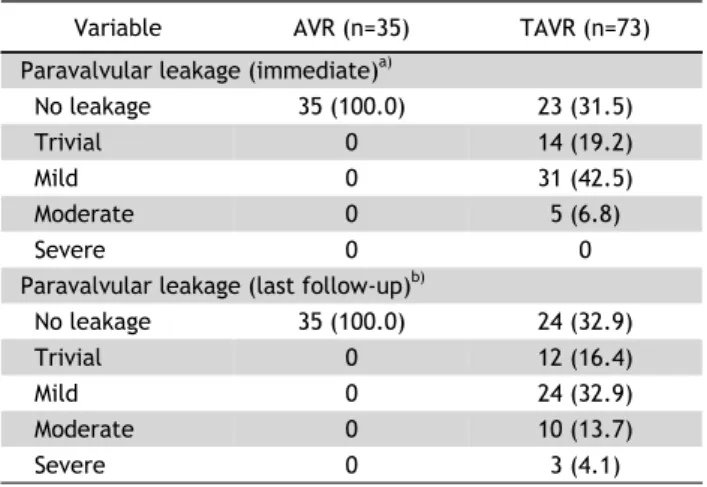
Permanent pacemaker insertion was significantly more common in the TAVR group (p=0.010). Renal failure requiring dialysis and new-onset atrial fibrillation was more frequent and the length of hospital stay was longer in the AVR group; however, this difference did not reach statistical significance. In the TAVR group, 14 patients (19.2%) were rehospitalized due to cardiac problems, and 13 patients (17.8%) had developed significant paravalvular leakage by the time of the last follow-up echocardiography. Conclusion: TAVR could be a good alternative to conventional surgical AVR in elderly patients. However, TAVR has several short- comings, such as frequent significant paravalvular leakage or readmission, which should be considered in de- cision-making.
Key words: 1. Aortic valve, surgery 2. Heart valve disease 3. Outcomes
4. Transcatheter aortic valve replacement
Introduction
Aortic valve disease is a significant cardiovascular problem that is likely to become increasingly sig- nificant as the population ages [1,2]. In particular, aortic stenosis is an insidious disease resulting in a
high mortality rate among untreated patients [3].
Surgical replacement of the aortic valve (AVR) re-
duces symptoms and improves survival in patients
with aortic stenosis [4,5] and, in the absence of seri-
ous coexisting conditions, the procedure is associated
with a low operative mortality rate [6]. However,
https://doi.org/10.5090/kjtcs.2017.50.4.255
elderly patients with coexisting medical problems are likely to be at high risk when undergoing surgery.
Recently, transcatheter aortic valve replacement (TAVR) has entered the spotlight and is now re- garded as a new therapy for patients who are not candidates for surgery or who are at a high risk of complications due to surgery [7].
Several studies comparing AVR and TAVR in Korea have been conducted [8]. The present study de- scribes the clinical outcomes and echocardiographic findings after AVR or TAVR in elderly patients aged above 80.
Methods
1) Patient population
According to Asan Medical Center database, 1,718 patients underwent AVR or TAVR between January 2010 and December 2015. Among this population, we identified 108 patients aged over 80. Of these, 35 patients underwent isolated AVR and 73 underwent TAVR. The exclusion criteria were the presence of endocarditis pathology, having undergone a previous aortic valve operation, and simultaneous operations on the aorta, coronary arteries, or other heart valves.
The decision for selecting the treatment modality (AVR or TAVR) was made by a team consisting of cardiovascular surgeons and interventional cardiolo- gists. The team considered each patient’s medical his- tory, comorbidities, and anatomical structures. In the absence of a perfect quantitative score, the risk as- sessment relied on the clinical judgement of the team.
2) Procedures
(1) Surgical replacement of the aortic valve: Six surgeons performed the operations. The approaches used were median sternotomy (n=29), transverse sternotomy (n=3), upper sternotomy (n=2), and right anterior thoracotomy (n=1). After opening the peri- cardium, cardiopulmonary bypass (CPB) was estab- lished by cannulation with arterial and venous can- nulae. After CPB was instated, the aorta was cross- clamped and cardioplegic solution was infused. Then, an aortotomy was made and the diseased aortic valve leaflets were excised. Thereafter, a prosthetic aortic valve was suture-tied and the aortotomy was repaired. Aortic cross-clamping was then released
and the patient was weaned from CPB. Chest tubes were inserted and the wound was closed layer by layer. Finally, the patient was transferred to the in- tensive care unit (ICU) in an intubated state.
(2) Transcatheter aortic valve replacement: The Edwards SAPIEN prosthesis (Edwards Lifesciences, Irvine, CA, USA; n=41) and the CoreValve prosthesis (Medtronic, Minneapolis, MN, USA; n=32) were used in TAVR. The Edwards SAPIEN device consists of bo- vine pericardial tissue mounted in a balloon-expanda- ble, stainless-steel stent or, more recently, a cobalt- chromium, open-cell stent (SAPIEN XT). The CoreValve prosthesis consists of porcine pericardial tissue, mounted in a self-expanding nitinol stent.
The procedure was performed in a hybrid operat- ing room with on-site cardiac surgery on standby to prepare for emergent situations, such as aortic rup- ture or migration of the prosthetic valve. The proce- dure was performed under general anesthesia. Tran- sesophageal echocardiography was used to ensure the size of the aortic annulus and to evaluate the valve position and function. After positioning the valve at the aortic annulus, balloon dilation was per- formed with rapid ventricular pacing. The patient was then transferred to the ICU.
3) Postoperative management
Patients were extubated as soon as possible after their vital signs stabilized. Then, they were trans- ferred to the general ward in a stable condition.
Postoperative echocardiography was usually per- formed on the third or fourth postoperative day (POD). If there were no complications, the patient was discharged.
Depending on the surgeon’s preference, warfarin or aspirin was prescribed. When warfarin was used, the target prothrombin time/international normalized ratio was 2.0 for 3 months. After the discharge, when- ever possible, follow-up echocardiographic evaluations were carried out 1, 3, 6, and 12 months after sur- gery.
4) Statistical analysis
Categorical variables, expressed in percentages or
frequencies, were compared using the chi-square test
or the Fisher exact test. Continuous variables, ex-
pressed as mean±standard deviation, were compared
using the Student t-test. Kaplan-Meier curves were
Table 1. Baseline characteristics and hemodynamic data
Characteristic Aortic valve replacement
(n=35)
Transcatheter aortic valve
replacement (n=73) p-value
Age (yr) 82.3±3.5 83.4±2.6 0.073
Male sex 16 (45.7) 38 (52.1) 0.537
Diabetes mellitus 6 (17.1) 26 (35.6) 0.049
Hypertension 24 (68.6) 55 (75.3) 0.457
Cerebrovascular disease 4 (11.4) 6 (8.2) 0.590
Chronic obstructive pulmonary disease 6 (17.1) 15 (20.5) 0.676
Creatinine (mg/dL) 1.0±0.4 1.0±0.4 0.984
Atrial fibrillation 2 (5.7) 10 (13.7) 0.217
Body mass index (kg/m
2) 23.2±3.7 23.6±3.1 0.520
European System for Cardiac Operative Risk Evaluation II 3.3±3.4 4.7±4.3 0.108
New York Heart Association functional classification III or IV 10 (28.6) 21 (28.8) 0.983
Previous coronary artery disease 6 (17.1) 32 (43.8) 0.007
Previous percutaneous coronary intervention 1 (2.9) 22 (30.1) 0.001
Previous coronary artery bypass graft surgery 0 2 (2.7) 0.323
Previous cardiac surgery 0 3 (4.1) 0.224
Aortic valve pathology
Stenosis 25 (71.4) 65 (89.0) 0.022
Regurgitation 3 (8.6) 0 0.011
Combined 7 (20.0) 8 (11.0) 0.204
Echocardiographic findings
Aortic valve area (cm
2) 0.6±0.2 0.6±0.2 0.947
Mean gradient (mm Hg) 64.4±24.7 61.5±21.5 0.550
LV ejection fraction (%) 59.6±10.4 59.5±9.8 0.986
LV mass index (g/m
2) 150.6±40.5 136.6±34.1 0.078
Moderate or severe mitral regurgitation 4 (11.4) 8 (11.0) 0.942
Follow-up duration (day) 766.4±528.7 755.2±546.6 0.920
Values are presented as mean±standard deviation or number (%).
LV, left ventricle.
formulated to illustrate patients’ freedom from read- mission or infective endocarditis over time. The log-rank test was used to compare the differences between the groups. All p-values<0.05 were consid- ered to indicate statistical significance. All analyses were performed using IBM SPSS ver. 21.0 (IBM Corp., Armonk, NY, USA).
Results
1) Baseline characteristics
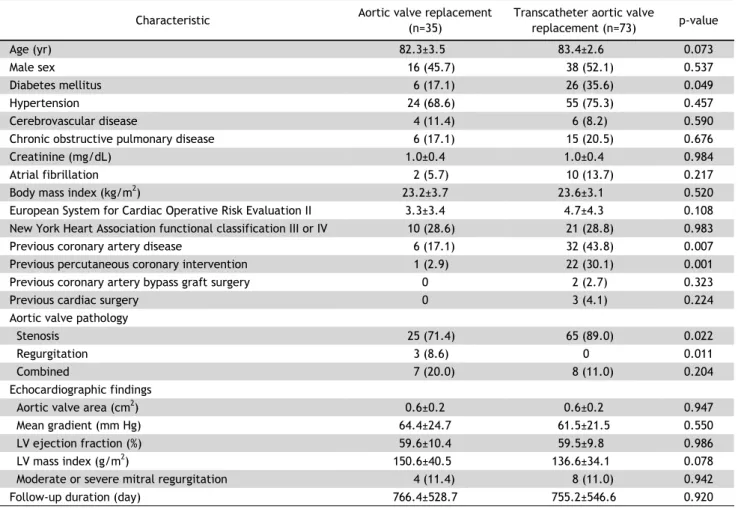
The baseline demographics and clinical character- istics of all patients in both groups are summarized in Table 1. The TAVR group had significantly more patients with a history of diabetes mellitus (p=0.049) or coronary artery disease (p=0.007), and significan- tly more patients who had undergone percutaneous coronary interventions (p=0.001). Although the differ-
ences did not reach statistical significance, age and European System for Cardiac Operative Risk Evalua- tion (EuroSCORE) results were higher in the TAVR group. The mean follow-up duration was 748.7±531.8 days in the AVR group and 755. 2±546. 6 days in the TAVR group, and the mean timing of the last echo- cardiography follow-up was 481.7±509.4 days in the AVR group and 515.7±526.8 days in the TAVR group.
2) Intraoperative data
In the patients who underwent AVR, the mean CPB
time was 115.8±33.7 minutes, while the mean aortic
cross-clamp time was 73.6±21.4 minutes. Median ster-
notomies were performed in 29 patients (82.9%). In
this study, the TAVR procedure was performed only
by the transfemoral approach. In the AVR group, the
valve sizes were 19 mm (n=6, 17.1%), 21 mm (n=20,
57.1%), 23 mm (n=8, 22.9%), and 25 mm (n=1,
Table 3. Early and late clinical outcomes
Variable Aortic valve
replacement (n=35)
Transcatheter aortic valve
replacement (n=73) p-value
30-Day mortality 0 3 (4.1) 0.224
Low cardiac output syndrome 1 (2.9) 6 (8.2) 0.289
Neurologic event
a)2 (5.7) 3 (4.1) 0.710
Major vascular complication 0 2 (2.7) 0.323
Life-threatening or disabling bleeding 2 (5.7) 3 (4.1) 0.710
Renal failure
b)6 (17.1) 5 (6.8) 0.098
New atrial fibrillation 10 (28.6) 11 (15.1) 0.097
New permanent pacemaker 1 (2.9) 16 (21.9) 0.011
Extracorporeal membrane oxygenation insertion 0 0
Intensive care unit stay (d) 8.37±22.1 4.1±4.4 0.264
Hospital stay (d) 26.1±44.0 11.0±7.9 0.052
Readmission due to cardiac problem 2 (5.7) 14 (19.2) 0.065
Readmission due to heart failure 2 (5.7) 10 (13.7) 0.217
Reoperation 0 1 (1.4) 0.487
Infective endocarditis 0 2 (2.7) 0.323
Embolic stroke 0 1 (1.4) 0.487
Hemorrhagic stroke 0 1 (1.4) 0.487
Values are presented as number (%) or mean±standard deviation.
a)
In the event of hospitalization.
b)Renal failure was defined by the need for dialysis for any length of time.
Table 2. Intraoperative data
Variable
Aortic valve replacement
(n=35)
Transcatheter aortic valve replacement
(n=73) Cardiopulmonary bypass time (min) 115.8±33.7 - Aortic cross-clamp time (min) 73.6±21.4 - Approach
Upper sternotomy 2 (5.7) -
Transverse sternotomy 3 (8.6) -
Thoracotomy 1 (2.9) -
Median sternotomy 29 (82.9) -
Transfemoral 73 (100.0)
Valve size (mm)
19 6 (17.1) -
21 20 (57.1) -
23 8 (22.9) 17 (23.3)
25 1 (2.9) -
26 - 27 (37.0)
29 - 24 (32.9)
31 - 5 (6.8)
Values are presented as mean±standard deviation or number (%).
2.9%). In the TAVR group, the valve sizes were 23 mm (n=17, 23.3%), 26 mm (n=27, 37.0%), 29 mm (n=24, 32.9%), and 31 mm (n=5, 6.8%) (Table 2).
3) Early and late clinical outcomes
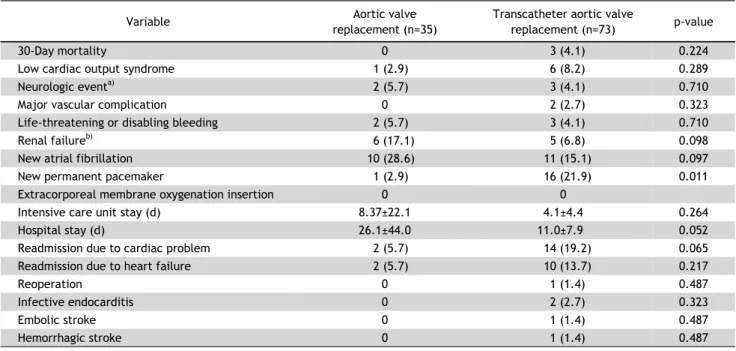
The early and late clinical outcomes of the 2 groups are shown in Table 3. Three patients (0 of 35, 0% in the AVR group versus 3 of 73, 4.1% in the TAVR group; overall 2.8%) died within 30 days after surgery. One patient had bowel ischemia followed by septic shock after the procedure. This patient died without further treatment because of advanced age and the high risk that would have been associated with further treatments. The other 2 patients con- tracted pneumonia after the procedure and died of sepsis owing to aggravated pneumonia.
Only permanent pacemaker (PPM) insertion was significantly more common in the TAVR group among the early clinical outcomes (1 of 36, 2.8% in the AVR group versus 16 of 73, 21.9% in the TAVR group; p=0.010). The Edwards SAPIEN device was used in 41 patients (56.2%), while the CoreValve prosthesis was used in 32 (73. 8%). Among patients in whom the Edwards SAPIEN device was used, 3 (7.32%) required PPM insertion, while 13 (40.6%) of the patients who received a CoreValve required PPM insertion (p=0.01).
Although these findings did not reach statistical
significance, several complications were more com-
mon in the AVR group. Specifically, renal failure re-
Table 4. Paravalvular leakage in echocardiographic findings
Variable AVR (n=35) TAVR (n=73)
Paravalvular leakage (immediate)
a)No leakage 35 (100.0) 23 (31.5)
Trivial 0 14 (19.2)
Mild 0 31 (42.5)
Moderate 0 5 (6.8)
Severe 0 0
Paravalvular leakage (last follow-up)
b)No leakage 35 (100.0) 24 (32.9)
Trivial 0 12 (16.4)
Mild 0 24 (32.9)
Moderate 0 10 (13.7)
Severe 0 3 (4.1)
Values are presented as number (%).
AVR, aortic valve replacement; TAVR, transcatheter aortic valve replacement.
a)
Echocardiography was performed on postoperative day 3 or 5.
b)