Synthesis and Evaluation of Antimicrobial Activity of
1, 3, 4-Thiadiazole Analogues for Potential Scaffold
Sagar Sahu1, Tanesh Sahu2, Gunjan Kalyani1, Bina Gidwani1*1Columbia Institute of Pharmacy, Raipur, India
2Shri Rawatpura Sarkar Institute of Pharmacy, Kumhari, India
Received June 4, 2020
Reviewed October 22, 2020
Accepted March 4, 2021
Objectives: Pathogenic microbes are causal agents for various types of severe and even lethal infectious diseases. Despite of development in medication, bacterial and fungal infections still persist to be a vital problem in health care. Bacteria and several fungal species have shown resistance to antibiotics used in treatment to current medications. Therefore, it is a considerable field of interest in the design and development of novel compounds with antimicrobial activity.
Methods: The compounds bearing a heterocyclic ring play an imperative role among other organic compounds with pharmacological activity used as drugs in human for control and cure of various infections. Thiadiazoles containing nitrogen–sulfur atom as part of their cyclic structure which shown wide-ranging application as structural units of biologically ac-tive molecules and are very useful intermediates in Medicinal Chemistry.
Results: The effectiveness of the thiadiazole nucleus was established by the drugs cur-rently used for the treatment of various infections. 1,3,4-Thiadiazoles and some of their derivatives are widely studied because of their broad spectrum of pharmacological activi-ties.
Conclusion: In the present work, a series of 1,3,4-Thiadiazole derivatives were synthe-sized by cyclization of a group of various benzaldehyde with thiosemicarbazide in the pres-ence of various reagent like FeCl3, HCHO by losing a molecule of water. These derivatives were found to possess prominent antimicrobial activity.
Keywords: 1,3,4-thiadiazole, heterocyclic, thiosemicarbazide, cyclization, antimicrobial *Corresponding Author
Bina Gidwani
Columbia Institute of Pharmacy, Raipur, India
Tel: +91-99-8190-3827 E-mail: [email protected]
INTRODUCTION
Thiadiazoles are classified under azole compounds. These are five-membered heterocyclic compound containing a sulfur atom with two nitrogen atoms. Presence of two double bonds gave aromatic ring; with the name Thiadiazole originating from the Hantzsch – Widman nomenclature. The thiadiazole was firstly described by Fischer in 1882, but the nature of the ring system was demonstrated by Freud and Kuhn in 1890. Thia-diazole and their structurally related chemical compounds are called 1, 3, 4-thiadiazole (two nitrogen and one sulphur hetero-atom in a five- membered cyclic ring). The structure is shown in Fig. 1. Basically, there are four isomeric forms of thiadiazole i.e,
❖ 1, 2, 3-thiadiazole ❖ 1, 2, 5-thiadiazole ❖ 1, 2, 4-thiadiazole ❖ 1, 3, 4-thiadiazole
Copyright © Korean Pharmacopuncture Institute
This is an Open-Access article distributed under the terms of the Creative Commons Attribution Non-Commercial License (http://creativecommons.org/licenses/by-nc/4.0/) which permits unrestricted noncommercial use, distribution, and reproduction in any medium, provided the original work is properly cited.
Journal of Pharmacopuncture 2021;24(1):32-40 pISSN: 2093-6966 • eISSN: 2234-6856 https://doi.org/10.3831/KPI.2021.24.1.32
Original Article
Figure 1. Structure of 1,3,4-thiadiazole molecule.
1
S
1
2
N
3
N
4
5
33
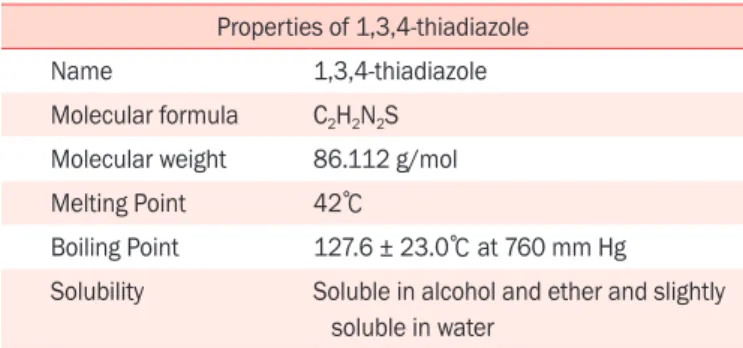
www.journal-jop.org1, 3, 4-thiadiazole is amongst the highly useful isomeric form because of its diverse biological actions in body. In par-ticular, compounds bearing the 1, 3, 4-thiadiazole nucleus is known to have exclusive action against bacterial infection and anti-inflammatory activities in body. Structurally substituted derivatives of Thiadiazole have also been found to bear diverse therapeutic activities such as analgesic, antimicrobial, antitu-bercular, anticonvulsant and anti-hepatitis B viral activities [1-3]. The properties are listed in Table 1. The biological activity of Thiadiazoles is because of strong aromaticity of the ring system that offers higher in vivo stability. Thiadiazoles is a bioisosteric replacement of Thiazole moiety. Also, it is a bioisostere of Oxa-diazole, Oxazole and Benzene. Substitution of these heterocy-clic systems with a Thiadiazole by and large leads to analogues with improved activity because sulfur atom imparts enhanced liposolubility.
An antimicrobial is an agent that either kills or inhibits the growth of microbes. Thus, this microbial agent may be either a chemical compound or any physical agents. These agents effi-ciently interfere with the growth and reproduction of causative microorganisms like bacteria, fungi, parasites, virus etc. The breakthrough obtained with the discovery of Penicillin in 1940 lead to development of an era which formed the basis of the prospering modern antimicrobial therapy. Diverse antibiotics and other agents have been discovered after the penicillin. The breakthrough of the antibiotic penicillin in the early 1940s be-came the vital mainstay for the era of. The most important dis-covery subsequently after the introduction of Penicillins in to be the pronouncement of the basic skeleton of which they were made. Thus, it was revealed that it could be modified chemi-cally in order to improve their characteristics. To summarize, it can be said that antimicrobial agents are used to manage ac-cessible illness and they can be used as prophylaxis for definite medical conditions and other surgical procedures [4, 5]. Based
on these facts the purpose of present research work was to syn-thesize some thidiazole derivatives that have broad spectrum of antimicrobial activity and to project these synthesized deriva-tives as an alternative to antibiotics on the basis of their action.
MATERIALS AND METHODS
All the chemicals and reagents used in the study were pur-chased from Sudarshan Chemicals, Raipur and were of com-mercial grade. Melting points were determined by melting point apparatus and were left uncorrected. The chemical used were Aromatic aldehyde, Thiosemicarbazide, Pthalmide, p-nitro aniline, Ethanol and Sulphuric acid.
1. Scheme for synthesis
The literature survey revealed that Thiadiazole moiety is an imperative heterocyclic system with different and diverse biological activities. Therefore, the objective was to prepare different Thiadiazole derivatives and evaluate them for their antimicrobial, analgesic, antioxidant, anti-inflammatory and antihelmintic. The synthesis of 1,3,4-Thiadiazole derivatives is attracting attention of researchers because it has multitudinous biological activities as discussed earlier. Therefore, synthesis of different derivatives of 1,3,4-Thiadiazole has been done and was evaluated for anti-microbial activity.
1) Step I
In a 500 ml beaker filled with warm alcohol (150 ml), p-Dimethylbenzaldehyde (0.1 mol) was added. The solution of Thiosemicarbazide (9.1 g, 0.1 mol) in hot water (150 ml) was prepared and added into the beaker, with slow mixing and con-tinuous stirring. The precipitated product was (Compound I) was filtered off and recrystallized from 50% ethanol [6].
2) Step II
Compound I (0.025 g) was suspended in 150 ml of distilled water in 500 ml beaker. Ferric chloride solution was added to the beaker (12.165 g. 0.075 mol in 150 ml distilled water). The reaction mixture was heated and maintained at temperature of 80-90℃ for 1-2 hours. Then reaction mixture was filtered hot.
A mixture of citric acid (11.55 g, 0.055 mol) and sodium citrate (7.35 g, 0.025 mol) was added to the filtrate and stirred well. Af-ter cooling the solution to room temperature, it was recrystal-ized with 50% aqueous ammonia. The precipitate (Compound
Table 1. Properties of 1,3,4-thiadiazole
Properties of 1,3,4-thiadiazole
Name 1,3,4-thiadiazole
Molecular formula C2H2N2S
Molecular weight 86.112 g/mol
Melting Point 42℃
Boiling Point 127.6 ± 23.0℃ at 760 mm Hg
Solubility Soluble in alcohol and ether and slightly
34
https://doi.org/10.3831/KPI.2021.24.1.32 Sagar Sahu, et al.II) separated out was filtered and recrystalized from 25% aque-ous ethanol. Then, compound II was identified using TLC, with mobile phase of Benzene, Ethyl acetate, Ethanol in ratio of (4:2:1) using silica gel G as stationary phase. The detection was done by using iodine vapours.
3) Step III
A methanolic solution of compound II (2 g, 0.001 mol) was placed into a three-neck flask equipped with a stirred and dropping funnel. The solution was stirred to dissolve the compound completely. To this, methanolic solution, formalde-hyde (7 ml, 37%) was added drop wise for 15-20 minutes. The resulting mixture was stirred for around 30 min. to complete reaction with formaldehyde for yielding of methyl derivatives. The methanolic solution of Phthalimido (1.5 g, 0.001 mol) was added drop wise with continuous stirring for about half an
hour at the temperature of 30℃. The solution was refluxed for
two hours at 65-70℃. It was then allowed to cool in ice water.
The solid obtained (Compound III) was filtered and washed thoroughly with hot water then air dried [7-9]. The steps for the synthesis are highlighted from Fig. 2 to 5.
2. Characterization of synthesized compounds
1) Thin layer chromatography
Thin layer chromatographic studies have been performed for the synthesized compounds (I), (II), (III) and (IV). The solvent system for the entire synthesized compound was same. The procedure for Rf value determination through TLC is discussed below -
• Sillica gel G used for TLC was activated in hot air oven at 100℃ for 1 hour.
2
Figure 2. Preparation of (E)-1-(2,4-dimethylbenzylidene) thiosemicarbazide (Compound I).
Figure 3. Preparation of 5-(2,4-dimethylphenyl)-1,3,4-thiadiazol-2-amine (Compound II).
3
Synthesis and Evaluation of Antimicrobial Activity of 1, 3, 4-Thiadiazole Analogues for Potential Scaffold
35
www.journal-jop.org• TLC plate at a distance 2 cm from the base, marks were made on the line for sample application.
• The sample was spotted on the line with the help of capil-lary tube and it was allowed to dry.
• The plate was placed in the developing chamber with mo-bile phase.
• Mobile phase was selected by hit and trial method.
• Various ratios of solvent systems were prepared and the spots was visualized and Rf value was calculated.
• After visualization of spots solvent system or mobile phase was selected.
TLC plates were run using solvent system benzene: ethyl acetate: ethanol in the ratio of 4:2:1 for synthesized compounds. The spots detection was done by using iodine vapor and Rf value was calculated [10].
2) Melting point determination
• A small amount of drug was filled into capillary tube upto 1/3 volume then other opening mouth was sealed by heat-ing. Now this capillary tube was attached to thermometer. • The thermometer with capillary tube was dipped into
thiel’s tube containing liquid paraffin. • Thiel’s tube was heated by the help of burner.
• When the compound starts melting, then exact tempera-ture was noted [11].
3) Elements detection
(1) Test for nitrogen
① A small piece of Na metal was heated in a fusion tube with the organic compound.
② The formed ionic salts were extracted from the fused mass by boiling it with distilled water. This is called so-dium fusion extract.
③ The extract was boiled with FeSO4 and acidified with
con-centrated H2SO4.
(2) Test for sulphur
① A small piece of Na metal was heated in a fusion tube with the organic compound.
② The formed ionic salts were extracted from the fused mass by boiling it with distilled water. This is called so-dium fusion extract.
③ The extract was treated with sodium nitroprusside. (3) Test for oxygen
① Ceric ammonium test (Alcohol oxygen)
i) 1 ml solution of organic compound was taken into test tube.
ii) Then few drops of ceric ammonium nitrate solution were added to solution.
iii) The mixture was allowed to stand for 15 minutes. ② 2,4-dinitrophenyl hydrazine test (carbonyl oxygen) i) Five drops of the compound to be tested was mixed with
5 drops of the dinitrophenylhydrazine reagent in 2 ml of ethanol.
ii) Then tube was shaken.
iii) The mixture was allowed to stand for 15 minutes [12].
3. Estimation of antimicrobial activity
The antibacterial activity of synthesized derivative of 1, 3, 4-Thiadiazole derivatives were carried out on Bacillus subtilis and Escherichia coli by using Agar diffusion method. Cipro-floxacin was used as a standard drug for evaluation. Initially, the stock cultures of bacteria were revived by inoculating in broth media and grown at 37℃ for 18 hrs. The agar plates of the
above media were prepared, and wells were made in the plate. Each plate was inoculated with 18 hr old cultures (100 μl, 10–4
cfu) and spread evenly on the plate. After 20 min, the wells were filled with of compound and antibiotic at different concentra-tions. All the plates were incubated at 37℃ for 24 hrs and the
diameter of inhibition zone (mm) were noted [13].
Figure 5. Preparation of 4-((5-(2,4-dimethylphenyl)-1,3,4-thiadiazol-2-yalmino)methylamino)phenol (Compound IV).
36
https://doi.org/10.3831/KPI.2021.24.1.32 Sagar Sahu, et al.RESULTS
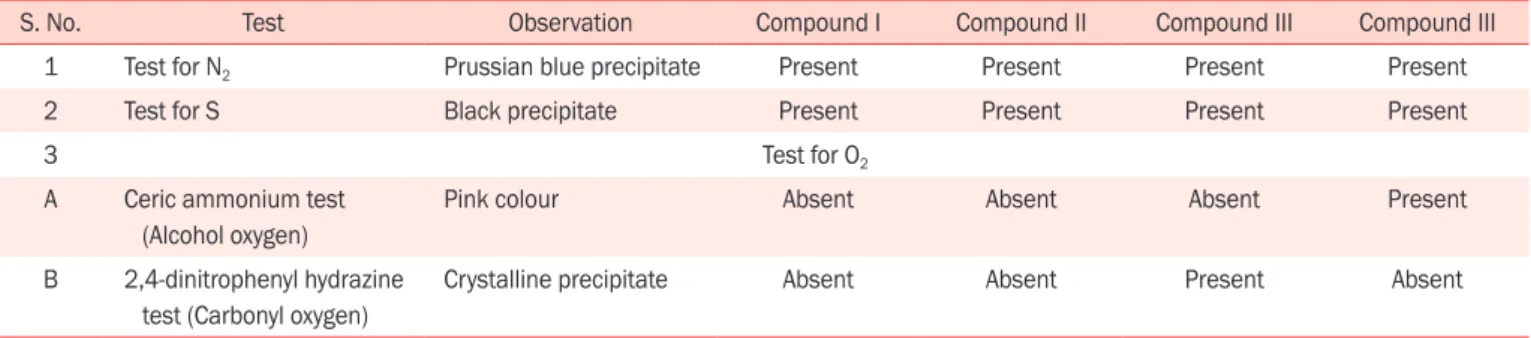
Total 4 compounds were synthesized. These compounds were characterized for physicochemical Properties like molecu-lar formula, molecumolecu-lar weight, melting point and yield. TLC was done and Rf value of synthesized compounds were estimat-ed. Results are shown in Table 2. The diagrammatic representa-tion of TLC plates is listed in Fig. 6.
1. Element detection
The synthesized compounds were estimated for the presence of elements like nitrogen, sulpher and oxygen etc. Results are
shown in Table 3.
2. Spectral characterization of compounds by FTIR
FTIR spectrum of the derivatives were recorded by KBr Press Pellet method (Shimadzu FTIR 8400S, Japan). The char-acteristic peaks along with their functional group are shown in
Fig. 7.
3. Antimicrobial activity of synthesized compound
The results indicated that among all the three tested com-pounds, III and IV showed good activity against all the fungal
Table 2. Physicochemical properties of synthesized compounds
S. No. Compound Molecular formula Molecular weight (g/mole) % Yield Melting point Rf value
1 I C10H14N4S 222.309 74 104℃ 0.8
2 II C10H12N4S 220.29 68 108℃ 0.79
3 III C18H15 N5 O2S 365.40 61 106℃ 0.6
4 IV C16H17N5OS 327.40 57 108℃ 0.6
Table 3. Element detection of synthesized compound
S. No. Test Observation Compound I Compound II Compound III Compound III
1 Test for N2 Prussian blue precipitate Present Present Present Present
2 Test for S Black precipitate Present Present Present Present
3 Test for O2
A Ceric ammonium test
(Alcohol oxygen)
Pink colour Absent Absent Absent Present
B 2,4-dinitrophenyl hydrazine test (Carbonyl oxygen)
Crystalline precipitate Absent Absent Present Absent
6 Figure 6. TLC of synthesized compounds.
37
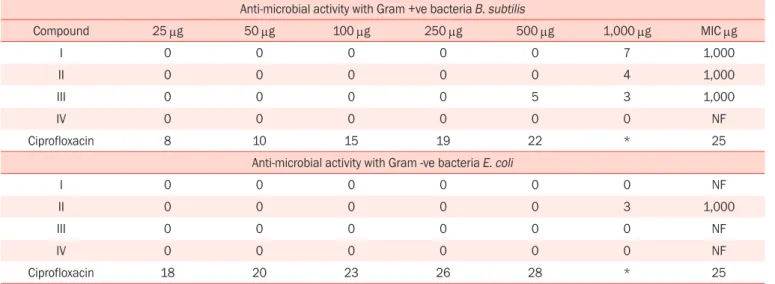
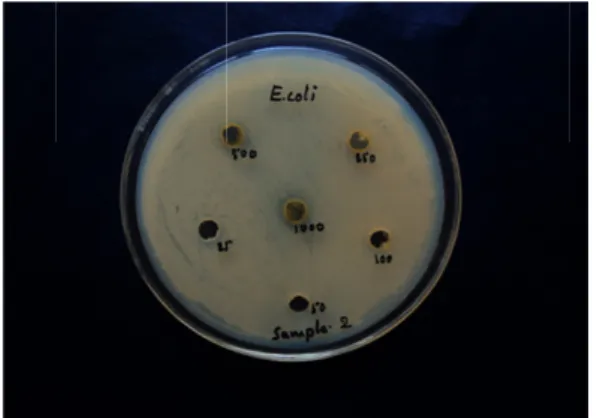
www.journal-jop.orgstrains at concentrations of 1 and 0.5 mg/mL compared to stan-dard drug. None of the synthesized compounds were superior to the standard drug against various tested microbial strains; However, the antifungal activities of some of the compounds are comparable to those of standard. Results of antimicrobial activity are shown in Table 4 and Fig. 8, 9.
DISCUSSION
In the present research work antibacterial activity of synthe-sized derivatives was performed by Agar diffusion method, it was observed that compounds have some significant activity against gram positive and gram-negative bacteria. It could thus
be assessed that antimicrobial activity of substituted 1,3,4-thia-diazole is a unique template with significant utility in medicinal chemistry. The studies revealed that the antimicrobial activity is dependent on the nature of the substituent at the thiadia-zole nucleus. Also, TLC revealed that derivatives could impart significant changes in their physical and chemical properties which can be explored for further pharmacological activity in-cluding estimation of their purity, detection of impurities and assessment of in-vivo activity.
CONCLUSION
Thiadiazole ring has various biological activities. Amongst
Figure 7. FTIR spectra of synthesized compounds.
Compou
Compoun
und I
nd III
1
Comp
Compo
pound II
ound IV
Compound I Compound IICompou
Compoun
und I
nd III
1
Comp
Compo
pound II
ound IV
38
https://doi.org/10.3831/KPI.2021.24.1.32 Sagar Sahu, et al.Table 4. Anti-microbial activity with Gram +ve, and Gram -ve bacteria
Anti-microbial activity with Gram +ve bacteria B. subtilis
Compound 25 μg 50 μg 100 μg 250 μg 500 μg 1,000 μg MIC μg I 0 0 0 0 0 7 1,000 II 0 0 0 0 0 4 1,000 III 0 0 0 0 5 3 1,000 IV 0 0 0 0 0 0 NF Ciprofloxacin 8 10 15 19 22 * 25
Anti-microbial activity with Gram -ve bacteria E. coli
I 0 0 0 0 0 0 NF
II 0 0 0 0 0 3 1,000
III 0 0 0 0 0 0 NF
IV 0 0 0 0 0 0 NF
Ciprofloxacin 18 20 23 26 28 * 25
In above tables, NF indicates that MIC was not found in the concentrations screened.
Compou
Compoun
und I
nd III
7
Comp
Co
pound II
ompound I
VV Compound I Compound IICompound III Compound IV
39
www.journal-jop.orgthe isomers of thiadiazole, 1,3,4-thiadiazole derivatives are widely studied due to their broad scale of pharmacological activities. Though a few pharmacological effects are exhibited by 1,3,4-thiadiazole derivatives which are currently used clini-cally (eg, antibacterial activity and carbonic anhydrase inhibit-ing activity), the substitution at Thiadiazole rinhibit-ing is an exigent approach to obtain agents with improved potency and lesser toxicity. Although the antibacterial activity, has been studied, other antimicrobial activities exhibited such as antifungal and antitubercular properties can also be explored.
CONFLICT OF INTEREST
The authors report no conflict of interest.
ORCID
Sagar Sahu, https://orcid.org/0000-0001-9387-0125 Tanesh Sahu, https://orcid.org/0000-0001-8914-9976
Gunjan Kalyani, https://orcid.org/0000-0003-1766-5095 Bina Gidwani, https://orcid.org/0000-0003-1257-723X
REFERENCES
1. Kaushal M, Kaur A. A review on some 2,5-disubstituted [1,3,4] thiadiazole substituted thiazolidinone derivatives as a potent antimicrobial agents. World J Pharm Res. 2016;5(6):1966-77.
2. Mehta D, Taya P, Neetu. A review on the various biological ac-tivities of thiadiazole. Int J Pharm Pharm Sci. 2015;7(4):39-47.
3. Rao MRK, Shil S. Some observations on thin layer chromatogra-phy technique. Int J Recent Technol Eng. 2019;8(2):1700-2.
4. Sandeep Kumar Reddy C, Azam Khan KK, Nagaraja C. A review on the determination of melting point measurement system. Int J Adv Res Electr Electron Instrum Eng. 2016;5(2):975-9.
5. Furniss BS, Vogel AI. Vogel’s textbook of practical organic chemistry. 5th ed. Harlow: Pearson/Prentice Hall; 2009. p. 236-8, 1204-10.
6. Serban G, Stanasel O, Serban E, Bota S. 2-Amino-1,3,4-thiadi-azole as a potential scaffold for promising antimicrobial agents.
Figure 9. Antimicrobial Activities of compounds Gram -ve bacteria.
Compound
Comp
d I
pound III
8Co
Comp
ompound II
pound IV
I
Compound I Compound II40
https://doi.org/10.3831/KPI.2021.24.1.32 Sagar Sahu, et al.Drug Des Devel Ther. 2018;12:1545-66.
7. Kaur P. 1,3,4-thiadiazole and its derivatives: a review on biologi-cal activities. Int J Univ Pharm Bio Sci. 2017;6(3):246-80.
8. Abo‐Bakr AM, Hashem HE. New 1,3,4‐thiadiazole derivatives: synthesis, characterization, and antimicrobial activity. J Hetero-cycl Chem. 2019;56(3):1038-47.
9. Parmar KC, Umrigar NH. Review article on synthesis of 1,3,4- thiadiazole derivatives and it’s biological activity. J Chem Pharm Res. 2017;9(6):202-14.
10. Adnan S, Mohammed AJ, Thamer H. Synthesis and identifica-tion of some derivatives of 1,3,4-thiadiazole. J Chem Pharm Res.
2015;7(10):1000-11.
11. Sayed A, Zaki Y, Aish E. A convenient route for the synthesis of new thiadiazoles. Turk J Chem. 2016;40(1):184-91.
12. Syed MA, Reddy YRP, Chandrasekhar KB. Design, one-pot synthesis and biological evaluation of imidazo[2,1-b] [1,3,4] thiadiazole Derivatives for their anti-tubercular and antifungal activity. J App Pharm Sci. 2018;8(7):21-7.
13. Jain AK, Sharma S, Vaidya A, Ravichandran V, Agrawal RK. 1,3,4-thiadiazole and its derivatives: a review on recent progress in biological activities. Chem Biol Drug Des. 2013;81(5):557-76.