Reduction of activation energy barrier of Stone-Wales transformation in endohedral
metallofullerenes
Woon Ih Choi,1Gunn Kim,1,2Seungwu Han,3and Jisoon Ihm1,* 1School of Physics, Seoul National University, Seoul 151-747, Korea
2Department of Physics, North Carolina State University, North Carolina 27695-7518, USA 3Department of Physics, Ewha Womans University, Seoul 120-750, Korea
共Received 16 July 2005; published 28 March 2006兲
Using ab initio calculations, we examine effects of encapsulated metal atoms inside a C60molecule on the
activation energy barrier for the Stone-Wales transformation. The encapsulated metal atoms we study are K, Ca, and La which nominally donate one, two, and three electrons to the C60cage, respectively. We find that
isomerization of the endohedral metallofullerene via the Stone-Wales transformation can occur more easily than that of the empty fullerene owing to the charge transfer. When K, Ca, and La atoms are encapsulated inside the fullerene, the activation energy barriers are lowered by 0.30, 0.55, and 0.80 eV, respectively com-pared with that of empty C60共7.16 eV兲. The lower activation energy barrier of the Stone-Wales transformation
implies the higher probability of isomerization and coalescence of metallofullerenes, which require a series of Stone-Wales transformations.
DOI:10.1103/PhysRevB.73.113406 PACS number共s兲: 61.48.⫹c, 81.05.Tp, 34.10.⫹x
Since its discovery,1 the fullerene 共C60兲 has been exten-sively studied both theoretically and experimentally because of its potential applications in the fields of nanomaterials and biomedical science. Although the fullerene molecule usually has the highest icosahedral symmetry allowed by sixty con-stituent carbon atoms, transformations to other isomers of lower symmetry are still possible. One of the plausible pro-cesses for isomerization of the fullerene is the so-called Stone-Wales共SW兲 or “pyracylene” rearrangement, which is the 90° rotation of two carbon atoms with respect to the midpoint of the bond.2The SW transformation is also used to describe the structural changes of sp2-bonded carbon nanosystems.3 For example, it has been proposed that the fusion process of fullerenes or carbon nanotubes may occur through a sequence of such a rearrangement.4–6One problem in this proposal is that the activation energy barrier of the SW transformation is⬃7 eV,7due to the breaking of two bonds, which is too high to overcome at the temperature in merging processes共1000–1500 °C兲.8,9
There are several factors that can affect the energy barrier in the SW transformation. Eggen et al. found that the activa-tion barrier for the SW rearrangement was substantially re-duced in the presence of a loosely bound carbon atom lo-cated preferentially in the region of paired pentagons,10 explaining the growth of fullerenes in terms of autocatalysis by a carbon atom. On the other hand, the energy barrier of the SW transformation could change through certain kinds of endohedral doping into the fullerene cage. While Slanina
et al. reported the catalytic effect of various kinds of
ele-ments or ions in the bowl-shaped C34H12,11 relatively few studies have been devoted to the SW transformation of the endohedral metallofullerene. In this paper, we investigate ef-fects of encapsulated metal atoms on the activation energy barrier in the SW transformation of the M@C60 molecule, where M = K, Ca, or La atoms. The nominal charge transfers from metal atoms to the fullerene will be 1–3 electrons, cor-responding to valence states of K+, Ca2+, and La3+. We find
that isomerization of the endohedral metallofullerene via the SW transformation can occur more easily than that of the bare fullerene owing to the charge transfer from the encap-sulated metal atoms to the fullerene. It is consistent with experiments that metallofullerenes are much easier to fuse than empty fullerenes in peapods.12,13
In this work, we perform ab initio pseudopotential calcu-lations using the plane wave basis set14within the local den-sity approximation for the exchange-correlation effect. The ultrasoft pseudopotential15 is adopted with the cutoff energy of 30 Ry. The supercell size is 29⫻29⫻29 aB3, where aB is the Bohr radius, which is large enough to exclude undesir-able interactions between supercells. For La, we treat 11 va-lence electrons共5s25p66s25d1兲 explicitly since the 5s and 5p orbitals have chemical interactions with the fullerene molecule.16The scalar relativistic effects important in heavy elements such as La are taken into account. The atomic po-sitions are relaxed until the total root-mean-square force of the atoms becomes less than 0.014 eV/ Å. We use the nudged-elastic-band共NEB兲 method17to calculate the activa-tion energy barrier in the SW transformaactiva-tion of the fullerene. Thirteen replicas are chosen including the initial and final configurations to construct an elastic band. We use the climb-ing image technique to locate the transition state 共TS兲 precisely.18
We start with optimizing the La position on a threefold symmetry axis 1.5 Å away from the center of the cage and obtain the stable position of the La atom in C60. For K@C60 and Ca@C60, the starting positions for optimization are at the center19and on a fivefold axis 1.5 Å away from the center of the cage,20respectively. After relaxation, we confirm that the relaxed positions are local minima rather than saddle points by perturbing the final position of the endohedral dopant.
The relaxed geometry shows that the K atom prefers to be at the center of C60. On the other hand, the stable positions of the La and Ca atoms are off-centered and the distances from the La and Ca atom to the nearest C atom are 2.5 Å and PHYSICAL REVIEW B 73, 113406共2006兲
3.1 Å, respectively. Upon encapsulation of the La atom, the threefold degeneracy of the t1ustates is split into 2 + 1 since the off-centered La atom breaks the icosahedral symmetry of an isolated C60.21Almost three electrons are transferred from the La atom to the doubly degenerate states共fourfold degen-eracy including the spin degrees of freedom兲 of C60.21,22The twofold degeneracy is split again by occupation of the de-generate states with an odd number of electrons.
In Fig. 1, the SW transformation of an empty fullerene is shown with a schematic diagram of the potential energy. In the TS, the rotating carbon dimer 关shown in black in Fig. 1共b兲兴 has a bond length of 1.23 Å, with 1.40 Å bonds to each of the two nearest carbon atoms for C60. This result is in agreement with previous studies.7,23 To confirm that the en-ergy maximum point along the pathway is actually a transi-tion state with the Hessian index of one, we analyze the Hessian matrix at the highest point. Instead of the full phonon-mode analysis whose computational load is very heavy, we look into a 6⫻6 Hessian matrix in a configura-tional subspace constructed by two rotating carbon atoms. We find that only one of the six eigenvalues of the matrix is nagative, i.e., the Hessian index of one, and this demon-strates that the NEB method reliably identifies the transition state. Regarding the SW transformation of metallofullerenes with off-centered dopants, we rotate the C-C dimer which is the closest to the metal atom共Ca and La兲.
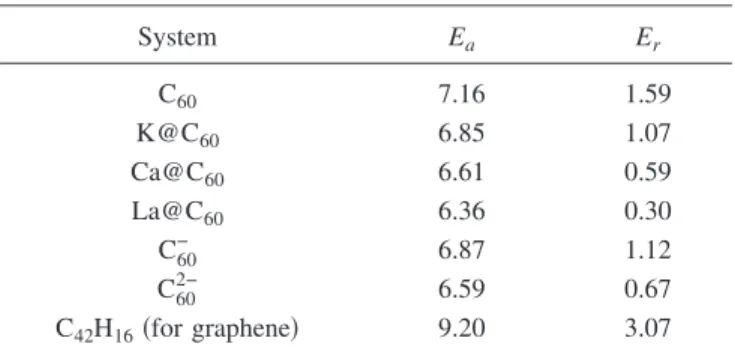
Table I lists the computed activation barriers共Ea兲 of the SW transformations in various fullerenes and a graphene sheet. The activation barrier in the SW transformation of the fullerene 共7.16 eV兲 is lower than that of the graphene sheet共9.2 eV, the highest among the systems we study兲. The barrier reduction in fullerenes is due to the curvature effect associated with the deviation from the sp2 bonding.6 When K, Ca, and La atoms are encapsulated inside the fullerene, the activation energy barriers are lowered by 0.30, 0.55, and 0.80 eV, respectively, compared with that of bare C60.
To determine the major effect of the encapsulated metal atom on the lowering of the activation barrier, we perform calculations for fullerenes charged with one or two electrons. The results for C603− are not presented because the third
elec-tron is found to be unbound. When a fullerene is charged, the activation barrier becomes lower than that of the neutral cage, similar to the endohedral metallofullerenes. The barrier reduction is approximately proportional to the number of do-nated electrons. Eain the SW transformation of C60− 共C602−兲 is almost identical to that of K@C60共Ca@C60兲. Therefore, one can conclude that the electron donation of the incorporated metal atom lowers the barrier and that the chemical bonding between the metal atom and C60is less important.
The reaction energy 共Er= Eproduct− Ereactant兲 shows the same trend as Eain Table I. The C2v-symmetry C60with two pairs of adjacent pentagons obtained by the SW transforma-tion is 1.59 eV higher in energy than C60 with the
Ih-symmetry. This value is in good agreement with other re-sults found in the literature.24By contrast, for La@C
60, Eris 0.3 eV, which is much smaller than that of C60共1.59 eV兲. It implies that an isomer of the metallofullerene which has ad-jacent pentagons can exist with higher probability compared to empty C60. In the case of K@C60 which has an interme-diate value of Er, the K atom at the center of the cage does not move during the process of the SW transformation. By contrast, the La atom in the fullerene moves by 1.0 Å toward the paired pentagons during the dimer rotation. The displace-ment of the La atom induces a large elongation of the C60 cage compared with the empty C60 molecule. The geometry of an empty fullerene is governed by the isolated-pentagon rule共IPR兲,25,26which means that the structure is most stable when all pentagons are surrounded by five hexagons. The IPR-violating cages such as Sc2@C66and Sc3N@C68, how-ever, are stabilized by the electron transfer between the en-capsulated metal atoms and the carbon cage, which signifi-cantly decreases the strain energy caused by paired pentagons and thus stabilizes the fullerene.27,28Owing to the 108° bond angles of the pentagon, the apex atoms in the paired pentagon regions of the empty fullerene have a hy-bridization very close to sp3and exhibit a dangling-bondlike character.29 For metallofullerenes, on the other hand, the electron donation from the metal atom weakens the dangling-bondlike character and stabilizes the IPR-violating isomers.
To clarify the role of the encapsulated metal atom, we investigate the electronic structures of C60 and La@C60 in detail. The inspection of the projected density of states 共PDOS兲 onto the 6s and 5d orbitals of La for each reactant, FIG. 1. Schematic energy diagram and the atomic configuration
along the reaction coordinate in the Stone-Wales transformation of empty C60. 共a兲 Energy profile along the reaction coordinate. The
dots represent the energies of the replicas in the SW transformation in the NEB method.共b兲 Atomic rearrangement from the Ihisomer to
the C2visomer of the empty C60molecule. Here, the rotating carbon dimer is shown in black.
TABLE I. Activation barrier共Ea兲 and reaction energy 共Er兲 of the
SW transformation in various sp2-bonded carbon systems. All
en-ergy values are in eV.
System Ea Er C60 7.16 1.59 K@C60 6.85 1.07 Ca@C60 6.61 0.59 La@C60 6.36 0.30 C60− 6.87 1.12 C602− 6.59 0.67 C42H16共for graphene兲 9.20 3.07
BRIEF REPORTS PHYSICAL REVIEW B 73, 113406共2006兲
transition state, and product indicates that the 6s and 5d en-ergy levels of the La atom mainly lie above the Fermi level. It means that almost three electrons transfer from La to the fullerene in La@C60. In Fig. 2共a兲, the highest occupied mo-lecular orbital共HOMO兲 at −0.2 eV 共indicated by the arrow兲 corresponds to the dangling-bond-originated state as illus-trated in Fig. 2共b兲. This state is above the HOMO of C60共i.e., the fivefold degenerate states originating from the HOMO of empty C60which are split off now兲. The energy level which has the dangling bond character in La@C60 is at −0.7 eV 共HOMO−2兲 as shown in Fig. 2共c兲 by the arrow and the wave function in Fig. 2共d兲. Here one can observe three electrons coming from the La atom occupy the upper one and half levels which are the lowest unoccupied molecular orbital 共LUMO兲 and LUMO+1 levels in the transition state of C60. The overall shape of the two wave functions关Figs. 2共b兲 and 2共d兲兴 is similar except for small changes due to the perturba-tion of the La atom.
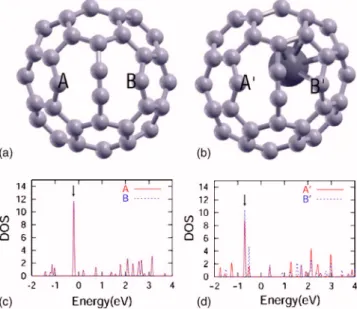
Figures 3共c兲 and 3共d兲 show the PDOS onto 2p orbitals of two carbon atoms关labeled as A, B and A
⬘
, B⬘
in Figs. 3共a兲 and 3共b兲兴 which have the dangling bonds in the transition state. In the case of empty C60, the PDOS of A and B are exactly same. For La@C60, on the other hand, the charge density of nonbonding states at site A⬘
共between −1 and 0 eV兲 is not identical to the density at site B⬘
. This difference arises from the hybridization between the La atom and the C atom at site B. In the TS configuration of empty C60, the HOMO and LUMO are both localized states within thehemisphere containing two dangling atoms while the HOMO and LUMO in the TS of La@C60 are delocalized on the whole cage. Consequently, the electron transfer and hybrid-ization between the fullerene and metal atom reduce the ac-tivation energy barrier of the SW transformation in the en-dohedral metallofullerene.
In summary, we have studied the effect of encapsulated metal atoms inside a C60 molecule on the activation energy barrier of the SW transformation. The metal atoms in our study are K, Ca, and La, which donate one, two, and three electrons to the C60 cage, respectively. We have found that isomerization of the endohedral metallofullerene by the SW transformation can occur more easily than that of the empty fullerene owing to the charge transfer. The reduction of the activation energy barrier by the electron transfer may also explain the fact that metallofullerenes are much easier to coalesce than empty fullerenes inside nanotubes.
We thank H. Shinohara for valuable discussions. This work is supported by the CNNC of Sungkyunkwan Univer-sity, the KRF Grant No. KRF-2005-070-C00041, the Sam-sung SDI-SNU Display Innovation Program, and the MOST through the NSTP Grant No. M1-0213-04-001. S. Han ac-knowledges support by the KRF共Grant No. KRF-2004-005-C00057兲. The computations were performed at the Super-computing Center of KISTI through the SuperSuper-computing Application Support Program using thePWSCFcode.30 FIG. 2. 共Color online兲 Density of states 共DOS兲 for C60 and
La@C60in the transition state 关共a兲 and 共c兲, respectively兴 and the isodensity surface plots of particular states for C60and La@C60关共b兲
and共d兲兴. The energy levels of the wave functions in 共b兲 and 共d兲 are indicated by arrows in 共a兲 and 共c兲, respectively. The isodensity value is 0.0014 e / Å3and the surface is color-coded according to
the sign of the wave functions.
FIG. 3. 共Color online兲 Atomic structures of the transition state configuration for共a兲 C60and共b兲 La@C60, and PDOS of two atoms 关labeled A, B and A⬘, B⬘ in 共a兲 and 共b兲, respectively兴 which have dangling bonds in the transition state, for共c兲 C60and共d兲 La@C60. The defect states due to the dangling bonds or distorted bonding configurations are indicated by arrows. The red solid and blue dot-ted lines are the PDOS onto 2p orbitals of A, A⬘and B, B⬘atoms, respectively.
BRIEF REPORTS PHYSICAL REVIEW B 73, 113406共2006兲
*Corresponding author. Electronic address: [email protected]
1H. W. Croat, J. R. Heath, S. C. O’Brien, R. F. Curl, and R. E.
Smalley, Nature共London兲 318, 162 共1985兲.
2A. J. Stone and D. J. Wales, Chem. Phys. Lett. 128, 501共1986兲. 3F. Diederich, R. Ettl, Y. Rubin, R. L. Whetten, R. Beck, M.
Al-varez, S. Anz, D. Sensharma, F. Wudl, K. C. Khemani, and A. Koch, Science 252, 548共1991兲.
4S. Han, M. Yoon, S. Berber, N. Park, E. Osawa, J. Ihm, and D.
Tomanek, Phys. Rev. B 70, 113402共2004兲.
5Y. Zhao, B. I. Yakobson, and R. E. Smalley, Phys. Rev. Lett. 88,
185501共2002兲.
6M. Yoon, S. Han, G. Kim, S. Lee, S. Berber, E. Osawa, J. Ihm,
M. Terrones, F. Banhart, J.-C. Charlier, N. Grobert, H. Terrones, P. M. Ajayan, and D. Tománek, Phys. Rev. Lett. 92, 075504 共2004兲.
7H. F. Bettinger, B. I. Yakobson, and G. E. Scuseria, J. Am. Chem.
Soc. 125, 5572共2003兲.
8B. W. Smith and D. E. Luzzi, Chem. Phys. Lett. 321, 169共2000兲. 9S. Bandow, M. Takizawa, K. Hirahara, M. Yudasaka, and S.
Iijima, Chem. Phys. Lett. 337, 48共2001兲.
10B. R. Eggen, M. I. Heggie, G. Jungnickel, C. D. Latham, R.
Jones, and P. R. Briddon, Science 272, 87共1996兲.
11Z. Slanina, X. Zhao, F. Uhlik, M. Ozawa, and E. Osawa, J.
Or-ganomet. Chem. 599, 57共2000兲.
12T. Okazaki, K. Suenaga, K. Hirahara, S. Bandow, S. Iijima, and
H. Shinohara, J. Am. Chem. Soc. 123, 9673共2001兲.
13H. Shinohara共private communication兲.
14J. Ihm, A. Zunger, and M. L. Cohen, J. Phys. C 12, 4409共1979兲. 15D. Vanderbilt, Phys. Rev. B 41, R7892共1990兲.
16K. Laasonen, W. Andreoni, and M. Parrinello, Science 258, 1916
共1992兲.
17Y.-G. Yoon, M. S. C. Mazzoni, and S. G. Louie, Appl. Phys. Lett.
83, 5217共2003兲.
18L. S. Wang, J. M. Alford, Y. Chai, M. Diener, J. Zhang, S. M.
McClure, T. Guo, G. E. Scuseria, and R. E. Smalley, Chem. Phys. Lett. 207, 354共1993兲.
19G. Henkelman and H. Jonsson, J. Chem. Phys. 113, 9978共2000兲. 20G. Henkelman, B. P. Uberuaga, and H. Jonsson, J. Chem. Phys.
113, 9901共2000兲.
21S. Han, J. Korean Phys. Soc. 44, 889共2004兲.
22Jing Lu, Xinwei Zhang, and Xiangeng Zhao, Chem. Phys. Lett.
332, 51共2000兲.
23Y. Kumeda and D. J. Wales, Chem. Phys. Lett. 374, 125共2003兲. 24B. R. Eggen, C. D. Lantham, M. I. Heggie, B. Jones, and P. R.
Briddon, Synth. Met. 77, 165共1996兲.
25H. Kroto, Nature共London兲 329, 529 共1987兲.
26T. G. Schmalz, W. A. Seitz, D. J. Klein, and G. E. Hite, J. Am.
Chem. Soc. 110, 1113共1988兲.
27C. R. Wang, T. Kai, T. Tomiyama, T. Yoshida, Y. Kobayashi, E.
Nishibori, M. Takata, M. Sakata, and H. Shinohara, Nature 共London兲 408, 426 共2000兲.
28S. Stevenso, P. W. Fowler, T. Heine, J. C. Duchamp, G. Rice, T.
Glass, K. Harich, E. Hajdu, R. Bible, and H. C. Dorn, Nature 共London兲 408, 427 共2000兲.
29E. Kaxiras, in Atomic and Electronic Structure of Solids
共Cam-bridge University Press, Cam共Cam-bridge, 2003兲.
30S. Baroni, A. Dal Corso, S. de Gironcoli, and P. Giannozzi, http://
www.pwscf.org
BRIEF REPORTS PHYSICAL REVIEW B 73, 113406共2006兲