Development of the Peer Review Protocol for Steam Generator Tubing Inspection
Chan Hee Cho, Min Woo Nam, Jee Hong Jung, Hong Deok Kim, and Han Sup ChungKEPRI, Nuclear Power Lab., 103-16 Munji-Dong, Yuseong-Gu, Daejeon 305-380, [email protected] 1. Introduction
Steam generator tubes have an important safety role because they constitute one of the primary barriers between the radioactive and non-radioactive sides of the nuclear power plant. For this reason, the integrity of the tubing is essential in minimizing the leakage of water between the two sides of the nuclear power plant. The eddy current test is used to inspect steam generator tubing during the outage. Because not only the eddy current method includes the large number of known or unknown variables that appear in the output indication but also a single missed or incorrectly classified defect indication in eddy current data of steam generator tubing can lead to a plant shutdown or a tube rupture event, the analyst’s performance should be thoroughly demonstrated and the eddy current technique and data should be completely reviewed. The Korea Electric Power Research Institute (KEPRI) developed the peer review protocol for steam generator tubing inspection in order to increase the reliability of the inspection results.
2. Peer Review
The qualification of the inspection technique, the resolution of the inspection issue and the precise review of unusual or controversial eddy current signals are included in the peer review processes. The peer review team consists of QDAPR (Qualified Data Analyst Peer Review) and SIPR (Structural Integrity Peer Review). The personnel participating in QDAPR should be qualified ECT LevelⅡA-QDA, and the personnel participating in SIPR should have the knowledge and expertise for materials and/or structural analysis engineering. The peer review coordinator should be qualified ECT LevelⅢ-QDA.
2.1 Qualification of the Inspection Technique
The peer review team should consist of the QDAPR team of at least five qualified data analysts (QDA) and SIPR team of at least two materials and/or structural analysis engineers and the peer review coordinator. The documents to be qualified should be written in the form of EPRI (Electric Power Research Institute) ETSS (Examination Technique Specification Sheet). The QDAPR team should review the document in accordance with the Steam Generator Management Program Guidelines in Korea [1] and EPRI Pressurized Water Reactor Steam Generator Examination Guidelines, Appendix H, latest revision [2]. The
members of QDAPR team should review and judge at minimum the following:
1) Review and judgment of acquisition data 2) Review and judgment of analyzed data 3) Review and judgment of essential variables 4) Review and judgment of POD (Probability Of
Detection) acceptability
5) Review and judgment of inspection technique The SIPR team should review the acceptability of laboratory crack used in the technique, destructive examination processes and the statistical model used in constructing the POD model.
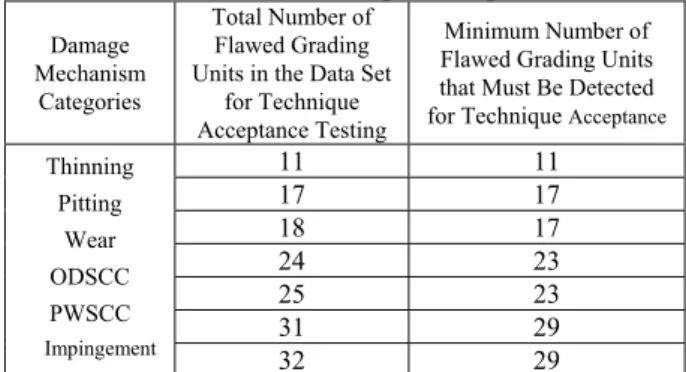
The proposed techniques can be qualified for detection if they demonstrate a POD of 0.80 or greater at a 90% lower bound CL (confidence level), using a data set of eleven or more flawed grading units. A flawed grading unit is defined, for this qualification, as a flaw that is either equal to or greater than 60% through wall, or equal to or greater than 0.7 inch (17.8mm) in axial length, or equal to or greater than 100° in circumferential length. Table 1 provides the minimum number of detections required to meet this acceptance criterion for data sets consisting of 11 to 32 flawed grading units and the damage mechanism categories.
Table 1. Minimum Number of Flawed Grading Units that Meet the Technique Acceptance Criterion
Damage Mechanism
Categories
Total Number of Flawed Grading Units in the Data Set
for Technique Acceptance Testing
Minimum Number of Flawed Grading Units that Must Be Detected for Technique Acceptance
11 11 17 17 18 17 24 23 25 23 31 29 Thinning Pitting Wear ODSCC PWSCC Impingement 32 29
To meet the criterion of a POD 0.80 or greater at 90% CL, for example, in data sets numbering from 11 to 17 flawed grading units, the technique must detect every flawed grading units. In data sets numbering from 18 to 24, the technique must detect all but one, and from 25 to 31, all but two. In constructing these results, calculations from the binomial distribution determined the minimum number of successes, x, required in examining a flaw data set of size n to ensure, at a CL of 90%, that the actual POD is 0.80 or greater. The binomial distribution provides the probability of each possible outcome over a specified number of trials when only two outcomes are possible on each trial-Transactions of the Korean Nuclear Society Autumn Meeting
success or failure-and the likelihood of a success or failure is known or assumed. The probability of exactly x successes in n trials, when the probability of success on each trial is p, is calculated as follows:
x n x
p
p
x
n
x
n
p
n
x
P
−
−−
=
(
1
)
)!
(
!
!
)
,
(
(1)Technique performance for sizing is based on a standard error of regression at a 90/50 confidence interval and correlation coefficient r of the eddy current measured parameters. Standard error of regression is defined by the following equation:
∑
−∑
−∑
∑
−∑ ∑
−∑
− = ] ) ( )] )( ( [ ) ( ][ ) 2 ( 1 [ 2 2 2 2 2 x x n y x xy n y y n n n σ (2)Correlation coefficient is defined by the following equation:
∑
−∑
∑
∑ ∑
∑
−∑
− = ] ) ( ][ ) ( [n x2 x 2 n y2 y 2 y x xy n r (3)Where x is the NDE (Non-Destructive Examination) estimate, y is the structural variables (metallurgical values) and n is the number of values in the data set.
Noise of eddy current data (NoiseET) in the area of
interest should be measured and recorded on the examination technique specification sheet. The areas of interest are three measurement increments above and below the flaw. These values are averaged for each flaw location. The measurements are performed as follows:
1) For rotating coils, the vertical NoiseET and
horizontal NoiseET (excluding flaw signals) for
0.3 inch axial measurement window and 0.3 inch increment.
2) For bobbin or array coils, the vertical NoiseET
and horizontal NoiseET (excluding flaw
signals) for 0.6 inch axial measurement window with a 0.6 inch increment.
The preferred method for calculating eddy current noise measurements requires that a baseline be established. The noise value is determined by the following equation: 2 2 y x T
N
N
N
=
+
(4)n
Y
Y
N
n i i y∑
=−
=
1 2)
(
withn
Y
Y
n i i∑
==
1 (5)n
X
X
N
n i i x∑
=−
=
1 2)
(
withn
X
X
n i i∑
==
1 (6) Where NT is the total NoiseET, Ny is the vertical NoiseET,and Nx is the horizontal NoiseET. In this case,
Y
andX
are the established baseline values within the measurement window and n is the number of data points within the measurement window.
2.2 Resolution of the Inspection Issue
The issue resolution team should consist of a minimum of five experts from the pool of peer review members. The chairperson of the peer review group should nominate the principal reviewer of the issue resolution members. The participants for the resolution of the issue in the steam generator tubing inspection should perform the analysis and discussion on the proposed issue in accordance with the peer review protocol. The principal reviewer is responsible for notification of the results to the peer review chairperson. 2.3 Review of the Eddy Current Signal
Many eddy current signals which are unusual or controversial may be encountered during the steam generator tubing inspection. To clarify the ambiguity of these signals, they have to be reviewed by the experienced analysts. The participants for this peer review should be qualified ECT LevelⅡA-QDA and have at least 5 years of experience in the analysis of eddy current data for steam generator tubes. The peer review process in this area is an independent review performed by QDA expert.
3. Conclusion
The Korea Electric Power Research Institute developed the peer review protocol for the steam generator tubing inspection. The peer review processes include the qualification of the inspection technique, the resolution of the inspection issues and the precise review of unusual or controversial eddy current signals. The results of the peer review can consider feedback to the steam generator management program and application to the degradation assessment. Implementation of this peer review program is expected to increase the reliability of inspection results.
REFERENCES
[1] Korea Hydro and Nuclear Power Co., Steam Generator Management Program, 2005.
[2] Electric Power Research Institute, Pressurized Water Reactor Steam Generator Examination Guidelines: Revision 6, Appendix G, 2002.