DOI 10.17480/psk.2016.60.3.135
2',4'-Dimethoxychalcone 유도체 합성 및 비소폐암세포주에서 항암 활성평가
최명아 · 정주희 · 오용진 · 이영숙 · 서영호#
계명대학교 약학대학
(Received April 15, 2016; Revised May 7, 2016; Accepted May 10, 2016)
Synthesis of 2',4'-Dimethoxychalcone Derivatives and Evaluation of Their
Antitumor Activities Against Non-small Cell Lung Cancer
Myeong A Choi, Ju Hui Jeong, Yong Jin Oh, Young Sook Lee and Young Ho Seo#
College of Pharmacy, Keimyung University, Daegu 42601, Korea
Abstract — Heat shock protein 90 (Hsp90) is a ubiquitous molecular chaperone, which is associated with stabilization of many oncogenic proteins for cancer cell survival. Hsp90 is overexpressed 2-10 fold higher in cancer cells than normal cells. Due to its potential to simultaneously disable multiple signaling pathway, Hsp90 has been identified as a validated target for cancer therapy. Accordingly, we designed and synthesized 2',4'-dimethoxychalcone derivatives to inhibit Hsp90 chaperone function. Among 2',4'-dimethoxychalcone derivatives, we found that compound 1g disrupted Hsp90 chaperoning function and impaired the growth of cancer cells. These findings indicated that 1g could serve a potential lead compound to target Hsp90 in cancer chemotherapy.
Keywords□ chalcone, Hsp90, cancer, flavokawain B, small molecule
Heat shock protein 90(Hsp90)는 ATP 의존성 분자 샤페론 단 백질로서 세포 주기, 전사 인자 조절 및 신호전달 매개체에 핵심 역할을 하는 단백질들의 접힘과 안정화에 관여한다.1-3) Hsp90가 관여하는 단백질들을 ‘client 단백질’이라 부르며, 대표적으로 epidermal growth factor receptor(EGFR), human epidermal growth factor receptor 2(Her2), cyclin-dependent kinase 4(Cdk4), mesenchymal-epithelial transition(Met), mutant p53, hypoxia-inducible factor-1α(HIF-1α) 등이 포함되어 있다.4) Hsp90의 client 단백질들은 대부분 발암 단백질로 알려져 있으 며 정상세포를 암세포로 변화시키는 신호전달경로에 필요한 단 백질이다.5)따라서 Hsp90 저해는 여러 client 단백질들의 잘못 된 접힘을 야기시켜 프로테아좀에 의해 분해되고, 다양한 암 발 생 신호전달경로를 동시에 차단하여 암세포의 사멸을 유도할 수 있는 장점을 제공한다.6-8) Hsp90는 암세포가 지닌 저산소증, 산 성화, 영양분 부족과 같은 열악한 세포 내 환경에서 Hsp90의 샤 페론 기능에 대한 의존도가 높아 정상세포에 비해 암세포에서 2~10배 정도 과발현 되어있음이 보고되어 있으며,9-11)이는 암 세포에서 Hsp90의 선택적인 저해가 가능함을 나타낸다.앞서 언 급된 여러 장점들로 인해 Hsp90는 항암치료를 위한 표적으로 많 은 연구가 진행되고 있다.12)또한 항암치료에 있어 약물에 대한 내성을 지니거나,13)예후가 좋지 않은 암에서 Hsp90가 과발현 되어있다는 연구가 보고되면서14,15) Hsp90를 표적으로 하는 항 암제 개발 및 연구가 활발히 이루어지고 있다. Hsp90 저해제는 천연물질인 geldanamycin(GA)의 개발로부터 시작되었으며, GA는 천연 항생물질로서 1994년 Hsp90 저해를 통해 client 단백질인 Src의 분해를 유도함이 밝혀졌다.16,17) GA 는 강력한 항암 효과를 나타내고 있음에도 불구하고 간 독성, 용 해도, 안정성의 문제를 지니고 있다. 이를 보완하기 위해 GA 유 도체들이 개발되었지만 구조적 특성으로 인해 문제점이 해결되 지 않았다. 이 후 radicicol, purine, resorcinol, benzamide 등의 구조를 포함한 저해제들이 연구되고 있지만 아직까지 FDA 승인 을 받은 약물은 개발되지 않고 있다.18,19)
본 연구팀은 선행연구를 통해 Hsp90 저해제로서 flavokawain #Corresponding Author
Young Ho Seo
College of Pharmacy, Keimyung University, Deagu 42601, Korea Tel.: 053-580-6639 Fax.: 053-580-5164
E-mail: [email protected]
종설
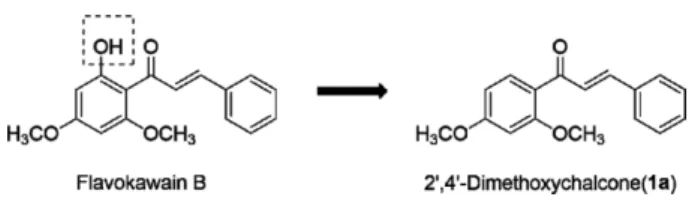
Short ReportB와 유도체들의 효능을 밝혔으며20) 2',4'-dimethoxychalcone(1a) 화합물 역시 Hsp90 저해 효능이 있음을 확인하였다.21)따라서 본 연구에서는 Hsp90 저해제 개발을 위해 2',4'-dimethoxychalcone 구조의 유도체들을 설계한 뒤 합성한 후 유도체들의 활성을 측 정하였다(Fig. 1).
실험 방법
시약 및 분석기기 본 실험에서 사용한 시약과 기기는 다음과 같다. 시약은 Aldrich, Acros, Junsei 그리고 삼전화학 등의 제품을 그대로 사용하거나 필요한 경우 합성하여 사용하였다. 합성 후 화합물의 정제를 위 해 MPLC(Biotage SNAP HP-Sil column)를 이용하였으며, 1 H-NMR 및 13C-NMR 스펙트럼은 Bruker Spectrospin 400 분광계 를 사용하였다. 용매로는 CDCl3를 이용하였고, 화학적 이동값(δ) 은 ppm으로 나타내었으며 피크는 s(singlet), d(doublet), m (multiplet), dd(doublet of doublet)으로 표시하였다.1-(2,4-Dimethoxyphenyl)ethanone(3)
2,4-Dihydroxyacetophenone(10.0 g, 65.7 mmol)을 Me2CO에 녹인 뒤, dimethyl sulfate(12.8 ml, 134.7 mmol)와 potassium carbonate(20.0 g, 65.7 mmol)을 넣고 65oC에서 12시간 동안 환 류 시켰다. 혼합물을 여과시킨 뒤 여과된 용매를 감압 증류하여 제거한 뒤, ethyl acetate에 녹인다. 유기층을 sodium bicar-bonate 포화수용액으로 씻어주고 sodium sulfate로 건조한 뒤, 용매를 감압 증류하여 제거한 뒤 화합물 3을 얻었다. Yield 98%. 1H NMR(400 MHz, CDCl 3) δ 7.67(d, J=8.8 Hz, 1H), 6.36 (dd, J= 8.8 Hz, 2.4 Hz, 1H), 6.30(d, J=1.2 Hz, 1H), 3.73(s, 3H), 3.69(s, 3H), 2.42(s, 3H). 13C NMR(100 MHz, CDCl3) δ 196.9, 164.2, 160.7, 132.1, 120.5, 104.8, 97.7, 55.1, 55.0, 31.4. Aldol condensation 방법 화합물 3(1 당량)을 MeOH(10 ml)에 녹인 뒤, 각각의 benzaldehyde(1.1 당량)와 potassium hydroxide(0.5 g)를 넣고 상 온에서 18시간 동안 교반 시킨다. 혼합물을 ethyl acetate에 녹 여, 1N HCl 포화수용액으로 씻어준다. 유기층을 sodium sulfate 로 건조한 뒤 용매를 감압 증류하여 제거하고, MPLC를 이용하 여 분리 정제하여 화합물 1a-j를 얻었다. (E)-1-(2,4-Dimethoxyphenyl)-3-phenylprop-2-en-1-one (1a)− Yield 78%. 1H NMR(400 MHz, CDCl3) δ 7.76(d, J=8.8 Hz, 1H), 7.68(d, J=15.6 Hz, 1H), 7.58(dd, J=7.6 Hz, 2.4 Hz, 1H), 7.52(d, J=16.0 Hz, 1H), 7.40~7.26(m, 3H), 6.55(dd, J= 8.8 Hz, 2.4 Hz, 1H), 6.48(d, J=2.4 Hz, 1H), 3.88(s, 3H), 3.84 (s, 3H), 13C NMR(100 MHz, CDCl3) δ 190.9, 164.7, 160.9, 142.4, 135.9, 133.4, 130.4, 129.3, 128.9, 128.8, 127.7, 127.3, 122.6, 105.8, 99.1, 56.2, 56.0. (E)-1-(2,4-Dimethoxyphenyl)-3-(4-methoxyphenyl)prop-2-en-1-one(1b)− Yield 42%. 1H NMR(400 MHz, CDCl3) δ 7.71 (d, J=8.8 Hz, 1H), 7.63(d, J=15.6 Hz, 1H), 7.51(d, J=8.8 Hz, 2H), 7.37(d, J=15.6 Hz, 1H), 6.87(d, J=8.4 Hz, 2H), 6.52(dd, J=8.6 Hz, 2.0 Hz, 1H), 6.46(d, J=2.0 Hz, 1H), 3.85(s, 3H), 3.81(s, 3H), 3.78(s, 3H). 13C NMR(100 MHz, CDCl3) δ 190.8, 164.2, 161.5, 142.3, 132.9, 130.2, 128.3, 125.2, 122.6, 114.5, 105.4, 98.8, 55.9, 55.7, 55.5. (E)-1-(2,4-Dimethoxyphenyl)-3-(3,4-dimethoxyphenyl) prop-2-en-1-one(1c)− Yield 50%. 1H NMR(400 MHz, CDCl3) δ 7.70(d, J=8.4 Hz, 1H), 7.59(d, J=15.6 Hz, 1H), 7.34(d, J= 15.6 Hz, 1H), 7.15(dd, J=8.2 Hz, 2.0 Hz, 1H), 7.09(d, J=2.0 Hz, 1H), 6.84(d, J=8.4 Hz, 1H), 6.53(dd, J=8.6 Hz, 2.0 Hz, 1H), 6.47(d, J=2.0 Hz, 1H), 3.89(s, 3H), 3.88(s, 3H), 3.86(s, 3H). 13C NMR(100 MHz, CDCl3) δ 190.7, 164.0, 160.2, 150.9, 142.4, 132.7, 128.4, 125.3, 122.6, 122.3, 111.1, 110.2, 105.1, 98.7, 56.0, 55.9, 55.7, 55.5. (E)-3-(Benzo[d][1,3]dioxol-5-yl)-1-(2,4-dimethoxyphenyl) prop-2-en-1-one(1d)− Yield 38%. 1H NMR(400 MHz, CDCl3) δ 7.70(d, J=8.4 Hz, 1H), 7.59(d, J=15.6 Hz, 1H), 7.34(d, J= 15.6 Hz, 1H), 7.15(dd, J=8.2 Hz, 2.0 Hz, 1H), 7.09(d, J=2.0 Hz, 1H), 6.84(d, J=8.4 Hz, 1H), 6.53(dd, J=8.6 Hz, 2.0 Hz, 1H), 6.47(d, J=2.0 Hz, 1H), 3.89(s, 3H), 3.88(s, 3H), 3.86(s, 3H). 13C NMR(100 MHz, CDCl3) δ 190.7, 164.0, 160.2, 150.9, 142.4, 132.7, 128.4, 125.3, 122.6, 122.3, 111.1, 110.2, 105.1, 98.7, 56.0, 55.9, 55.7, 55.5. (E)-1-(2,4-Dimethoxyphenyl)-3-(3,4,5-trimethoxyphenyl) prop-2-en-1-one(1e)− Yield 40%. 1H NMR(400 MHz, CDCl3) δ 7.71(dd, J=8.6 Hz, 1.6 Hz, 1H), 7.55(d, J=15.6 Hz, 1H), 7.36(dd, J=15.8 Hz, 1.6 Hz, 1H), 6.80(s, 2H), 6.54(dd, J=8.4 Hz, 2.0 Hz, 1H), 6.48(d, J=1.6 Hz, 1H), 3.87~3.84(m, 15H) 13C NMR(100 MHz, CDCl 3) δ 190.3, 163.9, 160.1, 153.2, 142.1, 139.6, 132.5, 130.8, 126.4, 122.0, 105.2, 104.9, 98.5, 60.8, 55.9, 55.5, 55.4.
(E)-3-(2-Chloro-3,4,5-trimethoxyphenyl)-1-(2,4-dimeth-oxyphenyl)prop-2-en-1-one(1f)− Yield 60%. 1H NMR(400 MHz, CDCl3) δ 7.96(d, J=15.6 Hz, 1H), 7.71(d, J=8.4 Hz, 1H), 7.34(d, J=16.0 Hz, 1H), 6.97(s, 1H), 6.53(dd, J=8.8 Hz, 2.0 Hz, 1H), 6.46(d, J=2.0 Hz, 1H), 3.87~3.83(m, 15H) 13C NMR(100 MHz, CDCl3) δ 190.3, 164.2, 160.2, 152.0, 144.7, 138.0, 132.8, 129.0, 128.9, 122.2, 121.8, 105.6, 105.2, 98.5, 61.2, 61.0, 56.1, 55.6, 55.5. (E)-3-(2-Bromo-3,4,5-trimethoxyphenyl)-1-(2,4-dimeth-oxyphenyl)prop-2-en-1-one(1g)− Yield 46%. 1H NMR(400 MHz, CDCl3) δ 7.95(d, J=16.0 Hz, 1H), 7.72(d, J=8.4 Hz, 1H), 7.30(dd, J=15.6 Hz, 1H), 7.02(s, 1H), 6.54(d, J=8.8 Hz, 1H), 6.48 (s, 1H), 3.91~3.86(m, 15H) 13C NMR(100 MHz, CDCl3) δ 190.8, 164.7, 160.7, 153.1, 151.5, 145.0, 141.2, 133.3, 131.3, 129.6, 122.2, 1136, 106.6, 105.7, 99.0, 61.7, 61.4, 56.6, 56.1, 56.0. (E)-1-(2,4-Dimethoxyphenyl)-3-(naphthalen-1-yl)prop-2-en-1-one(1h)− Yield 82%. 1H NMR(400 MHz, CDCl3) δ 8.55 (d, J=15.6 Hz, 1H), 8.28(d, J=8.4 Hz, 1H), 7.89~7.83(m, 4H), 7.63(d, J=12.4 Hz, 1H), 7.57~7.46(m, 3H), 6.57(dd, J= 8.0 Hz, 2.4 Hz, 1H), 6.49(d, J=2.0 Hz, 1H), 3.87(s, 3H), 3.83 (s, 3H). 13C NMR(100 MHz, CDCl3) δ 190.0, 164.1, 160.3, 138.4, 133.4, 132.8, 132.6, 131.5, 129.9, 129.5, 128.4, 126.4, 125.9, 125.2, 124.7, 123.4, 121.7, 105.1, 98.2, 55.4, 55.2. (E)-1-(2,4-Dimethoxyphenyl)-3-(naphthalen-2-yl)prop-2-en-1-one(1i)− Yield 55%. 1H NMR(400 MHz, CDCl3) δ 7.98 (s, 1H), 7.88~7.84(m, 2H), 7.83(d, J=2.4 Hz, 1H), 7.79(d, J= 8.4 Hz, 1H), 7.75(dd, J=8.6 Hz, 1.6 Hz, 1H), 7.62(d, J=1.6 Hz, 1H), 7.52~7.49(m, 2H), 6.58(dd, J=8.6 Hz, 2.0 Hz, 1H), 6.53(d, J=2.4 Hz, 1H), 3.93(s, 3H), 3.88(s, 3H) 13C NMR(100 MHz, CDCl3) δ 190.5, 164.2, 160.4, 142.1, 134.1, 133.4, 133.0, 128.5, 127.7, 127.3, 127.0, 126.6, 123.8, 122.3, 105.2, 98.7, 55.8, 55.5. (E)-1-(2,4-Dimethoxyphenyl)-3-(4-methoxynaphthalen-1-yl)prop-2-en-1-one(1j)− Yield 26%. 1H NMR(400 MHz, CDCl3) δ 8.47(d, J=15.6 Hz, 1H), 8.31(d, J=8.4 Hz, 1H), 8.24 (d, J=8.4 Hz, 1H), 7.84~7.95(m, 2H), 7.59~7.56(m, 1H), 7.54~7.49(m, 2H), 6.85(d, J=8.4 Hz, 1H), 6.58(dd, J=8.8 Hz, 2.4 Hz, 1H), 6.51(d, J=2.4 Hz, 1H), 4.03(s, 3H), 3.90(s, 3H), 3.87(s, 3H) 13C NMR(100 MHz, CDCl3) δ 190.6, 164.0, 160.3, 157.2, 139.1, 132.9, 132.8, 127.4, 127.3, 126.0, 125.6, 125.5, 125.1, 123.4, 122.6, 122.5, 105.1, 103.8, 98.6, 55.7, 55.6, 55.5. 세포배양
Gefitinib에 대한 내성을 지닌 H1975(non-small cell lung
cancer) 세포주를 10% fetal bovine serum(FBS), streptomycin (500 mg/ml)과 penicillin(100 units/ml)을 첨가한 RPMI 1640 배 지를 사용하여 5% CO2와 37oC 조건하에 배양하였다.
MTS assay
H1975(1.5×10³ cells)를 RPMI 1640 배지로 희석하여 96 well plate에 분주한 뒤, 14시간 동안 배양하였다. 14시간 후 각 농도에 해당하는 화합물을 배지에 넣어 24, 48, 72시간 동안 배 양한 뒤, MTS(Promega Cell Titer 96 Aqueous One Solution)를 20μl씩 넣는다. 37oC에서 1시간 동안 반응시킨 뒤, 490 nm의 파 장으로 흡광도를 측정하였다.
Western blot
H1975(5×10⁵ cells)를 24시간 동안 배양하여 각 화합물(20 μM) 을 24시간 동안 처리하였다. Lysis buffer(RIPA buffer, phenyl-methane sulfonyl fluoride, HaltTM protease& phosphatase)을 이용하여 30분 동안 용해시킨 다음 상등액을 회수하여 처리한 세포들의 단백질을 얻었다. BCA assay kit(Waltham, MA)로 단 백질정량을 한 뒤, SDS-polyacrylamide gel electrophoresis (SDS-PAGE)를 실시하였다. 분리된 단백질을 immunoblot PVDF Membrane을 사용하여 100 V로 75분 동안 이동시킨 뒤, blocking solution(5% skim milk) 용액으로 2시간 동안 blocking하였다. Hsp90 기능저해를 통한 client 단백질발현을 알아보기 위해 EGFR, Her2, Met, Akt, Hsp90 기능저해의 cellular marker인 Hsp70 그리고 loading control인 β-actin을 사용하여 4oC에서 12시 간 동안 반응시켰다. TBS-T 용액으로 3~4회 씻어준 다음 2차 항 체를 상온에서 2시간 반응시킨 후 TBS-T 용액으로 씻어주었다. ECL Select Western Blotting Detection Reagent(Pittsburgh, PA)를 이용하여 단백질 발현을 확인하였다. 이미지는 LAS-4000 (Fuji, Japan, Tokyo)을 이용하여 측정하였다.
결과 및 고찰
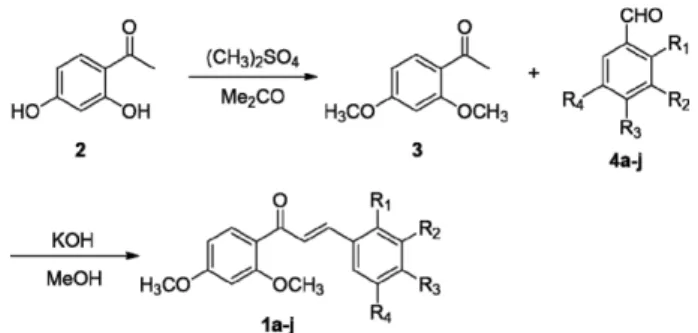
2',4'-Dimethoxychalcone(1a)와 그 유도체들(1b-j)은 2',4'-dihy-droxyacetophenone(2)을 출발물질로 하여 2단계의 반응을 통해 합성하였다(Scheme 1). 출발물질의 알코올기를 염기조건하에 dimethyl sulfate를 사용하여 메틸화시켜 98%의 수율로 화합물 3을 합성하였다. 합성된 화합물 3과 10 종류의 benzaldehyde(4a-j)를 염기조건하에 각각 aldol condensation을 진행하였다. 반응 용매로는 메탄올을 사용하였으며, 반응물에 따라 실온에서 교반 시키거나 65oC에서 환류시켰다. 화합물들을 ethyl acetate과 hexane 혼합 용매를 사용하여 MPLC로 정제하였으며, 26~82% 의 수율로 최종 화합물 1a-j를 얻었다. 10가지 화합물 1a-j를 H1975에 처리하였을 때 세포증식 억제효과를 확인하기 위해 MTS assay를 수행하였다. 화합물 1a-j를 72시간 동안 30 μM 농도로 처리하여 세포증식 억제 효과를 확 인하였다. 실험결과 다른 화합물들에 비해 화합물 1e, 1f, 1g가 뛰어난 활성을 나타내었으며 30 μM에서 47%, 47%, 46%로 세 포 증식을 억제하였다(Table I). 농도, 시간에 따른 보다 정밀한 세포증식 억제효과를 확인하 기 위해서 화합물(1a-j)을 10, 30, 60, 90 μM의 농도로 24, 48, 72시간 동안 처리하여 활성을 측정하였다. 실험결과 농도, 시 간 의존적으로 세포증식억제 효과를 나타내 었으며, 화합물 1e, 1f, 1g가 효과적으로 세포성장을 저해함을 확인할 수 있었다 (Fig. 2). 화합물에 의한 세포증식 억제가 Hsp90 기능 저해를 통한 조 절인지 확인해 보기 위해 화합물(1a-j)을 20 μM에서 Hsp90 client 단백질의 분해 유도효과를 확인하였다(Fig. 3). MTS 결과 와 일관성 있게 화합물 1e, 1f, 1g가 EGFR, Her2, Met, Akt와 같은 Hsp90 client 단백질의 분해를 유도하였으며, Hsp90 기능 저해를 통해 Hsp70 발현 유도함을 확인하였다. 화합물 1i의 경 우 세포증식저해에는 영향을 미치지 않았으나, 단백질 발현에서 EGFR, Her2, Met의 분해가 유도됨을 확인하였다. 이와 같은 결 과는 1e, 1f, 1g 화합물이 Hsp90 기능을 저해함으로써 client 단 백질이 분해되어 세포성장을 저해하는 것을 확인할 수 있다. 본 연구결과를 토대로 2',4'-dimethoxychalcone(1a)와 9가지 유도체 들 중에서 화합물 1g가 H1975 세포에서 가장 뛰어난 효능을 보 임을 확인할 수 있었다.
결
론
본 연구는 Hsp90 저해를 통해 항암효과를 나타내는 합성 신 약을 개발하기 위해 2',4'-dimethoxychalcone 유도체들을 설계한 뒤 합성하였다. 합성된 화합물은 MTS assay, western blot을 통 Scheme 1− Synthesis of 2',4'-dimethoxychalcone derivatives (1a-j).Table I− 2',4'-Dimethoxychalcone derivatives and their inhibition of H1975 cell proliferation R1 R2 R3 R4 % inhibitionb 1aa H H H H 40 1b H H OMe H 28 1c H OMe OMe H 40 1d H OCH2O H 31
1e H OMe OMe OMe 47
1f C1 OMe OMe OMe 47
1g Br OMe OMe OMe 46
1h CHCHCHCH H H 35
1i H CHCHCHCH H 32
1j CHCHCHCH OMe H 26
a2',4'-Dimethoxychalcone. bThe inhibitory effect of H1975 cell proliferation at 30μM.
Fig. 2− Effect of 2',4'-dimethoxychalcone (1a) and their derivatives (1b-j) on the proliferation of H1975 cells. H1975 cells were treated with the indicated compound (10, 30, 60, and 90μM) for 0, 1, 2, and 3 days, and cell viability was determined by MTS assay. Values are presented as means±SD (n=4).
해 세포 성장저해 효과 및 Hsp90 client 단백질 분해유도에 미 치는 영향을 확인하였다. 활성평가를 통해서 화합물 1g가 가장 효율적으로 세포성장을 저해하고 있음을 확인하였다. 또한 화합 물 1g는 EGFR, Her2, Met, Akt와 같은 Hsp90 client 단백질의 분해를 유도함을 확인할 수 있었다. 따라서 본 연구를 통해 화합 물 1g는 Hsp90 저해제로서 잠재적인 개발 가능성을 제시하며, 이러한 연구는 신약개발에 있어 중요한 자료가 될 것으로 생각된다.
감사의 말씀
이 논문은 한국연구재단의 지원을 받아 수행된 기초연구사업 (과제번호: NRF-2011-0023605, 과제번호: NRF-2013R1A1A2058644) 에 의해 수행되었으며, 이에 감사드립니다.References
1) Young, J. C. and Hartl, F. U. : Polypeptide release by Hsp90 involves ATP hydrolysis and is enhanced by the co-chaperone p23. EMBO J. 19, 5930 (2000).
2) Sun, J., Lin, C., Qin, X., Dong, X., Tu, Z., Tang, F., Chen, C. and Zhang, J. : Synthesis and biological evaluation of 6,5-disubstituted-4-alkynylisoxozales as a novel class of HSP90 inhibitors. Bioorg. Med. Chem. Lett. 25, 3129 (2015). 3) Raman, S., Singh, M., Tatu, U. and Suguna, K. : First structural
view of a peptide interacting with the nucleotide binding domain of heat shock protein 90. Sci. Rep. 5, 17015 (2015).
4) Mahalingam, D., Swords, R., Carew, J. S., Nawrocki, S. T., Bhalla, K. and Giles, F. J. : Targeting HSP90 for cancer therapy. Br. J. Cancer. 100, 1523 (2009).
5) Hanahan, D. and Weinberg, R. A. : The hallmarks of cancer cell. Cell. 100, 57 (2000).
6) Chen, D., Shen, A., Li, J., Shi, F., Chen, W., Ren, J., Liu, H., Xu, Y., Wang, X., Yang, X., Sun, Y., Yang, M., He, J., Wang, Y., Zhang, L., Huang, M., Geng, M., Xiong, B. and Shen, J. : Discovery of potent N-(isoxazol-5-yl)amides as Hsp90 inhibitors. Eur. J. Med. Chem. 87, 765 (2014).
7) Garcia-Carbonero, R., Carnero, A. and Paz-Ares, L. : Inhibition of HSP90 molecular chaperones: moving into the clinic. Lancet Oncol. 14, e358 (2013).
8) Soga, S., Akinaga, S. and Shiotsu, Y. : Hsp90 inhibitors as anti-cancer agents, from basic discoveries to clinical development. Curr. Pharm. Des. 19, 366 (2013).
9) Solit, D. B. and Chiosis, G. : Development and application of Hsp90 inhibitors. Drug Discov. Today 13, 38 (2008). 10) Chiosis, G. and Neckers, L. : Tumor selectivity of Hsp90
inhibitors: the explanation remains elusive. ACS Chem. Biol. 1, 279 (2006).
11) Whitesell, L. and Lindguist, S. L. : HSP90 and the chaperoning of cancer. Nat. Rev. Cancer. 5, 761 (2005).
12) Hong, D. S., Banerji, U., Tavana, B., George, G. C., Aaron, J. and Kurzrock R. : Targeting the molecular chaperone heat shock protein 90 (HSP90): lessons learned and future directions. Cancer Treat. Rev. 39, 375 (2013).
13) Nanbu, K., Konishi, I., Mandai, M., kuroda, H., Hamid, A. A., Komatsu, T. and Mori, T. : Prognostic significance of heat shock proteins HSP70 and HSP90 in endometrial carcinomas. Cancer Detect. Prev. 22, 549 (1998).
14) Uozaki, H., Ishida, T., Kakiuchi, C., Horiuchi, H., Gotoh, T., Iijima, T., Imamura, T. and Machinami, R. : Expression of heat shock proteins in osteosarcoma and its relationship to prognosis. Pathol. Res. Pract. 196, 665 (2000)
15) Moulick, K., Ahn, J. H., Zong, H., Rodina, A., Cerchietti, L., Gomes DaGama, E. M., Caldas-Lopes, E., Beebe, K., Perna, F., Hatzi, K., Vu, L. P., Zhao, X., Zatorska, D., Taldone, T., Smith-Jones, P., Alpqugh, M., Gross, S. S., Pillarsetty, N., Ku, T., Lewis, J. S., Larson, S. M., Levine, R., Erdjument-Bromage, H., Guzman, M. L., Nimer, S. D., Melnick, A., Necker, L. and Chiosis, G. : Affinity-based proteomics reveal cancer-specific network coordinated by Hsp90. Nat. Chem. Biol. 7, 818 (2011). 16) Neckers, L. and Workman, P. : Hsp90 molecular chaperone inhibitors: are we there yet?. Clin. Cancer Res. 18, 64 (2012). 17) Neckers, L. : Hsp90 inhibitors as novel cancer chemotherapeutic
agents. Trends Mol. Med. 8, S55 (2002).
18) Whitesell, L., Mimnaugh, E. G., De Costa, B., Myers, C. E. and Neckers, L. M. : Inhibition of heat shock protein HSP90-Fig. 3− Effect of 2',4'-dimethoxychalcone (1a) and their derivatives
(1b-j) on the expression of Hsp90 client proteins. Cells were treated with the indicated compound (20μM) for 24 h and the expression of Hsp90 client proteins (EGFR, Her2, Met, Akt) along with Hsp70, Hsp90, and β-actin were analyzed by western blotting. D (DMSO), GA (Geldanymycin, 1μM) were employed as negative control and positive control, respectively.
pp60v-src heteroprotein complex formation by benzoquinone ansamycins: essential role for stress protein in oncogenic transformation. Proc. Natl. Acad. Sci. U.S.A. 91, 8324 (1994). 19) Sidera, K. and Patsavoudi, E. : HSP90 inhibitors: current development and potential in cancer therapy. Recent Pat. Anticancer Drug Discov. 9, 1 (2014).
20) Seo, Y. H. and Park, S. Y : Synthesis of flavokawain analogues
and their anti-neoplastic effects on drug-resistant cancer cells through Hsp90 inhibition. Bull. Korean Chem. Soc. 35, 1154 (2014).
21) Seo, Y. H. : Discovery of 2',4'-dimethoxychalcone as a Hsp90 inhibitors and its effect on iressa-resistant non-small cell lung cancer (NSCLC). Arch. Pharm. Res. 38, 1783 (2015).