Antibacterial, Anti-Diarrhoeal, Analgesic, Cytotoxic Activities, and
GC-MS Profiling of Sonneratia apetala (Buch.-Ham.) Seed
Sheikh Julfikar Hossain1, M Rabiul Islam1, Tahmina Pervin1, M Iftekharuzzaman1, Omer A A Hamdi2, Sanzida Mubassara3, M Saifuzzaman4, and Jamil Ahmad Shilpi4
1
Biotechnology and Genetic Engineering Discipline and 4Pharmacy Discipline, Khulna University, Khulna 9208, Bangladesh
2Department of Chemistry, Faculty of Science and Technology, Al-Neelain University, Khartoum 12702, Sudan
3Department of Botany, Jahangirnagar University, Dhaka 1342, Bangladesh
pISSN 2287-1098ㆍeISSN 2287-8602
Received 18 May 2017; Accepted 2 August 2017; Published online 30 September 2017
Correspondence to Sheikh Julfikar Hossain, Tel: +88-41-725842, E-mail: [email protected]; [email protected] Copyright © 2017 by The Korean Society of Food Science and Nutrition. All rights Reserved.
This is an Open Access article distributed under the terms of the Creative Commons Attribution Non-Commercial License (http://creativecommons.org/licenses/by-nc/4.0) which permits unrestricted non-commercial use, distribution, and reproduction in any medium, provided the original work is properly cited.
ABSTRACT: Fruits of Sonneratia apetala (Buch.-Ham.), (English: mangrove apple, Bengali: keora) both seeds and pericarps, are largely consumed as food besides their enormous medicinal application. The fruit seeds have high content of nutri-ents and bioactive componnutri-ents. The seeds powder of S. apetala was successively fractionated using n-hexane, diethyl ether, chloroform, ethyl acetate, and methanol. The fractions were used to evaluate antibacterial, anti-diarrhoeal, analgesic, and cytotoxic activities. Methanol fraction of seeds (MeS) stronly inhibited Escherichia coli strains, Salmonella Paratyphi A, Salmo-nella Typhi, Shigella dysenteriae, and Staphylococcus aureus except Vibrio cholerae at 500 µg/disc. All the fractions strongly inhib-ited castor oil induced diarrhoeal episodes and onset time in mice at 500 mg extract/kg body weight (P<0.001). At the same concentration, MeS had the strongest inhibitory activity on diarrhoeal episodes, whereas the n-hexane fraction (HS) significantly (P<0.05) prolonged diarrhoeal onset time as compared to positive control. Similarly, HS (P<0.005) inhibited acetic acid induced writhing in mice at 500 mg extract/kg, more than any other fraction. HS and diethyl ether fractions of seed strongly increased reaction time of mice in hot plate test at 500 mg extract/kg. All the fractions showed strong cyto-toxic effects in brine shrimp lethality tests. Gas chromatography-mass spectrometry analysis of HS led to the identifica-tion of 23 compounds. Linoleic acid (29.9%), palmitic acid (23.2%), ascorbyl palmitate (21.2%), and stearic acid (10.5%) were the major compounds in HS. These results suggest that seeds of S. apetala could be of great use as nutraceuticals.
Keywords: analgesic, anti-diarrhoea, keora, mangrove apple, Sonneratia apetala
INTRODUCTION
Sonneratia apetala (Buch.-Ham.) is a true mangrove, be-longing to the family Lythraceae. It is called keora in Ben-gali and mangrove apple in English. It is a native plant abundantly grown in the world’s largest tidal halophytic forest, the Sundarbans’ along with coastal areas in Ban-gladesh, India, Myanmar, Thailand, Malaysia, Indonesia, Sri Lanka, and China, etc. The plants grow well on newly accreted soil in moderate to strong saline areas, and are considered as a pioneer species in ecological succession. Its fruits are berry-like, generally 1.5 to 2 cm in diameter, globose with persistent leathery calyx. Each fruit con-tains numerous seeds, even up to a hundred. Seeds are compactly arranged in 6 to 8 locules, yellowish, mostly U or V shaped, 0.88±0.07×0.65±0.09 cm in size, and 0.09 ±0.02 g in weight (1-3).
The whole fruit, both pericarp and seed, is extensively
consumed following cooking and through other prepara-tions. People adjacent to the Sundarbans’ generally con-sume the fruits by cooking with pulses and small shrimps. The fruits are also processed to produce pickles and sour sauce to be sold commercially. In addition, coastal people in Bangladesh use the fruit juice as tonic and to treat diarrhoea-like diseases (4). Reportedly, ripe fruits are also used to expel intestinal parasites (Malay) and half- ripe fruits are believed to be good for coughs. Fermented juice of this fruit is useful in arresting hae-morrhaging (5). It was reported that fruits and barks of the plants have remedial activities against asthma, febri-fuge, ulcers, swellings, sprains, bleeding, hemorrhages, and piles (5). Leaves of S. apetala showed anti-hepatitis activity (5). Ethanol extract of S. apetala plant (leaves, barks, and pneumatophores) showed antimicrobial activ-ity against Gram-positive, Gram-negative bacteria, and Candida albicans with the inhibitory zones ranged from
15∼20 mm at the concentration of 100 mg/mL (6). Dif-ferent solvent (acetone, ethanol, methanol, and water) extracts showed antibacterial activity against nine Gram- positive and Gram-negative bacteria [minimum inhibito-ry concentrations (MICs) 1.25 to 5.0 mg/mL for active extracts], had antioxidant activity [2,2-diphenyl-1-picryl-hydrazyl, nitric oxide, and 2,2’-azino-bis(3-ethylbenzo-thiazoline-6-sulphonic acid) scavenging assay, ferrous ion chelating, and reducing power], α-glucosidase inhib-itory activity (IC50 values 0.29∼0.64 mg/mL), and in vivo anticancer activity of methanol extract against Ehrlich as-cites carcinoma (EAC) cells in Swiss albino mice at the dose of 0.2 mmol/kg body weight (b.w.) (7). Neverthe-less, little scientific attention has been paid to the fruits. Earlier, antioxidant, antidiabetic, and antibacterial activ-ities of methanol extract of the fruit were reported (4). It was also reported that the whole fruit ethanol extract showed some biological activities (8). Recently, nutrient compositions, antioxidant activity, and common phenol-ics of the fruit have been reported (9). In addition, cook-ing time (optimum 20 min) of fruit was found to influ-ence the yield of phenolics and antioxidants (10). These investigations revealed that seeds of S. apetala consist of high amounts of polyphenols, flavonoids, anthocyanins, vitamin C, and antioxidants as compared to fruit peri-carps. The present study was designed to prepare differ-ent fractions of S. apetala seeds to evaluate their antibac-terial, anti-diarrhoeal, analgesic, and cytotoxic activities as well as to detect and quantify compounds in the frac-tion showing promising activity. The study was also a continuation of previous work (4,9) to clarify the active metabolites according to their polarity through the screening of different fractions and then chemically ana-lysing the active fractions by gas chromatography-mass spectrometry (GC-MS).
MATERIALS AND METHODS
Chemicals and reagents
n-Hexane, diethyl ether, chloroform, ethyl acetate, meth-anol, dimethyl sulfoxide (DMSO), acetic acid, and Tween- 80 were obtained from Merck (Darmstadt, Germany). Nutrient broth and nutrient agar media were purchased from Hi Media Laboratories Pvt. Ltd. (Mumbai, India). Morphine was obtained from Gonosastha Pharmaceuti-cals Limited (Dhaka, Bangladesh).
Sample collection
The mature unripe fruits of S. apetala (Buch.-Ham.) were collected during August 2015 from Munshiganj Forest Office area of the Sundarbans. The seeds, packed inside the fruits, were separated by removing the pericarps and shed dried. Dried seeds were ground into fine powder
and stored in an air tight container at room temperature (24oC).
Extraction
Ten grams of powdered seeds was fractionated with sol-vents, starting with 200 mL of 100% n-hexane with vig-orous shaking and kept in air tight bottle. After 30 min, it was filtered using Whatman no. 1 filter paper. The fil-trate was air dried in the fume cupboard until the solvent evaporated, the solid was taken in a screw cap vial and kept in the freezer (−15oC) as hexane fraction (HS). Di-ethyl ether, chloroform, Di-ethyl acetate, and methanol frac-tions were successively prepared using the residues on the filter paper and designated as DS, CS, ES and MeS, respectively. In addition, 10 g of untreated seed powder was also extracted with methanol (99%) to prepare the crude methanol extract (CMeS). For different experi-ments, extracts were dissolved in water at defined con-centrations with the aid of DMSO where the concentra-tion of DMSO did not exceed 1%. Control was prepared in the same fashion without the addition of extract. Antibacterial activity assay
Bacteria Staphylococcus aureus, Salmonella Paratyphi A, Sal-monella Typhi, Shigella dysenteriae, and Vibrio cholera were obtained from ICDDR’B (International Centre for Diar-rheal Disease Research’ Bangladesh), Dhaka, Bangladesh. Strains of Escherichia coli were avirulent (containing only PHO gene); virulent and enterotoxigenic (containing PHO gene along with ST1 gene; and LT2 gene); virulent and enterophathogenic (having PHO gene and EAE gene). They were isolated from contaminated fish farms, and identified using polymerase chain reaction (PCR) based techniques. The bacterial strains were consecutive-ly sub-cultured in nutrient agar media at least three times with 24 h intervals before use. Ten μL of culture was transferred to a 10 mL nutrient broth medium and incu-bated at 37oC for 24 h.
For susceptibility tests, nutrient agar plates were seed-ed by pouring the culture broth to make a bacterial lawn. The bacterial population was adjusted through compari-son with 0.5% McFarland standard to make 5×10⁶ CFU/ mL. The extracts were dissolved in respective solvent to prepare the stock and added to the paper discs (6 mm) using a micropipette so that the disc contained 500 μg extract. Discs impregnated with the fractions/extract were placed at proportionate distance from each other using a sterile needle. The plates were incubated for 12 h at 37oC and checked for clear zone of inhibition around the disc. Tube dilution method was used to determine IC50 and MIC of the fractions. The lowest concentration of the fraction required to inhibit the growth of tested bacteria was reported as the MIC.
Animals
Young Swiss albino mice (16∼22 g) of either sex were purchased from the ICDDR’B. They were provided with ICDDR’B formulated food and tap water ad libitum and maintained in polypropylene cages (5 mice in each cage of 30 cm×15 cm×15 cm dimension) with natural day-night cycle. All experiments were conducted in an isolated and noiseless conditions located in the animal house section in accordance with the guidelines of the Animal Ethics Committee, Khulna University, Khulna, Bangladesh (Re-search Ref. No.: KUAEC-2017/07/01), which agrees with the EU Directive 2010 for animal experiments.
Antidiarrhoeal activitiy assay
Castor oil induced diarrhoea was studied as described by Shoba and Thomas (11). The test animals fasted with water for 24 h were randomly divided into control, pos-itive control and test groups (n=6). Each mouse was placed in an individual cage, the floor of which was lined with absorbent paper. Suspensions of the fractions were prepared in water with the assistance of 0.1% Tween-80. The control group received distilled water containing 0.1 % Tween-80; the positive control group received loper-amide hydrochloride (3 mg/kg b.w.); the test groups re-ceived the S. apetala seed fractions at 250 and 500 mg/kg b.w. After 1 h each mouse was given 0.5 mL of castor oil with the help of a feeding needle for mice. The time elapsed between the administration of castor oil and the excretion of the first diarrhoeal stool, and the total num-bers of the characteristics diarrhoeal droppings were not-ed every half an hour over a time period of 5 h.
Analgesic activity assay
Acetic acid induced writhing was studied as described by Koster et al. (12). The test animals fasted for 18 h with water were randomly divided into control, positive con-trol, and test groups (n=6). Each mouse was placed in an individual cage, the floor of which was lined with ab-sorbent paper. Suspensions of the fractions were prepared in water with the assistance of 0.1% Tween-80 which were orally administered to mice 30 min before intraper-itoneal injection of 0.7% (v/v) acetic acid, at a dose of 10 mg/kg b.w., while the control group received distilled water containing 0.1% Tween-80 and the positive con-trol group received diclofenac sodium (25 mg/kg b.w.). Writhings, i.e., stretching or bending of the body, that occurred between 5 and 15 min after acetic acid admin-istration were counted. Dose-dependent inhibition of writhings was also measured.
The method of Eddy and Leimbach (13) was used with slight modification to study analgesic activity by hot plate test. The test animals fasted with water for 12 h were randomly divided into control, positive control, and test groups (n=6). Prior to the experiments, the hot plate
was set to 55oC. Mice of different groups were treated with control vehicle (0.1% Tween-80 in distilled water), morphine (10 mg/kg b.w.), and different fractions of seeds (500 mg/kg b.w.) with the help of a feeding nee-dle. The animal was placed on the hot plate (Ugo Basile, Varese, Lombardy, Italy) and the time for licking paws or jumping on the hot plate, which was appeared first had been recorded by using a stop watch. To observe the ef-fect of the fractions with the passage of time, mice were placed on the hot plate at 0, 30, 60, 90, 120, 180, and 240 min after the administration of the respective drugs and the reaction time was recorded. The cut off time for the reaction time recording was set to 20 s to minimize undue tissue damage as a result of over exposure to heat. Cytotoxicity test
Brine shrimp lethality bioassay was studied as described by McLaughlin (14). The eggs of Artemia salina was col-lected from Fisheries and Marine Resource Technology Discipline, Khulna University, Khulna, Bangladesh. They were hatched in a rectangular tank of two unequal com-partments containing artificial sea water (20 g of NaCl and 18 g of table salt in 1 L of distilled water). Eggs hatched into larvae in the large compartment attracted by the light and moved to the small compartment where they were collected to investigate the cytotoxicity of dif-ferent fractions of seeds. Difdif-ferent concentrations (μg/ mL) of the fractions were tested in triplicate. Fractions were dissolved in distilled water with the assistance of DMSO in such a way that the final concentration of DMSO did not exceed 1%. As positive control, vincristine sulphate (Cipla Pharmaceuticals, Hyderabad, Telangana, India) was used; and 1% DMSO in distilled water served as the negative control. Survivors were counted after 24 h, and % mortality was calculated. The values of the le-thal concentration in which 50% (LC50) or 90% (LC90) of the larvae died were determined from the best-fit linear line plotted of concentration verses percentage mortality. GC-MS analysis
The HS was analyzed on a Shimadzu GC system QP2010 Ultra equipped with a FID detector using a fused capil-lary column Rtx-5MS, length 30 m, internal diameter 0.25 mm, and film thickness 0.25 μm (Shimadzu, Kyoto, Japan). Ultra-high purity helium (99.99%) (National In-dustrial Gas Plants, Salwa, Sudan) was used as the car-rier gas at a constant flow rate of 1 mL/min. The column oven temperature was programmed at 35oC having a holding time of 3 min whereas the injection temperature was set at 250oC. The injection mode was split with a ra-tio of 100 and the flow control mode had a linear veloc-ity of 39.4 cm. The total flow rate was 124 mL/min, whereas the column flow rate and purge flow rate were 1.2 and 3.0 mL/min, respectively, at 61.8 kPa pressure.
The other parameters include ion source temperature of 200oC, interface temperature of 250oC and solvent cut time of 3.5 min. The MS start time was 4 min and the end time was 61.3 min. The acquisition mode was oper-ated at 1,666 scan speed with 0.5 s event time. Sample was run in the 35∼800 m/z range and the total ion chromatogram obtained was auto-integrated using ChemStation. The components were identified by com-parison with the National Institute of Standards and Technology (NIST) and Wiley 7 libraries. The relative percentage amount of each component was calculated by comparing its average peak area to the total areas. Statistical analysis
Statistical analysis was performed using SPSS (version 16, Chicago, IL, USA). Results were expressed as mean ±standard deviation. One way analysis of variance (ANOVA) was used to analyze the statistical difference between several groups. Differences with P values <0.05 were considered statistically significant.
RESULTS AND DISCUSSION
Antibacterial activity
Antibacterial activities of the different fractions of seeds were determined using disc diffusion method. Diameter of inhibition zones was measured in mm against the test bacteria. Among the fractions, MeS strongly inhibited all the E. coli strains used, S. Paratyphi A, S. Typhi, S. Dysen-teriae, and S. aureus at 500 μg/disc (Table 1). Results showed that CMeS had the stronger inhibitory activity than MeS. At the same concentration, CS inhibited V. cholerae (9.4±0.2 mm) strongly, whereas HS, DS, and ES showed smaller inhibitory effects than MeS. Control disc diameter was 6.5 mm, and streptomycin (30 μg/disc) was used as a positive control. In the antibacterial assay, IC50 and MIC of CMeS, MeS, ES, and HS were deter-mined. The IC50 values of MeS for inhibition of E. coli, S. Paratyphi A, S. Typhi, S. dysenteriae, and S. aureus were 0.59, 0.28, 1.63, 0.83, and 1.1 mg/mL, respectively (Table 1), whereas IC50 of CS for S. aureus and V. cholerae were 1.32 and 1.22 mg/mL, respectively (data not shown). The study showed that among the fractions, MeS had the lowest IC50 and MIC for S. Paratyphi A followed by E. coli and S. dysenteriae. MeS potentially inhibited all the bacterial species except V. cholerae. CMeS showed small-er IC50 values and MICs than MeS. This may be due to the effects of extraction methods; extraction that used only methanol as a solvent, extracted mainly polar and some parts of semi-polar components. Successive extrac-tion sequentially extracted the components depending on their polarity. Therefore, components of seeds of S. apetala probably have, at least in part, synergistic
antibac-Ta bl e 1. An ti ba c ter ial ac ti vi ti es of d if fer en t s o lv en t [n -h ex an e ( H S) , d iet h yl et h er ( DS ), c h lo ro fo rm ( CS) , et h yl ac et a te ( ES) , m et h a n ol ( M eS) , an d c ru d e m et h an ol ( C M eS) ] fr a c ti on s of Son n er a ti a ap et al a s eed s , t h ei r IC50 , a nd m ini m um i nhi b ito ry co nce nt rati o n ( M IC ) N a m e of ba c ter ia Zon e of i n h ibi ti on ( m m ±S D) F ra c ti on s of s eed (m g /m L ) S e e d f ra c ti o n s ( 500 µ g/ d is c ) IC50 MI C H S D S CS ES M eS CM eS H S ES M eS CM eS H S ES M eS CM eS Es c h er ic h ia c o li (a vi rul e n t: P H O g e n e ) 9. 5± 0. 0 8. 3± 0. 4 7. 5± 1. 4 8. 8± 0. 4 12. 0± 0. 0 13. 3± 1. 1 1. 25 0. 65 0. 61 0. 35 3. 5 3. 0 2. 5 2. 0 E . c o li (v ir u le n t: P H O g e n e a n d S T 1 g e n e ) 9. 5± 0. 0 8. 5± 0. 0 7. 5± 1. 4 9. 5± 0. 0 12. 3± 0. 4 13. 0± 0. 0 1. 30 0. 71 0. 60 0. 46 4. 0 3. 0 2. 5 2. 0 E. c o li (v ir u le n t: P H O g e n e a n d L T 2 g e n e ) 9. 3± 0. 4 7. 5± 0. 0 8. 3± 0. 3 9. 3± 0. 4 12. 0± 0. 0 12. 3± 1. 1 1. 14 0. 66 0. 57 0. 49 4. 0 3. 0 2. 5 2. 0 E. c ol i (v ir u len t: PH O gen e an d E AE gen e) 9 .0 ± 1 .0 8 .5 ± 0 .0 7 .0 ± 0 .7 * 9. 0± 1. 0 12. 3± 0. 4 13. 0± 1. 4 1. 12 0. 67 0. 59 0. 47 3. 5 3. 0 2. 5 2. 0 S a lm o n e lla Par at yp h i A 6. 7± 0. 5 * 7. 2± 0. 5 6. 9± 0. 0 7. 8± 0. 3 14. 5± 0. 3 16. 3± 2. 0 − − 0. 28 0. 19 − − 2. 0 1. 5 S a lm o n e lla T yp h i 6 .6 ± 0 .3 * 6. 6± 0. 2 * 6. 8± 0. 0 7. 2± 0. 1 11. 3± 0. 5 12. 4± 1. 0 − − 1. 63 0. 82 − − 3. 5 3. 0 S h ig e lla d ys e n te ria e 6. 8± 0. 2 6. 5± 0. 0 * 6. 5± 0. 0 * 6. 9± 0. 0 11. 8± 0. 5 12. 6± 1. 3 − − 0. 83 0. 54 − − 2. 5 2. 0 S ta p h ylo co c c u s a u re u s 9. 2± 0. 2 6. 7± 0. 2 * 9. 8± 0. 3 8. 8± 0. 3 12. 6± 0. 4 13. 4± 1. 0 1. 53 0. 92 1. 10 0. 88 4. 0 3. 5 3. 0 2. 5 V ibr io c h ol er a e 6. 5± 0. 4 * 6. 6± 0. 1 * 9. 4± 0. 2 7. 3± 0. 3 7. 8± 0. 4 8. 6± 1. 0 − − − − − − − − *N o n-si g ni fi cant w he n co m pa re d to co nt ro l, 6. 5 m m . IC50 , i nhi b it io n c o nce nt ra ti o n 50; M IC , m ini m um i nhi b it o ry co nc e ntr a ti o n; − , no t de te c te d .
Fig. 1. Effects of different solvent [n-hexane (HS), diethyl ether (DS), chloroform (CS), ethyl acetate (ES), and methanol (MeS)]
fractions of Sonneratia apetala seeds on castor oil induced diarrhoea in mice. (A) Inhibition (%) and (B) onset time (min) of diarrhoea
in different treatment groups at 500 mg extract/kg body weight (b.w). All data were significant when compared to control, and different letters (a-c) indicate significant differences when compared to positive control (PC, 3 mg loperamide/kg b.w.) using one
way analysis of variance (ANOVA) at P<0.05.
terial effects. Hence, CMeS should be the choice of ex-tract to control common pathogenic bacteria followed by MeS. Potential antimicrobial effects of aerial parts other than fruits of S. apetala have also been reported (15,6). This may be due to the presence of high content of poly-phenols, especially caffeic acid, (+)-catechin, ( -)-epi-catechin, ellagic acid, gallic acid, and quercetin (9). Arif et al. (16) reported that antidiabetic medicinal plants with high contents of polyphenols have strong antibac-terial activities. Phenolics and polyphenols have antimi-crobial effects through various mechanisms (17). Anti-diarrhoeal activity
At the dose of 500 mg/kg, all fractions significantly (P<0.05 vs. control as Student’s t-test) inhibited castor oil induced diarrhoea in mice. MeS showed the highest inhibition (68%) followed by DS (65%), CS (51%), HS (50%), and ES (39%) whereas loperamide (3 mg/kg), an anti-diarrhoeal drug showed 52.6% inhibition (Fig. 1A). The average number of characteristics diarrhoeal stool for control group was 16±2. Significant differences (P< 0.05) were observed between positive control group (PC, loperamide treated) and test groups treated with ES, and MeS. At that concentration, all the fractions significantly (P<0.05 vs. control as Student’s t-test) delayed the onset of diarrhoeal episodes. It was the highest for HS (114 min), followed by MeS (101 min), DS (96 min), CS (92 min), and ES (67 min), whereas those for loperamide and control were 91 and 22 min, respectively (Fig. 1B). HS showed significantly higher and ES showed smaller pro-longation of diarrhoea onset time than loperamide treat-ed group and other fractions. The fractions showtreat-ed dose dependent inhibition of diarrhoea (data not shown). People in coastal Bangladesh and some other countries use this fruit juice as tonic and also to treat abdominal pain and diarrhea-like diseases (4). In this study, castor
oil was used to induce diarrhoea in mice model since its ricinoleic acid had produced irritation and inflammation of the intestinal mucosa resulting in the release of pros-taglandins that induces motility and secretion (18). This condition increases the permeability of the mucosal cells and decreases Na+ and K+ absorption, stimulating peri-staltic activity and diarrhoea. The observed anti-diarrhoe-al activity of the fractions of seed may be due to the in-hibition of prostaglandin biosynthesis and/or reduction of gastrointestinal motility. Reportedly, tannins have an-ti-diarrhoeal activity since protein-tannate makes muco-sa more resistant and reduces intestinal secretion. Flavo-noids also inhibit intestinal motility and hydro-electro-lytic secretion. Therefore, the anti-diarrhoeal activity of the fractions may be attributed to its content of tannins, flavonoids, polyphenols, and/or antioxidants. It was shown that polyphenol extract from apples dose-depend-ently inhibited cholera toxin induced diarrhoea and the fraction containing polymerized catechins most effective-ly inhibited the toxin-mediated fluid secretion (19). Analgesic activity
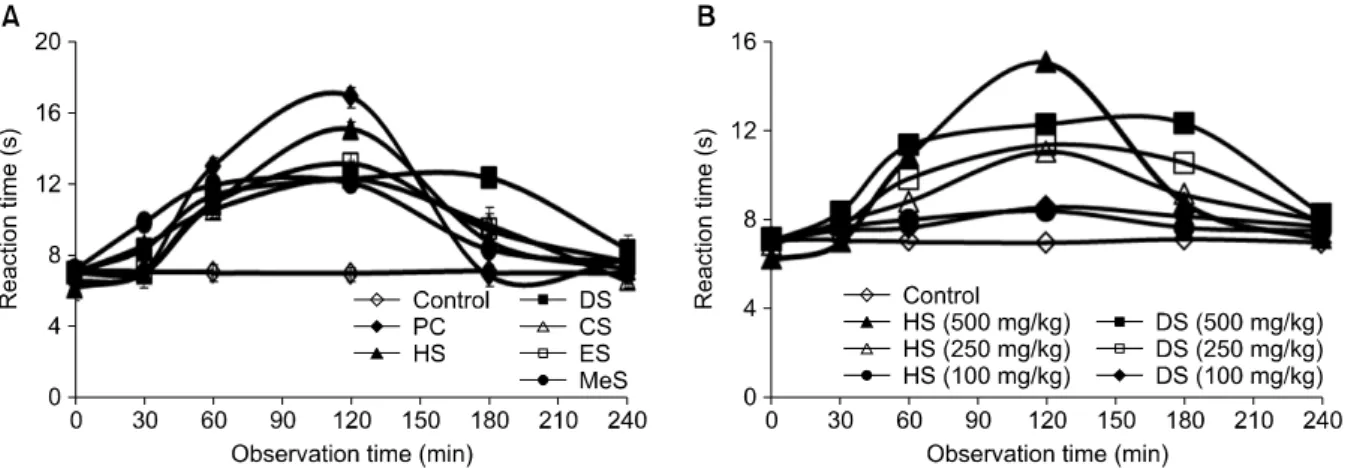
In acetic acid induced writhing test, each of the five frac-tions of seed when given orally (500 mg/kg b.w.), signif-icantly (P<0.05) inhibited the frequency of acetic acid in-duced abdominal constrictions in mice (Fig. 2). Among them, only HS strongly inhibited (P<0.05) the abdomi-nal constrictions in mice more than the positive control, diclofenac sodium (25 mg/kg b.w). At that concentra-tion, DS, CS, ES, and MeS showed similar inhibitory ef-fects as that of positive control. Control group showed the average writhing numbers of 60±6. The dose-depend-ent inhibition of acetic acid induced writhing numbers in mice was also shown in Fig. 2. Increasing the reaction time (paw licking/jumping) by different fractions of seed on mice was tested using hot plate test. Fig. 3A showed
Fig. 2. Dose-dependent inhibitory effects of different solvent
[n-hexane (HS), diethyl ether (DS), chloroform (CS), ethyl
ace-tate (ES), and methanol (MeS)] fractions of Sonneratia apetala
seeds on acetic acid induced writhing in mice. All data were significant when compared to control, and different letters (a-e) indicate significant differences when compared to positive
con-trol (PC, 2.5 mg diclofenac sodium/kg body weight) at P<0.05.
Fig. 3. Reaction time increasing of mice with different solvent [n-hexane (HS), diethyl ether (DS), chloroform (CS), ethyl acetate
(ES), and methanol (MeS)] fractions of Sonneratia apetala seeds. Treatment at 500 mg extract/kg body weight (b.w.) and PC [positive
control (morphine, 10 mg/kg b.w.)], (A) and dose-dependent effects of HS and DS on reaction time of mice (B). All data were
significant (P<0.05) at 60, 120, and 180 min when compared to control group.
reaction time increasing effects of different fractions of seed at 500 mg/kg b.w. on mice. All the fractions in-creased reaction time with the highest effect at 120 min. At that time, HS showed the highest reaction time (15.1 s), whereas morphine (10 mg/kg b.w.) used as a positive control, showed 16.9 s. The reaction time for all groups started to decline after 120 min except DS treated group, which showed similar effect until 180 min and then declined. All treatment groups significantly (P<0.05) in-creased the reaction time at 60, 120, and 180 min. Since HS showed the highest reaction time followed by DS, their dose-dependent effects were shown in Fig. 3B. In-traperitoneal administration of acetic acid stimulates the tissue to produce prostaglandins (PGs) and sympatho-mimetic mediators like PGE2 and PGF2α (20), bradykinin, histamine, and 5-hydroxytryptamine (21) in the perito-neal fluid, which stimulates peripheral nociceptive neu-rons. Hot plate test measures nociceptive response
la-tencies of test animals to thermal stimulus, which is sen-sitive to opioid receptors located in the central nervous system (22). All the fractions at 500 mg/kg, inhibited acetic acid induced writhes, and delayed the reaction time in mice significantly. Among the fractions, HS showed the highest analgesic activity through both the peripher-al and the centrperipher-al nervous system. DS prolonged (30∼ 180 min) analgesic effect through opioid receptors. These observations suggest that seeds of S. apetala possess pe-ripherally and centrally mediated analgesic properties. The peripheral analgesic action of these fractions may be mediated via inhibition of cyclo-oxygenases (COXs) and /or lipoxygenases (LOXs), whereas the central analgesic action may be mediated through the inhibition of central pain receptors. Since the seed of S. apetala is a rich source of both hydrophilic and lipophilic antioxidants (9), they could effectively ameliorate inflammatory responses through the reduction of oxidative stress and the inhib-ition of pro-inflammatory enzymes activities. Phenolic- enriched extracts of copao fruits effectively inhibited pro- inflammatory enzymes-LOX and COX-2, and thus showed anti-inflammatory activity (23). The antihistaminic and/ or anti-inflammatory activities of citrus fruit peels, and various edible fruits were also reported in different stud-ies (24,25).
Cytotoxicity
In brine shrimp lethality bioassay, LC50 and LC90 were determined. ES had the lowest LC50 (36 μg/mL) followed by HS (46 μg/mL) (Fig. 4). DS, CS, and MeS showed LC50 values of 48, 68, and 56 μg/mL, respectively whereas vincristine sulphate, a positive control, had 0.45 μg/mL. The LC90 values of HS, DS, CS, ES, and MeS were 493, 563, 794, 482, and 616 μg/mL, respectively, and that for vincristine sulphate was 3.6 μg/mL. The brine shrimp le-thality test is a simple bioassay used for the preliminary screening of large number of crude extracts in the drug
Fig. 4. LC50 and LC90 values of cytotoxic activity of different
sol-vent [n-hexane (HS), diethyl ether (DS), chloroform (CS), ethyl
acetate (ES), and methanol (MeS)] fractions of Sonneratia
ape-tala seeds on brine shrimp nauplii. All data were significant at P<0.001 when compared to PC (positive control, vincristine) by
Student’s t-test.
Fig. 5. GC-MS chromatogram of the n-hexane fraction (HS) of Sonneratia apetala seed.
discovery process. It is an indicator of cytotoxicity, anti-fungal, pesticidal and various pharmacologic actions (14). This in vitro test is highly correlated with in vivo tests and it is a useful alternative model for predicting toxicity of plant extracts (26). In the present investigation, all the fractions of S. apetala seeds showed dose-dependent lethality of brine shrimp nauplii with LC50 values much lower than 250 μg/mL. It was postulated that extracts having LC50 values less than 250 μg/mL were signifi-cantly active and potential for further investigation (27). Seeds of S. apetala could be a potential source of cytotox-ic compounds due to the presence of various functional phytochemicals such as polyphenols, flavonoids, sapo-nins, steroids, and alkaloids, etc. It has been reported
that some polyphenols destruct the membrane structure (28,29).
GC-MS analysis of HS
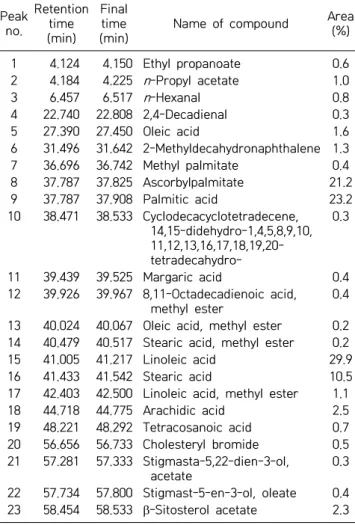
The GC-MS chromatograms of HS (Fig. 5) enabled the identification of 23 compounds (Table 2). A mixture of different classes of compounds such as ester, aldehyde, and fatty acids composed the n-hexane fraction of S. ape-tala seed. The mass spectrum of each compound was compared with the NIST library and the Wiley 7 library. Among the 23 compounds, four of them constitute 85% of n-hexane fraction. They are linoleic acid (30%), pal-mitic acid (23%), ascorbyl palmitate (21%), and stearic acid (11%). Linoleic acid is a polyunsaturated omega-6 fatty acid known as cis-9, cis-12-octadecadienoic acid, whereas oleic acid (2%) is a monounsaturated omega-9 fatty acid recognized as cis-9-octadecenoic acid. They are essential for maintaining health of humans. Reportedly, omega fatty acids show various health benefits such as antimicrobial, anti-inflammatory, anticancer, hypocholes-terolemic, hypotensive, hepatoprotective, antihistaminic, and antiarthritic activities. Palmitic acid is known as n-hexadecanoic acid, widely used in processed foods for improving texture and as natural additive. Anti-inflam-matory activity of palmitate was also reported (30). As-corbyl palmitate called as L-(+)-ascorbic acid 2,6-dihex-adecanoate is a fat soluble form of vitamin C, which is used as a source of vitamin C and as an antioxidant food additive in many countries. Stearic acid known as octa-decanoic acid, a common saturated fatty acid in nature is used to produce dietary supplements, cosmetics and de-tergents. It is also associated with lowering low-density
Table 2. Chemical composition of n-hexane fraction (HS) of Sonneratia apetala seeds analyzed by GC-MS
Peak no. Retention time (min) Final time (min)
Name of compound Area
(%) 1 4.124 4.150 Ethyl propanoate 0.6 2 4.184 4.225 n-Propyl acetate 1.0 3 6.457 6.517 n-Hexanal 0.8 4 22.740 22.808 2,4-Decadienal 0.3 5 27.390 27.450 Oleic acid 1.6 6 31.496 31.642 2-Methyldecahydronaphthalene 1.3 7 36.696 36.742 Methyl palmitate 0.4 8 37.787 37.825 Ascorbylpalmitate 21.2 9 37.787 37.908 Palmitic acid 23.2 10 38.471 38.533 Cyclodecacyclotetradecene, 14,15-didehydro-1,4,5,8,9,10, 11,12,13,16,17,18,19,20- tetradecahydro-0.3 11 39.439 39.525 Margaric acid 0.4 12 39.926 39.967 8,11-Octadecadienoic acid, methyl ester 0.4
13 40.024 40.067 Oleic acid, methyl ester 0.2
14 40.479 40.517 Stearic acid, methyl ester 0.2
15 41.005 41.217 Linoleic acid 29.9
16 41.433 41.542 Stearic acid 10.5
17 42.403 42.500 Linoleic acid, methyl ester 1.1
18 44.718 44.775 Arachidic acid 2.5 19 48.221 48.292 Tetracosanoic acid 0.7 20 56.656 56.733 Cholesteryl bromide 0.5 21 57.281 57.333 Stigmasta-5,22-dien-3-ol, acetate 0.3 22 57.734 57.800 Stigmast-5-en-3-ol, oleate 0.4 23 58.454 58.533 β-Sitosterol acetate 2.3
lipoprotein cholesterol (31). Other compounds identified in n-hexane fraction, though they are in small amounts, also reportedly have antimicrobial, anti-diarrhoeal, angesic, and cytotoxic activities. In addition, esters and al-dehydes such as ethyl propanoate, propyl acetate, hexa-nal, and decadienal have characteristics aroma and thus are commonly used in fragrances and as a flavor additive in a wide varieties of products including foods and bev-erages. Thus, functional and pharmacological properties of S. apetala seeds are possibly due to the presence of polyphenols, flavonoids, anthocyanins, vitamin C, anti-oxidants (4), and the identified chemical compounds in HS. In previous work, health promoting polyphenols such as caffeic acid, (+)- catechin, (-)-epicatechin, ellagic ac-id, gallic acac-id, and quercetin were detected and quantified at 88.1, 1459.3, 310.1, 616.9, 416.7, and 71.8 mg/100 g of methanol fraction of seed (MeS), respectively (9). Re-ports showed that dietary fruit intake increased the con-centration of serum salicylic acid and had beneficial ef-fects on postprandial metabolic and inflammatory re-sponses (32).
Nutraceutical and pharmacological properties of edible mangrove fruit of S. apetala are attributed to presence of various active compounds. Seeds fractions found to have
potential as antibacterial, anti-diarrhoeal, analgesic, and cytotoxic constituents. Linoleic acid, palmitic acid, ascor-byl palmitate, and stearic acid constitute 85% of n-hex-ane fraction of S. apetala seed. Hence, seeds can be used as a good source of linoleic acid, a polyunsaturated ga-6 fatty acid, and oleic acid, a monounsaturated ome-ga-9 fatty acid. Moreover, the seeds may also be used as a natural preservative owing to their significant activity against food spoilage organisms. Considering food secu-rity, primary health care, income generation, and coastal environment protection, such fruit crops cultivation could be a boom for farmers in the tidal sea-water intruded vast tropical coastal regions of the world. Also, availability of such raw ingredient will help in meeting the rising con-sumer demand for functional foods and dietary supple-ments.
ACKNOWLEDGEMENTS
The present research was supported by a grant received in 2012∼2013 from the Ministry of Science and Technol-ogy, Government of the Peoples Republic of Bangladesh, which is gratefully acknowledged.
AUTHOR DISCLOSURE STATEMENT
The authors declare no conflict of interest.
REFERENCES
1. Das S, Siddiqi NA. 1985. The mangroves and mangrove forests of Bangladesh. Mangrove silviculture division, bulletin no. 2. Bangladesh Forest Research Institute, Chittagonge, Bangla-desh.
2. Tomlinson PB. 1994. The botany of mangroves. Cambridge Uni-versity Press, Cambridge, UK.
3. Das S, Ghose M. 2003. Seed structure and germination pat-tern of some Indian mangroves with taxonomic relevance. Taiwania 48: 287-298.
4. Hossain SJ, Basar MH, Rokeya B, Arif KMT, Sultana MS, Rahman MH. 2013. Evaluation of antioxidant, antidiabetic and antibacterial activities of the fruit of Sonneratia apetala (Buch.-Ham.). Orient Pharm Exp Med 13: 95-102.
5. Bandaranayake WM. 1998. Traditional and medicinal uses of mangroves. Mangroves and Salt Marshes 2: 133-148.
6. Teja VP, Ravishankar K. 2013. Preliminary phytochemical investigation and in vitro antimicrobial activity of ethanol ex-tract of Sonneratia apetala. Int Res J Pharm 4: 84-87.
7. Patra JK, Das SK, Thatoi H. 2015. Phytochemical profiling and bioactivity of a mangrove plant, Sonneratia apetala, from Odisha Coast of India. Chin J Integr Med 21: 274-285. 8. Shefa AA, Baishakhi FS, Islam S, Sadhu SK. 2014.
Phyto-chemical and pharmacological evaluation of fruits of
Sonnera-tia apetala. GJMR-B-Pharma, Drug Discovery, Toxicology and
Medicine 14: 1-6.
Moniruzzaman M, Rahman MM, Hossain H. 2016. Nutrient compositions, antioxidant activity, and common phenolics of Sonneratia apetala (Buch.-Ham.) fruit. Int J Food Prop 19: 1080-1092.
10. Hossain SJ, Pervin T, Suma SA. 2016. Effects of cooking methods at different time durations on total phenolics and antioxidant activities of fresh and dried-stored fruits of Sonneratia apetala (Buch.-Ham.). Int Food Res J 23: 556-563. 11. Shoba FG, Thomas M. 2001. Study of antidiarrhoeal activity
of four medicinal plants in castor-oil induced diarrhoea. J Ethnopharmacol 76: 73-76.
12. Koster R, Anderson M, De Beer EJ. 1959. Acetic acid-induced analgesic screening. Fed Proc 18: 412.
13. Eddy NB, Leimbach D. 1953. Synthetic analgesics. II. Dithi-enylbutenyl- and dithienylbutylamines. J Pharmacol Exp Ther 107: 385-393.
14. McLaughlin JL. 1991. Crown gall tumors on potato disc and brine shrimp lethality: two simple assays for higher plant screening and fractionation. In Methods in Plant Biochemistry Assays for Bioactivity. Dey PM, Harborne JB, Hostettman K, eds. Academic Press, San Diego, CA, USA. Vol 6, p 1-32. 15. Bobbarala V, Vadlapudi V, Naidu KC. 2009. Mangrove plant
Sonneratia apetala antimicrobial activity on selected patho-genic microorganisms. Orient J Chem 25: 445-447.
16. Arif KMT, Datta RK, Sarower MG, Hossain SJ. 2014. Com-parison of phenolics and antibacterial activity of commonly used antidiabetic medicinal plants in Bangladesh. Pharma-cologyOnline 1: 7-15.
17. Cowan MM. 1999. Plant products as antimicrobial agents. Clin Microbiol Rev 12: 564-582.
18. Pierce NF, Carpenter CC Jr, Elliott HL, Greenough WB 3rd. 1971. Effects of prostaglandins, theophylline, and cholera exotoxin upon transmucosal water and electrolyte movement in the canine jejunum. Gastroenterology 60: 22-32.
19. Saito T, Miyake M, Toba M, Okamatsu H, Shimizu S, Noda M. 2002. Inhibition by apple polyphenols of ADP-ribosyl-transferase activity of cholera toxin and toxin-induced fluid accumulation in mice. Microbiol Immunol 46: 249-255. 20. Collier HO, Dinneen LC, Johnson CA, Schneider C. 1968. The
abdominal constriction response and its suppression by an-algesic drugs in the mouse. Br J Pharmacol Chemother 32: 295- 310.
21. Whittle BA. 1964. The use of changes in capillary permeabil-ity in mice to distinguish between narcotic and nonnarcotic analgesics. Br J Pharmacol Chemother 22: 246-253.
22. Yaksh TL, Rudy TA. 1977. Studies on the direct spinal action
of narcotics in the production of analgesia in the rat. J Pharmacol Exp Ther 202: 411-428.
23. Jiménez-Aspee F, Alberto MR, Quispe C, Soriano Mdel P, Theoduloz C, Zampini IC, Isla MI, Schmeda-Hirschmann G. 2015. Anti-inflammatory activity of copao (Eulychnia acida Phil., Cactaceae) fruits. Plant Foods Hum Nutr 70: 135-140. 24. Hossain SJ, Tsujiyama I, Takasugi M, Islam MA, Biswas RS,
Aoshima H. 2008. Total phenolic content, antioxidative, an-ti-amylase, anti-glucosidase, and antihistamine release activ-ities of Bangladeshi fruits. Food Sci Technol Res 14: 261-268. 25. Tsujiyama I, Mubassara S, Aoshima H, Hossain SJ. 2013. An-ti-histamine release and anti-inflammatory activities of aque-ous extracts of citrus fruits peels. Orient Pharm Exp Med 13: 175-180.
26. Logarto Parra A, Silva Yhebra R, Guerra Sardiñas I, Iglesias Buela L. 2001. Comparative study of the assay of Artemia
sali-na L. and the estimate of the medium lethal dose (LD50 value)
in mice, to determine oral acute toxicity of plant extracts. Phytomedicine 8: 395-400.
27. Rieser MJ, Gu ZM, Fang XP, Zeng L, Wood KV, McLaughlin JL. 1996. Five novel mono-tetrahydrofuran ring acetogenins from the seeds of Annona muricata. J Nat Prod 59: 100-108. 28. Hossain SJ, Kato H, Aoshima H, Yokoyama T, Yamada M,
Hara Y. 2002. Polyphenol-induced inhibition of the response
of Na+/glucose cotransporter expressed in Xenopus oocytes.
J Agric Food Chem 50: 5215-5219.
29. Hossain SJ, Aoshima H, Koda H, Kiso Y. 2007. Review of functional studies of beverage components acting on the
re-combinant GABAA neuroreceptor, and Na+/glucose
cotrans-porter-response using the Xenopus oocyte expression system and electrophysiological measurements. Food Biotechnol 21: 237-270.
30. Saeed NM, El-Demerdash E, Abdel-Rahman HM, Algandaby MM, Al-Abbasi FA, Abdel-Naim AB. 2012. Anti-inflamma-tory activity of methyl palmitate and ethyl palmitate in differ-ent experimdiffer-ental rat models. Toxicol Appl Pharmacol 264: 84- 93.
31. Hunter JE, Zhang J, Kris-Etherton PM. 2010. Cardiovascular disease risk of dietary stearic acid compared with trans, other saturated, and unsaturated fatty acids: a systematic review. Am J Clin Nutr 91: 46-63.
32. Rinelli S, Spadafranca A, Fiorillo G, Cocucci M, Bertoli S, Battezzati A. 2012. Circulating salicylic acid and metabolic and inflammatory responses after fruit ingestion. Plant Foods Hum Nutr 67: 100-104.
![Fig. 1. Effects of different solvent [n-hexane (HS), diethyl ether (DS), chloroform (CS), ethyl acetate (ES), and methanol (MeS)]](https://thumb-ap.123doks.com/thumbv2/123dokinfo/5000693.58609/5.892.107.791.862.1092/effects-different-solvent-hexane-diethyl-chloroform-acetate-methanol.webp)