The phase II trial of fractionated
irinotecan plus carboplatin for
previously untreated
extensive-disease small cell lung cancer
Hye Jin Choi
Department of Medicine
The phase II trial of fractionated
irinotecan plus carboplatin for
previously untreated
extensive-disease small cell lung cancer
Directed by Professor Joo Hang Kim
The Master’s thesis submitted to the
Department of Medicine
the Graduate School of Yonsei Universisty
in partial fulfillment of the requirements for the
degree of Master of Medicine
Choi Hye Jin
December 2005
This certifies that the Master's Thesis
Hye Jin Choi is approved.
Thesis Supervisor : Joo Hang Kim
Thesis Committee Member: Se Kyu Kim
Thesis Committee Member: Chae Ok Yun
The Graduate School
Yonsei University
Acknowledgements
I would like to thank professor Joo Hang Kim who
gave me the opportunity to participate in such a great
project and always provided me with good and
thorough ments with deep sincerity. In addition, I am
in debt to professor Se Kye Kim and Chae Ok Yun
who gave me many great advices during the study.
Furthermore, I am greateful to Ju Hyuk Sohn who
was helpful with meaningful discussion. Finally I
express my greatest love to my parents who
supported me with deep love and belief.
TABLE OF CONTENTS
ABSTRACT ··· 1
I. INTRODUCTION ··· 3
II. MATERIALS AND METHODS 1. Patients ··· 5
2. Treatment Schedule ··· 5
3. Assessment ··· 6
4. Response and Toxicity Criteria ··· 7
5. Statistical Methods ··· 8
III. RESULTS 1. Patients ··· 9
2. Dose Intensity and Delivery ··· 11
3. Response to Treatment and Survival ··· 13
4. Toxicity ··· 16
IV. DISCUSSION ··· 19
V. CONCLUSION ··· 23
LIST OF FIGURES
Figure 1. Overall survival curve ··· 14 Figure 2. Time to Progression curve ··· 15
LIST OF TABLES
Table 1. Characteristics of the patients ··· 10 Table 2. Treatment summary ··· 12 Table 3. Toxicity profiles ··· 17
ABSTRACT
The Phase II Trial of fractionated irinotecan plus carboplatin for previously untreated extensive-disease small cell lung cancer
Hye Jin Choi
Department of Medicine
The Graduate School, Yonsei University
(Directed by Professor Joo Hang Kim)
Irinotecan plus cisplatin has been previously documented to be effective in the treatment of extensive-disease small-cell lung cancer (ED-SCLC). This study was undertaken to investigate the efficacy and feasibility of combination chemotherapy of irinotecan and carboplatin in previously untreated ED-SCLC. From December 2002 to April 2005, 32 patients with previously untreated ED-SCLC were enrolled. Patients were treated with irinotecan (50mg/m2 i.v. on day 1, 8, and 15) and carboplatin (target AUC=5 i.v. on day 1) every 4 weeks for up
to 6 cycles. Twenty-eight patients (87.5%) were male and the median age was 65 years. ECOG performance status was 0-1 in 18 (56.2%) and 2 in 14 (43.8%) patients. The median cycles of chemotherapy was 5.5 (range, 1-6 cycles). Twenty-nine patients were assessable for response evaluation. The overall response rate was 68.7% (1 CR, 21 PR) under the intent-to-treat analysis. After a median follow-up of 15.4 months, median time to progression was 6.4 months (95% CI: 5.4-7.4 months) and median overall survival was 12.7 months (95% CI: 2.3-23.1 months). The estimated 1-year survival rate was 47.1%. In terms of toxicities, Grade 3/4 neutropenia and thrombocytopenia occurred in 8 (25.0%) and 5 (15.6%) patients, respectively. Grade 3/4 non-hematologic toxicities included diarrhea (9.4%), anorexia (9.4%), infection (6.3%), and neutropenic fever (6.3%). There was one treatment-related death because of superimposed infection on bronchopleural fistula. The combination chemotherapy of irinotecan and carboplatin was effective and tolerable in previously untreated ED-SCLC. Based on the favorable results in this trial, further large scaled phase III studies are warranted.
The Phase II Trial of fractionated irinotecan plus carboplatin for previously untreated extensive-disease small cell lung cancer
Hye Jin Choi
Department of Medicine
The Graduate School, Yonsei University
(Directed by Professor Joo Hang Kim)
I. INTRODUCTION
Small cell lung cancer (SCLC) comprises 20 % of the all lung malignancy and is classified into the limited and extensive stage depending on the extent of disease whether within or beyond the one hemithorax. For the last 15 years, chemotherapy with etoposide and cisplatin (EP) have been the standard treatment in extensive disease small cell lung cancer (ED-SCLC) with the median survival of 10-12 months 1.
Irinotecan, a camptothecin analogue that inhibits the nuclear enzyme, topoisomerase I, has been shown excellent antitumor activity against SCLC in monotherapy or in combination with cisplatin 2 3. Irinotecan plus cisplatin was compared with EP in a randomized phase III trial resulting in a better survival in ED-SCLC 4; however, it was not confirmed by the subsequent confirmative trial5.
Cisplatin is the most active agent in the treatment of lung cancer; however, it gives rise to significant toxicities such as nausea, vomiting, nephrotoxicity, and neurotoxicity. On the other hand, carboplatin, another platinum derivative, has a similar activity to cisplatin but exhibits a more favorable toxicity profile and it is easier to administer 6 7. Therefore, carboplatin is widely used as a practical substitute for cisplatin in various malignancies such as ovarian cancer or ED-SCLC 8 9.
Several in vitro studies showed a synergistic effect between irinotecan and carboplatin in various cell lines 10. Moreover, there were trials showing that irinotecan/carboplatin regimen was effective in heavily treated ED-SCLC patients 11 12. Under the background of these previous studies, we have conducted a phase II trial of irinotecan plus carboplatin for previously untreated ED-SCLC with the recommended schedule from the other phase I trials 13 14.
II. MATERIALS AND METHODS
1. Patients
Patients with previously untreated SCLC, diagnosed histologically or cytologically, participated in this study. Patients were considered as eligible if they had extensive stage SCLC, defined as the extent of disease outside the unilateral hemithorax or as a disease with a malignant pleural effusion, with at least one unidimensionally measurable lesion, they were ≤ 75 years and had an Eastern Cooperative Oncology Group (ECOG) performance status(PS) of 0-2, and adequate organ functions, i.e. absolute neutrophil ≥ 1,500 /uL, hemoglobin ≥ 10 g/dl, platelets ≥ 100,000/uL, serum creatinine ≤ 1.5 mg/dl, total bilirubin ≤ 1.5mg/dl, and AST/ALT ≤ 3 times normal value. Patients who had symptomatic brain metastasis, prior treatment history for SCLC, and concurrent uncontrolled medical illness were excluded. All patients gave written informed consent before enrollment. The study was approved by the Ethical Review Committee of the center.
2. Treatment Schedule
Irinotecan was administered as a 90-min intravenous infusion at a dosage of 50 mg/m2 on days 1, 8 and 15. Carboplatin was given at a dose of AUC
5mgⅹmin/ml on day 1 in 500ml 5 % glucose over 2hrs. The carboplatin dose was calculated with Calvert’s formula and the 24-h creatinine clearance rate15. Treatment was repeated every 28 days and continued for up to six cycles if there were not unacceptable toxicities or disease progression. No prophylactic recombinant human granulocyte colony stimulating factor (G-CSF) or loperamide was administered. Administration of irinotecan was skipped on day 8 or 15 if the leukocyte count was less than 1,500/uL, if the platelet count was less than 100,000/uL, or if there was diarrhea. G-CSF was administered when neutropenia was less than 500/uL. Platelet transfusion was done when platelet count less than 50,000/uL. Subsequently, after recovery the next course was started. Neither a dose reduction nor dose escalation was allowed.
3. Assessment
All patients underwent an evaluation of medical history, symptoms, physical examination, ECOG PS, and clinical tumor assessment at screening, each cycle and follow-up. Pretreatment laboratory evaluations consisted of complete blood count (CBC) with differentiation, serum chemistry profiles (total bilirubin, AST, ALT, alkaline phosphatase, and electrolytes) and urinalysis. Chest radiography, computed tomography (CT) of the chest, abdominal CT scan or ultrasound sonography and radionuclide bone scan were evaluated to determine the stage of
disease at screening. Chest X-rays, CBC with differentiation and a complete biochemical profile were obtained on day 1 of each cycle. CBC with differentiation was repeated on days 8 and 15. Response was assessed by plain chest x-ray before each course, with final response designation using chest CT scan after every third cycle, or whenever needed. In case of target lesion surrounded by lung parenchyma in chest X-ray, tumor response could be evaluated by chest X-ray.
4. Response and Toxicity Criteria
Objective response of a tumor to the current regimen was evaluated according to the Response Evaluation Criteria in Solid Tumors (RECIST) 16. A CR of target lesions was defined as the disappearance of all target lesions for a minimum of 4 weeks. A PR was defined as at least a 30% decrease in the sum of the longest diameter of target lesions for a minimum of 4 weeks, during which no new lesion could appear. PD was defined as at least a 20% increase in the sum of the longest diameter of the target lesion or the appearance of one or more new lesions. SD was defined as neither sufficient shrinkage to qualify for PR nor sufficient increase to qualify for PD. A CR of non target lesions was defined as the disappearance of all non target lesions. An incomplete response/stable disease was defined as the persistence of one or more non target lesion(s). PD
was defined as the appearance of one or more new lesions and/or unequivocal progression of existing non target lesions. Toxicity evaluation was repeated before each cycle. Toxicities werescored according to the National Cancer Institute (NCI) commontoxicity criteria version 2.0.
5. Statistical Methods
The primary end point of this study was the response rate and median overall survival time. Overall survival time (OS) was defined as the interval between the study treatment start date and the last date of follow-up (for patients still alive) or until death. The secondary end point of this study was the toxicity, response duration and time to progression (TTP). TTP was defined as the interval between the start date of treatment and the date of progression. If a patient was lost to follow-up, the patient was censored on the date of last contact. Response duration was defined as the interval between the date of response to the date of progression. Survival curves were estimated using the method of Kaplan-Meier. SPSS (version 12.0) was used to run the analysis.
III. RESULTS
1. Patients
Between December 2002 and April 2005, 32 patients were enrolled in the trial. The demographics of these patients are listed in Table 1. Three patients were not assessable for response. After 1 cycle of chemotherapy, three patients refused the treatment because of financial difficulties or toxicity. The median age was 64 years (range, 39 to 73 years). Twenty eight patients were male and 18 patients had an ECOG PS of 0 or 1. Eighteen patients had more than 2 sites of metastasis.
Table1 . Characteristics of the Patients
Number of patients ( % ) Number of total patients 32
Median age (years) 64.5 (range, 39 to 73) Sex
Male 28 (87.5 %)
Female 4 (12.5%)
ECOG performance status
0 2 (6.2%)
1 16 (50.0%)
2 14 (43.8%)
No. of distant metastasis 1 ≥2 14 18 (43.8%) (56.2%) Abbreviations: ECOG, Eastern Oncology Cooperative Group
2. Dose intensity and Delivery
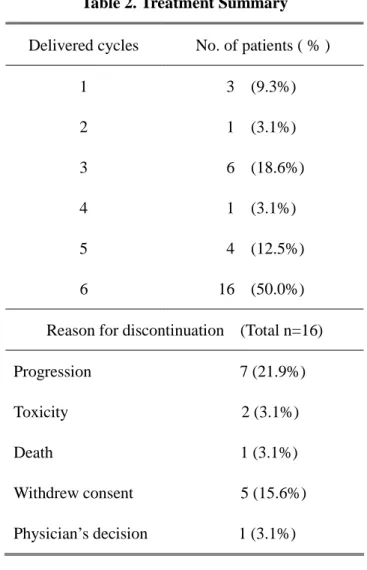
A total 146 treatment cycles were administered, with a median of 5.5 cycles per patient (range, 1 to 6 cycles). Sixteen (50.0%) patients completed six cycles of chemotherapy. Table2 shows the reason for discontinuation of chemotherapy of 16 patients. Mean actual dose intensity of irinotecan was 31.4 mg/m2/wk (range 21.7~ 37.5) and carboplatin was 1.2 mgⅹmin/ml /wk. The relative dose intensity of irinotecan and carboplatin was 0.84 and 0.96, respectively. The percent of administration on day 8 and day 15 were 92.8% and 70.5 %. The major reason for the omission of chemotherapy on day 8 and day 15 was neutropenia.
Table 2. Treatment Summary
Delivered cycles No. of patients ( % )
1 3 (9.3%) 2 1 (3.1%) 3 6 (18.6%) 4 1 (3.1%) 5 4 (12.5%) 6 16 (50.0%) Reason for discontinuation (Total n=16) Progression 7 (21.9%) Toxicity 2 (3.1%) Death 1 (3.1%) Withdrew consent 5 (15.6%) Physician’s decision 1 (3.1%)
3. Response to Treatment and Survival
All 32 patients were included in the analysis of tumor response and survival. There were 1 CR (3.1 %), 21 PR(65.6 %), 4 SD(12.5 %) , 3 PD(9.3 %) and 3 unassesable (9.3 %). The overall response rate was 68.7 % by the intent-to-treat analysis and 75.9 % by per protocol analysis. Most common lesion of relapse was thorax (78.1 %), followed by bone(20.0 %), brain(16.0 %) and liver(8.0 %). Fourteen(43.7 %) of 32 patients were treated as 2nd line regimen chemotherapy after progression; 11 received etoposide/topotecan chemotherapy ; 1 received cyclophosphamide/adriamycin/vincristine ; 2 received ifosfamide/etoposide and 4 patients received palliative radiotherapy on thorax, brain or bone.
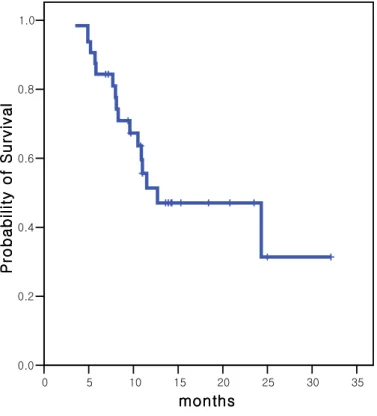
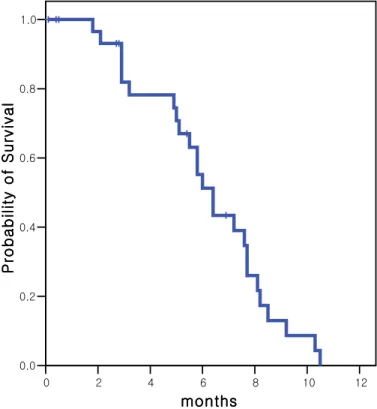
Median follow up duration was 15.4 months (range 3.8 ~ 32.1 months). Sixteen patients died. The median TTP was 6.4 months (95% Confidence Interval 5.4~ 7.4 months). The median OS was 12.7 months (95% Confidence Interval 2.3~23.1 months). The estimated 1- year survival rate was 47.1%. The median response duration was 4.5 months (range, 1.7 to 9.6 months). The Kaplan-Meier curves of TTP and OS of the patients are shown in Figure 1 and 2.
Figure 1. Overall survival curve
1yr survival rate: 47.1 %, median overall survival: 12.7 months
0 5 10 15 20 25 30 35 months months months months 0.0 0.2 0.4 0.6 0.8 1.0 P ro b a b il it y o f S u rv iv a l P ro b a b il it y o f S u rv iv a l P ro b a b il it y o f S u rv iv a l P ro b a b il it y o f S u rv iv a l
Figure 2. Time to progression curve
Median time to progression: 6.4 months
0 2 4 6 8 10 12 months monthsmonths months 0.0 0.2 0.4 0.6 0.8 1.0 P ro b a b il it y o f S u rv iv a l P ro b a b il it y o f S u rv iv a l P ro b a b il it y o f S u rv iv a l P ro b a b il it y o f S u rv iv a l
4. Toxicity
All 32 patients were included in the toxicity analysis. Table 3 lists the maximum toxicity experience during treatment. The most frequent toxicity was myelosuppression. Grade 3/ 4 neutropenia and thrombocytopenia were observed in 8(25.0 %) and 5(15.6 %) patients, respectively. Nine patients received G-CSF support. Five patients received platelet transfusion and 12 patients received transfusion of erythrocytes. Majority of non-hematologic toxicities were modest. Grade 3 /4 diarrhea was occurred in 3(9.4 %) patients. Grade 3 /4 neutropenic fever was reported 3 (9.4 %) patients and Grade 3 /5 infection was reported in 2(6.3 %) patients and they were recovered from infection except one patient. Treatment-related death was respiratory failure following bronchopleural fistula and pneumonia.
Table3 . Toxicity Profiles Hematological toxicities (n=32) NCI-CTC grade G 1 G 2 G 3 G 4 G 5 G3-5 (%) Neutropenia 7 6 6 2 0 8 (25.0%) Leukopenia 2 8 4 0 0 4 (12.5%) Anemia 10 4 4 0 0 4 (12.5%) Thrombocytopenia 5 5 4 1 0 5 (15.6%) Nonhematological toxicities (n=32) NCI-CTC grade G 1 G 2 G 3 G 4 G 5 G3-5 (%) Anorexia 5 3 3 0 0 3 (9.4%) Nausea Vomiting 4 3 3 0 2 1 0 1 0 0 2 (6.3%) 2 (6.3%) Diarrhea 5 3 2 1 0 3 (9.4%) Constipation General weakness Hyperbilirubinemia AST elevation ALT elevation Alopecia 1 4 1 3 1 5 2 2 0 0 0 2 0 1 1 1 1 0 0 0 0 0 0 0 0 0 0 0 (0%) 1 (3.1%) 1 (3.1%) 1 (3.1%) 1 (3.1%)
Pain Infection Neutropenic fever 7 1 0 4 2 0 0 1 1 0 0 2 0 1 0 0 (0%) 2 (6.3%) 3 (9.4%) Abbreviations: NCI-CTC, the National Cancer Institute’s Common Toxicity Criteria
IV. DISCUSSION
Small cell lung cancer (SCLC) is one of those cancers which responds to chemotherapy very sensitively. But it metastasizes at the early stage of the disease to be called an aggressive malignancy. Over 20 years, many studies have been done for extensive-disease small cell lung cancer(ED-SCLC), including non-cross resistant alternating regimen, high-dose and dose-intensive chemotherapy with granulocyte-colony stimulating factor (G-CSF) and maintenance therapy 17-19. But there is only a little improvement in median survival time and still the combination of etoposide and cisplatin is regarded as the standard chemo-therapeutic regimen for SCLC1. Therefore, necessity of new novel drug has been brought up for the better treatment outcome of ED-SCLC. Recently, taxane, gemcitabine, topotecan 20-22 and irinotecan have been tried to SCLC. Among them, only irinotecan showed the improvement of survival 4.
Noda et al. from Japan Clinical Oncology Group(JCOG) reported results of a phase III trial (JCOG9511) combinating irinotecan and cisplatin. Comparing to the combination of etoposide /cisplatin combination, irinotecan/cisplatin combination treated group showed significant increase in response rate , progression-free survival and overall survival in previously untreated ED-SCLC. In the Japanese design, the object was 77 ED-SCLC patients who were
previously untreated. They recieved 60mg/m2 of irinotecan on days 1,8, and 15 with 60mg/m2 of cisplatin on day 1, repeated in every 28 days. Overall response rate was 84.4 % and median TTP, OS was 6.9 months, 12.8 months respectively.
For the rationale to examine a regimen that is equally active and more tolerable in ED-SCLC, we performed a phase II trial on 32 patients using irinotecan 50 mg/m2 (day 1, 8 and 15) and carboplatin (day 1) with a target AUC 5mgⅹmin/ml by Calvert formula. The trial produced an overall RR of 68.7 %, a median TTP of 6.4 months, a median OS of 12.4 months, and an estimated 1-year survival rate of 47.1 %. In terms of response rate, our result was at least comparable to that of irinotecan/cisplatin treated group in Japanese study and similar to those established therapies using etoposide/cisplatin in ED-SCLC1 4.
The principal toxicity in irinotecan/carboplatin regimen was myelosuppression, especially neutropenia. Grade 3/ 4 neutropenia and thrombocytopenia was observed in 8 (25.0 %) patients and 5 (15.6 %) patients, respectively. Neutropenia was the main cause of treatment omission, but it was easily recovered by temporary CSF support and prophylactic administration of G-CSF was not considered. In contrast, Noda et al. reported a Grade 3 /4 neutropenia of 65.3 % and thrombocytopenia of 5.3 %. Even though our regimen used lower dose intensity of irinotecan than Noda’s, carboplatin has
much more potency of myelosuppression rather than cisplatin, which means our regimen is more profitable for hematologic toxicities. In the point of view that thrombocytopenia is the major dose-limiting toxicity of carboplatin, relatively high incidence of thrombocytopenia in this study might be due to carboplatin.
With regard to non-hematologic toxicity, Grade 3/ 4 nausea and vomiting was 6.3 % in our trial and 13.3 % of Noda’s. Diarrhea is another dose limiting toxicity of irinotecan treatment. Grade 3 / 4 diarrhea was reported in 3 (9.4 %) patients of our trial and 12 (16.0 %) patients in Noda’s. High dose loperamide treatment seemed to reduce the incidence of diarrhea. Neutropenic fever was observed in 3(9.4 %) patients and all of them recovered easily after using intravenous antibiotics and G-CSF support. One patient experienced a varicella-zoster infection and one patient died of respiratory failure following broncho-pleural fistula and pneumonia. These non-hematologic toxicities were mild and comparable to those of recently published combination chemotherapy in ED-SCLC.
Approximately 44 % of our patients was in ECOG performance status 2 and 56 % of our patients had more than two metastatic sites. Direct comparing between patients enrolled in JCOG group & in our study may not be meaningful, but our patients were in more poor status than Japanese patients. In spite of progressed disease, patients could maintain their performance status during the
treatment course, and could receive second line treatment. Fourteen (43.7 %) of 32 patients were treated with combination chemotherapy and 4 patients received palliative radiotherapy on thorax, brain or bone. It can be interpreted as new combination is more tolerable in ED-SCLC patients.
In conclusion, the efficacy of fractionated irinotecan plus carboplatin was not inferior to irinotecan plus cisplatin, and this combination was less toxic in previously untreated ED-SCLC patients. Palliation of disease and improvement in quality of life as well as survival are the important goals of treatment in ED-SCLC. From this point of view, the regimen of fractionated irinotecan plus carboplatin would be a promising substitute for irinotecan/cisplatin, especially in patients with poor performance status or old age.
V. CONCLUSION
The combination chemotherapy of irinotecan and carboplatin was effective and tolerable in previously untreated ED-SCLC. Based on the favorable results in this trial, further large scaled phase III studies are warranted.
REFERENCES
1. Mascaux C, Paesmans M, Berghmans T, Branle T, Lafitte JJ, Lemaıˆtre F, et al. A systematic review of the role of etoposide and cisplatin in the chemotherapy of small cell lung cancer with methodology assessment and meta analysis. Lung cancer 2000;30(1):23-36.
2. Masuda N, Fukuoka M, Kusunoki Y, Matsui K, Takifuji N, Kudoh S, et al. CPT-11; a new derivative of camptothecin for the treatment of refractory or relapsed small-cell lung cancer. J Clin Oncol 1992;10:1225-1229. 3. Kudoh S, Fujiwara Y, Takada Y, Yamamoto H, Kinoshita A, Ariyoshi Y, et
al. Phase II study of irinotecan combined with cisplatin in patients with previously untreated small-cell lung cancer. West Japan Lung Cancer Group. J Clin Oncol 1998;16: 1068-1074.
4. Noda K, Nishiwaki Y, Kawahara M, Negoro S, Sugiura T, Yokoyama A, et al. Irinotecan plus cisplatin compared with etoposide plus cisplatin for extensive small-cell lung cancer. N Engl J Med 2002;346.85-91.
5. Hanna N, Einhom L, Sandler A, Langer C, Hariharan S, Ansari R, et al. Randomized phase III trial comparing irinotecan/cisplatin with etoposide/cisplatin in patients with previously untreated, extensive-stage
small cell lung cancer SCLC. Proc Am Soc Clin Oncol 2005;23:1094s
6. Skarlos DV, Samantas E, Kosmidis P, Fountzilas G, Angelidou M, Palamidas P, et al. Randomized comparison of etoposide-cisplatin vs etoposide-carboplatin and irradiation in small cell lung cancer. A Hellenic Co-operative Oncology Group study. Ann Oncol 1994;5:601-607.
7. Brahmer JR, Ettinger DS. Carboplatin in the treatment of small cell lung cancer. Oncologist 1998;3:143-154.
8. Paccagnella A, Favaretto A, Oniga F, Barbieri F, Ceresoli G, Torri W, et al. Cisplatin versus carboplatin in combination with mitomycin and vinblastine in advanced non small cell lung cancer. A multicenter, randomized phase III trial. Lung Cancer 2004;43:83-91.
9. Ozols RF, Bundy BN, Greer BE, Fowler JM, Clarke-Pearson D, Burger RA, et al. Phase III trial of carboplatin and paclitaxel compared with cisplatin and paclitaxel in patients with optimally resected stage III ovarian cancer: a Gynecologic Oncology Group study. J Clin Oncol 2003;21:3194-3200.
combination with other anticancer agents on human leukemia cell lines. Leuk Res 1993;17:113-119.
11. Naka N, Kawahara M, Okishio K, Hosoe S, Ogawara M, Atagi S, et al. Phase II study of weekly irinotecan and carboplatin for refractory of relapsed small-call lung cancer. Lung cancer 2002;37:319-323.
12. Hirose T, Horichi N, Ohmori T, Ogura K, Hosaka T, Ando K, et al. Phase II study of irinotecan and carboplatin in patients with the refractory or relapsed small cell lung cancer. Lung cancer 2003;40:333-338.
13. Fukuda M, Oka M, Soda H, Terashi K, Kawabata S, Nakatomi K, et al. Phase I study of irinotecan combined with carboplatin in previously untreated solid cancers. Clin Cancer Res 1999;5:3963-3969.
14. Schmittel A, Schulze K, Hutter G, Krebs P, Thiel E, Keilholz U. Phase I dose escalation study of carboplatin to a fixed dose of irinotecan as first-line treatment of small cell lung cancer. Onkologie 2004;27:280-284.
15. Calvert AH, Newell DR, Gumbrell LA, O’Reilly S, Burnell M, Boxall FE, et al. Carboplatin dosage: prospective evaluation of a simple formula based on renal function. J Clin Oncol 1989;7:1748-1756.
16. Therasse P, Arbuck SG, Eisenhauer EA, Wanders J, Kaplan RS, Rubinstein L, et al. New guidelines to evaluate the response to treatment in solid tumors. European Organization for Research and Treatment of Cancer, National Cancer Institute of the United States, National Cancer Institute of Canada. J Natl Cancer Inst 2000;92:205–216.
17. Lassen U, Østerlind K, Hansen M, Dombernowsky P, Bergman B, Hansen HH. Long-term survival in small cell lung cancer: post-treatment characteristics in patients surviving 5–18 years—an analysis of 1714 consecutive patients. J Clin Oncol 1995;13:1215–1220.
18. Wolf M, Havemann K, Holle R, Gropp C, Drings P, Hans K. et al. Cisplatin/etoposide versus ifosfamide/etoposide combination chemotherapy in small cell lung cancer: a multicenter German randomised trial. J Clin Oncol 1987;5:1880–1889.
19. Ihde DC, Mulshine JL, Kramer BS, Steinberg SM, Linnoila RI, Gazdar AF, et al. Prospective randomized comparison of high-dose and standard-dose etoposide and cisplatin chemotherapy in patients with extensive-stage small-cell lung cancer. J Clin Oncol 1994;12:2022-2034.
versus observation after cisplatin plus etoposide in extensive-stage small-cell lung cancer : E7593-a phase III trial of the Eastern Cooperative Oncology Group. J Clin Oncol 2001;19:2114-2122.
21. Mavroudis D, Papadakis E ,Veslemes M, Tsiafaki X, Stavrakakis J, Kouroussis C, et al. A multicenter randomized clinical trial comparing paclitaxel-cisplatin –etoposide versus cisplatin-etoposide as first-line treatment in patients with small-cell lung cancer. Ann Oncol 2001;12:463-470.
22. James L, Rudd R, Gower N, Gregory W, Lee S, Eisen T, et al. A phase III randomized comparison of gemcitabine/carboplatin(GC) with cisplatin/etoposide(PE) in patients with poor prognosis small cell lung cancer (SCLC). Proc Am Soc Clin Oncol 2002;21:2193.
ABSTRACT (IN KOREAN) 치료받지 않은 확장 병기 소세포 폐암에서 Irinotecan 및 Carboplatin 병용 화학 요법에 관한 2상 연구 지도교수 김주항 연세대학교 대학원 의학과 최혜진 확장 병기 소세포 폐암에서 Irinotecan 과 Carboplatin 병합 화학 요법은 효과가 있다고 알려져 있다. 이 연구는 치료 받지 않은 확장 병기 소세포 폐암에서 Irinotecan 과 Carboplatin 병합 화학 요법에 대한 효과와 그 가능성을 연구하고자 하였다. 2002년 12월부터 2005년 4월까지 치료받지 않은 소세포 폐암 환자 32명이 등록되었다. Irinotecan (50mg/m2, 정맥 주사, 제 1, 8 및 15일 투여) 과 Carboplatin( 목표 AUC=5, 제 1일 투여)을 매 4주마다 총 6주기까지 투여하였다. 환자 중에 남자가 28명 (87.5 %)이었고, 환자들의 중간 나이는 65세였다. ECOG 수행지수는 0-1이 18명(56.2 %) 이었다. 화학 요법은 평균 5.5
주기(범위, 1-6 주기) 시행되었다. 29명의 환자가 반응 평가가 가능하였으며, 반응률은 68.7% (완전 반응 1명, 부분 반응 21명) 이었다. 평균 15.4 개월의 추적 관찰 결과, 무진행 기간은 6.4 개월(95% 신뢰구간: 5.4-7.4개월)이었고, 총 생존 기간은 12.7개월(95% 신뢰구간: 2.3-23.1개월)이었다. 예측 1년 생존률은 47.1%였다. 독성을 살펴보면, 3/4도 백혈구 감소증과 혈소판 감소증이 각각 8명(25.0%)과 5명(15.6%)에서 나타났다. 3/4도 비혈액 독성으로는 설사(9.4%), 오심(9.4%), 감염(6.3%) 그리고 호중구감소열(6.3%)이 있었다. 치료와 관련된 사망은 1명이 있었으며, 기관지늑막루에 병발된 감염으로 사망하였다. 치료 받지 않은 확장 병기 소세포 폐암에서 Irinotecan과 Carboplatin 병합 화학 요법은 효과가 있으며, 독성은 수용 가능하였다. 이를 바탕으로 앞으로 3상 연구가 필요하다고 생각된다. 핵심되는 말: 확장 병기 소세포 폐암, irinotecan, carboplatin