이용자는 아래의 조건을 따르는 경우에 한하여 자유롭게
l 이 저작물을 복제, 배포, 전송, 전시, 공연 및 방송할 수 있습니다. 다음과 같은 조건을 따라야 합니다:
l 귀하는, 이 저작물의 재이용이나 배포의 경우, 이 저작물에 적용된 이용허락조건 을 명확하게 나타내어야 합니다.
l 저작권자로부터 별도의 허가를 받으면 이러한 조건들은 적용되지 않습니다.
저작권법에 따른 이용자의 권리는 위의 내용에 의하여 영향을 받지 않습니다. 이것은 이용허락규약(Legal Code)을 이해하기 쉽게 요약한 것입니다.
Disclaimer
저작자표시. 귀하는 원저작자를 표시하여야 합니다.
비영리. 귀하는 이 저작물을 영리 목적으로 이용할 수 없습니다.
변경금지. 귀하는 이 저작물을 개작, 변형 또는 가공할 수 없습니다.
Promoted Differentiation of Mesenchymal Stem Cells using a Stretchable Piezoelectric Substrate for Regeneration of Myocardium
and Skeletal Muscle
Abstract
Promoted Differentiation of Mesenchymal Stem Cells using a Stretchable Piezoelectric Substrate for Regeneration of Myocardium
and Skeletal Muscle
Jeong-Kee Yoon School of Chemical and Biological Engineering The Graduate School Seoul National University
In native muscle microenvironment, electrical and mechanical stimuli exist in the form of action potential and muscle contraction. Here we developed a cell culture system that can mimic the in vivo microenvironment and provide these stimuli to cultured cells and investigated whether the stimulation can promote myogenic differentiation of human mesenchymal stem cells (hMSCs). Ex vivo induction of myogenic differentiation of MSCs prior to implantation would potentiate therapeutic efficacy of stem cell therapies for muscle diseases, since MSCs rarely
(PMEC) to stimulate myogenic differentiation of MSCs ex vivo. Stretchable and piezoelectric substrate (SPS) was fabricated by polydimethylsiloxane spin-coating on aligned ZnO nanorods. PMEC were provided to hMSCs cultured on SPS by subjecting SPS to cyclic stretching and bending, resulting in significantly promoted myogenic differentiation of hMSCs as well as intracellular signaling related to the differentiation. There are three types of muscle in human body: cardiac muscle, skeletal muscle, and smooth muscle. In the present study, we have focused on hMSCs differentiation into cardiac muscle cells and skeletal muscle cells in part 3 and 4, respectively. In part 3, bone marrow-derived hMSCs were induced to differentiate into cardiomyocytes to confirm the efficiency of PMEC for myogenic differentiation. Furthermore, in part 4, human umbilical cord blood MSCs were induced to differentiate into skeletal myocyte on pNIPAAm-engrafted thermosensitive SPS (TSPS). Following differentiation ex vivo, the cells were detached from TSPS in the form of cell-sheet fragments by changing the temperature to 4°C. The injection of cell-sheet fragments of differentiated cells into injured skeletal muscle in mice showed improved cell retention and muscle regeneration compared to injection of either undifferentiated cells or differentiated/dissociated cells. Our system may provide a tool for study of electrical and mechanical regulation of stem cells and be utilized to potentiate stem cell therapies.
Table of contents
Abs trac t … ……… ……… …… ……… ……… ……… ……… …… …… I
Table of conte nts ……… III
List of fig ures ……… VII
Abbreviations ……… IX
Chapter 1. Research backgrounds and objective ……… 1
1.1. Cardiovascular diseases and stem cell therapy ……… 3
1.2. Skeletal muscle disorders and stem cell therapy ……… 5
1.3. Cardiomyogenic and skeletal myogenic differentiation of MSCs ……… 6
1.4. Piezoelectricity ……… 8
1.5. Thermosensitivity and cell sheet formation ……… 10
1.6. Research objective of thesis ……… 11
Chapter 2. Experimental methods ……… 13
2.1. Fabrication and characterization of SPS, TSPS ……… 15
2.1.1. Chemicals ……… 15
2.1.2. Synthesis of bi-axially grown ZnO NRs ……… 15
2.1.5. Piezoelectric properties of SPS and TSPS ……… 18
2.1.6. Thermosensitivity of TSPS ……… 19
2.2. In vitro assays ……… 20
2.2.1. hBMSC culture and cardiomyogenic differentiation ……… 20
2.2.2. hUCBMSC culture and skeletal myogenic differentiation ………… 21
2.2.3. Immunocytochemistry ……… 22
2.2.4. Reverse transcription polymerase chain reaction (RT-PCR) ………… 23
2.2.5. Phalloidin staining ……… 24
2.2.6. Western blot analysis ……… 25
2.2.7. Quantitative polymerase chain reaction (qPCR) ……… 26
2.2.8. Transmission electron microscope (TEM) ……… 26
2.2.9. Fragmentation of cell sheet ……… 27
2.3. In vivo assays ……… 28
2.3.1. Inducing skeletal muscle injury and cell transplantation ……… 28
2.3.2. Histological examinations ……… 28
2.3.3. In vivo live imaging of injected cells ……… 29
Chapter 3. A stretchable piezoelectric substrate providing pulsatile mechanoelectric cues for cardiomyogenic differentiation of mesenchymal stem
cells ……… 31
3.1. Introduction ……… 33
3.2. Results and discussion ……… 37
3.2.1. Piezoelectric characteristics of SPS ……… 37
3.2.2. Cytotoxicity of SPS, bending, stretching, and EP ……… 40
3.2.3. Cell alignment induced by cyclic stretching ……… 43
3.2.4. Enhanced cardiomyogenic differentiation by EP and cyclic stretching. ……… 45
3.2.5. Cardiomyogenic differentiation -related autocrine growth factor expression and intracellular signaling enhanced by EP and cyclic stretching. ……… 49
Chapter 4. Thermosensitive, stretchable, and piezoelectric substrate for generation of myogenic cell sheet fragments from human mesenchymal stem cells ……… 53
4.1. Introduction ……… 55
4.2. Results and discussion ……… 59
4.2.4. Enhanced myogenic differentiation of hUCBMSCs by PMEC …… 69 4.2.5. Intracellular signaling related to myogenic differentiation ………… 73 4.2.6. Characteristics of myogenic differentiated cell sheet fragments …… 77 4.2.7. Improved skeletal muscle regeneration by injecting myogenic differentiated hUCBMSC sheet fragments ……… 79 4.2.8. Enhanced in vivo retention of hUCBMSC sheet fragments ………… 83 Chapter 5. Conclusions ……… 85
References ……… 89
……… 109
List of figures
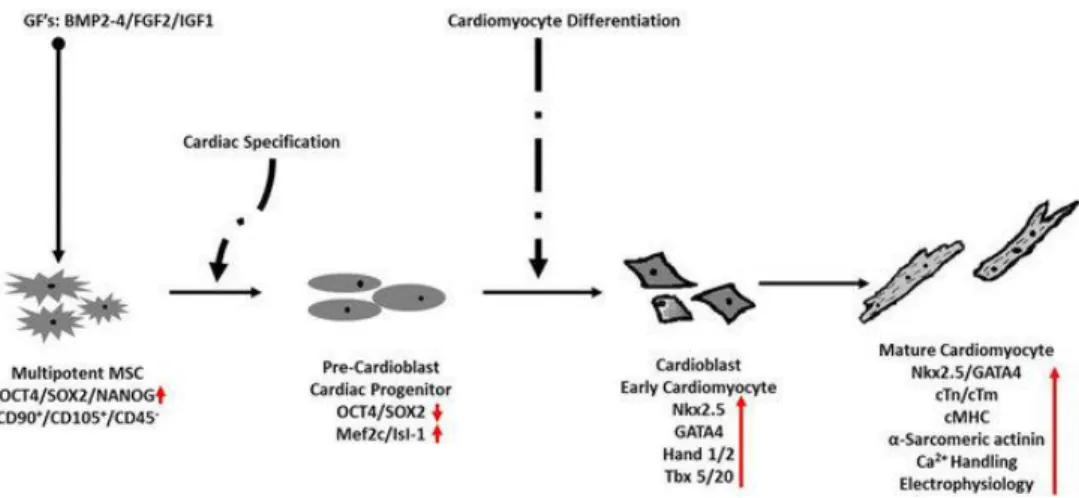
Figure 1.1. Illustration of expected stages of cardiomyogenesis in MSCs …… 7
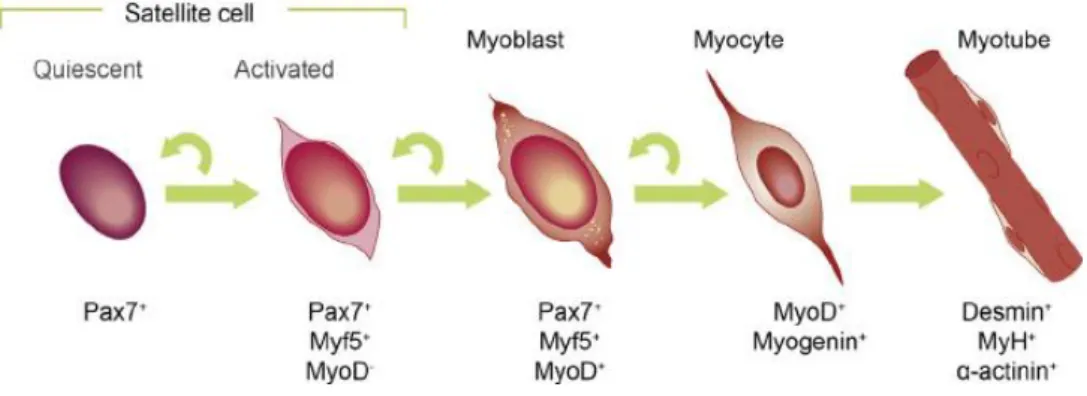
Figure 1.2. Differentiation progression during adult myogenesis: from satellite cells to differentiated myotubes ……… 7 Figure. 1.3. Wurzite structure of ZnO and induced dipole moment through mechanical stress ……… 9 Figure 1.4. When uni-axially grown ZnO NRs is convexly bent, the net potential is zero ……… 9 Figure 1.5. When bi-axially grown ZnO NRs is convexly bent, positive charge is generated in a convex direction ……… 9 Figure 3.1. Schematic diagrams for stimulation of cardiomyogenic differentiation of hMSCs using stretchable piezoelectric substrate (SPS) ……… 36 Figure 3.2. Fabrication and characterization of SPS ……… 39 Figure 3.3. Cytotoxicity of SPS, bending, CS, and EP ……… 42
Figure 3.4. hMSC alignment induced by cyclic stretching for 10 days ……… 44
Figure 3.5. Enhanced cardiomyogenic differentiation of hMSCs in vitro by EP and cyclic stretching for 10 days ……… 47 Figure 3.6. Cardiomyogenic differentiation-related autocrine factor expression and
Figure 4.1. Schematic diagrams for myogenic differentiation of hUCBMSCs using T SP S ……… ……… ……… ……… ……… ……… ……… ……… …… 58 Figure 4.2. Fabrication and piezoelectric charisteristics of TSPS. (A) A single crystalline ZnO NR ……… 61 Figure 4.3. Simulation of the cell membrane potential changes due to piezoelectric p o t e n t i a l … … … 6 5 Figure 4.4. Thermosensitive properties of TSPS ……… 68
Figure 4.5. Enhanced myogenic differentiation of hUCBMSCs in vitro by PMEC for 10 days ……… 71 Figure 4.6. Myogenic differentiation-related intracellular signaling induced by PMEC ……… 75 Figure 4.7. Characterization of myogenic differentiated hUCBMSCs sheet fragments ……… 78 Figure 4.8. Improved skeletal muscle regeneration by injection of myogenic differentiated hUCBMSC sheet fragments 10 days after cell injection into injured muscle in mice ……… 81 Figure 4.9. Enhanced cell retention of myogenic differentiated hUCBMSC sheet fragments injected into injured muscle in mice ……… 84
Abbreviations
5-azaC 5-azacytidine ANOVA analysis of variance
ATF6 activating transcription factor BCL-2 B-cell CLL/lymphoma 2 bFGF basic fibroblast growth factor BMP bone morphogenetic protein
BMSC bone marrow-derived mesenchymal stem cell CACNA1C voltage-dependent, L type, alpha 1C subunit cDNA complementary DNA
CM cell membrane
CTX cardiotoxin
Cx43 connexin43
DAPI 4,6-diamidino-2-phenylindole ECM extracellular matrix
EDL electrical double layer
ERK1/2 extracellular signal-regulated kinases 1/2 FAK focal adhesion kinase
FITC fluorescein isothiocyanate GATA4 GATA binding protein 4
grp78 glucose-regulated protein 78 kDa H&E hematoxylin and eosin
HCN2 cyclic nucleotide-gated potassium channel 2 HMTA hexamethylenetetramine
HNA human nuclear antigen hsp27 heat shock protein 27
hUCBMSC human umbilical cord blood-derived mesenchymal stem cell IACUC Institutional Animal Care and Use Committee
IGF insulin-like growth factor MEF-2 myocyte enhancer factor 2 MRFs myogenic regulatory factors
MS mechanical strain
Myh2 myosin heavy chain 2 NKX 2.5 NK2 homeobox 5
nNOS neuronal nitric oxide synthase 1 PBS phosphate buffer saline
PDMS polydimethylsiloxane
pERK1/2 phosphorylated extracellular signal-regulated kinases 1/2 pFAK phosphorylated focal adhesion kinase
PMEC pulsatile mechanoelectric cues
pmTOR phosphorylated mammalian target of rapamycin pNIPAAm poly(N-isopropylacrylamide)
PP piezoelectric pulse
pp38 phosphorylated p38 pSMAD phosphorylated SMAD
qPCR quantitative polymerase chain reaction RhoA Ras homolog family member A
RNA ribonucleic acid
RT-PCR reverse transcription polymerase chain reaction
SPS stretchable piezoelectric substrate SWCNT single-walled carbon nanotubes TA tibialis anterior
TBPO tert-butyl peroxide TCP tissue culture plate
TEM transmission electron microscope TGF-β transforming growth factor-β TRITC rhodamine
TSPS thermosensitive, stretchable, and piezoelectric substrate VEGF vascular endothelial growth factor
Vmem cell membrane potential
XPS X-ray photoelectron spectroscopy ZnO NRs zinc oxide nanorods
β-MHC beta myosin heavy chain
Chapter 1.
Research backgrounds and objective
1.1. Cardiovascular diseases and stem cell therapy
When cardiovascular diseases, such as myocardial infarction occur, cardiomyocytes undergo apoptosis and necrosis due to lack of nutrients or oxygen.1 The major problem of these cardiovascular diseases is that only a few cardiomyocytes regenerate in infarcted area and are progressively replaced by fibroblasts to form scar tissues.2 The host cells are not able to fully reconstitute the fibrotic tissue and overcome cardiac malfunction due to this massive loss of functional cardiomyocytes, and these problems leads to chronic heart diseases or death.
To treat such cardiovascular diseases, heart transplantation has been a therapy for several decades, however, it has severe limitation by the shortage of donors and the host immune rejection. To overcome such problems, cell therapy, especially stem cell therapy, has been widely studied in this century. The role of the transplanted stem cell in infarcted area is still unknown, but blood vessel formation, scar tissue reduction, or secretion of beneficial growth factors or cytokines are suggested.3-4
Also, some of the studies tried to differentiate the stem cell into functional cardiomyocytes ex vivo before transplantation, using embryonic stem cells.
Although embryonic stem cells have shown a good functional performance, the embryonic stem cells have a severe limitation for being transplanted in vivo, such as teratoma formation.5 To overcome such problems, mesenchymal stem cells
were transplanted into infracted area, these cells hardly differentiate into functional cardiomyocytes in vivo, indicating that transplantation of undifferentiated MSCs may not be the best approach for cardiac regeneration.3, 7 Thus the differentiation of MSCs into functional cardiomyocytes has been widely studied, while the capability of MSCs differentiating into functional cardiomyocytes is still controversial.
1.2. Skeletal muscle disorders and stem cell therapy
Functional loss of skeletal muscle tissue due to trauma, aging, genetic problem, or degenerative muscle disorders, such as sarcopenia and muscular dystrophy, have significant clinical problems in human society. Several clinical trials have been developed, however, they were not much efficient due to morbidity of target tissues.
Spontaneous regeneration of adult skeletal muscle is regulated by the differentiation of myogenic precursor cells, termed satellite cells, which are quiescent in normal state.8-9 Under abnormal conditions, the satellite cells proliferate as myogenic precursor cells, termed myoblasts, and ultimately undergo terminal differentiation and fuse to each other to form new myotubes or incorporate into pre-existing muscle fibers.
There have been many therapeutic challenges for treatment of such skeletal muscle disorders, especially cell therapy, as many skeletal muscle disorders are caused by severe degeneration compared to satellite cell proliferation and differentiation.10 First, myoblasts have been suggested to be transplanted into patients, resulting only low therapeutic efficiency by poor cell survival, immune rejection, poor migration in vivo, and slow proliferation in vitro.11-12 To overcome such problems, adult stem cells such as MSCs have been a candidate source for skeletal muscle regeneration. Although stem cells transplantation have shown better regeneration efficiency than myoblasts, the frequency of incorporation into skeletal muscle was still not high enough.13
1.3. Cardiomyogenic and skeletal myogenic differentiation of MSCs
As MSCs hardly function or incorporate into cardiac muscle tissue or skeletal muscle tissue transplanted in vivo, MSCs have to be primed or be differentiated into cardiomyocytes or skeletal myocytes.
To differentiate MSCs into cardiomyocytes, treatments with 5-azacytidine (5- azaC),14-15 growth factors such as transforming growth factor-β (TGF-β),16 basic fibroblast growth factor (bFGF), insulin-like growth factor-1 (IGF-1), and bone morphogenetic protein-2 (BMP-2),17 conditioned medium from cardiomyocyte culture,18 and by co-culture with cardiomyocytes.19 However, chemical factors, such as 5-azaC, are able to promote cardiomyogenic differentiation of MSCs (Fig.
1.1), the efficiency is known to be relatively low.
For skeletal myogenic differentiation of MSCs, some methods such as development of myogenic medium,20-21 culturing cells in three-dimensional scaffold,22 and expose to laser irradiation23 have been developed, by their efficiency of differentiation (Fig. 1.2) was also relatively low.
Recently, several studies have demonstrated that mimicking native muscle microenvironment, such as electrical24-25 and mechanical stimulation26-27 can promote myogenic differentiation of the stem cells. However, there was no study
Figure 1.1. Illustration of expected stages of cardiomyogenesis in MSCs.28
Figure 1.2. Differentiation progression during adult myogenesis: from satellite cells to differentiated myotubes.29
1.4. Piezoelectricity
In the present study, we developed a stretchable piezoelectric substrate (SPS) for myogenic differentiation of hMSCs. SPS consists of aligned bi-axially grown ZnO NRs which have piezoelectricity, and polydimethylsiloxane (PDMS) which has elasticity.
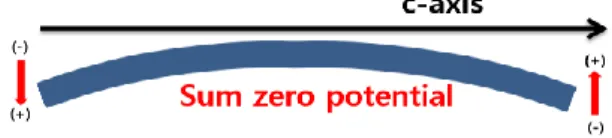
Piezoelectricity is the electric charge that accumulates in certain solid materials, in response to applied mechanical stress. The piezoelectric effects of piezoelectric materials are closely related with the electric dipole moments. When a mechanical stress is applied, the polarization of the dipole moment changes to generate piezoelectric effect. In our study, we used bi-axially grown zinc oxide nanorods (ZnO NRs) for piezoelectric property of SPS. ZnO has a hexagonal wurzite structure, which have a permanent dipole moment in the positive direction along the c-axis (Fig. 1.3). The ZnO NRs can be bi-axially or uni-axially grown, however, when the uni-axially grown ZnO NRs were bent, the net potential of the ZnO NRs becomes zero as shown in figure 1.4. On the other hand, when the bi-axially grown ZnO NRs were convexly bent, positive charge is generated in a convex direction as shown in figure 1.5.
Figure. 1.3. Wurzite structure of ZnO and induced dipole moment through mechanical stress
Figure 1.4. When uni-axially grown ZnO NRs is convexly bent, the net potential is zero.
Figure 1.5. When bi-axially grown ZnO NRs is convexly bent, positive charge is generated in a convex direction.
1.5. Thermosensitivity and cell sheet formation
As previously mentioned, cell therapy has been widely used for muscle disorders, such as myocardial infarction or skeletal muscle degeneration. However, when the cells are transplanted in vivo, the poor survival of the transplanted cells has been a severe problem, such as anoikis. 30-32 Anoikis means programmed cell death of anchorage-dependent cells, occurred when they are detached from the surrounding extracellular matrix (ECM). To prevent anoikis, various methods have been devised, such as three dimensional culture as cell spheroid, 31 or cell sheet formation.32 In part 4, the skeletal myogenic differentiated cells were transplanted as a form of cell sheet fragments to prevent anoikis.
We have grafted poly(N-isopropylacrylamide) (pNIPAAm) which has thermosensitivity on the surface of SPS to fabricate TSPS. pNIPAAm is a thermosensitive polymer, which undergoes a reversible phase transition from a swollen hydrophilic state to a shrunken hydrophobic state, when it is heated above 32ºC. pNIPAAm has been widely used in tissue engineering, as the temperature of the reversible phase transition is near that of the human body.
In the present study, the cells cultured and differentiated on TSPS in chapter 4, were detached as a cell sheet and sliced into smaller fragments to be injected with syringe, to increase engraftment efficiency and prevent anoikis.
1.6. Research objective of thesis
The research objective in this thesis is the enhancement of the myogenic differentiation efficiency of hMSCs, for stem cell therapy to treat muscle disorders, such as myocardial infarction or skeletal muscle degeneration.
Firstly, the chapter 3 reports the enhanced cardiomyogenic differentiation of bone marrow-derived hMSCs using SPS. In cardiac microenvironments, electric pulse and cyclic mechanical strain are sequentially produced. However, no study has applied the pulsatile mechanoelectric cues (PMEC) to stimulate cardiomyogenic differentiation of MSCs ex vivo. We developed the SPS that can provide PMEC to hMSCs for cardiomyogenic differentiation ex vivo. We showed that hMSCs subjected to PMEC by SPS underwent promoted cardiac phenotype development; cell alignment and the expression of cardiac markers (i.e., cardiac transcription factors, structural proteins, ion channel proteins, and gap junction proteins). The enhanced cardiac phenotype development was mediated by the up- regulation of cardiomyogenic differentiation-related autocrine factor expression and focal adhesion kinase and extracellular signal-regulated kinases signaling pathways. Ex vivo induction of cardiomyogenic differentiation of hMSCs using SPS prior to implantation would potentiate therapeutic efficacy of stem cell therapies for ischemic heart diseases, since MSCs rarely undergo cardiomyogenic differentiation following implantation.33 However, we did not observed the in vivo therapeutic efficacy of cardiomyogenic differentiated hMSCs.
potential and muscle contraction. We developed a cell culture system that can mimic the in vivo microenvironment and provide these stimuli to cultured cells and investigated whether the stimulation can promote skeletal myogenic differentiation of hUCBMSCs. TSPS was fabricated by subsequent grafting pNIPAAm on the polydimethylsiloxane surface of SPS. PMEC were provided to hUCBMSCs cultured on TSPS by subjecting TSPS to cyclic stretching and bending, resulting in significantly promoted skeletal myogenic differentiation of hUCBMSCs as well as intracellular signaling related to the differentiation. Following differentiation ex vivo, the cells were detached from TSPS in the form of cell-sheet fragments by changing the temperature to 4°C. The injection of cell-sheet fragments of differentiated cells into injured skeletal muscle in mice showed improved cell retention and muscle regeneration compared to injection of either undifferentiated cells or differentiated/dissociated cells. This system may provide a tool for study of electrical and mechanical regulation of stem cells and be utilized to potentiate stem cell therapies.
Chapter 2.
Experimental methods
2.1. Fabrication and characterization of SPS, TSPS
2.1.1. Chemicals
Zinc nitrate hexahydrate (Zn(NO3)2·6H2O, ≥ 99.0 %), hexamethylenetetramine (HMTA) (C6H12N4, ≥ 99.0 %) and anhydrous hexane were purchased from Sigma Aldrich (St. Louis, MO, USA). Zinc nitrate hexahydrate and HMTA were dissolved in deionized water by stirring for 30 min prior to use. Sylgard 184 PDMS prepolymer and curing agents were purchased from Dow Corning Chemicals (Midland, MI, USA).
2.1.2. Synthesis of bi-axially grown ZnO NRs
A wet chemical process was used to prepare bi-axially grown ZnO NRs.34 Two precursor solutions were prepared by separately dissolving 0.42 g of zinc nitrate hexahydrate in 100 mL of deionized water and 0.24 g of HMTA in 100 mL of deionized water at room temperature. The zinc precursor solution was continuously injected into the HMTA solution with vigorous stirring at 85 °C via a syringe pump at an injection rate of 2 mL/hr for 25 min, and the process was completed after aging for 5 min. After synthesis, ZnO NRs were washed three times with deionized water and dried at 80 °C. Finally, the ZnO NR powder was thermally annealed at 400 °C for 2 hr in vacuum to increase crystallinity.
2.1.3. Fabrication of SPS
Before the PDMS was used (PDMS:PDMS curing agent weight ratio = 10:1), PDMS and hexane were mixed to control the film thickness of PDMS (PDMS:hexane weight ratio = 1:1). The PDMS and hexane mixtures were spin- coated at 3,000 rpm for 30 sec. A monolayer of ZnO NRs was formed using a unidirectional rubbing process with a PDMS block on the PDMS substrate. This procedure was repeated five or three times to make a one-direction array and close- packed SPS with five layers of ZnO NRs that generated 3 V or 120 mV. 3 mm of PDMS was prepared for before stacking 5 layers fabricating of SPS, and each layer, consisting of ZnO NRs and PDMS, was 5 μm-thick. The thickness and electrical properties were evaluated after SPS formation.
2.1.4. pNIPAAm grafting
GMA monomer (97%) and the tert-butyl peroxide (TBPO) initiator (98%) were purchased from Sigma-Aldrich and used without further purification. Polymerized GMA films were deposited onto the stretchable piezoelectric substrate in an iCVD reactor (Daeki Hi-Tech Co., Korea). GMA monomer was heated to 35 °C and the vaporized GMA was fed into the reactor at a flow rate of 1.9 sccm for coating the pGMA film on the stretchable piezoelectric substrate. The vaporized TBPO initiator was fed into the reactor via metering valves at a flow rate of 0.8 sccm at room-temperature. In order to keep the stretchable piezoelectric substrate at 25 °C during the pGMA coating process, the substrates were placed on a stage cooled by a recirculating chiller. The filament temperature was maintained at 180 °C. The growth rate of film deposition was monitored in situ using a He-Ne laser (JDS Uniphase, Milpitas, USA). Amine-terminated pNIPAAm (Mn = 2500, Sigma- Aldrich Co.) was dissolved in deionized (DI) water at a concentration of 1 g/30 mL.
The pNIPAAm solution was reacted with the pGMA deposited the stretchable piezoelectric substrate through epoxy-amine addition reaction in a shaker at 50 °C for 12 h at 55 rpm. Next, it was washed several times with DI water. Prior to cell seeding, substrates were sterilized with 70% (v/v) ethanol and UV treated for 1 h on a clean bench.
2.1.5. Piezoelectric properties of SPS and TSPS
The morphology of the ZnO NRs was characterized with a JEOL JSM-7000F field emission SEM (FESEM, Jeol Ltd, Akishima, Tokyo, Japan; 15 kV). To evaluate the electrical properties of the SPS, silver electrodes (200 nm) were deposited on the top and bottom sides of the SPS by thermal evaporation. The silver electrode was not used for cell culture. After placing the device on the 3-mm thick PDMS substrate, voltage and current signals were measured. The SPS was then bent with a 20 mm bending radius, and the current density and voltage generated were measured using a picoammeter (Keithley 6485, Keithley Instruments, Cleveland, OH, USA) and electrometer/high resistance meter (Keithley 6517, Keithley Instruments), respectively. It is not possible to experimentally acquire values of voltage and current at the same time, since the measured voltage is an open circuit voltage and the measured current is a short circuit current. Five samples were used for evaluation of electrical properties in this study. The deviation of voltage and current between samples was less than 10 %. Permanent deformations of SPS and PDMS were determined by comparing the length after cyclic bending or cyclic bending/stretching (n = 3) to the original length. ZnO NR alignment in the SPS was evaluated on day 0 and after 10 days of cyclic bending and stretching using 5 images photographed at random sites on the substrate using an optical microscope (BX41, Olympus, Tokyo, Japan). The alignment was analyzed using Image J software (National Institute of Health, Bethesda, MD, USA).
2.1.6. Thermosensitivity of TSPS
The chemical composition and atomic ratio of PDMS, pGMA-PDMS and pNIPAAm-pGMA-PDMS surface was analyzed by X-ray photoelectron spectroscopy (XPS, K-alpha, Thermo VG Scientific Inc, UK). The vacuum base pressure was maintained at 2.0 × 10⁻⁹ mb. The spectrum was recorded with a monochromatic Al Kα radiation X-ray source having 12kV and 1486.6eV KE with the range of 100 – 1100 eV. The atomic ratio of each surface was determined by Avantage program (Thermo Scientific).
To evaluate the thermosensitivity of TSPS, the TSPS was characterized using contact angle measurements, in two different temperatures, 25 ̊C and 37 ̊C.
Deionized water droplet (2 μL) was delivered on the TSPS surface by a calibrated syringe. To test the detachment of the attached cells, the cells on TSPS were cooled down to 4 °C for 10 min, being dipped in cold PBS. The cell detachment was observed using an image analysis system coupled to a light microscope.
2.2. In vitro assays
2.2.1. hMSC culture and cardiomyogenic differentiation
hMSCs (Lonza, Walkersville, MD, USA) were plated at 5 x 10⁴ cells/cm2 on tissue culture plate (TCP) and various types of substrates, and cultured. To promote cell attachment to the surfaces of TCP and the substrates, the surfaces were treated with oxygen plasma (60 W, PDC-32G, Harrick Scientific, Ossining, NY, USA) for 1 min. hMSCs were cultured with Dulbecco's Modified Eagle Medium low glucose (Gibco BRL, Gaithersburg, MD, USA) supplemented with 10 % (v/v) fetal bovine serum (Gibco BRL) and 1 % (v/v) penicillin/streptomycin (Gibco BRL) at 37 °C in a humidified incubator with 5 % (v/v) CO2. hMSCs at 5 passages were used for the experiments. hMSCs were pre-treated with 5-azaC (6 µmol/L) for 1 day. Cells were allowed to adhere to the substrates for 1 day, and subjected to cyclic bending at a 20 mm bending radius and 1 Hz frequency, and cyclic stretching at an amplitude of 3 % of the original length of the substrates and 1 Hz frequency for 10 days using a custom-made cell culture apparatus. We used 1 Hz frequency, because this frequency is similar to human heartbeat rate, as we used human-derived cells for cardiomyogenic differentiation. The culture medium was changed every 3 days.
2.2.2. hUCBMSC culture and skeletal myogenic differentiation
hUCBMSCs (Kangstem Biotech, Seoul, Korea) were plated at 5 x 10⁴ cells/cm2 on TSPS and cultured. To promote cell attachment on TSPS, TSPS was treated with oxygen plasma (60 W, PDC-32G, Harrick Scientific, Ossining, NY, USA) for 1 min. hUCBMSCs were cultured with Dulbecco's Modified Eagle Medium low glucose (Gibco BRL, Gaithersburg, MD, USA) supplemented with 10 % (v/v) fetal bovine serum (Gibco BRL) and 1 % (v/v) penicillin/streptomycin (Gibco BRL) at 37 °C in a humidified incubator with 5 % (v/v) CO2. hUCBMSCs at 5 passages were used for the experiments. For skeletal myogenic differentiation, myogenic medium consisting of Dulbecco's Modified Eagle Medium low glucose, 5 % horse serum, 0.1 μM dexamethasone, and 50 μM hydrocortisone was used.20 To inhibit calcium influx, 10 μM of nifedipine (Sigma) was added to myogenic medium. Cells were allowed to adhere to TSPS for a day and subjected to cyclic bending (36 mm bending radius) and/or cyclic stretching (amplitude of 3 % of the original length of the substrate) at 0.3 Hz frequency for 10 days using a custom-designed cell culture chamber. The external stimulation conditions were adjusted to conditions that did not induce apoptotic effects or cell detachment, but promote myogenic differentiation. Also, we used a shorter time point than previous study,20 10 days, to confirm the higher efficiency of our method for myogenic differentiation.
2.2.3. Immunocytochemistry
The cells on the substrates (n = 3) were fixed with 4 % paraformaldehyde for 10 min at room temperature and washed in phosphate buffer saline (PBS, Gibco-BRL).
Primary antibodies against caspase-3, connexin43 (Cx43), sarcomeric α-actinin, myogenin (all antibodies from Abcam) were used for staining. The samples were then incubated in PBS containing rhodamine (TRITC) or fluorescein isothiocyanate (FITC)-conjugated secondary antibodies (Jackson-Immunoresearch, West Grove, PA, USA) for 1 hr at room temperature. All samples were mounted with mounting solution containing 4,6-diamidino-2-phenylindole (DAPI, Vector Laboratories, Burlingame, CA, USA) to stain the nuclei, and photographed using a fluorescent microscope (Olympus, Tokyo, Japan).
2.2.4. Reverse transcription polymerase chain reaction (RT-PCR) RT-PCR was used to compare the relative gene expressions of CASPASE-3, BCL- 2, P53, BMP-4, TGF-β, VEGF, and IGF. Samples (n = 4) were lysed with TRIzol reagent (Invitrogen, Carlsbad, CA, USA). Total ribonucleic acid (RNA) was extracted with chloroform (Sigma) and precipitated with 80 % (v/v) isopropanol (Sigma). After the supernatant was removed, the RNA pellet was washed with 75 % (v/v) ethanol, air-dried, and dissolved in 0.1 % (v/v) diethyl pyrocarbonate-treated water (Sigma). RNA concentration was determined by measuring the absorbance at 260 nm with a NanoDrop 2000 Spectrophotometer (Thermo Scientific, Wilmington, DE). Reverse transcription was performed using 5 μg of pure total RNA and SuperScriptTM II reverse transcriptase (Invitrogen), followed by PCR amplification of the synthesized complementary DNA (cDNA). PCR consisted of 35 cycles of denaturing (94 °C, 30 sec), annealing (58 °C, 45 sec), and extending (72 °C, 45 sec), with a final extension at 72 °C for 10 min. PCR was followed by electrophoresis on 2 % (w/v) agarose gel and visualized using ethidium bromide staining. PCR products were analyzed using a gel documentation system (Gel Doc 1000, Bio-Rad, Hercules, CA, USA). β-actin served as the internal control. The RT- PCR results were quantified with an Imaging Densitometer (Bio-Rad).
2.2.5. Phalloidin staining
Phalloidin staining was performed to determine F-actin alignment and cell fusion, using an Actin Cytoskeleton and Focal Adhesion Staining Kit (FAK100; Millipore, Billerica, MA) according to the manufacturer's instructions. The images were photographed using a fluorescent microscope (Olympus). The average number of nuclei per cell was quantified by dividing the number of nuclei to the number of cell body (n > 100). The fused cell percentage was determined by dividing the number of multinucleated nuclei to the total number of nuclei analyzed (n > 100).
The angle of the F-actin-stained cell alignment to the direction of the MS was determined using Image J software (National Institute of Health, Bethesda, MD).
2.2.6. Western blot analysis
Apoptotic activity, cardiomyogenic differentiation, skeletal myogenic differentiation, and molecular signaling were evaluated by detecting relevant protein markers using western blot analysis. Cells (n = 4) were washed three times with PBS, lysed by adding sodium dodecyl sulfate (SDS) sample buffer (62.5 mM Tris–HCl (pH 6.8), 2 % SDS, 10 % glycerol, 50 mM dithiothreitol, 0.1 % Bromophenol Blue), and scraped. Proteins in the buffer were electrophoretically separated on 4-10 % SDS polyacrylamide gels and transferred to membranes (Millipore, Bedford, MA, USA). For protein detection, membranes were incubated with primary antibodies against caspase-3, Cx43, NKX2.5, MEF-2, GATA4, sarcomeric α-actinin, β-MHC, p38, pp38, SMAD, pSMAD, FAK, pFAK, ERK1/2, pERK1/2, MyoD, myogenin, troponin I, ATF6, RhoA, nNOS, mTOR, pmTOR, and β-actin (all antibodies from Abcam, Cambridge, MA, USA), overnight at 4 °C.
They were then washed and incubated with secondary antibodies conjugated to horseradish peroxidase (Sigma) for 50 min at room temperature. Blots were developed using enhanced chemiluminescence (LumiGLO, KPL Europe, Guildford, UK) as recommended by the manufacturer.
2.2.7. Quantitative polymerase chain reaction (qPCR)
qRT-PCR was used to quantify relative gene expression of ion channel markers, HCN2 and CACNA1C, and skeletal myogenic differentiation markers, MyoD, Myogenin, MEF2, troponin I and myosin heavy chain 1 and 2. Total RNA was extracted from samples (n = 4) using 1 mL Trizol reagent (Invitrogen) and 200 μL of chloroform. The lysed samples were centrifuged at 12,000 rpm for 10 min at 4 °C. The RNA pellet was washed with 75 % (v/v) ethanol in water and dried. After drying, samples were dissolved in RNase-free water. For qRT-PCR, the iQ™
SYBR Green Supermix kit (Bio-Rad) and the MyiQ™ single color Real-Time PCR Detection System (Bio-Rad), were used. β-actin served as the internal control.
2.2.8. Transmission electron microscope (TEM)
Cells were fixed using Karnovsky’s fixative for 4 h at 4 °C and rinsed three times with cold 0.05 M cacodylate buffer. The cells were fixed with 1 % osmium tetraoxide for 2 hr at 4 °C and washed twice with cold distilled water. The samples were treated with 0.5 % uranyl acetate overnight at 4 °C, dehydrated using graded concentrations of ethanol (30, 50, 70, 80, 90, 95, and 100%), rinsed with propylene oxide, and finally embedded in Spurr’s resin, which were then polymerized at 70 °C for 24 hr. Thin sections with thicknesses of 100 nm were obtained using an
2.2.9. Fragmentation of cell sheet
After hUCBMSCs were stimulated for myogenic differentiation for 10 days, the cell sheets were detached from TSPS by cooling down at 4 °C. The detached cell sheets were chopped into small cell sheet fragments (diameter = 94.9 ± 30.2 μm) for syringe injection and labeled with DiI. The cell sheet fragments were mounted with mounting solution containing DAPI (Vector Laboratories) to stain the nuclei.
The cell sheets were photographed using a fluorescent microscope (Olympus). The size of cell sheet fragments and number of nuclei per cell sheet fragments were quantified using Image J software (National Institute of Health).
2.3. In vivo assays
2.3.1. Inducing skeletal muscle injury and cell transplantation.
All animal experiments were performed under a protocol approved by the Institutional Animal Care and Use Committee (IACUC) of Seoul National University (SNU-160720-12). For muscle injury induction, 9 week-old female balb/c athymic nude mice (Orient Bio, Seoul, Korea) (n = 5 mice per group) were anesthetized with xylazine (10 mg/kg) and ketamine (100 mg/kg), and 50 μL of 1 mM cardiotoxin (CTX, Latoxan, Rosans, France) was administered into the right TA muscles of mice. One day after CTX injection, cells (2x10⁵ cells/mouse) or PBS were intramuscularly injected with 24-gauge syringe.
2.3.2. Histological examinations
Ten and 28 days after cell transplantation, the TA muscles were harvested and embedded in OCT compound. The embedded tissues were cut in 10 μm sections and stained with hematoxylin and eosin (H&E) or underwent to immunohistochemistry against laminin, troponin I, desmin, and HNA (all antibodies purchased from Abcam) by following standard protocols. The optical and fluorescent images were obtained using a light microscope (Olympus) and fluorescent microscope (Olympus), respectively. The cross-sectional area of
2.3.3. In vivo live imaging of injected cells
Before cell sheet detachment or treatment with trypsin, hUCBMSCs were labeled with DiO for 3 hr. At 4, 10, and 28 days after cell implantation into TA muscles, the mice were anesthetized with xylazine (10 mg/kg) and ketamine (100 mg/kg) and the retention of the injected cells was examined using an eXplore Optix System (Advanced Research Technologies Inc.).
2.4. Statistical analysis
All quantitative data are expressed as mean ± standard deviation. A one-way analysis of variance (ANOVA) using the Bonferroni test was performed to determine significant differences. The assumptions of ANOVA were found to satisfy Levene’s test for homogeneity of variance and to pass tests for normality. A value of p < 0.05 was considered statistically significant.
Chapter 3.
A stretchable piezoelectric substrate providing pulsatile mechanoelectric cues
for cardiomyogenic differentiation of
mesenchymal stem cells
3.1. Introduction
MSC therapy is an attractive strategy for treating myocardial infarction, which causes cardiomyocyte loss and scar tissue formation resulting in the loss of regional contractility of the heart.6, 33, 35-38
MSCs implanted into myocardial infarction regions exhibit therapeutic effects such as attenuating pathological cardiac remodeling and improving cardiac functions.6, 36-37 However, it is generally accepted that MSCs implanted into cardiac infarction sites rarely differentiate into cardiomyocytes.33 Therefore, the functional benefits observed in the MSC therapy for cardiac repair may be related to paracrine soluble factors secreted by the implanted MSCs rather than the differentiation of MSCs to cardiomyocytes.39 Importantly, ex vivo induction of the cardiac phenotype in MSCs prior to implantation may further improve the efficacy of the MSC therapy for cardiac repair. Indeed, several studies have demonstrated that implantation of bone marrow-derived mesenchymal stem cells (BMSCs) that were induced to differentiate into cells with cardiomyocyte-like phenotypes ex vivo resulted in better cardiac tissue regeneration with larger improvement in cardiac function, than implanting non-modified BMSCs.16, 38 Furthermore, in the previous study, the ex vivo modified BMSCs underwent myogenic differentiation after implantation, which is important for cardiac muscle regeneration and restoring contractility, but non-modified BMSCs did not.16
MSCs can exhibit cardiomyocyte-like phenotypes ex vivo by treatments with 5-azaC,15, 40-41 growth factors such as TGF-β,16 bFGF, IGF-1, BMP-2,17 conditioned
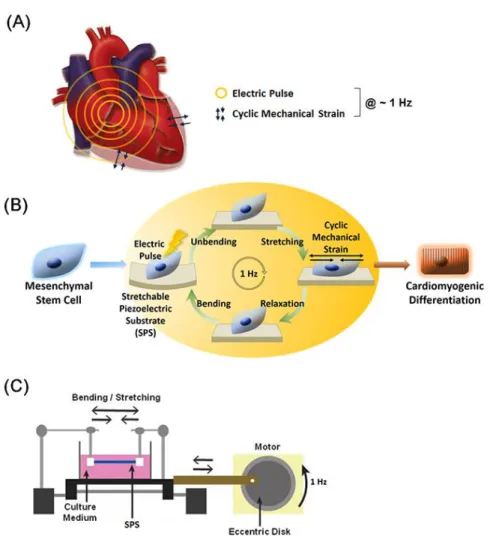
several studies have demonstrated that mimicking the microenvironments of in vivo cardiac tissue such as applying electric stimulation24-25 or cyclic strain26-27 (Fig.
3.1A), can enhance cardiomyogenic differentiation of MSCs more efficiently than chemical factors. However, no study has applied PMEC as a cardiac-mimetic microenvironments, in which mechanical strain (MS) and electric pulse (EP) are sequentially produced, to stimulate cardiomyogenic differentiation of MSCs in vitro yet.
Here, we developed a SPS that can provide PMEC to stimulate cardiomyogenic differentiation of human BMSCs in vitro. Piezoelectric materials can generate EP upon the deformation of their crystal structure by external MS.43 Recently, piezoelectric materials have been applied to many fields including self- powered devices,44 liquid crystal displays,45 and medical devices.46-47 The SPS used in this study was designed in the form of multi-stacked layer-by-layer composite consisting of aligned ZnO NRs and PDMS. Unlike typical uni-axial grown ZnO NR, bi-axially grown ZnO NR has been reported as a highly efficient piezoelectric crystal which can generate EP upon its c-axis bending.48 Moreover, the ZnO NR is biocompatible49 enough to be selected as the piezoelectric material in this study.
The SPS was used as a culture substrate for hMSCs to stimulate cardiomyogenic differentiation in vitro by providing the PMEC (Fig. 3.1B), which mimics the in vivo cardiac microenvironments. We have stimulated hMSCs for 10 days for cardiomyogenic differentiation, because previous studies used one or two
are cultured on an insulating material that is placed on an electric field generator.26 This is attributed to that electric field or electrostatic potential is formed on the insulating material surface when electric potential differences are present.50 Although PDMS is an insulating material, it has a low dielectric constant (≈ 2.3),51 indicating that PDMS of the SPS can be electrically charged by the electrical potential differences upon bending the SPS. Thus, bending the SPS can electrically stimulate hMSCs cultured on the SPS, even though the piezoelectric ZnO NRs of the SPS are wrapped with insulating PDMS. Finally, we investigated whether our technique stimulated cardiomyogenic differentiation of MSCs and cellular signaling pathways related to cardiomyogenic differentiation.
Figure 3.1. Schematic diagrams for stimulation of cardiomyogenic differentiation of hMSCs using stretchable piezoelectric substrate (SPS). (A) Electric pulse and cyclic mechanical strain signals are present in cardiac microenvironments. (B) SPS, on which hMSCs are cultured, can mimic the cardiac microenvironments and generate electric pulse and cyclic mechanical strain signals upon bending and cyclic stretching,
3.2. Results and discussion
3.2.1. Piezoelectric characteristics of SPS
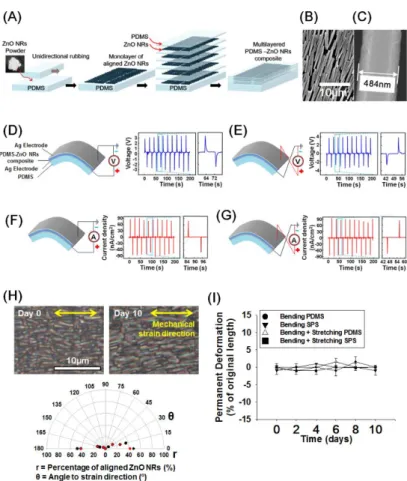
Figure 3.2A shows a typical process for fabricating SPS, which is based on a previous study.48 ZnO NR powder was produced using a kinetically controlled wet chemical method.34 The ZnO NRs were placed on a PDMS substrate and rubbed against another PDMS block in one direction. This created a monolayer of the ZnO NRs that were aligned in the direction of rubbing (Fig. 3.2B). During rubbing, one prismatic side (Fig. 3.2C) of ZnO NRs was affixed to the hydrophobic surface of the PDMS substrate along its in-plane direction until the entire surface of the substrate was covered with ZnO NRs. Strong van der Waals forces allowed the ZnO NRs to attach to the PDMS substrate. We then coated this monolayer with another thin PDMS layer to fasten the ZnO NRs to the substrate, thus forming the first layer of the NRs. By repeating this procedure five times, a multi-layered SPS was fabricated (Fig. 3.2A). The number of ZnO NR monolayers in the SPS was selected to generate a proper output voltage for electrically stimulating hMSCs.
In order to evaluate the output voltage and current density generated on the surface of the SPS upon bending, an energy-harvesting device with five layers of piezoelectric ZnO NRs was fabricated. The energy-harvester, of which the top and bottom sides of SPS was deposited with silver electrodes, was put on a PDMS substrate having the same thickness of the SPS and activated with a 20-mm bending radius. When the device was convexly bent, a positive voltage and current density
and bottom sides of the device, which were +1.5 V and -1.5 V, respectively.
Additionally, to prove the piezoelectric behavior of the SPS, polarity changes in the voltage and current density produced in the SPS were measured using a reverse connecting method as shown in figure 3.2E and G. When the electrical connecting direction was reversed, the polarities of the voltage and current density on the top side became negative.
The surface charge density of the SPS containing ZnO NRs is changed by bending the SPS, since the permanent dipole moment of each ZnO NR has the time- dependent deviation during the bending. PDMS of the SPS has no permanent dipole moment but finite dielectric property (dielectric constant ≈ 2.3).51 Thus, the electrostatic potential generated by the deviation in dipole moment of the ZnO NRs can be transferred to the surface of the SPS by charging the capacitance of the PDMS. Until fully charging the capacitance, the surface charge density of the SPS would be changed. Based on this principle, periodically changing surface charge density is generated on the surface of the SPS by the cyclic bending motion (Fig.
3.2D-G). Thus, hMSCs cultured on the SPS can be electrically stimulated by cyclic bending
The alignment of ZnO NRs in SPS was examined by optical microscopy. The direction of ZnO NRs was quantified at day 0 and after 10 days of cyclic bending and stretching. No significant change in the alignment of ZnO NRs was found for 10 days (Fig. 3.2H), so it could be assumed that the electric property of SPS would be maintained at least for 10 days of cell culture. In addition, SPS exhibited elastic
Figure 3.2. Fabrication and characterization of SPS. (A) The fabrication process of SPS.
SEM images of (B) aligned zinc oxide nanorods and (C) single zinc oxide nanorod in the SPS. Open circuit voltages generated on the SPS surface connected in the (D) forward and (E) reverse directions. Short circuit current density generated from the SPS connected in the (F) forward and (G) reverse directions. (H) Alignment of ZnO NRs in SPS at day 0 and after 10 days of cyclic bending and stretching. ZnO NRs were visible under light microscopy as the ZnO NR layer was covered by a very thin layer of PDMS.
The orientations of ZnO NRs were quantified on day 0 (black) and after 10 days (red)
3.2.2. Cytotoxicity of SPS, bending, stretching, and EP
Prior to cell differentiation experiments, the cytotoxicity of SPS, bending, stretching, and EP was evaluated by culturing hMSCs on SPS with or without stimulation. The biocompatibility and biosafety of ZnO nanowires were evaluated in a previous study, and showed no cytotoxicity below a concentration of 100 μg/ml.49
PDMS, ZnO NRs, and 5-azaC are known to be non-cytotoxic, however, we had to observe the apoptotic effects of EP and MS, especially at 3 V and 3 % of magnitude, respectively, as the EP and MS stimulation could induce apoptosis of hMSCs.
The SPSs were bent and unbent at a 20-mm bending radius to generate bi- polar pulsed 3 V EP. The SPSs were also subjected to cyclic strain at 3 % of the original length. The cytotoxic effect was evaluated by immunofluorescence staining of caspase-3, an apoptotic marker (Fig. 3.3A), and RT-PCR of CASPASE- 3 (Fig. 3.3B), B-cell CLL/lymphoma 2 (BCL-2, anti-apoptotic marker), and P53 (pro-apoptotic marker) (Fig. 3.3C). The results showed that no cytotoxic effect was induced by SPS itself, EP generated by SPS bending, cyclic bending (of PDMS), and stretching.
The cells in first group is the hMSCs cultured on tissue culture plate, as a negative control for cardiomyogenic differentiation. The cells of second and third
generation. The cells in sixth group were cultured on PDMS, and were cyclic bent and stretched, to be mechanically stimulated. The cells in last group were cultured on SPS, and were cyclic bent and stretched, to be simultaneously stimulated by MS and EP.
A previous study used 10 V electrostimulation for inducing cardiomyogenic differentiation of MSCs.25 In contrast, we used 3 V to circumvent the possible harmful apoptotic effects of EP on hMSCs as electrical stimulation above 10 V can decrease the viability of the cells.52 Previous studies have used a stretching amplitude of 10 % of the original length to induce cardiomyogenic or vascular differentiation of MSCs.27, 53 However, more than 5 % of stretching amplitude induced cell detachment and even cell death in the present study (data not shown).
Therefore, we used 3 % of stretching amplitude of in this study, which showed no cytotoxicity or cell detachment but able to induce cell alignment.
Figure 3.3. Cytotoxicity of SPS, bending, CS, and EP. (A) Apoptotic activity of hMSCs cultured under various conditions for 10 days as evaluated by immunocytochemistry for caspase-3 (red, arrows, n = 3 per group). Blue indicates nucleus (DAPI). Scale bars
3.2.3. Cell alignment induced by cyclic stretching
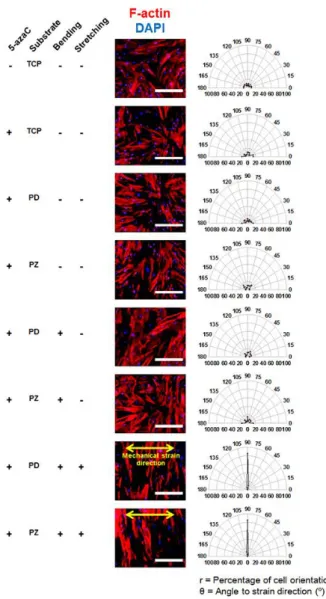
Cardiac cell alignment is important for anisotropic action potential propagation and cardiac contraction.54 MSCs are known to align perpendicularly to the direction of cyclic stretching to minimize the external stress.27 F-actin staining analysis revealed that cyclic stretching induced a perpendicular alignment of hMSCs (Fig. 3.4), which is in accordance with the results of previous studies,27, 53 while cells randomly aligned in the other groups. Bending or EP did not induce cell alignment. cyclic stretching also enhanced the expression of Cx43 (Fig 3.5A), a protein strongly related to cell-cell coupling and cellular conductivity, which are essential to the cardiac contraction.54 The cyclic stretching-induced cell alignment and Cx43 expression is in agreement with the results of previous reports in which cardiomyocytes and smooth muscle cells subjected to cyclic stretching were aligned and expressed more Cx43.55-56
Figure 3.4. hMSC alignment induced by cyclic stretching for 10 days, as evaluated by F-actin staining (phalloidin staining, red). Blue (DAPI) indicates the nucleus of hMSC.
3.2.4. Enhanced cardiomyogenic differentiation by EP and cyclic stretching.
We investigated whether EP and cyclic stretching additively promote the cardiomyogenic differentiation of hMSCs (Fig. 3.5). Treatment with 5-azaC induced the expression of cardiomyogenic genes at low levels, which is in accordance to previous studies.14-15, 38 After treatment with 5-azaC (i.e., under permissive condition for cardiomyogenic differentiation), EP and cyclic stretching additively promoted the expression of early stage cardiac markers, such as cardiac- associated transcription factors [NK2 homeobox 5 (NKX2.5), myocyte enhancer factor 2 (MEF-2), and GATA binding protein 4 (GATA4)], late stage cardiac- specific structural markers, such as beta myosin heavy chain (β-MHC) and sarcomeric α-actinin,28 and a gap junction protein (Cx43), as evaluated by Western blot analyses (Fig. 3.5A). In the absence of bending and CS, PDMS and SPS groups did not exhibit enhanced cardiomyogenic differentiation. The enhanced expression of Cx43 and sarcomeric α-actinin in the EP and cyclic stretching group was confirmed by immunocytochemistry (Fig. 3.5B). In the cardiac microenvironment, gap junction proteins (Cx43) are essential for the conductivity between cells (i.e., cell-to-cell calcium ion fluctuation) and contraction of the cells.54, 57-59 Previous studies have shown that cardiomyocytes express more Cx43 when subjected to cyclic stretching.55, 60 Cardiomyogenic differentiation of MSCs induced by either EP or cyclic stretching has already been reported in previous studies.24-25, 27, 61
However, no study has reported the additive enhancement in cardiomyogenic
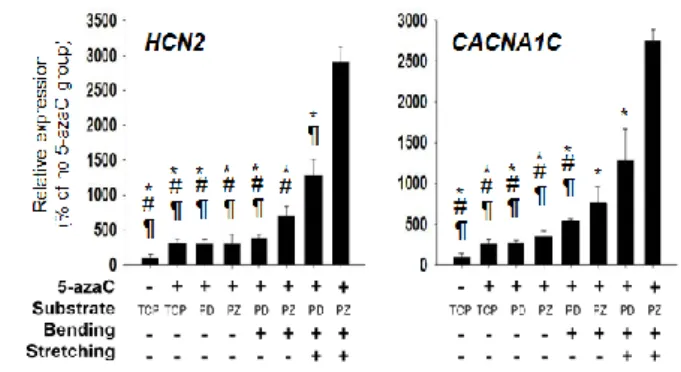
voltage-dependent, L type, alpha 1C subunit (CACNA1C), as evaluated by qPCR (Fig. 3.5C). The ion channels are known to be essential for the electrical activity of the heart such as the generation of ion currents for action potential.62 Meanwhile, contraction is one of the critical functions of mature cardiomyocytes, and some studies have observed the contractility of cardiomyogenic cells, especially differentiated from embryonic stem cells or induced pluripotent stem cells.
However, many studies observed that cardiomyogenic cells differentiated from MSCs did not show cell contraction. In agreement of those studies, we had not observed the contractility of the cardiomyogenic cells differentiated cells from hMSCs.
Figure 3.5. Enhanced cardiomyogenic differentiation of hMSCs in vitro by EP and cyclic stretching for 10 days. (A) Western blot analysis and quantification for early (NKX 2.5, MEF-2, and GATA4) and late stage (β-MHC and sarcomeric α-actinin) cardiac markers, and Cx43. (n = 4 per group, *p < 0.05 versus the PZ/bending/stretching group, #p < 0.05 versus the PDMS/ bending/stretcing group, ¶p
< 0.05 versus the PZ/bending group). (B) Enhanced expression of Cx43 (green) and sarcomeric α-actinin (red) as evaluated by immunocytochemistry. Blue (DAPI) indicates the nucleus of hMSC. Scale bars indicate 50 μm. (C) mRNA expression of ion channel markers (HCN2, CACNA1C) as quantified by qRT-PCR. (n = 4 per group,
*p < 0.05 versus the PZ/bending/stretching group, #p < 0.05 versus the PDMS/bending/stretching group, ¶p < 0.05 versus the PZ/bending group) TCP, PD and PZ stand for tissue culture plate, PDMS and SPS, respectively.
3.2.5. Cardiomyogenic differentiation-related autocrine growth factor expression and intracellular signaling enhanced by EP and cyclic stretching.
Figure 3.6A summarizes autocrine factor expression and intracellular signaling pathways, which can be stimulated by EP and cyclic stretching, for cardiomyogenic differentiation of MSCs. EP or electric field is known to increase the expression of growth factors,63 such as BMP-4,64 IGF,65 vascular endothelial growth factor (VEGF),66 and TGF-β,65 that enhance the cardiomyogenic differentiation of MSCs in an autocrine mechanism. Cyclic stretching is known to increase the expression of IGF,67 VEGF,68-69 and TGF-β.70-71 BMP-4 is known to induce cardiomyogenic differentiation by enhancing phosphorylation of SMAD-1,4,5,8 and upregulating NKX2.5, MEF-2, and β–MHC.72-73 VEGF and TGF-β were shown to enhance Cx43 expression.74 IGF was shown to induce cardiomyogenesis by enhancing phosphorylation of p38 and upregulating MEF-2.75 As demonstrated by RT-PCR data in figure 3.6B, EP and cyclic stretching additively upregulated mRNA expression of BMP-4, TGF-β, VEGF, and IGF in hMSCs, which are autocrine factors that enhance cardiomyogenic differentiation via the intracellular signaling mechanism shown in figure 3.6A. As hMSCs were stimulated by the autocrine factors, EP and cyclic stretching additively enhanced the protein expressions of intracellular signaling molecules for cardiomyogenic differentiation [phosphorylated p38 (pp38) and phosphorylated SMAD (pSMAD)], as evaluated by Western blot analyses (Fig. 3.6C). Additionally, the phosphorylation of focal
elevating GATA4 expression.80 As all data were quantified, the relative expressions of phosphorylated p38 (pp38), phosphorylated SMAD (pSMAD), pFAK, and pERK1/2 compared to p38, SMAD, FAK, ERK1/2, respectively, were additively enhanced by simultaneous EP and cyclic stretching signals, compared to the hMSCs stimulated by either EP or cyclic stretching (Fig. 3.6C).
(A)
Figure 3.6. Cardiomyogenic differentiation-related autocrine factor expression and intracellular signaling enhanced by EP and cyclic stretching. (A) A schematic diagram describing autocrine growth factor expression and intracellular signaling pathways for cardiomyogenic differentiation of MSCs enhanced by EP and cyclic stretching. (B) mRNA expression of autocrine growth factors (BMP-4, TGF-β, VEGF, and IGF) on 10 days as evaluated by RT-PCR (n = 4 per group, *p < 0.05 versus the PZ/bending/stretching group, #p < 0.05 versus the PDMS/bending/stretching group, ¶p
< 0.05 versus the PZ/bending group). (C) Protein expressions of intracellular signaling molecules for cardiomyogenic differentiation on 10 days, as evaluated by western blot analyses. (n = 4 per group, *p < 0.05 versus the PZ/bending/stretching group, #p < 0.05 versus the PDMS/bending/stretching group, ¶p < 0.05 versus the PZ/bending group).
TCP, PD and PZ stand for tissue culture plate, PDMS and SPS, respectively.
Chapter 4.
Thermosensitive, stretchable, and piezoelectric substrate for generation of
myogenic cell sheet fragments from
human mesenchymal stem cells
4.1. Introduction
Sarcopenia, which is a skeletal muscle disease associated with aging, is the degenerative decline of skeletal muscle mass and strength. The disease causes severe social problems and reduction in quality of human life. Once a skeletal muscle tissue is damaged, the satellite cells, the skeletal muscle precursor cells that reside in skeletal muscle, start to proliferate, migrate, and differentiate for myogenesis.81-82 In the process of myogenesis, several cellular events are observed;
expression of myogenic regulatory factors (MRFs) including MyoD, Myf5, Myf6, and Myogenin, cell alignment and cell fusion.83 However, the muscle loss with aging is likely caused by the decrease in the number and myogenic differentiation capability of the muscle satellite cells.84 Thus, implantation of myogenic differentiated cells may be necessary to treat such muscle disorder.
MSCs have a great potential for treating skeletal muscle diseases, by secretion of paracrine factors85 or by differentiating into muscle cells to be part of the host myofiber.86 It has been known that MSCs derived from various sources can differentiate into muscle cells.21, 87-88 In particular, hUCBMSCs have advantages for skeletal muscle regeneration because they are able to differentiate into myocytes and easy to obtain in large quantities for allogenic or autogenic implantation or secrete paracrine factors.89-90 Autologous MSCs derived from aged patients’ bone marrow or adipose tissues may not be ideal stem cells for skeletal muscle because MSCs isolated from aged humans have limited capability of proliferation and differentiation.91 Several approaches have been attempted to induce myogenic
in three-dimensional scaffold,22 modulating matrix stiffness13,15 and expose to laser irradiation.23
Recently, several studies have tried to mimic in vitro either the electrical92-
93 or mechanical94 properties of native muscle. Subjecting cells to electrical and mechanical stimulation mimics the physiological environment of native skeletal muscle, as the muscle cells mechanically contract by action potential stimulation from motor neurons (Fig. 4.1A). However, there has not yet been any research to simultaneously apply both electrical and mechanical stimulation for myogenic differentiation of stem cells in vitro. To provide both electrical and mechanical stimulation for myogenic differentiation of hUCBMSCs, here we developed a thermosensitive, stretchable, and piezoelectric substrate (TSPS). TSPS is composed of three parts; (i) aligned bi-axially grown ZnO NRs to provide piezoelectric pulse (PP) which is produced by cyclic bending of TSPS, (ii) polydimethylsiloxane (PDMS) that can be stretched by external force to provide mechanical strain (MS), and (iii) thermosensitive poly(N-isopropylacrylamide) (pNIPAAm) which is coated on the PDMS surface and forces the cells to be detached from TSPS at a low temperature. ZnO NRs, which have a piezoelectric property, in TSPS were bi- axially grown unlike typical uni-axial grown ZnO NRs to generate PP upon its c- axis bending,48 and are biocompatible.49 TSPS was repetitively bent and stretched for 10 days at 0.3 Hz in a custom-designed cell culture chamber, providing PMEC to attached hUCBMSCs to produce myogenic differentiated cell sheets from
the native skeletal muscle microenvironment, may be a promising stem cell therapy to treat muscular diseases.
Figure 4.1. Schematic diagrams for myogenic differentiation of hUCBMSCs using TSPS. (A) Mechanical and electrical stimulation in native skeletal muscle