Korean J Androl. Vol. 29, No. 3, December 2011 h t t p : / / d x . d o i . o r g / 1 0 . 5 5 3 4 / k j a . 2 0 1 1 . 2 9 . 3 . 2 2 3
223
접수일자: 2011년 7월 28일, 수정일자: (1차) 2011년 8월 21일, (2차) 2011년 12월 6일, 게재일자: 2011년 12월 9일 Correspondence to: Woo Sik Chung
Department of Urology, Ewha Womans University School of Medicine, 911-1, Mokdong, Yangcheon-gu, Seoul 158-710, Korea Tel: 02-2650-5157, Fax: 02-2654-3682, E-mail: [email protected]
Efficacy and Safety of Biodegradable Microparticles in the Regeneration of Injured Rabbit Corpus Cavernosum:
Primary Report
Young Joon Kim1, Sung Joo Lee1, Hana Yoon1, Wo Sik Chung1, Jeoung Yong Kim2, Mi Jung Shin3, Won Hwa Kang3, Gun Poong Kim3
Department of Urology, 1Ewha Womans University School of Medicine,
2Kangseo Songdo Hospital, 3REGEN Biotech, Seoul, Korea
= Abstract =
Purpose: This study analyzed the effectiveness of poly (lactic-co-glycolic acid) (PLGA) as a tissue recovery agent and determines the in vivo safety and efficacy of microparticle-based PLGA.
Materials and Methods: Fifteen 3-month-old male white rabbits were used. Allogenic adipose tissue derived stromal vascular fraction (SVF) was cultured and labeled with the fluorescent dye PKH26. The rabbits were divided into 4 groups: the SVF group, the PLGA group, the normal control group, and the disease control group. The right corpus cavernosal tissue of the rabbits was surgically removed in the selected portion, except in the normal control group. The defect space of each rabbit was replaced with 106 SVF cells in the SVF group and 0.1 g of biodegradable polymer solution in the PLGA group. Microscopic confirmation and analysis of tissue regeneration were performed after 8 weeks. Using confocal microscopy, the nuclei of the smooth muscle cells and SVF migration were examined.
The composition of smooth muscle and fibrosis of the injured corpus cavernosum were compared and analyzed by Masson’s trichrome stain.
Results: There were no signs of migration or rejection of the injected materials in any of the experimental groups.
The mean amount of smooth muscle in the normal control group was 15.25±1.34 μm2 (right) and 13.90±0.703 μm2 (left); in the disease control group it was 11.10±0.87 μm2 (right) and 12.80±1.01 μm2 (left); in the SVF group it was 13.82±4.10 μm2 (right) and 13.96±3.94 μm2 (left); and in the PLGA group it was 12.89±1.39 μm2 (right) and 13.24±1.43 μm2 (left). Only the disease control group showed significant decreased smooth muscle in the left cavernosum (p<0.05). No significant difference was found between the left and right side of each rabbit’s cavernosal smooth muscle in the SVF or PLGA group (p>0.05). Furthermore, no difference was found between any two groups (normal control versus SVF (p=0.705), normal control versus PLGA (p=0.88), SVF versus PLGA (p=0.23).
Conclusions: PLGA microparticles had the same tissue restoring effect when compared with SVF and no adverse effect or migration of particles was found through the injection of PLGA or SVF. PLGA is safe and has the proper tissue recovery effect, saving additional tissue harvesting.
Key Words: Penis, Poly (lactic-co-glycolic acid), Regeneration
Introduction
Good tissue restoration without anatomical or func- tional damage is a surgical challenge in the penile cor- pus cavernosum. Adipose tissue autografts or implant- able prostheses are used for treating penile tissue de- fects or anatomical corrections of the penis; however, none of them has provided satisfactory results. Poly (lactic-co-glycolic acid) (PLGA) has been successful as a biodegradable polymer because it undergoes hy- drolysis in the body to produce original monomers, lactic acid, and glycolic acid. These two monomers are by-products of various metabolic pathways in the body. As a result, there is minimal systemic toxicity or local foreign body reaction associated with the use of PLGA for mediating tissue regeneration.1,2
During the past decades, various approaches to tis- sue engineering for the penile corpus cavernosum have been explored. Kershen et al.3 successfully reconst- ructed human corporal smooth muscle tissue from cul- tured human corporal smooth cells seeded onto bio- degradable PLGA scaffolds. Perovic et al.4 used a PLGA scaffold in penile girth enlargement surgery.
Although stem cell studies have limitations, the data are promising.
Urologically injectable agents consisted of PLGA microparticles are usually bulking agents commonly used as a therapy for urinary incontinence.5,6 Previous studies of biodegradable materials for penile tissue en- gineering mainly dealt with scaffolds that need to be inserted. If injectable microparticles are as effective as scaffolds without tissue migration, the process of ma- nipulation of the injured corpus cavernosum would be- come much easier.
There is a lack of data about the safety and tissue regenerating effect of biodegradable PLGA micro- particles in animal or human studies.
Therefore, in this study, we aimed to preliminarily investigate the efficacy and safety of microparticles of PLGA in the tissue recovery of the injured penile cor- pus cavernosum of rabbits.
Materials and Methods
1. Isolation of allogenic rabbit stromal vascular fraction (rSVF) cells from adipose tissue Allogenic rabbit SVF cells were obtained from rab- bit intra-abdominal adipose tissue. Adipose tissues for rSVF cell isolation were harvested from same kind of New Zealand white rabbits (3 months old with an average body weight of 3.0 kg). They were discarded after collecting intra-abdominal adipose tissues. The rabbit adipose tissue was washed extensively with phosphate-buffered saline (PBS) to remove contami- nating debris and red blood cells. The washed adipose tissue was finely minced and treated with 0.1% colla- genase I (Sigma-Aldrich Co., LLC, St.Louis, MO, USA) in Dulbecco’s modified Eagle’s medium (DMEM;
GIBCO, Invitrogen, Life Technologies Co., Grand Island, NY, USA) for 60 min at 37oC with gentle agitation. The collagenase I was neutralized by adding an equal volume of DMEM that contained 10% fetal bovine serum (FBS; GIBCO, Invitrogen, Life Technol- ogies, Co., Grand Island, NY, USA), 100 μg/ml pen- icillin and 100 μg/ml streptomycin (control medium, Sigma-Aldrich Co., LLC, St.Louis, MO, USA), and fil- tered through a 100 μm cell strainer (BD Biosciences Co., Ltd., San Jose, CA, USA) to remove the debris.
The filtrate was centrifuged at 1,000 rpm for 10 min and the pellet was suspended with DMEM/10% FBS.
The rSVF cells were cryopreserved, labeled with PKH26 dye, and plated onto conventional culture plates. After culture for 24 h, the cells adhered to the culture plates were further cultured for 6 days.
2. PLGA microparticle preparation
Microparticles were prepared by a new solvent spray technique. One point seven grams of poly- laticglycolic acid (PLGA; Lakeshore Biomaterial, Co., Ltd., Dallas, TX, USA) was dissolved into 10 ml of methyl sulfoxide (DMSO; Merck, Co., Ltd., Darmstadt Germany). The solution was sprayed into a cold hex- ane (−5oC) to create frozen microparticles. After transferring the frozen microparticles to a two-fold
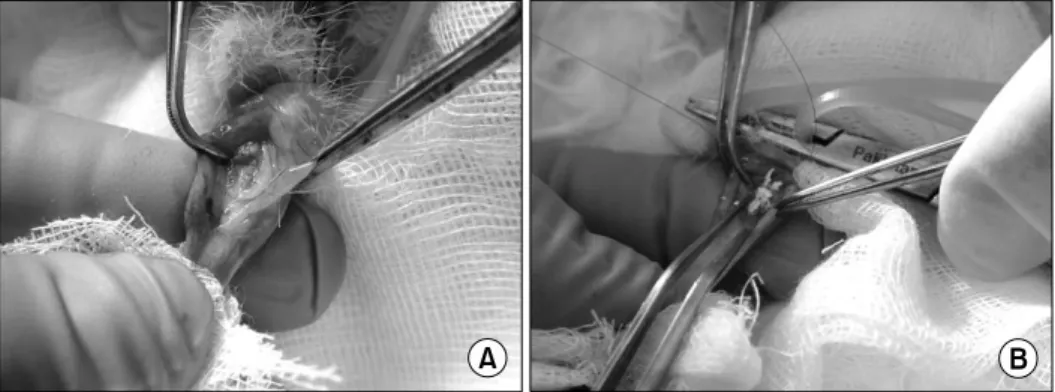
Fig. 1. Surgical features of rabbit corpus cavernosum. (A) An incision was made and tissue was partially removed in the right dorsum of the rabbit corpus cavernosum. (B) Nylon 5-0 suture was performed as a marker and the tunica albuginea was closed so that it was watertight. Poly (lactic-co-glycolic acid) (PLGA) microparticle (0.1 g) solution was injected into the defect of the corpus cavernosum at the final step of the closure. This figure shows the placement of the PLGA is in the corpus cavernosum defect before closure.
cold solution (−20oC) containing 25% NaCl (Duksan, Co., Ltd., Ansan, Korea), the solution was stored in a freezer (−20oC) for 48 h to remove the DMSO. The microparticles were washed three times with distilled water and dried. Two grams of 50∼100 μm micro- particles were suspended in 3 ml of 3% carboxymethyl cellulose (CMC; Bolak Co., Ltd., Hwasung, Korea).
3. Cell labeling with PKH26 fluorescent dye The rSVF cells isolated from rabbit adipose tissue were labeled with the fluorescent dye PKH26 (Sigma-Aldrich Co., LLC, St.Louis, MO, USA) ac- cording to the manufacturer’s protocol. Briefly, 2×10⁶ rSVF cells were suspended in 1 ml of dilution buffer from the manufacturer’s labeling kit. The cell suspen- sion was mixed with an equal volume of a labeling solution containing 4×10⁻⁶ M PKH26 dye in the dilu- tion buffer and incubated for 4 min at room temperature. The reaction was terminated by adding 2 ml of FBS. After washing with a control medium, 5×10⁵ rSVF cells labeled with PKH26 dye were in- cubated for 1 day in control medium at 37oC in 5%
CO2. The attachments of rSVF cells were observed by confocal fluorescence microscopy (Olympus FV1000, Olympus Co., Ltd., Tokyo, Japan).
4. Animals and surgical procedures
The subject animals were 15 male New Zealand
white rabbits (3 months old with an average body weight of 3.0 kg). All rabbits were kept in an aseptic environment with a room temperature of 22∼24oC at 40∼60% humidity. Sufficient food and water were provided for all the rabbits.
The 15 New Zealand white rabbits were divided in- to 4 groups: the normal control group (n=3), disease control group (n=2), SVF group (n=5), and PLGA group (n=5). General anesthesia was accomplished by intramuscular injection of xylazine (0.15 mg/kg body- weight, Bayer Korea Co., Ltd., Seoul, Korea) and tilet- amine (0.05 mg/kg bodyweight, Virbac Korea Co., Ltd., Seoul, Korea) solution. After anesthesia, shaving and povidone draping was performed from the um- bilicus to the knee including the genital area. All sur- gical procedures were conducted under sterile conditions. In the supine position, a 1 cm incision was made at the penile dorsum of the rabbit. Except in the normal control group, a further incision was made at the right tunica albugenia and a 3×3×5 mm rec- tangular area was removed from the corpus cavernosum by scalpel and Metzenbaum scissors. In the normal control, we only incised the penile skin without mak- ing a cavernosal defect. In the disease control, the cor- pus cavernosal tissue was removed as in the other ex- perimental groups, without adding any biodegradable material. 106 SVF was injected into the right corpus cavernosum for the SVF group, and 0.1 g PLGA was
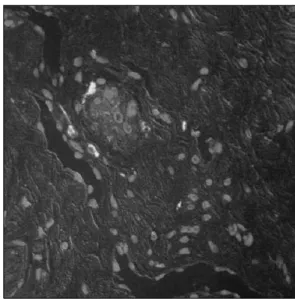
Fig. 2. Fluorescence was confirmed in the nuclear area of the corpus cavernosal smooth muscle cells in the injected site of the stromal vascular fraction (SVF). Smooth muscle cells with fluorescence-positive nuclei were differentiated from injected SVF, and there was no evidence of abnormal differentiation from or migration of SVF.
inserted for the PLGA group (Fig. 1A). Nylon 5-0 su- ture was performed as a marking to ensure the incised and injected region in the cavernosum (Fig. 1B). The tunica albuginea was closed so that it was watertight.
PLGA or SVF was injected into the corpus cav- ernosum defect at the final step of the closure to pre- vent solution leakage. To prevent operation site in- fection, 1 g Triaxone (Hanmi Pharmaceutical Co., Ltd., Seoul, Korea) was injected intramuscularly for 7 days to all rabbits. Two rabbits (1 from the SVF group and 1 from the PLGA group) were sacrificed on the 8th postoperative day for detecting any acute rejection.
The bodyweight was measured twice, before the ex- periment and 8 weeks later. Blood sampling tests in- cluding complete blood cell count (CBC), amino- transferase (ALT), alanine transaminase (ALT), blood urea nitrogen (BUN), and creatinine (Cr) were proc- essed on the 8th week before sacrifice. To confirm the presence of PLGA particles, an additional rabbit from the PLGA group was sacrificed on the 4th week. All the other rabbits were sacrificed in a CO2 chamber on the 8th week. Corpus cavernosal tissue was harvested from the proximal penile shaft in all the sacrificed rabbits.
All procedures were approved by the Ewha Institu- tional Research Board and Committee of Animal Models.
5. Histological analysis
The penile specimens were fixed with formalin in a neutral buffer. Sections (6 μm) were processed for Masson’s trichrome staining according to a standard procedure. Digital images were obtained and analyzed using Image Pro 6.2 (Media Cybernetics, Inc., Bethesda, MD, USA). In each section, 10 fields of 600×400 μm were randomly assisted. The smooth muscle density of each field was checked under a 100× microscopic magnification.
6. Statistical analysis
The data was analyzed through a Mann-Whitney test; a p-value of less than 0.05 was considered to be statistically significant.
Results
The bodyweights of the rabbits slightly decreased in all of the four groups. Although the average body- weight of all the groups decreased, the weight loss was statistically insignificant when compared with the nor- mal control group. In 8th week’s blood tests, there were no significant serologic changes or signs of in- fection or inflammation associated with material in- jections in any of the groups. To detect signs of acute rejection of SVF or PLGA injection, we closely ob- served the rabbits’ behavioral changes and performed daily physical examinations. No sign of acute rejection were found in the 2 rabbits which were sacrificed on the 8th day.
At the surgical wound sites, no signs of necrosis or infection were found in any of the 15 rabbits over the 8 weeks. No migration of PLGA particles to the main organs (lung, kidney, liver, heart, or brain) was found after the autopsies. There was no evidence of migra- tion to adjacent tissue from the injection site in the penile corpus cavernosum.
In the SVF group, fluorescence was confirmed in
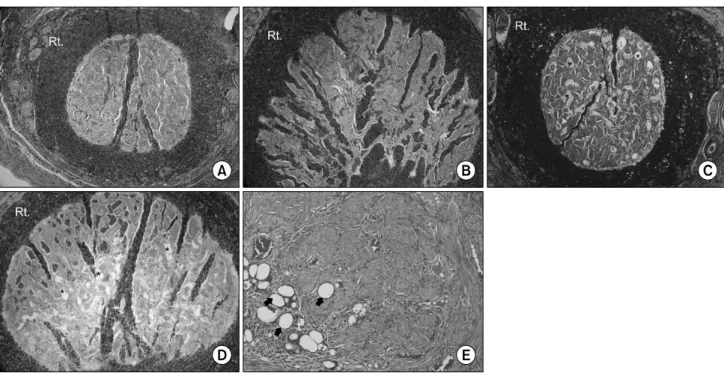
Fig. 3. Section of corpus cavernosum with Masson-trichrome stain. (A) Normal control group. (B) Disease control group. (C) Stromal vascular fraction (SVF) group, 8 weeks after the SVF injection. (D) Poly (lactic-co-glycolic acid) (PLGA) group, 8 weeks after the injection. PLGA particles were almost completely resolved 8 weeks after implantation (40× each). Whitish empty spaces (*) in the corpus cavernosal area of the SVF (C) and PLGA (D) groups are artifacts that developed during processing. (E) The PLGA group, 4 weeks after the injection. Distinguishable PLGA particles (arrows) were present (400×).
the nuclear area of the smooth muscle cells in the in- jected site of the corpus cavernosum, showing that these smooth muscle cells were differentiated from in- jected SVF (Fig. 2). Masson’s trichrome staining of the four groups revealed that cavernosal smooth muscle of the four groups was successfully restored (Fig. 3A∼
D). PLGA particles were almost completely resolved after 8 weeks from implantation (Fig. 3D). To observe the nature of PLGA degradation, we additionally ob- served the status of PLGA particles after 4 weeks of injection. PLGA particles were observed at the in- jection site of the corpus cavernosum at week 4 (Fig.
3E).
Smooth muscle components of each side of the cor- pus cavernosum were measured with an image ana- lyzer program with a repeat measurement of a 6×4 μm field under a light microscope. The mean amount of smooth muscle in the normal control group was 15.25±1.34 μm2 (right) and 13.90±0.703 μm2 (left);
in the disease control group, it was 11.10±0.87 μm2 (right) and 12.80±1.01 μm2 (left); in the SVF group,
it was 13.82±4.10 μm2 (right) and 13.96±3.94 μm2 (left); in the PLGA group, it was 12.89±1.39 μm2 (right) and 13.24±1.43 μm2 (left). Only the disease control group showed significantly decreased smooth muscle in the left cavernosum (p<0.05). When com- paring the amount of smooth muscle in the right cav- ernosum, which was experimental side, among the groups, it was significantly lower only in the disease control group (Fig. 4, p<0.05).
Discussion
There have been various reports on replacing tissue with biodegradable polymers and initial experiments were carried out by Kershen et al.7 in the late 1990s.
The results showed that cultured human corporal smooth muscle cells may be used in conjunction with biodegradable polymers to create corpus cavernosum tissue de novo. When grown on collagen, corporal cavernosal endothelial cells formed capillary structures that created complex three-dimensional capillary
Fig. 4. Only the disease control group showed a significantly decreased amount of smooth muscle in the left cavernosum (p
<0.05 in Mann-Whitney test) When comparing the amount of smooth muscle content among the groups, in the right cavernosum, which was experimental side, it was significantly decreased only in the disease control group (p<0.05 in Mann- Whitney test). a: normal control group left vs. right p=0.175, b: disease control group left vs. right p=0.016, c: SVF group left vs. right p=0.917, d: PLGA group left vs. right p=0.745, e: normal control group vs. SVF group p=0.175, f: positive group vs. PLGA group p=0.076, g: SVF group vs. PLGA group p=0.230, h: normal control group vs. disease control group p=0.009, i: disease control group vs SVF group p=0.016, j:
disease control group vs. PLGA group p=0.047.
networks. In addition, PLGA is studied in many other fields. In a recent study performed by Kuzyk et al.8 18 canine tibiae were reamed to 7.0 mm and fixed with a 6.5 mm statically locked intramedullary nail, af- ter the creation of an 8.0 mm diaphyseal defect. The results showed a greater percent vasculature volume in the scaffold group than the autograft group.
The forms of PLGA are the most widely used bio- degradable polyesters having biocompatibility and a predictable degradation rate for medical applications.9,10 The form of PLGA used currently is mostly macro- porous scaffold.4,11,12 However, the researchers in this study used a microparticular form of PLGA with a sol- ution to be injected that is more convenient to handle.
Microparticle-dispersed PLGA has been studied in var-
ious fields, such as drug delivery or injected as a bulk- ing agent.6,13-15 We investigated tissue regeneration and the migration of injected PLGA microparticles to com- pare with SVF cells.
Proper smooth muscle regeneration was confirmed in the injured site of the corpus cavernosum after the injection of a PLGA microparticle solution. There was no tissue overgrowth or fibrosis in the regenerated de- fect of the corpus cavernosum, with a similar con- sistency compared to normal corpus cavernosum of the contralateral side and the normal control.
Studies have revealed that SVF is multipotent and shares numerous features with mesenchymal stem cells derived from bone marrow. SVF has also shown a strong pro-angiogenic potential.16 With these advan- tages, previous studies have shown that it can be used for repair of tendons and bones as well as skeletal muscle.17-19
In this study, SVF showed a good tissue re- generative effect in the injured corpus cavernosum, and the PLGA microparticle solution also had a sat- isfactory effect in regenerating the corpus cavernosum.
Tissue regeneration after the injection of PLGA showed the same results as the SVF injection: focused locally on the site of the injection and without any migration. This suggests that the injection of the PLGA solution into the corpus cavernosum should be safe from microparticle migration or the formation of emboli.
The injection of PLGA and SVF through 24 gauge needles proved to be simple during the experiment and no sign of wound infection or polymer leakage was observed. No foreign body reaction was observed after injecting the polymers. We created the corpus cav- ernosal injuries by removing the cavernosal tissue after opening the tunica albuginea. Although PLGA or SVF were injected at the final step after water-tight suturing of the cleaved tunica albuginea, this process might provide some possibilities for leakage of injected ma- terials leading to observational error.
The main advantage of PLGA in urological surgery is the absence of a tissue harvesting procedure that is necessary to provide enough bulking or graft material.7,10 Some reports have shown unsatisfactory results of tis-
sue regeneration with PLGA or biodegradable material only, and better results with cell seeding, but others have not.6,20 In vitro and in vivo reconstitution of hu- man corpus cavernosum from cultured human corporal smooth muscle celled with scaffolds became clinically available.3 Adipose-derived SVF or SVF seeded scaf- folds are currently being used in penile plastic sur- geries with good cosmetic results.4,6 However, in our experiment, we performed similar tissue regeneration with biodegradable microparticles without the cellular component. In this study, PLGA particles were still present until the 4th week after injection, but later on, at the 8th week, they had been almost completely absorbed. We did not observe the whole process of PLGA absorption over time, but we could confirm that the PLGA particles degrade enough within a matter of months.
Although the microparticle form of PLGA might be advantageous compared to other scaffold forms of bio- degradable material, we need further study to confirm whether the same results are possible in a larger tissue areas such as the human corpus cavernosum.
The PLGA microparticle solution used in this study has the advantage of application by direct injection to the area of concern without the skin incision that was an unavoidable procedure for the insertion of a tissue or graft/block form of PLGA. In addition, PLGA with- out additional SVF showed similar tissue regeneration compared to the control and the SVF group, with a complete degradation of the PLGA material over time.
This shows that it has the advantage of avoiding the unnecessary extra processes of adipose tissue harvesting.
To further the application of the microparticular form of PLGA to humans in tissue recovery or organ augmentation, it will be necessary to develop a proper microparticle size and a safe buffer to ensure their safety and from the lack of migration or embolization even in organs with larger vessels.
This study has clear limitations in that we could not perform a functional evaluation. Based on the results of morphological restoration by PLGA microparticle injection, further research about proper functional re- storation could be performed.
Conclusions
This study was performed to investigate the in vivo safety and efficacy of microparticle-type PLGA in- jection in injured corpus cavernosum. Microparticle-type PLGA did not show any complications related to in- jection and had the advantage of simple injection with proper tissue regeneration.
This study is a preliminary report supporting that the injectable biodegradable polymer (PLGA) has a tissue recovery effect without distant migration in the rabbit penile corpus cavernosum, and further study in- cluding proof of functional restoration and reproduci- bility in larger tissues will be required.
REFERENCES
1) Woodward SC, Brewer PS, Moatamed F, Schindler A, Pitt CG. The intracellular degradation of poly (epsilon-caprolactone). J Biomed Mater Res 1985;19:
437-44
2) Pitt CG, Gratzl MM, Kimmel GL, Surles J, Schindler A. Aliphatic polyesters II. The degradation of poly (DL-lactide), poly (epsilon-caprolactone), and their copolymers in vivo. Biomaterials 1981;2:
215-20
3) Kershen RT, Yoo JJ, Moreland RB, Krane RJ, Atala A. Reconstitution of human corpus cavernosum smooth muscle in vitro and in vivo. Tissue Eng 2002;8:
515-24
4) Perovic SV, Byun JS, Scheplev P, Djordjevic ML, Kim JH, Bubanj T. New perspectives of penile en- hancement surgery: tissue engineering with bio- degradable scaffolds. Eur Urol 2006;49:139-47 5) Lee KE, Kim BK, Yuk SH. Biodegradable poly-
meric nanospheres formed by temperature-induced phase transition in a mixture of poly(lactide-co-gly- colide) and poly(ethylene oxide)-poly(propylene ox- ide)-poly(ethylene oxide) triblock copolymer. Bio- macromolecules 2002;3:1115-9
6) Oh SH, Lee JY, Ghil SH, Lee SS, Yuk SH, Lee JH.
PCL microparticle-dispersed PLGA solution as a po- tential injectable urethral bulking agent. Biomaterials 2006;27:1936-44
7) Kershen RT, Yoo JJ, Moreland RB, Krane RJ, Atala A. Reconstitution of human corpus cavernosum smooth muscle in vitro and in vivo. Tissue Eng 2002;8:
515-24
8) Kuzyk PR, Schemitsch EH, Davies JE. A bio- degradable scaffold for the treatment of a diaphyseal bone defect of the tibia. J Orthop Res 2010;28:
474-80
9) Lin WJ, Flanagan DR, Linhardt RJ. A novel fab- rication of poly(epsilon-caprolactone) microspheres from blends of poly(epsilon-caprolactone) and poly (ethyleneglycol)s. Polymer 1999;40:1731-5
10) Gilding DK. Biodegradable polymers. In: Willams DF, editor. Biocompatibility of clinical implant materials. Boca Raton, Fla: CRC Press; 1981;209-32 11) Freed LE, Vunjak-Novakovic G, Biron RJ, Eagles
DB, Lesnoy DC, Barlow SK, et al. Biodegradable polymer scaffolds for tissue engineering. Biotechnology (NY) 1994;12:689-93
12) Tanaka T, Hirose M, Kotobuki N, Tadokoro M, Ohgushi H, Fukuchi T, et al. Bone augmentation by bone marrow mesenchymal stem cells cultured in three-dimensional biodegradable polymer scaffolds. J Biomed Mater Res A 2009;91:428-35
13) Lee SW, Kim BS, Park HJ. Preliminary evaluation for New Injectable Material: PLGA Microsphere.
Korean J Urol 2003;44:1167-71
14) Chung HJ, Park TG. Injectable cellular aggregates
prepared from biodegradable porous microspheres for adipose tissue engineering. Tissue Eng Part A 2009;15:1391-400
15) Krebs MD, Sutter KA, Lin AS, Guldberg RE, Alsberg E. Injectable poly(lactic-co-glycolic) acid scaffolds with in situ pore formation for tissue engineering. Acta Biomater 2009;5:2847-59
16) Casteilla L, Planat-Bénard V, Cousin B, Laharrague P, Bourin P. Vascular and endothelial regeneration.
Curr Stem Cell Res Ther 2010;5:141-4
17) Bacou F, el Andalousi RB, Daussin PA, Micallef JP, Levin JM, Chammas M, et al. Transplantation of adipose tissue-derived stromal cells increases mass and functional capacity of damaged skeletal muscle.
Cell Transplant 2004;13:103-11
18) Fraser JK, Wulur I, Alfonso Z, Hedrick MH. Fat tis- sue: an underappreciated source of stem cells for biotechnology. Trends Biotechnol 2006;24:150-4 19) Planat-Benard V, Silvestre JS, Cousin B, André M,
Nibbelink M, Tamarat R, et al. Plasticity of human adipose lineage cells toward endothelial cells: phys- iological and therapeutic perspectives. Circulation 2004;109:656-63
20) Chen KL, Eberli D, Yoo JJ, Atala A. Bioengineered corporal tissue for structural and functional restora- tion of the penis. Proc Natl Acad Sci USA 2010;
107:3346-50