저작자표시-비영리-변경금지 2.0 대한민국 이용자는 아래의 조건을 따르는 경우에 한하여 자유롭게
l 이 저작물을 복제, 배포, 전송, 전시, 공연 및 방송할 수 있습니다. 다음과 같은 조건을 따라야 합니다:
l 귀하는, 이 저작물의 재이용이나 배포의 경우, 이 저작물에 적용된 이용허락조건 을 명확하게 나타내어야 합니다.
l 저작권자로부터 별도의 허가를 받으면 이러한 조건들은 적용되지 않습니다.
저작권법에 따른 이용자의 권리는 위의 내용에 의하여 영향을 받지 않습니다. 이것은 이용허락규약(Legal Code)을 이해하기 쉽게 요약한 것입니다.
Disclaimer
저작자표시. 귀하는 원저작자를 표시하여야 합니다.
비영리. 귀하는 이 저작물을 영리 목적으로 이용할 수 없습니다.
변경금지. 귀하는 이 저작물을 개작, 변형 또는 가공할 수 없습니다.
문학 석사 학위 논문
A Corpus-based Study on
Whom and Who in the Preposed PP
전치된 전치사 구 안
Whom과 Who의 코퍼스 기반 연구
2017 년 2 월
서울대학교 대학원 영어영문학과 영어학 전공
정 수 연
Abstract
A Corpus-based Study on
Whom and Who in the Preposed PP
Jung, Suyeon Department of English Language and Literature The Graduate School Seoul National University
Piles of researches covered the use of whom and who, and the differences between them. Most of them argued that not only in the subject position but also in positions that were originally thought of as whom-only areas, who seems to appear. Nevertheless, scholars such as Jespersen (1969), Sohn (1978), Quirk et al. (1985), Walsh and Walsh (1989), and Bauer (1994) claimed that there still exists an exclusive area for whom, and this is known to be a preposed PP. The term refers to a prepositional phrase that has been moved to the front from the following clause behind.
This paper searched for whom and who in the preposed PP from two big corpora (COHA and COCA spoken data), and compared them to see if whom was exclusively used in that position. It turned out that when used
with a preposition, who (although not as many as whom) could be found to a certain extent. However, in the preposed PP, whom-only area, who was seldom used and even nonexistent in some prepositional phrase. The result was quite the contrary to that of whom and who found in the postverbal position. Here, who was used as equally as, or even more (with some verbs) than whom. In addition, from the data organized by genre, this paper could also find that whom itself triggers a formal register.
The possible explanation for such results is that the preposed PP has been a formal register throughout the history. The preposed PP was believed to be a more graceful and perspicuous expression. It has been perceived as more natural, formal, and grammatical than preposition stranding ever since the Middle English.
Accordingly, we can assume that in a formal register like the preposed PP, whom is exclusively used because it triggers a formal register, too.
Based on those findings, this study concludes that the preposed PP is indeed an exclusive area for whom, and that whom would last, or at least, it would take a very long time for who to finally replace the place of whom in the preposed PP.
Keyword: whom, who, preposed PP, sluicing, PP in situ, preposition stranding, pied-piping, formal register
Student Number: 2013-22761
Table of Contents
Abstract...i
Chapter 1. Introduction...1
1.1 Introduction...1
1.2 Organization of the Study...3
Chapter 2. Previous Studies and Research Questions...4
2.1 Previous Studies...4
2.1.1 Controversy over Areas for Whom and Who...4
2.1.2 History of Whom and Who...6
2.1.3 Lee (2010)'s Study...9
2.2 Research Questions...11
Chapter 3. Data Analysis and Results...14
3.1 Data and Method...14
3.1.1 Data...14
3.1.1.1 Corpus of Historical American English (COHA)...15
3.1.1.2 Corpus of Contemporary American English (COCA)...15
3.1.2 Method...16
3.1.2.1 Preposition selection...16
3.1.2.2 Random sampling...17
3.2 Data Analysis...18
3.2.1 Preposition+Whom/Who in COHA...18
3.2.1.1 Preposed PP criterion...22
3.2.1.2 To/For/With+whom...24
3.2.1.3 To/For/With+who...28
3.2.2 Preposition+Who in COCA Spoken Data...36
3.2.2.1 To who...38
3.2.2.2 For who...40
3.2.2.3 With who...41
3.3 Summary...44
3.3.1 Summarized Results...44
3.3.2 Whom versus Who...46
Chapter 4. Discussions...51
4.1 Pied-piping and Preposition Stranding...52
4.2 Preposed PP and Formality...53
4.3 Other Hypotheses...58
Chapter 5. Conclusion...62
5.1 Summary...62
5.2 Limitations and Further Studies...63
Bibliography...65
국문초록...71
Chapter 1. Introduction
1.1 Introduction
Language is constantly changing even at this moment (Trudgill 2009). It is a linguist's job to figure out the current language usage and based on that, predict what is to come in the near future. If the certain language usage had to change, it would be important to know why this language changes, and in what ways or to what degree it would change.
The issue regarding whether whom will survive or not is a very complex matter. It has triggered many linguists to work on the differences between the usage of whom and who. Some linguists (Aarts 1994, Sweet 1898, and Contemporary Grammarians such as Quirk et al. 1985 and Biber et al.
1999) insist that who has been replacing almost all the areas of whom.
Others (Crystal 1988, Lee 2010, Mair and Leech 2006, and others) raise questions about the claim and argue that there still exists an exclusive area for whom. This exclusive area is known to be a preposed PP (Quirk et al.
1985, Lee 2010, Bauer 1994, and so on). Examples of such are given below.
(1) Preposed PP (COHA)
a. If you did know to whom I gave the ring, (Merchant Venice 1890) b. a man to whom a creature clung (Flute Gods 1909)
c. To whom directed? (Italian Father 1810)
Despite countless literature on whom and who, the preposed PP has not been looked at in great depth. Although Lee (2010) recently conducted a study regarding this area, the subject has not been studied empirically enough to fully validate if whom is exclusively used in the preposed PP or not. In short, previous researches including Lee (2010) never really covered corpus-based analysis in order to figure out if the preposed PP has been an exclusive area for whom. The purpose of this paper is to add more light and get more glimpse of the truth as to whether whom appears more often immediately after a preposition as apposed to who in the preposed PP using data in corpora.
For the analysis, two American corpora COHA and COCA (spoken data) will be looked up. To support the findings, the history of pied-piping and preposition stranding, along with other factors that seem to have influenced the results will be discussed. It is known that the earliest documents exhibit only pied-piping structures and that the stranding option with wh-pronouns as relatives was introduced in the Middle English. Pied-piping being a normal feature and preposition stranding being an exceptional feature will play an important role in elucidating why whom appears more in the preposed PP than who.
1.2 Organization of the Study
This paper is divided into 5 chapters. Chapter 1 establishes a brief introduction of the topic. Chapter 2 describes the background of the topic and the objectives of this research. It gives an overview of the long history regarding the usage of whom and who. Also, it suggests an exclusive area for whom. Chapter 3 introduces two corpora used for this study, and summarizes results obtained from the analyses of the two. This chapter is expected to provide a better insight as to whether whom is exclusively used in the preposed PP or not. Chapter 4 summarizes significance of the findings, and deals with possible explanations as to why prepositions are more often used with whom than who in the preposed PP. Finally, Chapter 5 makes suggestions for improvement, and recommendations for future work.
Chapter 2. Previous Studies and Research Questions
2.1 Previous Studies
2.1.1 Controversy over Areas for Whom and Who
Prescriptive Grammarians have been arguing ever since the 18th century that in cases other than the subject, whom is the only correct form to be used. Sapir (1921:156) stated that it would take a couple of hundred years for whom to go completely extinct. Mair and Leech (2006), too, in their British National Corpus (BNC) analysis, considered the frequency of whom (129 times per million, mainly in texts) significantly high. They also compared occurrences of whom in LOB (Lancaster-Oslo/ Bergen Corpus)-Brown Corpus (both made in 1961) and FROWN (Feriburg-Brown)-FLOB (Freiburg-LOB, based on 1992 material), and found out that there was no significant difference in the use of whom for 30 years.
In 1986, BBC had a radio program called English Now, and it received a lot of letters from its listeners complaining about the misuse of who (Crystal 1988). These people would agree that the following sentence Children need access to someone to whom they can speak in confidence, whom they can trust and who will take what they are saying seriously represents a correct usage. This episode highlights that there are people who use whom based on
their (Prescriptive) grammar.
However, most papers insisted that the straight line between whom and who is disappearing. For example, they disputed the previous episode with an explanation that the people had to apply Prescriptive Grammar rules because the situation was formal, and in everyday speech situation, they would not use whom (Aarts 1994). Sweet (1898) also claimed that many educated people always use who but never whom. He went on to affirm that the only relatives for general colloquial use are that and who. What is more, Contemporary Grammarians (Quirk et al. 1985, Biber et al. 1999, and Huddleston and Pullum 2002, and many others) stated that whom is already felt dead among the majority of people.
In a recent study done by Lee (2010), this view continues. In his study, he let some native English professors evaluate in 6-level Likert scale sentences that included whom and who. The result indicated that the average for each sentence was never extreme as fully acceptable (5 points) or completely unacceptable (0 point), but in terms of whom, some participants marked it 0 whereas no such cases were found with who. In addition, the participants evaluated who in the preposed PP, as natural as whom (whom:
3.25, who: 2.875). He asserted that this implies who is in general taken to be more natural than whom.
Having discussed various perspectives on whom and who, it is now necessary to move on to the history of whom and who. The historial overview of whom and who and their grammatical traditions will give more information as to if there exist any whom-only areas.
2.1.2 History of Whom and Who
Whom and who in the Old English era, originally started off as interrogative pronouns (hwæm/hwam, hwa). The gender distinction was between masculine/feminine (or animate) hwa and neuter (or inanimate) hwæt (what). To form relative clauses in the Old English, þe was used (in combination with a demonstrative, or simply the demonstrative alone) (Brinton 2011).
In the Early Middle English era, interrogative pronouns were used as relative pronouns, too. After the Middle English era, as inflection began to disappear, the accusative case hwone/hwane/hwæne got absorbed into the dative case whom, and the distinction among the remaining whom and who also became blurred gradually (Lee 2010). Incorrect use of relative pronouns whom and who, according to Oxford English Dictionary, traces back to Stonor Papers:
(2) I schall both se yow and my Nawnt with Godes Grase, whome evyr preserve yow and yowrs for his mersy.
'I shall see both you and my aunt with God's Grace, who ever preserves you and yours for his mercy.' (Stonor Papers 1467 / Aarts 1993:71)
Here, as God is a subject of the following sentence evyr preserve yow and yowrs for his mersy, the relative pronoun who should have been used
instead of whom.
Moving on to the grammatical traditions of the 18th and early 19th century treating whom and who, Lowth (1979:133) argued that who should be used as a subject and whom should be used as an object. Therefore, he did not mention any possibility of the use of who in the following sentence Horace is an author, whom I am much delighted with. Murray (1795:107), too, followed his idea that he considered the use of who ungrammatical in the following sentence Our tutors are our benefactors, who we owe obedience to, and who we ought to love. Likewise, Cobbett (1818:93~112) rejected who in Who, for the sake of his numerous services, the office was given to and whom in Whom, for the sake of his numerous services, had an office of honour bestowed upon him.
Strict grammatical traditions of whom and who became more and more relaxed when the Modern English era came. When a noun is an object of the verb or preposition and is preposed before the sentence, both whom and who can be used: Whom/who did you meet?/ Whom/who are you staring at?
This usage is tracked back to the Middle English era:
(3) Who doth he trot withal?
'Who does it trot with?' (As You Like It 1603 / Schneider 1996:491)
What is more, who can be used instead of whom when it is next to the preposition governing it in an independent PP1: You should give them away.
1 In a more syntactic term, this phrase is called sluicing. In syntax, sluicing is a type of ellipsis that occurs in both direct and indirect interrogative clauses. The ellipsis is introduced
To whom/who?/ Arrest? For whom/who?2 This kind of phrase can also be found in some Early Modern English Literature including Pride and Prejudice.
(4) I am going to Gretna Green, and if you cannot guess with who, I shall think you a simpleton. (Pride and Prejudice 1894 / Austen)
If there is no movement of PP (this is called PP in situ) in a sentence, both whom and who can be used as in the following multiple wh-question:
(5) Who said what to whom/who?
Who can appear as an object of the verb in such sentences, too:
(6) Who is going to marry whom/who?
What we could assume from the overview of the usage of whom and who so far, is that if not the whole PP is preposed in a sentence, it is possible for who to appear even after a preposition governing it. Who can
by a wh-expression. Sluicing is known to occur in numerous languages. Refer to Ross (1969), Chung et al. (1995), and Merchant (2001).
2 In a single-word question, however, only who is used: I met your friend this morning. Oh, who? (Huddleston and Pullan 2002:465). This was the case in the 19th century too:
a. And so you haven't the courage to tell him? Him! Who?
(Shaw P 1898 / Dekeyser 1975:196~197)
also show up before a preposition, as this can be witnessed in a sentence like:
(7) Valentine! Who for, miss?
(Far from the Madding Crowd 1906 / Lee 2010:120)
However, whom does not seem to appear in this inversed position.
In summary, a considerable amount of literature have been published on the usage of whom and who, and the fate of whom in the future. Various arguments were discussed and the scholars have come up with their own explanations. What they seemed to agree on was that in the Modern English era, who can replace most of the whom areas. Besides when it is a subject, it looks like who has been showing itself more and more in what was originally thought of as the sole areas of whom. However, as Jespersen (1969), Sohn (1978), Quirk et al. (1985), Walsh and Walsh (1989), and Bauer (1994) insisted, the use of whom seems quite obligatory in the position preceded by a preposition governing it. It can thus be hypothesized that the preposed PP in a sentence is where whom is exclusively used.
2.1.3 Lee (2010)'s Study
Lee (2010) took this postulation that preposed PP is an exclusive area for whom, and went on further to validate it. He, along with the questionnaire conducted to English native professors, analyzed preposed preposition+who
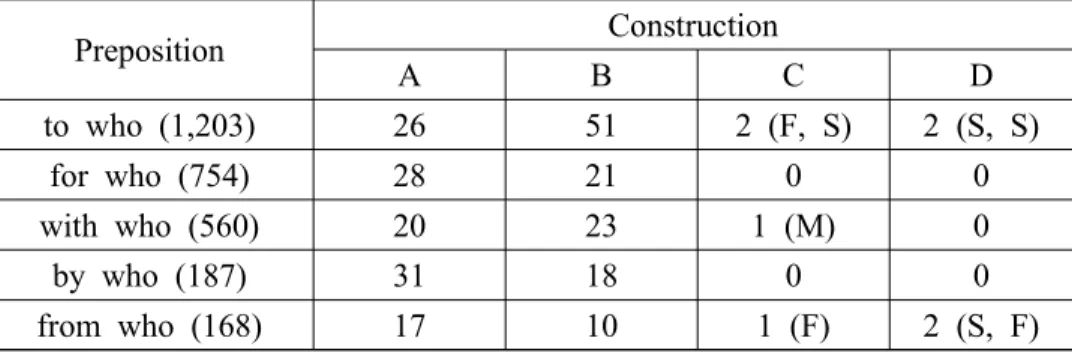
phrases in the Corpus of Contemporary American English (COCA). Out of the top 10 most frequent prepositions, he chose 5 prepositions (to/for/with/by/from) that he thought would very likely take a person as their objects. The results were as follows:
Construction A is sluicing. Construction B is PP in situ. Preposed who in Construction C was used as an interrogative pronoun while in Construction D, it was used as a relative pronoun. M refers to magazines, F stands for fiction, and S is an initial for spoken data. Here, Construction C and D are the main concern.
As can be seen from the table above, in case of Construction C and D, Lee came up with very few data for who in the preposed PP: it was either none, 1, or 2. He concluded that this result was not enough to draw any conclusion since it was not sure whether this few data could be considered as potential for who in the preposed PP, or just a plain exception. Based on these, Lee (2010:133) ended his paper presuming "the use of whom itself and in the preposed PP would eventually disappear, but it would be
Preposition Construction
A B C D
to who (1,203) 26 51 2 (F, S) 2 (S, S)
for who (754) 28 21 0 0
with who (560) 20 23 1 (M) 0
by who (187) 31 18 0 0
from who (168) 17 10 1 (F) 2 (S, F)
Table 1. Summarized results from Lee (2010)
impossible to basically predict how a linguistic phenomenon would change."
He thus left the fate of whom in doubt.
2.2 Research Questions
Throughout the comprehensive literature review from the previous section, it is suggested that there may exist an exclusive area for whom, and if it does, it would be a preposed PP.
As mentioned earlier, Lee (2010) made a detailed investigation into this exclusive area. Despite Lee's useful and timely analysis regarding whom and who, better results would have been yielded if several weaknesses had been resolved.3
Firstly, Lee did not compare who with whom in the same corpus. In
3 Also, in terms of the survey conducted to the English speakers, the result would have been more reliable and significantly different, if he had used above-7-level Likert scale. He used 6-level Likert scale ranging from completely unacceptable (0 point) to fully acceptable (5 points) with no middle choice such as not good, not bad. Typically, people tend not to choose two extreme choices on the edge of Liker scale, so the choices would have been made among just the two on one side, and the two on the other side, with no choice in the middle. This, in turn, could have produced a rather extreme result that needed to be taken with caution.
Likert scale is a type of ordinal data. It assumes that the strength/intensity of experience is linear: the data is ranked. For example, bad is better than very bad. Usually, 5-level Likert item is used, but many psychometricians advocate 7 or 9 levels. The more level your item is, the more likely it is for the coefficient of correlation of your sample to approach the coefficient of a population (although levels above 9 are not usually recommended).
High-level item is more desirable when the number of your sample is relatively small (Dawes 2008).
order to conclude whether who is used in the preposed PP as much as whom or not, whom must be searched for to be compared with. The raw data of who in the preposed PP does not say anything about the status of who because frequency is a relative concept and should be understood in relation to others. Without knowing how often whom is used in what is believed to be an exclusive area for whom, it would be hard to draw any precise conclusion for the use of who. In this paper, both of them will, therefore, be looked into.
Secondly, Lee's research would have been far more persuasive and convincing if he had taken time trends into consideration. If who was taking more and more the place of whom in the preposed PP, there should be an increase in the use of who and a decrease in the use of whom in the preposed PP over time. Analysis of such would allow one to conclude with more certainty whether the preposed PP has been an exclusive area for whom or not.
Taking into account these limitations and their potential solutions, this paper will establish the following research questions:
Research questions
1. Is the preposed PP in a sentence really an exclusive area for whom?
2. If whom is exclusively used in the preposed PP (and not who), how can we properly explain the phenomenon?
Since Lee (2010) was not able to draw any conclusion as to whether the preposed PP is an area in which whom is exclusively used, this paper will take that as the first research question again and compare preposed preposition+whom and preposition+who phrases in corpora. To what degree the two differ in frequency and usage will be the focus of this comparison.
Time trends will also be observed.
If the results of the corpora analysis show that the preposed PP is indeed where whom is used a lot more frequently than who, and the difference between the two is significantly great, this paper will then move on to offer some possible explanations to describe why. Several hypotheses will be brought up and discussed later on along with this study's claim.
Chapter 3. Data Analysis and Results
3.1 Data and Method
3.1.1 Data
Two big freely-available corpora (both invented by Mark Davies) were chosen to explore the overall usage of preposed preposition+whom and preposition+who phrases. Frequencies of each phrase were searched both as a whole, and according to certain time scales. For individual sentence analysis, data obtained from random sampling (provided by each corpus) were scanned through. The corpora used for this research both represent American English. As there may be slightly different preference towards the use of whom and who among varieties of English, for the sake of uniformity, this paper selected American English corpora and continued analyzing them.4
4 For instance, New Zealand English prefers whom as a verbal object more whereas American English prefers whom as a prepositional object more. These two also show a different pattern when it comes to the encroachment of who upon whom. American English displays a more conservative stage of whom (meaning less who) in prepositional phrases in contrast to New Zealand English (especially in spoken English). British English seems to be in an intermediate state (Beatriz 2005).
3.1.1.1 Corpus of Historical American English (COHA)
The Corpus of Historical American English is the largest structured corpus of historical English. It contains more than 400 million words of text from the 1980s to 2000s (mainly from the Early Modern English to the Modern English era), and its individual genres are fiction, magazines, newspapers and other nonfiction. COHA allows researches on chronological fluctuation in words' frequencies. It also enables researchers to divide text according to different time scales. In order to identify how the use of preposed preposition+whom and preposition+who phrases changed over time, COHA was chosen. Data will be dealt in several time divisions.
3.1.1.2 Corpus of Contemporary American English (COCA)
The Corpus of Contemporary American English is probably the most widely-used corpus of English. This corpus contains more than 520 million words out of 190,000 texts from 1990 to 2015 (updated by adding 20 million words each year), and is divided among spoken, fiction, popular magazines, newspapers and academic texts. COCA is by far the biggest general corpus for American English. The corpus was selected additionally because COHA lacks data from spoken genre. Who is likely to be used more often in spoken environment and therefore preposed preposition+who phrases in the spoken portion of COCA were also taken into analysis.5,
5 Sweet (1898), Roberts (1954), Klima (1984), Follett (1966), Kaye (1991), and Aarts (1994) were the scholars who highlighted the importance of style, colloquialism, and diglossia
The British National Corpus (BNC) and the Michigan Corpus of Academic Spoken English (MICASE) offer spoken data too, but the size of each corpus is relatively small compared with COCA (BNC: 10 million words, MICASE: 1.8 million words, and COCA: 78.8 million words). What is more, BNC covers British English, and the period of time both corpora contain data from is relatively short and not recent (BNC: from the 1980s to early 1990s and MICASE: from 1997 to 2002). As a result, it was best to use COCA spoken data among the other alternative spoken corpora.
3.1.2 Method
3.1.2.1 Preposition selection
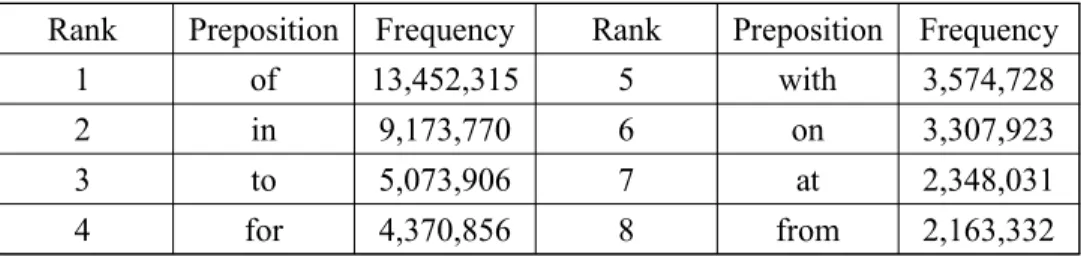
Three most frequent prepositions were selected from COCA (Table 2): to, for, and with. Since the purpose of this analysis is to look at whom and who, these three prepositions had to be the ones that were most likely to be used with a person.
Rank Preposition Frequency Rank Preposition Frequency
1 of 13,452,315 5 with 3,574,728
2 in 9,173,770 6 on 3,307,923
3 to 5,073,906 7 at 2,348,031
4 for 4,370,856 8 from 2,163,332
Table 2. Most frequent prepositions in COCA
regarding the usage of whom and who.
This paper did not choose of since it is likely that the data of preposition+of would produce not only sentences like (8a) but also sentences like (8b).
(8) a. ... the lovely lady of whom we are concerned.
b. Brian, a son of whom my daughter is friends with.
Sentence (8b) has a structure of NP of whom, and is not what this paper is looking for. Only of whom has to be preposed, not the whole NP constituent. It was estimated that this kind of structure would be found quite frequently in both corpora.
Next, in is mostly used with a thing. When looked up in COCA, the most frequent one-word-right collocate (pronoun) of in was it. The number was 26,302, and it was more than four times bigger than that of the second most frequent collocate them (6,907). For nouns too, the top 100 most frequent nouns (one-word-right collocate) were all objects. Given this fact, it was thought that the corpora would not produce many preposed in whom/who phrases.
For these reasons, of and in were not picked for this study's analysis.
3.1.2.2 Random sampling
Random sampling function provided by COHA was used.6 100 samples
were randomly collected for to/for/with+whom phrases and to/for/with+who phrases. The reason for 100 samples was because the total frequency of with who phrases was just 172 in total. The sampling number had to be 100 so that the same number of samples could be extracted from each data to be compared with. For COCA analysis, since the data found for each prepositional phrase was small, just 50 samples were looked through to get the glimpse of a tendency.
3.2 Data Analysis
3.2.1 Preposition+Whom/Who in COHA
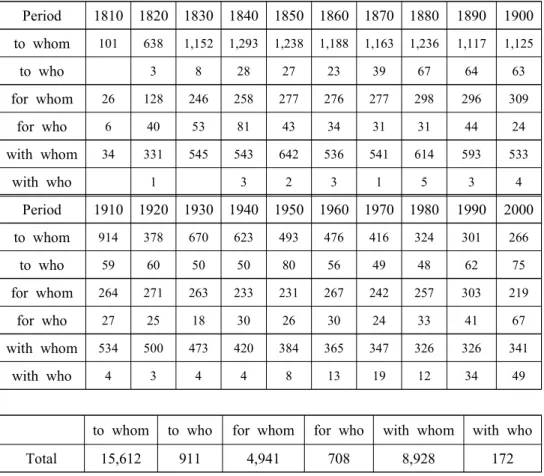
Table 3 (next page) shows the overall usage patterns of to/for/with+whom and to/for/with+who phrases over 200 years of time. Obviously, the use of to/for/with+whom phrases is decreasing whereas the use of to/for/with+who phrases is increasing. However, to/for/with+who phrases are increasing at very low speed, and the frequency of each to/for/with+whom phrase is way higher than that of each to/for/with+who phrase. To who and with who phrases do not appear before the 1820s. Also, it is after the 1960s that the frequency of with who phrases starts to escalate sharply. What is interesting
6 Mark Davies (the creator of COCA and COHA) mentioned that randomizing is carried out via a simple random number generator in SQL Server. It assigns a completely random number to each row of data, and then it just takes the top 100 (or 200, or 500, or 1,000) rows, based on that random value.
in this data is that the frequencies of preposition to, for, and with, when they are used with who, they share the same frequency order as in Table 2:
to who the highest and with who the lowest. By contrast, when it comes to preposition+whom phrases, though the frequency of to whom is likewise the highest, the frequency of with whom phrases is almost two times higher than that of for whom phrases.
Period 1810 1820 1830 1840 1850 1860 1870 1880 1890 1900
to whom 101 638 1,152 1,293 1,238 1,188 1,163 1,236 1,117 1,125
to who 3 8 28 27 23 39 67 64 63
for whom 26 128 246 258 277 276 277 298 296 309
for who 6 40 53 81 43 34 31 31 44 24
with whom 34 331 545 543 642 536 541 614 593 533
with who 1 3 2 3 1 5 3 4
Period 1910 1920 1930 1940 1950 1960 1970 1980 1990 2000
to whom 914 378 670 623 493 476 416 324 301 266
to who 59 60 50 50 80 56 49 48 62 75
for whom 264 271 263 233 231 267 242 257 303 219
for who 27 25 18 30 26 30 24 33 41 67
with whom 534 500 473 420 384 365 347 326 326 341
with who 4 3 4 4 8 13 19 12 34 49
Table 3. To/for/with+whom and to/for/with+who in COHA (by decade)
to whom to who for whom for who with whom with who
Total 15,612 911 4,941 708 8,928 172
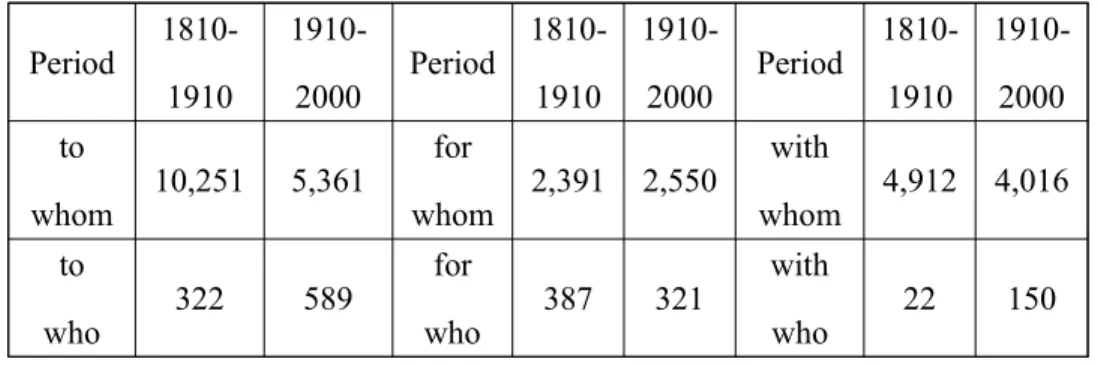
Period
1810- 1910
1910- 2000
Period
1810- 1910
1910- 2000
Period
1810- 1910
1910- 2000 to
whom
10,251 5,361
for whom
2,391 2,550
with whom
4,912 4,016 to
who
322 589
for who
387 321
with who
22 150
Table 4. To/for/with+whom and to/for/with+who in COHA (by century)
Period 1810-1910 1910-2000 Total
to/for/with+whom 17,554 11,927 29,481
to/for/with+who 731 1,060 1,791
Table 5. Three prepositional phrases in COHA
Table 4 and 5 present the same data organized by different time period.
In Table 4, it is more apparent that the use of to/for/with+whom phrases has dropped, and the use of to/for/with+who phrases has risen. A striking result is with for whom phrases and for who phases. The use of for whom phrases has actually gone up a little bit, while the use of for who phrases has declined slightly. This result may be puzzling, yet when all these prepositional phrases are summed up for whom and who each, as in Table 5, it is clear that there is an apparent trend of decreasing in preposition+whom phrases and increasing in preposition+who phrases.7 COHA
7 The puzzling result of for whom/who phrases in Table 4 may be just an exceptional case.
As can be seen from Table 3, which is the bigger picture, the general use of for whom phrases is falling and the general use of for who phrases is rising although during some periods, there have been ups in the use of for whom phrases and downs in the use of for
frequency data that have been analyzed so far are illustrated in Chart 1.8
From the analysis so far, what the data of preposition+who phrases
who phrases.
8 The use of to/for/with+whom rose dramatically from the 1810s to 1830s. Around 1825, America was number one in supplying all kinds of newspaper all over the regions in America. It had the most newspapers in the world. Philosopher Alexis de Tocqueville (1805~1859), who visited America during this period once mentioned that the number of publication was unbelievable and every village had their own newspaper in America.
Newspapers as mass media were revolutionized, and the readers started to change from a few limited number of merchants and the elite, to many ordinary people in the 1830s. A typical daily newspaper was covered with ads on their first and last pages. The abrupt change in the use of to/for/with+whom may partially be due to this (information from Gang: http://blog.naver.com/lsb8666/10182753816).
indicates is that there has been quite a number of preposition+who sequence though not as many as preposition+whom phrases. What is more, it looks like the frequency of preposition+who has been increasing. Now, this data must be interpreted with caution because it is just the plain sequence. It may contain irrelevant data that this paper does not need to take into count.
So for this reason, we need to further establish among the data what to count and not to count as a preposed PP of this study's interest.
3.2.1.1 Preposed PP criterion
Whom and who can be used as interrogative pronouns. They can also be used as relative pronouns with or without any preceding antecedents (the latter is similar to what in this sense, and is called a free relative).
Whatever their usage was, as long as they were posited in the preposed PP inside a sentence, the data was counted. Examples of such are listed below.
(9) a. To whom it may concern (NYT-Reg 1975)
b. ... Captain had a young deaf and dumb friend and child, for whom he wished to procure an asylum, (Isabel Sicily a Pilgrimage 1829) c. With whom did you come to town? (Clinton Brad Shaw 1835)
What we are interested in is occurrence of PP in which the complement is realized by the form of whom or who. Cases where a preposition is followed by who but where the two do not make up a single constituent
were discarded, together with who not functioning as an object.
(10) a. The number depends on who is talking at the moment.
(Brown Corpus E32 1290 / De Haan 2000) b. I have no idea, as to who might be willing to come in, and no
idea as to ... (NYT-Reg 1945)
Equally disposed of was PP in situ as whom in such phrases is reported to be replaceable with who (Lee 2010).
(11) " ... go and report something I did that was against the Law." "Report to whom, Ernest?" "The police," said Detweiler. (Eighth Day 1967)
Whom can also be seen in an independent PP (or sluicing) as in the sentences below. However, as discussed early on, this, too, is a place where who can show up instead (Jespersen 1924). Although syntactically the structure could be regarded as a preposed PP, it is not a whom-only area.
Accordingly, such data was not counted for this paper's analysis.
(12) a. Indeed, sir ... may I ask with whom? (Confession Blind 1856) b. "So it might be fun." "For whom?" (Changes 1983)
Having set the criterion for preposed PP, we will now move on to the results of the scrutinized whom and who in the preposed PP.
3.2.1.2 To/For/With+whom
First, regarding to whom, only two out of 100 were the sentences that were out of this paper's interest. They are given below.
(13) Engaged, did you say? To whom, dear? (Bressant 1873)
(14) What conceded what to whom, how carter and Co. negotiated the ...
(Time 1979)
To whom in sentence (13) is sluicing. Whom in this phrase can be replaced by who. To whom in sentence (14) is PP in situ, and thus it needs to be excluded as well. Regarding the usage of whom, only 11 out of 100 were used as interrogative pronouns. That is, whom is mainly used as a relative pronoun with to. Some examples of preposed to whom phrases are listed below. Whom in (15) was used as an interrogative pronoun, and whom in (16) was used as a relative pronoun.
(15) a. ... and to whom, if judiciously applied, it would be of the greatest benefit? (North Am Rev 1883)
b. Do you know to whom the chateau belongs?
(Billy Baxters Letters 1899) c. ... what the individual does and how he looks rather than to whom
he was born. (Human Society 1949)
d. To whom shall I have the honor of surrendering?
(Three Brides Love 1856)
(16) a. Anthony, who understand and trust each other to the very core and to whom God has given this ineffably beautiful passionate ...
(Anniversary 1948) b. ... the boy with the kind voice and soft blue eyes, to whom I gave
Magdalen, but I can't quite make out how that Magdalen and this are one. (Millibank Roger 1871)
c. We have now to meet the fiercer passions of men, to whom the word mercy is unknown. (Captain Kyd the Wizard 1839)
d. It is the mother to whom we look, for the discharge of these momentous offices. (Young Maiden 1840)
e. I will say so to none but you, to whom, alone, I am anxious to justify myself. (Wilderness Braddocks 1823)
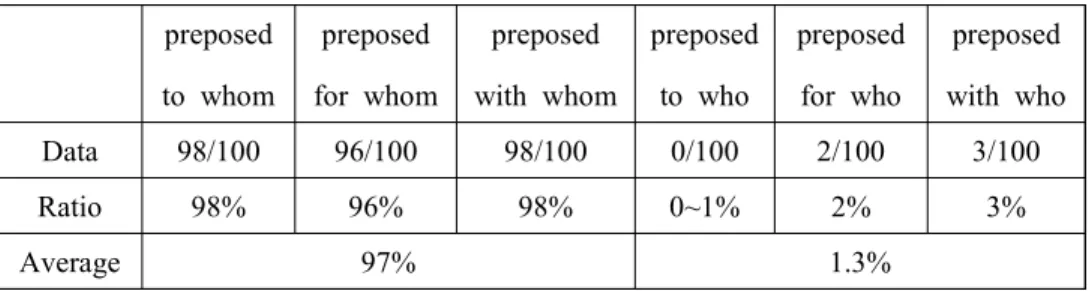
Given this fact, by simple multiplication by ratio (15,612×98/100), it is reasonable to assume that approximately the total frequency of preposed to whom phrases found in COHA would be revised to 15,300 out of 15,612.9 We can see that there is not much difference between the two numbers.
Similarly, in for whom sentences, just 4 out of 100 were the sentences not to be counted. They are as follows:
9 The number was rounded up to the unit's place. It is an estimated number.
(17) a. Right for whom? She asked. (Captive Bride 1987)
b. There's no question that Dr. Vernon is trouble ... but for whom?
Not her parents, that's for certain. (Mens Health 2006)
(18) a. "For us?" "For whom?" "For all of us ... " (Roderick Hudson 1876) b. Danger? Where? For whom? (Cetshwayo 1956)
Sentences (17) show for whom in situ phrases.10 The rest are sluicing.
Some examples of preposed for whom phrases are provided below.
(19) for whom, would you vote? (Houston 1996)
(20) a. The difference today is that many students for whom English is a new language are ... (NYT 1982)
b. To the masses of mankind, for whom manifold thwartings of ambitions and wishes are inevitable, (Atlantic 1932)
c. He handed the jeweler for whom he worked a formal written request ... (Heart Is Lonely Hunter 1940)
The usage of whom in Sentence (19) is an interrogative pronoun. There were, in total, 10 sentences of this sort. Sentences (20) display whom as
10 These two sentences could be analyzed as sluicing, but this paper viewed them as PP in situ based on the intuition that those two are not entirely independent from the former sentence (or context): something is right for whom, and Dr. Veron is trouble for whom.
Only PP as an independent one was counted as sluicing. For example, like the ones in sentences (18).
relative pronouns. Whom is mainly used as a relative pronoun with for, too.
The estimated total frequency of preposed for whom phrases of this paper's interest found in COHA would be hence, 4,743 out of 4,941 by multiplication.
Finally in with whom data, every preposed PP was to be counted. There were just two sentences to be thrown out. They are right below.
(21) a. ... dancing in a cluster, so it was hard to tell who was really with whom. (Southern Rev 1993)
b. ... how she looks, and where she travels, and what she eats and with whom. (My Life as Man 1974)
Here, whom is in PP in situ functioning as an interrogative pronoun. Who can appear in this position.
When it comes to the usage of whom, two in (21) were whom as interrogative pronouns, and one was whom as a free relative as shown below.
(22) We're a private club. We have a right to choose and associate with whom we please. (AP 2002)
Whom here is a free relative meaning anyone whom or whomever. Since with and whom do not form a constituent, this phrase cannot be considered as a preposed PP that originally came from behind. Rather, with seems to
be attached more strongly to the verb associate.
The remaining 97 sentences were whom as relative pronouns. They are sentences like below.
(23) a. ... and the name of the person with whom you spoke.
(Consumers Research Magazine 1992) b. And do you have family in the New York City with whom you
could stay if we were to allow you to leave? (Shattered Silk 1986) c. one with whom he likes to ski ... a Chinese girl in Hong Kong.
(Full Circle 1984)
Accordingly, the expected total frequency of with whom phrases that we are interested in (whom in the preposed PP) found in COHA would be 8,749 out of 8,928.
Summing up, all three prepositions, when used with whom, more than 97% of their usage (to whom: 98%, for whom: 96%, and with whom: 98%) was in the preposed PP. In addition, whom was most frequently used as a relative pronoun after a preposition. The next part of this paper will cover who.
3.2.1.3 To/For/With+who
Contrary to preposition+whom, to who phrases of 100 random samples
were not preposed at all, and most of the time, who functioned as a subject of the following clause except in three cases. These are illustrated below.
(24) ... Dora said. George blinked. "Talk to who?" "You know who," Dora said. (Enemy Camp 1958)
(25) He knew all right whether he was getting married or whether he wasn't, and to who, didn't he? (Back Town 1952)
(26) "To who?" inquired Gaston, with suppressed agitation.
(Fairy Fingers 1865)
The usage of who in sentence (24), (25), and (26) is an interrogative pronoun working as an object. To who phrases in sentence (24) and (25) are PP in situ while sentence (26) has who in sluicing. As it was already heightened, both whom and who can show up in PP in situ and sluicing structures, and therefore, these three above will not be reckoned.
Mostly, the usage of who in to who phrases was an interrogative pronoun, but two were free relatives and other two were relative pronouns.
The most frequent pattern of who as an interrogative pronoun was an NP as to who ... pattern (such as the sentence below). Question, doubt, and idea were the top three most frequently-used nouns for NP.11
11 Adjacent collocates refer to collocates that occur immediately to the right or left of the keyword. This type of collocation is therefore close to real linguistic structures (Lindquist 2009). Three-word-left collocates of to who were investigated to figure out the most frequent antecedents of this pattern. Only nouns were searched so that the results could show only the possible antecedents of the keyword. Antecedents may be farther away, but this case would be so rare.
(27) a. Then it became a question as to who should go to meet her at the dock. (Lion Mouse Story 1906)
b. Now there is likely to be as much as attention paid to who will be Andropov's successor as to Andropov's success. (NYT 1981)
(28) a. Show her how to group them according to who or what she sees.
(Parenting 1998) b. I now am full resolved to take a wife, and turn her out to who
will take her in. (Change Heart, 1892)
(29) a. It's pleasant having some one to talk to who can speak your own tongue. (Princess Aline, 1895)
b. None of the people I talked to who lived anywhere near the last address we had for him admitted ever knowing the guy.
(Fantasy SciFi 1998)
Who in (27) is an interrogative pronoun functioning as a subject of the following clause. Sentences (28) are who as free relatives meaning anyone whom, and anyone who each. In the former sentence, who is an object of the following VP she sees whereas who in the latter is a subject of the following VP will take her in. Sentences (29) show who as a relative pronoun. Each who is a subject of the following VP can speak your own tongue and lived anywhere near the last address we had for him. Their antecedents are some one and people respectively. Each to who here does
not form a constituent.
In conclusion, although who in the sequence of to who phrases appeared 911 times in Table 3 earlier, who in the exclusive area for whom (that is, preposed to who phrases) was very hard to find. With that being said, the inferred total frequency of preposed to who phrases would be so small, or (less likely but possibly) even nonexistent in COHA.
Similar to to who, who was used very often as an interrogative pronoun in 100 for who samples. However, a marked difference was that there existed a lot of free relative usage of who as well. Sentences beneath are the examples of such.
(30) a. For who that fear God, hearing what great things he has done for your soul, do not rejoice and wonder ...
(Men Centuries European 1948) b. That's been going on for who was tapped by the Kremlin for
leadership but later murdered by Chechen Islamist in a ...
(USA Today 2009)
Who in both sentences were used as free relatives meaning people/ those who (in the first sentence) and someone who (in the second sentence). They are subjects of the following clauses, and are definitely not what this paper is searching for.
(31) a. Maryland psychiatrist who served in Vietnam, doesn't believe there
are any indicators for who will perform heroically in times of high stress. (Good house 2002)
b. We helped them plan for who's going to take care of the kids, and we're there for ... (Redbook 1999)
c. The battle for who's going to be the next first lady has started, and it looks like ... (First Lady 2007)
d. You might also show it to young Gillis, and see what he knows about it. Gillis might even give you a name for who got it from Rivers. (Murder in Gunroom 1953)
Sentences above show who as an interrogative pronoun. Who in each sentence is used as a subject of the following clause, and is not composing a constituent with for.
(32) "For who?" sneers my daughter. (Californios 1974)
(33) "Looking for who?" "Jojohn. Em Jojohn." (Cry Angels 1974)
Who in sentence (32) and (33) are used instead of whom, but they are irrelevant to counting. For who phrase in sentence (32) is sluicing, and who in sentence (33) is in PP in situ. There were, in total, 9 sentences of PP in situ and sluicing structures.
(34) a. I am indeed the most fortunate of men; for who but my Alice could be so sweet and self-abnegatory as to take upon her own dear little shoulders the burden of responsibilities that ...
(House an Episode 1986) b. How he for who we hold such high regard was like in a certain
story where the hero is ... (Early Grave 1964)
Finally, sentences above are what this paper has been seeking. These two reveal for who phrases in which who was actually used as a substitute for whom (here, as a relative pronoun) in the preposed PP. The estimated total frequency of for who phrases (who in the preposed PP of this paper's interest) would be therefore, 14 out of 708 total PP sequence of for who phrases.
Lastly, in 100 random samples of with who, three were the phrases with who as a substitute for whom in the preposed PP. Another important finding was that there existed many sentences of PP in situ and sluicing structures (PP in situ: 10 and sluicing: 11).
Who in the preposed PP, which is the focus of this paper's analysis, is provided first.
(35) a. ... send to the President a little-know quotation from Abraham Lincoln, with who Mr. Nixon in his wartime anguish identifies.
(Harpers 1972) b. I am sure it has also been a blessing to the universe of individuals
with who you share your message in helping them understand their condition, how to live with ... (Total Health 2004)
Who in (35) was used as a relative pronoun replacing whom, and their antecedents are Abraham Lincoln and individuals each.
(36) a. Made a deal with who, Daddy? (Bonnie Clyde 1967)
b. I mean I guess everybody on the river knows who puts up with who in that house. (Seven Days in May 1962)
c. What the fuck do I care who fucks with who?
(Sincerity Forever 1990)
(37) With who? There's nobody here. (Pentimento 1973)
What can be seen from these sentences is that who in with who could also be found in PP in situ in (36) and in sluicing structures as in (37) all taking the place of whom.
Under are the sentences that used who as a relative pronoun (subjective case) and a free relative. In sentence (38a), who refers to a friend in the former clause and is a subject of the following VP is a doctor in the D.C.
area ... In sentence (38b), who is a subject of the following VP didn't ride the saw, and with comes from I ever sawed with. The two do not form a constituent. The antecedent of who here is the only man.
(38) a. I've got a friend I grew up with who's a doctor in the D.C. area, and ... (Fortune 1993)
b. He was about the only man I ever sawed with who didn't ride the saw. (Other Main-Travelled 1910)
(39) In the summers I travel. Getting a ride with who I can.
(Words My Roaring 2002)
Sentence (39) would be similar to a sentence I want to fall in love with who I can. Who seems to have come from the ellipsis behind: I can (fall in love with). Therefore, free relative who here is not in a constituent with the former preposition with.
With all these considered, the calculated total frequency of with who phrases (who in the preposed PP of this paper's concern) would be 5 out of the total with who sequence 172.
So far, this paper compared preposed preposition+whom phrases with preposition+who phrases. It is evident from the comparison that when whom is used with a preposition, most of the time, it is used as a relative pronoun in the preposed PP. Who, on the other hand, is often used as an interrogative pronoun (and partially as a free relative), and preposed who in whom position was very hard to find. Below, preposition+whom and preposition+who phrases in COHA are summarized.
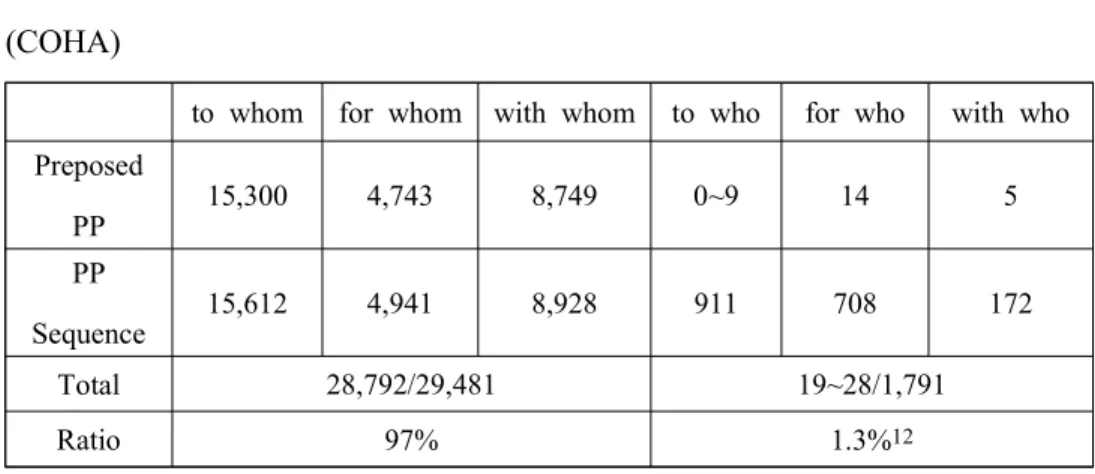
to whom for whom with whom to who for who with who Preposed
PP
15,300 4,743 8,749 0~9 14 5
PP Sequence
15,612 4,941 8,928 911 708 172
Total 28,792/29,481 19~28/1,791
Ratio 97% 1.3%12
Table 6. To/for/with+whom and to/for/with+who in the preposed PP (COHA)
Again, from Table 6, we can see that the number of whom used right after a preposition as a prepositional object is huge compared to that of who. Also, whom was placed in the sheer preposed PP most of the time whereas who in the real preposed PP of this study's concern was just above one percent.
3.2.2 Preposition+Who in COCA Spoken Data
It was obvious from the previous section that in the preposed PP, whom is used a lot more often than who. It is undeniable that the gap between the two is huge and that whom seems to be used exclusively in the preposed PP. Nonetheless, as for who, one could raise a question as to whether the result of who was partially due to the genres of COHA. As was pointed out earlier in Chapter 3, COHA consists of only written texts
12 The number was rounded up to the first decimal place.
such as fiction, magazines, newspapers and other nonfiction. Who may be used more often in spoken environment. This paper, in turn, decided to examine who further in COCA spoken data, too. If who is found less in the preposed PP even in the spoken data, this would bolster up the results of COHA more firmly.
The spoken language in COCA consists of transcripts of unscripted conversation from radio and TV programs so it may not be fully comparable with private conversations of other spoken corpora (Lindquist 2009).
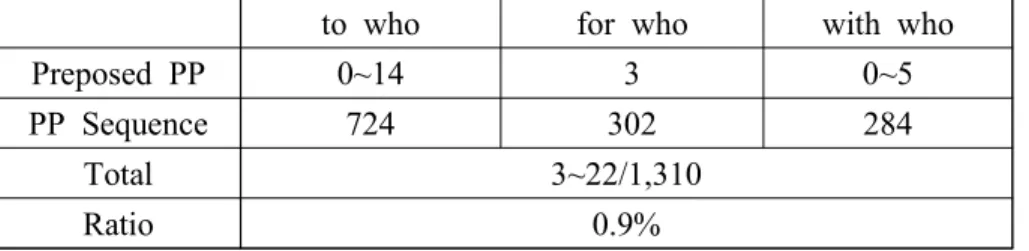
Frequency Frequency Frequency
to whom 512 for whom 496 with whom 662
to who 724 for who 302 with who 284
Table 7. To/for/with+whom and to/for/with+who in COCA spoken data
Table 7 provides to/for/with+whom phrases and to/for/with+who phrases from COCA spoken data. Without doubt, to/for/with+who phrases are used a lot more in spoken data from COCA than in written data from COHA in the ratio of 1,310 over 78.8 million words (COCA) versus 1,791 over 406 million words (COHA). Although in total, preposition+whom phrases are used a little more than preposition+who phrases (compare 1,670 versus 1,310) in COCA spoken data, the gap is not wide and when combined with to, to who phrases are even more used than to whom phrases. The result, to some degree, seems to support the arguments that style and colloquialism affect the use of who (Sweet 1898, Roberts 1954, Klima 1984, Follett 1966,
Kaye 1991, Aarts 1994).
Since this paper is concerning whom and who in the preposed PP, who in this data has to be further analyzed. The results obtained from this analysis are followed up next.
3.2.2.1 To who
Just as the analysis of COHA, data obtained from random sampling function provided by COCA were scanned through, and the sampling number was 50. It turned out that there were no preposed to who phrases in the samples. Similar to the data found in the written material of COHA, who was most frequently used as an interrogative pronoun.
Four were who used in the original position of whom (PP in situ), and an NP as to who ... pattern was found 13 times, which is similar to to who results found in COHA.
(40) a. Nor am I going to give advice to John McCain as to who he ought to choose. (ABC This Week 2008)
b. ... but in a survey as to who you would like to have a beer with.
(FOX Oreilly 2004)
(41) so the issue really comes down to who's the more scientifically credential. (NPR ATC 2001)