저작자표시-비영리-변경금지 2.0 대한민국 이용자는 아래의 조건을 따르는 경우에 한하여 자유롭게
l 이 저작물을 복제, 배포, 전송, 전시, 공연 및 방송할 수 있습니다. 다음과 같은 조건을 따라야 합니다:
l 귀하는, 이 저작물의 재이용이나 배포의 경우, 이 저작물에 적용된 이용허락조건 을 명확하게 나타내어야 합니다.
l 저작권자로부터 별도의 허가를 받으면 이러한 조건들은 적용되지 않습니다.
저작권법에 따른 이용자의 권리는 위의 내용에 의하여 영향을 받지 않습니다. 이것은 이용허락규약(Legal Code)을 이해하기 쉽게 요약한 것입니다.
Disclaimer
저작자표시. 귀하는 원저작자를 표시하여야 합니다.
비영리. 귀하는 이 저작물을 영리 목적으로 이용할 수 없습니다.
변경금지. 귀하는 이 저작물을 개작, 변형 또는 가공할 수 없습니다.
I
이학박사 학위논문
An antibody to a novel epitope on mouse complement C5 β-chain potently neutralizes C5 cleavage
마우스 보체 C5 β-chain 에 특이적인 C5 활성 중화 항체 개발
2017 년 2 월
서울대학교 대학원
의학과 협동과정 종양생물학전공
양 원 준
II
Abstract
Complement is a system of interacting proteins that supports the elimination of pathogens and forms an important component of innate immunity. C5 is the final gatekeeper for regulating the terminal pathway in the complement cascade. It has been the main therapeutic target for complement-related disorders. Many attempts have been made in the past to target these components by developing therapeutic agents; however, only a few drugs are available on the market.
Eculizumab is the only approved therapeutic antibody drug for patients suffering from paroxysmal nocturnal hemoglobinuria (PNH) and atypical hemolytic uremic syndrome (aHUS). Eculizumab binds to MG7 domain of α-chain for preventing C5 cleavage by C5 convertase, and it is a highly effective therapy for patients with rare diseases. According to the New England Journal of Medicine, minor PNH patients have a SNP (R885H/C), which shows a poor response to eculizumab. To this end, it is important to develop a new C5 targeting therapy for the minor PNH patient group that has a low response to the conventional eculizumab treatment.
In this study, we proposed a novel epitope binding antibody (moC5-72) that inhibits complement C5 cleavage via MG4 domain of β chain. This antibody also demonstrated clinical efficacy in a mouse model of nephritis. Thus, MG4 domain also plays a critical role in C5 cleavage. It is a distinct target for developing a novel therapeutic antibody to inhibit C5 cleavage in humans.
III
Keyword : Complement, C5, therapeutic antibody, Eculizumab, SNP, Adriamycin induced nephropathy
Student Number :2010-21884
IV
Contents
Abstract ………..II
Contents ………....IV
List of Tables
………...V
List of figures ………VI
Purpose of the study
………..…VIII
1. Introduction ………1
2. Materials and Methods ………22
3. Result ……….
42
4. Discussion ……….…….
62
V
5. Reference ……….. 64
국문 초록 ………..… 70
List of Tables
Table 1. Complement regulators and receptors
Table 2. Therapeutic antibodies approved in the United States.
Table 3. Primers for V
λand V
Hof chicken single-chain Fv
libraries with long linker
VI
List of figures
Figure 1. The three different pathways of complement activation Figure 2. Overall process of antibody generation from
construction of antibody library to selection of antibody clones
Figure 3. Construction of chicken scFv libraries (long linker) Figure 4. Expression of the recombinant mouse C5 β-chain and
MG4 Fc/cκ fusion protein
Figure 5. Titration of serum antibodies after immunization and boosting
Figure 6. Construction of scFv libraries by overlap PCR Figure 7. Reactivity of antibodies to recombinant mouse
complement C5 β-chain and MG4 domain Figure 8. Selection of cross species reactive clones
Figure 9. Immunoblot analysis of anti-mouse C5 antibody
Figure 10. Binding affinity of anti-mouse C5 antibody
VII
Figure 11. Inhibition of hemolysis assay by anti-mouse C5 antibody
Figure 12. Inhibition of C5a generation by anti-mouse C5 antibody
Figure 13. Mouse serum analysis
Figure 14. Efficacy of anti-mouse C5 antibody in adriamycin induced nephritis mouse model
Figure 15. Anti-mouse C5 antibody effects on choroidal neovascularization mouse model
Figure 16. Anti-mouse C5 antibody reduce C5a and MCP-1
generation in RCS complex
VIII
Purpose of the study
C5 plays a critical role in the complement system. C5 is the final gatekeeper for regulation of the terminal pathway in the complement cascade. Although C5 convertase cleaves C5 into C5a and C5b, the exact mechanism by which C5 convertase interacts with C5 is still unknown. C5 is made up of α- and β-chains and there are several important binding domains for C5 convertase. Eculizumab binds to α-chain of C5 and is the only therapeutic drug approved by the FDA for inhibition of C5 cleavage. As a result, inhibition of C5 cleavage by β-chain has not yet been elucidated. This study was performed to investigate the role of β-chain in binding with C5 convertase and to examine a neutralizing monoclonal antibody against β-chain of C5 in vitroand in vivomouse models.
1
1. Introduction
1. 1. Complement system
Complement is one of important factor of innate immunity that performs a role for first defense against foreign and altered host cells (1). In the 80s, complement was identified when it was found to aid or “complement” the elimination of bacteria by inactivated antibodies present in normal serum (2). The complement system consists of various proteins that are either present as membrane-associated proteins or soluble proteins in the blood (3). Complement activation leads to a sequential enzymatic reaction, causing the generation of potent anaphylatoxin C3a and C5a that result in strong physiological responses to apoptosis (3). At the beginning, complement was regarded to play a major role, exclusively in innate immunity (4).
However, surprisingly, complement also plays a critical role with T cells and B cells in adaptive immunity that supports elimination of pathogens and maintenance of immunological memory (4, 5). The complement is not merely involved in innate and adaptive immunity, but is also involved in tumor proliferation, regeneration of tissue and orphan disease such as paroxysmal nocturnal hemoglobinuria (PNH), atypical hemolytic uremic syndrome (aHUS) and age-related macular degeneration (AMD) (6, 7).
2
1. 2. Complement activation pathways
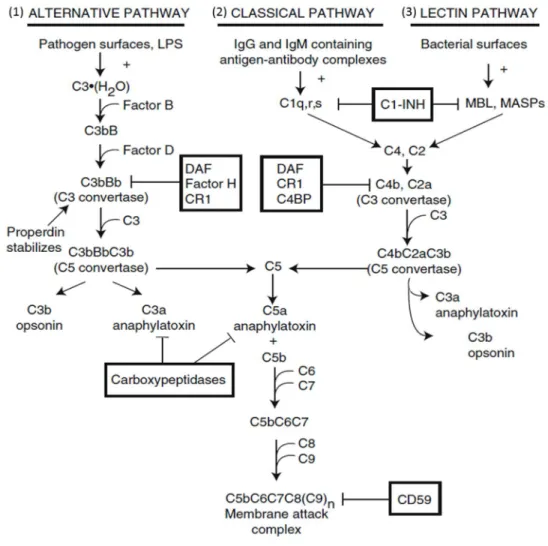
The activation of complement involves three different pathways, which are classical, alternative and lectin pathways (Figure 1). All the pathways involve C3 and C5 components, which lead to the formation of the activation products C3a, C3b, C5a and C5b-9 (Membrane attack complex, MAC) (2).
The first step of the classical pathway is binding with C1q; the C1 component is a multimeric complex consisting of C1q, C1r and C1s molecules. These complement molecules bind to the FC portion of the IgG or IgM immune complex (8).
Following C1q binding to the exposed Fc portion of IgG or IgM, C1s and C1r are recruited to the complex. C1s cleaves C4 and C2 to form the C4bC2a complex (C3 convertase) (8).
The alternative pathway is initiated to recognize carbohydrates, lipids and proteins which are foreign and non self-molecules (6). Low level of C3 is cleaved into C3a and C3b, which spontaneously bind to targets such as bacteria and pathogens (9).
C3b recruits Factor B followed by Factor D that cleaves Factor B to form the C3bBb complex (C3 convertase), which is maintained by the presence of plasma properdin (10). Properdin is a small protein released from activated neutrophils. It helps to stabilize the convertase by binding to C3b and preventing its cleavage by Factors H and I (10).
The lectin pathway is triggered by mannose binding lectin (MBL) moieties on the surfaces of pathogens including bacteria, molds, viruses and so on (11, 12). There are related with four MASPs structure. When MASP2 binds to pathogens, conformational changes are induced, which lead to auto activation and this causes
3
cleavage of C4 into C4a and C4b. C4b binds with C2a to form the C4bC2a complex (C3 convertase), which also has enzymatic activity (11). The role of the other MASPs has not yet been reported. Thus, MASPs support to increase complement activation by binding complexes (11).
Both C3 convertases (C4bC2a and C3bBb) cleave C3 to release C3a and C3b.
Particularly, C3b is an opsonizing molecule which helps to further enhance complement activation as well as increases in phagocytosis (3). Moreover, C3b complexes with C3 convertases help to generate the C5 convertases, which are C3bBbC3b and C4bC2aC3b (Figure 1). The C5 convertase cleaves C5 to form C5a and C5b. The membrane attack complex (MAC) is then initiated by C6 and C7 binding to the C5bC6C7 complex. The membrane attack complex forms pores by inserting itself into cell membranes, resulting in cell lysis.
4
Figure 1. The three different pathways of complement activation
Classical, alternative and lectin pathways; molecules can inhibit pathways are indicated in boxes (3).
5
1. 3. Anaphylatoxin C5a and C5b-9 membrane attack complex
Both C5a and C5b-9 (Membrane attack complex, MAC) are complement activation products. C5a is a protein fragment released from cleavage of C5. It is the most potent anaphylactic component and a powerful chemoattractant for neutrophils and monocytes, with the ability to promote migration, extravasation, and activation of these cells (13). Following the C5a gradient, neutrophils migrate to the site of infection and phagocytize the pathogen (14). Neutrophils produce reactive oxygen species and release granule constituents for phagocytosis of the ingested particles (14). C5a is also secreted into the extracellular space to kill microorganisms (15).
Moreover C5a induces release of various pro-inflammatory factors such as histamine, leukotrienes, platelet activating factor, cytokines and chemokines (16, 17). The membrane attack complex causes lysis of foreign or disordered cells and has pro-inflammatory activity that mediates the induction of self-cell activation by causing up-regulation of adhesion molecules, tissue factor, and chemokines (18).
6
1. 4. Complement regulators and receptors
Complement activation is finely regulated by various regulators and inhibitors in every cascade (19, 20). These regulators distinguish between self and non-self surfaces (21). Host cells control complement activation by using the combination of plasma regulators.
The balance of the plasma regulators find out progression of the amplification reaction. There are more than thirty components involved in the complement system. These components comprise the nine main components of the cascade (C1 to C9) and their multiple activation factors have varied biological activities (22, 23);
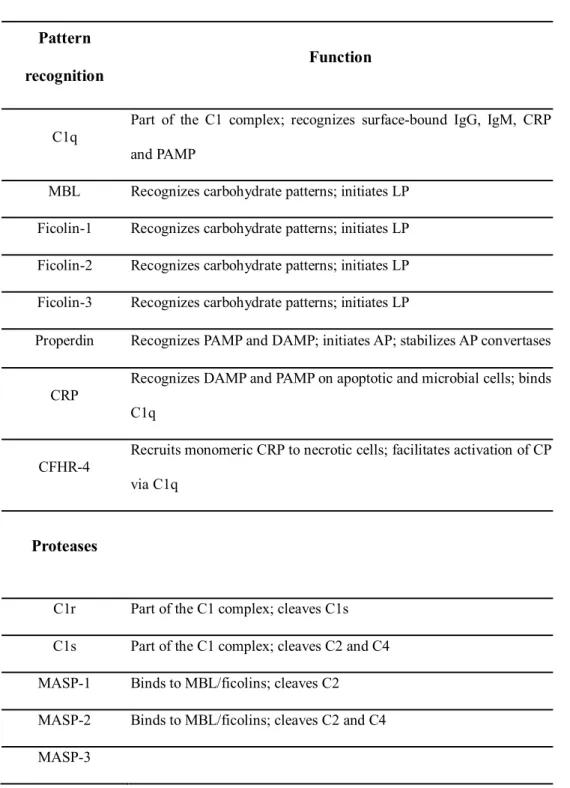
regulators and inhibitors (such as factor H, factor H-like protein 1 (FHL1), complement factor H-related protein 1 (CFHR1), CR1 , C4b binding protein, proteases and newly assembled enzymes (for example, factor B, factor D, C3bBb and C4bC2b) or receptors for effector molecules (such as C3aR, C5aR, C5L2 and complement component C1q receptor (C1qR)) (Table 1). According to the report, mutations of the complement gene cause either interference with protein secretion or function of proteins in the complement system (24).
7
Table 1. Complement regulators and receptors (1)
Pattern
recognition Function
C1q Part of the C1 complex; recognizes surface-bound IgG, IgM, CRP and PAMP
MBL Recognizes carbohydrate patterns; initiates LP Ficolin-1 Recognizes carbohydrate patterns; initiates LP Ficolin-2 Recognizes carbohydrate patterns; initiates LP Ficolin-3 Recognizes carbohydrate patterns; initiates LP
Properdin Recognizes PAMP and DAMP; initiates AP; stabilizes AP convertases
CRP Recognizes DAMP and PAMP on apoptotic and microbial cells; binds C1q
CFHR-4 Recruits monomeric CRP to necrotic cells; facilitates activation of CP via C1q
Proteases
C1r Part of the C1 complex; cleaves C1s C1s Part of the C1 complex; cleaves C2 and C4 MASP-1 Binds to MBL/ficolins; cleaves C2
MASP-2 Binds to MBL/ficolins; cleaves C2 and C4 MASP-3
8
C2 Part of the CP/LP convertases; cleaves C3/C5 Factor B Part of the AP C3/C5 convertases; cleaves C3/C5
Factor D Cleaves C3b-bound FB to form the AP C3/C5 convertases Factor I Degrades C3b and C4b
Complement components
C3 Progenitor for anaphylatoxin C3a, opsonin C3b and signaling fragments
C4 Progenitor for opsonin C4b; part of the CP/LP convertases C5 Progenitor for anaphylatoxin C5a and C5b/TCC
C6 Part of TCC (membrane insertion) C7 Part of TCC (membrane insertion) C8 Part of TCC (induction of pore formation) C9 Part of TCC (forms lytic pore)
Receptors
CR1 Binds C3b/iC3b; induces phagocytosis: accelerates decay of convertases
CR2 Binds iC3b/C3dg/C3d; lowers threshold for B-cell stimulation CR3 Induces phagocytosis through interaction with iC3b
CR4 Induces phagocytosis through interaction with iC3b C3aR Binds C3a; triggers pro-inflammatory signaling C5aR Binds C5a; triggers pro-inflammatory signaling
9
C5L2 Binds C5a (strongly) and C5adesArg (weakly); might bind C3a/C3adesArg
CRIg Induces phagocytosis through interaction with iC3b/C3c
cC1qR Recognizes bound C1q; induces phagocytic signaling through CD91
gC1qR Recognizes C1q; potential role in phagocytosis and signaling;
modulates IL-12 on APCs
C1qRp Part of receptor complex that binds C1q and mediates phagocytosis
Regulators
C1-INH Inhibits C1r/s and MASPs
sMAP Binds to MBL, competes with MASPs MAP-1 Binds to MBL/ficolins; inhibits C4 deposition
C4BP Accelerates decay of LP/CP convertases; cofactor for fI
Factor H Recognizes self-surfaces; accelerates convertase decay; cofactor for fI
FHL-1 Accelerates convertase decay; cofactor for fI MCP Cofactor for fI
DAF Accelerates decay of convertases
CFHR-1 Recognizes self-surfaces and C5; inhibits C5 cleavage and TCC formation
CD59 Binds to C8 and C9; prevents assembly of TCC Vitronectin Binds to C5b-9; prevents assembly of TCC
Clusterin Binds to C7-C9; prevents assembly of TCC Carboxypeptidase Degrades C3a and C5a to their desArg forms
10
1. 5. Complement mediated disorders
Activation of complement results in enhanced elimination of abnormal cells and pathogens and enhanced recruitment of immune cells (macrophages, neutrophils).
Hyper activated complement is involved in several inflammatory, autoimmune, ocular, neurodegenerative and infectious diseases (25). The pathology of complement-related disease is caused either due to inappropriate activation of the complement cascade or deficiencies in complement factor or regulators of various pathways, resulting in aberrant activation (26). For example, Paroxysmal nocturnal hemoglobinuria (PNH) and atypical hemolytic uremic syndrome; PNH is a rare form of hemolytic anemia (27). This disease occurs due to mutation of the X- chromosomal PIG-A gene in hematopoietic stem cells. As a result, it causes deficiency of complement regulators CD59 and DAF in red blood cells (28). aHUS is another complement-related disease, which is also a rare disease. aHUS is characterized by repeated occurrence of endothelial cell damage, hemolytic anemia, thrombotic thrombocytopenia and kidney failure. The cause of the disease is not known clearly. However, the reason for the occurrence is associated with mutations in FH, MCP, factor I, factor B or C3 (29). Eculizumab (Soliris) is the only therapy approved by the FDA to treat both diseases (28).
11
1. 6. Approved therapeutic antibody
Antibodies have introduced the new deal the pharmaceutical industry and the medicine, providing new hope for patients that conventional therapies have failed.
Antibodies are one of the major factors in our defense system. Antibodies presented on the B-cell membrane or secreted by plasma cells bind and neutralize antigens specifically. Many efforts have been made to mimic these abilities of antibodies for therapeutic uses (30). The first antibody to be clinically available with approval from the Food and Drug Administration (FDA) is muromonab-CD3 (Orthoclone OKT-3) which was developed in 1986. This mouse antibody was directed at reducing acute immune rejection and it showed substantial efficacy compared to conventional chemical drugs. This mouse antibody had a major disadvantage as it caused immunogenicity in 50% of the patients treated. Human anti-mouse antibody (HAMA) response drastically decreased its efficacy. Also, serum half-life of this antibody was very short and it ranged from 0.3 to 0.75 days (31). This occurred due to rapid lysosomal degradation as the Fc receptor was not able to recognize murine Fc. In 1994, abciximab (ReoPro) was developed in the form of a chimeric antibody. Chimeric antibody was generated by combining variable regions of a mouse antibody and constant regions of a human antibody.
Chimeric antibodies showed improved qualities with respect to immunogenicity-
12
related issues with rituximab, the first antibody in full Immunoglobulin G (IgG) form, immunogenic in only 1.1% of low grade or follicular non-Hodgkin’s lymphoma patients and cetuximab immunogenic in only 5% of the patients treated (32, 33). Serum half-life of chimeric antibodies was increased to days. Among the chimeric antibodies, rituximab showed serum half-life comparable to that of IgG, average of 22 days. The first humanized antibody daclizumab was generated by grafting CDRs from non-human antibody into a human variable. Humanized antibodies showed substantially improved qualities. Among many humanized antibodies that have been developed, immunogenicity of trastuzumab was exceptionally low, with anti-trastuzumab antibody detected only in one patient when 903 women with metastatic breast cancer were treated (7). Serum half-lives of humanized antibodies were also increased, nearly approaching the serum half- life of IgG. Fully human antibodies were subsequently followed by antibodies having low immunogenicity and high serum half-lives. Currently, 54 antibodies are available for human use (Table 2) (34)
13
Table 2. Therapeutic antibodies approved in the United States
Generic Name mAb type Antigen Approval date
Muromonab-CD3 murine CD3 19.06.1986
Ibritumomab Tiuxetan murine CD20 19.02.2002
Tositumomab-I131 murine CD20 27.06.2003
Abciximab chimeric GPⅡb/Ⅲa 22.12.1994
Rituximab chimeric CD20 26.11.1997
Basiliximab chimeric CD25 12.05.1998
Infliximab chimeric TNFα 24.08.1998
Cetuximab chimeric EGFR 12.02.2004
Brentuximab Vedotin chimeric
CD30
(drug conjugate) 19.08.2011
Siltuximab chimeric IL-6 23.04.2014
Daclizumab humanized CD25 10.12.1997
Palivizumab humanized RSVgpF 19.06.1998
Trastuzumab humanized HER-2 25.09.1998
14 Gemtuzumab
ozogamicin humanized CD33 17.05.2000
Alemtuzumab humanized CD52 97.95.2001
Omalizumab humanized IgE 20.06.2003
Efalizumab humanized
CD11a
(LFA-1) 16.10.2003
Bevacizumab humanized VEGF 26.02.2004
Natalizumab humanized
a1 subunit of a4b1and a4b7
integrins
11.23.2004
Ranibizumab humanized VEGF-A 30.06.2006
Eculizumab humanized Complement C5 16.03.2007
Certolizumab
pegol humanized TNFα 22.04.2008
Toclizumab humanized IL6 11.01.2010
Pertuzumab humanized Her2 08.06.2012
Ado-trastuzumab
emtansine humanized Her2 (drug conjugate) 22.02.2013
Obinutuzumab humanized CD20 01.11.2013
Vedolizumab humanized Integrin α4β7 20.05.2014
Adalimumab human TNFα 25.05.2006
Panitumumab human EGFR 28.09.2006
Golimumab human TNFα 24.04.2009
Canakinumab human IL-1b 18.06.2009
Ofatumumab human CD20 26.10.2009
15
Ustekinumab human p40 subunit of the IL-12
and IL-23 cytokine 30.12.2009
Denosumab human RANk ligand 01.06.2010
Ipilimumab human CTLA-4 28.03.2011
Raxibacumab human B. anthrasis 15.12.2012
Belimumab human B cell activating factor 06.01.2012
Ramucirumab human VEGFR2 21.04.2014
Pembrolizumab humanized PD-1 04.09.2014
Nivolumab human PD-1 01.12.2014
Blinatumomab mouse CD19, CD3 01.12.2014
Siltuximab chimeric IL-6 23.04.2014
Dinutuximab chimeric GD2 10.03.2015
Alirocumab human PCSK9 01.07.2015
Evolocumab human PCSK9 27.08.2015
Mepolizumab humanized IL-5 04.11.2015
Daratumumab human CD38 16.11.2015
Necitumumab human EGFR 24.11.2015
Elotuzumab humanized SLAMF7 30.11.2015
Obiltoxaximab chimeric anthrax 18.03.2016
Ixekizumab humanized IL-17A 22.03.2016
Reslizumab humanized IL-5 23.03.2016
Atezolizumab humanized PD-L1 18.05.2016
Daclizumab humanized IL-2 27.05.2016
16
1. 7. Antibody phage libraries
Antibody library could roughly be categorized into ‘immune library’ and ‘non- immune library’. Immune library is generated with antibody genes from immunized donors, while non-immune library uses naïve library generated with antibody genes from humans or animals, or artificially generated synthetic library without immunization process (35). Traditional antibody development often includes immunized library. Lymphocytes were collected from immune organs (bone marrow, spleen and etc.) and several rounds of PCR were performed using a set of various primers to obtain the antibody genes (36). The encoded antibody is fused to the minor coat protein pⅢ of the phage, can be successfully displayed on the surface of the phage.
In one study, we constructed an antibody in the single chain Fragment variable (scFv) region form. ScFv is an antibody, which consists of heavy (VH) and light (VL) chain variable regions. Rearranging heavy chain VHand light chain VL gene segments in vitro and introducing varying sequences of artificial complementarity determining regions (CDRs) via overlap PCR using random primers are the major parts of antibody library construction. Generated fragment of the antibody is cloned
17
into a phagemid vector in order to transform into E. coli. Antibodies and most eukaryotic proteins require disulfide bond formation for stability. E. coli periplasm provides an oxidizing environment, which is an appropriate compartment for correct antibody folding.
Phage-displayed antibodies are produced by transfection with VCSM13 helper phage for precise replication and assembly of phage particles (37). Antibodies with diverse CDR combinations would be produced, since the final library size typically reaches 109. As it takes only a few weeks to engineer a target-specific antibody, phage display is an efficient technique for antibody development.
18
1. 8. Phage display
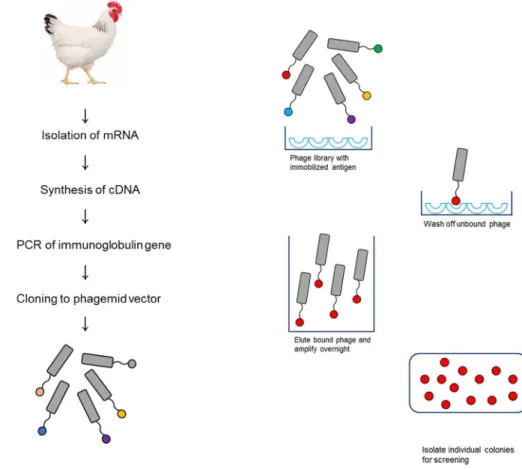
Phage display technology is a powerful tool for the selection of specific monoclonal antibodies against known or novel antigens. Filamentous bacteriophages (phage) are viruses that contain a circular single-stranded DNA and Ff class of phages such as M13 and Fd are well known. The name indicates that these phages infect their host, E. coli, through the F pilus (37). The phages mainly enclosed gene 8protein that was a major coat protein, and four other coat proteins are also located on the phage surface. Among these coat proteins, the inserted genes were displayed through gene 3protein (pⅢ), gene 6 protein (pⅥ) or gene 8 protein (pⅧ). However, phage DNA has low transformation efficiency; therefore, a phagemid vector is used in phage display system for simple cloning directly into the phage genome and it displayed large proteins on the phage. Phagemid display on pⅢ is the most commonly used method, and a foreign protein is presented on the phage surface through insertion of foreign DNA before gene 3 by restriction sites (38). The ultimate purpose of phage display is selection of specific antibodies to target the antigen and exclusion of nonspecific phages through bio-panning. Bio- panning consists of the following 4 steps: 1) immobilization of target antigen and
19
incubation with phage libraries, 2) washing out of unbound or low affinity phages, 3) elution of bound phages, and 4) overnight amplification of eluted phages. All steps are repeated three or four times until enrichment is achieved (Figure 2). After the final round of bio-panning, colony picking of individual clones and infected E.
coli cells is performed for phage amplification of each clone. Each amplified phage clone is screened by phage enzyme-linked immunosorbent assay (ELISA). There are ongoing antibody selection procedures through sequencing analysis, over- expression in mammalian cells and antibody purification by affinity chromatography.
20
Figure 2. Overall process of antibody generation from construction of antibody library to selection of antibody clones
After immunizing antigens to animals, total RNA is prepared and cDNA was synthesized. Genes encoding VHand VLare amplified by PCR and assembled. The assembled scFv genes are inserted into phagemid vector. The vector DNA is transformed to E. coli. After adding the helper phage, the diverse library of antibodies is displayed on phage. This antibody phage library containing millions of different antibody fragments can be used to select positive antibody clones by bio-panning. Bio-panning consists of a series of recursive cycles of binding, washing, elution, and amplification. The resultant phage pool can be tested by
21
ELISA to evaluate the success of bio-panning and select antibody clones.
22
2. Materials and Methods
2. 1. Preparation of mouse complement C5 recombinant proteins
Mouse complement C5 β-chain and MG4 domain recombinant proteins were produced in our laboratory. The mouse complement C5 β-chain (amino acid 19 to 674), mouse C5 MG4 domain (amino acid 351 to 458) gene were synthesized (Genscript, piscataway, NJ, USA). The gene was fused to a C-terminal human Fc or human cKappa tag which was subcloned into the modified pCEP4 vector that has double sfi1 restriction enzyme sites, as described previously (39). Subsequently, the vectors were used to transfect HEK293F cells (1.0 x 10⁶cells/㎖) (Invitrogen, Carlsbad, CA, USA) using polyethylenimine (Polysciences, Warrington, PA, USA), and the transfected cells were cultured in Freestyle 293 expression medium (Invitrogen) in a 37 ℃ CO2incubator as described previously (40). The human Fc fused recombinant protein was purified by affinity chromatography using protein A sepharose (Repligen, Waltham, Ma, USA) column, as described previously (39).
The protein was fusion to human cKappa recombinant protein was purified using the Kappaselect resin (GE healthcare, Pittsburgh, PA, USA) was according to the manufacturer’s instruction.
23
2. 2. Generation of anti-mouse C5 β-chain scFv antibodies
2. 2. 1. Immunization
Three white reghorn chickens were immunized with the purified recombinant mouse C5 β-chain-Fc and mouse C5 MG4-Fc proteins respectively. Briefly, fifty μg of the purified mouse C5 β-chain-Fc and mouse C5 MG4-Fc in 2mL of Freund’s adjuvant (Sigma Chemical Co., St. Louis, MO) was incubated at 37 °C for 30 min, and used for immunization of the chickens. The immunization was performed 3 times at 2 week intervals, as described previously (41). The titer of serum antibody was determined by ELISA (enzyme linked immunosorbent assay) using horseradish peroxidase (HRP) conjugated rabbit anti-chicken IgY polyclonal antibody (Chemicon, Temecula, CA) as secondary antibody.
2. 2. 2. Isolation of total RNA from the spleen and bone marrow of the immunized chickens
Total RNA was isolated from the spleen, bone marrow and bursa of fabricius of the immunized chickens using TRIzol reagent. The extracted tissue in TRIzol was homogenized using homogenizer. The homogenized samples were centrifuged at 2,500 g for 10 min at 4 °C. The supernatant was transferred to a 50 mL centrifuge tube and added 1 mL of BCP (1-bromo-3-chrolo-propane) (Sigma Chemical Co., St.
Louis, MO) to each supernatant. The tubes were vortexed for 15 sec and incubated for 15 min at room temperature. The mixture was centrifuged at 17,500 g for 15 min at 4 °C and the supernatant was transferred to fresh tube. The 15 mL of isopropanol was added and incubated for 10 min at room temperature. Repeated
24
centrifugation as previously described, the supernatant was removed carefully and the pellet was washed with 10 mL of 75 % ethanol without resuspension. After centrifugation at 17,500 g for 10 min at 4 °C, the supernatant was removed and the pellet was air-dried briefly at room temperature. The pellet was dissolved in 250 uL of RNase-free water and stored in -80 °C. The RNA concentration was determined by measuring the optical density at 260 nm (40 ng/uL RNA gives and OD260=1) and the purity was calculated by the ratio of OD260/OD280(typically in the range of 1.6 to 1.9)
2. 2. 3. First-strand cDNA synthesis from total RNA
First-strand cDNA was synthesized using the Superscript™ III first-strand synthesis supermix with Oligo (dT) priming (Invitrogen). 5 ug of isolated total RNA was mixed with 1 uL of 50 uM oligo(dT)20, 1 uL of 10 mM dNTP mix and added DEPC (diethyl pyrocarbonate)-treated water up to 10 uL. The mixture was incubated for 5 min at 65 °C and placed on ice for at least 1 min. 2 uL of 10X reaction buffer, 4 uL of 25 mM MgCl2, 2 uL of 0.1M DTT (dithiothreitol), 1 uL of RNaseOUTTM (40 U/uL), and 1 uL of Superscript III reverse transcriptase were added to the mixture and incubated for 50 min at 50 °C. The reaction was terminated by incubation for 5 min at 85 °C and chilled on ice. 1 uL of RNase H was added and incubated for 20 min at 37 °C. The first-strand cDNA was stored at -20 °C until use.
2. 2. 4. First round of PCR
The cDNAs from the spleen, bone marrow and bursa of fabricius of the immunized
25
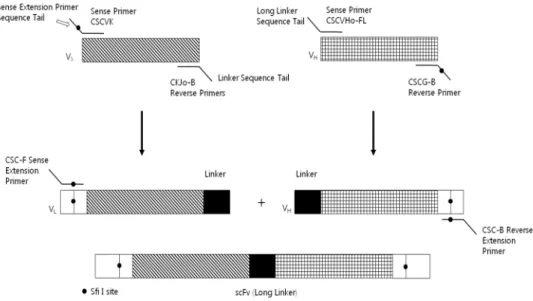
chickens were amplified by PCR using expand high fidelity PCR system (Roche molecular diagnostics, Pleasanton, CA). 2 primer for amplification of chicken VL (Vλ) and 2 primers for amplification of chicken VH coding sequences were used together (Figure 3 and Table 3). About 0.5 ug of cDNA was mixed with 60 pmol of each primer sets, 10 uL of 10X reaction buffer, 8 uL of 2.5 mM dNTPs (Promega, Madison, WI), 0.5 uL of Taq DNA polymerase, and distilled water to bring the final volume of 100 uL. The reactions were carried out under the following conditions: 30 cycles of 15 sec at 94 °C, 30 sec at 56 °C, and 90 sec at 72 °C, followed by a final extension for 10 min at 72 °C. The size of VLand VHproducts was about 350 bp, each PCR products were analyzed on a 2% agarose gel. The light chain PCR products were combined into one pool and the heavy chain products into another pool. They were loaded and run on a 1.5% agarose gel and purified by QIAEX II gel extraction kit (Qiagen, Valencia, CA). The purified PCR products were quantified by reading the O.D. at 260 nm (1 O.D. unit=50 ug/mL).
2. 2. 5. Second round of PCR
For the generation of scFv, the first round VLproducts and VHproducts were joined by overlap extension PCR (Figure 4). The primer sets for this were described as above (Table. 3). 100 ng of purified light chain product and heavy chain product were mixed with 60 pmol of each primer, 10 uL of 10X reaction buffer, 8 uL of 2.5 mM dNTPs (Promega, Madison, WI), 0.5 uL of Taq DNA polymerase, and water to bring the final volume of 100 uL. The reactions were carried out under the following conditions: 20 cycles of 15 sec at 94 °C, 30 sec at 56 °C, and 2 min at 72 °C, followed by a final extension for 10 min at 72 °C. About 700 bp sized
26
products were loaded and run on a 1.5% agarose gel. They were purified as described above.
2. 2. 6. Restriction enzyme digestion of the purified overlap extension product and the vector DNA
The PCR product and pComb3X vector for cloning were digested with sfiI (Roche, Sussex, UK). 10 ug of purified overlap PCR product was mixed with 360 U of sfiI (16 U per ug of DNA) (Roche), 20 uL of 10X reaction buffer M, and water to bring the final volume of 200 uL. 20 ug of pCobm3X vector was incubated with 120 U of sfiI (6 U per ug of DNA) (Roche), 20 uL of 10X reaction buffer M, and water to bring the final volume of 200 uL. Both digest were incubated for 5 h at 50 °C.
About 700 bp of the digested insert was purified on a 1% agarose gel and the vector (~3400 bp) and the stuffer fragment (~1600 bp) were purified on a 0.6%
agarose gel as described above.
27
Table 3. Primers for Vλand VHof chicken single-chain Fv libraries with long linker (37)
Vλ Primers
CSCVK (sense) GTG GCC CAG GCG GCC CTG ACT CAG CCG TCC TCG GTG TC CKJo-B (reverse) GGA AGA TCT AGA GGA CTG ACC TAG GAC GGT CAG G
VH Primers
CSCVHo-FL (sense)GGT CAG TCC TCT AGA TCT TCC GGC GGT GGT GGC AGC TCC GGT GGT GGC GGT TCC GCC GTG ACG TTG GAC GAG CSCG-B (reverse) CTG GCC GGC CTG GCC ACT AGT GGA GGA GAC GAT GAC TTC GGT CC
Overlap Extension Primers
GAG GAG GAG GAG GAG GAG GTG GCC CAG GCG GCC CTG ACT CAG GAG GAG GAG GAG GAG GAG GAG CTG GCC GGC CTG GCC ACT AGT GGA GG CSC-F (sense)
CSC-B (reverse)
28
Figure 3. Construction of chicken scFv libraries (long linker)
Each sense primer is combined with reverse primer to amplify Vλ and VH gene segments from chicken cDNA. CSCVK and CSC-B have SfiI sites that are recognized by the extension primer in the second-round PCR. CKJo-B reverse primer and CSCVHo-FL reverse primer have the sequence tails that corresponds to the linker sequence that are used in the overlap extension PCR. The sense and reverse extension primers used in the second round of PCR recognize the sequence tails that were generated in the first round of PCR (37).
29 2. 2. 7. Preparation of competent cell
A single colony of E. coliER2738 (New England Biolabs, Beverly, MA, USA) was inoculated to 15 ml of pre-warmed SB medium containing 12 μg/ml of tetracycline and incubated overnight at 37 ℃. The next day, 2.5 ml of the culture was
transferred into 500 ml SB medium containing 10 ml of 20 % (w/v) glucose and 5 ml of 1 M MgCl2and shook at 250 rpm and 37 ℃until the optical density (OD) at 600 nm reaches 0.8~1.0. The culture was poured into pre-chilled centrifuge bottle and incubated 15 min on ice. The culture was separated into supernatant and pellet by centrifugation at 3,000 g for 20 min at 4 ℃. The supernatant was discarded and the pellet was re-suspended in 300 ml of pre-chilled 10 % (w/v) glycerol solution.
The resuspension was spun as before. After three times of pellet washing, the supernatant was discarded and the pellet was re-suspended in the small volume of glycerol solution remnant, and stored at -80 ℃.
2. 2. 8. Preparation of helper phage
A single plaque of VCSM13 (Stratagene, La Jolla, CA, USA) was infected to the E.
coliER2738 culture which was incubated in 10 ml of SB medium and reached OD
600 = 1.0. Infected culture was incubated for 2 hr and transferred to 500 ml of pre- warmed SB medium containing kanamycin to a final concentration of 70 μg/ml and cultured overnight at 37 ℃. After the culture was centrifuged at 3,500 rpm for 15
min, the supernatant was incubated at 70 ℃for 20 min and spun at 3,500 rpm for
30
15 min again. The supernatant was isolated and stored at 4℃.
2. 2. 9. Test ligation of the digested overlap PCR product with the vector DNA Small scale ligations were performed to assess the suitability of the vector and inserts for high efficiency ligation and transformation. 140 ng of sfiI digested vector DNA was mixed with 70 ng of sfiI digested PCR products, 4 uL of 5X ligase buffer, 1 uL of T4 DNA ligase (Invitrogen), and water to bring the final volume of 20 uL. The ligation efficiency was compared to two controls, for insert control and for vector self-ligation. For insert control, 140 ng of sfiI digested stuffer fragment used for instead of insert. Only sfiI digested vector DNA was mixed with 5X ligase buffer and 1 uL of T4 DNA ligase for vector self-ligation control. The ligation mixtures were incubated between 4 h and overnight at 16 °C. 1 uL of ligation mixture was mixed with 50 uL of ER2738 (NEB) electrocompetent cells and incubated on ice for 1 min. The mixture was transferred into 0.2 cm cuvette and eletroporated by Gene pulser (Bio Rad laboratories, Hercules, CA) at a condition of 2.5 kV, 25 uF and 200 Ω. The cells were resuspended with 3 mL of SB medium and incubated for 1 h at 37 °C. The transformed cultures were diluted 10 fold and 100 fold with pre-warmed SB medium, and plated 100 uL of each dilution on LB+carbenicillin plates for calculation of transformants. The final library size should be at least 108 CUF per ug of vector DNA and should have less than 5%
vector self-ligation.
2. 2. 10. Library ligation and transformation
Single library ligation was carried out using 1.4 ug of sfiI digested pComb3X
31
vector, 700 ng of sfiI digested PCR product, 40 uL of 5X ligase buffer, 10 uL of T4 DNA ligase, and water to bring the final volume of 200 uL. The ligation mixture was incubated overnight at 16 °C. The mixture was precipitated by adding 1 uL of glycogen, 20 uL (0.1 volumes) of 3 M sodium acetate, pH 5.2, and 440 uL (2.2 volumes) of ethanol. The sample was stored at -80 °C followed by centrifugation at full speed for 15 min at 4 °C. The pellet was rinsed with 1 mL of 70% (v/v) ethanol and dried briefly, and dissolved in 15 uL of distilled water. The ligated library sample was transformed into 300 uL of ER2738 (NEB) electrocompetent cells as described above. The cells was resuspended with 5 mL of SB medium and incubated for 1 h at 37 °C. 10 mL of pre-warmed SB medium and 3 uL of 100 mg/mL carbenicillin were added to the culture. To titer the transformed library, the culture was diluted 100 fold in SB medium, and plated 10 uL and 100 uL of this on LB+carbenicillin plates. The culture was incubated 1 h at 37 °C, 4.5 uL of 100 mg/mL carbenicillin was added to the culture and shook for an additional hour. The culture was added with 2 mL of VCSM13 helper phage (1012to 1013pfu/mL), 183 mL of pre-warmed SB medium and 92.5 uL of 100 mg/ml carbenicillin. This culture was shook at 300 rpm for 1.5-2 h at 37 °C. 280 uL of 50 mg/mL kanamycin was added and continued shaking overnight at 37 °C. In the next day, the phage pool was collected by centrifugation at 3,000 g for 15 min. The supernatant was transferred to a clean 500 mL centrifuge bottle and the bacterial pellet was saved for phagemid DNA preparation. 8 g of PEG-8000 (polyethylene glycol-8000) and 6 g of NaCl were mixed with supernatant. The solid was dissolved well by shaking at 37 °C for 10 min and the mixture was stored on ice for 30 min. The phage was pelleted by centrifugation at 15,000 g for 15 min and 4 °C. The supernatant was
32
discarded and the phage pellet was resuspended in Tris-buffered saline (TBS) containing 1% (w/v) BSA supplemented with 0.02% NaN3. The phage sup was centrifuged and filtered with 0.2 um filter for eliminate the remnants of bacterial cells.
2. 2. 11. Bio-panning on an immobilized antigen
Three μg of the recombinant mouse C5 MG4-cκ was coated to 1 x 10 7 paramagnetic beads (Dynabeads® M270- Epoxy, Invitrogen) at room temperature for 16 hr. The beads were washed with phosphate-buffered saline (PBS) and blocked with PBS containing 3% BSA at room temperature for 1 hr. After washing of the recombinant mouse C5 MG4-cκ coated beads with PBS containing 0.5%
Tween 20 (TPBS) briefly, beads were incubated with phage-displayed scFvs at room temperature for 2 hr. The beads were washed with 0.5 % TPBS to remove unbound phage. The number of washing step was increased from once in first round to 10 times in fifth round of panning. Bound phages were eluted using 100 μl of 0.1 M Glycine-HCl (pH 2.2) and neutralized by 6 μl of 2 M Tris-HCl (pH 9.0).
Eluted phages were used to infect E. coliER2738 and the phagemid was rescued with VCSM13 helper phage for overnight amplification. The input and output phage titer were determined by plating the phage infected bacterial culture on LB plate containing 50 μg /ml of carbenicillin. Next day, phage was precipitated by adding PEG-8000 and NaCl as described above.
2. 2. 12. Small scale phage amplification
The individual clones on LB plates were inoculated in deep well plate (Axygen,
33
Union city, CA) containing 1 mL of SB medium with 50 ug/mL carbenicillin. The culture was shook at 250 rpm and 37 °C until the O.D. at 600 nm was about 0.6.
After the proper O.D. was reached, 10 uL of VCSM13 helper phage (1012 to 1013 pfu/mL) was added and incubated additional 2 h at 37 °C. 7 uL of 50 mg/mL kanamycin was added and continued shaking overnight at 37 °C.
2. 2. 13. Phage ELISA screening
The half-well ELISA plates (Corning Costar Corp., Cambridge, MA) were coated with 100ng of mouse C5 β-chain-cκ, MG4-cκ and human C5 protein overnight at 4 °C. The wells were blocked with 150 μL of 3% BSA in PBS (w/v) for 1 h at 37 °C. The plates were washed with 150 μL of 0.05 % PBST. The phage supernatants were equally mixed with 6% BSA in PBS (w/v) and incubated at 37 °C for 2 h. After washing with 150 μL of 0.05% PBST three times, horseradish peroxidase (HRP) conjugated goat anti-M13 antibody (Pierce) diluted in blocking buffer (1:5,000) was added to 50 μL in each well and incubated for 1 h at 37 °C.
The washing step was repeated three times, 1 μg /ml of 2, 2’-azino-bis(3- ethylbenzothiazoline-6-sulphonic acid) (ABTS) (Amresco, solon, OH) in 0.05 M Citric acid buffer (pH 4.0) and 1.0 % H2O2were added to each well, and the optical density (OD) was measured at 405 nm.
2. 2. 14. Sequencing analysis
To identify the selected scFvs from phage ELISA, the nucleotide sequences of clones were determined by sequencing analysis. The primer sequences for pComb3X clones are as follow: 5’ ACA CTT TAT GCT TCC GGC TC 3’.
34
2. 3. Over-expression and purification of anti-mouse C5 antibody
2. 3. 1. Sub-cloning of anti-mouse complement C5 antibody into scFv-Fc vector and full IgG vector
For scFv-Fc minibody formation, the scFv antibody gene was subcloned into the modified pCEP4 vector which has 2 sfiI (Roche) sites for insertion of DNA fragment and human Fc tag after sfiIsite. For bispecific tandem scFv-Fc formation, the scFv gene was subcloned into the modified pCEP4 vector which has anti- cotinine scFv(39) and human Fc tag between two scFvs using sfiI site. For mouse full IgG formation, mouse immunoglobulin light chain Ckgene and heavy chain of IgG1 gene were synthesized (Genscript). Those genes were sub cloned with scFv antibody gene into the mammalian expression vector as described above.
2. 3. 2. Transfection and protein purification
Transfection was performed to over-express recombinant proteins. 2.5 μg of mammalian expression vector per ml of culture volume and 5 μg of polyethyleneimine/ml (PEI, Polysciences, Warrington, PA, USA) were mixed in 100 μl of 150 mM NaCl, and let stand at room temperature for 15 min. The mixture was added to the HEK 293F cells (2 x 10 6cells/ml, Invitrogen) and cultured for 5 days under the following condition : FreeStyle™ 293 Expression medium
35
(Invitrogen) containing 100 U/ml penicillin (Invitrogen) and 100 U/ml streptomycin (Invitrogen), 37 ℃, 7% CO2, 135 rpm on an orbital shaker. Cell culture supernatants were harvested and purified by affinity chromatography using protein A sepharose (Repligen, Waltham, Ma, USA) column, as described previously(39). The protein was fusion to human cKappa recombinant protein was purified using the Kappaselect resin (GE healthcare, Pittsburgh, PA, USA) was according to the manufacturer’s instruction(39).
36
2. 4. In vitro efficacy analysis with anti-mouse complement C5 antibody
2. 4. 1. Immunoblot
DBA/1 mouse blood was purchased Knotus. 1/10 diluted mouse serum were subjected to electrophoresis on a Novex 3-8 % Tris-Acetate gel (Invitrogen) and resolved proteins were transferred to nitrocellulose membrane. The membrane was blocked with 5 % skim milk (BD Biosciences, Sparks, MD, USA) in 0.2% TBST at room temperature for one hour. The membrane was incubated with bispecific tandem scFv-Fc fusion protein as primary antibody at a concentration of 5 μg/ml diluted in 5 % skim milk-0.2 % TBST for overnight at 4 ℃. After the membrane was washed three times with 0.2 % TBST, it was incubated with 10 μg/ml of HRP conjugated cotinine (39) diluted in 5 % skim milk-0.2 % TBST for two hours at room temperature. The membrane was washed three times with 0.2 % TBST, and protein was visualized by SuperSignal Pico West chemiluminescent substrate (Thermo Fisher Scientific, Rockford, IL, USA).
2. 4. 2. Estimation of affinity by serial dilution ELISA
The half-well ELISA plates (Corning Costar Corp., Cambridge, MA) were coated with 100ng of ckappa tagging mouse C5 β-chain or MG4 domain protein overnight at 4 °C. The wells were blocked with 150 μL of 3% BSA in PBS (w/v) for 1 h at
37
37 °C. The plates were washed with 150 μL of 0.05 % PBST. The phage supernatants were equally mixed with 6% BSA in PBS (w/v) and added 75 μL to first row. Furthermore, buffer of 3% BSA in PBS (w/v) were added 50 μL to rest row and serial diluted 25 μL to next rows incubated at 37 °C for 2 h. After washing with 150 μL of 0.05% PBST three times, horseradish peroxidase (HRP) conjugated goat anti-M13 antibody (Pierce) diluted in blocking buffer (1:5,000) was added to 50 μL in each well and incubated for 1 h at 37 °C. The washing step was repeated three times, 1 μg /ml of 2, 2’-azino-bis(3-ethylbenzothiazoline-6-sulphonic acid) (ABTS, Amresco, OH, USA) in 0.05 M Citric acid buffer (pH 4.0) and 1.0 % H2O2
were added to each well, and the optical density (OD) was measured at 405 nm.
2. 4. 3. Hemolysis assay
Antibody sensitized sheep red blood cells (Complement Technology, Tyler, TX) were washed twice with 10㎖ of GVB++ (Gelatin veronal buffer)(42). (B100, Complement Technology) moC5-72 and palivizumab (negative control) were serially 1:2 diluted from 100nM to 390pM in ICR mouse serum (Knotus) with GVB++ buffer which was diluted to 5% vol/vol with GVB++ buffer. 50㎕/well of aliquots of sheep erythrocytes (5 x 10⁸/㎖) added in triplicate to a 96-well microtiter plate(NUNC, Inc., Naperville, IL) and 200㎕/well of mouse serum with each antibody solution as describe above, mixed well, and incubated at 37℃ for 30min.
Each plate contained two additional wells of 50㎕ of identically prepared sheep erythrocytes, one incubated with GVB++buffer containing inactivated mouse serum
38
(65℃, 30min) (Background - Negative control) (43) as a control by using lysis buffer(44) for spontaneous hemolysis. The plate was then centrifuge at 1000 xg for 10 min and 150㎕ of the supernatant transferred to a new 96-well plate(45).
Hemoglobin release was determined at O.D. 414nm using a microplate reader (Thermoscientific, MultiSkan), and the percent hemolysis was determined using the following formula: (45)
Percentage of lysis
= (experimental O.D. – Background O.D.) / (Maximal O.D. – Background O.D.) x 100
2. 4. 4. C5a generation assay
After doing hemolysis assay, supernatant was used for mouse C5a measurement by sandwich ELISA using Mouse C5a ELISA (ELM-CCC5a, Ray Biotech) were used according to the manufacturer’s instructions.
2. 4. 5. Statistical analysis
Statistical analysis were performed with Prism 5 (Graphpad software). Data are shown as means±SD, unless otherwise specified. Significance of difference between two groups was calculated using ttest (α= 0.05), and intergroup difference among mean values was validated through one-way analysis of variance (ANOVA).
Data were analyzed with paired t test when comparing the same subset between different time points. For all comparisons, two-sided P values were used; where indicated *P<0.05; **P<0.01; ***P<0.005. For analysis of clonal distribution
39
among subsets, statistical comparison of enrichment between shared and non- shared clones was performed with Fisher’s test (α= 0.05)
2. 5. Evaluation of anti-mouse C5 antibody in nephropathy mouse model
Eight-week-old male of BALB/c mice were single injected via tail vein with 10.5mg/kg Adriamycin (Doxorubicin, Il Dong, Korea)(46). Mice received 1mg of surrogate antibody or control antibody (Palivizumab; Medimmune, Inc., Gaithersburg, MD, USA) 24hr before Adriamycin injection and twice a week for 14days. For treatment with moC5-72 in the Adriamycin induced nephritis model, the mice were randomized into four groups (n = 5 per group). Two groups were administrated vehicle with moC5-72 (1mg, i.v., twice a week) or control antibody (1mg, i.v., twice a week) and other two groups were treated Adriamycin with each antibody as described ahead. Four-teen days after Adriamycin induced, mice were anesthetized and euthanized. The kidneys of these mice were removed and fixed.
Those tissue were fixed in 10% neutral buffered formalin (Medilab, Korea). Mice renal tissue staining was performed by Abioncro (KOREA) and serum analysis was measured by Hitachi 7020 chemistry analyzer.
40
2. 6. Efficacy of anti-mouse C5 antibody in choroidal neovascularization mouse model
After deep anesthesia with zolazepam plus tiletamine (3.75 mg/Kg, Virbac) and xylazyine (7.5 mg/Kg, Bayer), mice were treated with a customized laser indirect ophthalmoscope system (ILOODA) to induce the rupture of Bruch’s membrane (300 μm spot size, 300 mW power, and 100 ms exposure time). After the laser photocoagulation, IgG1 isotype control (cat. no. sc3877, Santa Cruz; 1 μg/1 μL), anti-C5 antibody (1 μg/1 μL), or BB5.1 (Hycult; 1 μg/1 μL) was intravitreally administered to 12 mice per each group. For the evaluation of the effects of anti-C5 antibody on CNV, the enucleated eyes were prepared for the isolation of RPE- choroid-scleral complexes at 7 days after the laser photocoagulation. After immunostaining of RPE-choroid-scleral complexes with isolectin B4-594 (1:100;
cat. no. I21413, Invitrogen), CNV was quantitatively analyzed by the measurement of the area using the ImageJ (NIH).
41
2. 7. ELISA for the measurement of mouse C5a and MCP-1.
The enucleated eyes were prepared for the isolation of RPE-choroid-scleral complexes at designated time points. ELISA was performed with corresponding kits for mouse C5a (cat. no. EKU03407, Biomatik) and MCP-1 (cat. no. MJE00, R&D) for the measurement of each factor in extracted proteins from the RPE- choroid-scleral complexes according to the manufacturer’s instructions.
Care and use of laboratory animals.
All studies were conducted using protocols consistent with national regulations as applicable and approved by institutional animal care and use committees (IACUCs) at National Cancer Center. IACUC No. (NCC-15-267)
42
3. Result
3. 1. Overexpression of recombinant mouse complement C5 β-chain and MG4 domain protein
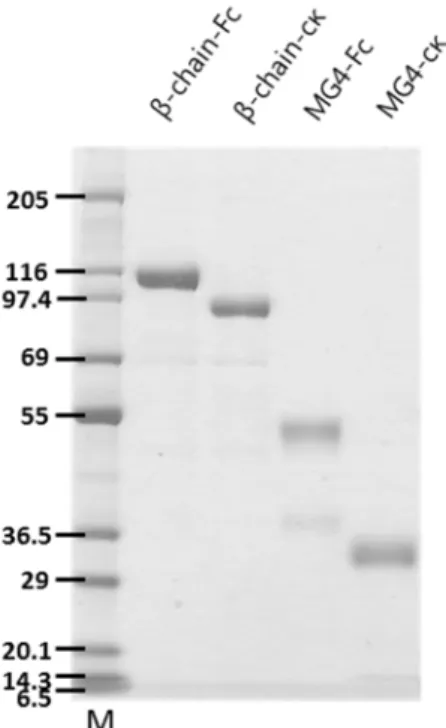
The gene of mouse complement C5 β-chain and MG4 domain were synthesized by genscript. To develop the recombinant mouse C5 β-chain-Fc, β-chain-cκ fusion protein and MG4-Fc, MG4-cκ fusion protein, the mammalian expression vector encoding those gene was transfected into HEK293F cells. Those recombinant protein was purified from the culture supernatant by protein A and kappaselect sepharose column chromatography. The expected C5 β-chain-Fc and β-chain-cκ molecular weight are 98 kDa, 86 kDa respectively. The expected molecular weight of the C5 MG4-Fc and MG4-cκ are 38 kDa, 26kDa respectively (Figure 4).
43
Figure 4. Expression of the recombinant mouse C5 β-chain and MG4 Fc/cκ fusion protein
The recombinant mouse C5 β-chain and MG4 Fc/cκ fusion protein was expressed in HEK293F cells and purified by protein A and kappaselect sepharose column chromatography. 1㎍ of each purified protein was confirmed by SDS- polyacrylamide gel electrophoresis and Coomassie staining under the reduced condition.
44
3. 2. Generation of anti-mouse C5 antibody
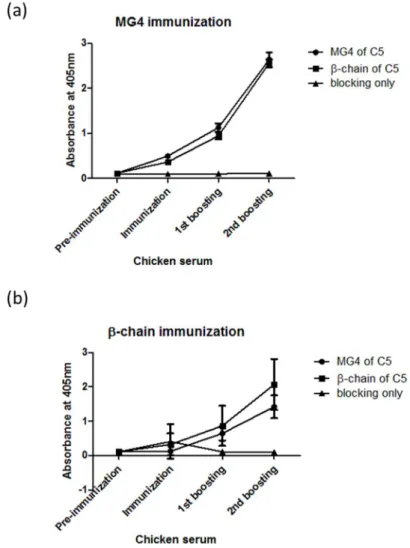
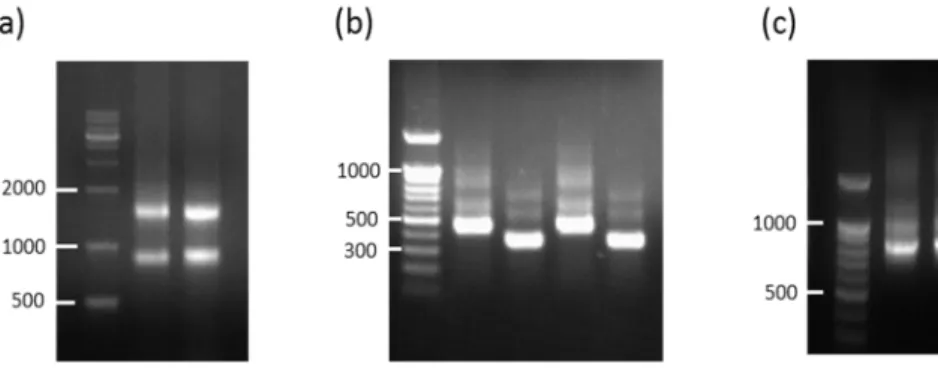
After immunization of chickens with the recombinant mouse C5 β-chain-Fc and MG4-Fc fusion protein, titration serum antibody was determined by enzyme linked immunospecific assay (Figure 5). Total RNA was extracted from bone marrow, spleen and bursa of fabricius, and the quality of RNA is assessed by electrophoresis with agarose gel (Figure 6a). The genes encoding VH and VL of chicken immunoglobulin was amplified from the cDNA library by PCR (Figure 6b). Finally, chicken immune scFv library was constructed using overlap extension PCR (Figure 6C).
The genes encoding the anti-mouse C5 scFv was cloned into a phagemid vector (pComb3X) for displaying anti-mouse C5 scFv on the surface of M13 phage. The phagemid library was transformed into E. coli cells and the scFv-displaying phages were rescued. The immunized chicken library (complexity of 4.8×10¹¹) was subjected to the bio-panning process for the screening of binders to mouse C5 β- chain and MG4.
For bio-panning, recombinant mouse C5 β-chain-cκ and MG4-cκ were prepared in mammalian expression system. Those were conjugated to magnetic beads using with the epoxy groups. After bio-panning, the antibody clones from the output titer plates in the final round of bio-panning were rescued and subjected to a phage
45
ELISA using microtiter plates coated with the recombinant mouse C5 β-chain-cκ and MG4-cκ fusion protein were overexpressed in HEK293F. Over the fifteen antibody clones from the immunized chicken library showed binding reactivity to both antigens and were selected for further study.
Figure 5. Titration of serum antibodies after immunization and boosting The immune titers of anti-mouse C5 β-chain and MG4 antibodies in chicken serum were measured by ELISA
46
Figure 6. Construction of scFv libraries by overlap PCR
(a) Total RNA preparation from chicken spleen, bone marrow and bursa of fabricius. (b) Amplification of chicken VL fragments and VH fragments and (c) Overlap extension PCR fragments were loaded and run on a 1% agarose gel.
47
3. 3. Antibody screening and characterization of anti-mouse C5 antibody
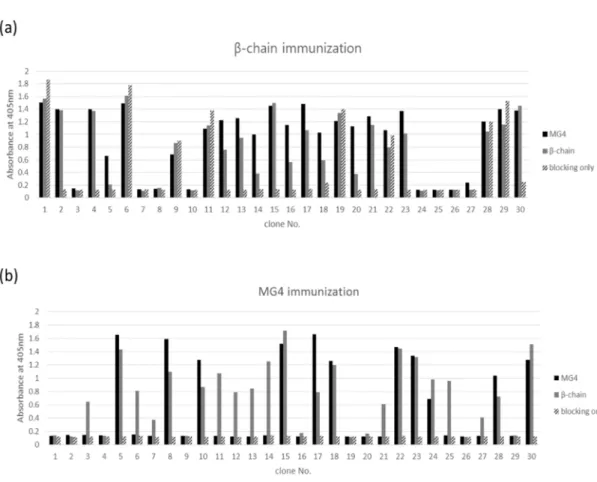
To select an antibody clone reactive to both mouse C5 β-chain and MG4 domain with having highest affinity, we performed ELISA screening using both mouse C5 β-chain and MG4 ckappa fusion protein (Figure 7). We selected highest affinity antibody clones which specifically binds to mouse C5 β-chain, MG4 domain (hereafter termed moC5-72) and other antibodies which also bind to mouse C5 β- chain, MG4 domain and human C5 (Figure 8). However, only moC5-72 could inhibit C5 cleavage by C5 convertase (data not shown). Thus moC5-72 antibody was used for further study. In order to measure the specificity and affinity, DBA/1 mice serum was separated by SDS-PAGE under non-reduced and reduced condition. The moC5-72 antibody bound to whole mouse C5 (non-reduced) and β- chain of C5 (reduced) respectively (Figure 9). This antibody was evaluated an affinity by serial dilution ELISA. It would be expected that this antibody has around 10-9KD value (Figure 10).
48
Figure 7. Reactivity of antibodies to recombinant mouse complement C5 β- chain and MG4 domain
Sixty scFv clones were randomly selected after four rounds of bio-panning from (a) MG4 domain of C5 immunized chicken library and (b) β-chain of C5 immunized chicken library and their reactivity to both mouse C5 MG4 and β-chain was determined by phage ELISA. ScFv displaying phage clones were amplified and
49
allowed to react with mouse C5 β-chain. HRP-conjugated anti-M13 antibody and ABTS substrate were used to detect bound phage.
Figure 8. Selection of cross species reactive clones
Four selected scFv clones were reacted with both human and mouse complement C5 by ELISA. However three of those clones could not effectively inhibit C5 cleavage in hemolysis inhibition assay.
50
Figure 9. Immunoblot analysis of anti-mouse C5 antibody
DBA/1 mice serum was diluted 1:10 with PBS. The samples were loaded in non- reduced condition (lane 1&3) and reduced condition (lane 2&4) in SDS-PAGE and transferred onto nitrocellulose membranes. moC5-72 X anti-cotinine bispecific scFv-human Fc fusion protein (lane 1&2) and secondary probe only (lane 3&4) were incubated with membranes. HRP-conjugated cotinine (secondary probe) and chemiluminescent substrate were used for visualization of the bands.
51
Figure 10. Binding affinity of anti-mouse C5 antibody
The binding affinity of the moC5-72 was estimated from 100nM to 1pM. This antibody can detect mouse C5 β-chain or MG4 at around 1nM of antibody concentration. Each point represents the mean with standard error bars of triplicate samples.
52
3. 4. Inhibition of complement activation by anti-mouse C5 antibody
In hemolysis assay, the moC5-72 antibody protect sheep RBC from complement dependent cytolysis in a concentration of serum dependent manner. This antibody showed potent inhibitory effect of cell lysis from complement. These data suggest that MAC formation was inhibited and C5a generation was reduced by anti- complement C5 antibody, so that sheep erythrocytes were protected from lysis (Figure 11, 12). Classical pathway is activated in this assay and C5 convertase, C2a4b3b, which cleaves C5 into C5a and C5b is assembled (Figure 1). But cleavage of C5 was blocked by anti-complement C5 antibody. These results explain that anti-complement C5 antibody binds to C5 and hinders binding of C5 convertase, resulting in blockade of both MAC formation and C5a generation.
53 ICR
0 200 400
0 20 40
60 Negative control Ab.
BB5.1 moC5-72
Antibody concentration (nM)
Percentage of lysis (%)
Figure 11. Inhibition of hemolysis assay by anti-mouse C5 antibody
The moC5-72 IgG, BB5.1 (positive control) and a negative IgG control, were serially diluted and pre-incubated with mouse serum. The mixture of antibody and serum were added to anti-sheep RBC antibody (IgM) sensitized sheep erythrocytes.
After 2hr 30mins, hemoglobin was measured at 414nm. The percentage of lysis was calculated by the formula described in Materials and Methods. DATA are means±SD.
54 ICR
0 200 400
0 1 2 3 4
5 Negative control Ab.
BB5.1 moC5-72
Antibody concentration (nM) C5a concentration (ng/㎖)
Figure 12. Inhibition of C5a generation by anti-mouse C5 antibody
The moC5-72 IgG, BB5.1 (positive control) and a negative IgG control, were serially diluted and pre-incubated with mouse serum. The mixture of antibody and serum were added to anti-sheep RBC antibody (IgM) sensitized sheep erythrocytes.
The supernatant was used for mouse C5a measurement by sandwich ELISA. DATA are means±SD.
55
3. 5. Adriamycin induced nephritis mouse model
To evaluate whether treatment with moC5-72 antibody, known to functionally inhibit C5 cleavage, could reduce inflammatory response in nephritis mouse model.
We intravenously administrated 1mg of moC5-72 or control antibody to BALB/c male mice with vehicle or Adriamycin. Those weight were monitored twice a week for two weeks. After four-teen days monitoring, we collected a blood samples and enucleated kidney of both sides. Compared to among the groups, two groups of moC5-72 or control antibody treated with vehicle. There weren’t denoted side effects that both groups of mice were not affected those antibodies. Their body weight, BUN, serum creatinine, serum albumin, total cholesterol and triglyceride were maintained as normal mice (figure 13. a~f). As tissue staining shown, glomerulus and tubule were had normal looking appearance (figure 14. a, b). In contrast, mice of Adriamycin treated with control antibody that the body weight and serum albumin concentration were decreased drastically however both of total cholesterol and triglyceride were risen. Furthermore, the stained renal tissue showed that the glomerulus became hypertrophy, hyaline deposits and mesangial expansion, as well as tubular vacuolization was found (figure 14. c). Adriamycin induced with moC5-72 mice represented that the body weight was declined gradually but overcome later on. The serum albumin was slightly decreased on the
56
other hand, BUN, serum creatinine, total cholesterol and triglyceride were similar to normal mice (figure 14. d).
57 Figure 13. Mouse serum analysis
Functional markers of renal injury in ADR-injected and control mice. Mice injected with Adriamycin developed hypoalbuminemia and hyperlipidemia. DATA are means±SD. *P≤0.05, **P≤0.01, ***P≤0.001
a ) Body weight, the body weight of Adriamycin treated groups fell quickly after administrated but moC5-72 treated group was finally recovered.
b )BUN, c ) Serum creatinine, Adriamycin administrated groups of the BUN and the serum creatinine panels were not significantly changed.
d ) Serum albumin, the serum albumin was decreased significantly in Adriamycin treated groups with palivizumab.
e ) Total cholesterol, f ) triglyceride, the total cholesterol and the triglyceride were risen by and large in the group of Adriamycin injected with palivizumab
58
Figure 14. Efficacy of anti-mouse C5 antibody in Adriamycin induced nephritis mouse model
a ) The mice were injected vehicle with palivizumab as a negative control. It showed normal mouse tissue.
b ) Vehicle treated with moC5-72 to mice. It didn’t damaged renal tissue.
c ) The mice were administrated Adriamycin with palivizumab who demonstrated progressive histological injury. The glomerulus were hypertrophy, displayed sclerosis and vacuolization.
d ) The group of mice was injected Adriamycin with moC5-72. It didn’t observed tissue damages by Adriamycin.
59
3. 6. Laser induced choroidal neovascularization mouse model
To verify the biological activity of moC5-72 surrogate antibody was injected into the vitreous cavity of mice just after laser photocoagulation. In this mouse model of laser-induced CNV, moC5-72 antibody demonstrated anti-angiogenic effect, comparable to vehicle and negative control antibody (Figure 15). A laser-induced CNV model in mice is an accelerated model of neovascular AMD (47). Laser photocoagulation not only induces a break in Bruch’s membrane but also invokes inflammatory cascades to promote the growth of new vessels (48, 49). As in a previous report (47), C5a levels were increased 6 hours after laser photocoagulation. The peaks of levels of monocyte chemoattractant protein (MCP)-1 was evident at 12 hours and 3 days after laser photocoagulation, respectively (Figure 16). A moC5-72