저작자표시-비영리-변경금지 2.0 대한민국 이용자는 아래의 조건을 따르는 경우에 한하여 자유롭게
l 이 저작물을 복제, 배포, 전송, 전시, 공연 및 방송할 수 있습니다. 다음과 같은 조건을 따라야 합니다:
l 귀하는, 이 저작물의 재이용이나 배포의 경우, 이 저작물에 적용된 이용허락조건 을 명확하게 나타내어야 합니다.
l 저작권자로부터 별도의 허가를 받으면 이러한 조건들은 적용되지 않습니다.
저작권법에 따른 이용자의 권리는 위의 내용에 의하여 영향을 받지 않습니다. 이것은 이용허락규약(Legal Code)을 이해하기 쉽게 요약한 것입니다.
Disclaimer
저작자표시. 귀하는 원저작자를 표시하여야 합니다.
비영리. 귀하는 이 저작물을 영리 목적으로 이용할 수 없습니다.
변경금지. 귀하는 이 저작물을 개작, 변형 또는 가공할 수 없습니다.
공학석사학위논문
분극곡선과 전기화학 임피던스 분광법을 통한 고분자 전해질 연료전지
저항 분리에 대한 연구
Resistance Separation of Polymer Electrolyte Membrane Fuel Cell by Polarization Curve and
Electrochemical Impedance Spectroscopy
2019 년 8 월
서울대학교 대학원 기계항공공학부
최 재 현
분극곡선과 전기화학 임피던스 분광법을 통한 고분자 전해질 연료전지
저항 분리에 대한 연구
Resistance Separation of Polymer Electrolyte Membrane Fuel Cell by Polarization Curve and
Electrochemical Impedance Spectroscopy
지도교수 민 경 덕
이 논문을 공학석사 학위논문으로 제출함
2019 년 4 월
서울대학교 대학원 기계항공공학부
최 재 현
최재현의 공학석사 학위논문을 인준함
2019 년 6 월
위 원 장
부위원장
위 원
Abstract
Resistance Separation of Polymer Electrolyte Membrane Fuel Cell by Polarization Curve and
Electrochemical Impedance Spectroscopy
Jaehyeon Choi Department of Mechanical and Aerospace Engineering The Graduate School Seoul National University
The separation of resistance is a main issue to improve the performance of a polymer electrolyte membrane (PEM) fuel cell. To separate the resistance, electrochemical impedance spectroscopy (EIS) and polarization curve are the major methodologies. In addition, to analyze the EIS, an equivalent circuit is selected; therefore, it is also a major issue. Although it has been an object of study for a long time; less attention has been given to separate the resistance, including the protonic resistance in the cathode catalyst layer (CCL). In this study, to separate the total resistance, a new method using the polarization curve and EIS was suggested for various operating conditions. Then, the overpotential was estimated to investigate the effect of each resistance.
First, a general solution was derived using the recursion formula to fit the Nyquist plot of the EIS. Second, to separate the total resistance, a polarization curve and EIS with an approximated solution were used. The error of the total resistance from the approximated solution at a RH 80 and 100% were around 1.5 and 1%, respectively. In addition, each resistance from the polarization curve was well matched with the EIS results (R2 > 0.995 and RMSE < 0.01).
Protonic resistance in the CCL was significantly changed by the water content.
To fully consider the relationship between diffusion and the effective protonic resistance in the CCL, these experiments were carried out in the Heliox condition. As the effective diffusion coefficient increased, the effective protonic resistance in the CCL decreased under high current density region due to the migration of the reaction points. The overpotential by the charge transfer resistance had the largest contribution (46.5 ~ 86.9%), and the overpotential by the ohmic resistance linearly increased with the current density. This study can help to identify the effect of the resistance in terms of the voltage and to improve the performance of PEM fuel cells.
Keywords: Resistance separation, Overpotential, Electrochemical impedance spectroscopy (EIS), Polarization curve, Protonic resistance, Water content
Student Number: 2017-22150
Contents
Acknowledgement ... i
Abastract ... iii
List of Figures ... vii
List of Tables ... ix
Nomenclature ... x
Chapter 1. Introduction ... 1
1.1 Background ... 1
1.2 Literature review ... 3
1.2.1 Electrochemical impedance spectroscopy of PEM fuel cells ... 3
1.2.2 Protonic resistance in the cathode catalyst layer ... 4
1.2.3 Effect of the current density and relative humidity on the resistance... 7
1.2.4 Correlation of EIS with polarization curve ... 8
1.3 Objective ... 10
Chapter 2. Experimental setup and assumptions ... 12
2.1 Experimental conditions and assumptions ... 12
2.2 Experimental setup... 14
Chapter 3. Impedance model ... 19
3.1 Electrical equivalent circuit ... 19
3.2 General solution ... 21
3.3 Resistance separation using EIS ... 23
3.4 Validation of the recursion formula ... 27
3.5 Resistance separation using the correlation between the EIS and polarization curve ... 30
Chapter 4. Experimental results and discussion ... 36
4.1 Comparison of the EIS and the polarization curve ... 36
4.2 Comparison of the effective protonic resistance in the CCL and the membrane resistance with the RH and current density... 37
4.3 Analysis of the overpotential ... 40
Chapter 5. Conclusion ... 45
Bibliography ... 47
국 문 초 록 ... 53
List of Figures
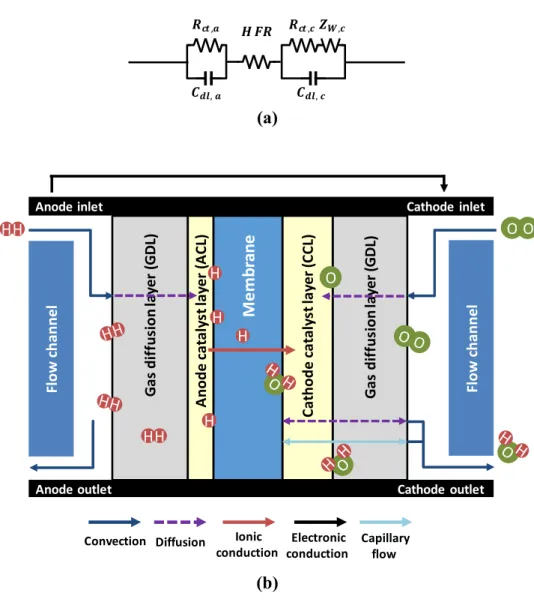
Figure 1.1 (a) Electrical equivalent circuit for a simple PEM fuel cell impedance model. is a charge transfer resistance, is a Warburg,
is a high frequency resistance and is a double layer capacitance. (b) A schematic of the cross-section view of a PEM fuel cell (not to scale) ... 11 Figure 2.1 Setup of the active area. (a) Flow channel (b) Assembly of end plate, flow channel, gasket and GDL ... 17 Figure 2.2 A schematic of the components in a PEM fuel cell (not to scale) ... 18 Figure 3.1 (a) A schematic of the CCL. represents the non-dimensional thickness of the CCL from CCL/GDL interface ( = ) to the PEM/CCL interface ( = ). (b) Electrical equivalent circuit of a PEM fuel cell represented by a TLM [1]. ... 33 Figure 3.2 (a) Nyquist plots are plotted at RH 100%, (b) RH 50% under H2/air condition. Open symbols represent general solution and closed symbols represent validation model. Cross symbols represent experimental data ... 34 Figure 3.3 Polarization curves and total resistances at (a) RH 100%, (b) RH 80%
under H2/air experiments. The experimental data of polarization curves were fitted using semi-empirical model. The total resistances using EIS were matched with the total resistances using polarization curves. ... 35
Figure 4.1 Results of the resistance separation under H2/air. (a) Charge transfer resistance at RH 80%. (b) Mass transport resistance at RH 80%. (c) Charge transfer resistance at RH 100%. (d) Mass transport resistance at RH 100%. ... 41 Figure 4.2 Separation of the ohmic resistance at (a) RH 100% under H2/air, (b) RH 80% under H2/air, and (c) RH 100% under H2/Heliox. Rhombus symbol is the protonic resistance in CCL, triangle symbol is the the effective protonic resistance in CCL, square symbol is the high frequency resistance and circle symbol is the ohmic resistance. At the dotted line, fitting of the EIS wasn’t well fitted, so protonic resistance in CCL can’t be evaluated. In this region, resistance separation was conducted using the correlation between EIS and polarization curve.
(d) Cross-sectional SEM image of GORETM PRIMEA® 5730 CCM.
... 42 Figure 4.3 Error of the total resistance at RH 100% under H2/air. Square symbol is the approximated solution using Eq. (26). Circle symbol is the approximated solution using Eq. (18). Triangle symbol is the validation model [1]. ... 43 Figure 4.4 The contribution of the resistances of overpotential in a PEM fuel cell at (a) RH 100%, (b) RH 80% under H2/air. ... 44
List of Tables
Table 2.1 Operating conditions for measuring the EIS and polarization curve ... 15 Table 2.2 Components used for the experiments. ... 16 Table 3.1 Summary of solutions ... 32
Nomenclature
distributed protonic resistance in the CCL, Ω cm
distributed charge transfer resistance, Ω cm
distributed BCPE, Ω cm
distributed mass transport resistance, Ω cm
parameter related to CPE, Ω cm s
CPE exponent
distributed parameter related to BCPE, Ω cm s
BCPE exponent
iteration number of the node, 1 ≤ ≤ − 1
total repeating number of the node
high frequency resistance, Ω cm
protonic resistance in the CCL, Ω cm
effective protonic resistance in the CCL, Ω cm
charge transfer resistance, Ω cm
BCPE, Ω cm
mass transfer resistance, Ω cm
ohmic resistance, Ω cm
total resistance, Ω cm
parameter related to CPE, Ω cm s
parameter related to BCPE, Ω cm s
effective diffusion coefficient of oxygen diffusion in the CCL, cm s
non-dimensional distance along the catalyst layer, 0 ≤ ≤ 1
thickness of the CCL, cm
proton conductivity, = /, S cm
specific proton conductivity, S cm
mass transport coefficient, V
simulation parameter for the polarization curve fitting, cm A
Tafel slope, V
cell voltage, V
open-circuit voltage (OCV), V
current density distribution along the CCL, A cm
∗ exchange current density, A cm
current density, A cm
overpotential at PEM/CCL interface, V
imaginary component in impedance
frequency, Hz
Faradaic constant, 96487 A s mol
total pressure, Pa T temperature, K
R Gas constant, 8.314 J K mol
Subscripts
constant phase element (CPE)
bounded constant phase element (BCPE) 1 PEM/CCL interface
Charge transfer
ℎ ohmic
mass transport
iteration number of the node, 1 ≤ ≤ − 1
total repeating number of the node
Chapter 1. Introduction
1.1 Background
Due to increasing greenhouse gases, global warming is one of the biggest environmental problems of the 21st century. In addition, 17% of the carbon dioxide emissions comes from the internal combustion engines of cars [2]. For zero- emissions and higher efficiency, automobiles with polymer electrolyte membrane (PEM) fuel cells have gained attention [3]. A PEM fuel cell converts the chemical energy of the reaction between hydrogen (H2) and oxygen (O2) into electrical energy with pure water [3, 4]. For that reason, PEM fuel cell technologies have been heavily invested in by automotive companies. Up to now, the Honda Clarity (2008), Mercedes-Benz F-Cell (2010), Toyota Myrai (2014), and Hyundai Nexo (2018) have been introduced to the market. Other corporations have also invested heavily to develop hydrogen techniques.
Identifying the performance and resistance of a fuel cell is helpful when investigating PEM fuel cell, because they can determine the research direction and the appropriate operating conditions. However, it is not easy to investigate these parameters of PEM fuel cells, because these data are closely related to each other.
For examples, water contents and oxygen transport mechanism are related to one another in which counteracting interdependencies are accounted for [5]. Oxygen transport is dominantly attributed to the water concentration in the Nafion and gas
diffusion layer (GDL), and the flow channel. Therefore, researchers need precise and detailed information on the PEM fuel cell performance and resistance to identify the research direction and operating conditions.
In order to get this information, researchers have generally used electrochemical impedance spectroscopy (EIS) and polarization curve which provide resistance and current-voltage information, respectively [5, 6]. However, these experimental methods have several limitations when interpreting the fuel cell conditions. EIS results are not always clear in terms of what specific features of the impedance spectrum relate to which physical, chemical, or electrochemical processes and features [5]. The separation method and equivalent circuit also need additional studies. For instance, protonic resistance in the cathode catalyst layer (CCL) has not been sufficiently studied at the middle and high current density regions [7], even though it is essential data for the fabrication of Membrane Electrode Assembly (MEA). In the case of the lumped circuit, it is difficult to describe the resistance in the CCL regardless of the operating conditions. On the other hand, a polarization curve provides the overall performance but no details. Namely, one of these two measurement techniques is not enough to separate the resistance or overpotential at a more detailed level. In this respect, testing techniques that consider both the EIS and polarization curve are needed because it can provide more precise and detailed information by comparing each experimental result.
1.2 Literature review
1.2.1 Electrochemical impedance spectroscopy of PEM fuel cells
The characteristics of a PEM fuel cell can be tested by ex situ and in situ methodologies. One of the in situ methodologies is EIS. This is also called ac impedance [5]. First, the basic concept of this method comes from the alternating expression of the fuel cell using an electrical circuit shown in Figure 1.1. This technique can distinguish the total resistance at a specific point on the polarization curve using the impedance spectrum. In general, an impedance spectrum is plotted in a Nyquist plot, which is a parametric plot as a function of frequency. The real part of the impedance spectrum is plotted on the X-axis, and the imaginary part is on the Y-axis. For visibility, the imaginary value is plotted with a negative sign. The frequency decreases from the left to the right [6]. AC impedance requires some assumptions, system linearity and stability for the facile analysis. Therefore, this technique should be performed on the cell using a small amplitude voltage or current perturbations within 20mV [8].
If the anode resistance is far smaller, the semi-circle related to the anode part cannot be found in the experimental results of the EIS, and the anode part of the equivalent circuit can be neglected. The kinetics of hydrogen oxidation is faster than of the oxygen reduction reaction; thus, the anode resistance can be negligible [9-12]. In addition, the resistance of fuel cell at the cathode can be divided into high
frequency resistance (including the ionic resistance, contact resistance and electronic bulk resistance such as flow field, diffusion media and cable), charge transfer resistance represented by a parallel RC circuit with a double layer capacitance, and mass transport resistance by the diffusion. In this case, various lumped circuits are widely used to fit the experimental results [4, 13-15]. However, a lumped circuit has a limitation in describing the protonic resistance in the CCL, except that potential drop along the pores caused by the electrolyte resistance is small [16].
1.2.2 Protonic resistance in the cathode catalyst layer
Generally, a lumped circuit is useful for approximately evaluating the resistance;
thus, this kind of equivalent circuit has been widely used. However, a lumped circuit is not appropriate to describe the region of the protonic resistance in the CCL which represents a 45-degree straight line at the high frequency region around the first semi-circle [7, 17-19]. More specifically, this line pushes away the first arc from the origin and that distance from the x-intercept is proportional to the magnitude of the protonic resistance in the CCL. The distance is called the effective protonic resistance in the CCL [9, 20-24]. To describe this 45-degree straight line, differential equations or the finite transmission-line model (TLM) is normally used to represent a porous electrode more specifically and precisely [7, 25, 26]. The model consists of an electronic resistor rail to explain the path of the electrons and an ionic resistor rail to explain the path of the protons in the CCL. Between these
two rails, capacitors and resistors are located to explain the reaction at the triple phase boundary (TPB). Occasionally, the reaction part of the TLM also includes the Warburg impedance to describe the diffusion process [1].
Meanwhile, Makharia et al. [7] reported the calculation of the effective protonic resistance using a differential equation and analyzed the results of H2/N2
experiments under low current densities. The sum of all the distributed proton transport resistances estimated from the TLM was approximately equal to three times the effective protonic resistance. However, in this process, the homogeneity of the distributed elements in the TLM was assumed, and the experiments were carried out at low current density. In this respect, Malevich et al. [27] studied the effect of distributed proton transport resistances in the CCL. When the distributed protonic resistances were non-uniform in the H2/N2 experiments, the effective protonic resistance in the CCL was not one third of the protonic resistance in the CCL. In addition, the line starting from x-intercept at the high frequency region was also not a clear 45-degree straight line. To be brief, the 45-degree straight line appeared when the distribution of the protonic resistance in the CCL was homogenous in the H2/N2 experiments. In this condition, the effective protonic resistance was approximately one third of the protonic resistance in the CCL.
However, these were based on the H2/N2 experiment; thus, it cannot consider the effect of water generation in the H2/air condition. The operating condition was also limited at the low current density region.
Furthermore, Gerteisen [28] additionally studied the impact of the inhomogeneity of the charge transfer resistance in the H2/air condition which affected the charge transfer arc. Because the non-uniformity of the charge transfer resistance affected the total resistance, Gaumont et al. [21] suggested a general solution which included a non-uniform distributed charge transfer resistance in the CCL. The general solution was derived using an equivalent circuit with the current distribution through the thickness of the electrode. Therefore, as the distance from the membrane was altered, the distributed charge transfer resistances were also changed. Consequently, when the protonic resistance in the CCL was less than or equal to the charge transfer resistance, the Nyquist plot with a small current approximation was almost similar to the general solution. However, when the protonic resistance was much larger than the charge transfer resistance, the approximated solution was represented as a much bigger semi-circle than that of the general solution. Although that work considered the variation in the distributed charge transfer resistance, the equivalent circuit did not take into account the effect of the mass transport resistance or the diffusion effect.
Cruz-Manzo and Chen [25] suggested using the TLM together with the Bounded Warburg to reflect the diffusion effect in the catalyst layer under the whole current density region [29]. That paper evaluated the differential equations and suggested the electrical equivalent circuit, but an estimation with a recursion formula was not attempted. To solve the differential equations, it was assumed that the protonic resistance in the CCL should be much smaller than the charge transfer resistance.
Therefore, even though these equations were derived without the current density restriction [29], the assumption should be satisfied to use the formula under the whole current density region. However, the formula was also derived under the assumption. For a clear estimation, the formula and resistance should be validated first using other methodologies or exact solutions. Moreover, that paper did not identify the relationship between the effective protonic resistance and the protonic resistance.
1.2.3 Effect of the current density and relative humidity on the
resistance
The current density and relative humidity (RH) are the most important variables in the operation of PEM fuel cells. These conditions critically affect the performance. Several works have been devoted to the study of the current density and relative humidity. Mann et al. [30] suggested an increase in the membrane resistance with the current density using prediction of a generalized steady-state electrochemical model. Cooper and Smith [31] compared the ohmic resistances determined by the current interrupt, polarization curve, and EIS experiments. All of them increased, as the current density was increased, even though each value of the resistance was not exactly the same. Andreaus [32] also measured the ohmic resistance with the current density using EIS and the current pulse method.
Furthermore, the change in the ohmic resistance was described with a polarization curve to refer to the condition of the PEM fuel cell. At a high current density, as the
anode overpotential increases, the membrane resistance is increased due to the drying out of the electrolyte adjacent to the anode. Meanwhile, Xu et al. [33]
investigated the effect of temperature and RH on the kinetics of the oxygen reduction reaction. A reduced RH increased the Tafel slope due to changes in the ORR pathways, proton activity, and catalyst surface condition. Brunetto et al. [4]
measured the variation of the resistance by the RH change. As the RH was increased, the ohmic resistance, charge transfer resistance, and mass transport resistance decreased under the low current density condition.
In contrast, further research is required on the change in protonic resistance with the operating condition. Although the proton conductivity [34-37] and water content [21, 38, 39] in the CCL have been investigated, there are few studies on the effect of the relative humidity and the current density on the effective protonic resistance in the CCL under the H2/air condition.
1.2.4 Correlation of EIS with polarization curve
While EIS provides detailed information on each resistance, polarization curve has also been commonly used to investigate the general quantification of performance [5]. Because each of these two experiments provides different information, several researchers have used both of them [4, 31, 40].
Wagner [41] mentioned the correlation between AC impedance and the polarization curve. The polarization resistance of the fuel cell was tangent to the
polarization curve at a specific potential. Moreover, the total resistance also can be measured using AC impedance at a frequency near 0Hz, because this measurement condition was very similar to the DC condition. To obtain the total resistance, two methods were suggested in that paper. First, one was an estimation of the EIS impedance at a very low frequency through extrapolation, and the second method was summation of the individual resistances.
Tang et al. [42] compared the cell voltage drop due to each resistance using EIS and polarization curve. To compare the two experimental results, each resistance was evaluated by EIS, and then, the percentage of the voltage drop was estimated and compared to the polarization curve. Consequently, that paper suggested a methodology to compare the EIS with the polarization curve using the resistance;
however, the protonic resistance in the CCL wasn’t considered.
1.3 Objective
Several works have been done using EIS and polarization curve. However, the estimation of each resistance (including the charge transfer resistance, high frequency resistance, mass transport resistance, and effective protonic resistance in the CCL) based on EIS and polarization curve could not be sufficiently carried out due to a deficiency in the methodologies to separate the resistance. In this study, the four types of resistances were considered to derive the general solution of the impedance model. From this general solution, a new method was proposed to separate the total resistance. When the distributed elements in the TLM were homogeneous and the distributed protonic resistance in the CCL was less than the summation of the distributed charge transfer resistance and mass transport resistance, each resistance can be evaluated only by EIS. In another case, the correlation between the EIS and the polarization curve was used. Consequently, the total resistance in a PEM fuel cell was quantitatively separated. It was conducted under different current densities and relative humidity conditions, and then the variations of the resistance were analyzed to ensure the reliability of the results.
After that, the overpotentials caused by each resistance were estimated to understand the effect of the resistance in terms of the voltage.
,,
,
,
,
(a)
Gas diffusion layer (GDL)
Gas diffusion layer (GDL) Cathode catalyst layer (CCL)
Anode catalyst layer (ACL) Membrane
Convection Diffusion Ionic conduction
Electronic conduction
Capillary flow
Anode inlet Cathode inlet
Anode outlet Cathode outlet
Flow channel
Flow channel
O O O
HH
H H
H H
HH
(b)
Figure 1.1 (a) Electrical equivalent circuit for a simple PEM fuel cell impedance model. is a charge transfer resistance, is a Warburg,
is a high frequency resistance and is a double layer capacitance. (b) A schematic of the cross-section view of a PEM fuel cell (not to scale)
Chapter 2. Experimental setup and assumptions
2.1 Experimental setup
The measurements for the EIS and the polarization curve were done in the experimental conditions listed in Table 2.1. Before measuring the EIS data, the voltage and current density were measured to plot the polarization curve; because the EIS and polarization curve were measured in the same operating condition, as far as possible. For these experiments, a FC Impedance Meter (KIKUSUI, KFM 2150 and PLZ-4W) was used. To satisfy the EIS assumptions such as linearity and stability, a potential amplitude should be maintained at less than 10 mV. For an AC sinusoidal signal, the analyzed frequency range was 20 kHz to 900 mHz. However, to ensure the existence of another semi-circle appearing around the low frequency, the end frequency was 10 mHz in the high current density region. The electronic bulk resistance and contact resistance in the high frequency resistance () were measured using an ex situ dc experiment with a PEM fuel cell except for the MEA.
This measurement can consider the whole electronic bulk resistance and contact resistance except for the MEA. To measure the electrical resistance, a milliohm (GWINSTEK, GOM-802) was used. The temperature and pressure were kept at 65
℃ and ambient pressure, respectively.
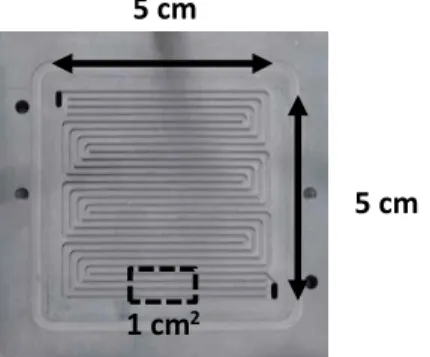
Table 2.2 lists the materials of the fuel cell used in this work. The 1 cm2 active area near the outlet of the 25 cm2 flow channel was assembled by using a gasket
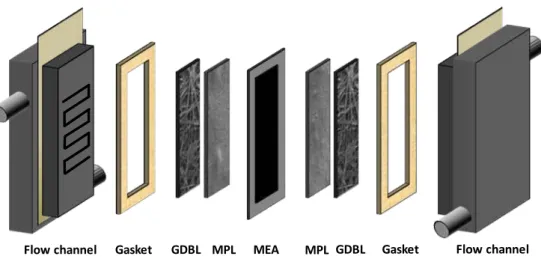
and GDL shown in Figure 2.1 which provides in-plane uniformity of the resistance, current distribution, and reactant gas. Thus, a single cell was used to control the operating condition as well. Figure 2.2 shows an overview of the components of the PEM fuel cell.
2.2 Experimental conditions and assumptions
Unlike other fuel cell experiments, EIS and polarization curve require high stoichiometry ratios (SR) and a small active area for several assumptions as follows.
These assumptions were related to the impedance model.
l The SR has to be kept high to minimize reactant depletion along the channels.
This setup also makes a high diffusion condition though the CCL.
l The active area of the fuel cell needs to be small to have a uniform pressure and velocity.
As mentioned later, this study used the current distribution equation, Eq. (7), which assumes a fast oxygen diffusion. For this reason, a high SR condition was used. The RH of the inlet gas was changed from 50% to 100% to investigate the effect on each resistance. The current was varied from 0.1 to 2.4 A/cm2 at 0.1A/cm2 increments to compare the EIS and polarization curve results. Almost all experimental cases were conducted under the H2/air condition; however, the H2/Heliox (21 % O2 with the balance made up of He) was also carried out to identify the diffusion effect of oxygen.
Table 2.1 Operating conditions for measuring the EIS and polarization curve
Parameter Condition
Test mode Galvanostatic technique
Frequency 20 kHz to 900mHz
Swing width of AC
current within a voltage amplitude of less than 10 mV
Current density 0.1 ~ 2.4 A/cm2
Mass flow Anode: 0.400 ln/min (SR* > 20) Cathode: 2.00 ln/min (SR* > 40)
Reactant gas H2/air
H2/Heliox(21 % O2, 87% He)
Inlet gas RH** 50, 80, 100 % (anode/ cathode)
Cell temperature 65 ℃
Outlet pressure Ambient pressure
* Stoichiometric Ratio
** Relative Humidity
Table 2.2 Components used for the experiments.
Component Condition
Flow Channel
Parallel channels (anode/ cathode) 1/0.815 mm width (channel/rib) 0.4/0.6 mm depth (anode/cathode)
GDL-MPL JNT30-A6H
(Thickness 325 ± 5 μm)
MEA† GORETM PRIMEA® 5730‡
†Membrane Electrode Assembly
‡Catalyst Coated Membrane
5 cm
5 cm
1 cm2
O2 O2
Figure 2.1 Setup of the active area. (a) Flow channel (b) Assembly of end plate, flow channel, gasket and GDL
Gasket
Flow channel GDBL MPL MEA MPL GDBL Gasket Flow channel
Figure 2.2 A schematic of the components in a PEM fuel cell (not to scale)
Chapter 3. Impedance model
3.1 Electrical equivalent circuit
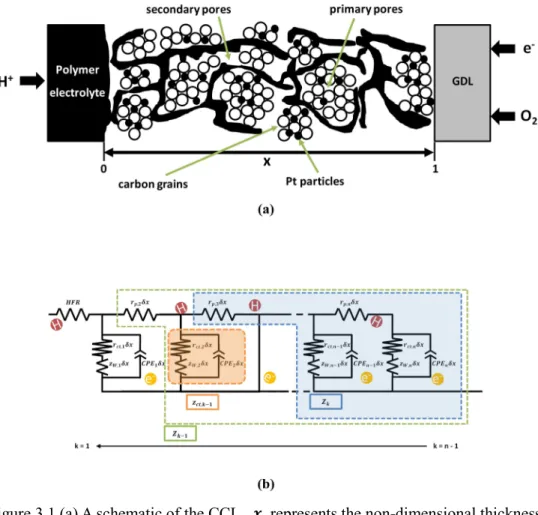
Reasonable selection of an electrical equivalent circuit is an essential step before analyzing the experimental data. The kinetics of the hydrogen oxidation reaction is faster than that of the oxygen reduction reaction; thus, the anode resistance can be negligible [9-12]. In addition, the ohmic resistance caused by the electron flow in the CCL can be negligible, because the electronic resistance in the CCL is smaller than that of the ionic resistance. Conclusively, the anode resistance and electronic resistance in the CCL were not critically shown in our experimental results. Thus, the anode part and the electronic resistances in the CCL were neglected as in previous studies [7, 9-12, 21]. Unlike other equivalent circuits, the bounded constant phase element (BCPE) in the TLM was needed to represent the mass transport effect in the CCL. Thus, the equivalent circuit suggested by Cruz-Mano et al. [1] was used in this work. To improve the fitting results, the Bounded Warburg was replaced by the BCPE, and the element of the inductor was eliminated shown in Figure 3.1.
includes the electronic bulk resistance, contact resistance and the resistance by the proton conduction in the membrane. The TLM, shown in Figure 3.1, represents the catalyst layer, which includes the distributed protonic resistance in the CCL (), distributed charge transfer resistance (), distributed BCPE (),
and constant phase element (CPE) for the double-layer capacitance. is the total repeating number and is the iteration number of the node in the interval (1 ≤ ≤ − 1). Referring a previous paper, is one thousand [21].
3.2 General solution
To represent the Nyquist plot with the TLM, general solution was used with recursion formula [21]. The CCL part of the Nyquist plot can be evaluated iteratively using the recursion formula from the CCL/GDL interface to the PEM/CCL interface as follows:
��
�
��= ,
+ ,
= 1
+ 1
,
+ , , ,= 0
(1)
with
where , , , , , , , and are, respectively, the thickness of the CCL, the non-dimensional distance along the CCL (0 ≤ ≤ 1), the distributed mass transport resistance, the distributed parameter related to the CPE, the CPE exponent, the imaginary component in the impedance, the frequency, the distributed parameter related to the BCPE and the BCPE exponent.
�
��
�
��
� =
= ,( ),
, = ,+ ,+
,= ℎ( , ,( ),)
,( ),
(2) (3) (4) (5)
, =
() 1
(6)
with
() =�2∗
∙ exp
2 ∙ ( ∗
2(1 − )exp
2) (7)
where is the Tafel slope; is the proton conductivity; ∗ is the exchange current density and is the overpotential at the PEM/CCL interface.
This equation can be used under the assumption that oxygen diffusion is fast.
Although this assumption is satisfied by the high SR condition, a single parameter is used to be sure.
=4
1
(8)
It was estimated as 14 ~ 250 based on the experimental results. Thus, Eq. (7) can be used in this study because ≫ 1.
3.3 Resistance separation using EIS
The general solution with the recursion formula was derived in the last section.
However the distributed resistance from the general solution is not convenient to separate the total resistance ( ). To divide into the effective protonic resistance in the CCL (), the charge transfer resistance (), and the mass transport resistance ( ) using the distributed elements, three assumptions were applied [16].
l The distributed elements are homogeneous.
l /( + ) ≪ 1.
l As previously mentioned, the anode resistance and electronic resistance in the CCL are neglected.
is the most important information in this study. Thus, a point of intersection in the real axis at a low frequency is extracted from the Eq. (1) [41].
= lim
→( + )
= + +
+ 1 +
(9)
with
= (+ 1)( + )
( + ) + (+ 1) , = 0 (10) Then, a general term can be derived as follows. From the Eq. (10),
= + 1 −
+ ∙ (+ 1) 1 + (+ 1) ∙
+
(11)
By the second assumption,
≈ + 1 −
+
(+ 1)
1 (12)
When k is large, Eq. (11) can be approximated more simply as shown below because both /( + ) and (+ 1) are small
≈ + 1 (13)
≈ − (14)
Therefore, the right hand side of the Eq. (12) can be simplified as Eq. (15) by Eq.
(14). At this point, the error by Eq. (14) is only acceptable when k is large.
Therefore, the error in the third term on the right hand side can be approximated using Eq. (14) due to /( + ). However, Eq. (14) does not apply to the first term on the right hand side, because the error in this term is not negligible without multiplication of /( + ).
≈ + 1 −
+ ∙ ( − ) (15)
Finally, the general term of the recursion formula can be derived from Eq. (15).
≈ − −
+
( − )( − + 1)(2 − 2 + 1)
6 (16)
The general term can be derived by substituting Eq. (16) into Eq. (9).
= + +
− 1 −
+
( − 1)()(2 − 1)
6 + 1
+ (17)
When the first assumption is valid, Eq. (17) can be rearranged as follows [9, 41].
= + +
(18)
= + + +
with
=
( − 1)(2 − 1) 6
1 −
+
( − 1)(2 − 1) 6
+ (19)
=
(20)
=
(21)
where is the ohmic resistance of the summation of and .
3.4 Validation of the recursion formula
In this section, the general solution (Eqs. (1) - (7)) and the general term ( substituting Eq. (16) into Eq. (9) ) were validated using the solution suggested by Cruz-Manzo and Chen [1] and by experimental results.
Cruz-Manzo and Chen [1] suggested not only an equivalent circuit but also a solution of differential equations for the impedance model as depicted in Figure 3.1.
This solution, the validation model, was used to validate the general solution. After disregarding the inductance term and replacing the Bounded Warburg with the BCPE, the final total impedance equation can be written as
= +[ + ]coth((1 − ))
1 + ( )[ + ] (22)
with =
+ ( )
= ℎ( ( ))
( ) (23)
where is the protonic resistance in the CCL; is the BCPE; is the parameter related to the CPE and is the parameter related to the BCPE. To derive Eq. (22), it was assumed that the element in the CCL was homogeneous.
Furthermore, to satisfy the homogeneity of , Eq. (24) should be valid [1].
≪ 1 (24)
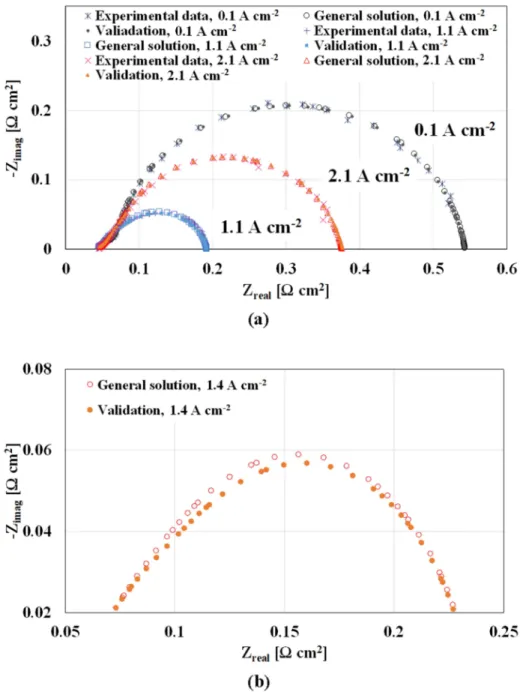
Figure 3.2 shows the fitting results of the general solution and the validation model. Both models fitted well with the experimental results regardless of the current densities. However, the general solution no longer fitted well with the validation model at RH 50%. The reason for these results can be found from the assumption on the homogeneity of . /( + ) was much smaller than 1 ( 3.5 × 10 > /( + ) > 7.6 × 10 ) regardless of the RH conditions;
thus, it seems that the reason for the mismatch at RH 50% was caused by the inhomogeneity of in TLM. As a result, the homogeneous assumption of
can be valid under RH 80% and 100%.
On the other hand, because the straight line in our experimental data was kept at 45-degrees, it seems that the impacts of the inhomogeneity of the double layer capacity and protonic conductivity might not be significant as in previous research [28].
Furthermore, the validation of the general term was done with which was evaluated with the experimental data. By comparing the from the general term and from the general solution, the error of general term was less than 1%
under RH 100% regardless of the current density. However, the error increased as the RH was decreased. The maximum error at the RH 80% was around 1.5%.
Therefore, the error caused by the assumption /( + ) ≪ 1 was not significant under RH 80%, 100%. Consequently, resistance separation can be
carried out by Eqs. (18) - (21) when the TLM is homogeneous, and the RH is over 80%.
In addition, ≈ /3 can be derived. From the Eq. (19),
=
( − 1)(2 − 1) 6
1 −
+
( − 1)(2 − 1) 6
+ (19)
Because ≫ 1 (in this study, is 1000), ≈ − 1 ≈ .
≈
3 1 −
+
3
+ (25)
If /( + ) ≈ 0 and ≪,
≈
1 −
+
3 +
3 1 −
+
3
(26)
≈
3
≈ 3
3.5 Resistance separation using the correlation between the EIS and polarization curve
In some cases, the approximation of /( + ) or the assumption on the homogeneity of may not be valid. The results of middle or high current densities under the H2/Heliox condition showed that the assumption /( +
) ≪ 1 was not correct because was low due to the high diffusion coefficient. This section suggests another methodology for this condition, because the resistance separation by Eqs. (18) - (21) is no longer available. For this reason, the correlation between EIS and polarization is applied to separate the resistance.
Naturally, resistance separation can be done with only a polarization curve [42];
however, an additional analysis of the EIS results is helpful to consolidate the validity of the resistance separation.
The polarization curves, shown in Figure 3.3, are expressed using a semi- empirical equation [44]:
= − ln( ∙ 10) − − exp( ) (27) where is the cell voltage; is the open-circuit voltage (OCV); is the current density; is the mass transport coefficient and is the simulation parameter for the polarization curve fitting. For resistance separation based on Eq. (27) [9],
= + +
(28)
=
=
+ + exp( )
=
+ + + exp( )
is evaluated by EIS regardless of the current density region. Meanwhile,
and are estimated by the EIS and polarization curve. In general, at a low current density region, the approximation of /( + ) and the assumption on the homogeneity of can be used [7, 21]. Thus, the unknown parameter in Eq. (27), such as , , and , are determined by the experimental data of the EIS under low current densities. By Eq. (28), the and
can be estimated, when /( + ) is large, or is not homogeneous.
Finally, can be evaluated by Eq. (28) because the total resistance is found by the EIS and polarization curve. Consequently, although /( + ) is not small and is not homogeneous, the resistance can be separated using Eq. (28) and the fitting results on the other current density region.
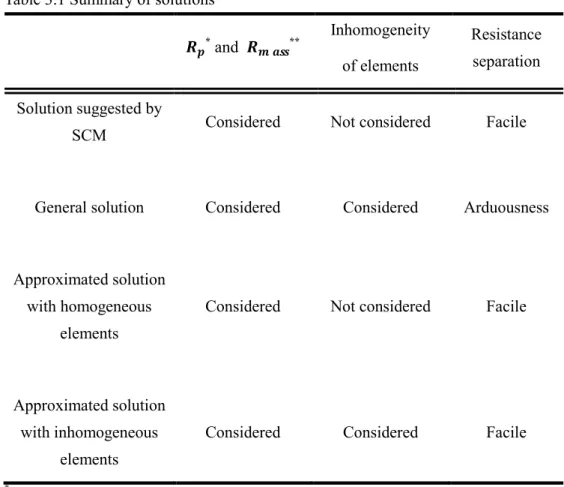
Table 3.1 Summary of solutions
* and **
Inhomogeneity of elements
Resistance separation Solution suggested by
SCM Considered Not considered Facile
General solution Considered Considered Arduousness
Approximated solution with homogeneous
elements
Considered Not considered Facile
Approximated solution with inhomogeneous
elements
Considered Considered Facile
* Protonic resistance in cathode catalyst layer
** Mass transport resistance
Figure 3.1 (a) A schematic of the CCL. represents the non-dimensional thickness of the CCL from CCL/GDL interface ( = ) to the PEM/CCL interface ( = ). (b) Electrical equivalent circuit of a PEM fuel cell represented by a TLM [1].
Figure 3.2 (a) Nyquist plots are plotted at RH 100%, (b) RH 50% under H2/air condition. Open symbols represent general solution and closed symbols represent validation model. Cross symbols represent experimental data.
0.0 0.2 0.4 0.6 0.8 1.0 1.2
0.0 0.2 0.4 0.6 0.8 1.0 1.2
0.0 0.5 1.0 1.5 2.0 2.5
Resistance [Ωcm2]
Voltage [V]
Current density [A cm-2] Fit using model Experimental data Using polarization curve Using EIS
RMSE : 0.015 R2 : 0.992
RMSE : 0.016 R2 : 0.999
0.0 0.2 0.4 0.6 0.8 1.0 1.2
0.0 0.2 0.4 0.6 0.8 1.0 1.2
0.0 0.5 1.0 1.5 2.0 2.5
Resistance [Ωcm2]
Voltage [V]
Current density [A cm-2] Fit using model Experimental data Using polarization curve Using EIS
RMSE : 0.013 R2 : 0.988
RMSE : 0.016 R2 : 0.997
Figure 3.3 Polarization curves and total resistances at (a) RH 100%, (b) RH 80%
under H2/air experiments. The experimental data of polarization curves were fitted using semi-empirical model. The total resistances using EIS were matched with the total resistances using polarization curves.
Chapter 4. Experimental results and discussion
4.1 Comparison of the EIS and the polarization curve
As shown in Figure 3.3, the polarization curves by our experimental results were well matched with fitting Eq.(27). Differentiating the fitting equation with respect to gave the information on the resistance as mentioned in chapter 3. Those results were also well matched with the experimental data of the EIS shown in Figure 4.1 (R2 > 0.995 and RMSE < 0.01). As reported by previous studies [33, 45], the increased as the RH decreased. The under RH 100% was larger than that under RH 80% in high current density region; however, these results were not maintained in the low current density region [4, 35, 46]. Furthermore, from the results of the at low current densities shown in Figure 4.2, the generated water in the CCL also affected and due to the change in the ORR pathways, proton activity, and the catalyst surface condition [33].
4.2 Comparison of the effective protonic resistance in the CCL and the membrane resistance with the RH and current density
Before the discussion, it is assumed that the electronic bulk resistance and contact resistance in were constant with the RH and current density. It means that the change of was caused by the variation of the membrane resistance.
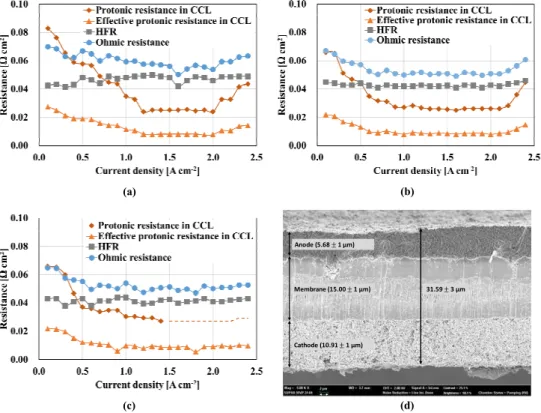
As shown in Figure 4.2 (a), (b), the was divided into and by the EIS and polarization curve under the H2/air experiments. It is already well known that the protonic resistance in Nafion is mostly determined by the water content [47, 48]. In addition, the water content was closely related to the RH and current density. In terms of the RH and current density, the definitely changed due to the , but was just a little affected. In other words, compared with , the change of was more sensitive to the operating current density and RH condition because of the water content. Furthermore, the change of was also highly related to the mean distance of the ionic transport.
As the current density was increased, the reaction rate and proton flow also increased. It means, in the low current density region, the effect of the water content increasing by the reaction was more critical than the proton flow increasing.
This effect was equilibrated around the middle current density region; thus, the
became constant. After that, increased again due to the high proton flow in the high current density region.
Additionally, the lowest level of was almost the same at the identical current densities (1.3 ~ 1.8A cm-2) regardless of the RH condition. It seems that the CCL was fully hydrated at these operating conditions, even though the RH was 80%.
The summation of the electronic bulk resistance and contact resistance in
was 0.026. It is a reasonable value when compared to that in a previous paper [7]. By this measurement, protonic resistance in the membrane can be evaluated. Therefore, the protonic resistance in the membrane was bigger than in the CCL under the middle and high current density regions shown in Figure 4.2 (a), (b). One of the reasons can be found in the thickness. The thickness of the MEA was measured using scanning electron microscope (SEM) image. As shown in Figure 4.2 (d), the membrane was 15.00 ± 1.5μm, and the CCL was 10.91 ± 1.5μm. Beased on ohm’s law, the resistance in the membrane should be bigger as in the experimental results. The second reason can be found in the diffusion effect and the distance of the proton flow. The protons migrated though the electrolyte, but the distance changed with the diffusion of the reactant gas and the proton conductivity.
In the membrane, the protons should migrate from the anode to cathode; thus, the movement distance was greater than or equal to the thickness of the membrane.
However, in the CCL, the movement distance of the proton was less than or equal to the thickness of the CCL, because O2 also migrated to the TPB. For this reason, the effective diffusion coefficient () can affect the . To ensure this effect, a H2/Heliox experiment was conducted to vary the shown in Figure 4.2 (c).
As a result, at a high current density was decreased because the movement distance of the proton flow in the CCL was decreased. In other words, several reactant points were moved to the nearby membrane.
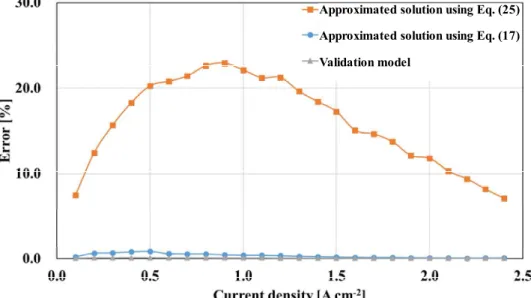
Eq. (26) is well-known equation to evaluate the . This equation can be derived from Eq. (19), and the error also can be estimated. To derive the equation,
/( + ) was assumed to be very small (/( + ) ≈ 0). It was stricter than the assumptions with Eq. (18). Therefore, the error due to the assumptions with Eq. (18) was less than 1.5%, but the error due to Eq. (26) was more than 5.8%
under RH 80% and 7.1% under RH 100%. In this context, was roughly
/3, but this assumption did not validate well under the main-operating load shown in Figure 4.3.
4.3 Analysis of the overpotential
The new separation methodology is advantageous that it can easily estimate the overpotential and identify the effect of the resistance in terms of the voltage using Eq. (27). Because the polarization curves were well matched with Eq.(27), the overpotential can be calculated using the equation. This calculation was more reliable because this calculation considered the . Figure 4.4 suggests the overpotential in regard to the effect of each resistance under different current densities and RH conditions. Consequently, the overpotential by was crucially high. However, the portion of the value decreased as the other overpotential increased by and At the low current density, the overpotential by
was not big. After this region, the overpotential increased as the current density increased.
(a) (b)
(c) (d)
Figure 4.1 Results of the resistance separation under H2/air. (a) Charge transfer resistance at RH 80%. (b) Mass transport resistance at RH 80%. (c) Charge transfer resistance at RH 100%. (d) Mass transport resistance at RH 100%.
(a) (b)
(c)
Anode (5.68 ±1 μm)
Membrane (15.00 ±1 μm)
Cathode (10.91 ±1 μm)
31.59 ±3 μm
(d)
Figure 4.2 Separation of the ohmic resistance at (a) RH 100% under H2/air, (b) RH 80% under H2/air, and (c) RH 100% under H2/Heliox. Rhombus symbol is the protonic resistance in CCL, triangle symbol is the the effective protonic resistance in CCL, square symbol is the high frequency resistance and circle symbol is the ohmic resistance. At the dotted line, fitting of the EIS wasn’t well fitted, so protonic resistance in CCL can’t be evaluated. In this region, resistance separation was conducted using