저작자표시-비영리-변경금지 2.0 대한민국 이용자는 아래의 조건을 따르는 경우에 한하여 자유롭게
l 이 저작물을 복제, 배포, 전송, 전시, 공연 및 방송할 수 있습니다. 다음과 같은 조건을 따라야 합니다:
l 귀하는, 이 저작물의 재이용이나 배포의 경우, 이 저작물에 적용된 이용허락조건 을 명확하게 나타내어야 합니다.
l 저작권자로부터 별도의 허가를 받으면 이러한 조건들은 적용되지 않습니다.
저작권법에 따른 이용자의 권리는 위의 내용에 의하여 영향을 받지 않습니다. 이것은 이용허락규약(Legal Code)을 이해하기 쉽게 요약한 것입니다.
Disclaimer
저작자표시. 귀하는 원저작자를 표시하여야 합니다.
비영리. 귀하는 이 저작물을 영리 목적으로 이용할 수 없습니다.
변경금지. 귀하는 이 저작물을 개작, 변형 또는 가공할 수 없습니다.
국제학석사학위논문
A Comparative Study on Foreign-invested Companies’ China Market Entry Strategies
after the Reform and Opening Up:
The Cases of Amorepacific and Shiseido
개혁개방 이후 외자기업의 중국 진출 전략에 관한 비교연구:
아모레퍼시픽과 시세이도를 중심으로
2017년 2월
서울대학교 국제대학원 국제학과 한국학전공
정 보 경
A Comparative Study on Foreign-invested Companies’ China Market Entry Strategies
after the Reform and Opening Up:
The Cases of Amorepacific and Shiseido
A thesis Presented By
Bokyung Jung
to
A dissertation submitted in partial fulfillment of the requirements for the degree of Master
of International Studies in the subject of Korean Studies
Graduate School of International Studies Seoul National University
Seoul, Republic of Korea
February 2017
Copyrights 2017 by Bokyung Jung
All Rights Reserved
Abstract
A Comparative Study on Foreign-invested Companies’ China Market Entry Strategies
after the Reform and Opening Up:
The Cases of Amorepacific and Shiseido
Bokyung Jung Korean Studies Major Graduate School of International Studies Seoul National University
This paper looks at the localization strategies of two global cosmetics companies, Korea’s Amorepacific and Japan’s Shiseido, which have achieved astounding growth in the Chinese market as a case study on localization strategies employed by multinational companies for overseas markets. Specifically, based on literature review, this research compares the localization strategies applied by the two companies in the Chinese market in terms of the marketing mix (4Ps), while, from the perspective that quick response to sudden market variables of the local market is a part
of localization, analyzing how each company reacted to the unexpected market variables
“Hallyu” and “anti-Japanese sentiments”, respectively, using the “4Ps+1” framework.
By showing that Amorepacific actively utilized the market variable “Hallyu”
for its localized marketing to achieve greater market share and that Shiseido overcame the negative market variable “anti-Japanese sentiments” through the localized marketing of its Chinese-exclusive brand, this paper provides guidelines on how Korean companies in the Chinese market including Amorepacific can respond to the anti-Hallyu sentiments surfacing in China due to recent political issues such as the THAAD deployment.
Keywords: Localization, Marketing mix, Chinese market, Cosmetics industry, Hallyu, Anti-Japanese sentiments
Student Number: 2014-24318
Table of Contents
Abstract
Table of Figures
1. Introduction --- 1
1.1 Research Question and Objectives --- 1
1.2 Research Methodology and Structure --- 4
1.3 Theoretical Background and Literature Review --- 5
1.3.1 Localization Strategy --- 5
1.3.2 Marketing Mix --- 7
2. The Case of Amorepacific --- 9
2.1 Amorepacific’s Entry into China and Its Localization Strategy --- 9
2.2 Marketing Mix and Hallyu --- 14
3. The Case of Shiseido --- 18
3.1 Shiseido’s Entry into China and Its Localization Strategy --- 18
3.2 Marketing Mix and Anti-Japanese Sentiments --- 23
4. Comparison of Localization Strategies and Its Implications --- 29
5. Conclusion --- 31
5.1 Summary of Findings --- 31
5.2 Limitations --- 33 References
Abstract in Korean
List of Figures
[Figure 1] The Hallyu Influence Coefficient for China (2014-2015) --- 13 [Figure 2] Amorepacific’s Product Sales and Sales Growth in China by Year --- 18 [Figure 3] Shiseido’s Product Sales and Sales Growth in China by Year --- 22 [Figure 4] Shiseido’s Operating Income and Operating Profitability by Year --- 22 [Figure 5] Shiseido’s Product Sales and Sales Growth in China in 2014 --- 28 [Figure 6] Shiseido’s Operating Income and Operating Profitability in 2014 ---- 29
1. Introduction
1.1 Research Question and Objectives
When multinational companies conduct overseas marketing, they are faced with the need to consider product standardization and localization simultaneously.
Product localization becomes necessary despite the advantages of product standardization mainly due to the differences in market environments across countries.
This is especially true from the perspective of the marketing mix (4Ps), which is blended for the purpose of achieving a specific marketing objective (Theodosiou & Leonidou, 2003: 156-162).
The present research sets out to investigate the localization strategies employed by global companies in a specific context: the cosmetic industry in the Chinese market. The Chinese market carries specificities and unique sociocultural characteristics that often pressure multinational companies towards localization. The Chinese market’s hidden barriers also contribute to positioning localized market strategies as a critical factor for business success (Yoo, 2015: 37). Meanwhile, cosmetics are often referred to as cultural products (Impact, 2014: 74) as cosmetic product sales are highly dependent on how much the company and product understands the local culture. The cosmetics industry is also a typical domestic industry as cosmetics were developed to match the skin colors, skin types, and make-up habits of the domestic population (Kolmar, 2014).
In addition, the cosmetics industry is often perceived as a cultural industry that is associated closely with the home country’s brand and image (Jung, 2015: 26).
Such distinct characteristics of the Chinese market and the cosmetics industry have made it necessary for global cosmetics companies to adopt various localization strategies that take into consideration China’s unique socio-cultural factors and consumer culture to achieve success in the Chinese market. The two companies to be discussed in this paper are no exceptions to such pressures of the Chinese market.
Amorepacific, a Korean cosmetics brand which is highly recognized throughout Asia, has been no exception. Korean cosmetics, especially Amorepacific, showed remarkable growth in China, mainly due to the efforts made in improving product quality and the positive effect coming from the spread of Korean popular culture (Hallyu) in China (Lee
& Son, 2015: 26). Many studies have found that Hallyu enhanced the Chinese people’s awareness of Korea and helped in forming a preference for Korean products among Chinese consumers. Furthermore, previous research has shown that Chinese consumers’
attachment to Hallyu stars positively affects their trust in the quality of the products promoted by the stars as well as the credibility of the company (Lee & Jung, 2016).
Whereas Amorepacific is the leading Korean cosmetics company in China, Shiseido is the Japanese counterpart of Amorepacific that has been highly successful in the Chinese market. However, in 2012, the dispute over Diaoyu Dao (Senkaku Islands) led to a massive anti-Japanese demonstration in China and an attack and boycott against Japanese companies. This unexpected market variable also damaged Shiseido’s image, leading to a decline in sales. The anti-Japanese sentiments in China have not yet been resolved, nevertheless, Shiseido is still a top foreign brand in the Chinese cosmetics market with a long history since its first entry into the Chinese market. Moreover, as a
first for a foreign-invested company, Shiseido launched a China-exclusive cosmetics brand based on its research on Chinese consumers which is said to be a “model of successful localization” (Leelapanyalert et al. 2015: 77-79) and which also saved Shiseido from political dangers.
Since the late 1990s, many studies have examined the localization strategies of multinational companies in China, generally using the marketing mix to analyze the strategies in reflection of its broad usage in the establishment and execution of marketing strategies by multinational companies in the Chinese market. However, localization strategically includes responding to various variables in the local market, especially more so in a distinctive market like that of China which presents unexpected market variables. In response to Hallyu and anti-Japanese sentiments, two market variables with distinctly contrasting characteristics, Amorepacific actively used the market variable
“Hallyu” for their localization marketing while Shiseido tried to overcome the market variable “anti-Japanese sentiments” through localization marketing.
This study will analyze the localization strategies of the two companies based on the “4Ps+1” framework which takes into consideration these additional two market variables on top of the basic 4Ps of the marketing mix. Through the comparison between Shiseido, who is the forerunner in the Chinese market, and Amorepacific, who joined the Chinese market later, the findings of this study will present useful insights, especially for Amorepacific, on enhancing competitiveness in face of the potential volatility, high competition among global brands, and the growth of Chinese local brands in the Chinese market.
1.2 Research Methodology and Structure
The present research analyzes the localization marketing strategies of Amorepacific and Shiseido based on literature review, to explain how the two companies formed their localization strategies and responded to the two contrasting market variables of Hallyu and anti-Japanese sentiments. The data for the timing, background, and process of Amorepacific and Shiseido’s entry into the Chinese market are mainly extracted from the companies’ annual reports, while data on localization strategies and market variables have been gained from various articles, existing studies, and documented interviews and fieldwork results.
The composition of this paper is as follows. Chapter 1 explains the research question and objectives, research methodology and structure, theoretical background, and literature review. Chapters 2 and 3 analyze the cases of Amorepacific and Shiseido in detail to clarify why the two companies are inseparable from their localization strategies. By comparing the two companies based on the data analyzed in Chapters 2 and 3, Chapter 4 discusses the factors that Amorepacific needs to strengthen to cope with the potential risk factors in the Chinese market. Finally, Chapter 5 summarizes the results of the study and discusses its implications and limitations.
1.3 Theoretical Background and Literature Review 1.3.1 Localization Strategy
There exist different approaches for defining the concept of localization.
Perlmutter (1969) defined localization as the process of surviving in the local market and establishing the company as a local enterprise by conducting major areas of corporate activities in a foreign country, and Rosenzweig & Nohria (1994) understood localization as the degree of similarity to the management strategies of local firms. Ahn & Paik (2006) identified localization as a multidimensional concept through which companies operating in foreign markets reconstruct their decision-making processes in accordance with local market characteristics. Seo & Kim (2013) defined localization as activities to improve the value-added activities of local subsidiaries and the process through which they establish themselves as local companies. In sum, the concept of localization can be understood as the efforts by multinational companies to establish a local system in all areas of business in the local market and to interact with the local society to establish themselves as local companies.
There has been active research on the localization of global companies. One of the main topics of research in the field of international marketing is the decision between standardization and localization strategies, which is an issue that was first raised in terms of marketing (Choi, 2005: 65). Standardization strategy is based on the idea that basic marketing needs are the same globally regardless of the differences in the local consumers’ habits and cultures, and refers to the application of the same marketing
strategy in all markets that the company has entered. On the other hand, localization strategy, also known as adaptation strategy, refers to the formulation and application of individual marketing strategies in accordance with local market conditions. Hall (1959) argued that localization is necessary due to the many cultural obstacles in transferring a successful strategy in one country to another, and Green and Cunningham (1980) found a significant difference between the way families in the U.S. and those in Venezuela make purchasing decisions and suggested that global companies should select different target customers for each market. As such, most studies supporting localization highlight the differences in socio-cultural and economic conditions between markets.
The trade-off between the two strategies is clear. The advantage of standardization strategy is that it can achieve economies of scale that lead to cost-savings, but if the standardized product does not meet the customer's needs in the specific market, it can adversely lead to loss of revenue. Meanwhile, localization strategy is beneficial for maximizing the marketing effect by taking the actual local market conditions into consideration, however, differentiated marketing activities can take up more time and cost. In case of the Chinese market, however, localization strategy gains importance because of the market’s unique sociocultural factors as well as the opportunities for developing marketing alternatives for products or services that open when adopting a localization strategy (Ahn & Paik, 2006; Kim, Park, Kwon & Lee, 2006). Kwon (2012) emphasized the importance of satisfying consumer needs through localization in strategically important markets such as the Chinese market and empirically showed the significant effect of localization on local management performances of Korean firms
who have entered the Chinese and Indian markets.
Korea Labor Foundation (2009) listed a management system that maximizes local management resources; the incorporation of unique Chinese characteristics such as history, culture, and customs; and the management of government-related risks that China’s socialist market economy system can entail as the top three success factors of global businesses in China, and identified China as a unique country that requires businesses to consider all three factors. In reality, LG Electronics implemented a full-scale localization that takes account of all three factors above in its efforts to succeed in the Chinese market, specifically, it established an R&D center using local resources and developed products that meet the needs of Chinese consumers;
identified the characteristics of the local market and local customers and implemented after-sales services such as the 365-day phone center; strengthened its CSR initiative for school-building in rural areas to improve brand familiarity and image among local governments and consumers (Park & Kim, 2002).
1.3.2 Marketing Mix
According to the American Marketing Association (AMA), marketing can be defined as “the activity for creating the activity, set of institutions, and processes for creating, communicating, delivering, and exchanging offerings that have value for customers, clients, partners, and society at large.” A company establishes its marketing plan for a specified period of time, which conventionally consists of a series interrelated
(Grewal & Levy, 2015). Marketing mix was first introduced by Neil Borden at the American Marketing Association (AMA) in 1953 to refer to “a mix of elements, useful for getting any response in the market.” Since then, many researchers have attempted to specify these elements. McCarty (1960) defined the marketing mix as a combination of controllable marketing tools that firms utilize to satisfy its target market and conceptualized the 4Ps. Kotler (1997) defined the marketing mix as a set of marketing tools that companies use to execute their marketing strategies. Although many other scholars have since proposed alternative classification systems, the 4Ps proposed by McCarty has been accepted as the dominant concept even up to the present (JEON &
BAE, 1999: 231).
The flow of the 4Ps is as follows. The company first creates a product that meets the needs of the customer, sets the price for the product, and decides which place to offer the product to the target customers. Finally, promotion is used to inform the target customers of the product (Kotler & Armstrong, 2012: 13-14). As such, the 4Ps are a set of controllable decisions and activities that can be utilized to respond to the needs of the target market. Kim (2004) stressed that firms need to apply appropriate localization when executing marketing mix strategies in the Chinese market, and divided the marketing mix strategies of Korean companies in China into product, price, distribution, and promotion localization to explain the major strategic variables for each type of localization. Kim and Lee (2001) analyzed the difference in localization strategies adapted by LG Electronics in a developing country (China) and an advanced country (US) and found many discrepancies in the marketing mix employed by the company
depending on the market to conclude that it is desirable to pursue an investment strategy for the Chinese market and a dominance strategy for the US market.
As such, marketing in China is characterized by the need to respond strategically to the various variables of the market. Therefore, it becomes necessary for firms to adjust and adapt controllable decision-making factors that influence marketing, that is, the 4Ps, to cope with the system that is embedded with uncontrollable market factors (Cateora, 1983: 4). In what follows, the cases of Amorepacific and Shiseido will be analyzed based on the marketing factors (4Ps) to identify their localization strategies and responses to market variables in the Chinese market.
2. The Case of Amore Pacific
2.1 Amorepacific’s Entry into China and Its Localization Strategy
Amorepacific entered the Chinese market as a latecomer in 1993. While Amorepacific had few domestic competitors that met its match, Amorepacific's competitiveness significantly weakened when the Korean market opened its doors to Western cosmetics in the 1990s, thereby leading the company to seek a breakthrough by entering overseas markets (Choi, 2006: 97). At first, Amorepacific launched in China’s three northeastern provinces (Shenyang, Changchun, and Harbin) due to their geographical proximity to Korea, affinities in history and culture, and dry climate which
can be advantageous in terms of cosmetic product sales (Ghemawat, Knoop & Kiron, 2006: 11). The company established a joint venture company in Shenyang and started to sell products imported from Korea as general products with a focus on wholesale.
However, sales were below expectations, and it was soon acknowledged that simply selling Korean products in similar markets to Korea in the same method employed in Korea was not a good strategy for the Chinese market (Lim, November 23, 2016).
After experiencing failure from its insufficient understanding of the Chinese market, Amorepacific reintroduced itself to the Chinese market in 2000 with a localization strategy on hand. The company’s decision to launch its Laneige brand first in the Chinese the market met with great success, and Laneige grew into the mega-brand that it is in the Chinese market today. Behind the success of Laneige is Amorepacific’s well-placed localization marketing strategy, as well as the specific variable ‘Hallyu’ of the Chinese market (Ghemawat et al., 2006: 11-12). As mentioned earlier, the cosmetics industry is highly dependent on the home country’s image as it is often perceived as a cultural industry that symbolizes the country’s brand (Cho, 2007), and Hallyu contributed in forming a positive perception and preference among Chinese consumers for made-in-Korea brands and increased their trust in Korean cosmetics (Park, 2015).
Capturing this trend, Amorepacific actively used the Hallyu effect in its local marketing activities.
“The cosmetics industry is a cultural industry. We tried, in the early 1980s in France...to export our cosmetics. But the French women did not show
any interest at all. This was because our products were MADE IN KOREA…. Whatever great ingredient or technology the product used, they did not even consider the product just because of its origin. But as you know, Hallyu has been a great helping hand for us.” (Park & Kim, 2012:
34) - Kang Byung-yong, Amorepacific CFO
As the interview above illustrates, Amorepacific is well-known for its active and successful utilization of the Hallyu boom in marketing its brand and products (Kim, Jeon & Kim, 2013). Therefore, to understand Amorepacific’s localization strategy in depth, it is necessary to examine Hallyu as a variable in the Chinese market.
Hallyu, also known as the Korean Wave, started in China when Korean TV dramas and popular music gained attention in the late 1990s after the normalization of Korea-China relations. Soon, in the 2000s, Hallyu contributed to not only raising the image of Korea in the minds of the Chinese population but also created a ripple effect on a wide range of areas ranging from business management to economic issues and even gave birth to unique Korean-style systems for business and economy called “Hallyu Management” and “Hallyu Economy,” respectively (Kang, 2006: 38-44). Hallyu spread its reach regionally and globally in stages. The first stage is called Hallyu 1.0, during which Korean TV dramas and popular music gained rapid popularity in China and Japan;
the second stage, Hallyu 2.0, expanded Hallyu globally through the spread of K-Pop and online games; then the third stage, Hallyu 3.0, won vast attention from the global population for K-culture in general through cultural hits such as Psy’s “Gangnam Style”
and the Korean TV drama series, My Love from the Star (Yoon, 2016: 3-8).
It was the impact of Hallyu during its second stage, Hallyu 2.0, from the mid-2000s to early 2010s that was particularly noteworthy for the Korean cosmetics industry. It was during this period that the attraction to Korean TV dramas and K-POP led to the interest in the appearance of Korean actors and singers and their make-up styles, and consequently, to the purchase of Korean cosmetic products by Hallyu fans (KOCCA, 2012: 12). Today, cosmetics is playing a leading role in the Hallyu industry, giving birth to expressions such as “Hallyu Cosmetics” and “K-Beauty” (KOFICE, 2015: 206).
Korea's cosmetics exports have been steadily increasing at a double-digit growth rate, which can be attributed to the efforts of Korean cosmetics companies in uncovering Hallyu’s marketing value and actively casting Hallyu stars for their marketing activities (KOFICE, 2005; Lee & Son, 2015: 26) Especially with cosmetics exports increasing more than eight times from US$96 million in 2001 to US$850 million in 2011, the cosmetics industry gained recognition as the biggest beneficiary of Hallyu and chosen as one of the “Top 5 exports that are expected to benefit from Hallyu” by the Korea Customs Service in 2011 (Impact, 2014: 74).
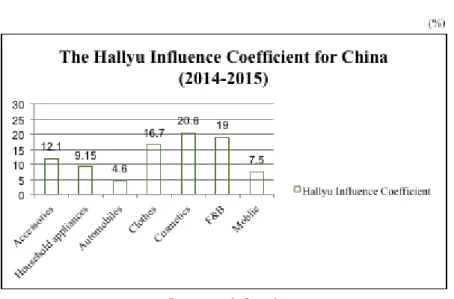
Empirical studies have also reported on the positive impact of Hallyu on Korean cosmetics’ export to and sales in China, one of which is the Hallyu influence coefficient analyzed by Korea Foundation for Cultural Industries Exchange (KOFICE) that examines the impact of Hallyu on the Korean consumer goods sales in China. The Hallyu influence coefficient is calculated based on a consumer survey conducted in 29 countries on how Hallyu has affected their purchase of different consumer goods. As
shown in Figure 1 below, according to the Hallyu influence coefficient calculated for 2014 and 2015, 20.6% of cosmetics product sales came from the Hallyu effect, which was the highest impacted category among measured consumer goods (cosmetics, foods and beverages, clothes, accessories, household appliances, automobiles, mobile). In contrast, for the same years, the Hallyu influence coefficient of cosmetics for Japan and Southeast Asia were 10.3% and 11.3%, respectively. Together, it can be inferred that Hallyu had the most influence in the Chinese market and the cosmetics industry.
Figure 1. The Hallyu Influence Coefficient for China
The following section will examine how Amorepacific took advantage of Hallyu as a market variable in the Chinese market based on the marketing mix (4Ps).
2.2 Marketing Mix (4Ps) and Hallyu (+1)
Product
After three years of market research, Amorepacific decided to launch Laneige, whose brand image and products are geared towards the younger generation, as its first brand to be introduced to the Chinese market. This decision was based on the facts that more than half of China's cosmetics demand is made up of women in their 20's (Kita, 2014: 10) and that most Chinese cosmetics brands are concentrated in the low-end segment (Kim, 2004: 317), pointing to the marketability of Laneige as a young premium brand. Laneige’s “Water Sleeping Mask” was released to appeal to Chinese consumers who wish to hydrate and moisturize their skin against China’s dry climate and water pollution, but who are unfamiliar with cosmetics and are not accustomed to step-by-step skincare using a variety of products “Capturing the Heart of Chinese Women (lbizkorea, 2014).
Naming the brand to fit with the Chinese sentiment is also very important in the Chinese market. Chinese consumers prefer brand names with meaning but at the same time, special attention is necessary to avoid unintentionally offending consumers by choosing Chinese characters with misconstruable homophones. A well-made brand name can have a direct impact on the success of the brand’s Chinese localization (Kim, 2007). Amorepacific chose lanzhi (兰芝) as the Chinese brand name for Laneige, which is not only similar to Laneige in pronunciation but is also a combination of the word lan (兰) meaning orchid and zhi (芝) meaning sesame, both of which are beneficial
ingredients for skincare (“Branding China”, 2014).
Price
The price range for Laneige was set at a mid-to-high range to match its premium image. To ensure that it avoids repeating the mistake it made in its previous venture into the Chinese market, Amorepacific sought to endow a clear positioning for Laneige. This price setting took into consideration the low brand loyalty of Chinese consumers, and aimed to instill loyalty in its consumers from the beginning by adding a definite premium to the brand (Park, Jun. 23, 2016). Also, a higher price strategy was determined better for avoiding Chinese consumers’ strong prejudice against cheap products that you get what you paid for (Lee, Dec. 29, 2010). At a time when the Chinese cosmetics market mostly consisted of imported high-end brands and local mid-to-low- end brands, Amorepacific's niche marketing in terms of price setting was possible because of the already-existing positive image of Korean cosmetics brands built through Hallyu stars “Capturing the Heart of Chinese Women”(lbizkorea, 2014)
Promotion
Amorepacific actively utilized the Hallyu effect in promoting its brand and products. Such efforts included hiring Hallyu stars as its celebrity spokesperson, sponsorship of various events, and product placement (PPL) in Korean TV dramas (Kim, 2005). Especially since 2005, Amorepacific hired Jun Ji-hyun and Song Hye-gyo, two Korean actresses who gained the most popularity in China, as advertisement models for
female consumers to have beautiful skin like the two actresses and attracted vast interest in Laneige's water science technology throughout China as well as promoted Laneige products ("Branding China", 2014).
In addition, when launching a new store or product, Amorepacific held autograph signing events featuring its advertising models which were hugely popular with customers lining up for the events from the day before and received the local media coverage on visit by Hallyu stars (Park, June 23, 2016). Recently, the growing influence of PPL has led Korean companies to sponsor Korean TV dramas that “show promise to be successful in China,” and Amorepacific has been no exception in its PPL sponsorship of TV dramas that feature the influential Hallyu stars the company hires as its products’
celebrity spokespeople.
Products that are featured in TV dramas are often given nicknames after the Hallyu star that used them within the TV drama (e.g., “Song Hye-gyo Lipstick”) and experience high peaks in sales after the show has aired. In February 2016, a Korean TV drama sponsored by Laneige became very popular in China, and as a direct result, Laneige products sold more than 10 times compared to the same period in the year before (Jeon, March 26, 2016). Moreover, Chinese power bloggers, also known as wang hong, who are major trendsetters in China, have been motivated by the increased interest of Chinese consumers in K-Beauty to introduce Amorepacific's products or upload tutorials for imitating the makeup styles of Hallyu stars on their SNS accounts, thereby bringing additional publicity to the products. In addition, as Hallyu also deepened the interest of Chinese consumers in Korean culture, Amorepacific has been incorporating elements of
Korean culture in their product contents and services such as packaging in Korean characters (hangul) and having store staffs greet customers in Korean (Choi, Nov. 27, 2014).
Place
Amorepacific strategically introduced Laneige to the Hong Kong market before its launch in mainland China, with the intention to build a good reputation and awareness of the brand in trend-leading Hong Kong first so as to increase the chances of success in mainland China (Kim & Hong, 2015: 138). This strategy turned out to be successful, and Amorepacific launched Laneige with relative ease in the mainland China market in 2002. However, although Laneige entered the Chinese market with a solid reputation from Hong Kong, the brand had low recognition compared to other foreign brands and was unable to secure store spaces on the first floor of department stores. Later, the rapid spread of Hallyu and K-Beauty elevated Laneige’s brand status and its shops were given the central position on the first floor with other imported cosmetics (Park, Oct. 27, 2014). As can be seen from Figure 2, Laneige and Amorepacific's sales in China became clearly different before and after the mid-2000s when Hallyu gained full-fledged interest in China.
Figure 2. Amorepacific’s Product Sales and Sales Growth in China by Year
As illustrated above, Amorepacific achieved remarkable growth as a result of its adjustment and adaptation of the 4Ps to attract Chinese consumers who prefer made-in-Korea products (Ghemawat et al., 2006: 11), and the company’s actively use Hallyu became recognized as a best practice case for its effective appeal to the sense of beauty held by Chinese consumers.
3. The Case of Shiseido
3.1 Shiseido’s Entry into China and Its Localization Strategy
Shiseido entered the Chinese market early on when it started exporting its cosmetic products to China in 1981 at the request of Beijing City. Shiseido products
imported into China were sold at department stores and hotels to be available for purchase only to the elite class, and this early positioning as a product for the rich continued to form Shiseido's premium brand image in China up to the present. Two years after Shiseido’s entry into the Chinese market, Beijing City requested Shiseido for technical cooperation to create the local brand, HUAZI. All HUAZI products were labelled with the phrase, “[t]his product was made with the technical cooperation of Shiseido of Japan,” and helped Shiseido to gain brand recognition throughout China (Jones, 2004: 11).
Along with the success of HUAZI, Beijing City established a joint venture with Shiseido in 1991 to develop the Chinese cosmetics industry by bringing in the advanced technology of Japanese companies, and this marks the beginning of Shiseido Group's full-fledged entry into China. The joint venture launched a China-exclusive brand called AUPRES in 1994, and the brand was received with enormous welcome to become China’s national brand. Not only that, when Shiseido was faced with the unexpected market variable of anti-Japanese sentiments and ensuing boycotts in 2012, AUPRES played the role of shield for Shiseido.
“If Shiseido had gone into China with a simple globalization approach, we would have failed. Our success in China was due to the fact that Shiseido placed great importance on China and Chinese culture, and developed products specifically aimed at the Chinese market.” (Geoffery G, 2004: 11) - Morio Ikeda, President & CEO, Shiseido Co., Ltd., 2001-2005.
As Ikeda points out, Shiseido's exclusive Chinese brand represented the company’s efforts to create a completely localized brand, and it is now recognized as a model example of localization for the Chinese market (Buckley & Horn, 2009: 502;
Leelapanyalert, Tanpradit, Khiewvan & Sakhonchaicharoen, 2015: 77-79). Moreover, Shiseido's overseas sales accounted for only 15% of its total sales in 1998 but its proportion increased more than 20% over the next 10 years to 38% in 2008, which can be attributed to the company’s strategic approach to the Chinese market with its China- exclusive brand at the forefront (Jung, Sep. 9, 2009).
Prior to launching AUPRES in China, Shiseido's target consumer was the upper class, and Shiseido products were known to be expensive beyond the reach of the general population (Noh & He, 2012: 78-80). However, as mentioned above, Shiseido as an Asian product was perceived inferior to Western brands due to the characteristics of the cosmetics industry (Jung, Apr. 24, 2010). In this context, the joint venture launched AUPRES with the aim to maintain the luxurious image of Shiseido while targeting middle-class consumers. Starting with AUPRES in 1994, Shiseido continued to launch additional China-exclusive brands such as PURE & MILD (2001) and URARA (2006) that targeted different consumer bases.
Shiseido continued its growth in the Chinese market until 2012, when it was met with a crisis: the dispute between China and Japan over the sovereignty of Diaoyu Dao deepened anti-Japanese sentiments among the Chinese and led to a boycott against Japanese products. Shiseido was not exempt from the boycott, and after experiencing its first negative growth, Shiseido quickly responded by emphasizing its “China-exclusive
brands.” Through marketing reform and the pro-China image of its China-exclusive brands, Shiseido was able to recover its sales in the following year.
Before examining Shiseido's countermeasures to the boycott more closely, it is necessary to understand the background and flow of the events that led to the anti- Japanese sentiments in China. The relationship between China and Japan since the restoration of diplomatic relations in 1972 can be described as “cold politics, hot economics (政冷經熱).” Underlying discontent from historical problems and disputes over sovereignty have continued to resurface, and each time, China spurred patriotism in its people and called for boycott against Japanese brands (Hong, 2005). It has been argued that such behavior is not irrelevant to China's sinocentrism: the Chinese government has been informally encouraging use of domestic products among its people and foreign companies residing within China, and Chinese consumers no longer believe as strongly as before about the superiority of foreign brands (Kim, 2005: 1-9).
On September 11, 2012, when Japan nationalized its control over Diaoyu Dao and its neighboring islands, anti-Japanese sentiments peaked and an anti-Japanese boycott spread all over China at a rapid pace. This shift in national sentiments forced Shiseido to postpone all scheduled promotions and events, close its stores, and remove all its products from retail shops (Shinzo, 2013: 10). The boycott continued onto the end of the year when sales are usually at its highest. As Figure 3 and 4 show, Shiseido, which has been recording a double-digit annual growth rate since its entry into China in 1981, experienced its first negative growth of -0.2% (local currency basis) in 2013 and Shiseido's overall operating income also fell 33.4% compared to the year before due to
the decline in sales growth in the Chinese market where Shiseido’s investment was highly concentrated (Shiseido, 2013).
Figure 3. Shiseido’s Product Sales and Sales Growth in China by Year
Figure 4. Shiseido’s Operating Income and Operating Profitability by Year
In the next section, Shiseido’s localization strategy in the Chinese market and response to the anti-Japanese sentiment will be analyzed based on each element of the marketing mix (4Ps).
3.2 Marketing Mix (4Ps) and Anti-Japanese Sentiments (+1)
Product
As a China-exclusive brand, the creation of AUPRES was based on thorough research on China's climate and the skin types of Chinese women from the initial development stage. To meet the needs of young female consumers who account for more than 60% of China's cosmetics sales, Shiseido launched a whitening and moisture-based product line for AUPRES that appealed to the desire for clear, white skin and deep moisturizing against China’s dry climate (“Shiseido Renews Its Line”, n.d.).
Red and gold colors were used for AUPRES product packaging to fit the taste of Chinese consumers (“Shiseido Renews Its Line”, n.d.), and the French word for “near” was used as the brand name to express the brand’s intention to move closer to Chinese consumers (“AUPRES 2016 revealed”, Feb. 25, 2016).
Chinese consumers often interpret foreign companies’ efforts to create a China-exclusive brand for the Chinese market as a show of respect for China (Korea International Labor Foundation, 2009: 42-43). By creating AUPRES, Shiseido satisfied the desire of Chinese consumers to see their country treated with special attention, thereby gaining a pro-Chinese brand image through AUPRES which helped to motivate
Chinese consumers to try Shiseido products that were previously unapproachable to many due to Shiseido’s luxurious image, as well as to overcome the low trust Chinese consumers held towards locally-made products (Noh & He, 2012: 78-80). Unlike the previous technology collaboration product lines, AUPRES was not labelled with the Shiseido logo to differentiate AUPRES from high-priced imported Shiseido products that were being sold in department stores and to strengthen AUPRES’ identity as a China-exclusive brand (Jung, Sep. 9, 2009).
Price
Imported Shiseido products were high-end and only accessible to a small number of upper-class customers. Moreover, as the cosmetics industry is a cultural industry that represents the country’s brand and image, Shiseido products had low price competitiveness compared to Western brands. By launching AUPRES, Shiseido was able to target a niche market that was formerly beyond its reach. AUPRES’ main consumer target was those who cannot purchase high-end imported cosmetic products but wish to acquire high quality cosmetics, so the price range for the products was set from 100 to 200 RMB which is approximately 60% of the price of imported Shiseido products (“Shiseido Renews Its Line”, n.d.). This price setting places AUPRES products at the middle between the average price of imported brands (300RMB) and the average price of local brands (10-20 RMB).
Promotion
were created based on thorough research on Chinese women's skin types and needs, and second, that it is a premium brand developed by Shiseido, the representative cosmetics brand in Asia. Chinese consumers particularly tend to project the images of the brands they purchase to their own, so brand image is critical for the Chinese market (Bae, Dec.
17, 2003). To highlight AUPRES as a localized brand, Shiseido incorporated Chinese elements not only in the products but also in the product display and staff uniforms, and hired Chinese models as the brand’s spokespeople for the first time as a foreign-invested company (Leelapanyalert et al. 2015: 78). Shiseido also placed beauty consultants and skin analyzers at its stores when such customer service was uncommon in China.
Through these efforts, AUPRES grew rapidly, and in 2000 and 2004, the brand was chosen as the official brand for the Chinese national team at various international events including the Olympics and solidified its position as China’s national brand (Leelapanyalert et al., 2015: 76).
Shiseido’s aggressive adaptive marketing strategy led to continuous growth in the Chinese market until the company faced a crisis in 2012 from the sudden boycott against Japanese brands in China. To cope with this crisis, Shiseido began to put its full- fledged efforts in selling its China-exclusive brand products as can be seen from the following excerpts from interviews with Shiseido executives:
“During the year ending March 2014, we will meticulously strengthen investment in two brands that are not significantly exposed to anti- Japanese sentiment because they are not marketed under the Shiseido
name: AUPRES (Shiseido, 2013: 19).” -Shinzo Maeda, President &CEO, Shiseido Co., Ltd., 2013-2014.
“I truly believe and I’m extremely grateful that we have nurtured these brands that Chinese women consider indispensable (Shiseido, 2013:
31).”–Masahi Kamata, Chief Area Managing Officer of China.
After experiencing a steep drop in sales due to the Diaoyu Dao dispute, Shiseido decided to concentrate on sales of its China-exclusive brand products in the Chinese market and executed a reform of its market strategy. In terms of promotion, first, Shiseido strengthened its customer services. In addition to beauty consulting, skin massage services were provided to customers to increase customer retention (Shiseido, 2013: 31), a localized strategy which reflects the Chinese way of thinking. More specifically, this strategy captured the Chinese people’s emphasis on mianzi (面子), that is, the Chinese consumers’ tendency to keep up an appearance to others by brandishing luxury brands, and provided services beyond the expectations of customers for the price they paid to raise their mianzi and induce their beauty purchases (Yoo & Kim, 2008: 14).
Place
AUPRES products were sold in high-end department stores at large cities from the beginning to build a premium image for the brand. It was possible for Shiseido to secure spaces on the first floor of these departments stores for AUPRES where only
imported cosmetics brands were placed, thanks to the high reputation of Shiseido built over time in China. At the time, China’s booming economy created a trend among residents in the large urban areas to enjoy shopping at high-end department stores as a major source of entertainment and a means to show off their economic status, and this trend drove high levels of consumption (Yoo & Kim, 2008: 14). In areas without high- end department stores, specialty stores were opened to capitalize on the characteristics of Chinese customers to purchase premium products at professional shops even at a higher price (Bae, Dec. 17, 2003).
During the period of the anti-Japanese movement, Shiseido narrowed their focus for brands and regions to increase efficiency in sales. Distribution and sales efforts were concentrated on AUPRES and URARA, Shiseido’s China-exclusive brands that had the greatest support from Chinese consumers, and on cities where anti-Japanese campaigns and boycotts were relatively weak (Shiseido Group, 2013: 31). Also, to reach customers who wished to buy AUPRES products but were reluctant to visit stores in person because of the disapproving looks from others, Shiseido actively developed its online sales (Roll, 2015: 168).
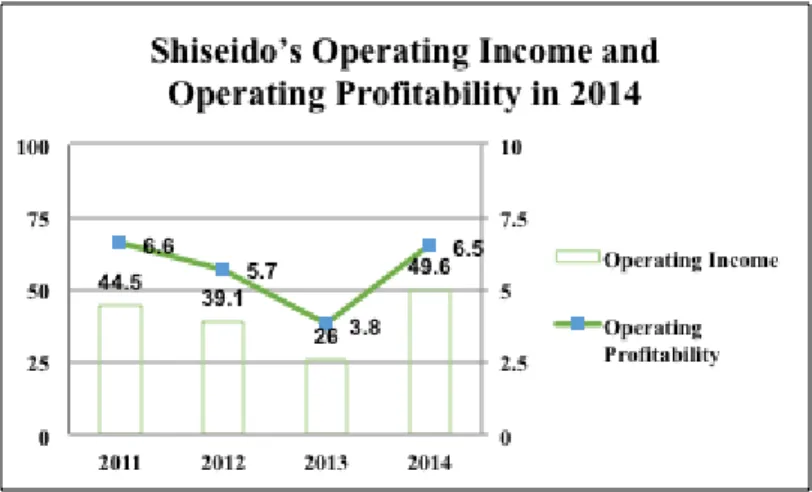
These quickly implemented marketing reforms and the pro-China, local brand image of Shiseido's exclusive Chinese brands, which were built based on a thoroughly localized marketing mix, helped the brands to speedily recover sales. In 2014, Shiseido's sales growth in China showed signs of recovery, and Shiseido's operating income rose 90.6% from the past year to 49,644 million yen (Shiseido, 2015). Although there were other growth factors such as favorable exchange rates, the recovery of sales
in the Chinese market in 2014 played a definite role in the company’s growth (Shiseido Group, 2015).
As such, Shiseido adjusted and adapted controllable marketing factors in a thoroughly localized manner to develop its Chinese exclusive brands into a pro-Chinese brand. Through these localized brands, Shiseido turned the sudden negative market variable into an opportunity to stand firm in the fiercely competitive Chinese market. In addition, the success of Shiseido's localized brands provided many implications for global companies, and led to the birth of localized products and brands from other global companies such as P&G’s OLAY which maintainns a high market share in China today.
Figure 5. Shiseido’s Product Sales and Sales Growth in China in 2014
Figure 6. Shiseido’s Operating Income and Operating Profitability in 2014
4. Comparison of Localization Strategies and Its Implications
As illustrated so far, both Amorepacific and Shiseido employed localization strategies while responding quickly to changes in the Chinese market to solidify their market positions. Amorepacific actively utilized the arrival of Hallyu in marketing its products to improve the image of Korean cosmetics and attract more purchases from Chinese consumers. In contrast, Shiseido was hit by the negative effect of anti-Japanese sentiments and experienced negative growth in sales for the first time since its first entry into the Chinese market. To cope with the situation, Shiseido centered on its China- exclusive brands, strengthened its pro-Chinese image and customer service, and
narrowed its sales territory to turn the crisis into opportunity.
Amorepacific grew into a leading global company by actively utilizing the value of Hallyu, however, the driver of this remarkable growth has recently faced what is dubbed a “Hallyu crisis” due to diplomatic issues such as the deployment of the Terminal High Altitude Area Defense (THAAD) anti-missile system in Korea by the U.S., leading to a growing ban against Hallyu and Korean companies in China. Also, as mentioned above, there exists a possibility that China’s sinocentrism and the great pride held by Chinese people in their cultural traditions may work against the use of Hallyu in marketing (Kim, 2013).
As the two have distinctly different characteristics, it is likely difficult to apply Shiseido’s localization strategy directly to Amorepacific. However, given the many potential crises that exist in the Chinese market today as well as the complexity and specificity of the market and its consumers, change is surely needed in Amorepacific’s localization strategy. The case of Shiseido provides useful insights for Amorepacific since Shiseido, an early participant in the Chinese market, has overcome various obstacles and market changes since its entry into China. While it is impossible to follow Shiseido’s example unilaterally, Amorepacific will benefit from using Shiseido as a reference as it searches for a new localization strategy in China.
5. Conclusion
5.1 Summary of Findings
The cosmetics industry is a cultural industry that represents the nation, and Amorepacific and Shiseido are cosmetics companies that have great influence not only in China but also throughout Asia. Based on previous literature and outcomes of fieldwork including interviews by researchers, this study attempted to understand how these two companies positioned themselves as a global company in the Chinese market through their localization strategies. To this purpose, the localization strategies of Amorepacific and Shiseido were analyzed based on the marketing mix (4Ps), and in recognition of the importance of responding quickly to changing variables in the local market in localization, the responses of the two companies to unexpected variables in the Chinese market were analyzed using the “4Ps+1” framework.
After experiencing failure once, Korea’s Amorepacific reintroduced itself to the Chinese market in 2002 with a marketing strategy that localized the brand’s positioning, naming, and products to the Chinese cosmetics market and consumers. As the Hallyu effect became stronger in China, Amorepacific actively used Hallyu to promote its brand and products, such as hiring top Hallyu stars as their advertising models and holding autograph signing events, participating in PPL sponsorships for Korean TV dramas that have potential to become hits in China, and providing Korean cultural contents to customers that visit its stores. Amorepacific grew into the top foreign-invested cosmetics company in China it is today by vigorously incorporating
Hallyu in its localization strategy when Hallyu surfaced as a market variable.
On the other hand, Shiseido was the first foreign-invested company to launch a China-exclusive brand. All products, packaging, naming, and positioning were localized to the taste of Chinese consumers, which was interpreted as “respect for China”
and imprinted Shiseido as a pro-China brand in Chinese consumers. In addition, thanks to Shiseido’s existing luxurious brand image, its China-exclusive brand overcame the Chinese consumers’ prejudice about locally-made products to achieve rapid growth of products sales. When Shiseido was confronted with the anti-Japanese movement in 2012, Shiseido placed its China-exclusive brand in the forefront and, underlining the existing pro-China brand image, strengthened customer service and implemented marketing reforms such as narrowing down its sales territory and conducting online sales. At the end, Shiseido turned the political dangers into opportunity.
Shiseido's exclusive brand for China developed into a pro-Chinese brand by showing the understanding and affinity the brand has with Chinese consumers, becoming Shiseido’s “symbol of growth in China” (Shiseido Group, 2013: 30). On the other hand, Amorepacific became a leading global corporation by actively utilizing Hallyu, a cultural trend, but there always exists the potential for unexpected downturns due to the volatile nature of the Chinese market and lurking political dangers. In addition, Chinese local cosmetics brands have been showing enormous growth recently to become a threat in maintaining brand competitiveness. The analysis of the localization strategy used by Shiseido to change crisis into opportunity and its comparison with Amorepacific presents helpful insights for Amorepacific on strengthening its competitiveness in Chinese
cosmetics market.
5.2 Limitations
The limitations of this study are as follows. First, this study limited its analysis of Amorepacific and Shiseido’s localization strategies to the marketing mix (4Ps), and therefore, was unable to present in-depth analysis on all areas of localization.
Second, this study chose to look only at Hallyu and the anti-Japanese movement in China among the many existing variables in the Chinese market. Third, this study may have benefited from more detailed financial data on the annual revenue and sales of Laneige and AUPRES in the Chinese market.
Nevertheless, this study contributes to existing literature by taking a fresh approach of including “quick response to diverse variables in the local market” as a part of localization strategy to conduct a comparative study of the localization strategies and reactions to unexpected market variables employed by Korea’s Amorepacific and Japan’s Shiseido using the “4Ps+1” framework. Amorepacific and Shiseido’s localization strategies have and will continue to evolve in accordance to the changes that await in the future. It is hoped that further research will be conducted to follow the companies’ localization strategies for deeper insight into the cosmetics industry in the Chinese market.
References
Buckley, P. J., & Horn, S. A. (2009). Japanese multinational enterprises in China:
Successful adaptation of marketing strategies. Long Range Planning, 42(4), 495-517.
Cateora, P. R., Gilly, M. C., & Graham, J.L. (2011). International Marketing. New York:
McGraw-Hill Irwin.
Choi, J. A. (2006). Latecomer Strategies in a Transnational Industry: the Case of Amorepacific Corp. International Business Review, 10(1), 95-128.
Geoffery Jones, G. G., Kanno, A., & Egawa, M. (2004). Making China Beautiful:
Shiseido and the China Market. Harvard Business School Case, 805-003.
Ghemawat, P., Knoop, C., & Kiron, D. (2006). Amore pacific: From Local to Global Beauty. Harvard Business School case, 706-411.
Green, R. T., & Cunningham, I. C. M. (1980), Family Purchasing Roles in Two Countries: United States and Venezuela. Journal of International Business Studies, 11, 92-97.
Grewal, D., & Levy, M. (2015). Marketing. Newyork: Mcgraw-Hill Education.
Hall, E. T. (1959). The silent language. New York: Doubleday.
Kotler, P. (1997). Marketing Management. New York: Prentice Hall.
Kotler, P., & Armstrong, G. (2012). Principles of Marketing. New Jersey: Pearson education.
Leelapanyalert, K., Tanpradit, N., Khiewvan, C., & Sakhonchaicharoen, P. (2015).
Shiseido Group: The turning points, challenge and future opportunities.
Academy of Asian Business, 1(2), 69-89.
Perlmutter, H. V. (1969). The tortuous evolution of the multinational corporation.
Columbia journal of world business, 4, 9-18.
Shiseido group (2012). Annual report 2012.
https://www.shiseidogroup.com/ir/library/annual/pdf/2012/anu00001.pdf Shiseido group (2013). Annual report 2013.
https://www.shiseidogroup.com/ir/library/annual/pdf/2013/anu00001.pdf Shiseido group (2014). Annual report 2014.
https://www.shiseidogroup.com/ir/library/annual/pdf/2014/anu00001.pdf Roll, M. (2016). Asian Brand Strategy: Building and Sustaining Strong Global Brands
in Asia. New York: Springer.
Rosenzweig, P. M., & Nohria, N. (1994). Influence on Human Resource Management Practice in Multinational Corporations, Journal of International Business Studies, 25(2), 229-251.
Theodosiou, M., & Leonidou, L. C. (2003). Standardization versus adaptation of international marketing strategy: an integrative assessment of the empirical research. International Business Review, 12(2), 141-171.
IMPACT (2014). 화장품 시장동향 및 전망. 임팩트북.
강철근 (2006). 한류 이야기. 서울: 이채.
권영철 & 김기현 (2012). 한국기업의 중국내수시장 진출 확대를 위한
차별화 및 현지화 전략. 유라시아 연구, 9(1), 1-24.
김난도, 전미영 & 김서영 (2013). 트렌드차이나. 서울: 오우아.
김성민 & 홍덕표 (2015, 7월). 혁신기업의 성공비결. 이코노미조선. 서울:
조선뉴스프레스.
김용규 & 이장로 (2001). 중국시장에서의 LG전자의 현지화 사례.
경영교육연구, 4(2), 7-23.
김용준, 박주희, 권지은 & 이준환 (2006). 중국 소비자 라이프스타일에 관한 실증연구: 북경, 상해, 광주 소비자 비교를 중심으로.
현대중국연구, 126-149.
김익수 (2004). 중국시장 마케팅: 전략과 사례. 서울: 박영사.
김익수 (2005). 중국 시장환경의 변화와 마케팅 전략. 한국수출입은행.
김화섭 (2005). 한류의 경제적 효과 극대화 방안. 서울: 경제사회연구회.
김희영 (2007). 한국기업의 중국현지화 전략: 브랜드 네이밍을 중심으로.
한국무역협회.
노사발전재단 국제노동센터[KOILAF]. 중국 진출기업 노무관리안내서.
국제노동협력원.
노수연 & 허시유 (2012). 중국 상하이시 고급소비재 시장 진출기업 경쟁전략 분석 및 시사점. 대외경제정책연구원.
박미소 (2014. 10. 27). 상하이는 K뷰티 메카. JTBC.
http://news.jtbc.joins.com/article/ArticlePrint.aspx?news_id=NB10617732 박상훈 (2015, 6월). 중국 화장품 시장. 친디아플러스, 105, 50-51.
박새롬, & 김민성. (2012). 아모레퍼시픽 강병영전무님과의유쾌한 이야기.
BT News, 29.
박용선. (2016. 06. 23). 아모레, 중국 변두리 선양서 상하이로, 프리미엄 전략 먹혔다. 조선일보.
http://biz.chosun.com/site/data/html_dir/2016/06/22/2016062201628.html 박의범 & 김은주 (2002). 한국기업의 대 중국진출 현지화전략에 관한
연구: 선도 전자기업의 현지화사례를 중심으로. 국제통상연구, 7(2), 1-25.
배영준 (2003. 12. 17). 중국 소비자의 "女心"을 잡아라. LG경제연구원. http://www.lgeri.co.kr/management/finance/article.asp?grouping=01020500
&seq=13
서민교 & 김희준 (2013). 인도네시아 진출 한국기업의 현지화에 관한 사례 연구. 통상정보연구, 15(4), 481-508.
아모레퍼시픽. http://www.amorepacific.com/int/ko/about-us.html
아시아문화산업교류재단[KOFACE]. (2005). 한류의 통합적 경제효과 분석.
KOFACE.
안종석 & 백권호 (2006). 중국 진출 한국기업의 경영현지화 어떻게 할
것인가. 국제경영리뷰, 10(2), 213-243.
유재욱 (2015). 다국적기업의 중국시장 현지화 전략과 사회적 책임 활동의 보완적 관계에 대한 연구. 대한경영정보학회, 34(1), 35-49.
유정민 & 김선미 (2008). 화장품 산업: 경쟁의 미학. 유진투자증권.
윤호진 (2016). 한류 20년, 대한민국 빅 콘텐츠. 서울: 커뮤니케이션북스.
이수희 & 정갑연 (2016). 한국 화장품 브랜드 광고모델인 한류 스타 특성이 한류 스타 애착 및 브랜드 진정성에 미치는 영향에 관한 연구: 중국소비자를 대상으로. 국제지역연구, 20(2), 141-172.
이정세 & 손상기 (2015). 중국소비자의 한국화장품 구매만족에 미치는 영향: 한류선호도의 조절효과. 한국중국문학학회, 47, 25-47.
이혜경 (2010. 12. 29). 중국 사로잡은 한국 기업 8가지 성공노하우!
명품-현지화 전략으로 '밀고' 한류 스타가 '확' 띄웠다. 조선일보. http://danmee.chosun.com/site/data/html_dir/2010/12/07/2010120701113.ht ml
임혜선. (2016, 11. 23). 中 규제에도 밀어붙인 서경배의 뚝심. 아모레, 올해 중국 매출 1조 달성. 아시아경제.
http://www.asiae.co.kr/news/view.htm?idxno=2016112211015266688
전인수 & 배일현 (1999). 마케팅 믹스에 관한 탐색적 연구. 경영연구, 24, 231-247.
전휴성 (2016. 03. 26). 태양의 후예 송혜교 립스틱, BB쿠션, 판매량
이정도야?. 컨슈머와이드.
http://www.consumerwide.com/news/articleView.html?idxno=8776 정기택 (2015). 보건산업 동향. 한국보건산업진흥원, 39, 26-31.
정욱 (2009. 09. 09). 시세이도 중국 진출서 배우는 국외전략. 매일경제.
http://news.mk.co.kr/newsRead.php?no=473239&year=2009
정준규 (2010. 04. 24). 중국 2, 3선 도시로 간다-시세이도.
대한무역투자진흥공사[KOTRA].
https://news.kotra.or.kr/user/globalBbs/kotranews/7/globalBbsDataView.do?
setIdx=245&dataIdx=97171.
조재국 (2007). 우리나라 화장품 산업의 발전방안. 보건경제와 정책연구, 13(2), 119-136.
중국 女心 사로잡은 라네즈 중국마케팅. (2014. 11. 18). L-biz Korea.
http://lbizkorea.co.kr
최동익 (2005). 다국적기업의 한국 내 현지화 전략. 한국학술정보.
최지홍(2014. 11 .27). 아모레퍼시픽, 중국 공략 5개 주요 브랜드 전략은?.
뷰티한국.
http://www.beautyhankook.com/news/articleView.html?idxno=29670 한국무역협회[KITA]. (2014). 중국화장품산업동향보고서. KITA.
한국문화산업교류재단[KOFICE]. (2015). 대한민국 한류백서. KOFICE 한국콘텐츠진흥원[KOCCA]. (2012). 국가별 한류 콘텐츠 수출동향과 한국
상품 소비인식 분석. KOCCA.
한국콜마홀딩스 (2014). 2014 사업보고서. 한국콜마홀딩스
홍상영 (2005). 중국의 반일시위가 우리의 수출, 투자에 미치는 영향.
대한무역투자진흥공사[KOTRA].
요약(국문초록)
본 논문은 다국적기업의 해외마케팅에서 현지화 전략이 어떻게 이루어지는지에 대한 사례연구로서, 중국시장에 진출하여 놀라운 성장을 이뤄낸 두 글로벌화장품 기업, 한국의 아모레퍼시픽과 일본의 시세이도의 현지화 전략을 문헌 연구 방법을 통해 비교분석하였다. 구체적으로, 이 두 기업이 중국시장에 적용한 현지화 전략을 마케팅믹스 (4P)를 기반으로 분석하는 한편, 현지 시장에 존재하는 다양한 변수에 신속히 대응하는 것도 현지화 전략의 하나로 볼 수 있다는 판단으로 ‘한류’와
‘반일감정’이라는 돌발 시장변수들에 대해 각 기업이 어떠한 마케팅전략을 펼쳤는지를 “4P+1”의 틀을 통해 살펴보았다.
본 연구는 아모레퍼시픽이 시장변수로 나타난 ‘한류’를 현지화마케팅에 적극적으로 활용하여 시장점유율을 크게 늘릴 수 있었으며, 시세이도는 자사의 중국 전용 브랜드를 활용한 현지화마케팅을 통해 갑작스럽게 등장한 부정적 시장변수인 ‘반일감정’을 이겨낼 수 있었다는 점을 보여줌으로써 최근 사드배치 등으로 인한 중국 내 반한류 감정에 대해 아모레퍼시픽 등 중국시장에 진출한 한국 기업들이 어떻게 대응할 수 있는지에 대한 가이드라인을 제시하는 것에 그 의의를 가진다.
주요어: 현지화, 마케팅믹스, 중국시장, 화장품산업, 한류, 반일감정 학번: 2014-24318